Database Integrity and Constraints for Consistent Data Management
Explore the importance of database integrity and constraints in ensuring consistent data management. Learn about referential integrity, check constraints, key constraints, and how they enforce data integrity in relational database management systems (RDBMS). Understand examples of data integrity enforcement and syntax for implementing referential integrity in SQL.

Download Presentation

Please find below an Image/Link to download the presentation.
The content on the website is provided AS IS for your information and personal use only. It may not be sold, licensed, or shared on other websites without obtaining consent from the author. If you encounter any issues during the download, it is possible that the publisher has removed the file from their server.
You are allowed to download the files provided on this website for personal or commercial use, subject to the condition that they are used lawfully. All files are the property of their respective owners.
The content on the website is provided AS IS for your information and personal use only. It may not be sold, licensed, or shared on other websites without obtaining consent from the author.
E N D
Presentation Transcript
CS143: Database Integrity Professor Junghoo John Cho
What We Will Learn How can we ensure that data in our database is consistent ? Referential integrity constraint CHECK constraint
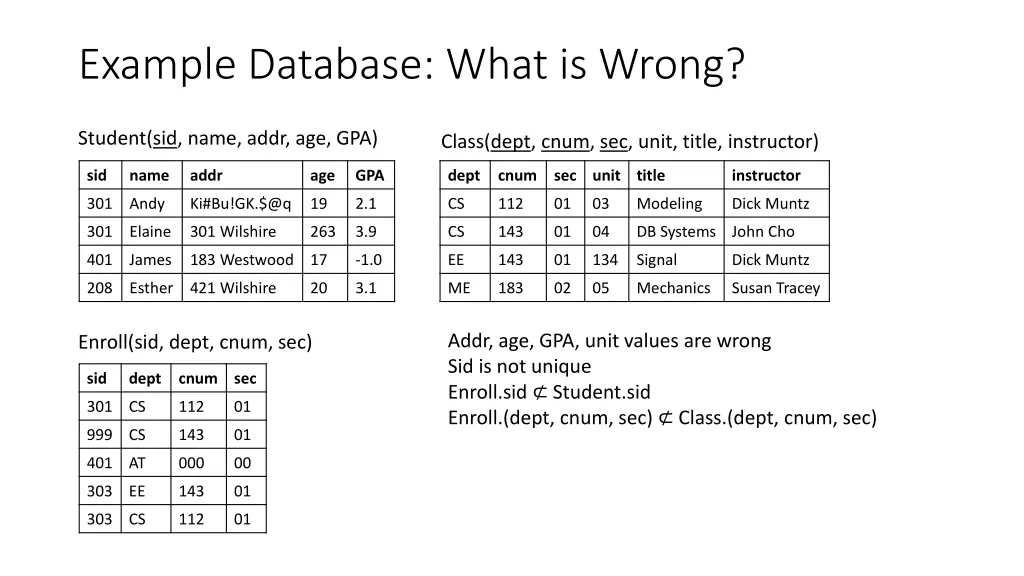
Example Database: What is Wrong? Student(sid, name, addr, age, GPA) Class(dept, cnum, sec, unit, title, instructor) sid name addr age GPA dept cnum sec unit title instructor 301 Andy Ki#Bu!GK.$@q 19 2.1 CS 112 01 03 Modeling Dick Muntz 301 Elaine 301 Wilshire 263 3.9 CS 143 01 04 DB Systems John Cho 401 James 183 Westwood 17 -1.0 EE 143 01 134 Signal Dick Muntz 208 Esther 421 Wilshire 20 3.1 ME 183 02 05 Mechanics Susan Tracey Addr, age, GPA, unit values are wrong Sid is not unique Enroll.sid Student.sid Enroll.(dept, cnum, sec) Class.(dept, cnum, sec) Enroll(sid, dept, cnum, sec) sid dept cnum sec 301 CS 112 01 999 CS 143 01 401 AT 000 00 303 EE 143 01 303 CS 112 01
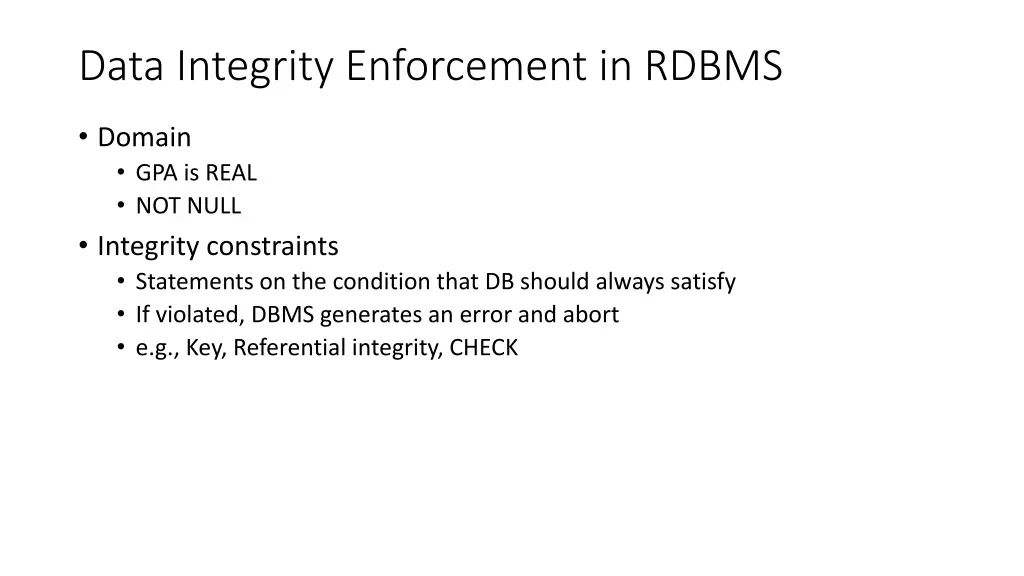
Data Integrity Enforcement in RDBMS Domain GPA is REAL NOT NULL Integrity constraints Statements on the condition that DB should always satisfy If violated, DBMS generates an error and abort e.g., Key, Referential integrity, CHECK
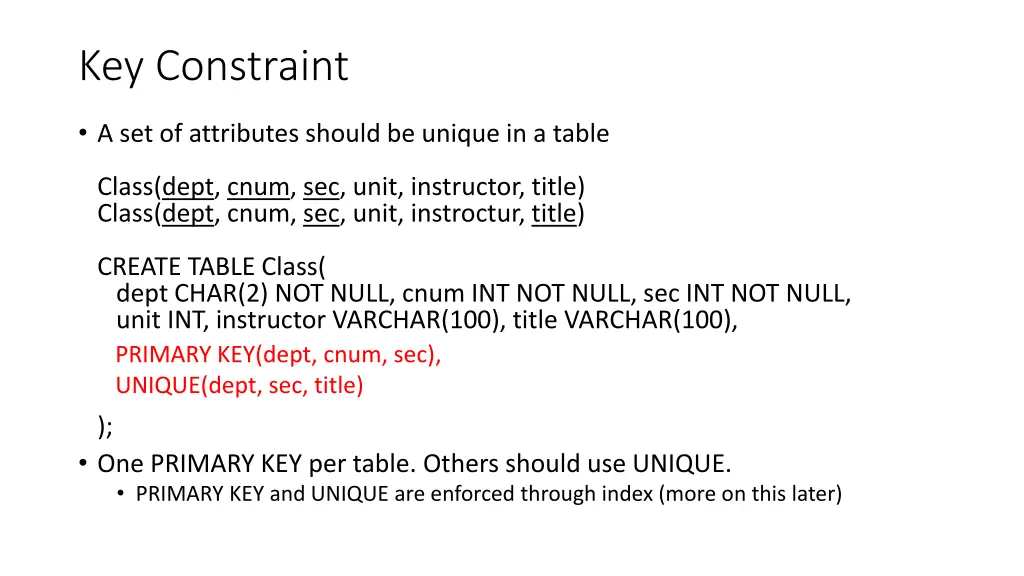
Key Constraint A set of attributes should be unique in a table Class(dept, cnum, sec, unit, instructor, title) Class(dept, cnum, sec, unit, instroctur, title) CREATE TABLE Class( dept CHAR(2) NOT NULL, cnum INT NOT NULL, sec INT NOT NULL, unit INT, instructor VARCHAR(100), title VARCHAR(100), PRIMARY KEY(dept, cnum, sec), UNIQUE(dept, sec, title) ); One PRIMARY KEY per table. Others should use UNIQUE. PRIMARY KEY and UNIQUE are enforced through index (more on this later)
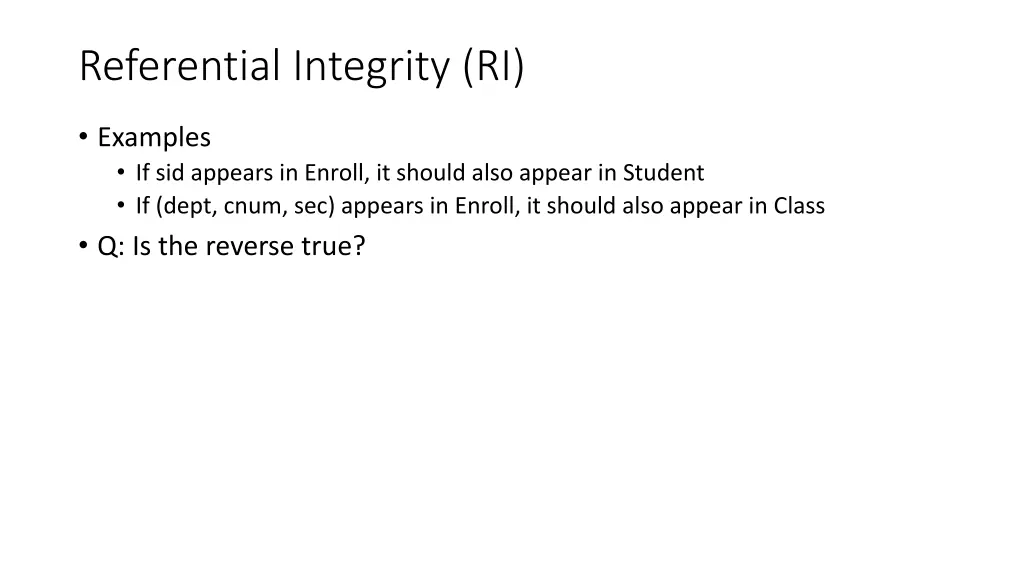
Referential Integrity (RI) Examples If sid appears in Enroll, it should also appear in Student If (dept, cnum, sec) appears in Enroll, it should also appear in Class Q: Is the reverse true?
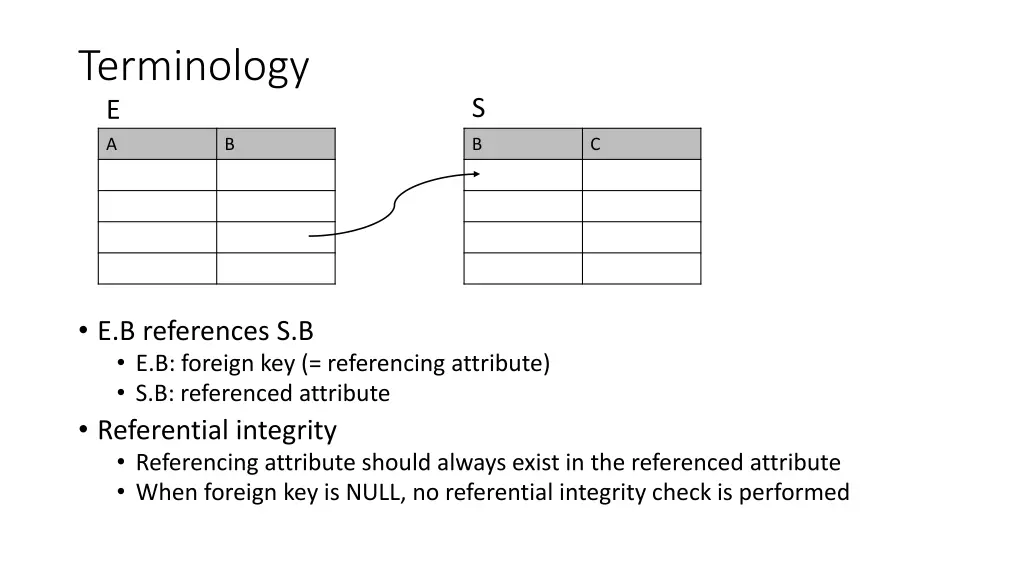
Terminology E S A B B C E.B references S.B E.B: foreign key (= referencing attribute) S.B: referenced attribute Referential integrity Referencing attribute should always exist in the referenced attribute When foreign key is NULL, no referential integrity check is performed
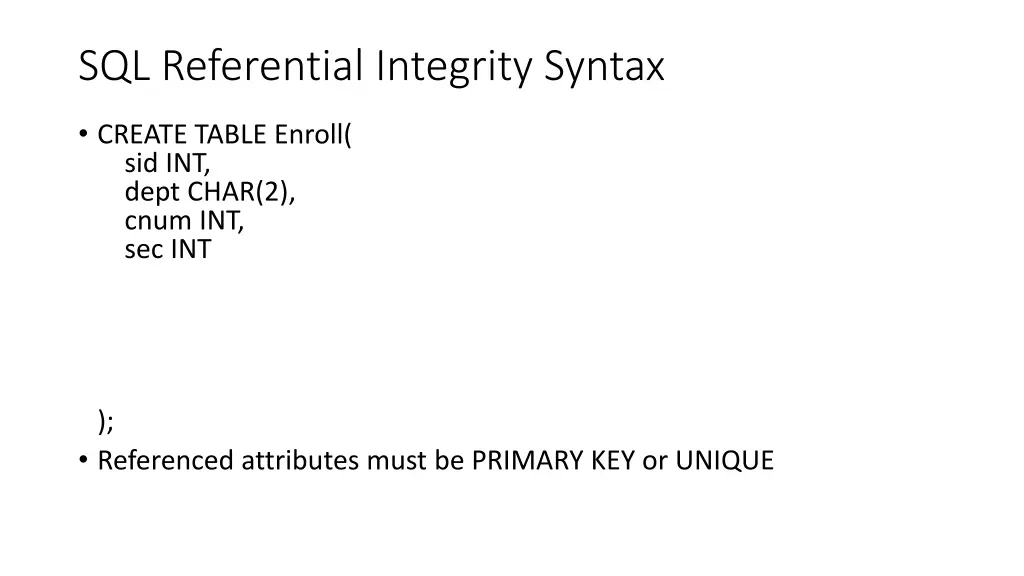
SQL Referential Integrity Syntax CREATE TABLE Enroll( sid INT, dept CHAR(2), cnum INT, sec INT ); Referenced attributes must be PRIMARY KEY or UNIQUE
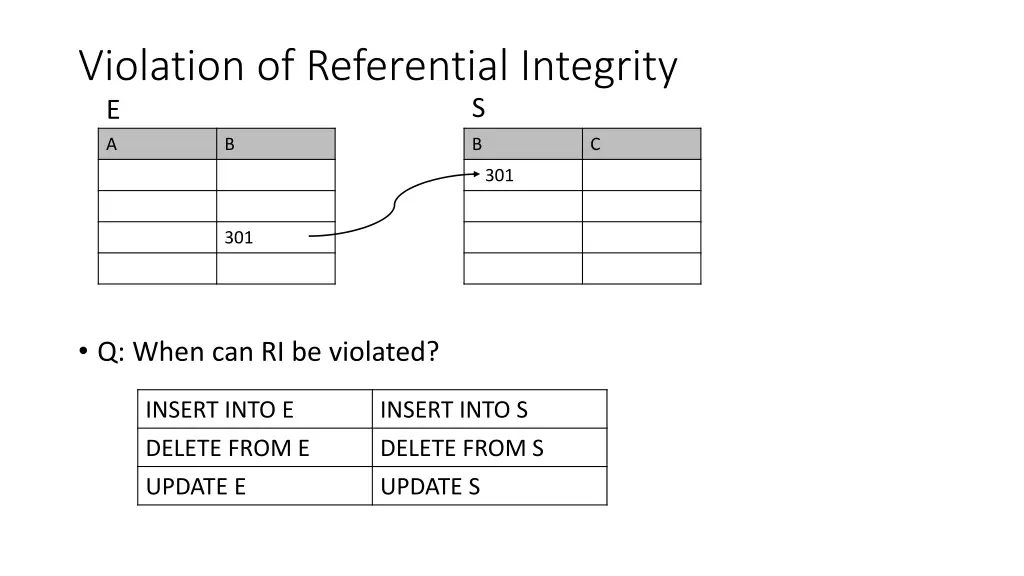
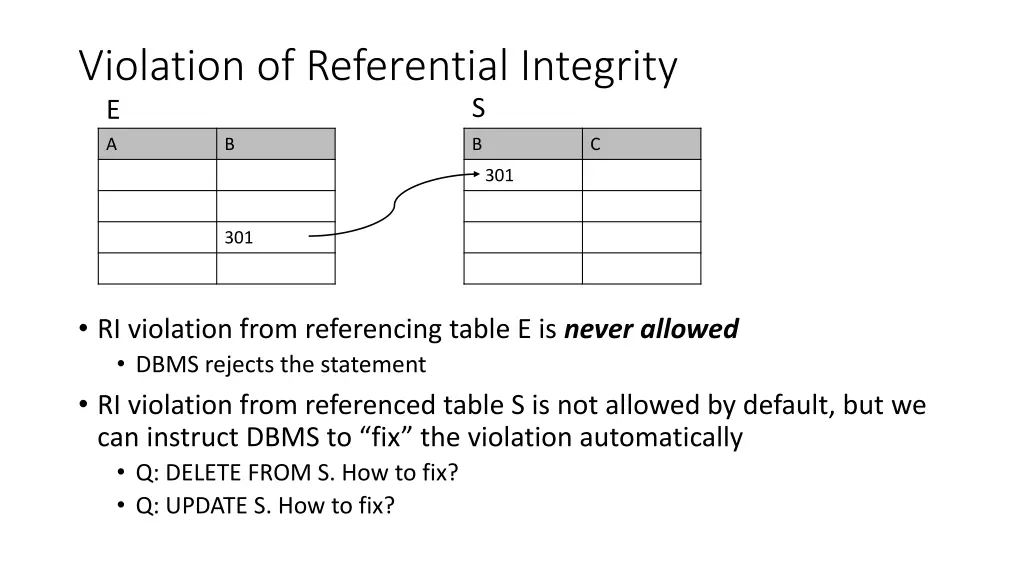
Violation of Referential Integrity E S A B B C 301 301 Q: When can RI be violated? INSERT INTO E INSERT INTO S DELETE FROM E UPDATE E DELETE FROM S UPDATE S
Violation of Referential Integrity E S A B B C 301 301 RI violation from referencing table E is never allowed DBMS rejects the statement RI violation from referenced table S is not allowed by default, but we can instruct DBMS to fix the violation automatically Q: DELETE FROM S. How to fix? Q: UPDATE S. How to fix?
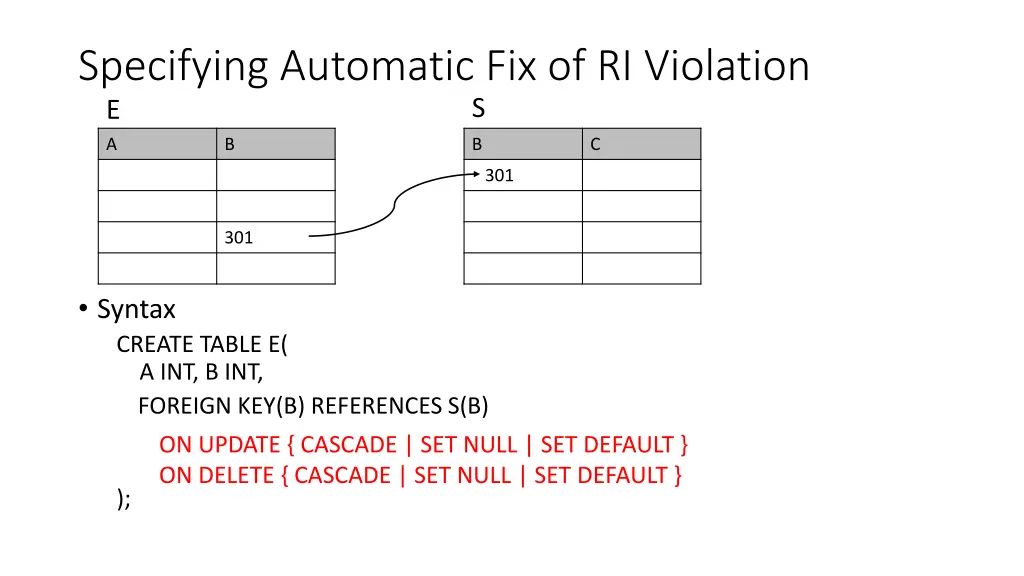
Specifying Automatic Fix of RI Violation E S A B B C 301 301 Syntax CREATE TABLE E( A INT, B INT, FOREIGN KEY(B) REFERENCES S(B) ON UPDATE { CASCADE | SET NULL | SET DEFAULT } ON DELETE { CASCADE | SET NULL | SET DEFAULT } );
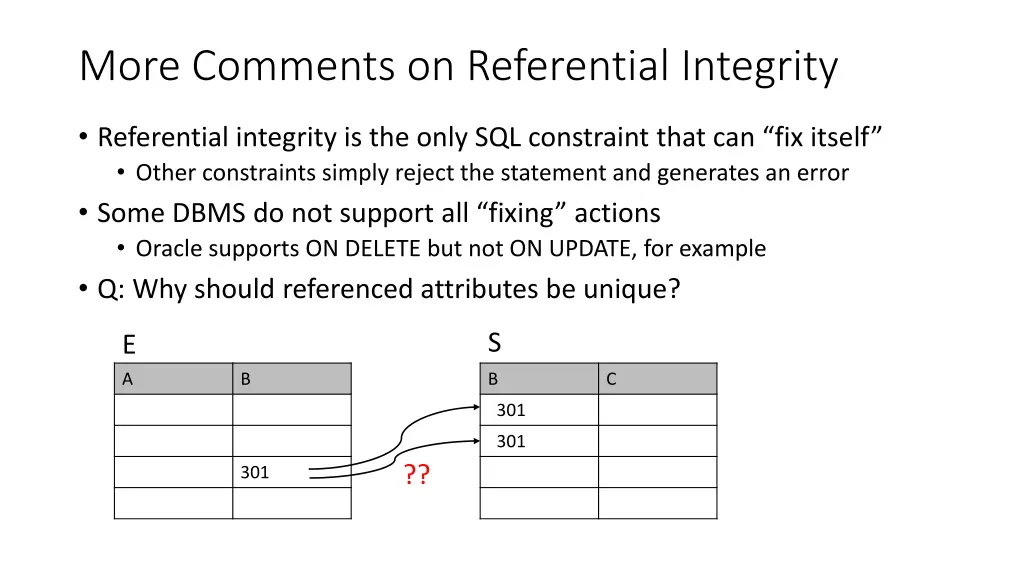
More Comments on Referential Integrity Referential integrity is the only SQL constraint that can fix itself Other constraints simply reject the statement and generates an error Some DBMS do not support all fixing actions Oracle supports ON DELETE but not ON UPDATE, for example Q: Why should referenced attributes be unique? S E A B B C 301 301 ?? 301
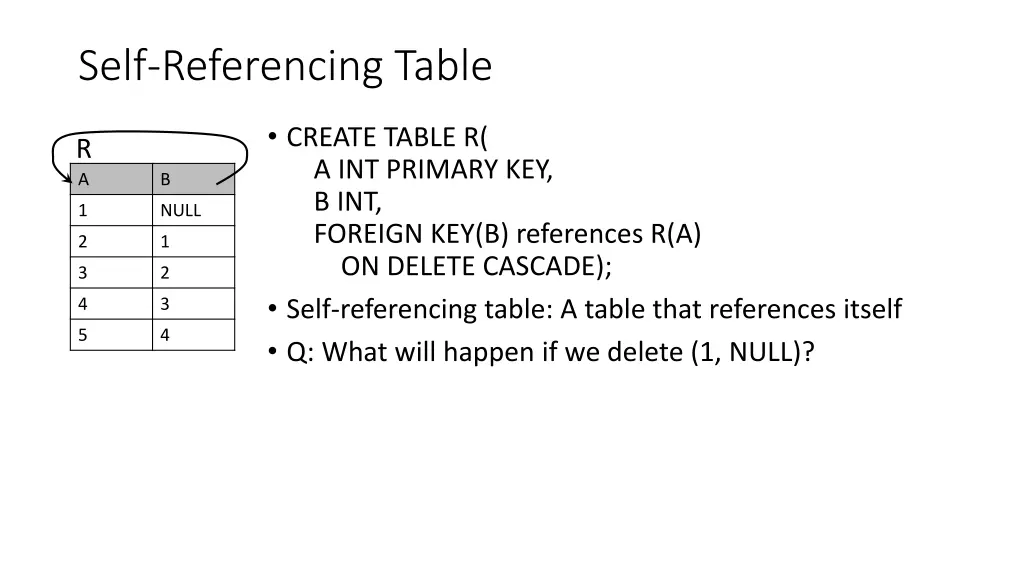
Self-Referencing Table CREATE TABLE R( A INT PRIMARY KEY, B INT, FOREIGN KEY(B) references R(A) ON DELETE CASCADE); Self-referencing table: A table that references itself Q: What will happen if we delete (1, NULL)? R A B 1 NULL 2 1 3 2 4 3 5 4
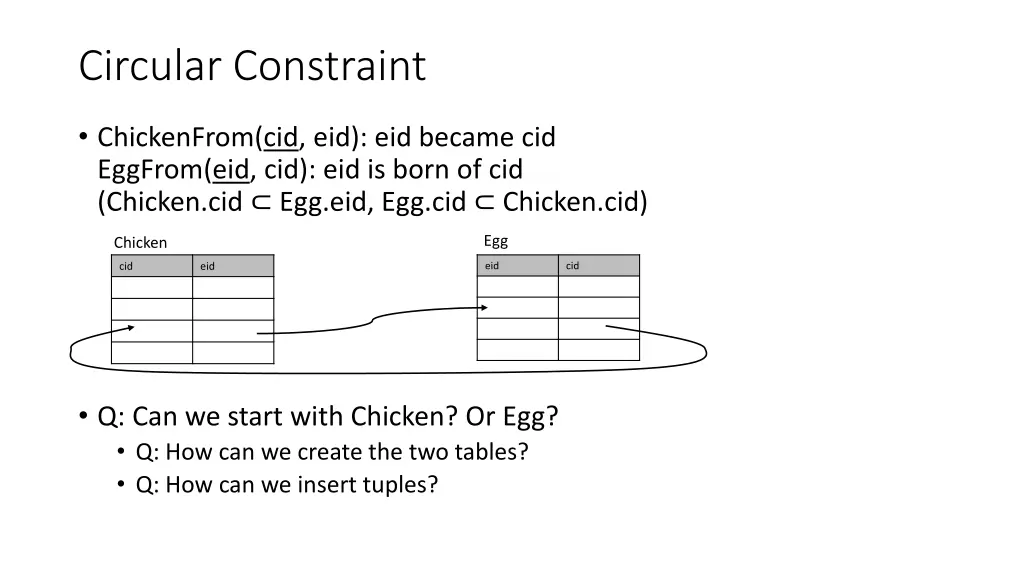
Circular Constraint ChickenFrom(cid, eid): eid became cid EggFrom(eid, cid): eid is born of cid (Chicken.cid Egg.eid, Egg.cid Chicken.cid) Egg Chicken eid cid cid eid Q: Can we start with Chicken? Or Egg? Q: How can we create the two tables? Q: How can we insert tuples?
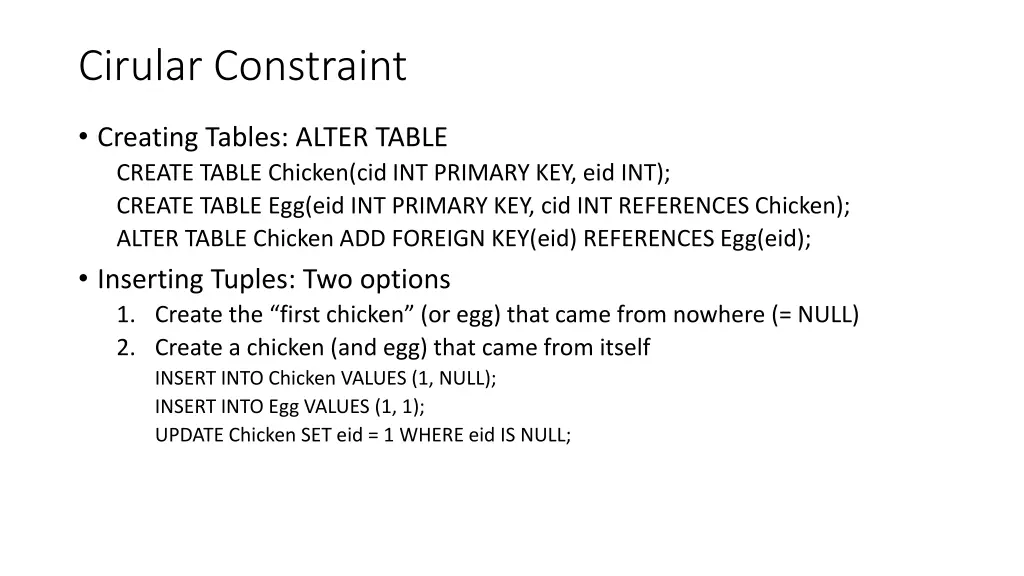
Cirular Constraint Creating Tables: ALTER TABLE CREATE TABLE Chicken(cid INT PRIMARY KEY, eid INT); CREATE TABLE Egg(eid INT PRIMARY KEY, cid INT REFERENCES Chicken); ALTER TABLE Chicken ADD FOREIGN KEY(eid) REFERENCES Egg(eid); Inserting Tuples: Two options 1. Create the first chicken (or egg) that came from nowhere (= NULL) 2. Create a chicken (and egg) that came from itself INSERT INTO Chicken VALUES (1, NULL); INSERT INTO Egg VALUES (1, 1); UPDATE Chicken SET eid = 1 WHERE eid IS NULL;
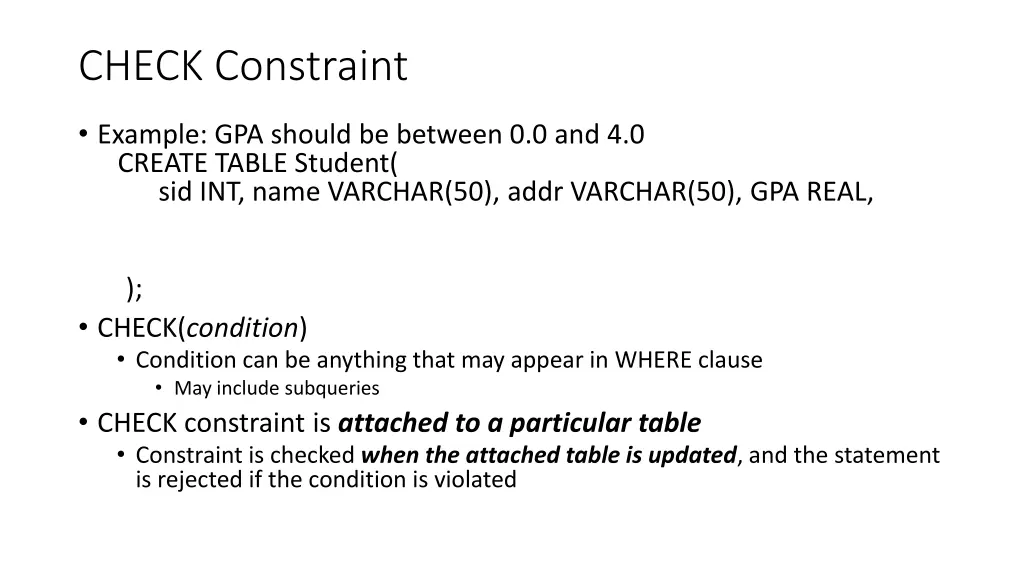
CHECK Constraint Example: GPA should be between 0.0 and 4.0 CREATE TABLE Student( sid INT, name VARCHAR(50), addr VARCHAR(50), GPA REAL, ); CHECK(condition) Condition can be anything that may appear in WHERE clause May include subqueries CHECK constraint is attached to a particular table Constraint is checked when the attached table is updated, and the statement is rejected if the condition is violated
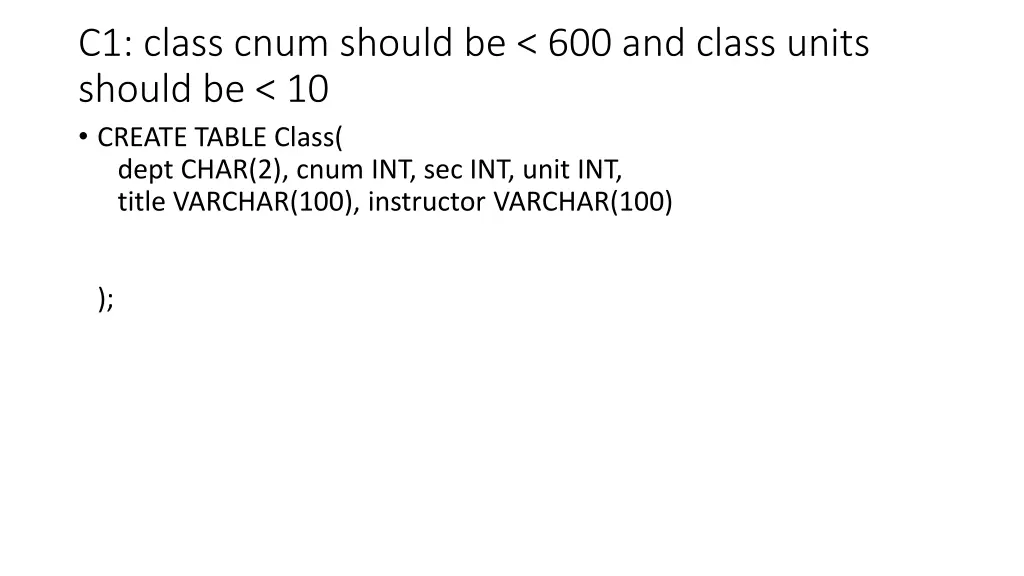
C1: class cnum should be < 600 and class units should be < 10 CREATE TABLE Class( dept CHAR(2), cnum INT, sec INT, unit INT, title VARCHAR(100), instructor VARCHAR(100) );
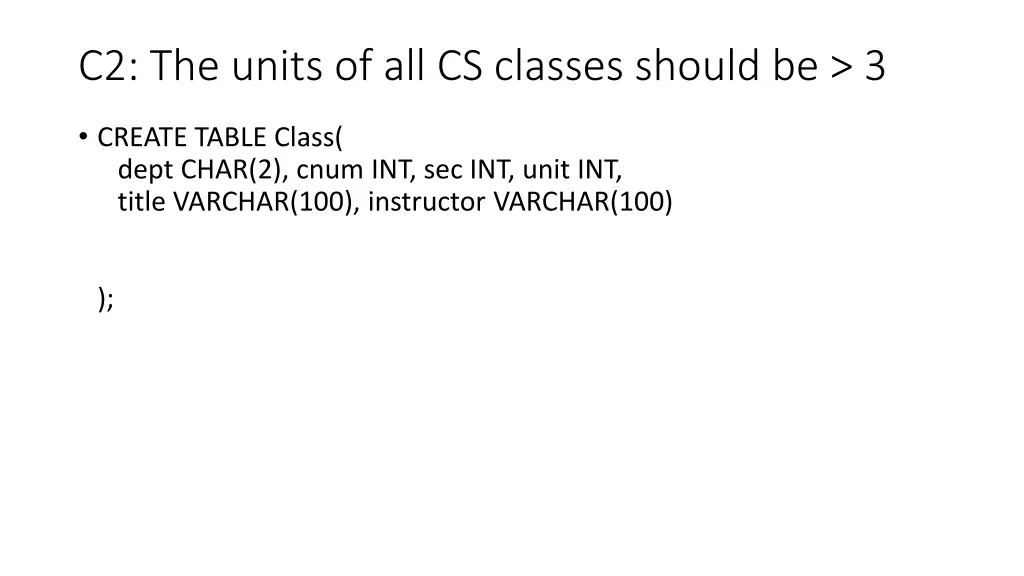
C2: The units of all CS classes should be > 3 CREATE TABLE Class( dept CHAR(2), cnum INT, sec INT, unit INT, title VARCHAR(100), instructor VARCHAR(100) );
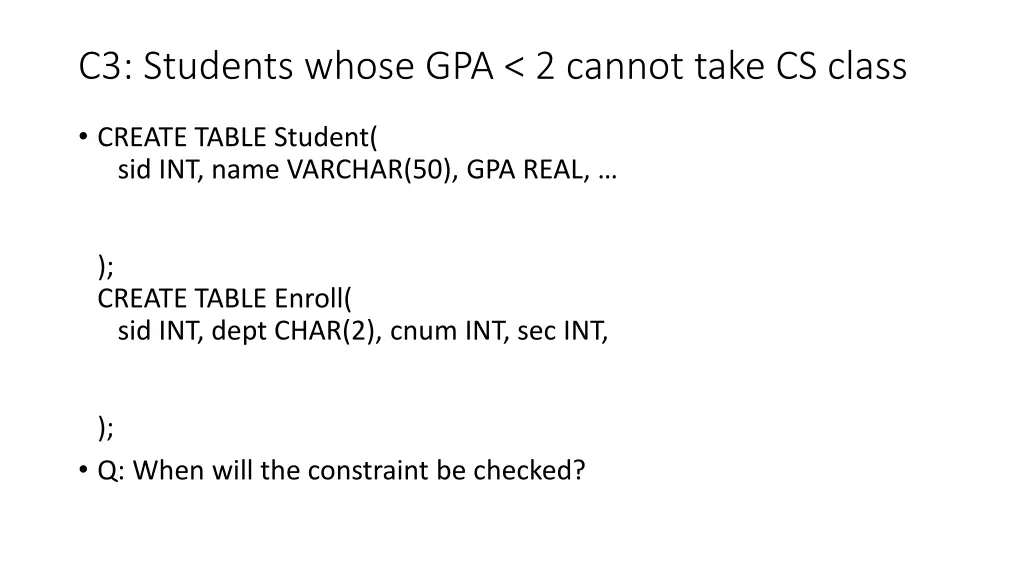
C3: Students whose GPA < 2 cannot take CS class CREATE TABLE Student( sid INT, name VARCHAR(50), GPA REAL, ); CREATE TABLE Enroll( sid INT, dept CHAR(2), cnum INT, sec INT, ); Q: When will the constraint be checked?
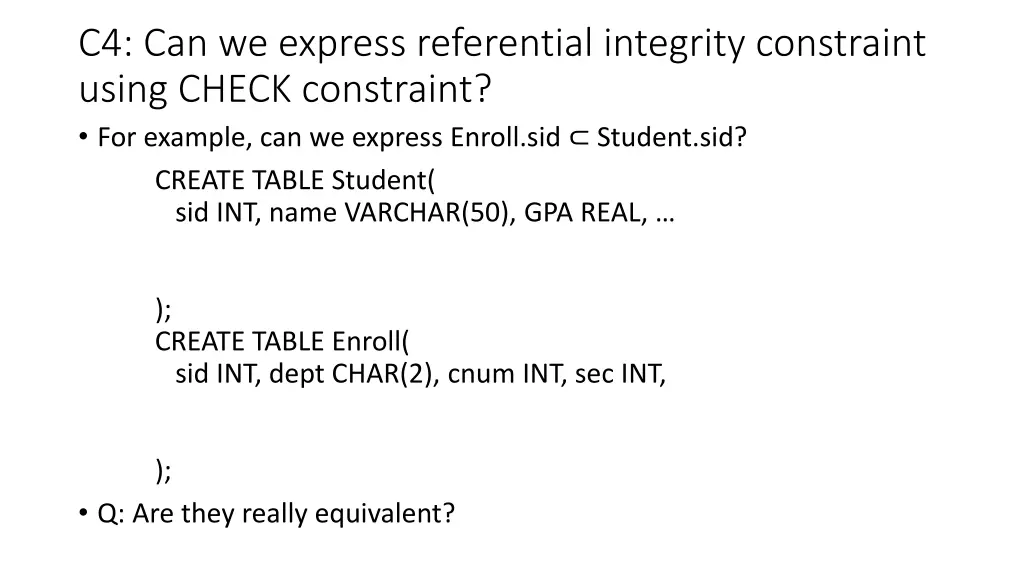
C4: Can we express referential integrity constraint using CHECK constraint? For example, can we express Enroll.sid Student.sid? CREATE TABLE Student( sid INT, name VARCHAR(50), GPA REAL, ); CREATE TABLE Enroll( sid INT, dept CHAR(2), cnum INT, sec INT, Q: Are they really equivalent? );
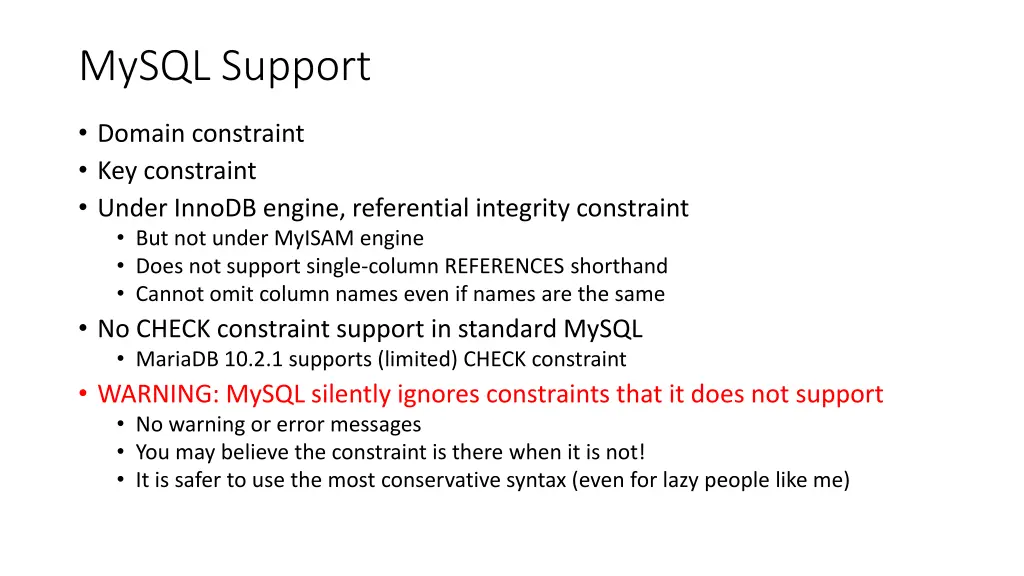
MySQL Support Domain constraint Key constraint Under InnoDB engine, referential integrity constraint But not under MyISAM engine Does not support single-column REFERENCES shorthand Cannot omit column names even if names are the same No CHECK constraint support in standard MySQL MariaDB 10.2.1 supports (limited) CHECK constraint WARNING: MySQL silently ignores constraints that it does not support No warning or error messages You may believe the constraint is there when it is not! It is safer to use the most conservative syntax (even for lazy people like me)
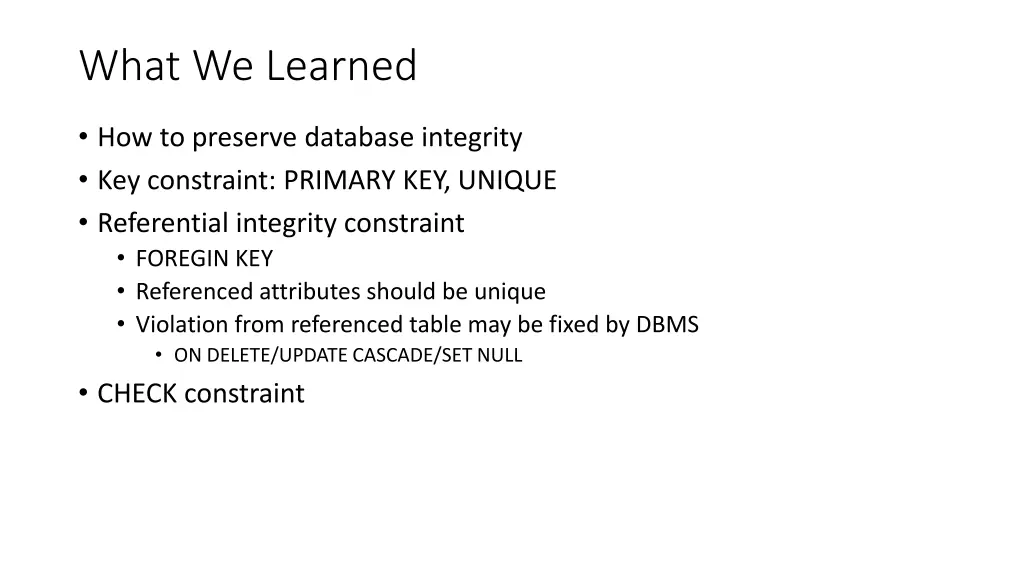
What We Learned How to preserve database integrity Key constraint: PRIMARY KEY, UNIQUE Referential integrity constraint FOREGIN KEY Referenced attributes should be unique Violation from referenced table may be fixed by DBMS ON DELETE/UPDATE CASCADE/SET NULL CHECK constraint