Decarbonisation and Climate Action Overview
Decarbonisation is essential in addressing climate change by reducing carbon emissions from fossil fuels. Learn about key strategies, COP28 outcomes, and the pathway to decarbonization for corporates. Gain insights into setting science-based targets for credible sustainability efforts.

Download Presentation

Please find below an Image/Link to download the presentation.
The content on the website is provided AS IS for your information and personal use only. It may not be sold, licensed, or shared on other websites without obtaining consent from the author.If you encounter any issues during the download, it is possible that the publisher has removed the file from their server.
You are allowed to download the files provided on this website for personal or commercial use, subject to the condition that they are used lawfully. All files are the property of their respective owners.
The content on the website is provided AS IS for your information and personal use only. It may not be sold, licensed, or shared on other websites without obtaining consent from the author.
E N D
Presentation Transcript
ISCA-LawSocs Sustainability Apex Programme (SAP) Masterclass 3: Decarbonisation Overview Summary Deck January 2024 1 1
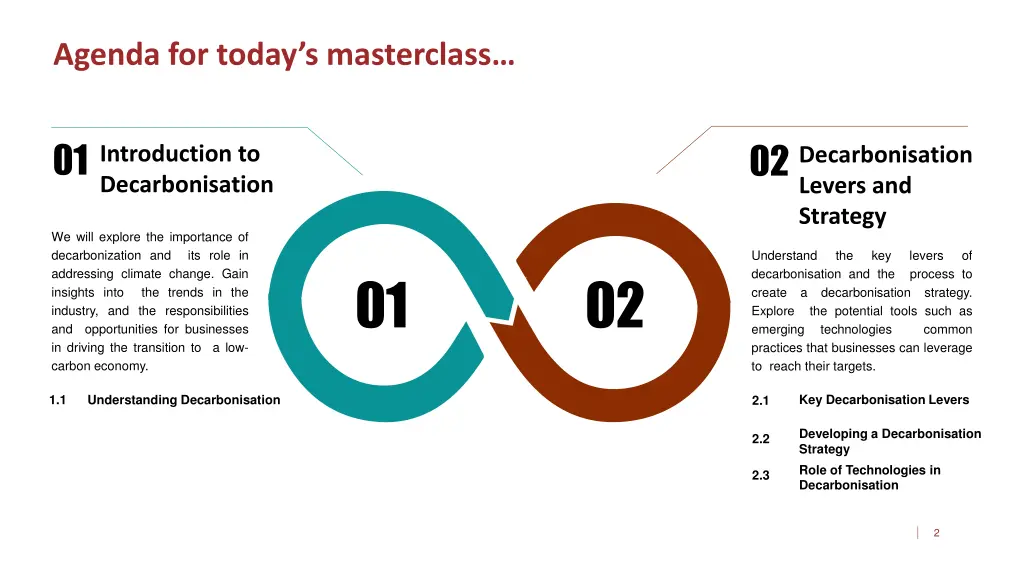
Agenda for todays masterclass 01 02 Introduction to Decarbonisation Decarbonisation Levers and Strategy We will explore the importance of decarbonization and its role in addressing climate change. Gain insights into the trends in the industry, and the responsibilities and opportunities for businesses in driving the transition to a low- carbon economy. Understand decarbonisation and the process to create a decarbonisation strategy. Explore the potential tools such as emerging technologies practices that businesses can leverage to reach their targets. the key levers of 01 02 common Key Decarbonisation Levers 1.1 Understanding Decarbonisation 2.1 Developing a Decarbonisation Strategy Role of Technologies in Decarbonisation 2.2 2.3 2
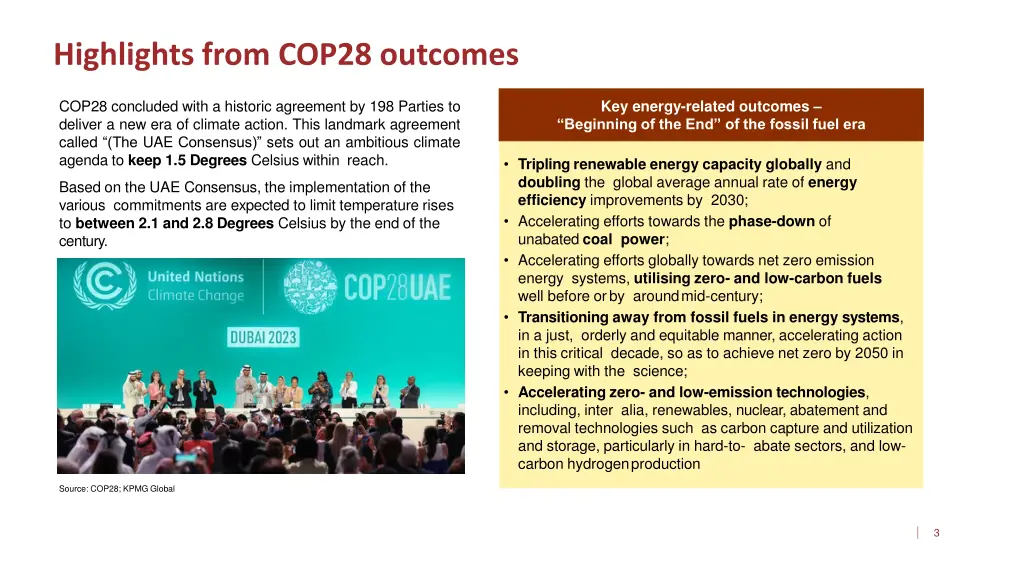
Highlights from COP28 outcomes Key energy-related outcomes Beginning of the End of the fossil fuel era COP28 concluded with a historic agreement by 198 Parties to deliver a new era of climate action. This landmark agreement called (The UAE Consensus) sets out an ambitious climate agenda to keep 1.5 Degrees Celsius within reach. Tripling renewable energy capacity globally and doubling the global average annual rate of energy efficiency improvements by 2030; Accelerating efforts towards the phase-down of unabated coal power; Accelerating efforts globally towards net zero emission energy systems, utilising zero- and low-carbon fuels well before orby aroundmid-century; Transitioning away from fossil fuels in energy systems, in a just, orderly and equitable manner, accelerating action in this critical decade, so as to achieve net zero by 2050 in keeping with the science; Accelerating zero- and low-emission technologies, including, inter alia, renewables, nuclear, abatement and removal technologies such as carbon capture and utilization and storage, particularly in hard-to- abate sectors, and low- carbon hydrogenproduction Based on the UAE Consensus, the implementation of the various commitments are expected to limit temperature rises to between 2.1 and 2.8 Degrees Celsius by the end of the century. Source: COP28; KPMG Global 3
What is decarbonisation? Decarbonisation tends to refer to the process of reducing carbon intensity , lowering the amount of greenhouse gas emissions produced by the burning of fossil fuels. Generally, this involves decreasing CO2 output per unit of electricity generated. Reducing the amount of carbon dioxide occurring as a result of transport and power generation is essential to meet global temperature standards set by the Paris Agreement. In order to keep the planet from warming to dangerous levels, our society needs to rapidly decarbonise by 2050. Thatmeans cutting our carbon emissions, and capturing and storing the emissions we can t avoid. TWI, Cambridge, UK Decarbonisation The process by which countries, individuals or other entities aim to achieve zero fossil carbon existence. Typically refers to a reduction of the carbon emissions associated with electricity, industry and transport. IPCC Source: decarbonisation: An Animated Graphic (columbia.edu) , What is Decarbonisation? - TWI (twi-global.com) 6 4
The pathway to decarbonization for corporates Setting a science based target will bring credibility to your efforts Define- Setting boundaries of the operations Communicate Report GHG emissions inventory Offset Set targets Develop a GHG emission reduction targets Foremissions that are unavoidable consider offsets and RECs 01 06 04 08 02 03 05 07 Review and Communicate Report transparently on reductions against targets and realign Carbon reduction Reduce emissions through RE, energy efficiency and sustainable products Hotspot Identify emissions hotspots and reduction potential Measure Review GHG emissions inventory Your reductions and offsets should be supported by management mechanisms likeGHG emissions policies, InternalCarbon Prices,cost of abatement curves Source: KPMGGlobal 5
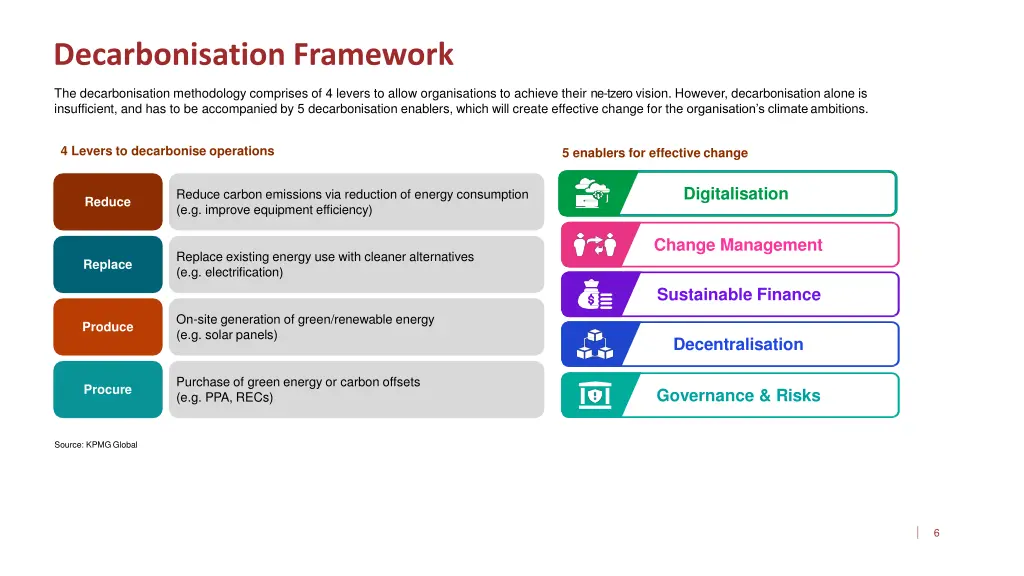
Decarbonisation Framework The decarbonisation methodology comprises of 4 levers to allow organisations to achieve their ne-tzero vision. However, decarbonisation alone is insufficient, and has to be accompanied by 5 decarbonisation enablers, which will create effective change for the organisation s climateambitions. 4 Levers to decarbonise operations 5 enablers for effective change Digitalisation Reduce carbon emissions via reduction of energy consumption (e.g. improve equipment efficiency) Reduce Change Management Replace existing energy use with cleaner alternatives (e.g. electrification) Replace Sustainable Finance On-site generation of green/renewable energy (e.g. solar panels) Produce Decentralisation Purchase of green energy or carbon offsets (e.g. PPA, RECs) Procure Governance & Risks Source: KPMGGlobal 6