Deciphering Break-even Analysis and Contribution Statements in International Management Accounting
Dive into the world of break-even analysis and contribution statements in the realm of international management accounting with Prof. Dr. Marc Beutner. Understand concepts such as cost-volume-profit decisions, full-cost pricing, and market-based pricing strategies to enhance your financial decision-making skills.

Download Presentation

Please find below an Image/Link to download the presentation.
The content on the website is provided AS IS for your information and personal use only. It may not be sold, licensed, or shared on other websites without obtaining consent from the author. If you encounter any issues during the download, it is possible that the publisher has removed the file from their server.
You are allowed to download the files provided on this website for personal or commercial use, subject to the condition that they are used lawfully. All files are the property of their respective owners.
The content on the website is provided AS IS for your information and personal use only. It may not be sold, licensed, or shared on other websites without obtaining consent from the author.
E N D
Presentation Transcript
Cost and Profit Decision Cost and Profit Decision- -Making International Management International Management Accounting Accounting Making Prof. Dr. Marc Beutner TH K ln 2nd Lecture SoSe 2024 Folie: 1
Prof. Dr. Marc Beutner Lehrstuhl Wirtschaftsp dagogik II Prof. Dr. Marc Beutner Lehrstuhl Wirtschaftsp dagogik II - Wirtschaftsp dagogik und Evaluationsforschung Universit t Paderborn Lehrauftrag an der TH K ln Email: Marc.Beutner@uni-paderborn.de Folie: 2
What are we going to do? Break-even analysis Finishing the rest of lecture 1 A fitness centre s decision Break even analysis Lecture 2: Costs and Profits Full-cost and market-based pricing, demand-based pricing, target pricing, pricing strategies, cost-volume-profit decisions Folie: 3
Step 1: Break-even analysis Finishing the rest of lecture 1 A fitness centre s decision Break even analysis Folie: 4
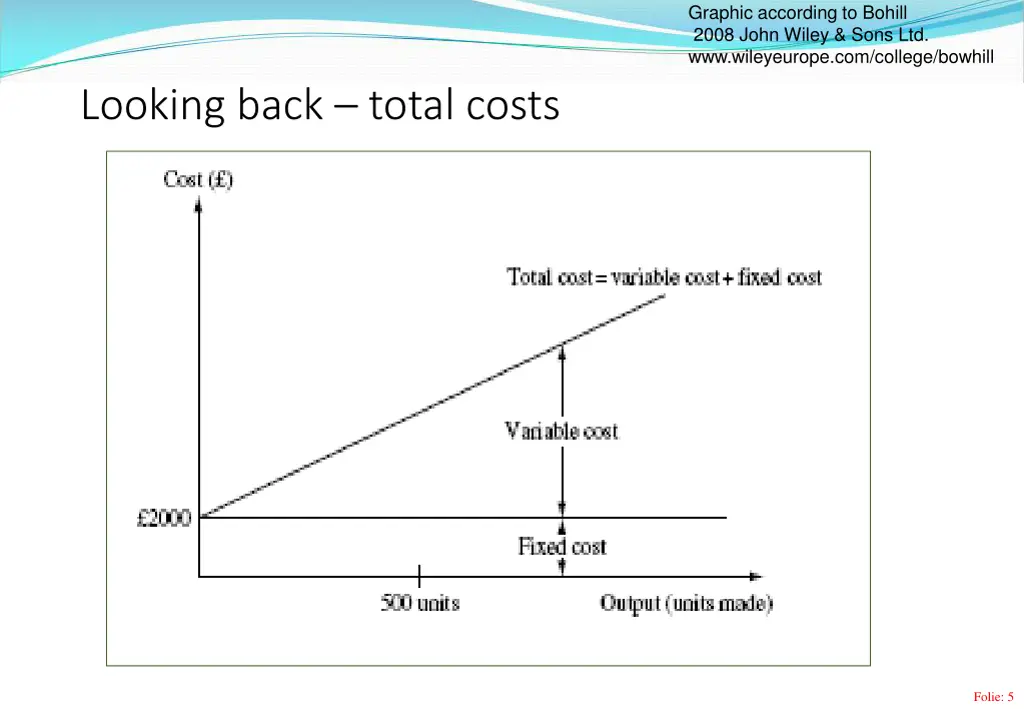
Graphic according to Bohill 2008 John Wiley & Sons Ltd. www.wileyeurope.com/college/bowhill Looking back total costs Folie: 5
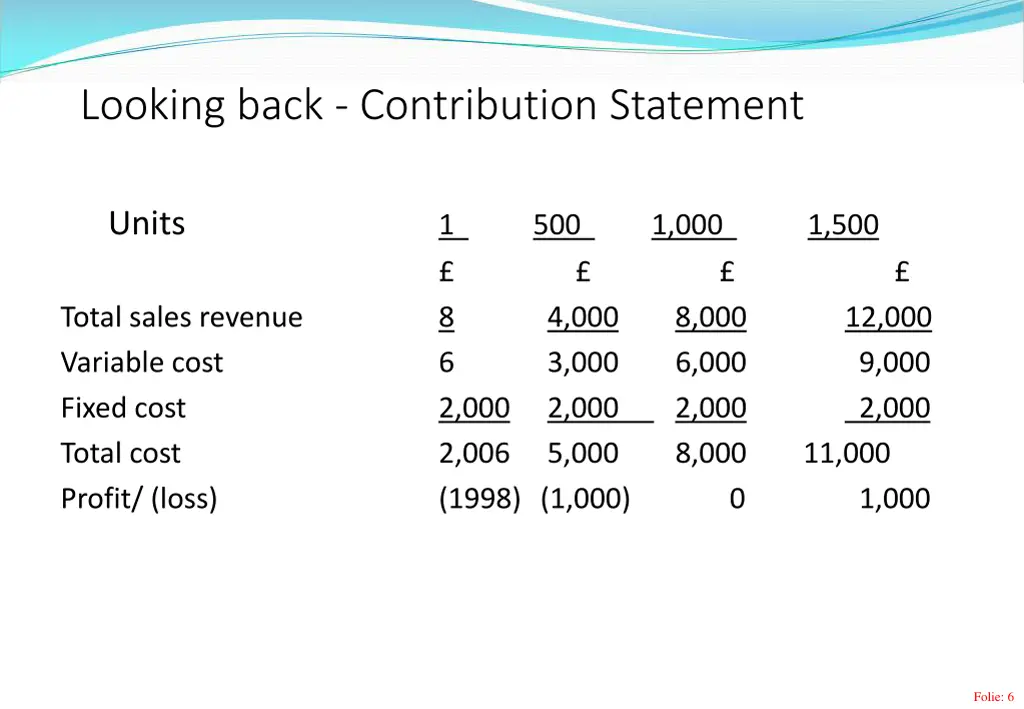
Looking back - Contribution Statement Units 1 8 6 2,000 2,006 (1998) (1,000) 0 500 1,000 1,500 Total sales revenue Variable cost Fixed cost Total cost Profit/ (loss) 4,000 3,000 6,000 2,000 2,000 5,000 8,000 11,000 8,000 12,000 9,000 2,000 1,000 Folie: 6
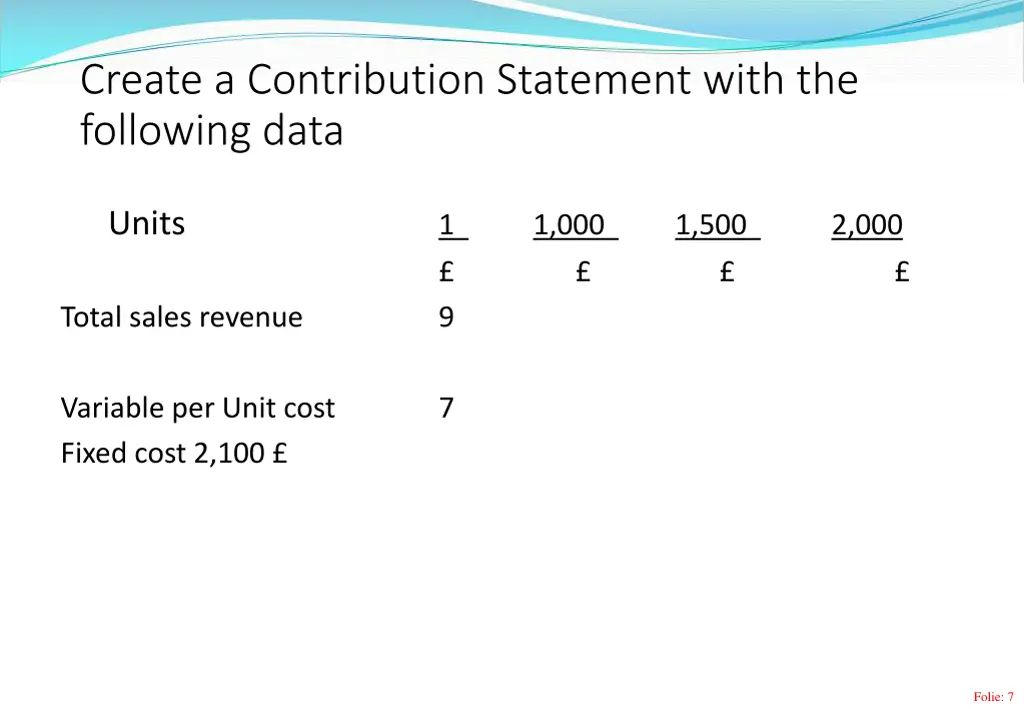
Create a Contribution Statement with the following data Units 1 9 1,000 1,500 2,000 Total sales revenue Variable per Unit cost Fixed cost 2,100 7 Folie: 7
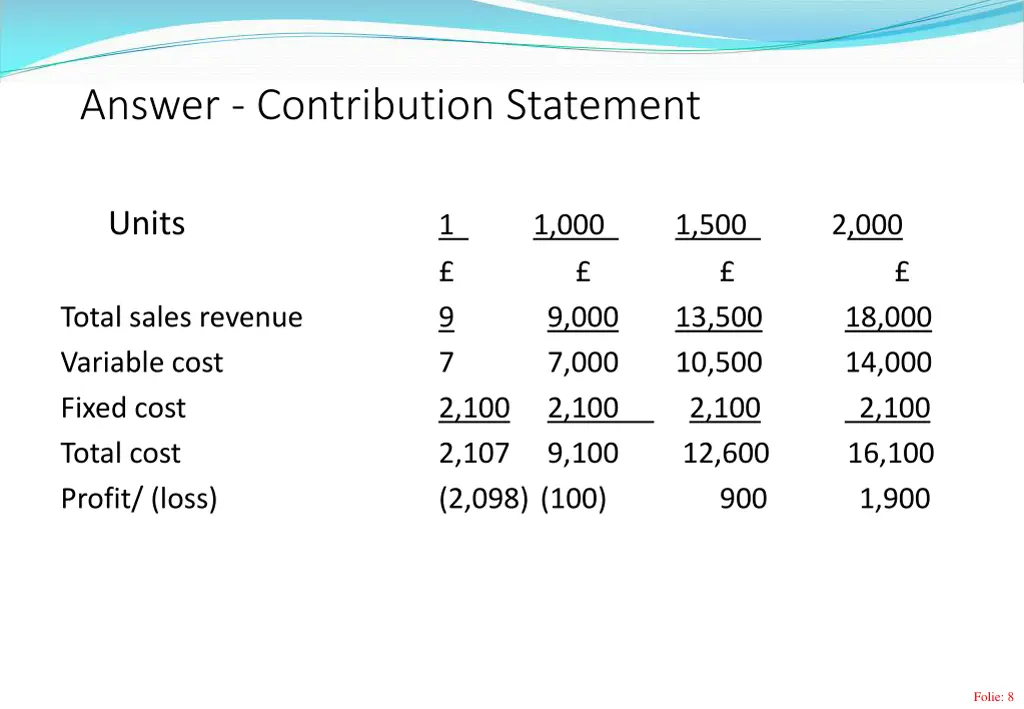
Answer - Contribution Statement Units 1 9 7 2,100 2,107 (2,098) (100) 900 1,000 9,000 7,000 10,500 2,100 9,100 12,600 16,100 1,500 2,000 Total sales revenue Variable cost Fixed cost Total cost Profit/ (loss) 13,500 18,000 14,000 2,100 2,100 1,900 Folie: 8
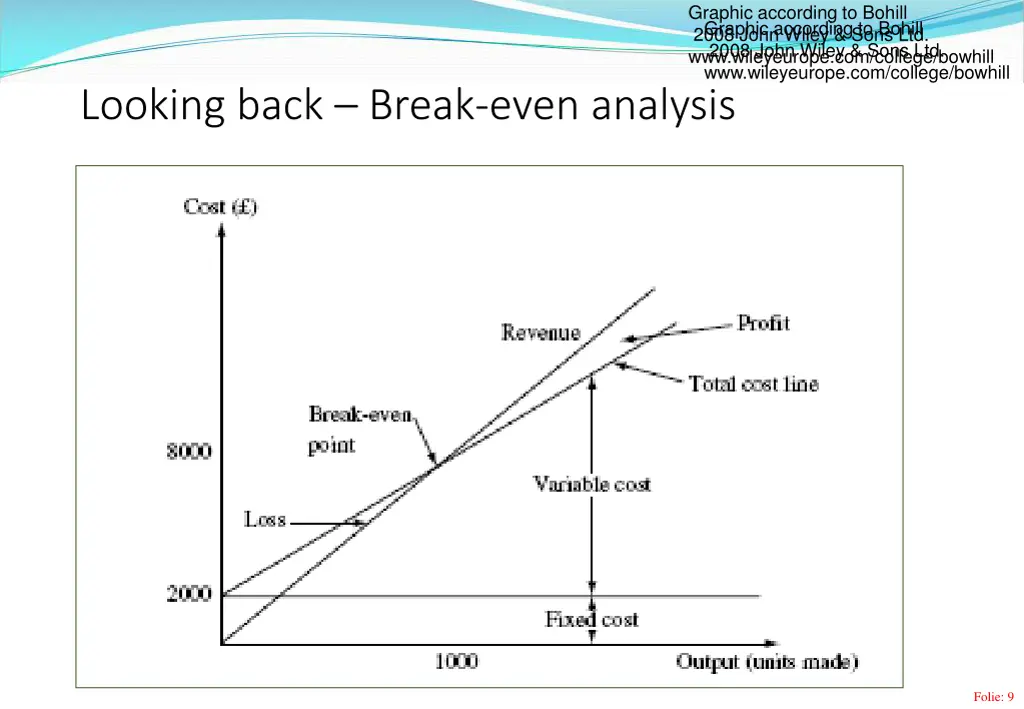
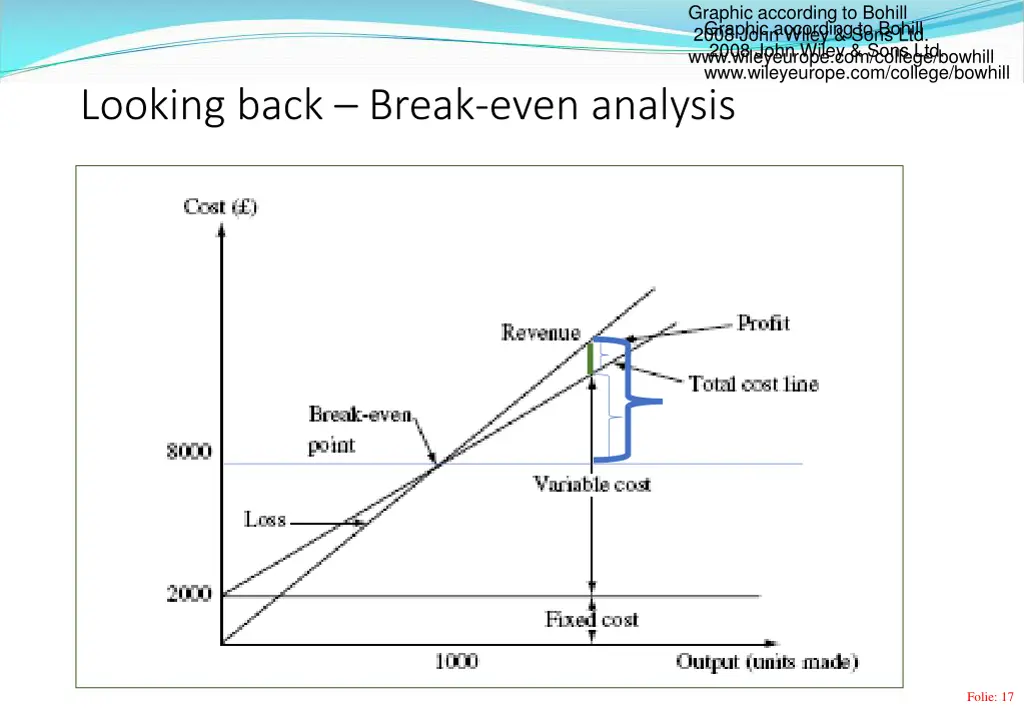
Graphic according to Bohill 2008 John Wiley & Sons Ltd. www.wileyeurope.com/college/bowhill www.wileyeurope.com/college/bowhill Graphic according to Bohill 2008 John Wiley & Sons Ltd. Looking back Break-even analysis Folie: 9
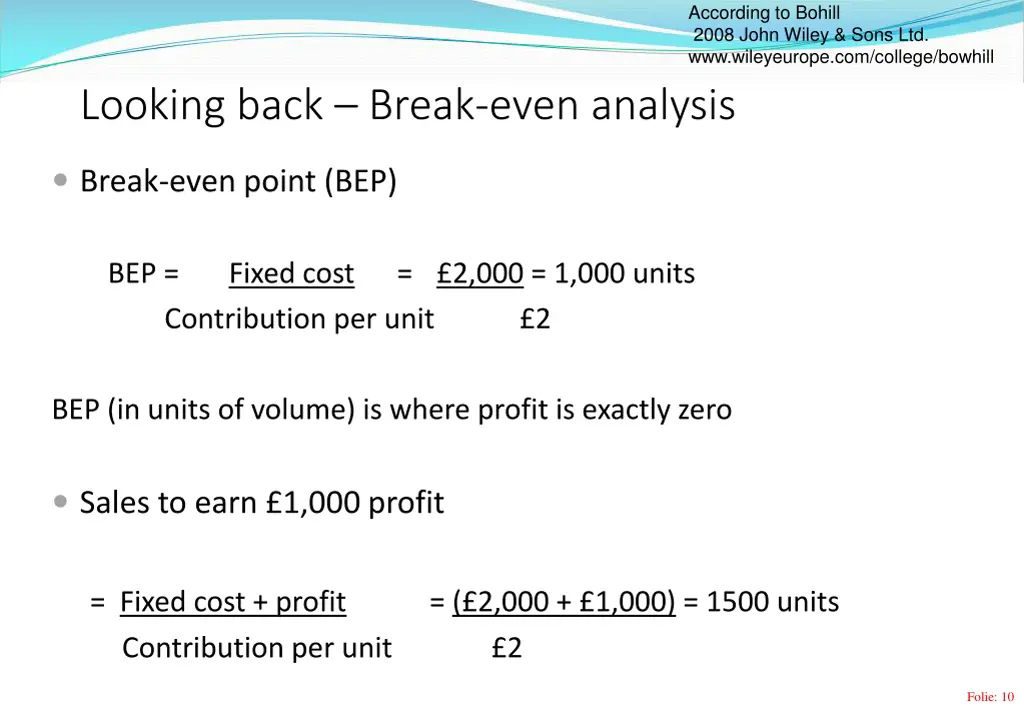
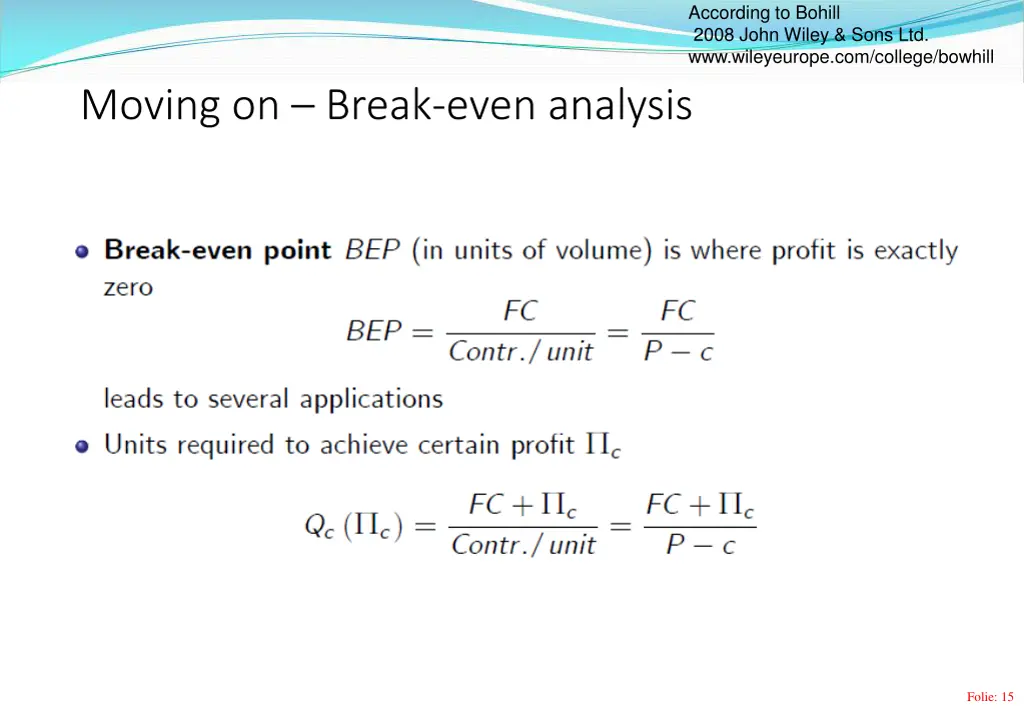
According to Bohill 2008 John Wiley & Sons Ltd. www.wileyeurope.com/college/bowhill Looking back Break-even analysis Break-even point (BEP) BEP = Fixed cost Contribution per unit 2 = 2,000 = 1,000 units BEP (in units of volume) is where profit is exactly zero Sales to earn 1,000 profit = Fixed cost + profit Contribution per unit 2 = ( 2,000 + 1,000) = 1500 units Folie: 10
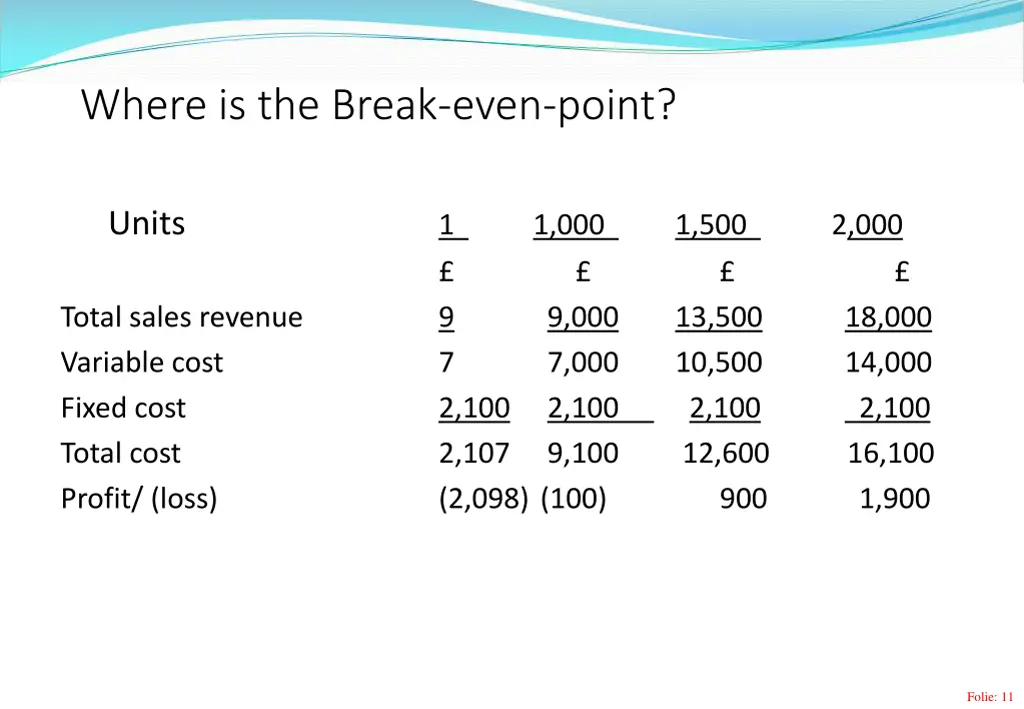
Where is the Break-even-point? Units 1 9 7 2,100 2,107 (2,098) (100) 900 1,000 9,000 7,000 10,500 2,100 9,100 12,600 16,100 1,500 2,000 Total sales revenue Variable cost Fixed cost Total cost Profit/ (loss) 13,500 18,000 14,000 2,100 2,100 1,900 Folie: 11
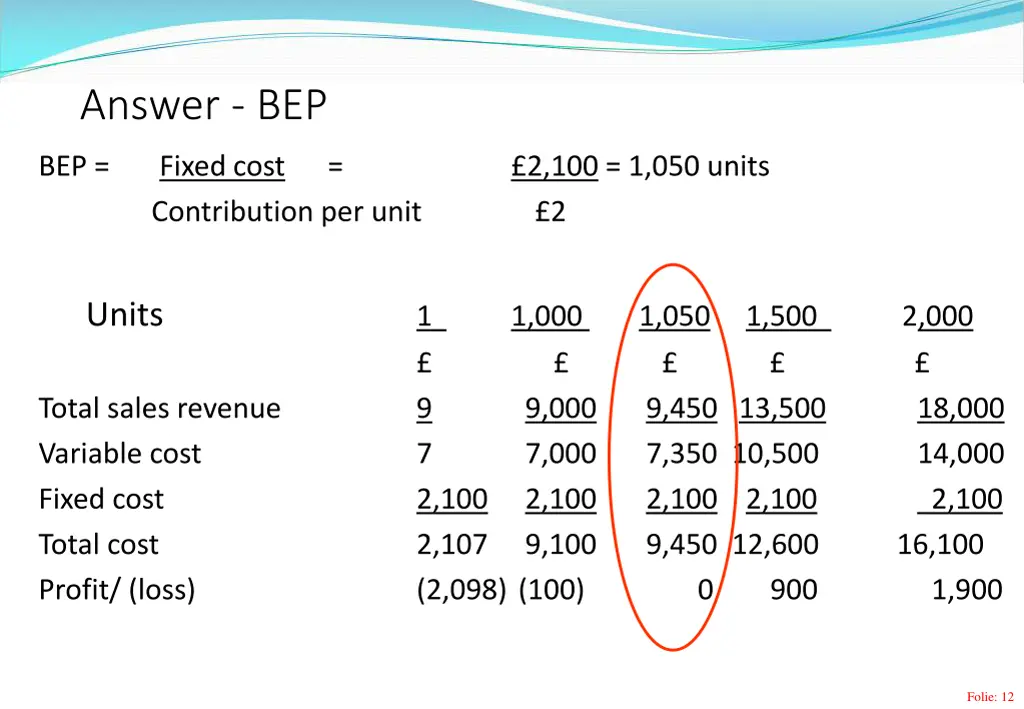
Answer - BEP BEP = Fixed cost Contribution per unit 2 = 2,100 = 1,050 units Units 1 9 7 2,100 2,107 (2,098) (100) 0 900 1,000 1,050 9,450 13,500 1,500 2,000 18,000 14,000 2,100 Total sales revenue Variable cost Fixed cost Total cost Profit/ (loss) 9,000 7,000 7,350 10,500 2,100 2,100 2,100 9,100 9,450 12,600 16,100 1,900 Folie: 12
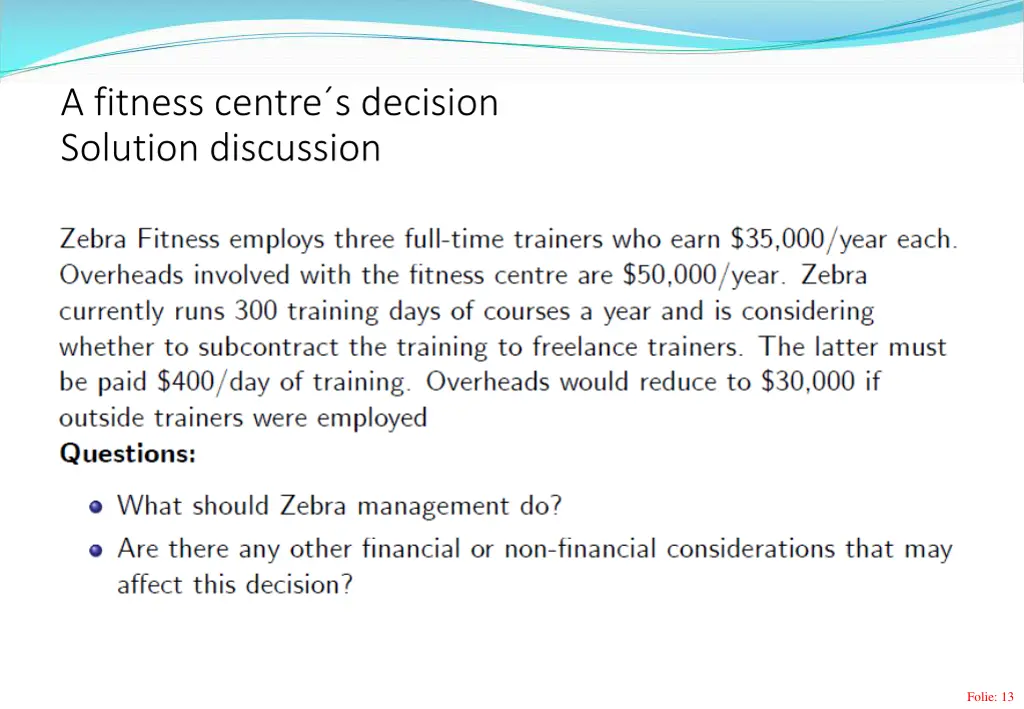
A fitness centres decision Solution discussion Folie: 13
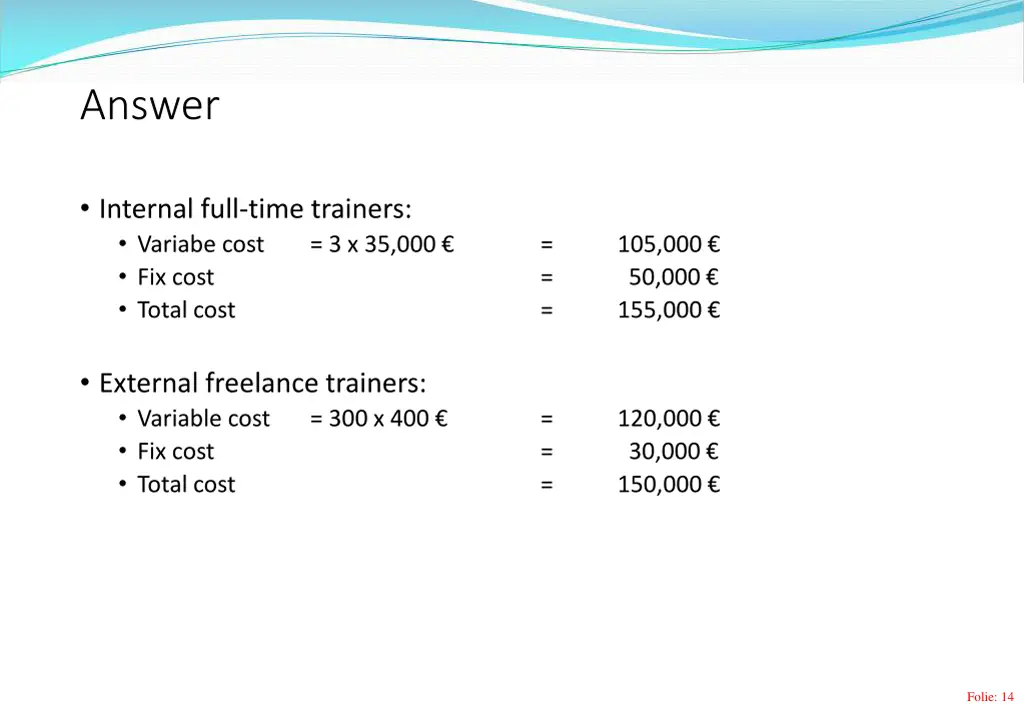
Answer Internal full-time trainers: Variabe cost Fix cost Total cost = 3 x 35,000 = = = 105,000 50,000 155,000 External freelance trainers: Variable cost Fix cost Total cost = 300 x 400 = = = 120,000 30,000 150,000 Folie: 14
According to Bohill 2008 John Wiley & Sons Ltd. www.wileyeurope.com/college/bowhill Moving on Break-even analysis Folie: 15
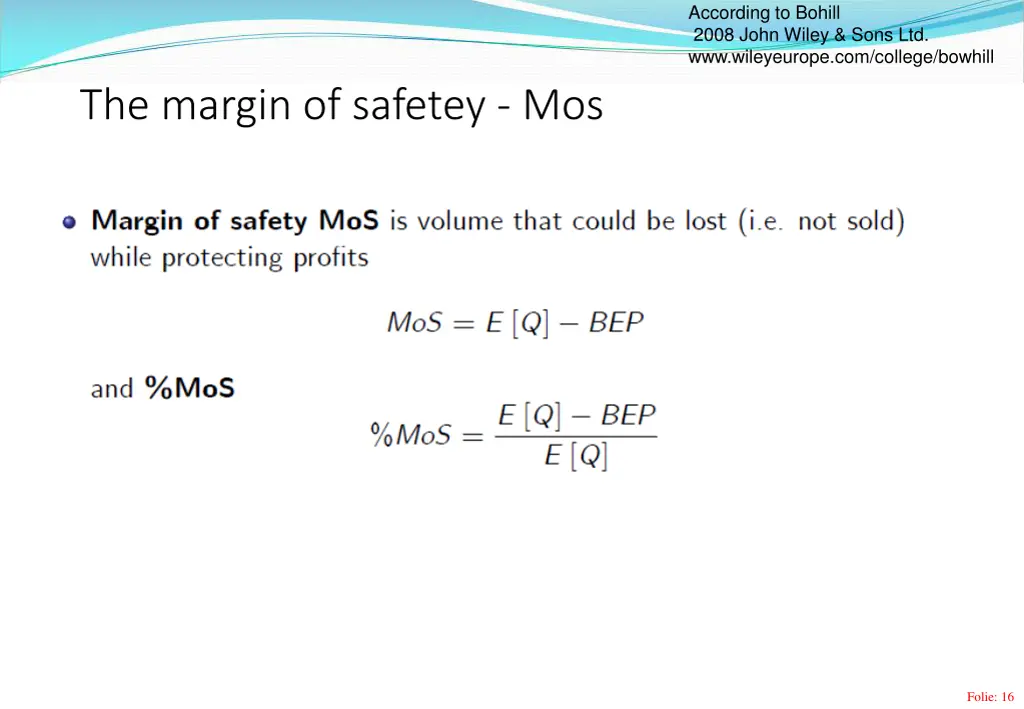
According to Bohill 2008 John Wiley & Sons Ltd. www.wileyeurope.com/college/bowhill The margin of safetey - Mos Folie: 16
Graphic according to Bohill 2008 John Wiley & Sons Ltd. www.wileyeurope.com/college/bowhill www.wileyeurope.com/college/bowhill Graphic according to Bohill 2008 John Wiley & Sons Ltd. Looking back Break-even analysis Folie: 17
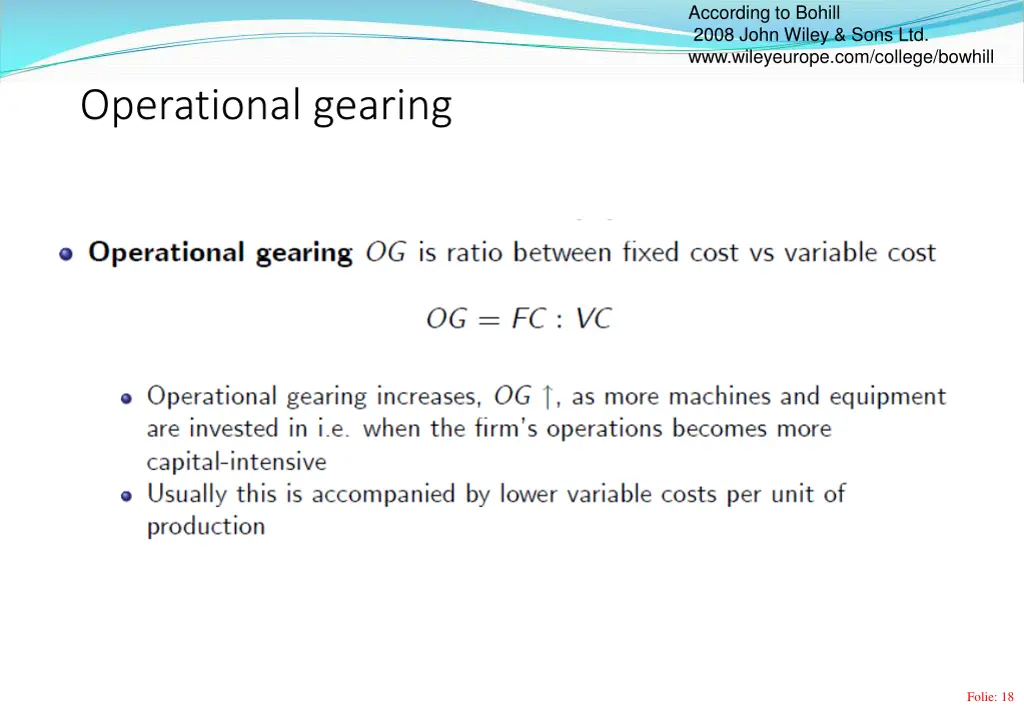
According to Bohill 2008 John Wiley & Sons Ltd. www.wileyeurope.com/college/bowhill Operational gearing Folie: 18
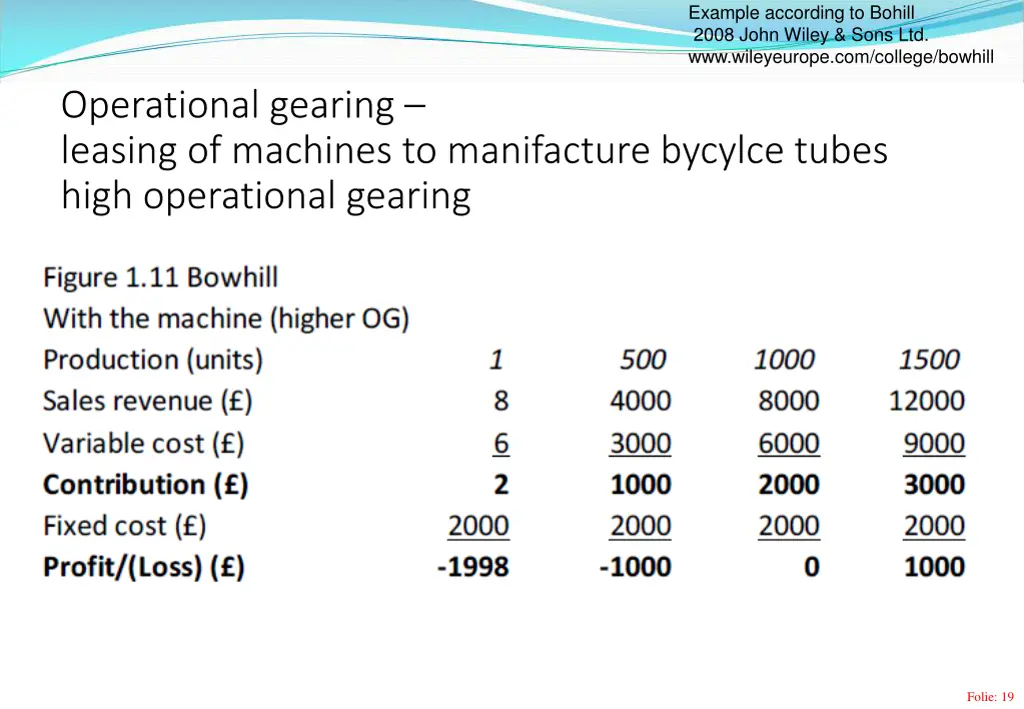
Example according to Bohill 2008 John Wiley & Sons Ltd. www.wileyeurope.com/college/bowhill Operational gearing leasing of machines to manifacture bycylce tubes high operational gearing Folie: 19
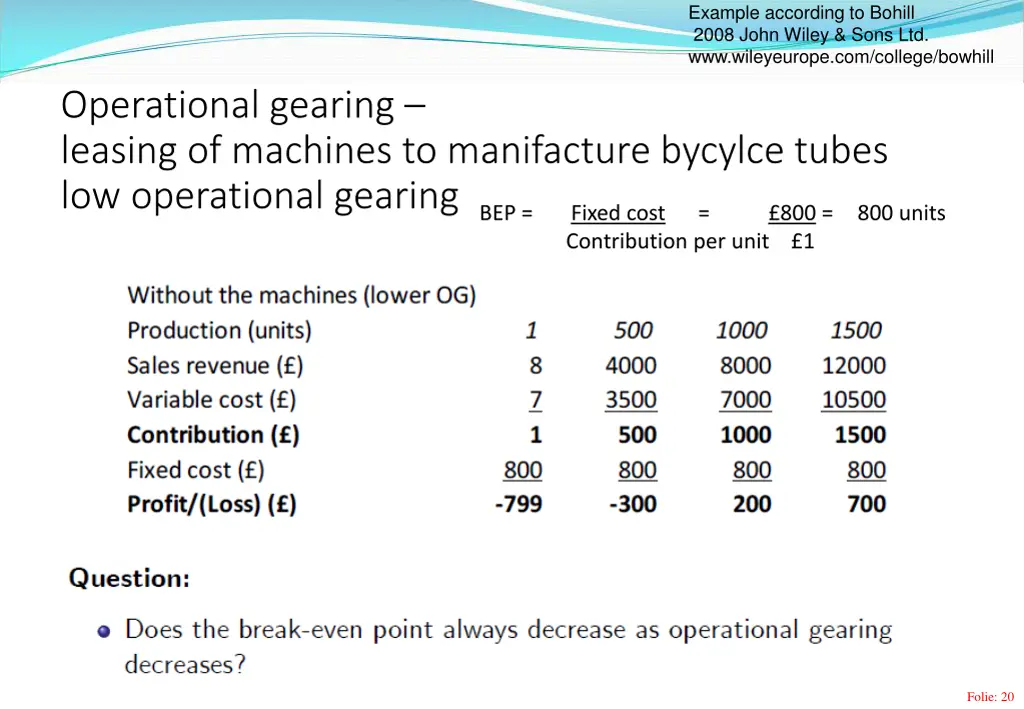
Example according to Bohill 2008 John Wiley & Sons Ltd. www.wileyeurope.com/college/bowhill Operational gearing leasing of machines to manifacture bycylce tubes low operational gearing BEP = Fixed cost Contribution per unit 1 = 800 = 800 units Folie: 20
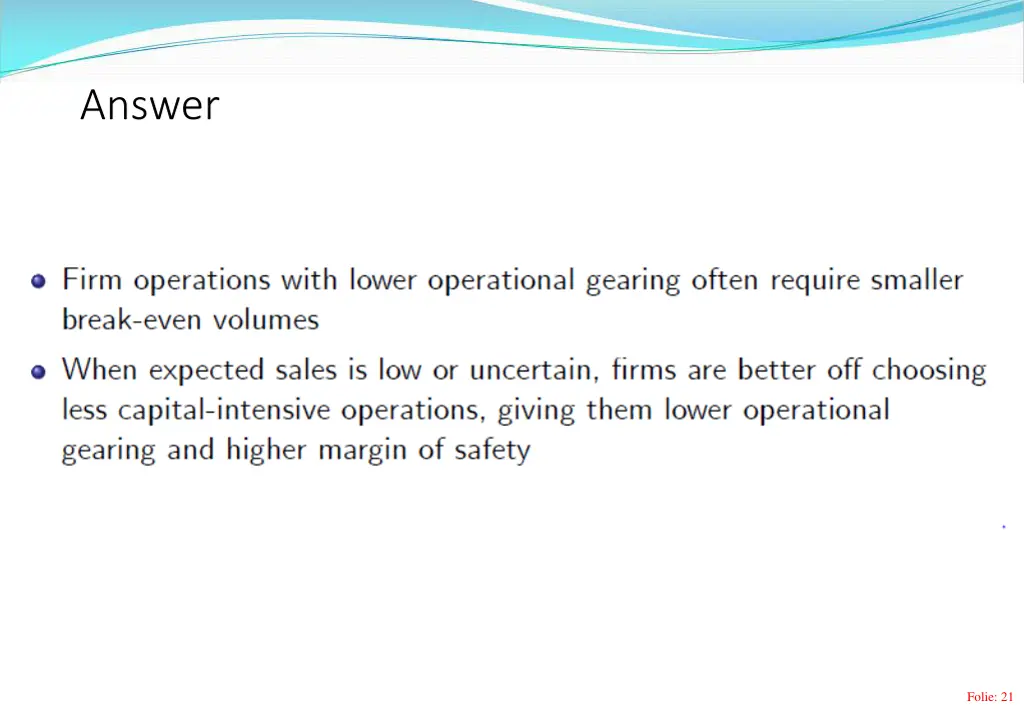
Answer Folie: 21
Discussion: Sherman Ltds metal tubes manufacturing - What assumptions are beeing made in this example? - Folie: 22
Discussion: Sherman Ltds metal tubes manufacturing - What assumptions are beeing made in this example? - Folie: 23
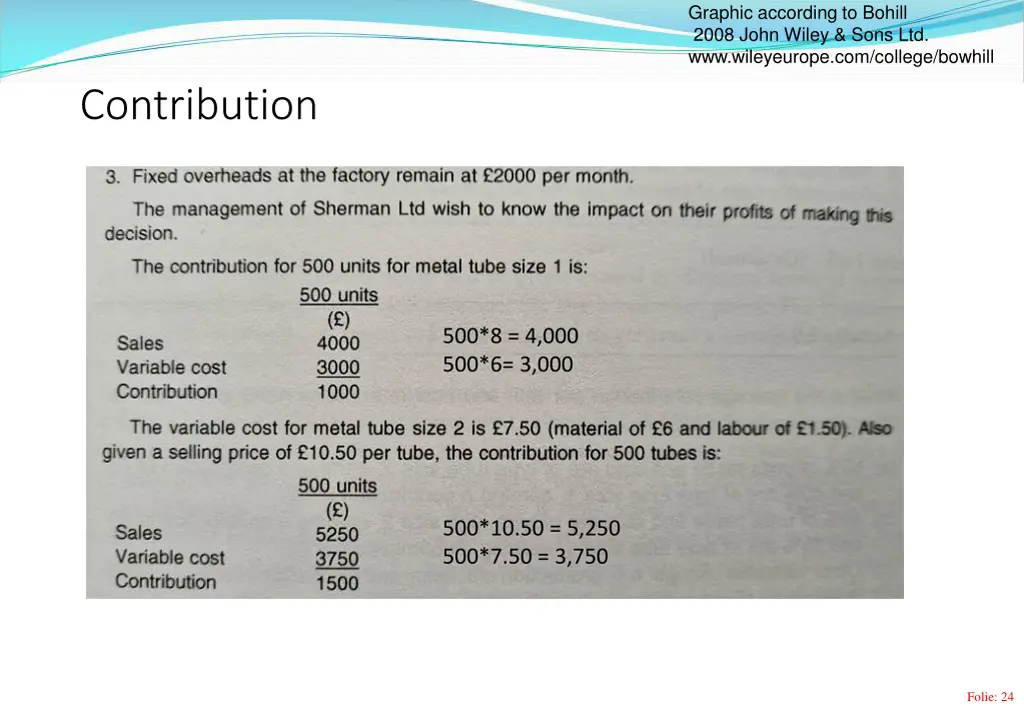
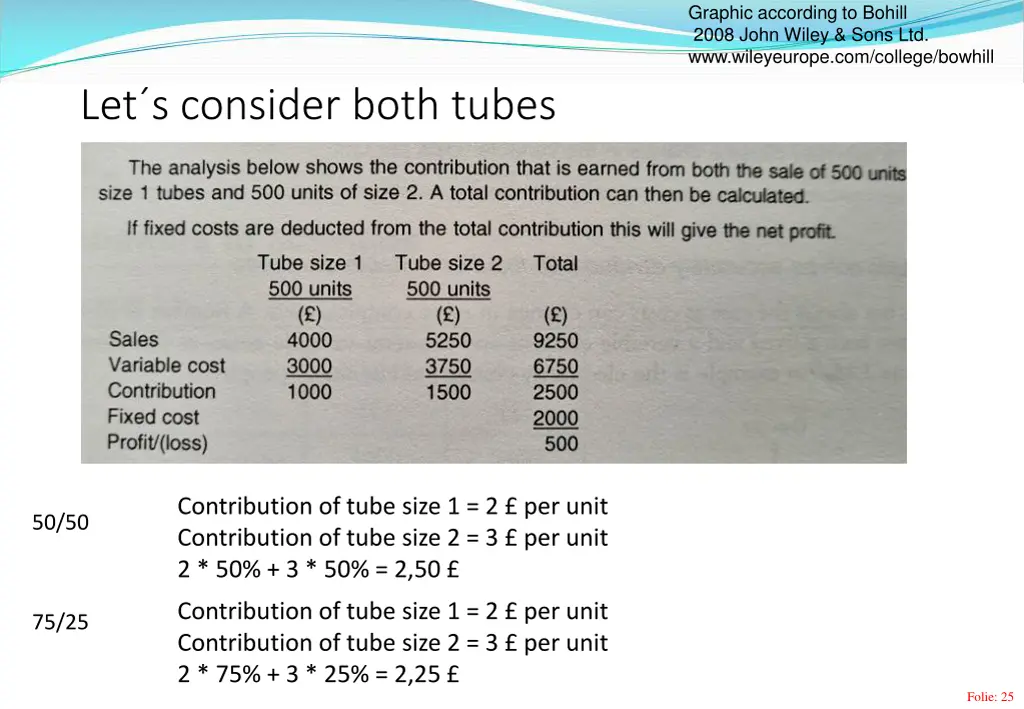
Graphic according to Bohill 2008 John Wiley & Sons Ltd. www.wileyeurope.com/college/bowhill Contribution 500*8 = 4,000 500*6= 3,000 500*10.50 = 5,250 500*7.50 = 3,750 Folie: 24
Graphic according to Bohill 2008 John Wiley & Sons Ltd. www.wileyeurope.com/college/bowhill Let s consider both tubes Contribution of tube size 1 = 2 per unit Contribution of tube size 2 = 3 per unit 2 * 50% + 3 * 50% = 2,50 50/50 Contribution of tube size 1 = 2 per unit Contribution of tube size 2 = 3 per unit 2 * 75% + 3 * 25% = 2,25 75/25 Folie: 25
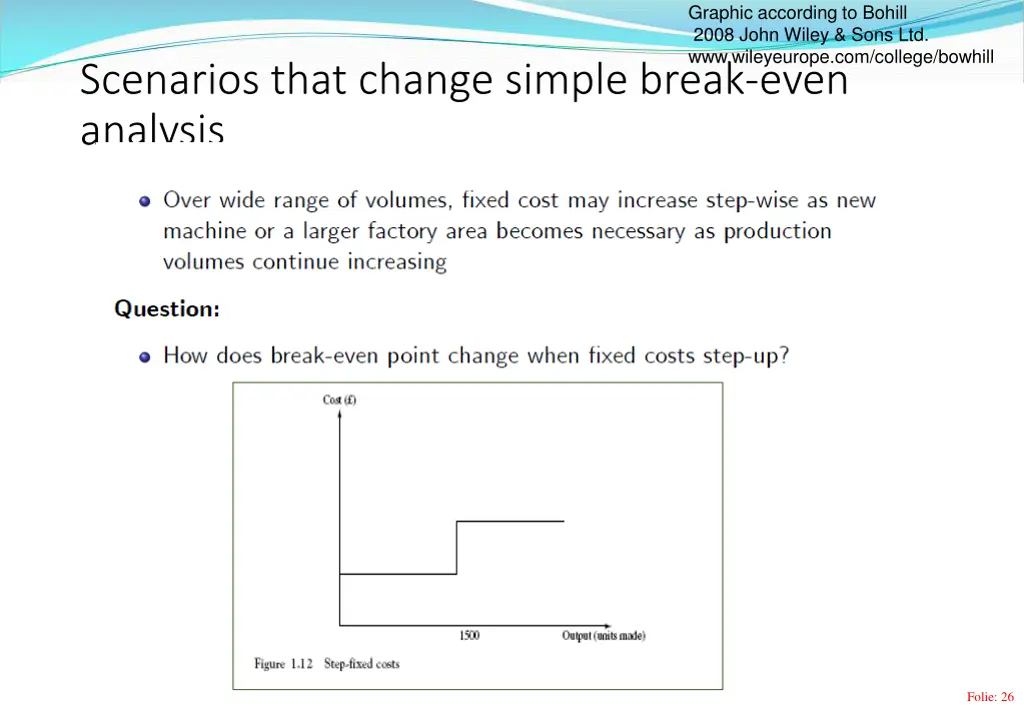
Graphic according to Bohill 2008 John Wiley & Sons Ltd. www.wileyeurope.com/college/bowhill Scenarios that change simple break-even analysis Folie: 26
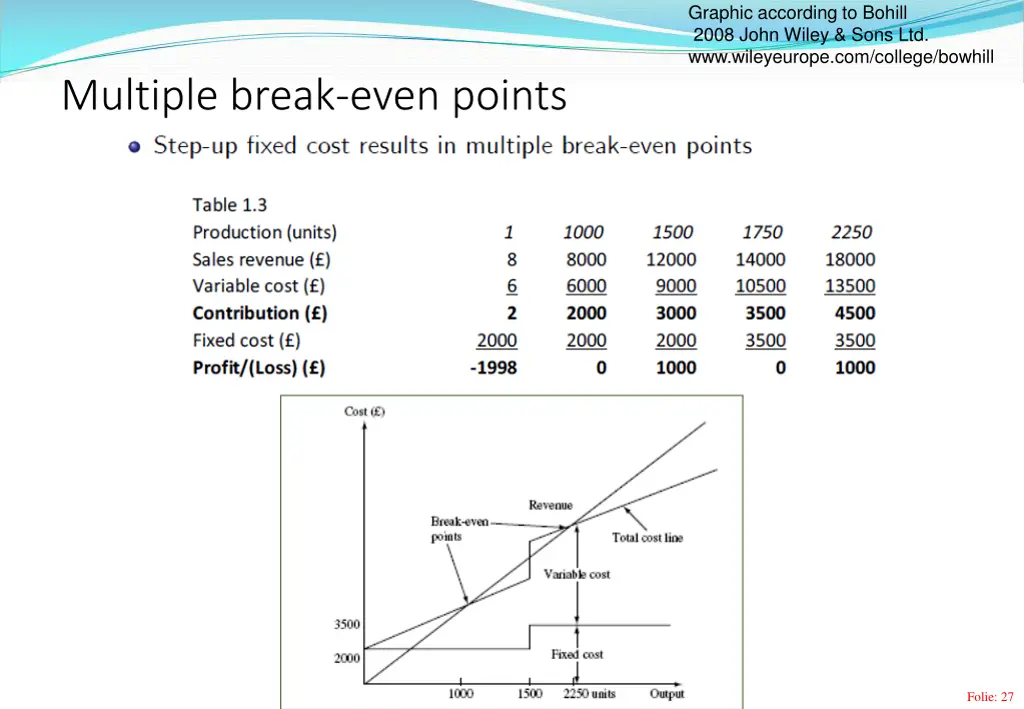
Graphic according to Bohill 2008 John Wiley & Sons Ltd. www.wileyeurope.com/college/bowhill Multiple break-even points Folie: 27
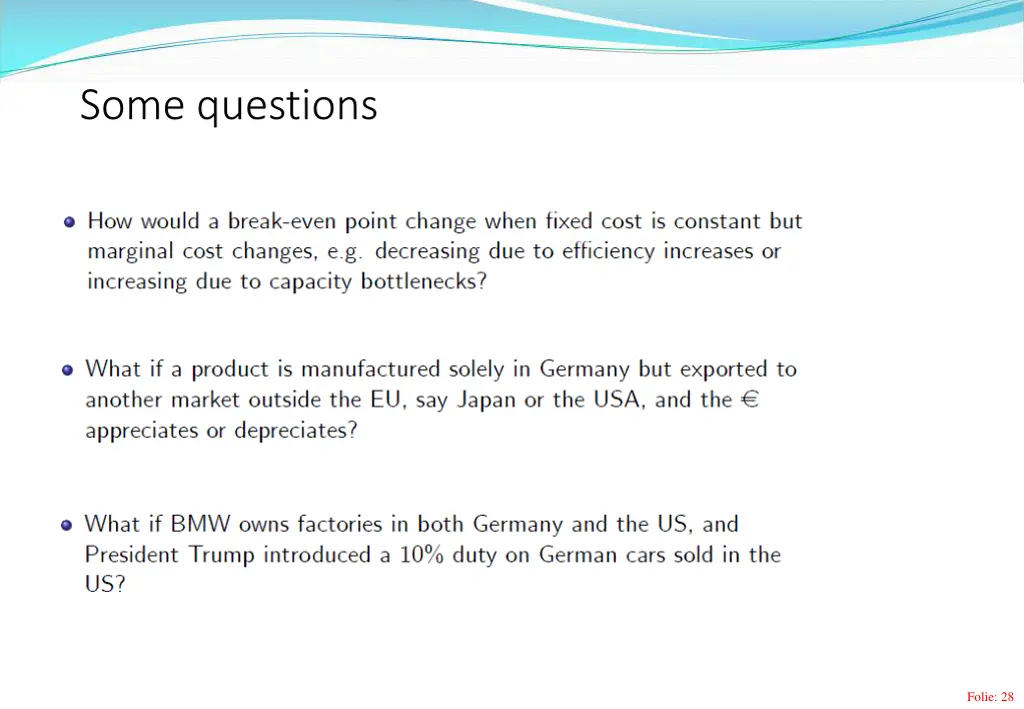
Some questions Folie: 28
Step 2: Bowhill Ch. 2-3 Lecture 2: Costs and Profits Full-cost and market-based pricing, demand-based pricing, target pricing, pricing strategies, cost-volume-profit decisions Folie: 29
Learning Outcomes Folie: 30
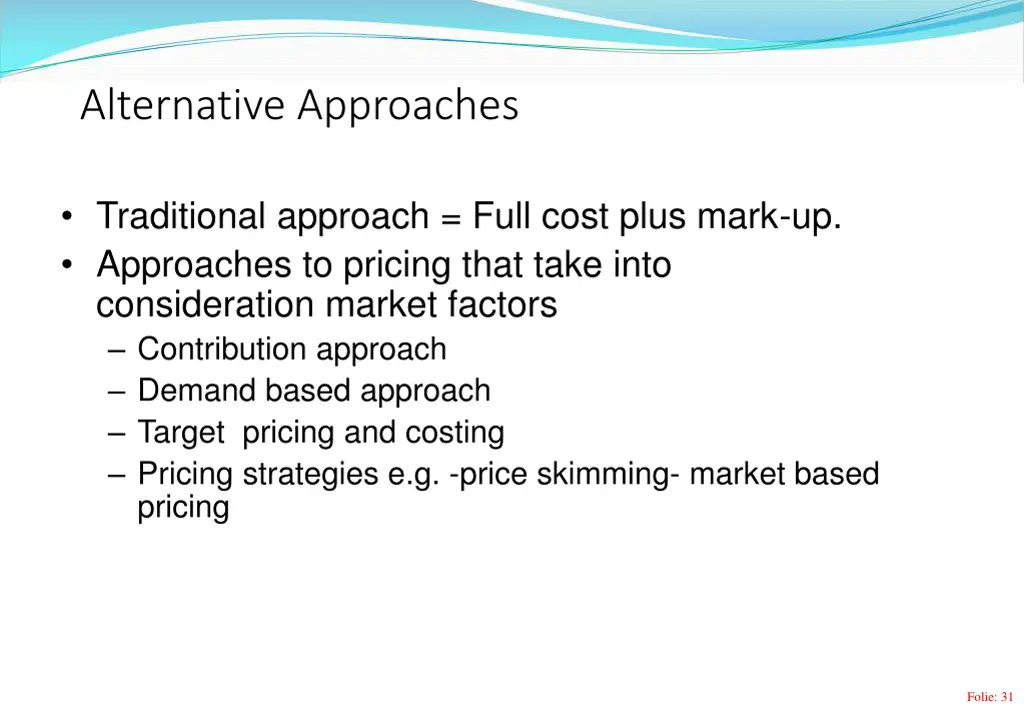
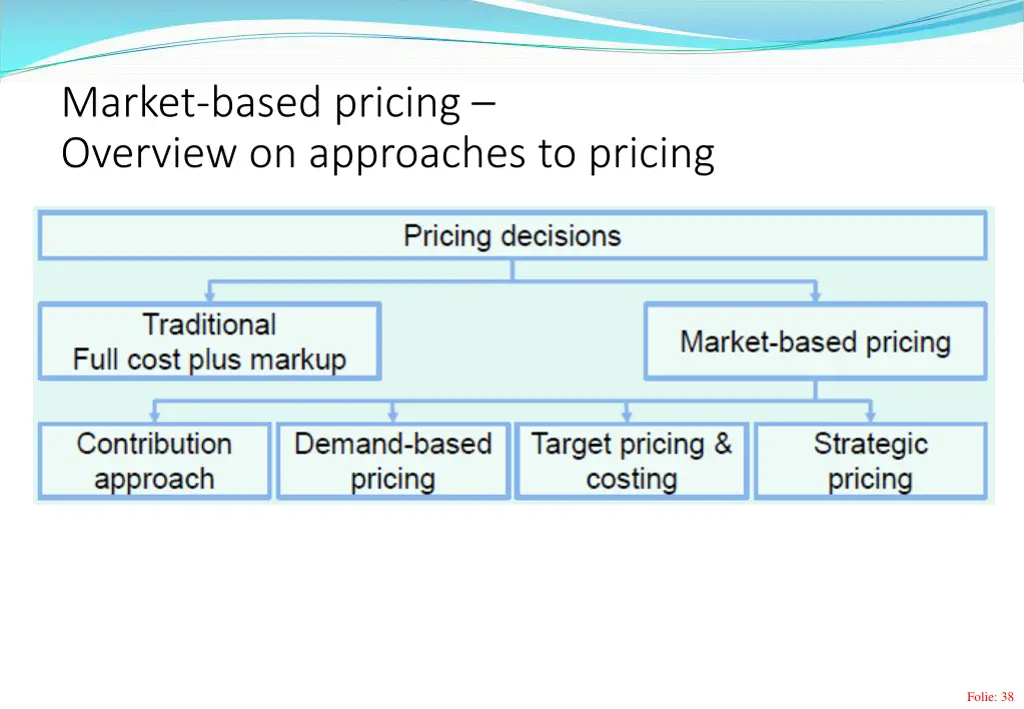
Alternative Approaches Traditional approach = Full cost plus mark-up. Approaches to pricing that take into consideration market factors Contribution approach Demand based approach Target pricing and costing Pricing strategies e.g. -price skimming- market based pricing Folie: 31
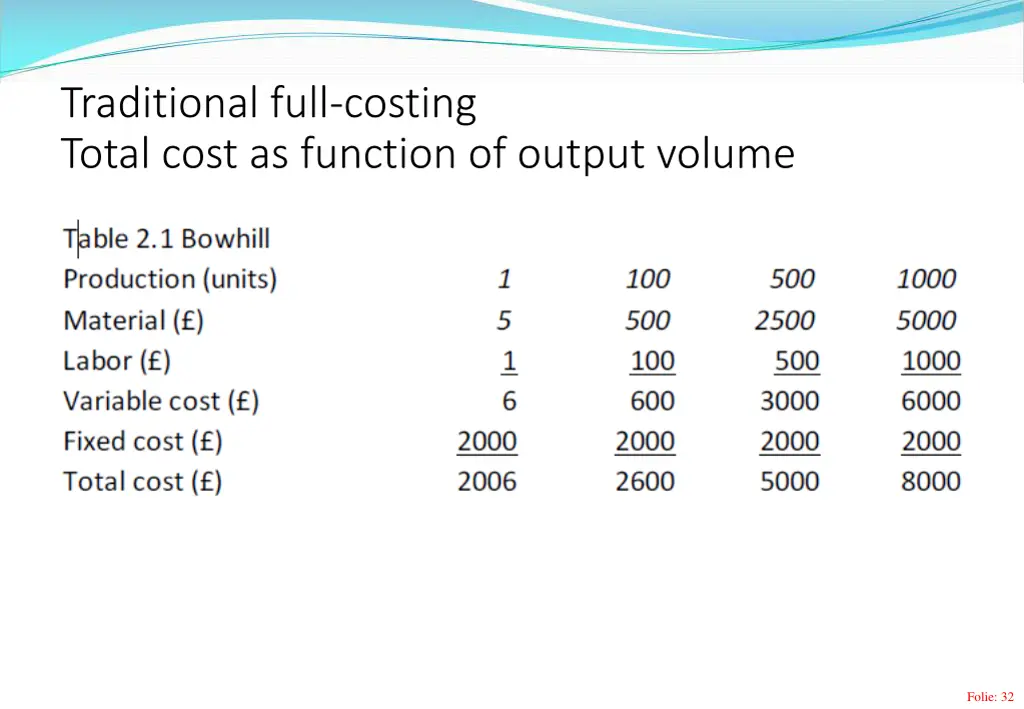
Traditional full-costing Total cost as function of output volume Folie: 32
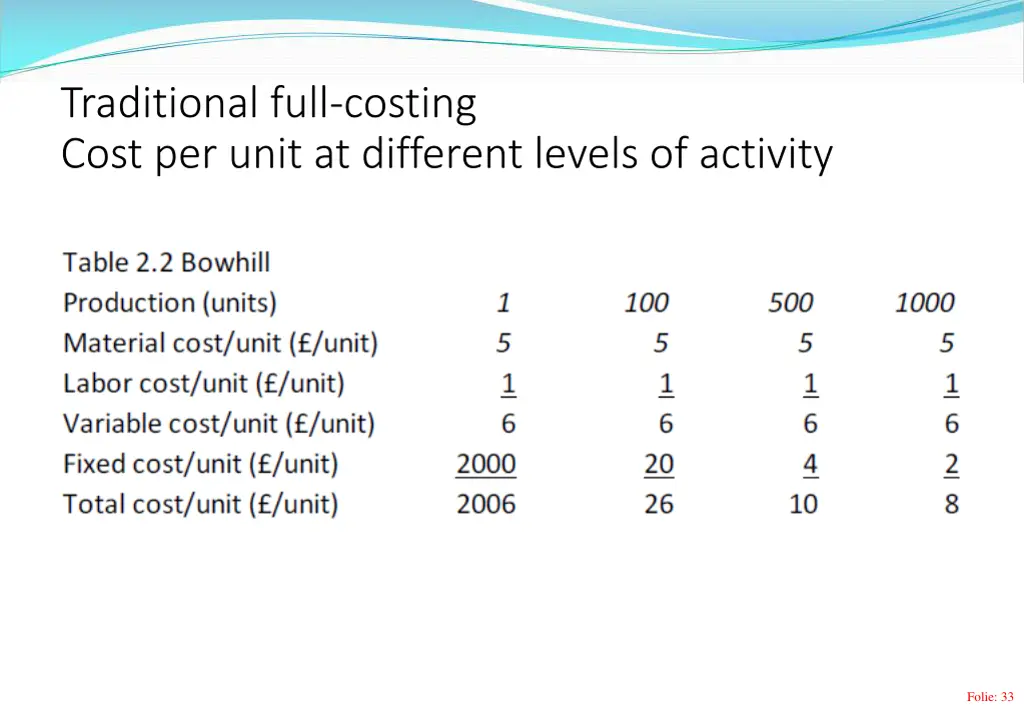
Traditional full-costing Cost per unit at different levels of activity Folie: 33
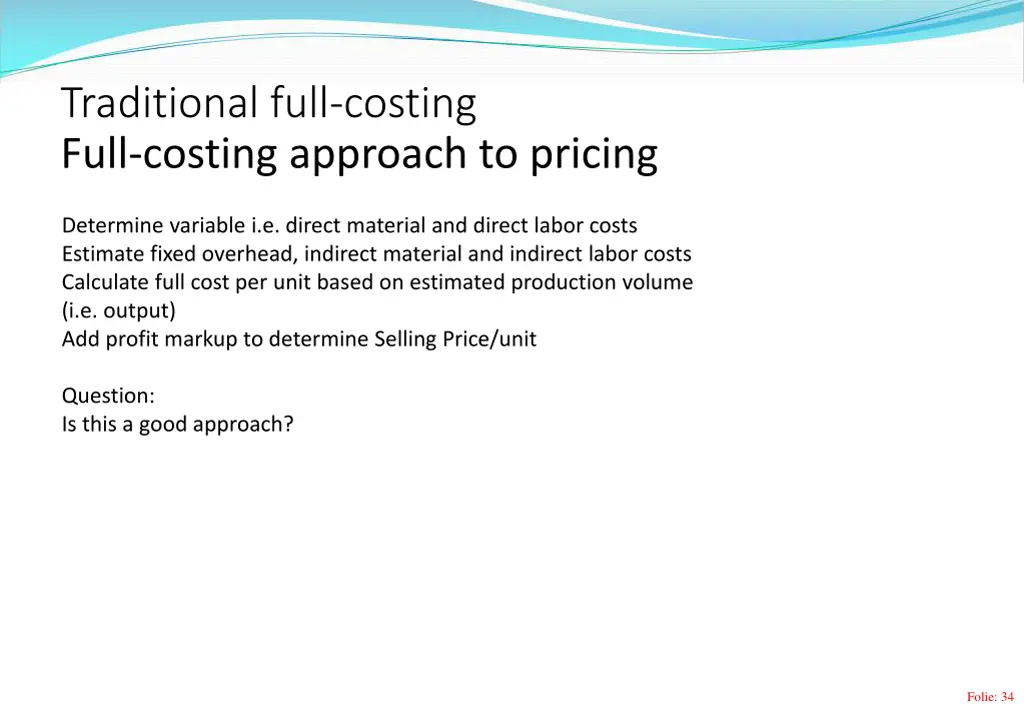
Traditional full-costing Full-costing approach to pricing Determine variable i.e. direct material and direct labor costs Estimate fixed overhead, indirect material and indirect labor costs Calculate full cost per unit based on estimated production volume (i.e. output) Add profit markup to determine Selling Price/unit Question: Is this a good approach? Folie: 34
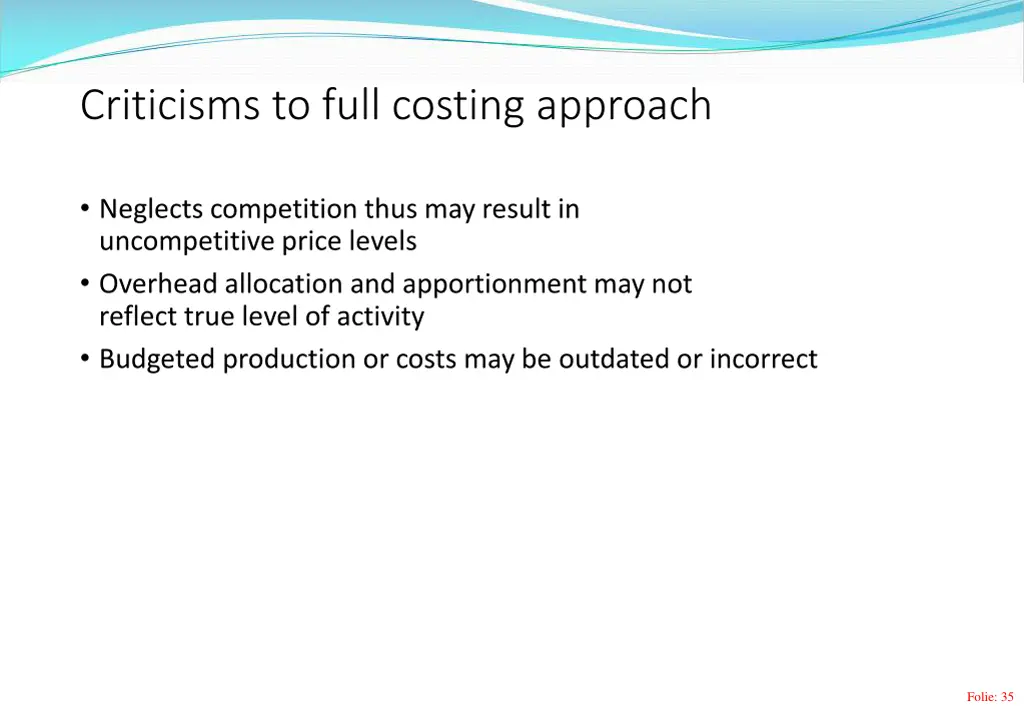
Criticisms to full costing approach Neglects competition thus may result in uncompetitive price levels Overhead allocation and apportionment may not reflect true level of activity Budgeted production or costs may be outdated or incorrect Folie: 35
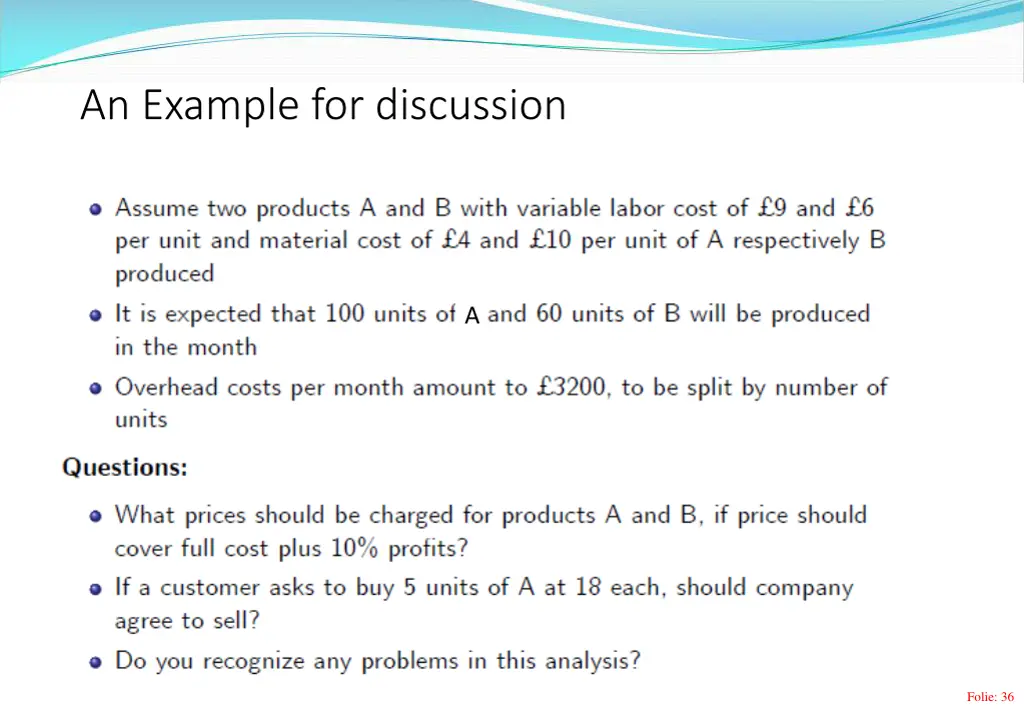
An Example for discussion A Folie: 36
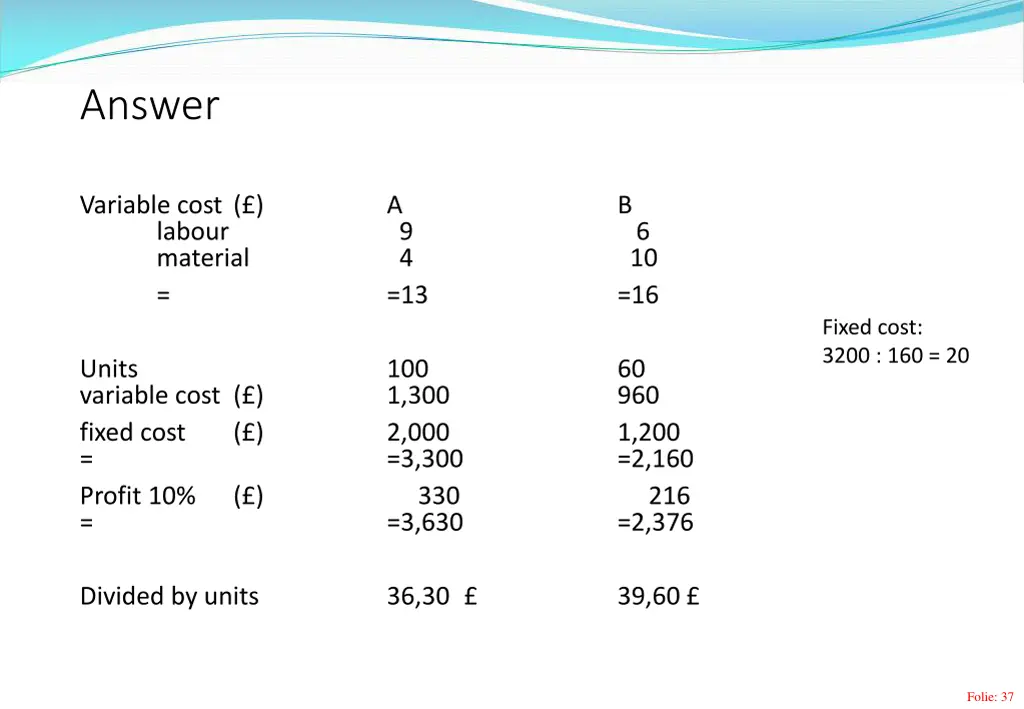
Answer Variable cost ( ) labour material = A 9 4 =13 B 6 10 =16 Fixed cost: 3200 : 160 = 20 Units variable cost ( ) fixed cost = Profit 10% = 100 1,300 2,000 =3,300 330 =3,630 60 960 1,200 =2,160 216 =2,376 ( ) ( ) Divided by units 36,30 39,60 Folie: 37
Market-based pricing Overview on approaches to pricing Folie: 38
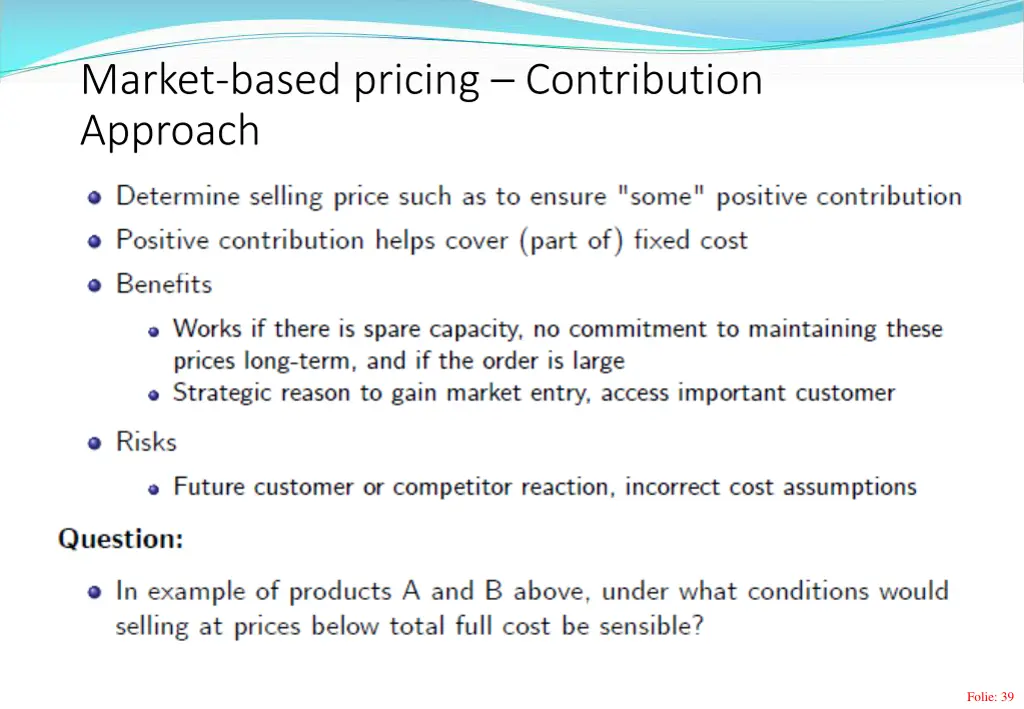
Market-based pricing Contribution Approach Folie: 39
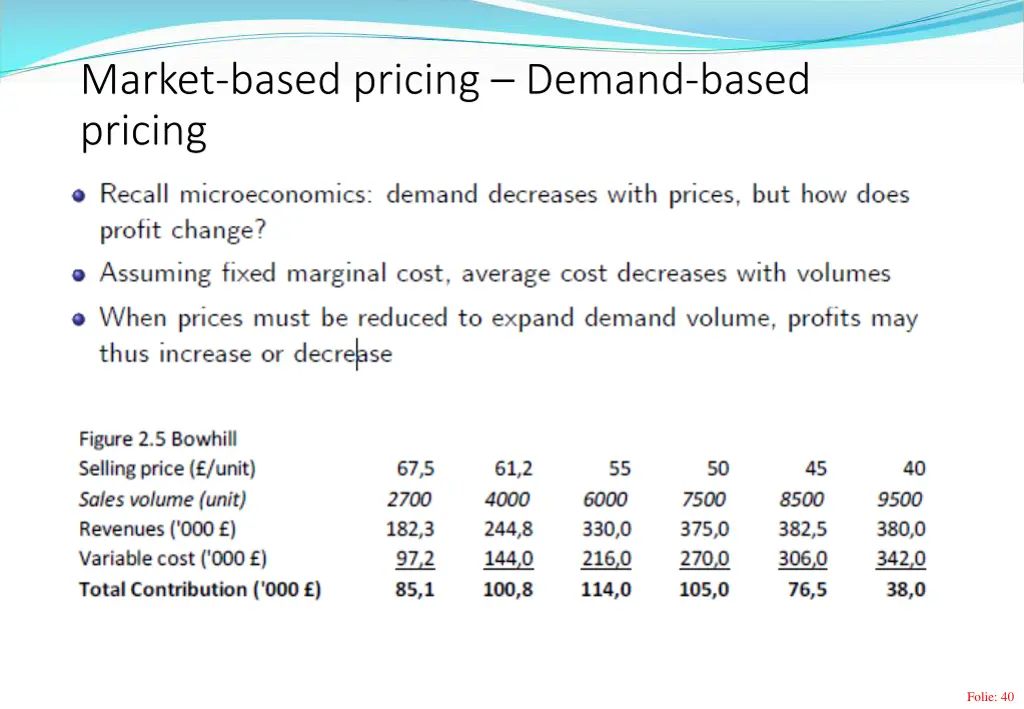
Market-based pricing Demand-based pricing Folie: 40
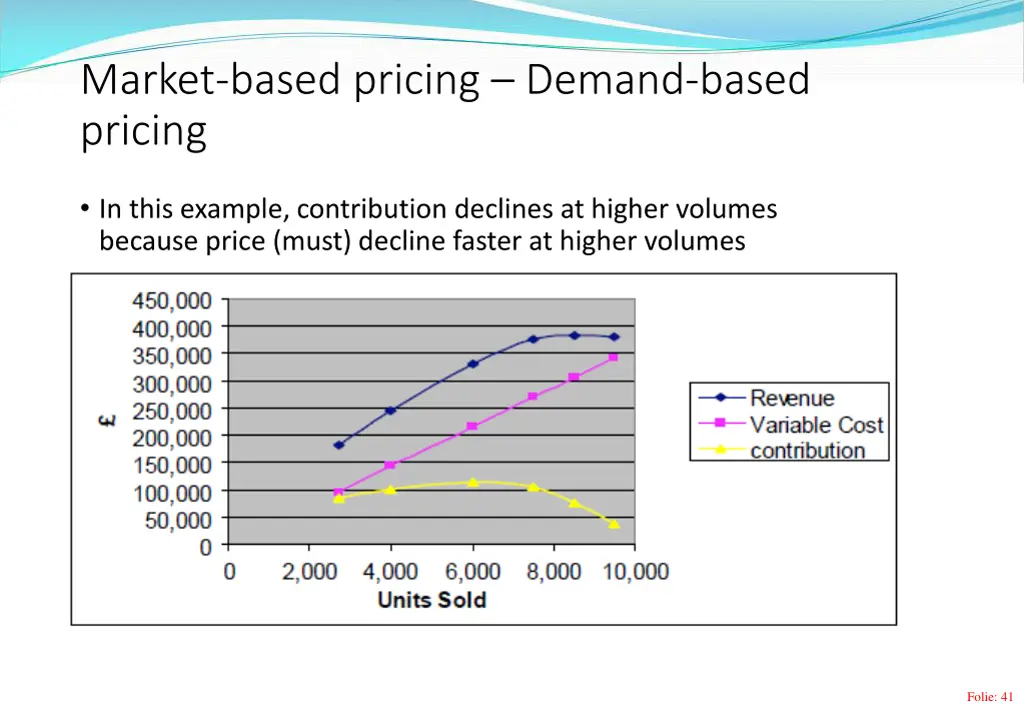
Market-based pricing Demand-based pricing In this example, contribution declines at higher volumes because price (must) decline faster at higher volumes Folie: 41
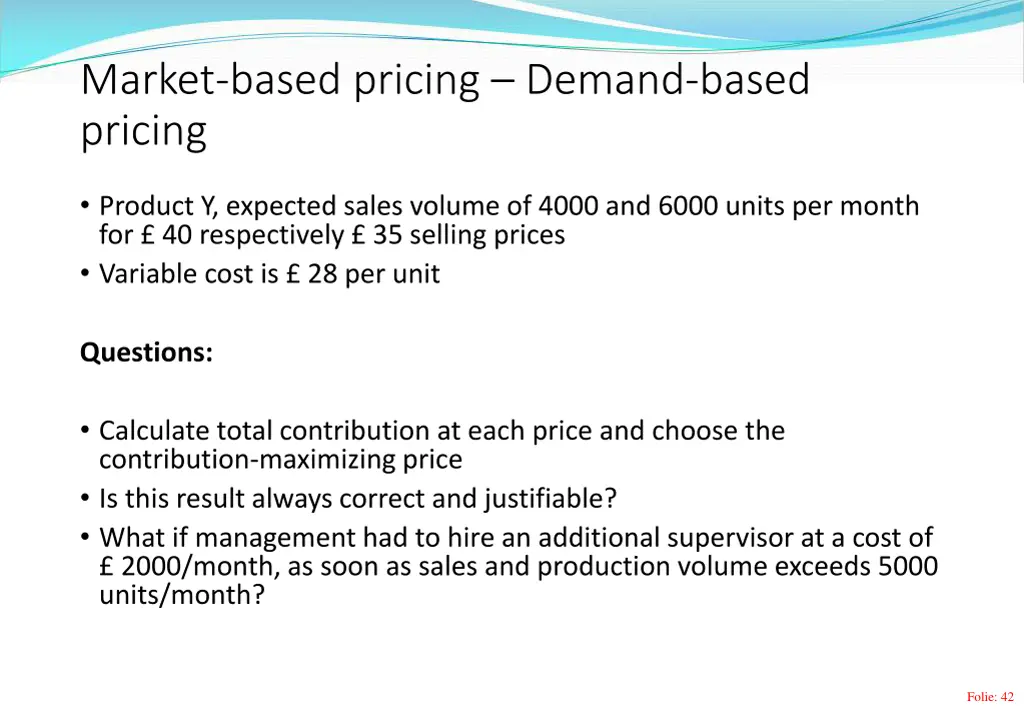
Market-based pricing Demand-based pricing Product Y, expected sales volume of 4000 and 6000 units per month for 40 respectively 35 selling prices Variable cost is 28 per unit Questions: Calculate total contribution at each price and choose the contribution-maximizing price Is this result always correct and justifiable? What if management had to hire an additional supervisor at a cost of 2000/month, as soon as sales and production volume exceeds 5000 units/month? Folie: 42
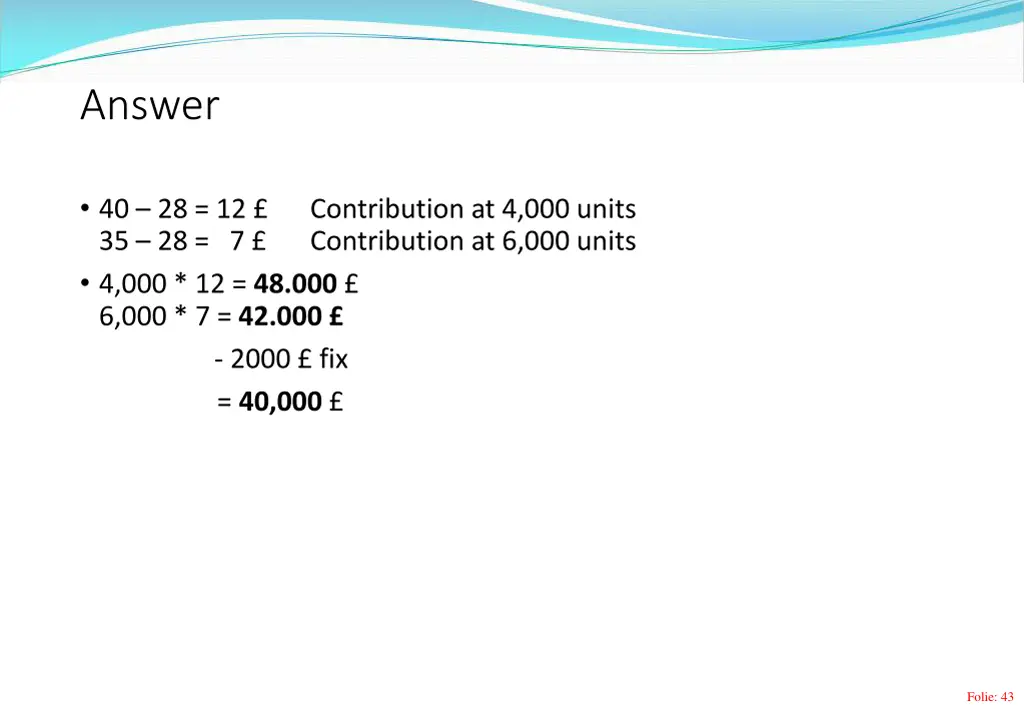
Answer 40 28 = 12 35 28 = 7 4,000 * 12 = 48.000 6,000 * 7 = 42.000 - 2000 fix = 40,000 Contribution at 4,000 units Contribution at 6,000 units Folie: 43
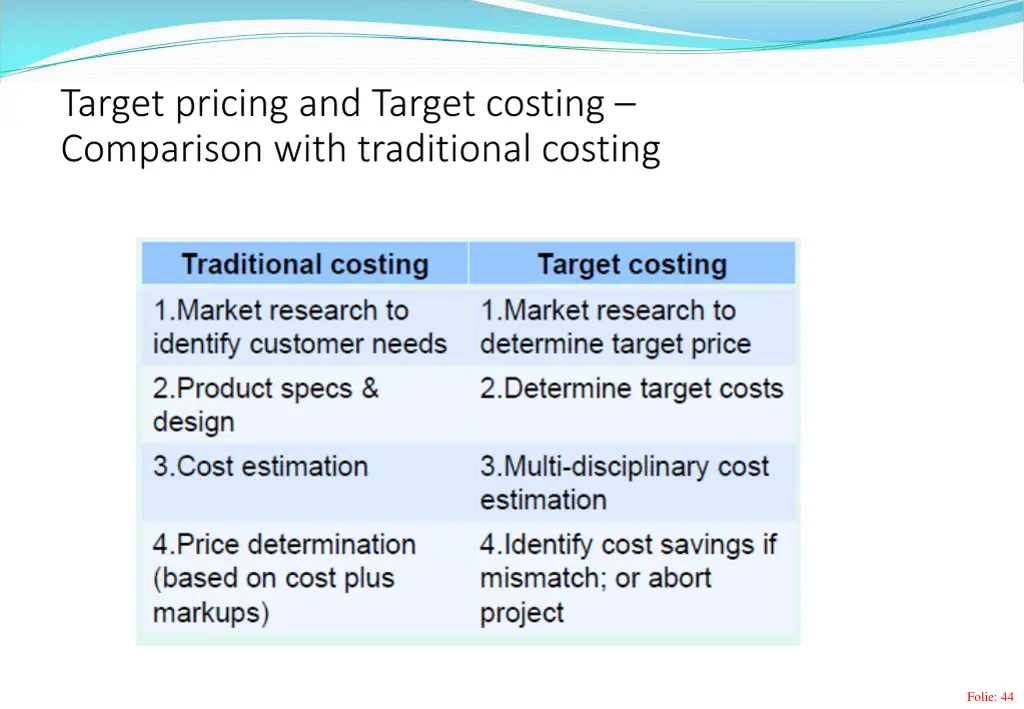
Target pricing and Target costing Comparison with traditional costing Folie: 44
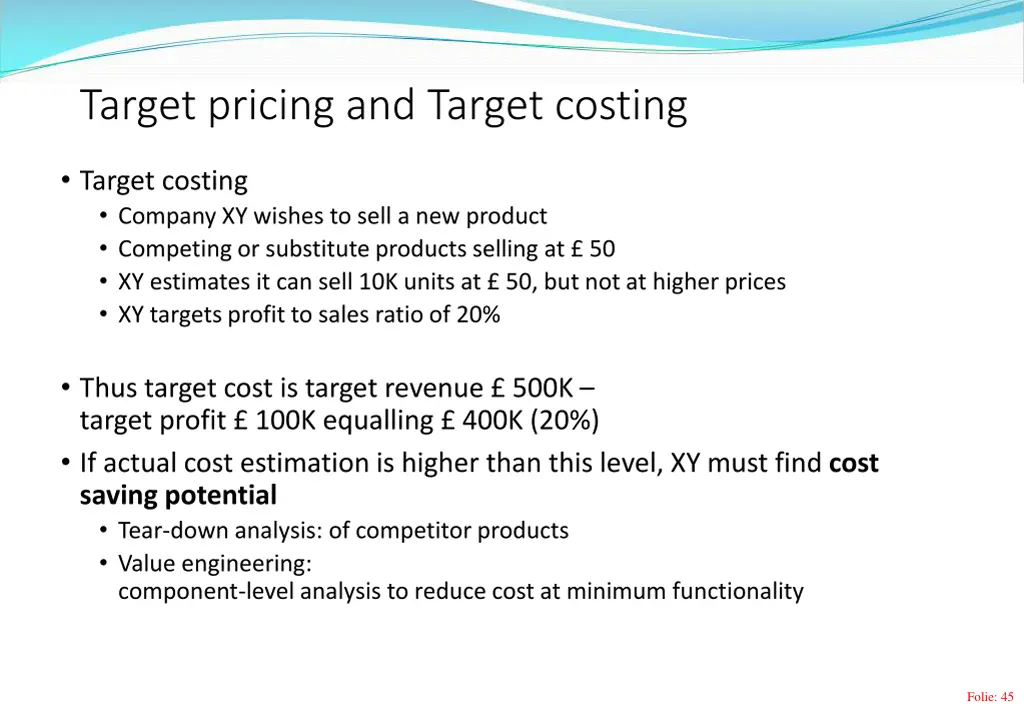
Target pricing and Target costing Target costing Company XY wishes to sell a new product Competing or substitute products selling at 50 XY estimates it can sell 10K units at 50, but not at higher prices XY targets profit to sales ratio of 20% Thus target cost is target revenue 500K target profit 100K equalling 400K (20%) If actual cost estimation is higher than this level, XY must find cost saving potential Tear-down analysis: of competitor products Value engineering: component-level analysis to reduce cost at minimum functionality Folie: 45
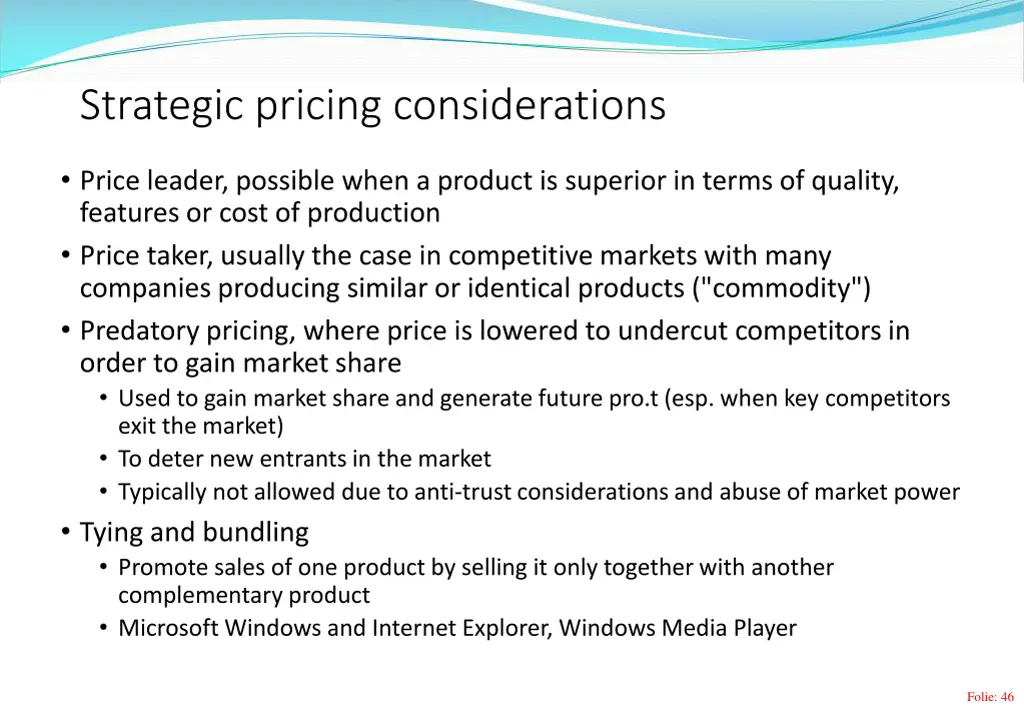
Strategic pricing considerations Price leader, possible when a product is superior in terms of quality, features or cost of production Price taker, usually the case in competitive markets with many companies producing similar or identical products ("commodity") Predatory pricing, where price is lowered to undercut competitors in order to gain market share Used to gain market share and generate future pro.t (esp. when key competitors exit the market) To deter new entrants in the market Typically not allowed due to anti-trust considerations and abuse of market power Tying and bundling Promote sales of one product by selling it only together with another complementary product Microsoft Windows and Internet Explorer, Windows Media Player Folie: 46
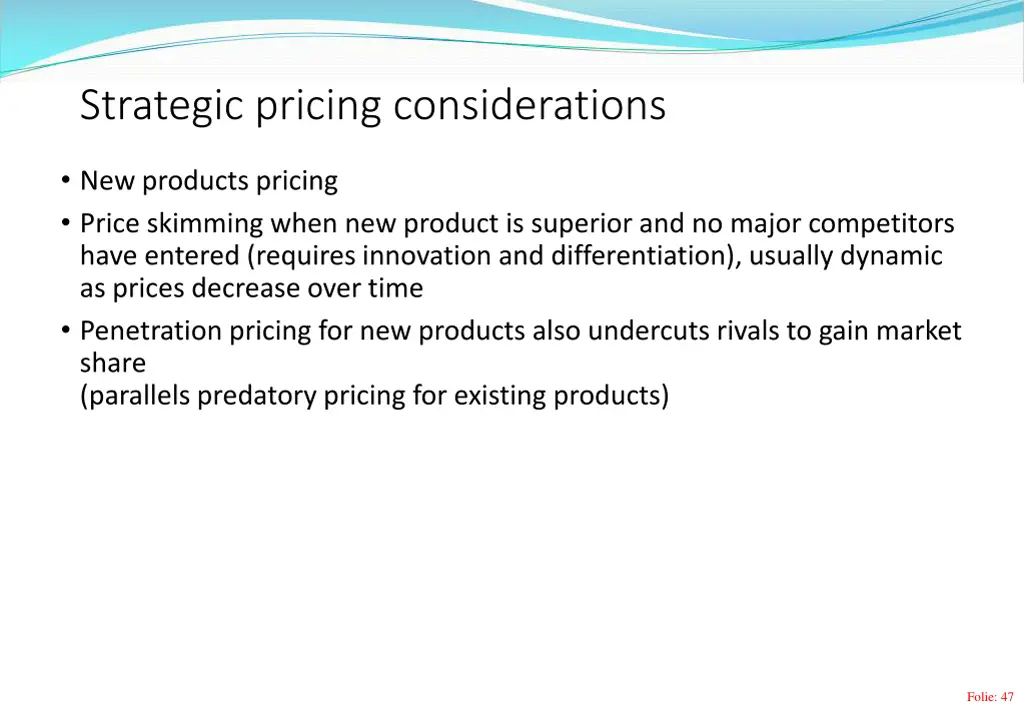
Strategic pricing considerations New products pricing Price skimming when new product is superior and no major competitors have entered (requires innovation and differentiation), usually dynamic as prices decrease over time Penetration pricing for new products also undercuts rivals to gain market share (parallels predatory pricing for existing products) Folie: 47
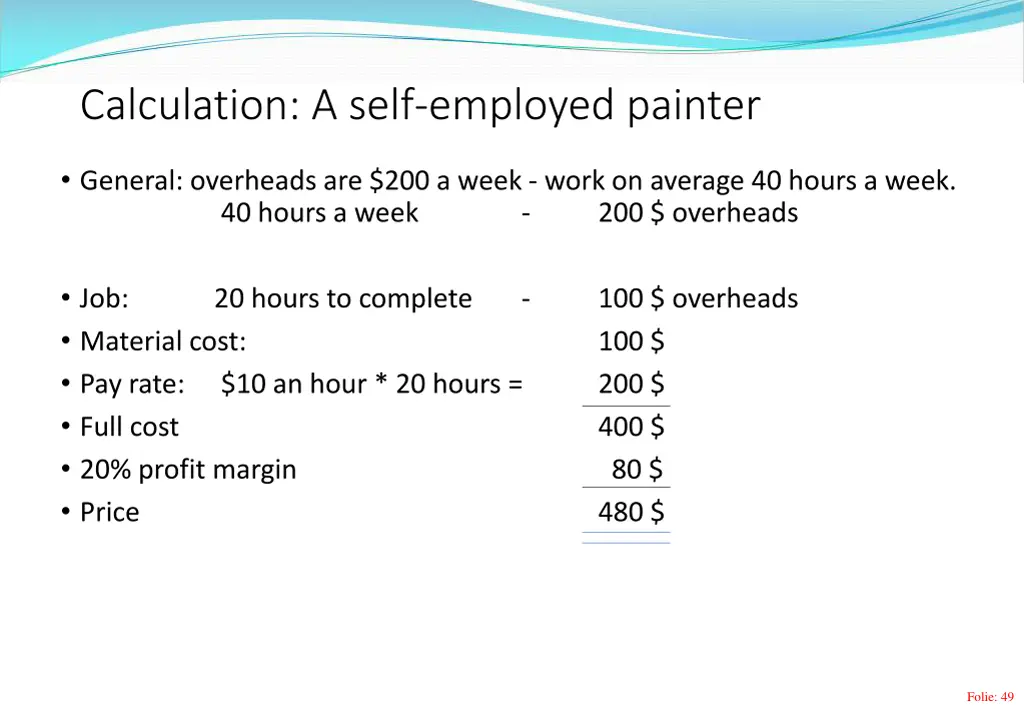
Discussion: A self-employed painter Mr Jones is a painter and decorator. His overheads are $200 a week and he expects to work on average 40 hours a week. He has been asked to quote for a job which he estimates will take him 20 hours to complete. The material cost for the job will be $100. Assume he includes a pay rate of $10 an hour for himself and builds in a 20% profit margin on full cost. Question: Calculate the price for the job that Mr Jones should quote to his customer. Folie: 48
Calculation: A self-employed painter General: overheads are $200 a week - work on average 40 hours a week. 40 hours a week - 200 $ overheads Job: Material cost: Pay rate: Full cost 20% profit margin Price 20 hours to complete - 100 $ overheads 100 $ 200 $ 400 $ 80 $ 480 $ $10 an hour * 20 hours = Folie: 49
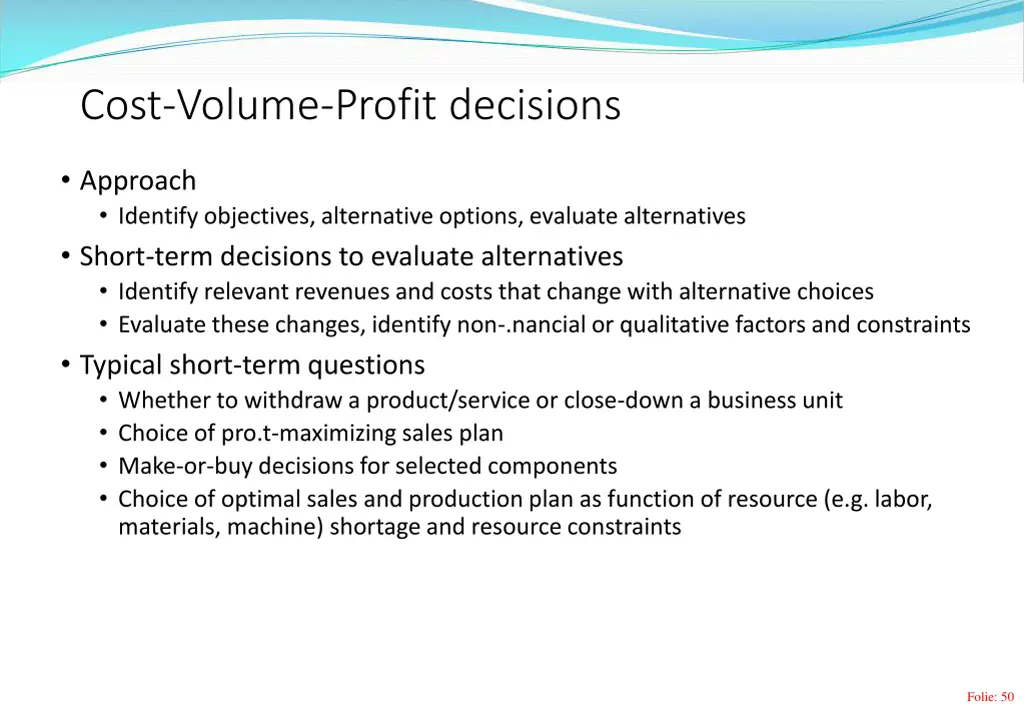
Cost-Volume-Profit decisions Approach Identify objectives, alternative options, evaluate alternatives Short-term decisions to evaluate alternatives Identify relevant revenues and costs that change with alternative choices Evaluate these changes, identify non-.nancial or qualitative factors and constraints Typical short-term questions Whether to withdraw a product/service or close-down a business unit Choice of pro.t-maximizing sales plan Make-or-buy decisions for selected components Choice of optimal sales and production plan as function of resource (e.g. labor, materials, machine) shortage and resource constraints Folie: 50