Explore how the Appreciative Inquiry process can enhance democratic co-curricular partnership development in higher education. Learn about the background, problem areas, and framing of the practice for inclusive and reciprocal engagements.
Please find below an Image/Link to download the presentation.
The content on the website is provided AS IS for your information and personal use only. It may not be sold, licensed, or shared on other websites without obtaining consent from the author. If you encounter any issues during the download, it is possible that the publisher has removed the file from their server.
You are allowed to download the files provided on this website for personal or commercial use, subject to the condition that they are used lawfully. All files are the property of their respective owners.
The content on the website is provided AS IS for your information and personal use only. It may not be sold, licensed, or shared on other websites without obtaining consent from the author.
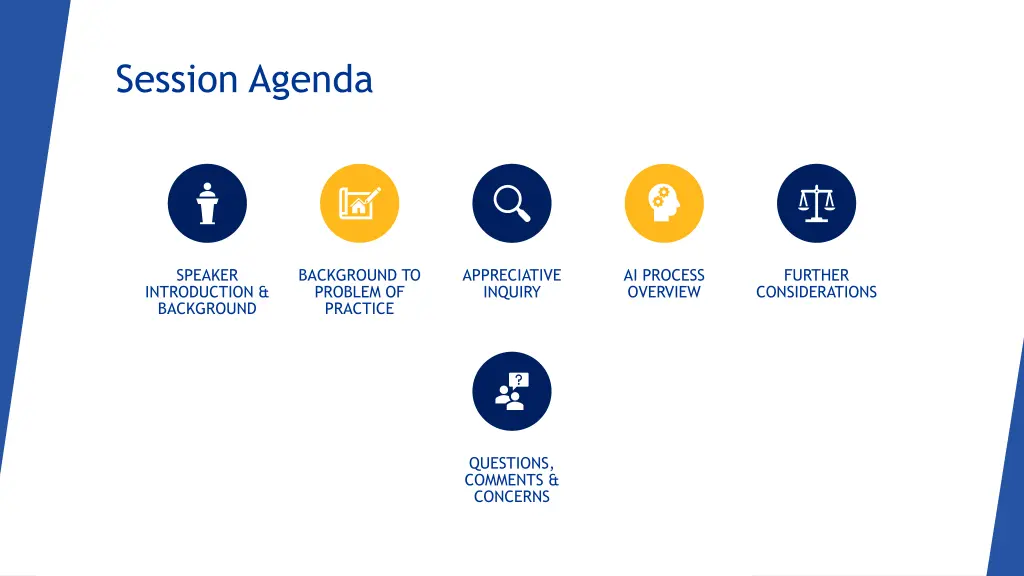
Session Agenda SPEAKER INTRODUCTION & BACKGROUND BACKGROUND TO PROBLEM OF PRACTICE APPRECIATIVE INQUIRY AI PROCESS OVERVIEW FURTHER CONSIDERATIONS QUESTIONS, COMMENTS & CONCERNS
Associate Director of Student Affairs at Penn State Greater Allegheny (McKeesport, PA) Director of Community Engagement at Washington & Jefferson College (Washington, PA) Speaker Introduction & Background Community Engagement Professional (CEP) (Dostilio & Perry, 2017) Background in student affairs EdD at Pitt Started Problem of Practice Research Transition to new role
Background to the Problem Area New approach in higher education: Democratic Engagement Values inclusiveness, participation, and reciprocity Specific Problem Research and practice surrounding democratic engagement is situated in the curricular 33% of Campus Compact member reported community engagement embedded within student affairs (Campus Compact, 2015). Institutionalizing democratic engagement Carnegie Classification for Community Engagement Need for the cocurricular CEPs to take ownership of framework, language and practice
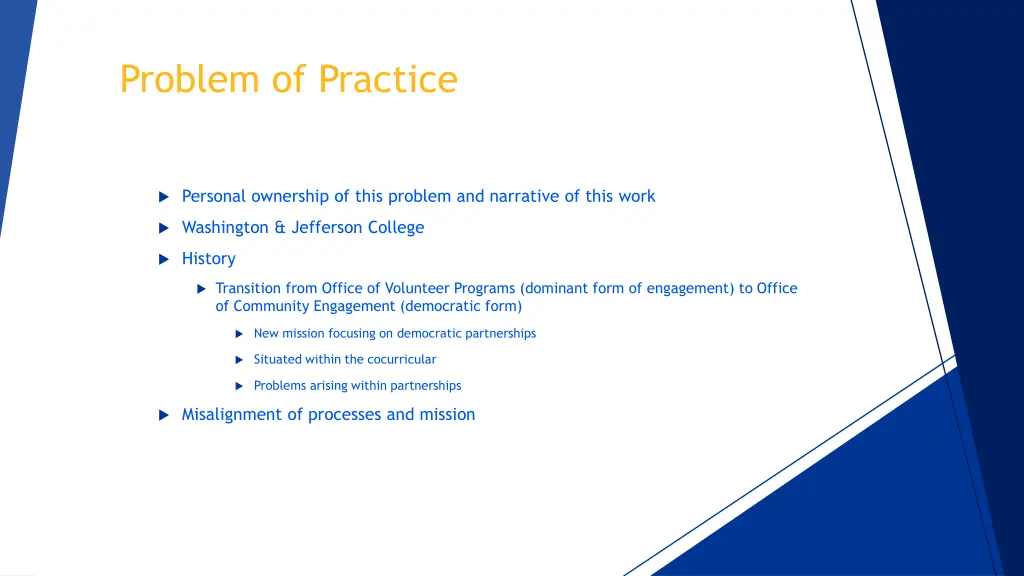
Problem of Practice Personal ownership of this problem and narrative of this work Washington & Jefferson College History Transition from Office of Volunteer Programs (dominant form of engagement) to Office of Community Engagement (democratic form) New mission focusing on democratic partnerships Situated within the cocurricular Problems arising within partnerships Misalignment of processes and mission
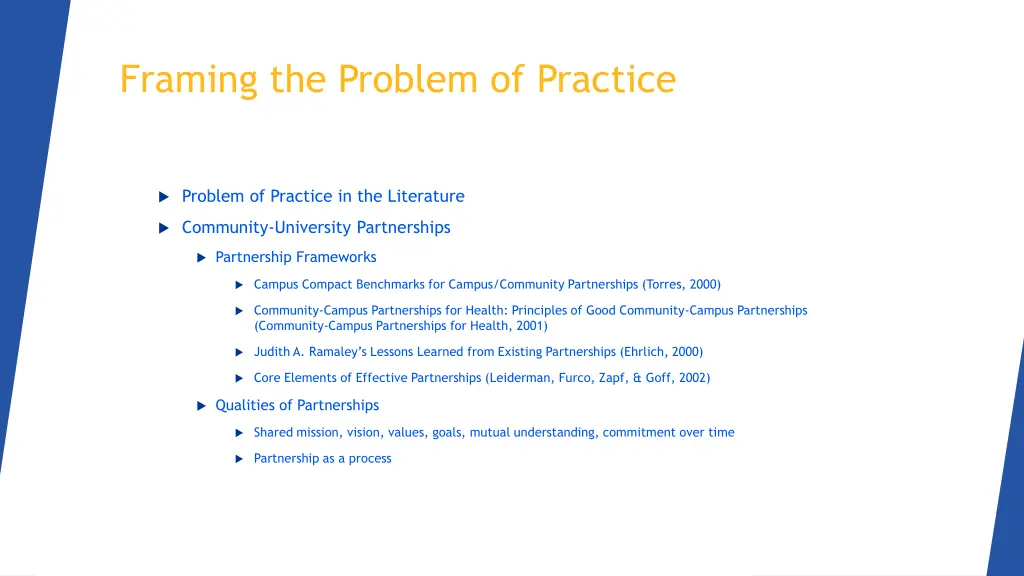
Framing the Problem of Practice Problem of Practice in the Literature Community-University Partnerships Partnership Frameworks Campus Compact Benchmarks for Campus/Community Partnerships (Torres, 2000) Community-Campus Partnerships for Health: Principles of Good Community-Campus Partnerships (Community-Campus Partnerships for Health, 2001) Judith A. Ramaley s Lessons Learned from Existing Partnerships (Ehrlich, 2000) Core Elements of Effective Partnerships (Leiderman, Furco, Zapf, & Goff, 2002) Qualities of Partnerships Shared mission, vision, values, goals, mutual understanding, commitment over time Partnership as a process
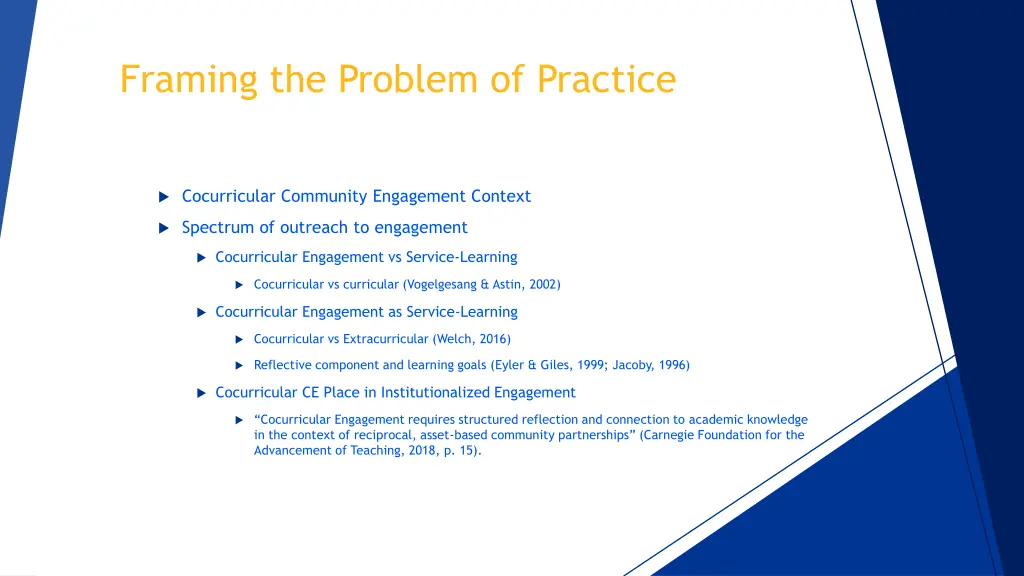
Framing the Problem of Practice Cocurricular Community Engagement Context Spectrum of outreach to engagement Cocurricular Engagement vs Service-Learning Cocurricular vs curricular (Vogelgesang & Astin, 2002) Cocurricular Engagement as Service-Learning Cocurricular vs Extracurricular (Welch, 2016) Reflective component and learning goals (Eyler & Giles, 1999; Jacoby, 1996) Cocurricular CE Place in Institutionalized Engagement Cocurricular Engagement requires structured reflection and connection to academic knowledge in the context of reciprocal, asset-based community partnerships (Carnegie Foundation for the Advancement of Teaching, 2018, p. 15).
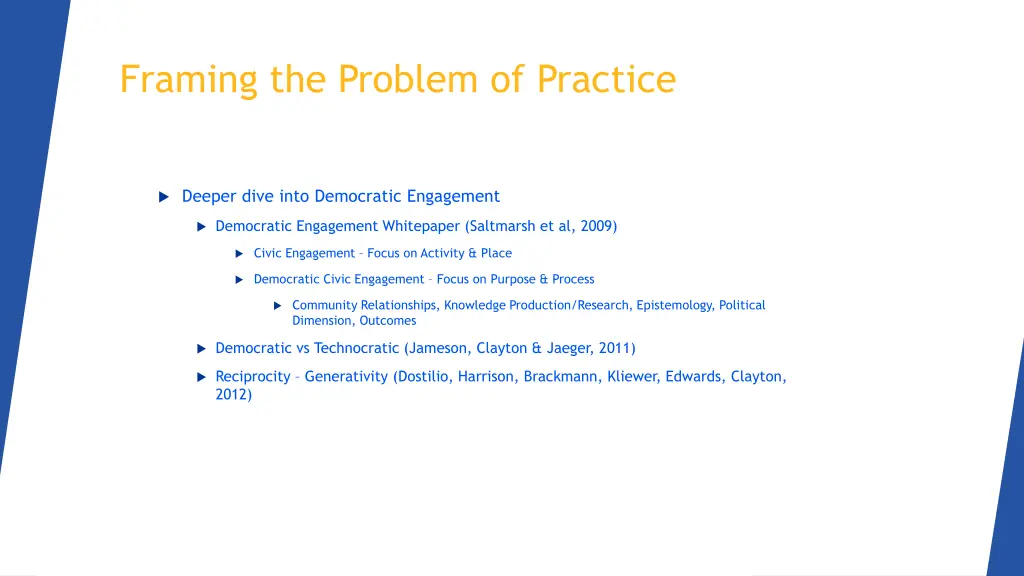
Framing the Problem of Practice Deeper dive into Democratic Engagement Democratic Engagement Whitepaper (Saltmarsh et al, 2009) Civic Engagement Focus on Activity & Place Democratic Civic Engagement Focus on Purpose & Process Community Relationships, Knowledge Production/Research, Epistemology, Political Dimension, Outcomes Democratic vs Technocratic (Jameson, Clayton & Jaeger, 2011) Reciprocity Generativity (Dostilio, Harrison, Brackmann, Kliewer, Edwards, Clayton, 2012)
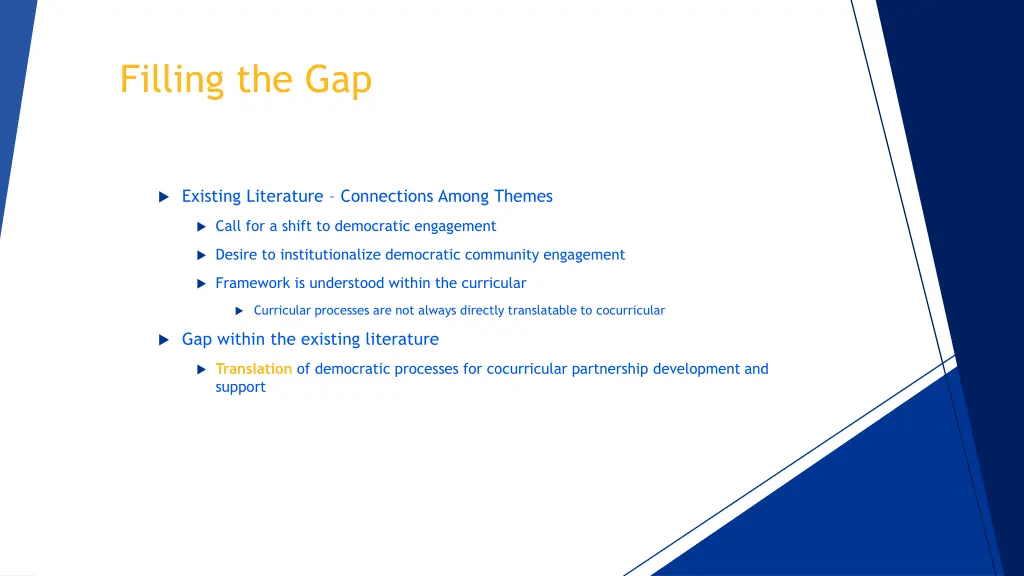
Filling the Gap Existing Literature Connections Among Themes Call for a shift to democratic engagement Desire to institutionalize democratic community engagement Framework is understood within the curricular Curricular processes are not always directly translatable to cocurricular Gap within the existing literature Translation of democratic processes for cocurricular partnership development and support
Appreciative Inquiry as a Process Process of facilitating partnership development and support Appreciative Inquiry (AI) as Participatory Action Research (PAR) Aligning AI and PAR wit Democratic Engagement
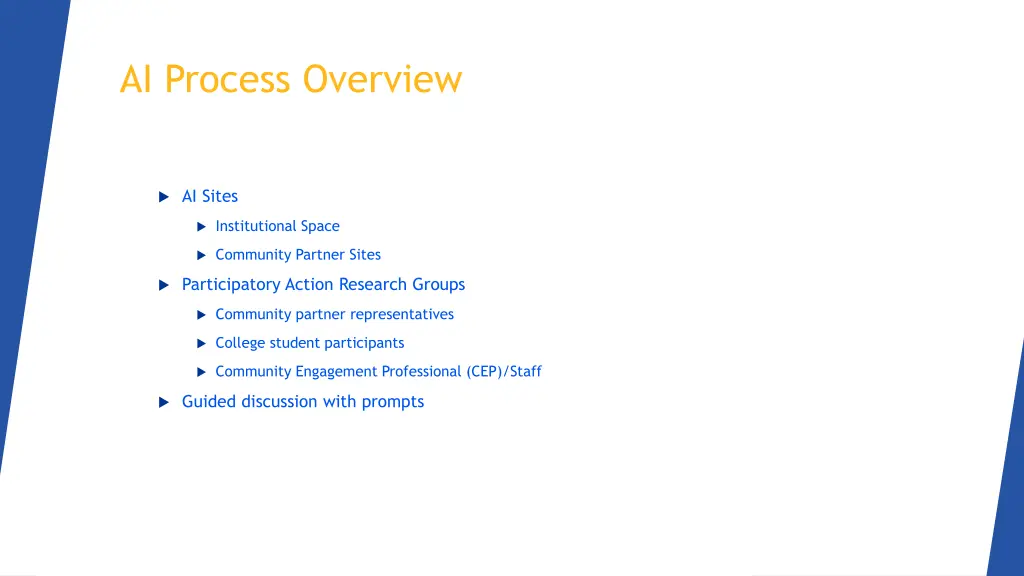
AI Process Overview AI Sites Institutional Space Community Partner Sites Participatory Action Research Groups Community partner representatives College student participants Community Engagement Professional (CEP)/Staff Guided discussion with prompts
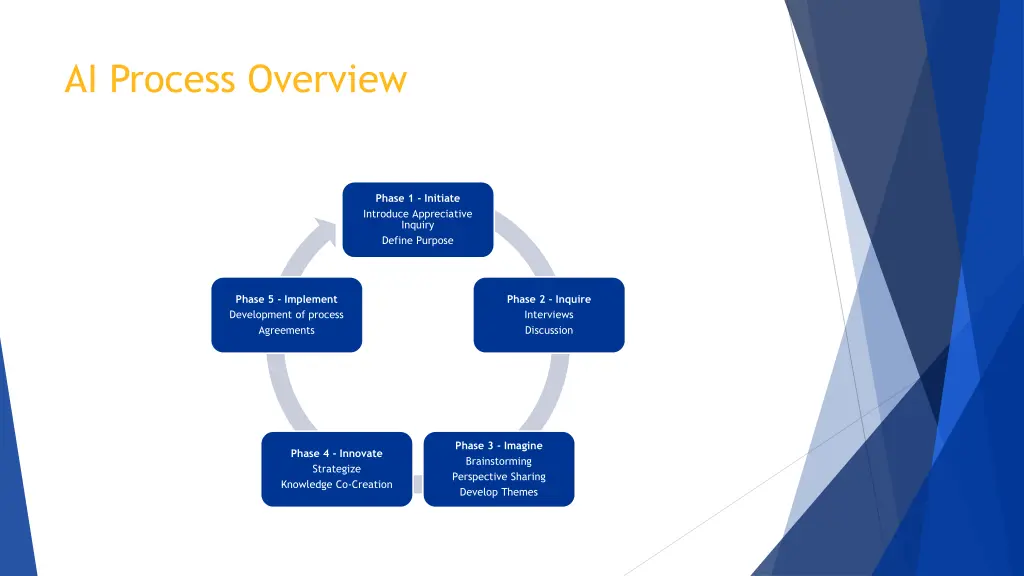
AI Process Overview Phase 1 - Initiate Introduce Appreciative Inquiry Define Purpose Phase 5 - Implement Development of process Agreements Phase 2 - Inquire Interviews Discussion Phase 3 - Imagine Brainstorming Perspective Sharing Develop Themes Phase 4 - Innovate Strategize Knowledge Co-Creation
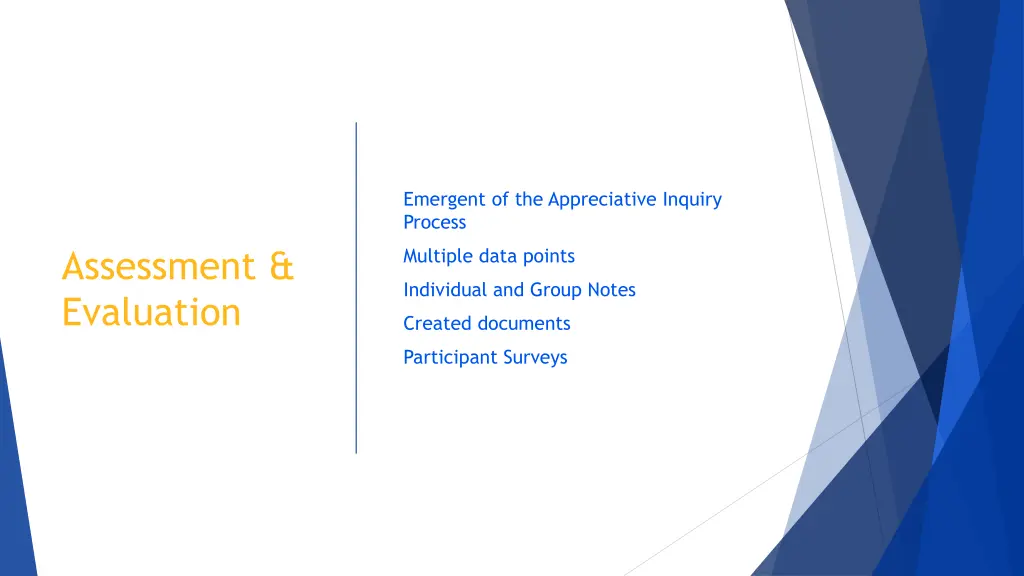
Emergent of the Appreciative Inquiry Process Assessment & Evaluation Multiple data points Individual and Group Notes Created documents Participant Surveys
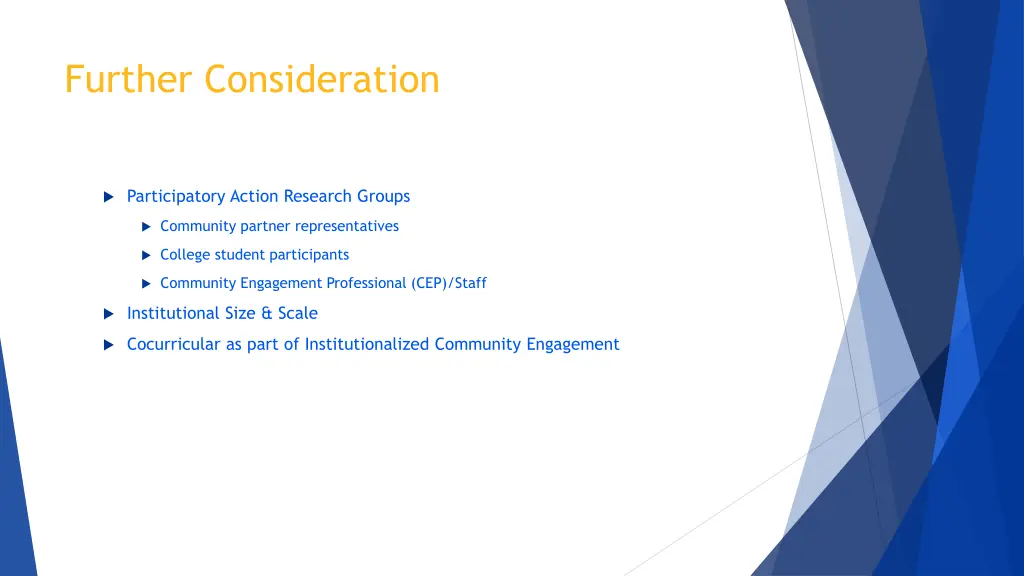
Further Consideration Participatory Action Research Groups Community partner representatives College student participants Community Engagement Professional (CEP)/Staff Institutional Size & Scale Cocurricular as part of Institutionalized Community Engagement
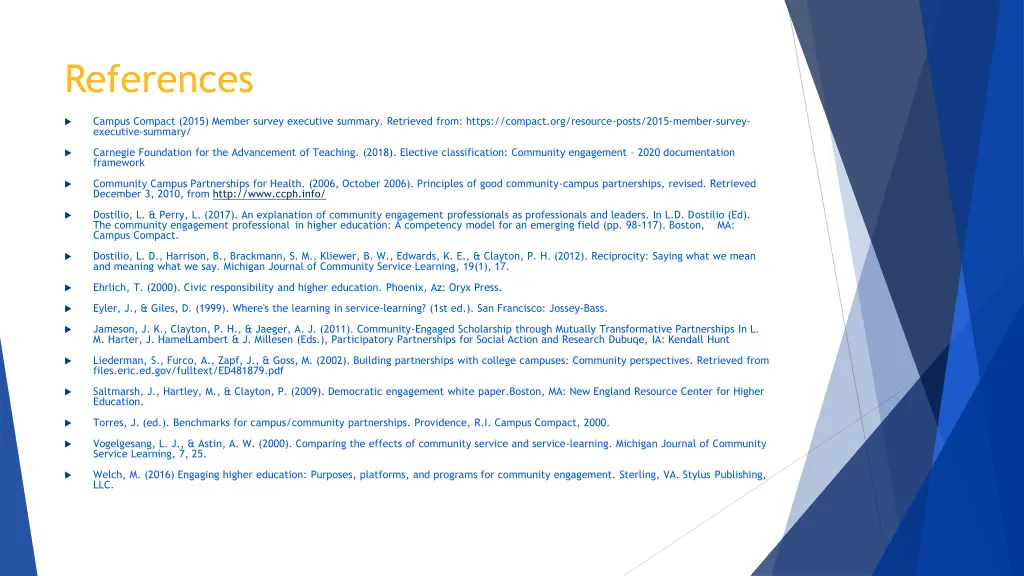
References Campus Compact (2015) Member survey executive summary. Retrieved from: https://compact.org/resource-posts/2015-member-survey- executive-summary/ Carnegie Foundation for the Advancement of Teaching. (2018). Elective classification: Community engagement 2020 documentation framework Community Campus Partnerships for Health. (2006, October 2006). Principles of good community-campus partnerships, revised. Retrieved December 3, 2010, from http://www.ccph.info/ Dostilio, L. & Perry, L. (2017). An explanation of community engagement professionals as professionals and leaders. In L.D. Dostilio (Ed). The community engagement professional in higher education: A competency model for an emerging field (pp. 98-117). Boston, MA: Campus Compact. Dostilio, L. D., Harrison, B., Brackmann, S. M., Kliewer, B. W., Edwards, K. E., & Clayton, P. H. (2012). Reciprocity: Saying what we mean and meaning what we say. Michigan Journal of Community Service Learning, 19(1), 17. Ehrlich, T. (2000). Civic responsibility and higher education. Phoenix, Az: Oryx Press. Eyler, J., & Giles, D. (1999). Where's the learning in service-learning? (1st ed.). San Francisco: Jossey-Bass. Jameson, J. K., Clayton, P. H., & Jaeger, A. J. (2011). Community-Engaged Scholarship through Mutually Transformative Partnerships In L. M. Harter, J. HamelLambert & J. Millesen (Eds.), Participatory Partnerships for Social Action and Research Dubuqe, IA: Kendall Hunt Liederman, S., Furco, A., Zapf, J., & Goss, M. (2002). Building partnerships with college campuses: Community perspectives. Retrieved from files.eric.ed.gov/fulltext/ED481879.pdf Saltmarsh, J., Hartley, M., & Clayton, P. (2009). Democratic engagement white paper.Boston, MA: New England Resource Center for Higher Education. Torres, J. (ed.). Benchmarks for campus/community partnerships. Providence, R.I. Campus Compact, 2000. Vogelgesang, L. J., & Astin, A. W. (2000). Comparing the effects of community service and service-learning. Michigan Journal of Community Service Learning, 7, 25. Welch, M. (2016) Engaging higher education: Purposes, platforms, and programs for community engagement. Sterling, VA. Stylus Publishing, LLC.