Descriptive Statistics: Measures of Association II Seminar

Explore research on the Liberal Democracy Index using STATA, focusing on measures of academic and cultural expression. Investigate the movement of Egalitarian Democracy Index concerning power distribution by gender and female Heads of State. Understand means and controlled comparisons in statistical analysis.

Uploaded on Feb 24, 2025 | 0 Views
Download Presentation

Please find below an Image/Link to download the presentation.
The content on the website is provided AS IS for your information and personal use only. It may not be sold, licensed, or shared on other websites without obtaining consent from the author.If you encounter any issues during the download, it is possible that the publisher has removed the file from their server.
You are allowed to download the files provided on this website for personal or commercial use, subject to the condition that they are used lawfully. All files are the property of their respective owners.
The content on the website is provided AS IS for your information and personal use only. It may not be sold, licensed, or shared on other websites without obtaining consent from the author.
E N D
Presentation Transcript
Research Methods Research Methods Prof. Matthew Loveless Prof. Matthew Loveless Descriptive Statistics: Descriptive Statistics: Measures of Association II Seminar University of Bologna University of Bologna Autumn Autumn 2023 2023
Outline Using datasets and codebooks in STATA Means Comparisons Controlled Comparisons Correlation (Bivariate) Regression
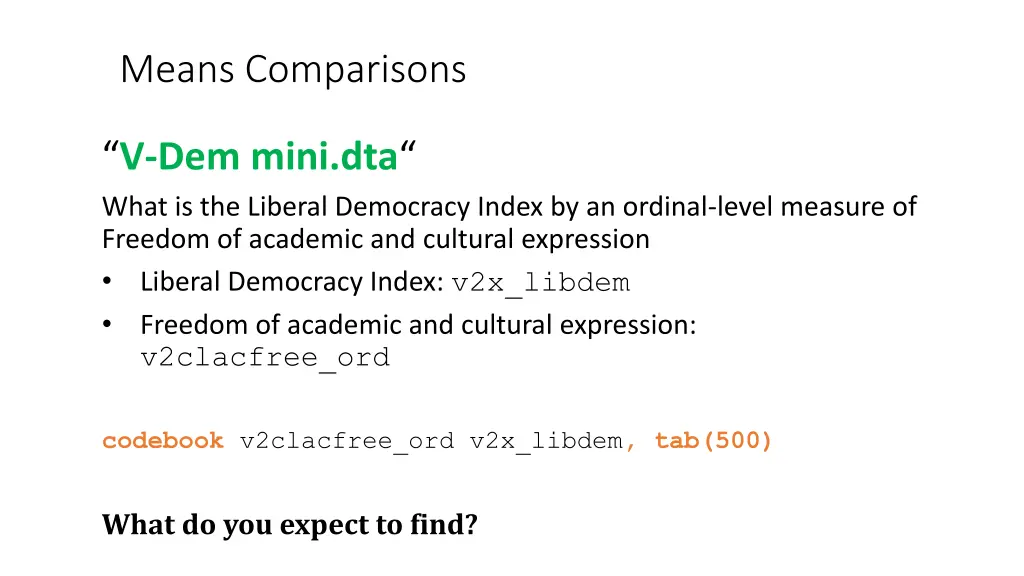
Means Comparisons V-Dem mini.dta What is the Liberal Democracy Index by an ordinal-level measure of Freedom of academic and cultural expression Liberal Democracy Index: v2x_libdem Freedom of academic and cultural expression: v2clacfree_ord codebook v2clacfree_ord v2x_libdem, tab(500) What do you expect to find?
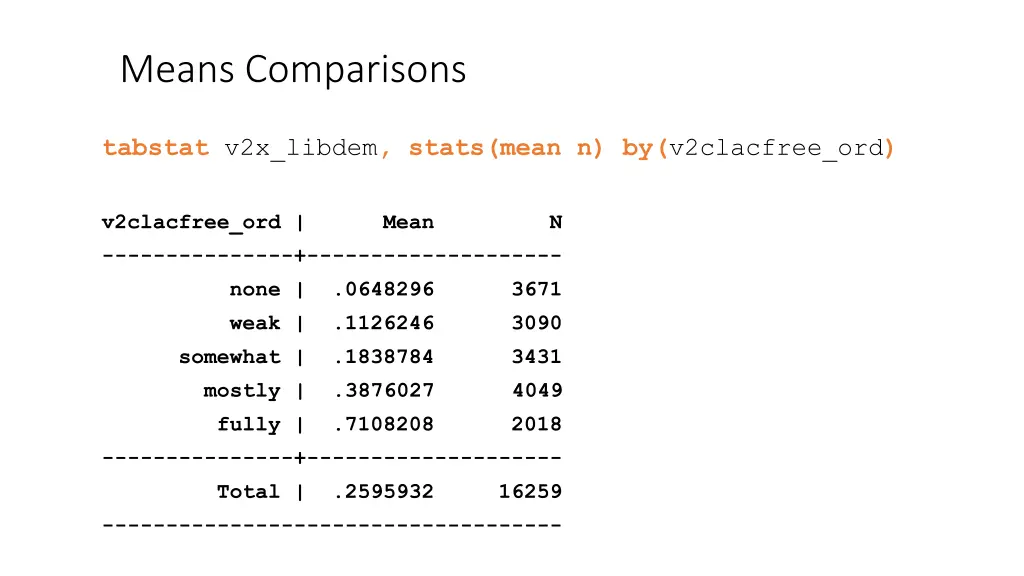
Means Comparisons tabstat v2x_libdem, stats(mean n) by(v2clacfree_ord) v2clacfree_ord | Mean N ---------------+-------------------- none | .0648296 3671 weak | .1126246 3090 somewhat | .1838784 3431 mostly | .3876027 4049 fully | .7108208 2018 ---------------+-------------------- Total | .2595932 16259 ------------------------------------
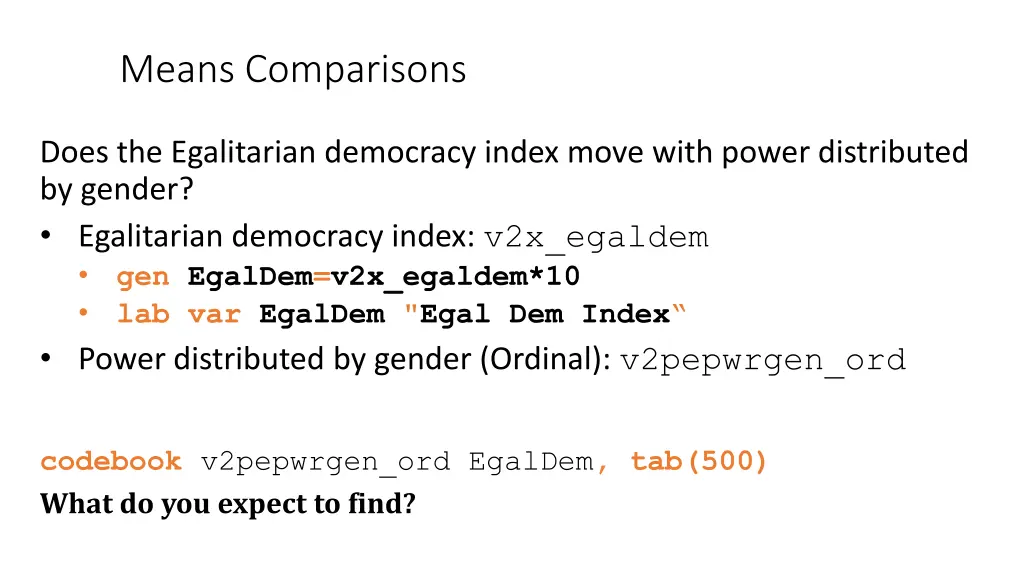
Means Comparisons Does the Egalitarian democracy index move with power distributed by gender? Egalitarian democracy index: v2x_egaldem gen EgalDem=v2x_egaldem*10 lab var EgalDem "Egal Dem Index Power distributed by gender (Ordinal): v2pepwrgen_ord codebook v2pepwrgen_ord EgalDem, tab(500) What do you expect to find?
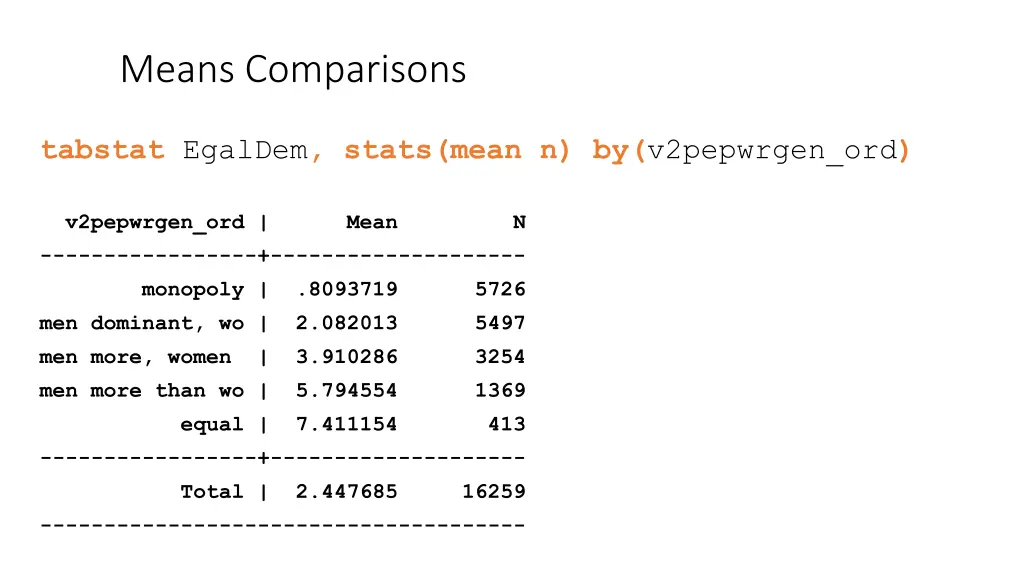
Means Comparisons tabstat EgalDem, stats(mean n) by(v2pepwrgen_ord) v2pepwrgen_ord | Mean N -----------------+-------------------- monopoly | .8093719 5726 men dominant, wo | 2.082013 5497 men more, women | 3.910286 3254 men more than wo | 5.794554 1369 equal | 7.411154 413 -----------------+-------------------- Total | 2.447685 16259 --------------------------------------
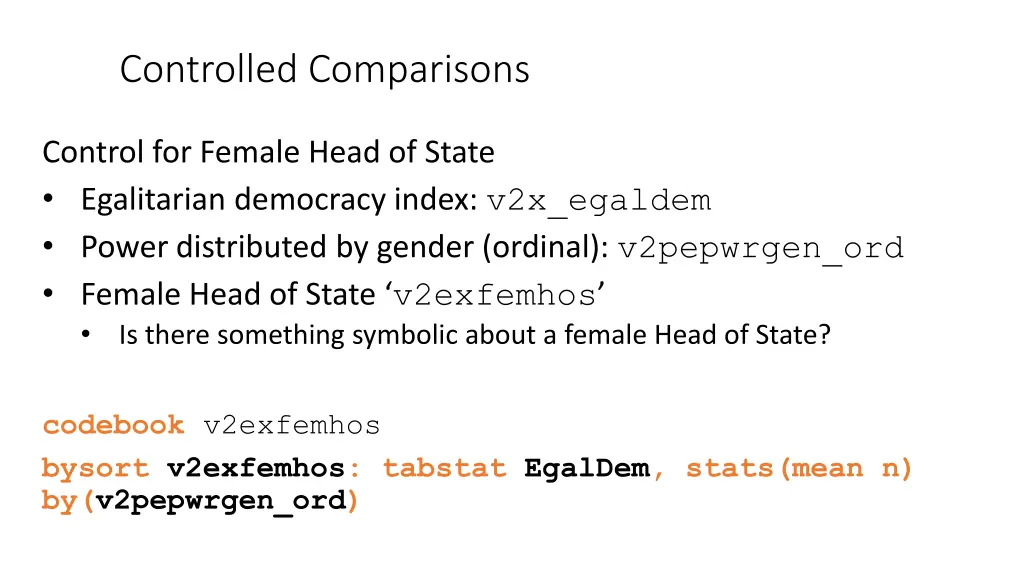
Controlled Comparisons Control for Female Head of State Egalitarian democracy index: v2x_egaldem Power distributed by gender (ordinal): v2pepwrgen_ord Female Head of State v2exfemhos Is there something symbolic about a female Head of State? codebook v2exfemhos bysort v2exfemhos: tabstat EgalDem, stats(mean n) by(v2pepwrgen_ord)
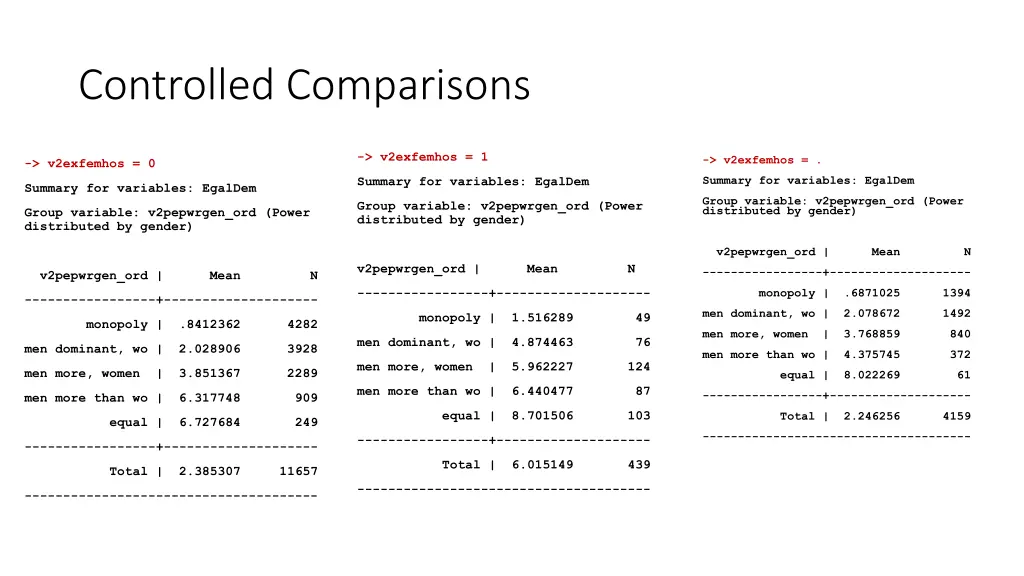
Controlled Comparisons -> v2exfemhos = 1 -> v2exfemhos = . -> v2exfemhos = 0 Summary for variables: EgalDem Summary for variables: EgalDem Summary for variables: EgalDem Group variable: v2pepwrgen_ord (Power distributed by gender) Group variable: v2pepwrgen_ord (Power distributed by gender) Group variable: v2pepwrgen_ord (Power distributed by gender) v2pepwrgen_ord | Mean N v2pepwrgen_ord | Mean N -----------------+-------------------- v2pepwrgen_ord | Mean N -----------------+-------------------- monopoly | .6871025 1394 -----------------+-------------------- men dominant, wo | 2.078672 1492 monopoly | 1.516289 49 monopoly | .8412362 4282 men more, women | 3.768859 840 men dominant, wo | 4.874463 76 men dominant, wo | 2.028906 3928 men more than wo | 4.375745 372 men more, women | 5.962227 124 men more, women | 3.851367 2289 equal | 8.022269 61 men more than wo | 6.440477 87 -----------------+-------------------- men more than wo | 6.317748 909 equal | 8.701506 103 Total | 2.246256 4159 equal | 6.727684 249 -------------------------------------- -----------------+-------------------- -----------------+-------------------- Total | 6.015149 439 Total | 2.385307 11657 -------------------------------------- --------------------------------------
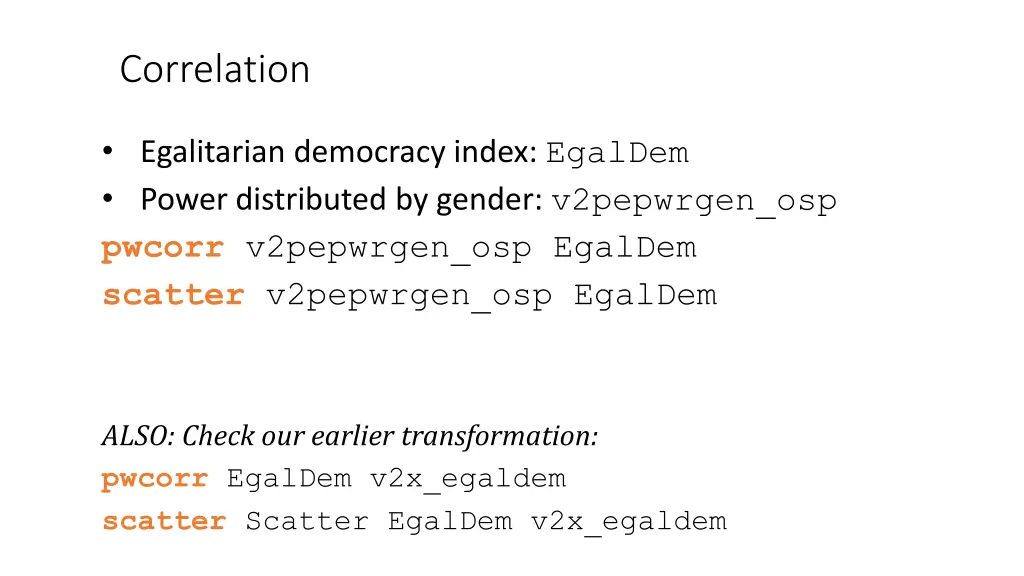
Correlation Egalitarian democracy index: EgalDem Power distributed by gender: v2pepwrgen_osp pwcorr v2pepwrgen_osp EgalDem scatter v2pepwrgen_osp EgalDem ALSO: Check our earlier transformation: pwcorr EgalDem v2x_egaldem scatter Scatter EgalDem v2x_egaldem
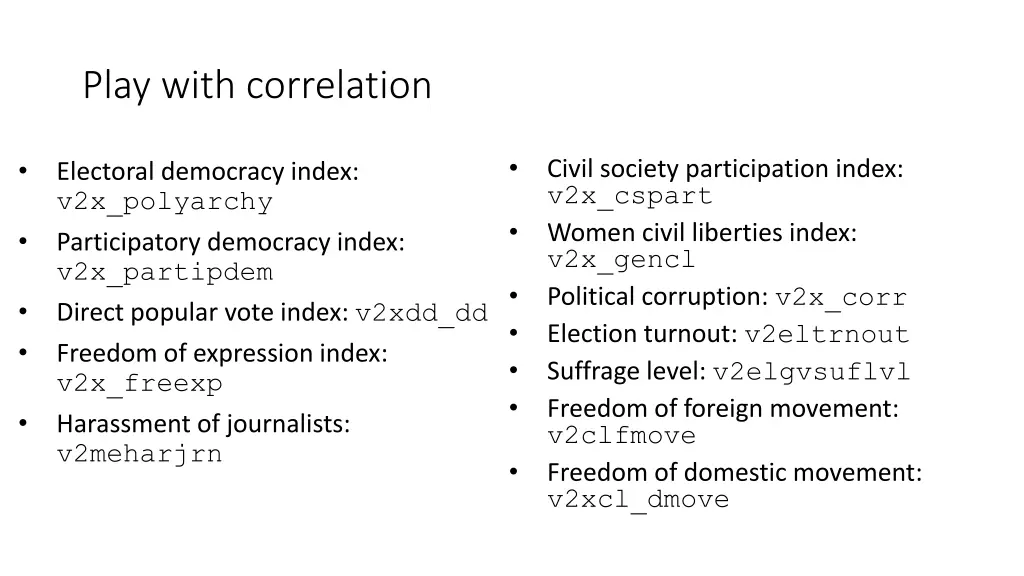
Play with correlation Civil society participation index: v2x_cspart Women civil liberties index: v2x_gencl Political corruption: v2x_corr Election turnout: v2eltrnout Suffrage level: v2elgvsuflvl Freedom of foreign movement: v2clfmove Freedom of domestic movement: v2xcl_dmove Electoral democracy index: v2x_polyarchy Participatory democracy index: v2x_partipdem Direct popular vote index: v2xdd_dd Freedom of expression index: v2x_freexp Harassment of journalists: v2meharjrn
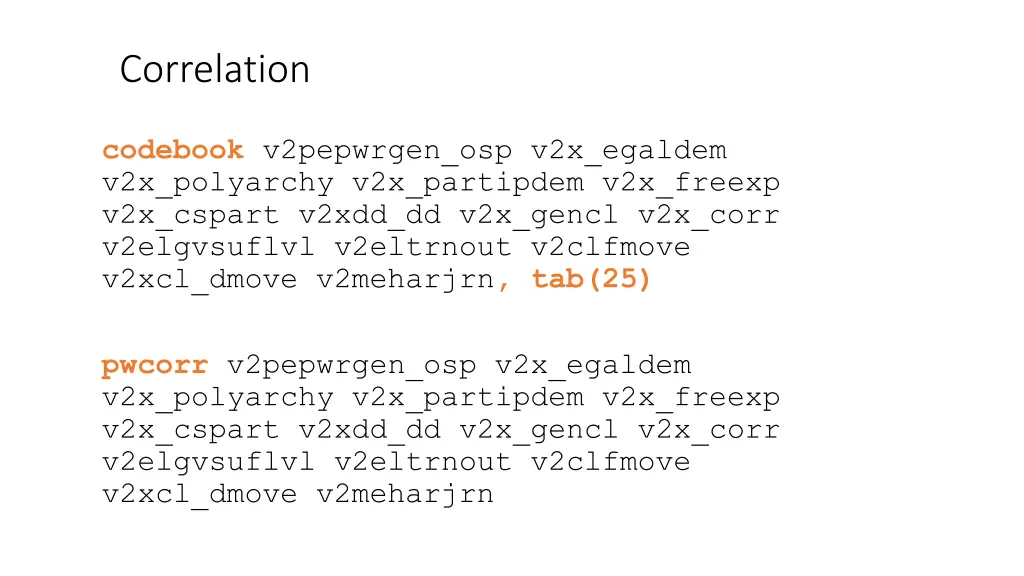
Correlation codebook v2pepwrgen_osp v2x_egaldem v2x_polyarchy v2x_partipdem v2x_freexp v2x_cspart v2xdd_dd v2x_gencl v2x_corr v2elgvsuflvl v2eltrnout v2clfmove v2xcl_dmove v2meharjrn, tab(25) pwcorr v2pepwrgen_osp v2x_egaldem v2x_polyarchy v2x_partipdem v2x_freexp v2x_cspart v2xdd_dd v2x_gencl v2x_corr v2elgvsuflvl v2eltrnout v2clfmove v2xcl_dmove v2meharjrn
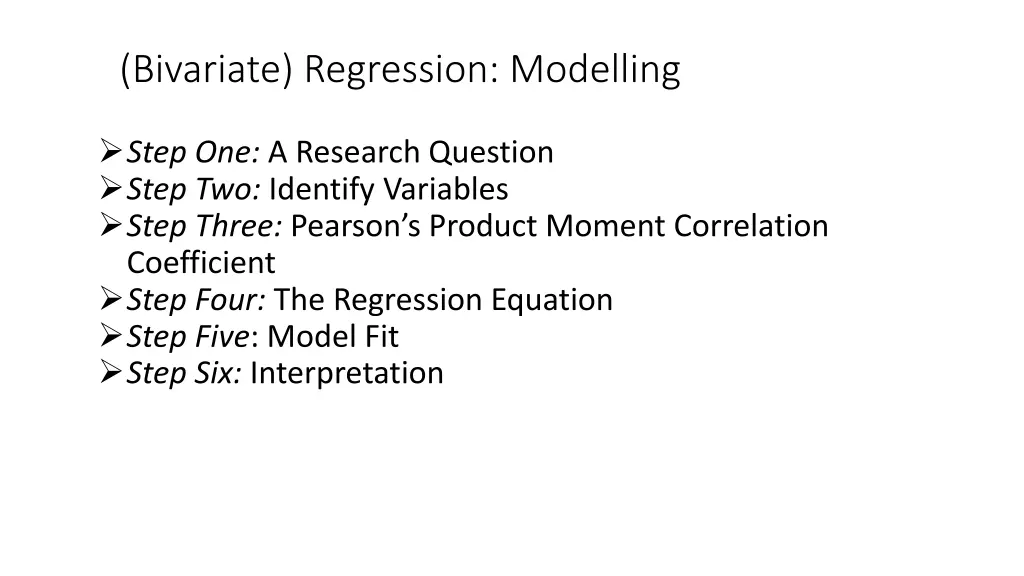
(Bivariate) Regression: Modelling Step One: A Research Question Step Two: Identify Variables Step Three:Pearson s Product Moment Correlation Coefficient Step Four: The Regression Equation Step Five: Model Fit Step Six: Interpretation
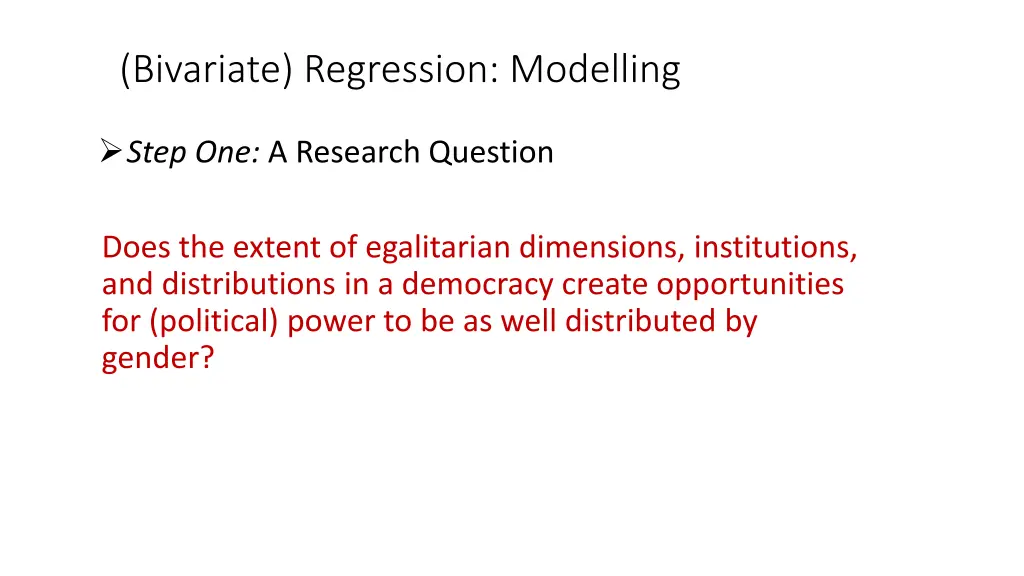
(Bivariate) Regression: Modelling Step One: A Research Question Does the extent of egalitarian dimensions, institutions, and distributions in a democracy create opportunities for (political) power to be as well distributed by gender?
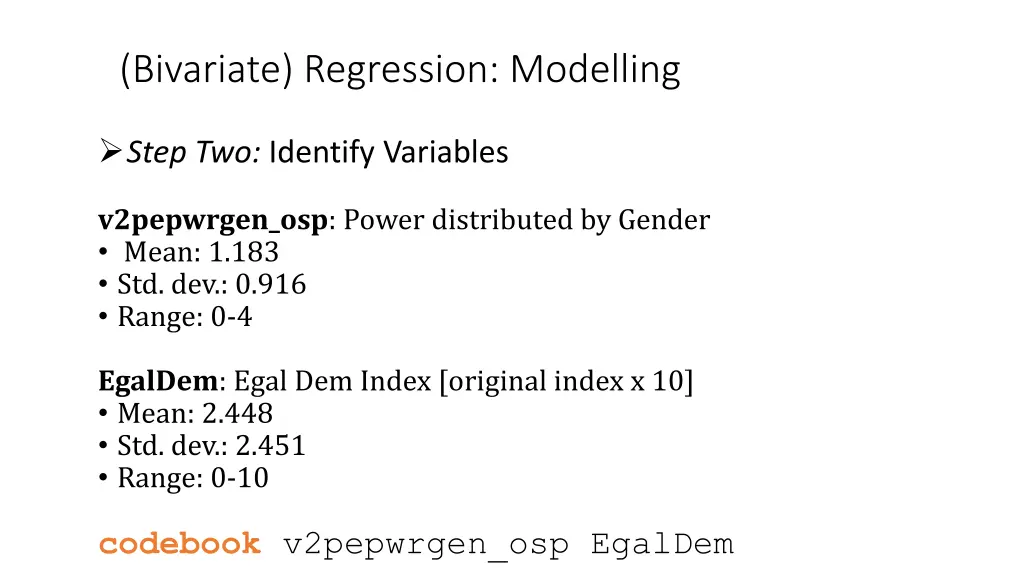
(Bivariate) Regression: Modelling Step Two: Identify Variables v2pepwrgen_osp: Power distributed by Gender Mean: 1.183 Std. dev.: 0.916 Range: 0-4 EgalDem: Egal Dem Index [original index x 10] Mean: 2.448 Std. dev.: 2.451 Range: 0-10 codebook v2pepwrgen_osp EgalDem
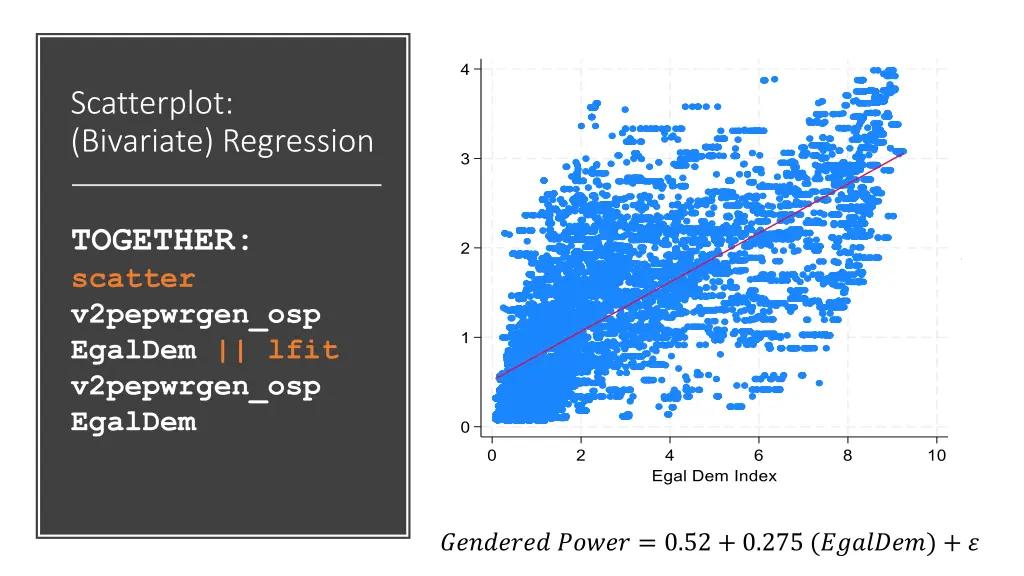
(Bivariate) Regression: Modelling Step Three:Pearson s Product Moment Correlation Coefficient pwcorr v2pepwrgen_osp EgalDem scatter v2pepwrgen_osp EgalDem | v2pepw~p EgalDem -------------+------------------ v2pepwrgen~p | 1.0000 EgalDem | 0.7326 1.0000
Scatterplot: (Bivariate) Regression (Bivariate) Regression Scatterplot: scatter v2pepwrgen_osp v2x_egaldem || lfit TOGETHER: scatter v2pepwrgen_osp EgalDem || lfit v2pepwrgen_osp EgalDem graph export ???????? ????? = 0.52 + 0.275 (???????) + ?
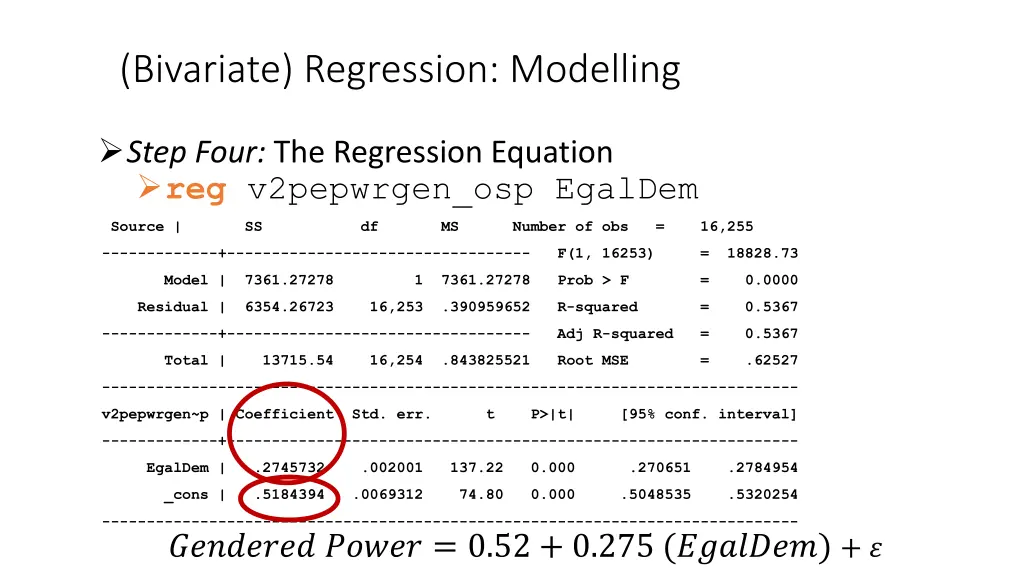
(Bivariate) Regression: Modelling Step Four: The Regression Equation reg v2pepwrgen_osp EgalDem Source | SS df MS Number of obs = 16,255 -------------+---------------------------------- F(1, 16253) = 18828.73 Model | 7361.27278 1 7361.27278 Prob > F = 0.0000 Residual | 6354.26723 16,253 .390959652 R-squared = 0.5367 -------------+---------------------------------- Adj R-squared = 0.5367 Total | 13715.54 16,254 .843825521 Root MSE = .62527 ------------------------------------------------------------------------------ v2pepwrgen~p | Coefficient Std. err. t P>|t| [95% conf. interval] -------------+---------------------------------------------------------------- EgalDem | .2745732 .002001 137.22 0.000 .270651 .2784954 _cons | .5184394 .0069312 74.80 0.000 .5048535 .5320254 ------------------------------------------------------------------------------ ???????? ????? = 0.52 + 0.275 (???????) + ?
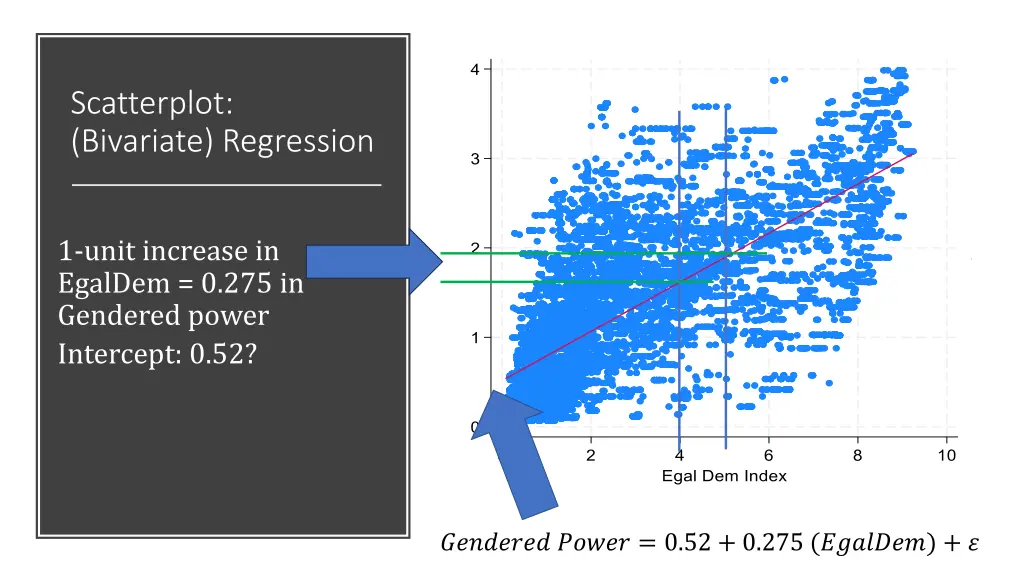
Scatterplot: (Bivariate) Regression (Bivariate) Regression Scatterplot: scatter v2pepwrgen_osp v2x_egaldem || lfit 1-unit increase in EgalDem = 0.275 in Gendered power Intercept: 0.52? graph export ???????? ????? = 0.52 + 0.275 (???????) + ?
(Bivariate) Regression: Modelling Step Five: Model Fit reg v2pepwrgen_osp EgalDem Source | SS df MS Number of obs = 16,255 -------------+---------------------------------- F(1, 16253) = 18828.73 Model | 7361.27278 1 7361.27278 Prob > F = 0.0000 Residual | 6354.26723 16,253 .390959652 R-squared = 0.5367 -------------+---------------------------------- Adj R-squared = 0.5367 Total | 13715.54 16,254 .843825521 Root MSE = .62527 ------------------------------------------------------------------------------ v2pepwrgen~p | Coefficient Std. err. t P>|t| [95% conf. interval] -------------+---------------------------------------------------------------- EgalDem | .2745732 .002001 137.22 0.000 .270651 .2784954 _cons | .5184394 .0069312 74.80 0.000 .5048535 .5320254 ------------------------------------------------------------------------------
(Bivariate) Regression: Modelling Step Six: Interpretation:Does the extent of egalitarian dimensions, institutions, and distributions in a democracy create opportunities for (political) power to be as well distributed by gender? The dependent variable is gendered power The independent variable is egalitarian demcoracy These interval-level variables have a substantial, positive correlation of r=0.73. The regression equation ???????? ????? = 0.52 + 0.275 (???????) + ? tells us that, on average, for every 1-unit change in EgalDem, there will be a 0.275-unit increase in the Gendered Power. The adj-R2 = 0.537 tells us that 53.7% of the variation in the Gendered Power can be explained by variation in Egalitarian Democracy.