Learn about Line Segment Detection (LSD) in computer vision, how it differs from edge detection and Hough transform, and the process of identifying potential line segments using line support regions and rectangles. Understand the validation criteria and principles such as the Helmholtz principle and the a contrario approach for accurate line segment detection.
Please find below an Image/Link to download the presentation.
The content on the website is provided AS IS for your information and personal use only. It may not be sold, licensed, or shared on other websites without obtaining consent from the author. If you encounter any issues during the download, it is possible that the publisher has removed the file from their server.
You are allowed to download the files provided on this website for personal or commercial use, subject to the condition that they are used lawfully. All files are the property of their respective owners.
The content on the website is provided AS IS for your information and personal use only. It may not be sold, licensed, or shared on other websites without obtaining consent from the author.
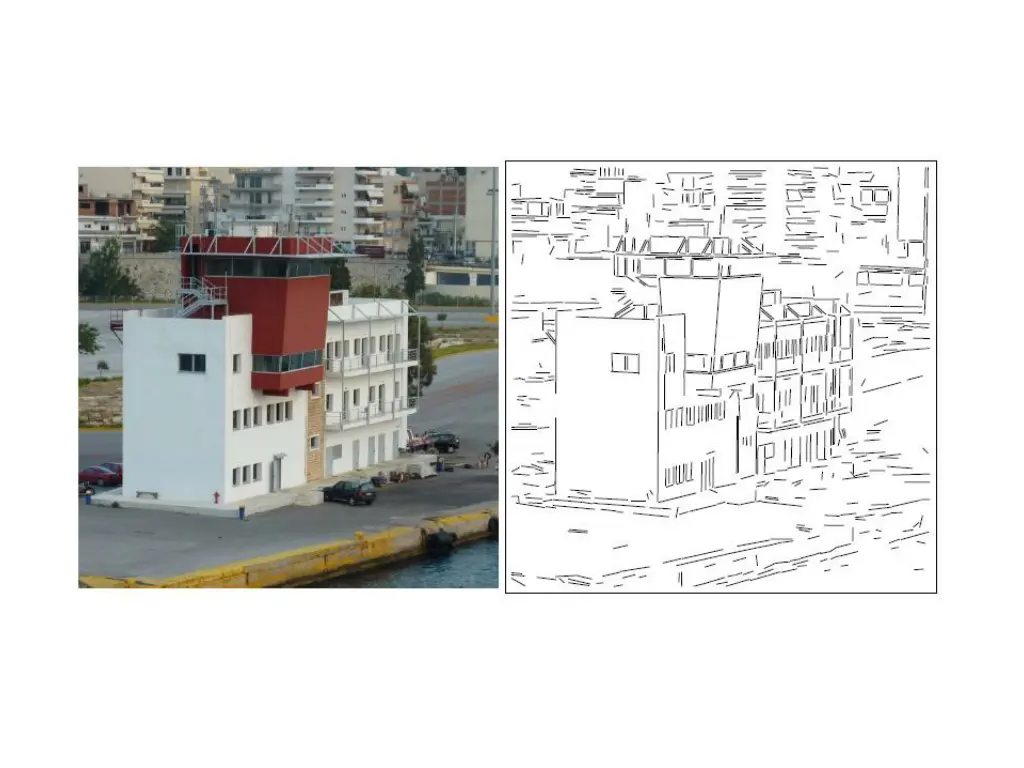
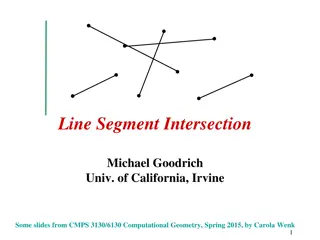
Line Segment Detection Edge detector gives potential edge pixels. Hough transform gives potential infinite lines. But we see line segments. In this lecture, we study a Line Segment Detector. Rafael Grompone von Gioi, Jeremie Jakubowicz, Jean-Michel Morel, Gregory Randall , LSD: a Line Segment Detector, Image Processing On Line, 2 (2012), pp. 35{55. http://dx.doi.org/10.5201/ipol.2012.gjmr-lsd
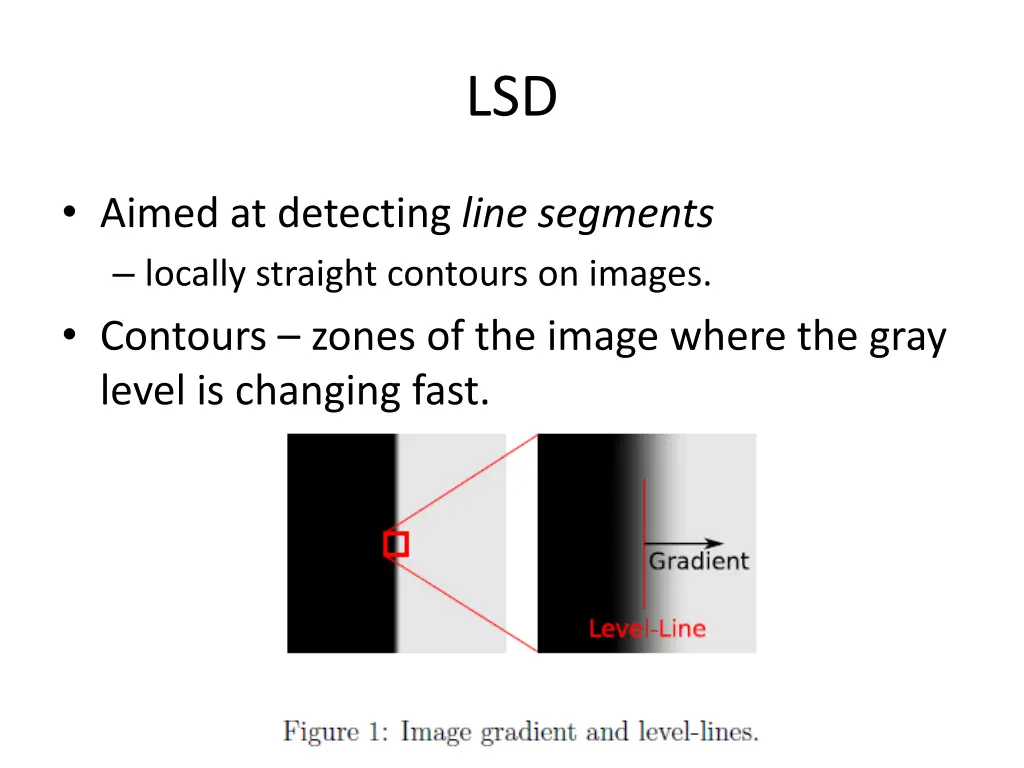
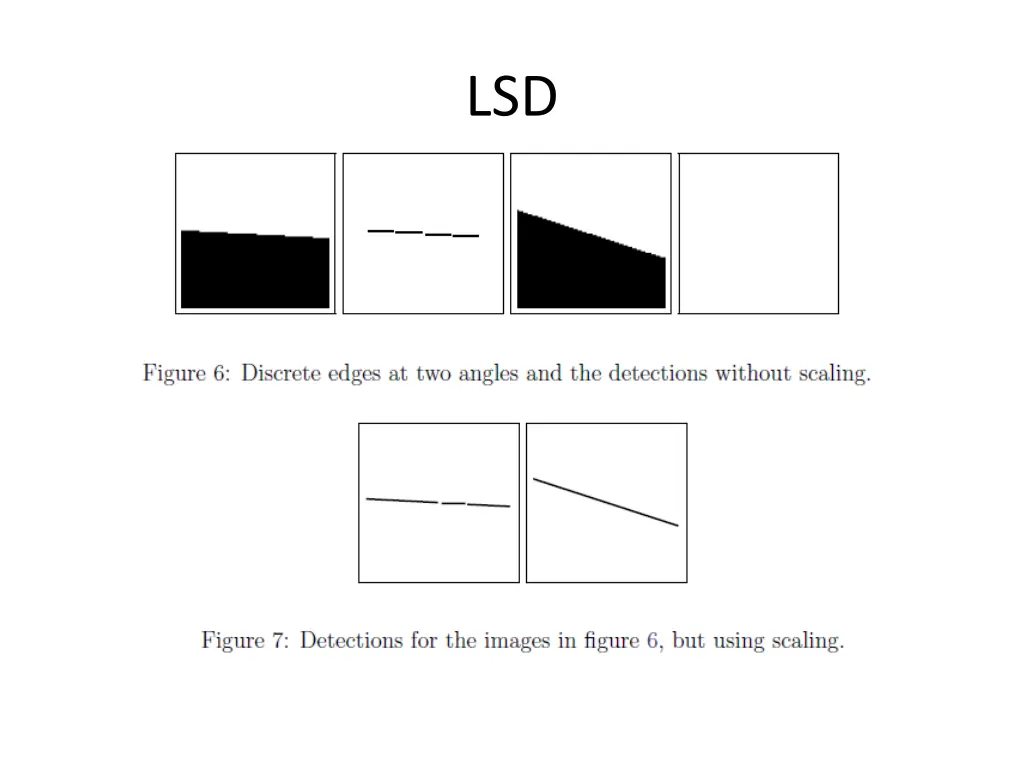
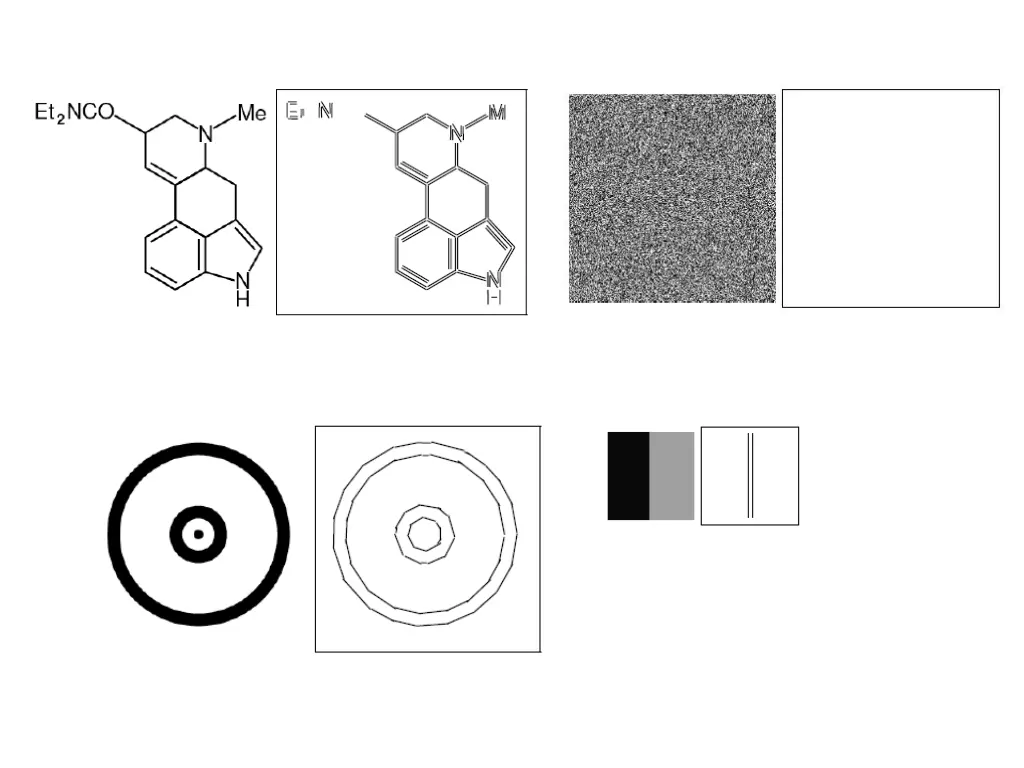
LSD Aimed at detecting line segments locally straight contours on images. Contours zones of the image where the gray level is changing fast.
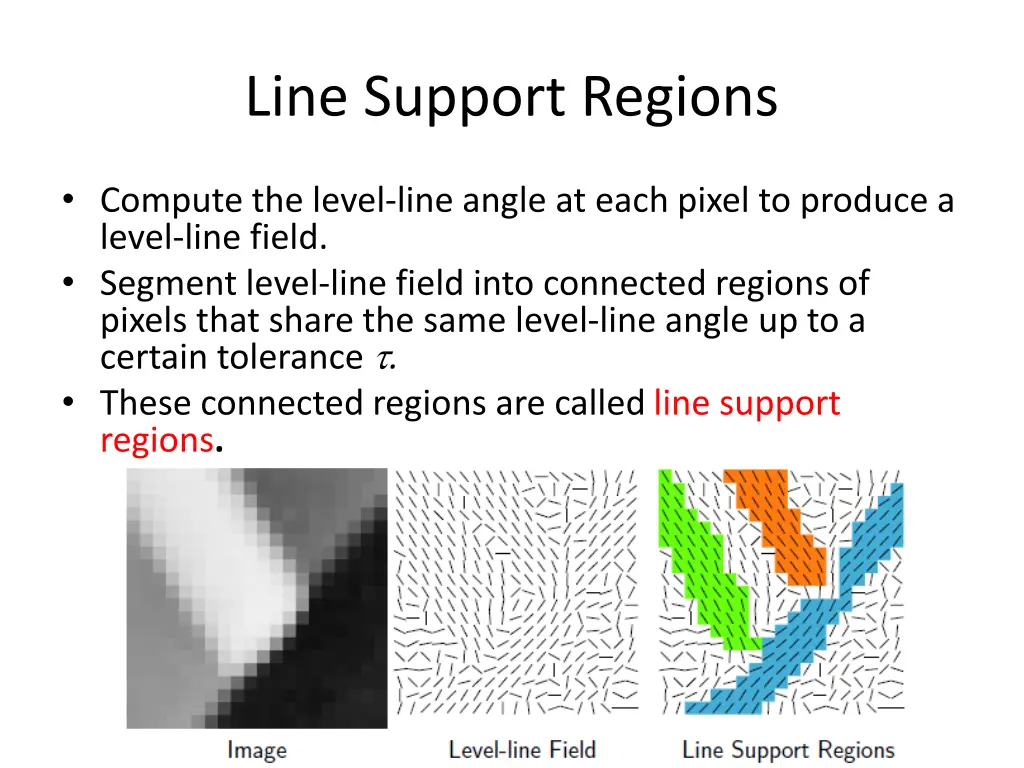
Line Support Regions Compute the level-line angle at each pixel to produce a level-line field. Segment level-line field into connected regions of pixels that share the same level-line angle up to a certain tolerance . These connected regions are called line support regions.
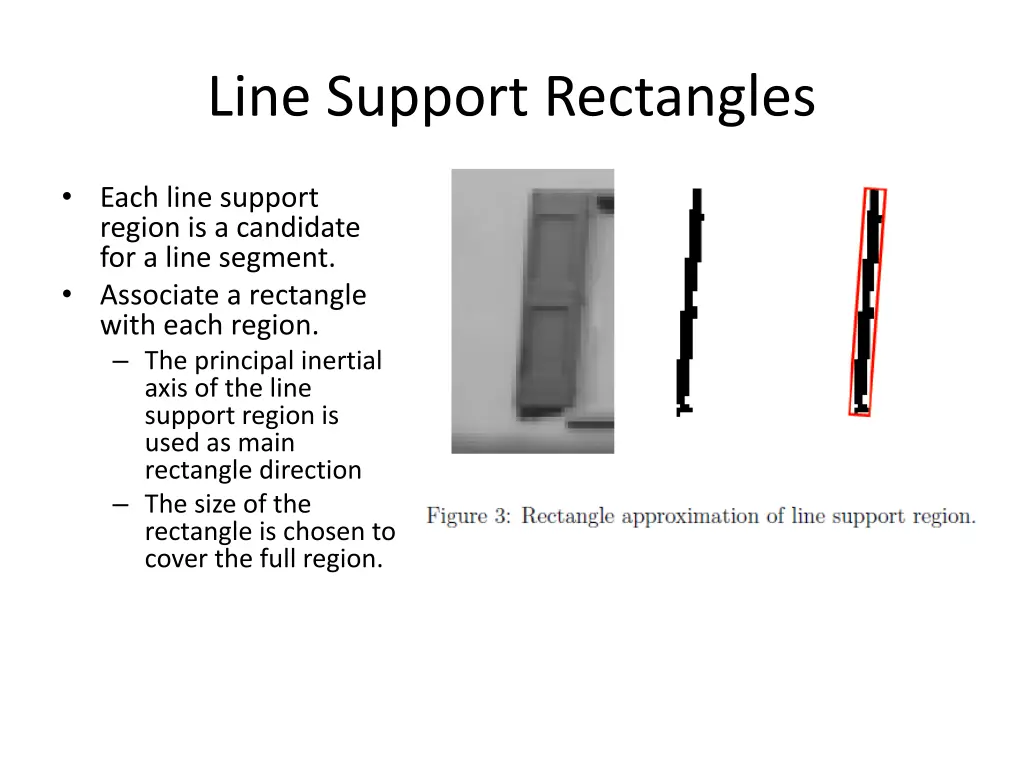
Line Support Rectangles Each line support region is a candidate for a line segment. Associate a rectangle with each region. The principal inertial axis of the line support region is used as main rectangle direction The size of the rectangle is chosen to cover the full region.
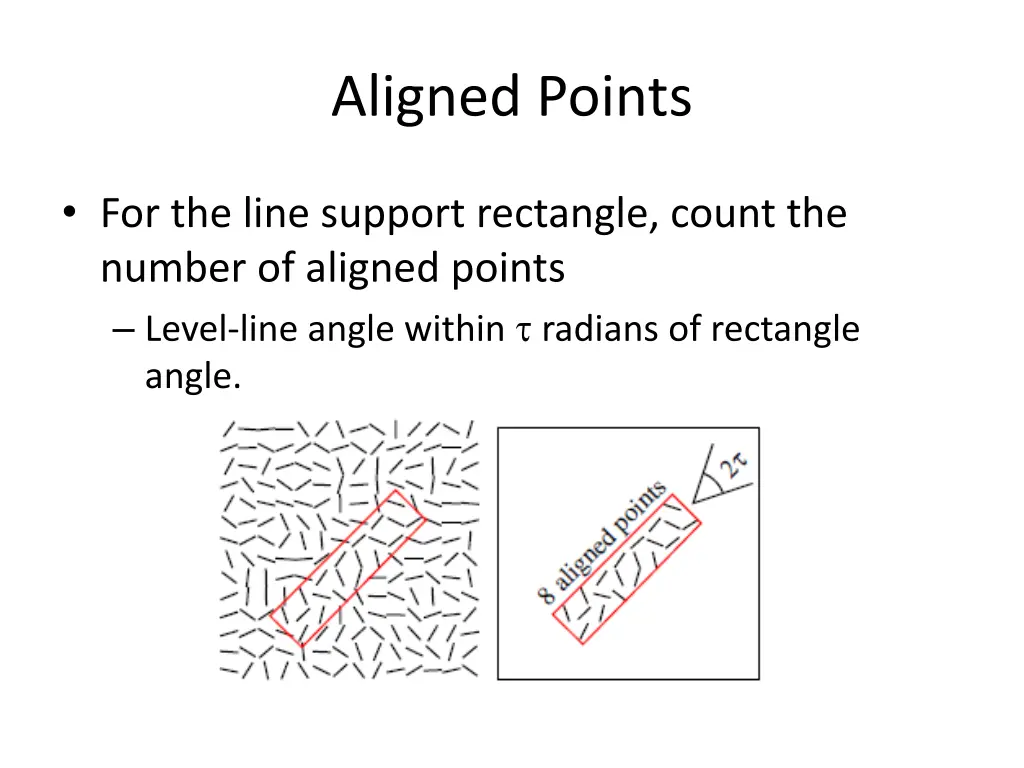
Aligned Points For the line support rectangle, count the number of aligned points Level-line angle within radians of rectangle angle.
Validation The total number of pixels in the rectangle, n, and its number of aligned points, k, are counted and used to validate the rectangle as a detected line segment.
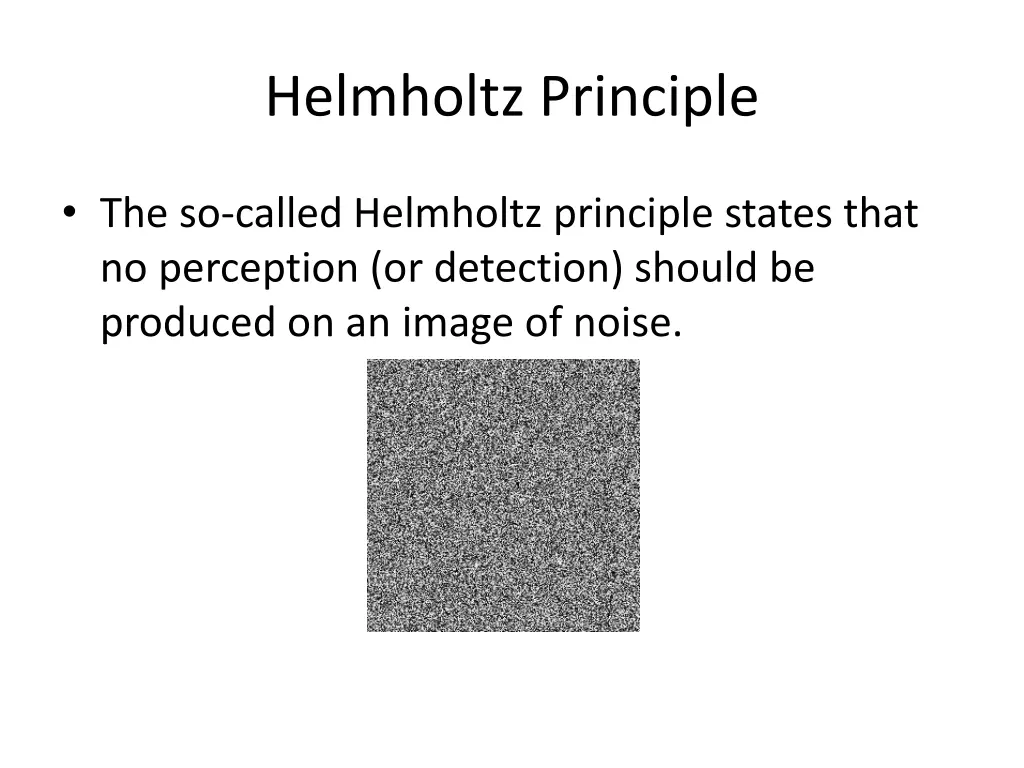
Helmholtz Principle The so-called Helmholtz principle states that no perception (or detection) should be produced on an image of noise.
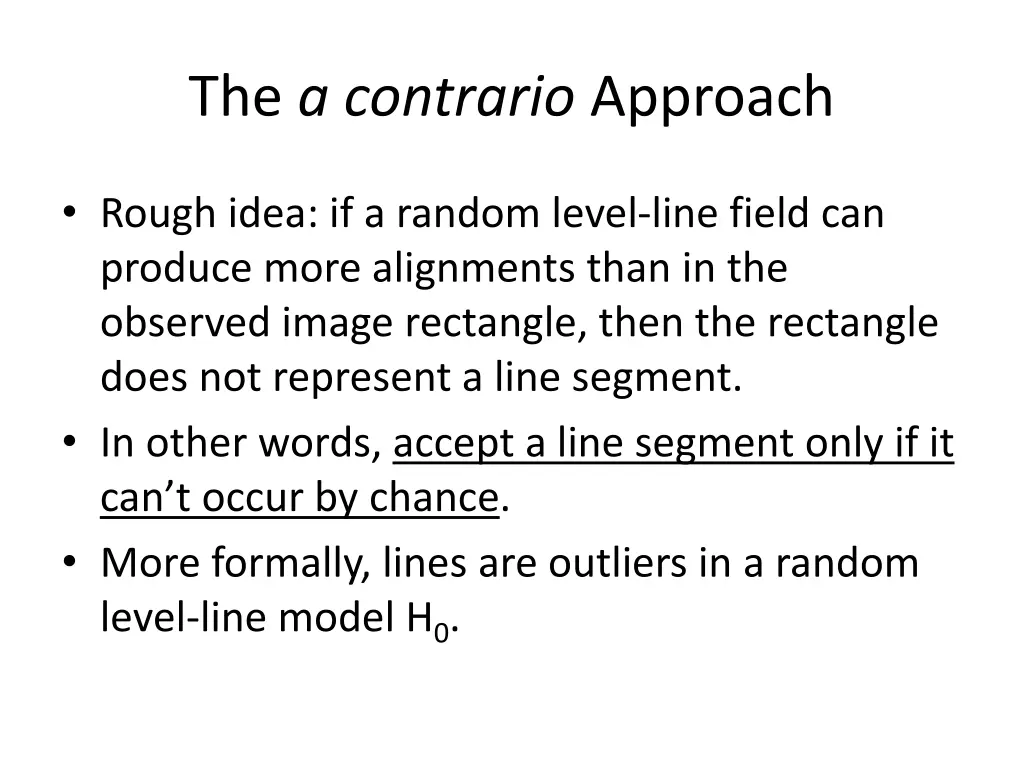
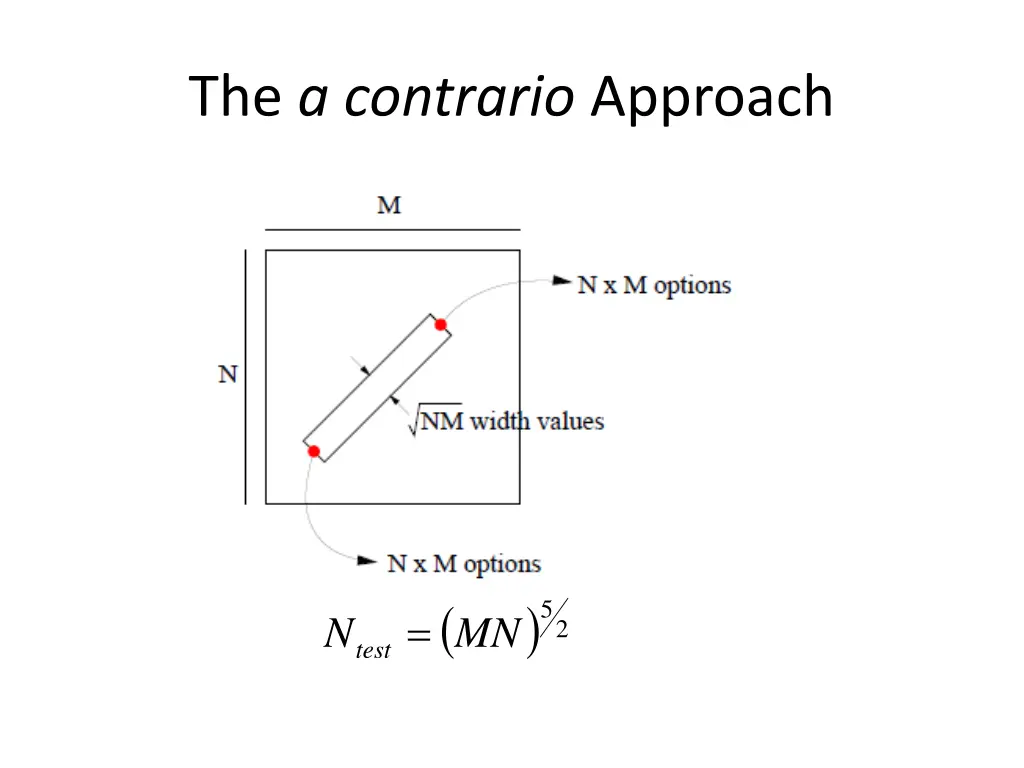
The a contrario Approach Rough idea: if a random level-line field can produce more alignments than in the observed image rectangle, then the rectangle does not represent a line segment. In other words, accept a line segment only if it can t occur by chance. More formally, lines are outliers in a random level-line model H0.
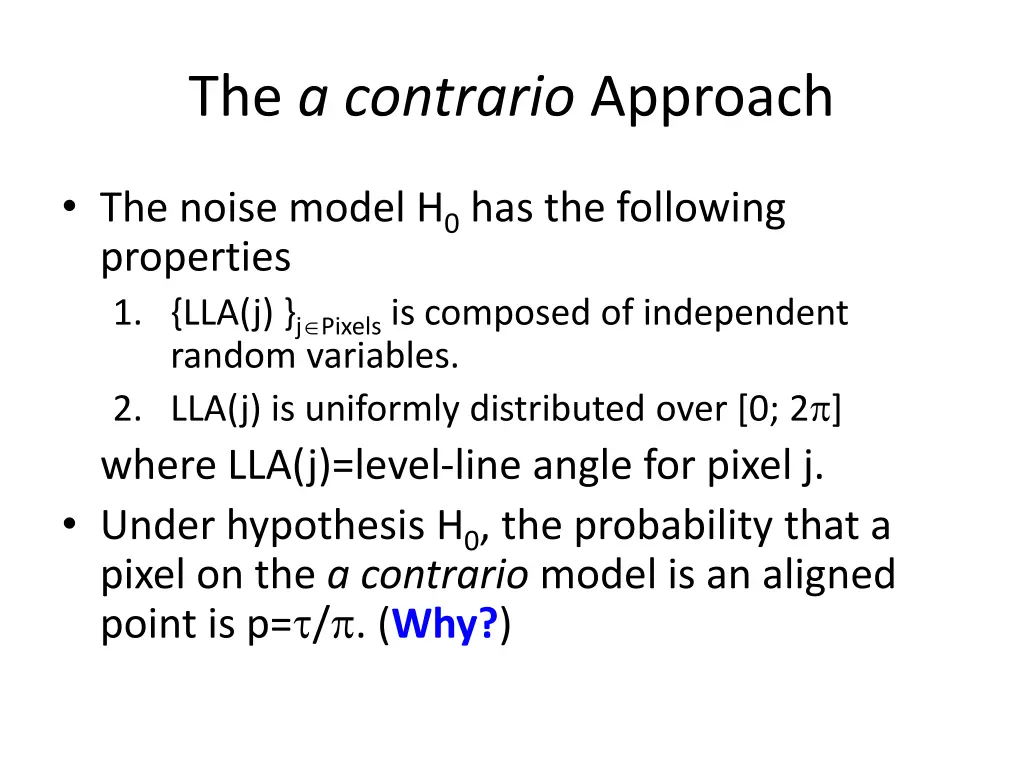
The a contrario Approach The noise model H0 has the following properties 1. {LLA(j) }j Pixels is composed of independent random variables. 2. LLA(j) is uniformly distributed over [0; 2 ] where LLA(j)=level-line angle for pixel j. Under hypothesis H0, the probability that a pixel on the a contrario model is an aligned point is p= / . (Why?)
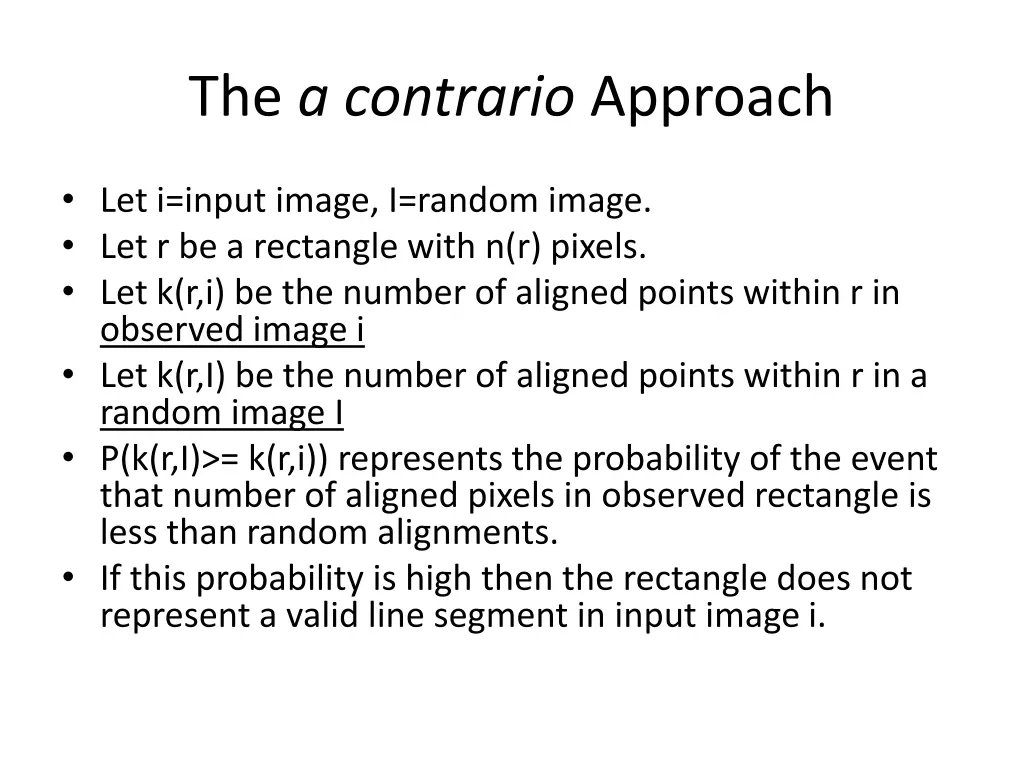
The a contrario Approach Let i=input image, I=random image. Let r be a rectangle with n(r) pixels. Let k(r,i) be the number of aligned points within r in observed image i Let k(r,I) be the number of aligned points within r in a random image I P(k(r,I)>= k(r,i)) represents the probability of the event that number of aligned pixels in observed rectangle is less than random alignments. If this probability is high then the rectangle does not represent a valid line segment in input image i.
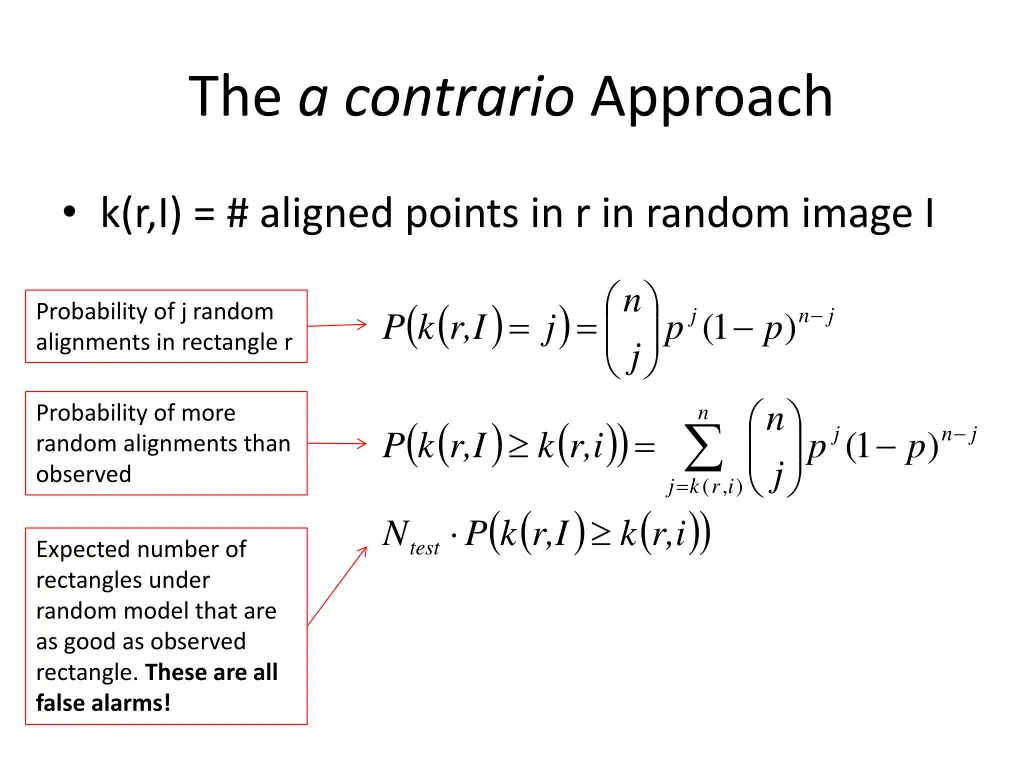
The a contrario Approach k(r,I) = # aligned points in r in random image I n ( ( ) ) Probability of j random alignments in rectangle r = = j n j 1 ( ) P k r,I j p p j n n Probability of more random alignments than observed ( ( ) ( ) r,i ) = = j n j 1 ( ) P k r,I k p p j ( , ) j k r i ( ( ) ( ) r,i ) N P k r,I k test Expected number of rectangles under random model that are as good as observed rectangle. These are all false alarms!
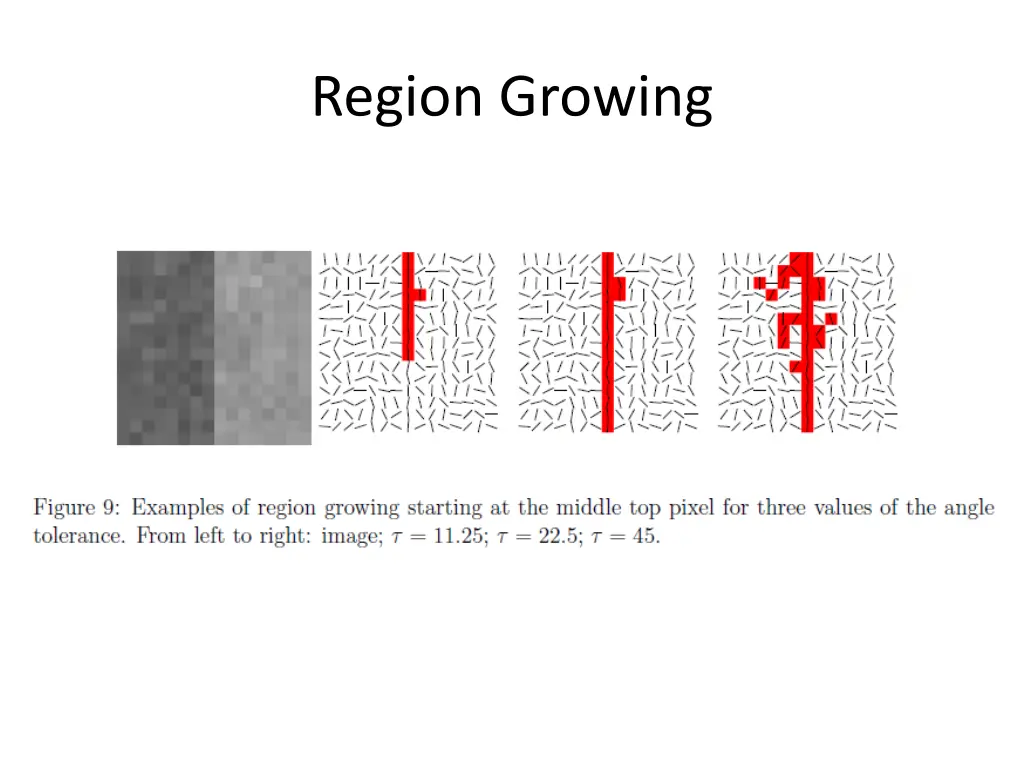
LSD Grow line support regions based on seed pixels with large gradients Form line support rectangles Validate each rectangle if the number of aligned points within the rectangle cannot be due to chance.