Development and Validation of Quality of Life Questionnaire for Hearing Loss
Explore the comprehensive process of developing and validating a Quality of Life questionnaire for individuals with hearing loss. The study includes a holistic approach, consideration of social, cognitive, and psychological aspects, as well as the initial formulation and testing of the questionnaire. Subjects completed the HL-QOL questionnaire and NCIQ, with validation results summarized by gender and age.

Download Presentation

Please find below an Image/Link to download the presentation.
The content on the website is provided AS IS for your information and personal use only. It may not be sold, licensed, or shared on other websites without obtaining consent from the author. If you encounter any issues during the download, it is possible that the publisher has removed the file from their server.
You are allowed to download the files provided on this website for personal or commercial use, subject to the condition that they are used lawfully. All files are the property of their respective owners.
The content on the website is provided AS IS for your information and personal use only. It may not be sold, licensed, or shared on other websites without obtaining consent from the author.
E N D
Presentation Transcript
loss Quality Quality of of Life Entwicklung und Validierung Angelika Illg1, Edda Amann2, Karin Koinig2, Ilona Anderson2, Thomas Lenarz1, Mareike Billinger-Finke2 Hearing Hearing loss Life Fragebogen Fragebogen Entwicklung und Validierung 1Medizinische Hochschule Hannover, Klinik und Poliklinik f r Hals-Nasen-Ohrenheilkunde, Direktor: Prof. Prof. h.c. Dr. med. Thomas Lenarz 2Elektromedizinische Ger te GmbH, Innsbruck, Direktor: Dr. Ingeborg Hochmair
Holistic approach to hearing loss Social aspects Ability to work (financial aspects) Relationship between hearing and cognitive abilities Cognition Cognitive decline/ dementia Psychological aspects intraindividual Depression Interdisciplinary approach to hearing loss
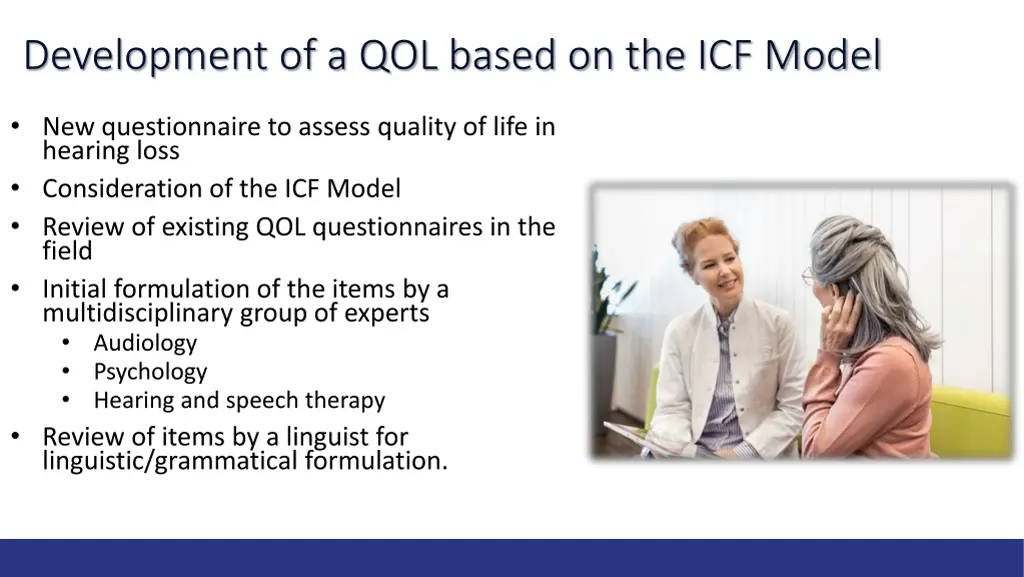
Development of a QOL based on the ICF Model New questionnaire to assess quality of life in hearing loss Consideration of the ICF Model Review of existing QOL questionnaires in the field Initial formulation of the items by a multidisciplinary group of experts Audiology Psychology Hearing and speech therapy Review of items by a linguist for linguistic/grammatical formulation.
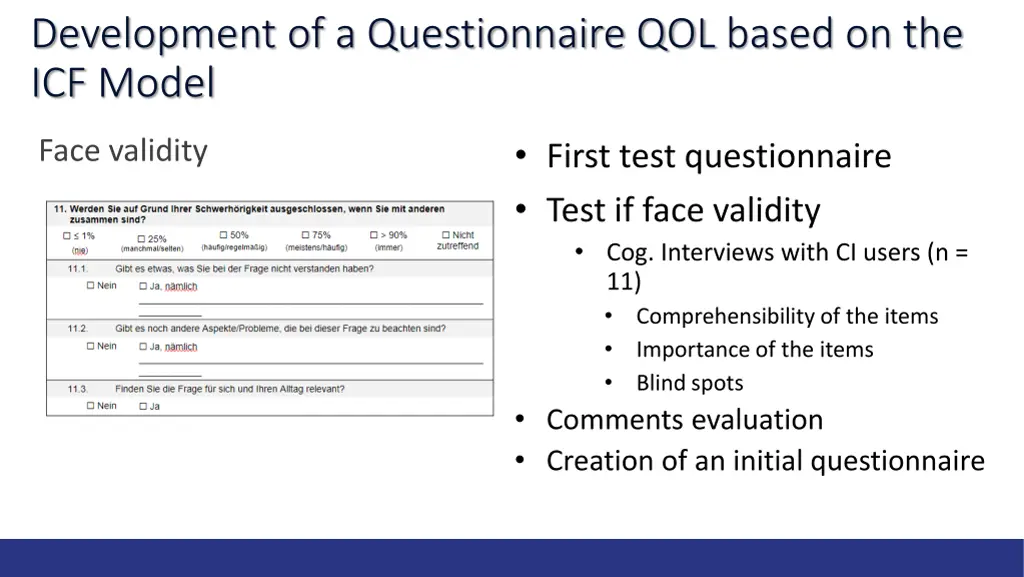
Development of a Questionnaire QOL based on the ICF Model First test questionnaire Test if face validity Cog. Interviews with CI users (n = 11) Comprehensibility of the items Importance of the items Blind spots Comments evaluation Creation of an initial questionnaire Face validity
Preliminary questionnaire with 23 questions 23 items with 7-point Likert scale Possibility to group the items according to ICF categories: Body Functions (8 Items) Activities & Participations (11 Items) Environmental Factors (2 Items) 2 items were considered important inital, but could not be assigned to the ICF
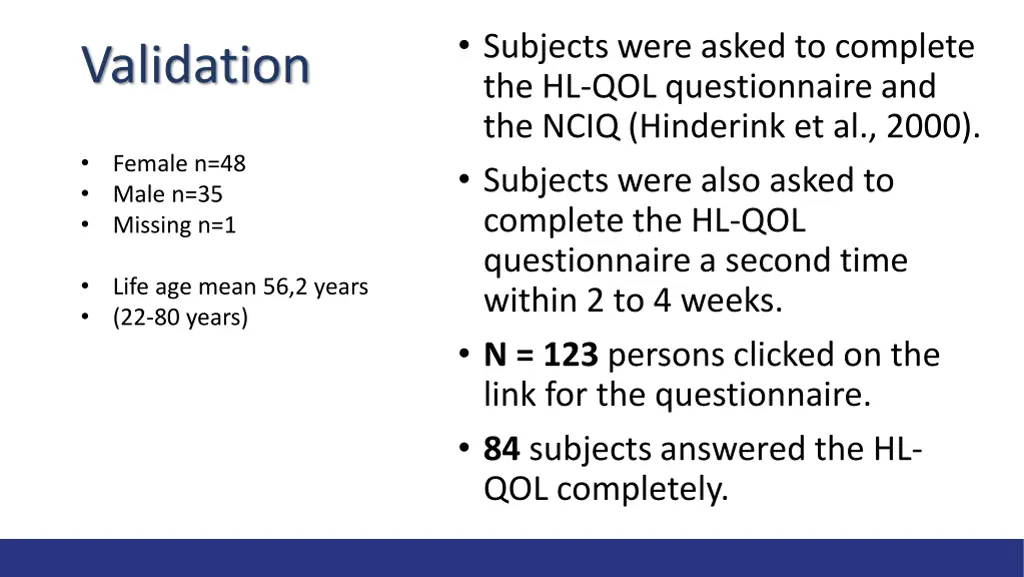
Subjects were asked to complete the HL-QOL questionnaire and the NCIQ (Hinderink et al., 2000). Subjects were also asked to complete the HL-QOL questionnaire a second time within 2 to 4 weeks. N = 123 persons clicked on the link for the questionnaire. 84 subjects answered the HL- QOL completely. Validation Female n=48 Male n=35 Missing n=1 Life age mean 56,2 years (22-80 years)
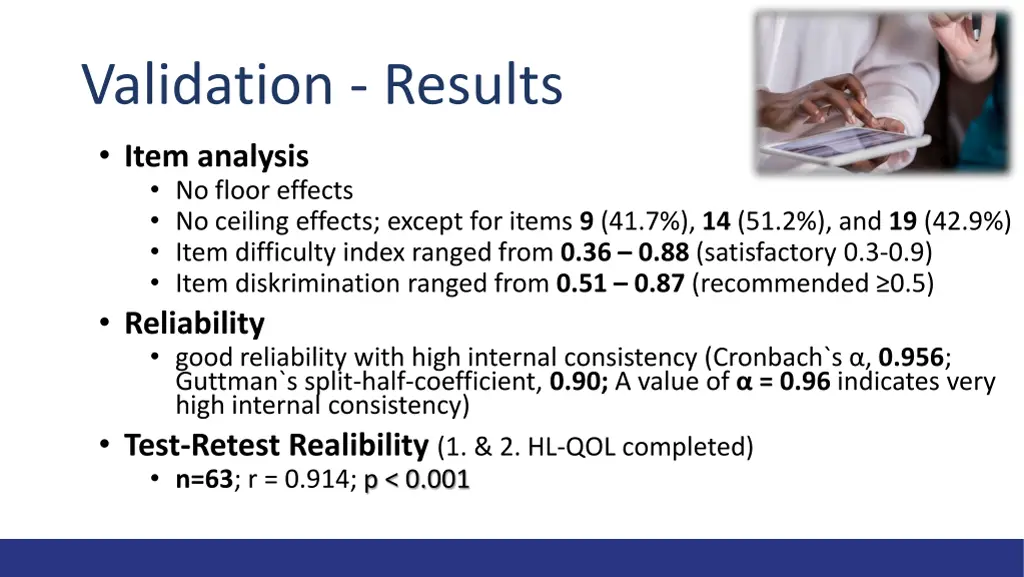
Validation - Results Item analysis No floor effects No ceiling effects; except for items 9 (41.7%), 14 (51.2%), and 19 (42.9%) Item difficulty index ranged from 0.36 0.88 (satisfactory 0.3-0.9) Item diskrimination ranged from 0.51 0.87 (recommended 0.5) Reliability good reliability with high internal consistency (Cronbach`s , 0.956; Guttman`s split-half-coefficient, 0.90; A value of = 0.96 indicates very high internal consistency) Test-Retest Realibility (1. & 2. HL-QOL completed) n=63; r = 0.914; p < 0.001
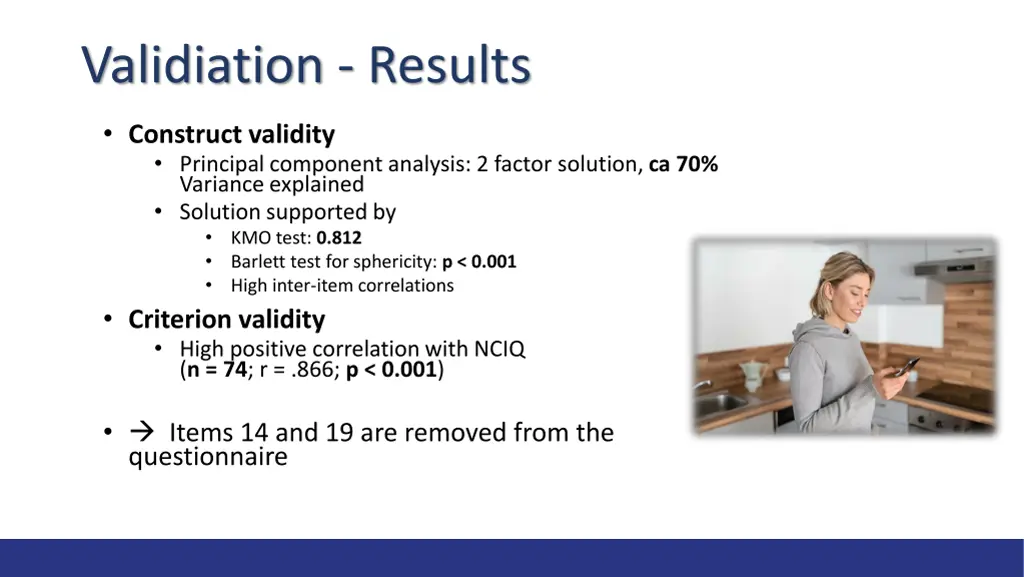
Validiation - Results Construct validity Principal component analysis: 2 factor solution, ca 70% Variance explained Solution supported by KMO test: 0.812 Barlett test for sphericity: p < 0.001 High inter-item correlations Criterion validity High positive correlation with NCIQ (n = 74; r = .866; p < 0.001) Items 14 and 19 are removed from the questionnaire
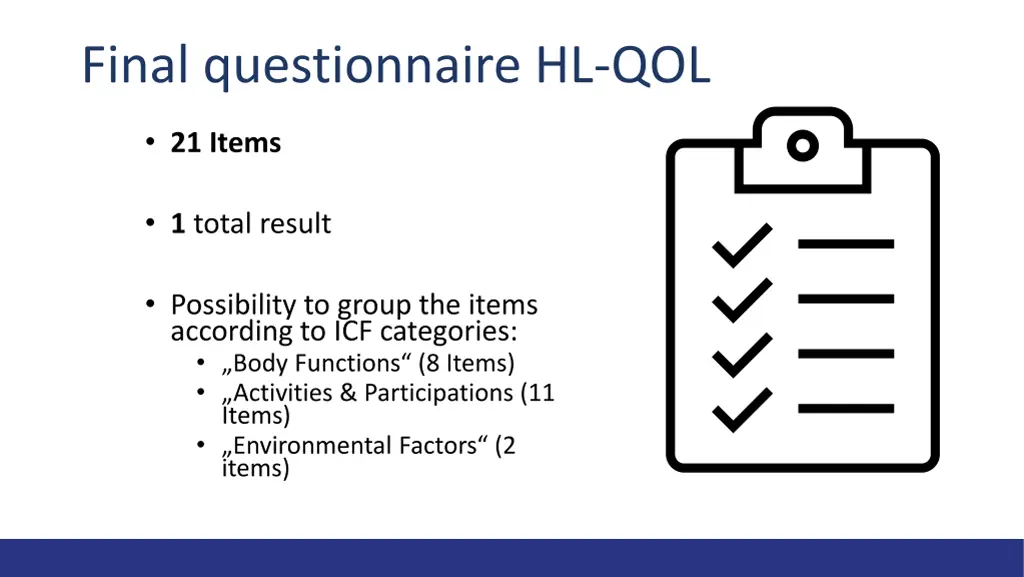
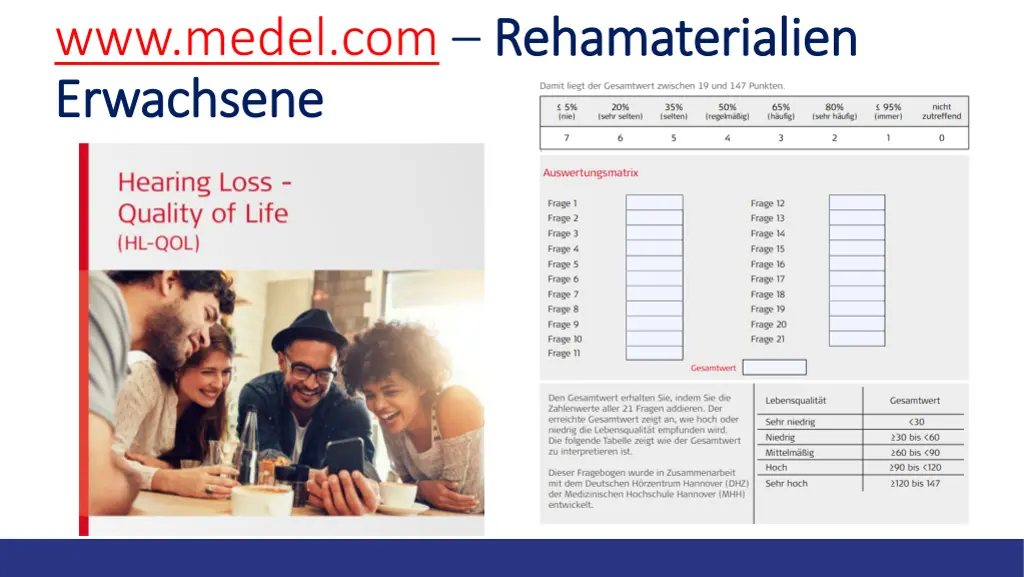
Final questionnaire HL-QOL 21 Items 1 total result Possibility to group the items according to ICF categories: Body Functions (8 Items) Activities & Participations (11 Items) Environmental Factors (2 items)
www.medel.com Rehamaterialien Erwachsene Erwachsene Rehamaterialien
Illg A, Amann E, Koinig KA, Anderson I, Lenarz T, Billinger-Finke M, A holistic perspective on hearing loss: first quality-of-life questionnaire (HL-QOL) for people with hearing loss based on the international classification of functioning, disability, and health, Frontiers in Audiology and Otology 1, 2023 https://www.frontiersin.org/articles/10.3389/fauot.2 023.1207220, DOI 10.3389/fauot.2023.1207220 Thank you for your attention! Illg.angelika@mh-hannover.de