Development Tool for NPHIs: Maturity Models & Discussion Guides
Explore the Staged Development Tool (SDT) designed for National Public Health Institutes (NPHIs), including maturity models and discussion guides to assess and enhance stages of development in key areas such as surveillance, leadership, and collaboration. Utilize numeric scores for nuanced discussions and domain descriptions to track progress effectively.

Download Presentation

Please find below an Image/Link to download the presentation.
The content on the website is provided AS IS for your information and personal use only. It may not be sold, licensed, or shared on other websites without obtaining consent from the author. If you encounter any issues during the download, it is possible that the publisher has removed the file from their server.
You are allowed to download the files provided on this website for personal or commercial use, subject to the condition that they are used lawfully. All files are the property of their respective owners.
The content on the website is provided AS IS for your information and personal use only. It may not be sold, licensed, or shared on other websites without obtaining consent from the author.
E N D
Presentation Transcript
STAGED DEVELOPMENT TOOL (SDT) BACKGROUND AND DESCRIPTION Revised 2024
Topics Maturity Models and Discussion Guides SDT Workshops Other Ways to Use Discussion Guides and the SDT
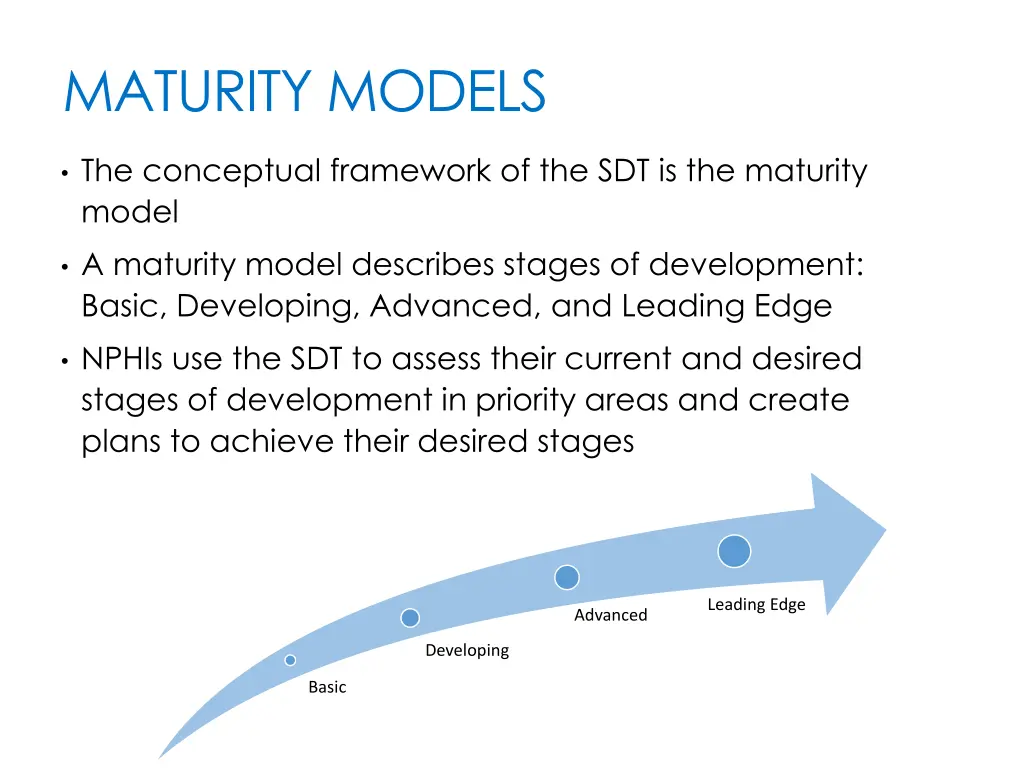
MATURITY MODELS The conceptual framework of the SDT is the maturity model A maturity model describes stages of development: Basic, Developing, Advanced, and Leading Edge NPHIs use the SDT to assess their current and desired stages of development in priority areas and create plans to achieve their desired stages Leading Edge Advanced Developing Basic
DISCUSSION GUIDES (DGS) DGs have been designed specifically for NPHIs They cover Internal-facing topics, such as leadership and management and internal communication External-facing topics, such as surveillance and multi-sectoral collaborations A generic Discussion Guide can be modified for use with topics not on the current list, such as injuries or mental health
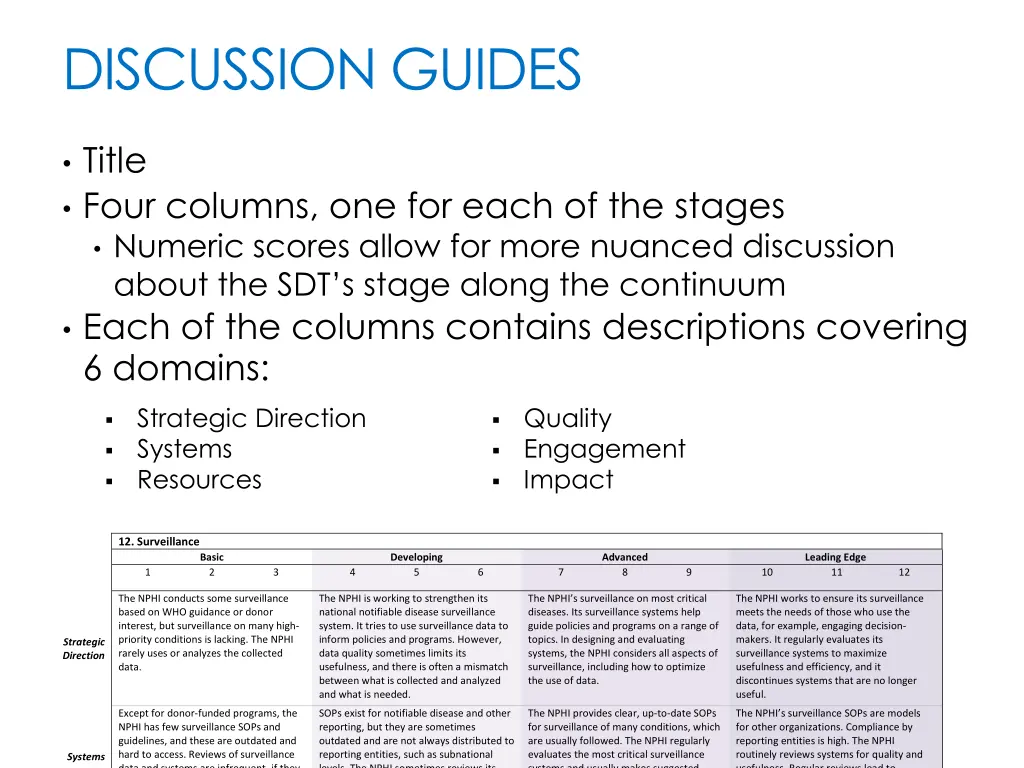
DISCUSSION GUIDES Title Four columns, one for each of the stages Numeric scores allow for more nuanced discussion about the SDT s stage along the continuum Each of the columns contains descriptions covering 6 domains: Strategic Direction Systems Resources Quality Engagement Impact 12. Surveillance 1 2 3 Basic Developing Advanced Leading Edge 4 5 6 7 8 9 10 11 12 The NPHI conducts some surveillance based on WHO guidance or donor interest, but surveillance on many high- priority conditions is lacking. The NPHI rarely uses or analyzes the collected data. The NPHI is working to strengthen its national notifiable disease surveillance system. It tries to use surveillance data to inform policies and programs. However, data quality sometimes limits its usefulness, and there is often a mismatch between what is collected and analyzed and what is needed. The NPHI s surveillance on most critical diseases. Its surveillance systems help guide policies and programs on a range of topics. In designing and evaluating systems, the NPHI considers all aspects of surveillance, including how to optimize the use of data. The NPHI works to ensure its surveillance meets the needs of those who use the data, for example, engaging decision- makers. It regularly evaluates its surveillance systems to maximize usefulness and efficiency, and it discontinues systems that are no longer useful. Strategic Direction Except for donor-funded programs, the NPHI has few surveillance SOPs and guidelines, and these are outdated and hard to access. Reviews of surveillance data and systems are infrequent, if they occur at all. SOPs exist for notifiable disease and other reporting, but they are sometimes outdated and are not always distributed to reporting entities, such as subnational levels. The NPHI sometimes reviews its surveillance systems, but findings rarely lead to improvements. The NPHI provides clear, up-to-date SOPs for surveillance of many conditions, which are usually followed. The NPHI regularly evaluates the most critical surveillance systems and usually makes suggested changes. The NPHI s surveillance SOPs are models for other organizations. Compliance by reporting entities is high. The NPHI routinely reviews systems for quality and usefulness. Regular reviews lead to continuous improvement. Systems Except for donor-funded programs, the NPHI has few resources to conduct surveillance and limited capacity to analyze and use surveillance data. Lack of computers and software and lack of training, including at subnational levels, limits data collection and analysis. While the NPHI has some resources to help improve data collection by reporting entities, these are insufficient. NPHI staff can conduct basic data analyses, but they lack skills and tools for more sophisticated work. The NPHI has substantial resources to assist reporting entities in improving data collection. NPHI staff have the skills and resources to collect and fully analyze data and make recommendations based on the findings. The NPHI invests substantially in all aspects of its surveillance systems. It works at all levels of the system to build capacity for data collection, analysis, and use of the data appropriate for that level. It regularly updates its infrastructure and staff skills to meet current and future needs. Resources Collected data are often of poor quality and are incomplete. Data are rarely analyzed, and the analyses that are done are basic and contain errors. Reporting to the NPHI of public health events of concern is rarely timely. Surveillance data quality varies. Some data analysis is timely, but much of the data remains unexamined. Reports tend to be very simple, for example, case counts without calculations of rates or analysis of trends. Reporting of events of concern is improving. The NPHI s surveillance is generally of high quality. Internationally accepted benchmarks help the NPHI identify areas needing improvement. Surveillance reports are timely and often include sophisticated analyses. Reporting to the NPHI about events of concern is timely. The NPHI excels in data collection and analysis. It consistently achieves international benchmarks, and it develops and evaluates innovative approaches to surveillance. The NPHI has helped to establish strong national capacity for identifying and reporting events of concern. Quality The NPHI rarely engages stakeholders in deciding what data to collect or in designing its surveillance systems. The NPHI occasionally shares surveillance summaries with subnational levels and other stakeholders. The NPHI sometimes involves stakeholders, such as subnational levels or decision-makers, in planning for surveillance. Surveillance summaries are sometimes posted on the website or distributed by email. Decision-makers and other stakeholders routinely provide input to the NPHI about its surveillance priorities and systems. The NPHI ensures that stakeholders have access to its findings through its website, public health bulletins, and other venues. The NPHI actively seeks input from a range of stakeholders to shape its data collection, analysis, and reporting. It disseminates its reports widely and makes specific efforts to share findings that might be important globally or useful to non-traditional partners, such as industry. Engagement The NPHI s surveillance data are rarely used for decision-making. The NPHI seldom identifies acute issues through its surveillance. The NPHI can provide a few examples where its surveillance has informed policies or programs or resulted in early detection of issues requiring intervention. Decision-makers often rely on the NPHI s surveillance data to inform programs and policies. The NPHI can provide several examples where problems were identified early through its surveillance systems. The NPHI s surveillance has a major impact on policies and programs in the country and, often, globally. The NPHI regularly identifies new or emerging public health issues from surveillance data. Impact
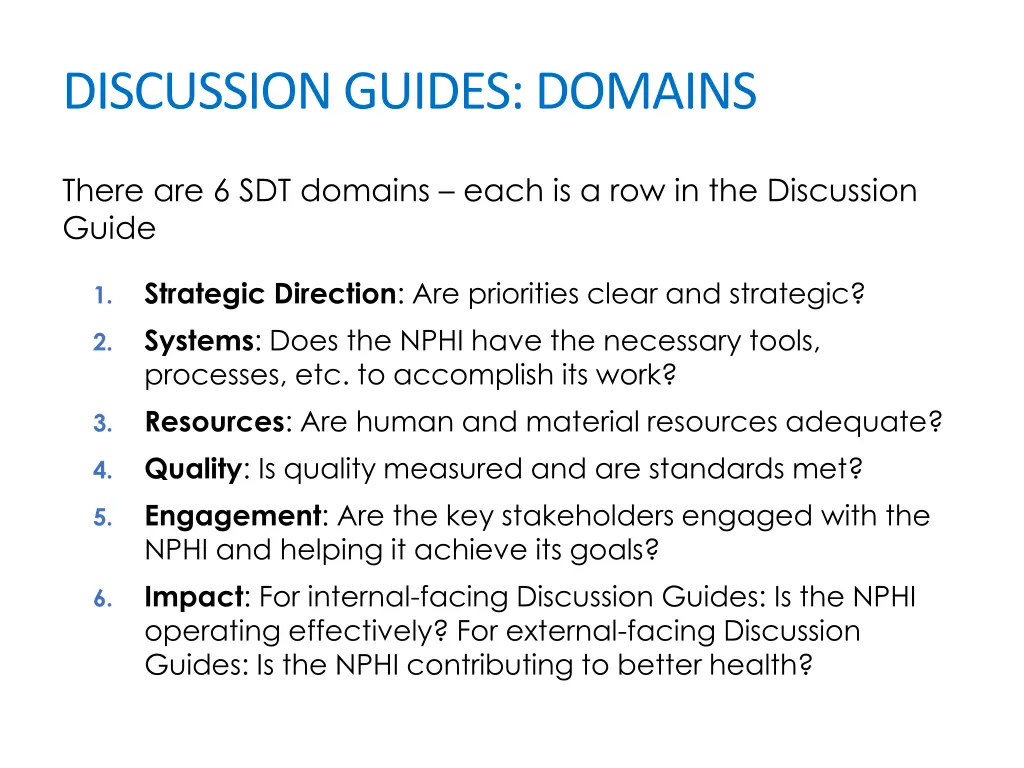
DISCUSSION GUIDES: DOMAINS There are 6 SDT domains each is a row in the Discussion Guide Strategic Direction: Are priorities clear and strategic? Systems: Does the NPHI have the necessary tools, processes, etc. to accomplish its work? Resources: Are human and material resources adequate? Quality: Is quality measured and are standards met? Engagement: Are the key stakeholders engaged with the NPHI and helping it achieve its goals? Impact: For internal-facing Discussion Guides: Is the NPHI operating effectively? For external-facing Discussion Guides: Is the NPHI contributing to better health? 1. 2. 3. 4. 5. 6.
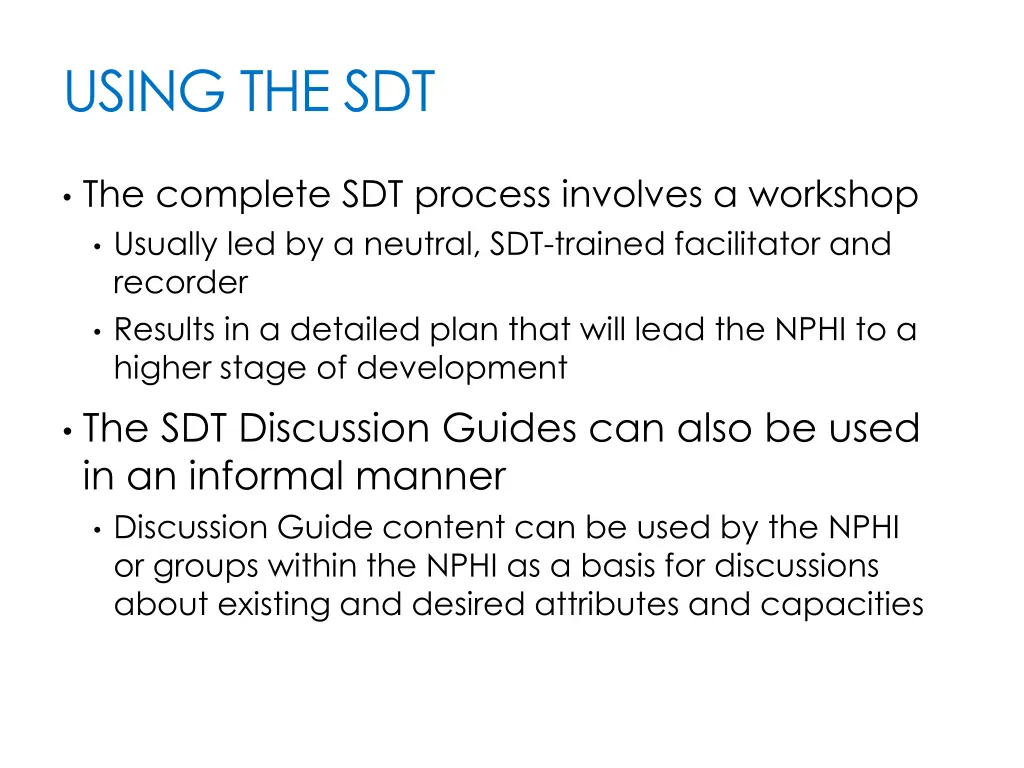
USING THE SDT The complete SDT process involves a workshop Usually led by a neutral, SDT-trained facilitator and recorder Results in a detailed plan that will lead the NPHI to a higher stage of development The SDT Discussion Guides can also be used in an informal manner Discussion Guide content can be used by the NPHI or groups within the NPHI as a basis for discussions about existing and desired attributes and capacities
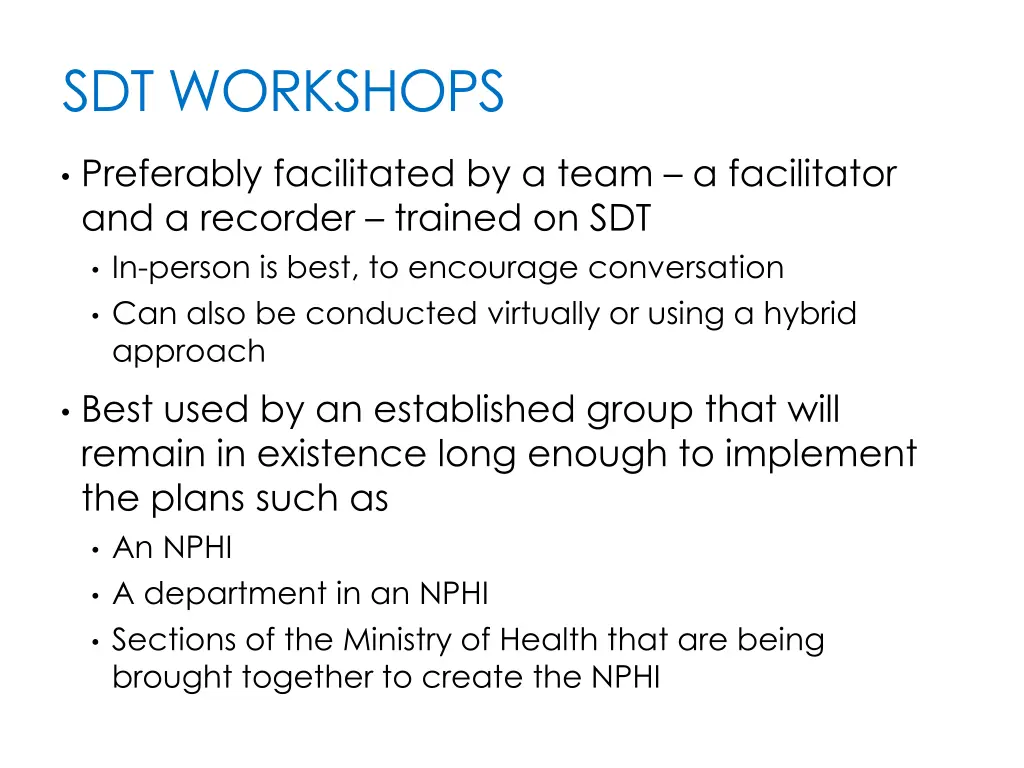
SDT WORKSHOPS Preferably facilitated by a team a facilitator and a recorder trained on SDT In-person is best, to encourage conversation Can also be conducted virtually or using a hybrid approach Best used by an established group that will remain in existence long enough to implement the plans such as An NPHI A department in an NPHI Sections of the Ministry of Health that are being brought together to create the NPHI
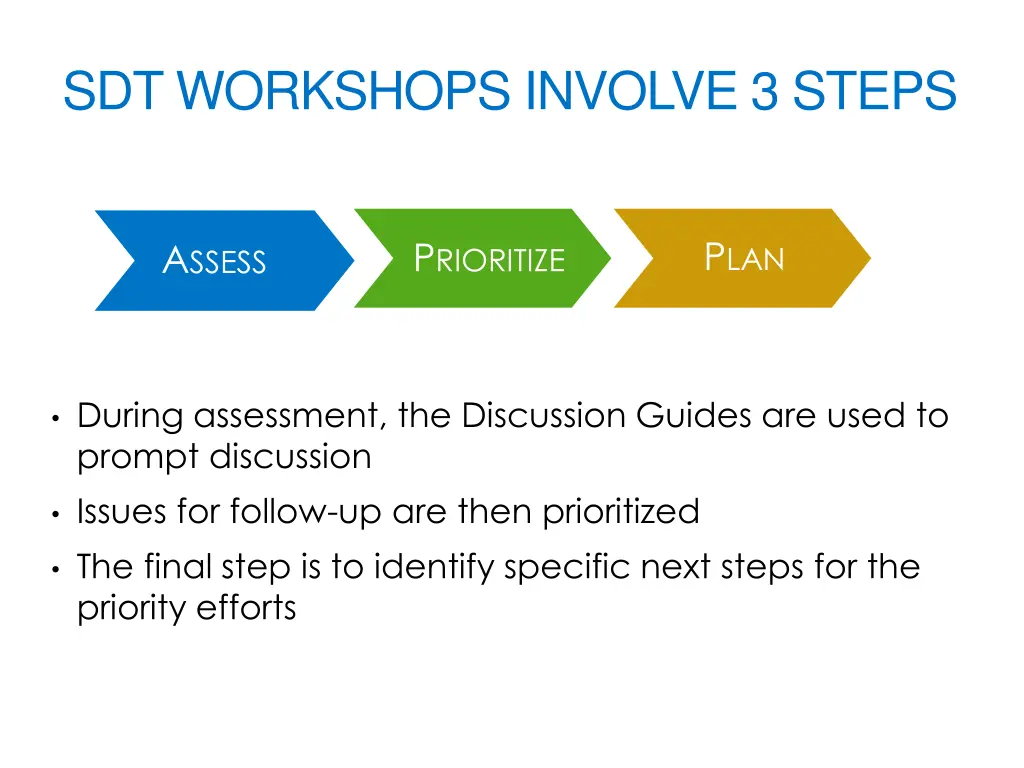
SDT WORKSHOPS INVOLVE 3 STEPS PLAN PRIORITIZE ASSESS During assessment, the Discussion Guides are used to prompt discussion Issues for follow-up are then prioritized The final step is to identify specific next steps for the priority efforts
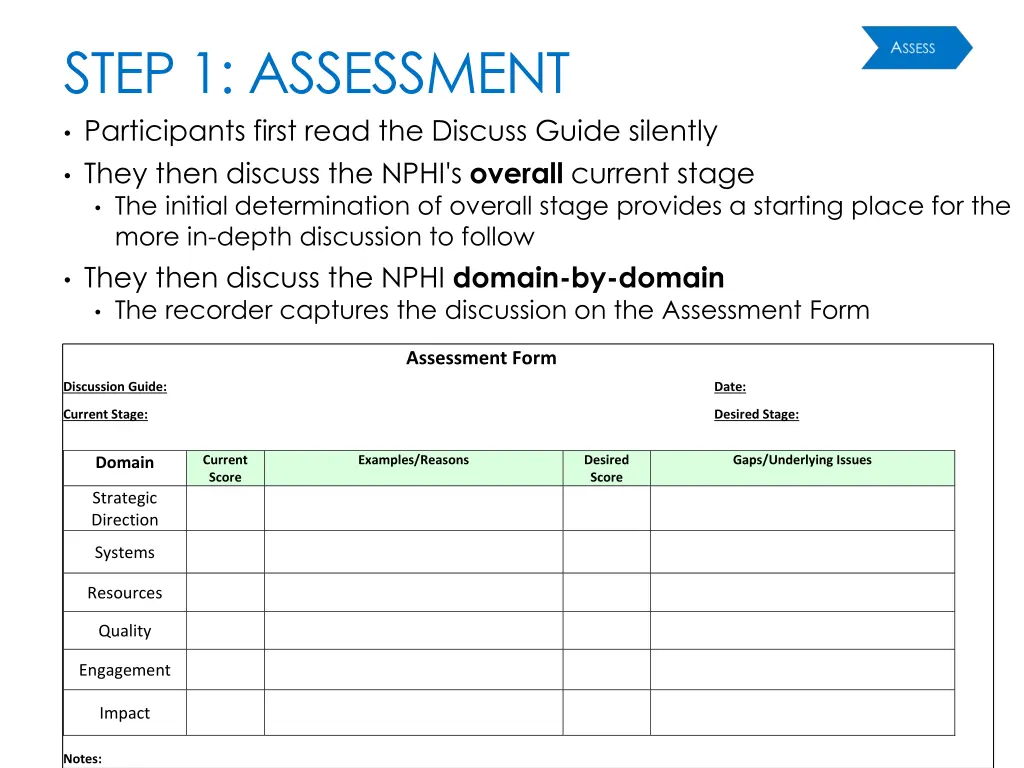
STEP 1: ASSESSMENT Participants first read the Discuss Guide silently They then discuss the NPHI's overall current stage The initial determination of overall stage provides a starting place for the more in-depth discussion to follow They then discuss the NPHI domain-by-domain The recorder captures the discussion on the Assessment Form Assessment Form Discussion Guide: Date: Current Stage: Desired Stage: Current Score Examples/Reasons Desired Score Gaps/Underlying Issues Domain Strategic Direction Systems Resources Quality Engagement Impact Notes:
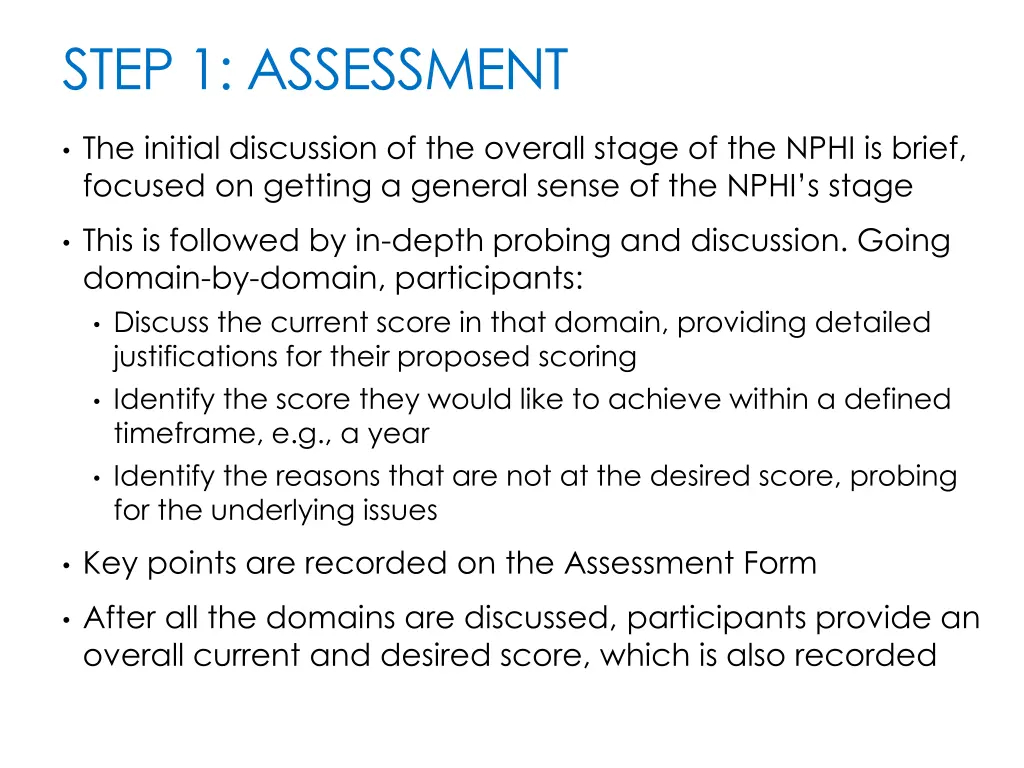
STEP 1: ASSESSMENT The initial discussion of the overall stage of the NPHI is brief, focused on getting a general sense of the NPHI s stage This is followed by in-depth probing and discussion. Going domain-by-domain, participants: Discuss the current score in that domain, providing detailed justifications for their proposed scoring Identify the score they would like to achieve within a defined timeframe, e.g., a year Identify the reasons that are not at the desired score, probing for the underlying issues Key points are recorded on the Assessment Form After all the domains are discussed, participants provide an overall current and desired score, which is also recorded
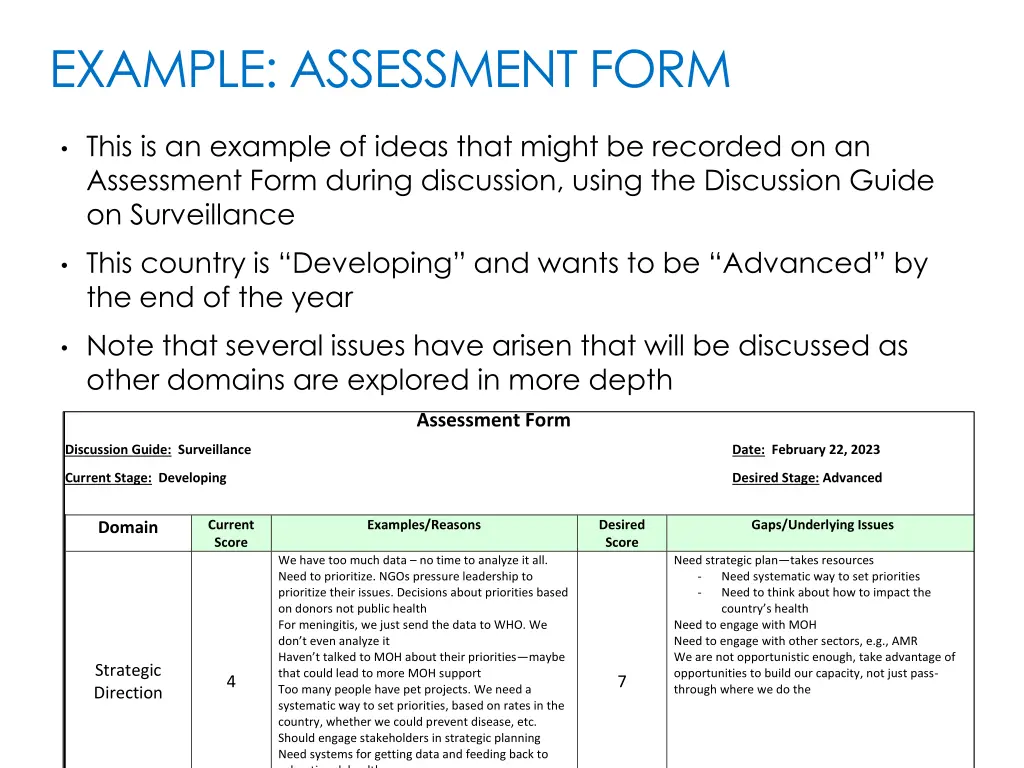
EXAMPLE: ASSESSMENT FORM This is an example of ideas that might be recorded on an Assessment Form during discussion, using the Discussion Guide on Surveillance This country is Developing and wants to be Advanced by the end of the year Note that several issues have arisen that will be discussed as other domains are explored in more depth Assessment Form Discussion Guide: Surveillance Date: February 22, 2023 Current Stage: Developing Desired Stage: Advanced Current Score Examples/Reasons Desired Score Gaps/Underlying Issues Domain We have too much data no time to analyze it all. Need to prioritize. NGOs pressure leadership to prioritize their issues. Decisions about priorities based on donors not public health For meningitis, we just send the data to WHO. We don t even analyze it Haven t talked to MOH about their priorities maybe that could lead to more MOH support Too many people have pet projects. We need a systematic way to set priorities, based on rates in the country, whether we could prevent disease, etc. Should engage stakeholders in strategic planning Need systems for getting data and feeding back to subnational, healthcare Need to think systems roles of subnational, health- care, etc. Need strategic plan takes resources - Need systematic way to set priorities - Need to think about how to impact the country s health Need to engage with MOH Need to engage with other sectors, e.g., AMR We are not opportunistic enough, take advantage of opportunities to build our capacity, not just pass- through where we do the Strategic Direction 4 7 Systems Resources Quality Engagement Impact Notes:
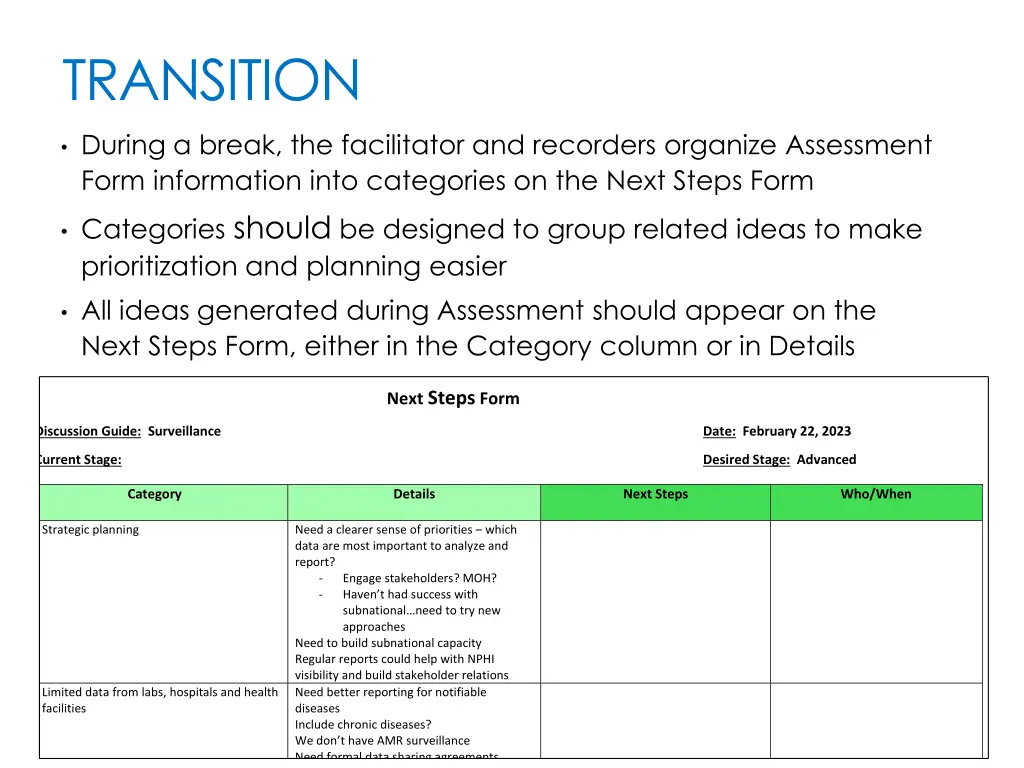
TRANSITION During a break, the facilitator and recorders organize Assessment Form information into categories on the Next Steps Form Categories should be designed to group related ideas to make prioritization and planning easier All ideas generated during Assessment should appear on the Next Steps Form, either in the Category column or in Details Next Steps Form Discussion Guide: Surveillance Date: February 22, 2023 Current Stage: Desired Stage: Advanced Category Details Next Steps Who/When Strategic planning Need a clearer sense of priorities which data are most important to analyze and report? - Engage stakeholders? MOH? - Haven t had success with subnational need to try new approaches Need to build subnational capacity Regular reports could help with NPHI visibility and build stakeholder relations Need better reporting for notifiable diseases Include chronic diseases? We don t have AMR surveillance Need formal data sharing agreements Would it help to have MOH involved? Could hold joint seminars with lab Limited data from labs, hospitals and health facilities Notes: The Staged Development Tool (SDT) for NPHIs was developed by the U.S. Centers for Disease Control and Prevention (CDC) and the International Association of National Public Health Institutes (IANPHI) with the assistance
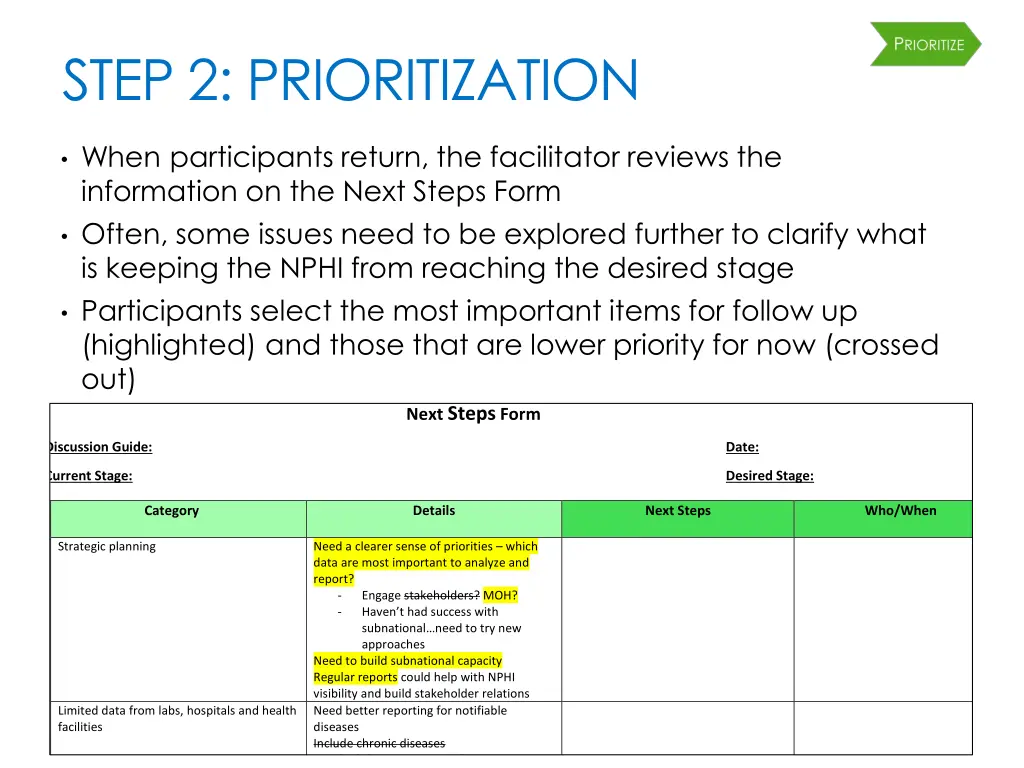
STEP 2: PRIORITIZATION When participants return, the facilitator reviews the information on the Next Steps Form Often, some issues need to be explored further to clarify what is keeping the NPHI from reaching the desired stage Participants select the most important items for follow up (highlighted) and those that are lower priority for now (crossed out) Next Steps Form Discussion Guide: Date: Current Stage: Desired Stage: Category Details Next Steps Who/When Strategic planning Need a clearer sense of priorities which data are most important to analyze and report? - Engage stakeholders? MOH? - Haven t had success with subnational need to try new approaches Need to build subnational capacity Regular reports could help with NPHI visibility and build stakeholder relations Need better reporting for notifiable diseases Include chronic diseases We don t have AMR surveillance Need formal data sharing agreements Would it help to have MOH involved? Could hold joint seminars with lab Limited data from labs, hospitals and health facilities Notes: The Staged Development Tool (SDT) for NPHIs was developed by the U.S. Centers for Disease Control and Prevention (CDC) and the International Association of National Public Health Institutes (IANPHI) with the assistance
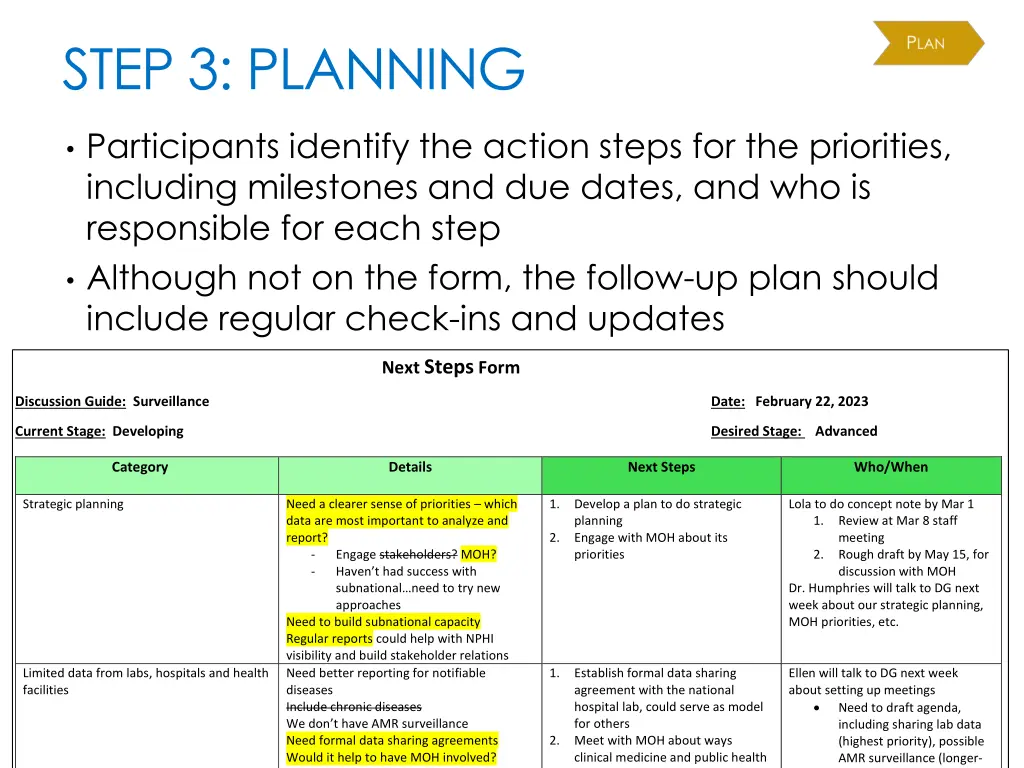
STEP 3: PLANNING Participants identify the action steps for the priorities, including milestones and due dates, and who is responsible for each step Although not on the form, the follow-up plan should include regular check-ins and updates Next Steps Form Discussion Guide: Surveillance Date: February 22, 2023 Current Stage: Developing Desired Stage: Advanced Category Details Next Steps Who/When 1.Develop a plan to do strategic planning 2.Engage with MOH about its priorities Strategic planning Need a clearer sense of priorities which data are most important to analyze and report? - Engage stakeholders? MOH? - Haven t had success with subnational need to try new approaches Need to build subnational capacity Regular reports could help with NPHI visibility and build stakeholder relations Need better reporting for notifiable diseases Include chronic diseases We don t have AMR surveillance Need formal data sharing agreements Would it help to have MOH involved? Could hold joint seminars with lab Lola to do concept note by Mar 1 1.Review at Mar 8 staff meeting 2.Rough draft by May 15, for discussion with MOH Dr. Humphries will talk to DG next week about our strategic planning, MOH priorities, etc. 1.Establish formal data sharing agreement with the national hospital lab, could serve as model for others 2.Meet with MOH about ways clinical medicine and public health could work together more closely (might impact AMR as well) Limited data from labs, hospitals and health facilities Ellen will talk to DG next week about setting up meetings Need to draft agenda, including sharing lab data (highest priority), possible AMR surveillance (longer- term issue) IT integration is also a longer term issue, but could come up Notes:
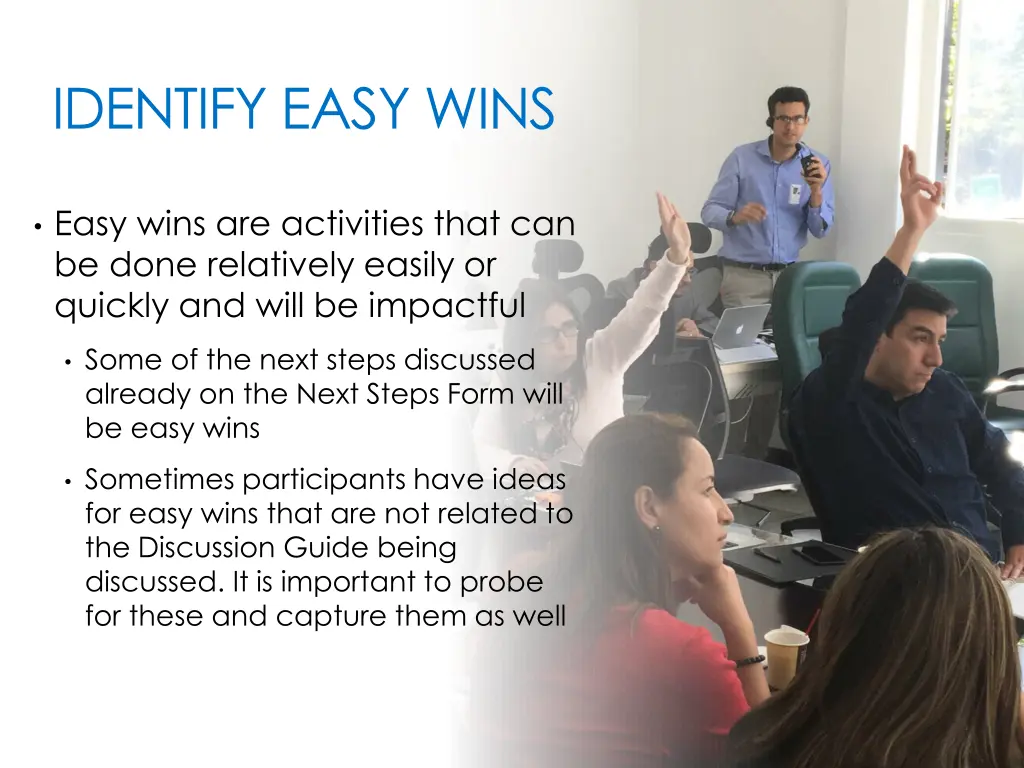
IDENTIFY EASY WINS Easy wins are activities that can be done relatively easily or quickly and will be impactful Some of the next steps discussed already on the Next Steps Form will be easy wins Sometimes participants have ideas for easy wins that are not related to the Discussion Guide being discussed. It is important to probe for these and capture them as well
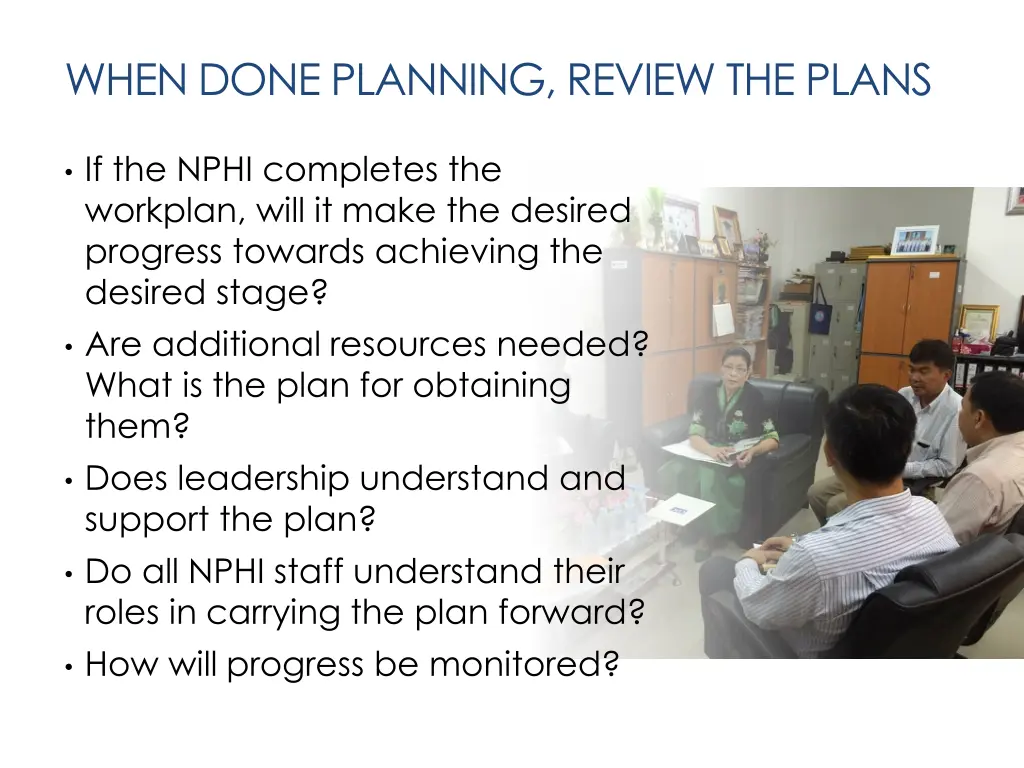
WHEN DONE PLANNING, REVIEW THE PLANS If the NPHI completes the workplan, will it make the desired progress towards achieving the desired stage? Are additional resources needed? What is the plan for obtaining them? Does leadership understand and support the plan? Do all NPHI staff understand their roles in carrying the plan forward? How will progress be monitored?
OTHER WAYS TO USE DISCUSSION GUIDES AND THE SDT
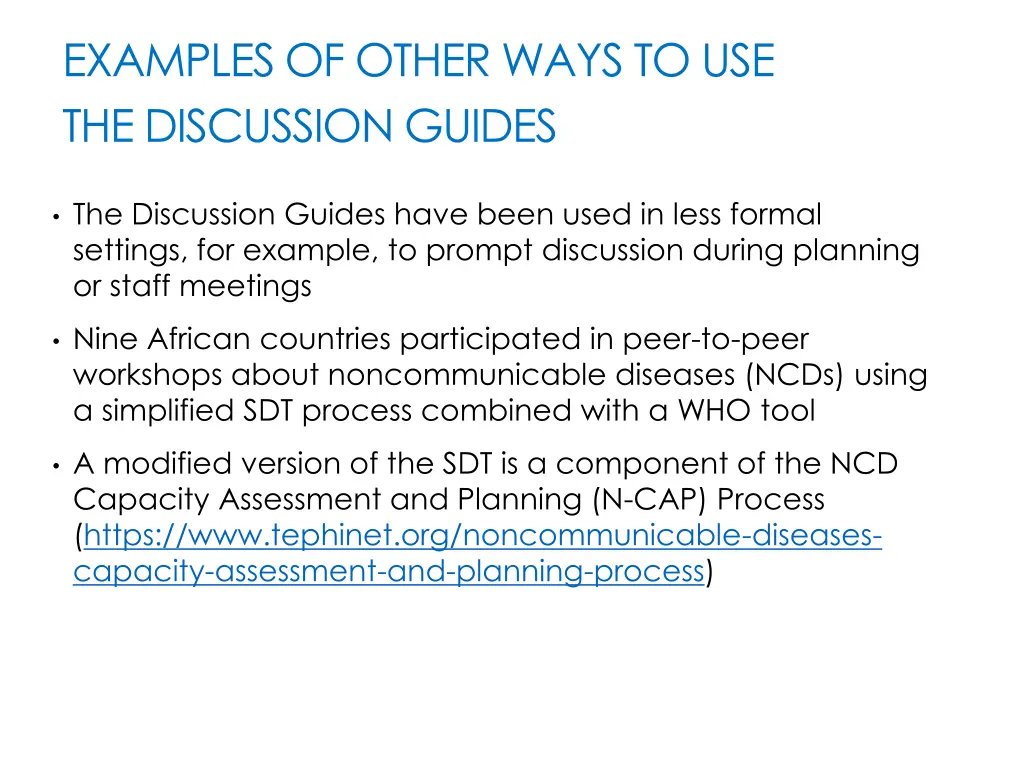
EXAMPLES OF OTHER WAYS TO USE THE DISCUSSION GUIDES The Discussion Guides have been used in less formal settings, for example, to prompt discussion during planning or staff meetings Nine African countries participated in peer-to-peer workshops about noncommunicable diseases (NCDs) using a simplified SDT process combined with a WHO tool A modified version of the SDT is a component of the NCD Capacity Assessment and Planning (N-CAP) Process (https://www.tephinet.org/noncommunicable-diseases- capacity-assessment-and-planning-process)
GOOD LUCK WITH PLANNING USING THE SDT!!! If you have any questions, please contact us Please also let us know about your experiences using the SDT or Discussion Guides We look forward to hearing from you IANPHI info@ianphi.org https://ianphi.org/tools-resources/sdt.html CDC bwp8@cdc.gov https://www.cdc.gov/globalhealth/healthprotection/nphi/sdt/index.html