Explore the journey of the UGJFA group in revising curricula to include diabetic foot care. Discover the approach, methodologies, and focus on multidisciplinary collaboration, evidence-informed practice, and client-centered approaches. See how the International Classification of Functioning is incorporated into the training program.
Please find below an Image/Link to download the presentation.
The content on the website is provided AS IS for your information and personal use only. It may not be sold, licensed, or shared on other websites without obtaining consent from the author. If you encounter any issues during the download, it is possible that the publisher has removed the file from their server.
You are allowed to download the files provided on this website for personal or commercial use, subject to the condition that they are used lawfully. All files are the property of their respective owners.
The content on the website is provided AS IS for your information and personal use only. It may not be sold, licensed, or shared on other websites without obtaining consent from the author.
E N D
Presentation Transcript
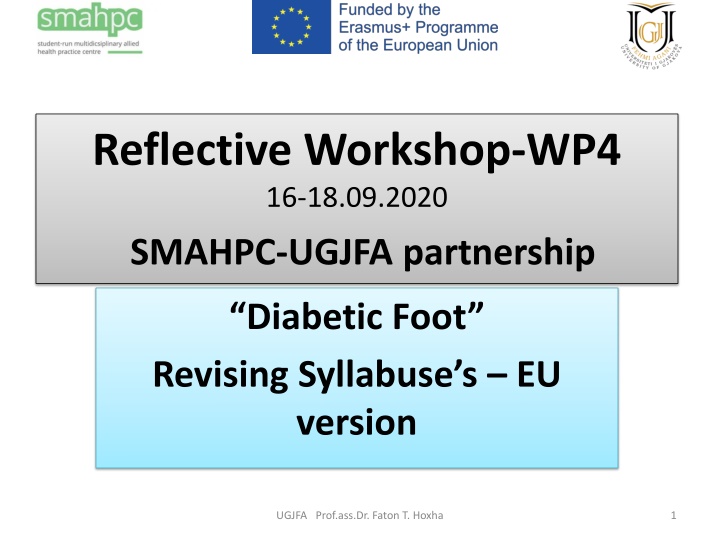
Reflective Workshop-WP4 16-18.09.2020 SMAHPC-UGJFA partnership Diabetic Foot Revising Syllabuse s EU version UGJFA Prof.ass.Dr. Faton T. Hoxha 1
SMAHPC Training courses online Tutoring Six teachers of Medical Faculty- UGJFA One administrative staff Seven students UGJFA Prof.ass.Dr. Faton T. Hoxha 2
UGJFA group from the point of involvement of Diabetic foot in SMAHPC project we have started to review and analyzing our Syllabuses during summer holidays. Revising of Curricula will be based on the: Teacher s Handbook for Course Planning and Producing Teaching Material and Handbook as a source of infromation about training for teachers on multidisciplinary , evidence- informed practice, client- centered approaches, innovation processes and entrepreneurship. The European Qualifications Framework (EQF). UGJFA Prof.ass.Dr. Faton T. Hoxha 3
Inclusion of Diabetic foot in Curricula We have planned to include Diabetic foot in eight curricula, in multidisciplinary approach through Collaboration, Evidence-Informed Practice, Client-Centered Approach and Innovation Processes and Entrepreneurship. Incorporating new learning methodology and competences in existing curricula Four curricula in each semester: Winter semester and Summer semester. at each curricula we are planning two lectures containing elements of Diabetic foot UGJFA Prof.ass.Dr. Faton T. Hoxha 4
ICF International Classification of Functioning, Disability and Health We have use during training program ICF for Diabetic foot, We will include ICF during lectures in Curricula about patients with Diabetic disease-Diabetic foot UGJFA Prof.ass.Dr. Faton T. Hoxha 5
Our Example: ICF Assessment from patient perspective in Diabetic foot patient The thing that bothers me most about my situation is depending on others so much, often I can t wear deep shoes, and I can t cut my nails because I have some fungus on my thumb. After eating I feel very tired I need to lie down a little Sometimes I can t sleep, I have a lot of pain in my feet,I have to get out of bed and walk around the house It often happens to me out night that I sweat and I have to take a piece of chocolate because I know my sugar has dropped When I walk in the evening I feel tired but I sleep better, and I have less pain Currently I m gaining weight I often feel nervous for no reason. UGJFA Prof.ass.Dr. Faton T. Hoxha 6
Our Example: ICF Assessment from the health professionals perspective in Diabetic foot patients We made a note of a number of impairments of our patient: s 550- Structure of the pancreas; s 750 - Structure of the lower extremity; s 7502- Structure of foot and ankle; s 830- Structure of the nails; b 134 - Sleeping is impaired; b 210 -Seeing problems related to diagnosis; b 530 -Weight maintenance function is impaired; b1302 -Appetite dysfunction; b 265- Touch functions impaired related to diagnosis; b 280 - Feet pain; UGJFA Prof.ass.Dr. Faton T. Hoxha 7
Our Example ICF Assessment in Diabetic foot Activities and participation Environmental factors e330 People in positions of authority e340 Personal care providers and personal assistants e355 Health professionals e360 Other professionals e410 Individual attitudes of immediate family members e415 Individual attitudes of extended family members e420 Individual attitudes of friends e425 Individual attitudes of acquaintances, peers, colleagues, neighbours and community members e430 Individual attitudes of people in positions of authority e440 Individual attitudes of personal care providers and personal assistants e450 Individual attitudes of health professionals e455 Individual attitudes of other professionals e465 Social norms, practices and ideologies e510 Services, systems and policies for the production of consumer goods d240 Handling stress and other psychological demands d440 Fine hand use d450 Walking d455 Moving around d475 Driving d520 Caring for body parts d570 Looking after one s health d620 Acquisition of goods and services d630 Preparing meals d750 Informal social relationships d760 Family relationships d770 Intimate relationships d845 Acquiring, keeping and terminating a job d850 Remunerative employment d920 Recreation and leisure UGJFA Prof.ass.Dr. Faton T. Hoxha 8
In Winter semester we have planned in each ( four) Competence one module like: UGJFA Prof.ass.Dr. Faton T. Hoxha 9
Competence: Multidisciplinary Collaboration in Student-Run Health Centre Nursing Care at internistic patients, Prof. Asoc. Dr. Dardan Ko inaj, Prof. Asoc. Dr. Idriz Berisha O/ III Competences Content Learning strategies On completion of the course, students will be able to: Understand the content of the subject, study object, its importance and application; Develop skills in clinical examination of the patient with internal disease Acquisition of subjective and objective method Reach knowledge about internal diseases, basic methods for diagnosing, monitoring, treatment, reporting. Recognition of internal diseases and nursing care, including patients with respiratory diseases, cardiovascular diseases, rheumatic, gastroenterology, endocrine, hematology, nephrology; internal diseases in narrow and broader sense Lectures Seminars Presentations Individual work Group work Laboratory practice Clinical practice Consulting Mentoring Multimedia Internet UGJFA Prof.ass.Dr. Faton T. Hoxha 10
Competence:Evidence-Informed Practice Public Health with Epidemiology and Nutrition, Prof. Asoc. Dr. Haxhi Kamberaj, Prof. Ass. Dr. Antigona Ukehaxhaj O/ III Competences Content Learning strategies The knowledge of the basic principles of the Public Health, Epidemiology and the importance of the Nutrition on the increase of the life quality. The focus leads to the introduction of the component of the danger, exploring models of Epidemiology, the use of the data and information technology in order to prevent diseases. The basis knowledges Nutrition, the role and their importance to the Health care. Food rational plan, compilation of the proper diets Students will be able to: Being able to use the health services on time for their best . Gaining the basic knowledge related to the appliance of epidemic methods on the identification of the components of the danger. Describing of the influence on the spread of the disease to the patient, family members, society and the local economic influence. Demonstrate the clinical abilities on the role of eating and nutrition s and prevention of any infection or crossed infection. Being able to sort out public health problems by understanding and using methods of statistics and information technology. Having logical access to the understanding of the epidemic diseases. Respecting of International laws on the chain of public health. Lectures, Exercise theoretical/laboratory, Practice work, Field exercises, Projects and presentations, individual and work group. about the groups of UGJFA Prof.ass.Dr. Faton T. Hoxha 11
Competence: Innovation Processes and Entrepreneurship Surgery and Oncology Nursing, Lec. Dr. Skender Ukaj ,O/ III Competences Content Learning strategies What we aim to achieve: The purpose of the study is the recognition of nurses in speciality of surgery and its object. Prepare of students with basic notions for surgery and treatment of patients in surgery of the chapters assigned by students Learning outcomes (means the knowledge, skills, and abilities the student will acquire after successfully completing this course. Verbs such as: know, describe, compare, project, design, develop , etc.). Upon completion of these lectures the student will be able to: Acquire basic knowledge of nosology, diagnosis and appropriate surgical therapy in patients with various surgical diseases. Win basic knowledge of the clinical chart of works for a health institution. Gains knowledge of the collection, electronic storage and storage of data and the use of statistical methods for clinical research The subject of surgery contains lectures on history, introduction, pre and post operative care, treatment of open and close wounds, palliative nursing care, thorax and abdominal wounds. The course contains lectures on malignant and benign diseases, diagnostic methods, their treatment and nursing care for patients with these diseases. conservative UGJFA Prof.ass.Dr. Faton T. Hoxha 12
Competence: Client-Centered Approach Nursing Surveillance, Prof. Ass. Dr. Faton Hoxha O/ III Competences Content Learning strategies Upon completion of this course , students will be able to : Outline the major political impact on health care Analyze critically about the many ways leadership discuss management strategies in a clinical setting Manage the care of a group of patients , Client-Centered Approach , individualized approach to each patient-client This course aims to inform students broaden understanding about the planning, organization and delivery of appropriate nursing care. This course will facilitate development of critical skills and nursing care delivery, management and leadership of students. In part of the lecture where discussing about diabetic foot, to recognize the roles of the patient and/or family and community in health care process and their involvement as most important members of the team for getting relevant self-care and support from family and community; Lectures Seminars Presentations Individual work Group work Laboratory practice Clinical practice Consulting Mentoring Multimedia Internet Co- creation Evidence based learning Simulation learning Problem based learning UGJFA Prof.ass.Dr. Faton T. Hoxha 13
In Summer semester we have planned in each (four) Competence one module like: UGJFA Prof.ass.Dr. Faton T. Hoxha 14
Competence: Multidisciplinary Collaboration in Student-Run Health Centre Palliative Care, Prof. Asoc. Dr. Dardan Kocinaj, Ass. Dr. Kushtrim Grezda E/ IV Competences Content Learning strategies Students will be able to: gain clinical experience, learning on reasoning, diagnoses and therapy; collaborate with health institutions and critical care teams in a variety of care units; acquire management skills, selection, ethical issues, legal aspects of complex patients; managing the common variety of care procedures (critical); manage pain and other symptoms; recognize cultural factors in care before death, loss, grief and preparation for the time of death. The course tend to be prepare students to conduct intensive palliative care with specialized multidisciplinary teams. It will also focus on care to patients/ clients with advanced disease and poor prognosis, as well as those with cancer; in controlling the symptoms; discussion on the recent decisions of life. Lectures Seminars Presentations Individual work Group work Laboratory practice Clinical practice Consulting Mentoring Multimedia Internet UGJFA Prof.ass.Dr. Faton T. Hoxha 15
Competence:Evidence-Informed Practice Methodology of Health Promotion and Education; Introduction to Research Methodology, Prof. Ass. Dr. Antigona Uk haxhaj, Ass. Arben Boshnjaku O/IV Competences Content Learning strategies On completion of the course, students will be able to: Acquaintances about common health problems which can be prevented and become easier with a healthy diet. Understands the role of the multidisciplinary team of healthcare in disease prevention and health promotion within and outside institutions. Understands the definition of education and health promotion, Recognizes pattern and approaches to health promotion, Gain knowledge about health promotion in different environments. This module examines the priorities and determinants of health, definition of health promotion and education, models and approaches to health promotion, the role of mass- media, and professional care, the planning of interventions and evaluation in health promotion. Lectures, Seminars Presentations Individual and work Group , Clinical practice, Consulting Mentoring ,Multimedia Internet. UGJFA Prof.ass.Dr. Faton T. Hoxha 16
Competence: Innovation Processes and Entrepreneurship Physical Medicine and Rehabilitation, Ass. Arben Boshnjaku E/IV Competences Content Learning strategies What we aim to achieve: to understand the positive effects of kinesiotherapy and occupational therapy, to gain knowledge about ortho-prosthetic tools and their application in rehabilitation, to understand the rehabilitation principles in patients with rheumatic, autoimmune, neurologic, cardiovascular and pulmonary diseases, to be acquainted with the indications and contraindications for the application of physical medicine and rehabilitation, to gain knowledge about the need for multidisciplinary action to rehabilitate various diseases and injuries, to be trained for educating people with physical disabilities for living an independent life. to manage cases in multi-professional approach, as well as understanding their role in the multidisciplinary team. Description of the module: This subject aims to introduce students to the physical agents that exist in clinical rehabilitation, indicating thermal, water, mechanical and electric agents. Additionally, it aims to develop the idea on how to apply and use the different procedures and techniques, as well as the indications and counter indication of their usage / clinical application. In addition, this module intends to equip students with theoretical knowledge and practical skills on offering rehabilitation services towards different health issues, involving diabetic foot issues. This includes topics such as: Why does the use of physical agents help the patient? Which are the appropriate physical agents to be used in different situations? Prescription and dosage of therapeutic exercise? Side effects and interactions that can be made with other treatments! Safe and effective application for the result optimization! Priority Problem based learning Co-creation Blended learning Evidence based learning Simulation learning Project-based learning Research based learning UGJFA Prof.ass.Dr. Faton T. Hoxha 17
Competence:Client-Centred Approach Operating block and nursing care, Prof. Ass. Dr. Faton Hoxha, Lec. Dr. Skender Ukaj E/IV Competences Content Learning strategies Upon completion of this course , students will be able to: recognising operating theatre procedures and equipment, patient safety, procedures of sterilisation and disinfection, ritual during operation procedures, concepts of perioperative management ; anatomy and physiology of all systems, Develop skills in the operating theatre, monitoring the patients, including basic skills in sterilisation, and the behaviours in the operating room. This course aims to inform students Operating theatre procedures and equipment, Patient safety and efficiency in the operating theatre, Sterilisation and desinfection, Behaviors and rituals in the operating theatre Homeostasis, stress and adaptation, Applying concepts from the nursing process, Perioperative concepts and nursing management Gas exchange and respiratory function, Cardiovascular, circulatory and haematological function, Digestive and gastrointestinal,Metabolic and endocrine, Kidney and urinary, Reproductive function, Immunological, lntegumentary function ( Management of patients with dermatological problems,Management of patients with burn injury );Sensori- Lectures Seminars Presentations Individual work Group work Laboratory practice Clinical practice Consulting Mentoring Multimedia Internet Co- creation Evidence based learning Simulation learning Problem based learning UGJFA Prof.ass.Dr. Faton T. Hoxha 18
Each of Teachers will implement the modern pedagogical approached learned from: the training program, and Teachers Books during the learning process of students. UGJFA Prof.ass.Dr. Faton T. Hoxha 19
Teachers will collaborate reviewing and co- designing existing curricula's, sharing their experience what might fit better in different subjects, based on The European Qualifications Framework (EQF). We need support from EU tutors as it is planned to be provided by plane package. UGJFA Prof.ass.Dr. Faton T. Hoxha 20