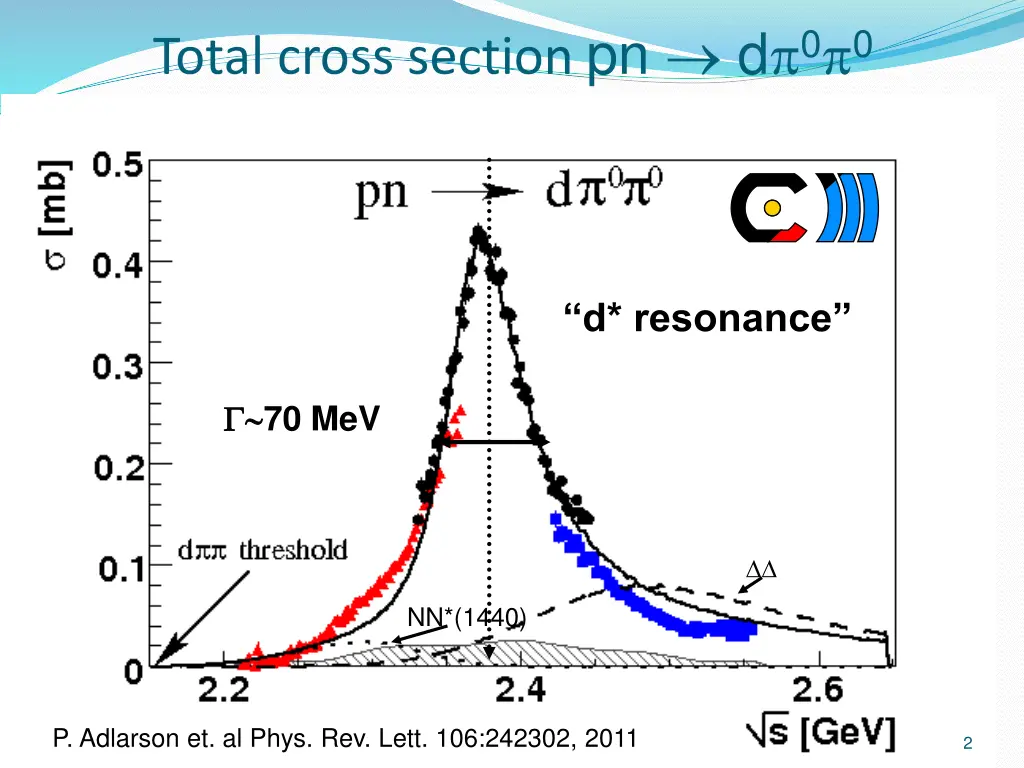
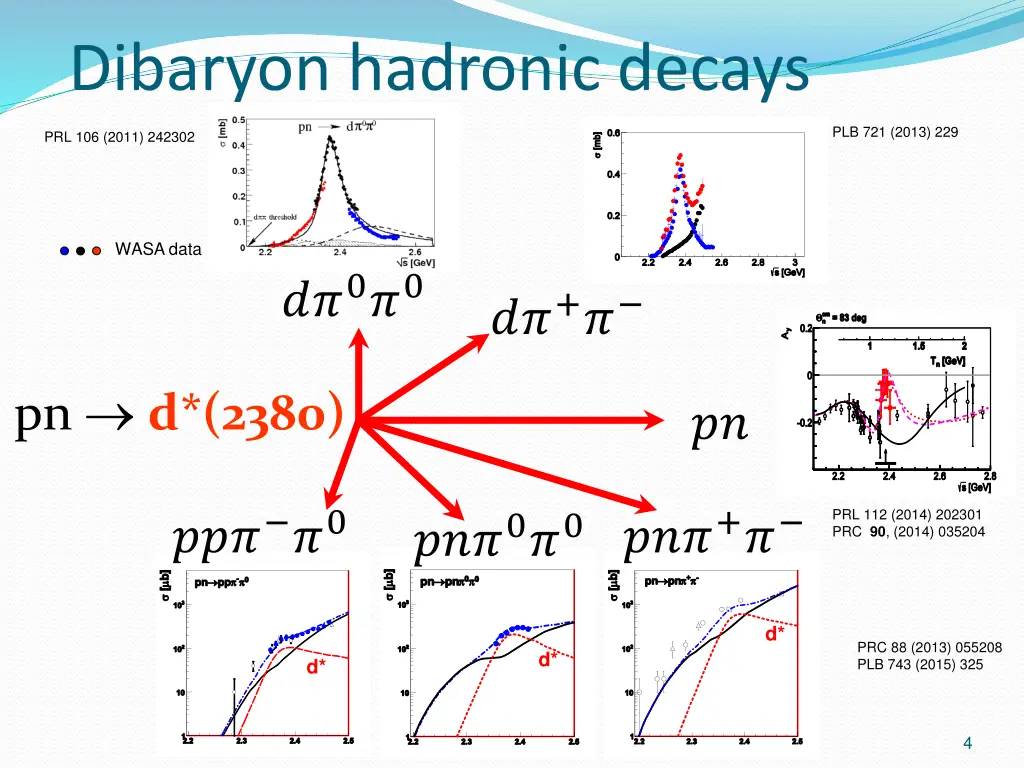
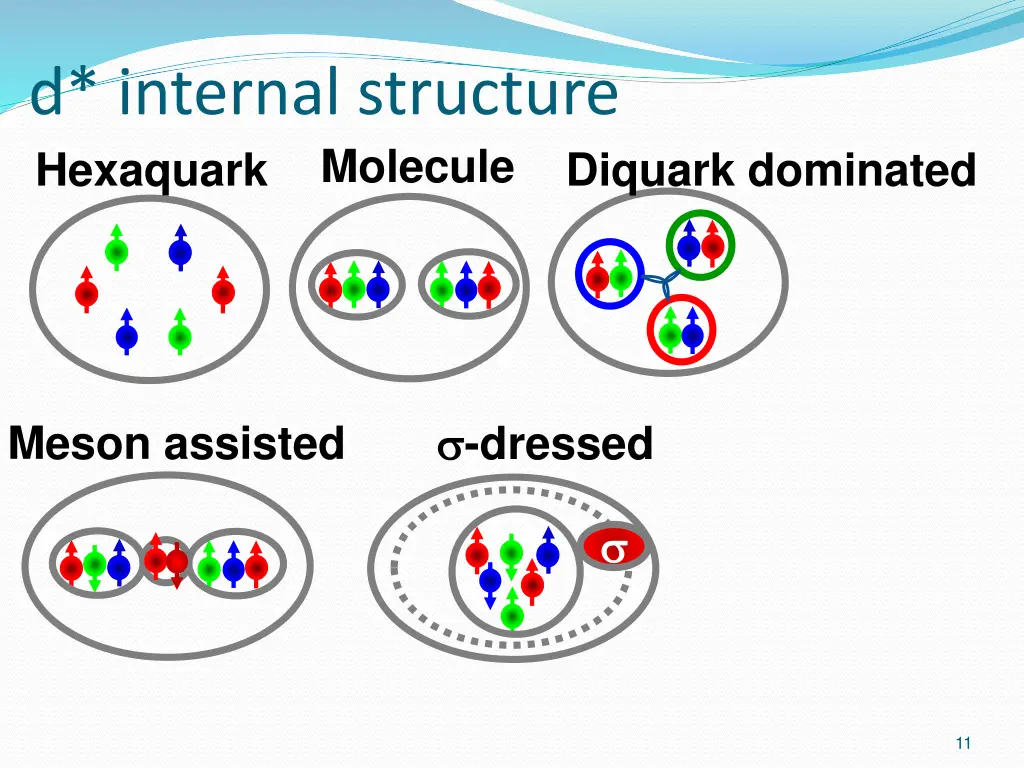
Explore the fascinating world of dibaryon decays and hidden color concepts such as hexaquarks. Learn about the decay branches, resonance peaks, and internal structures through a series of intriguing studies. Discover more about the unique properties of these exotic particles.
Please find below an Image/Link to download the presentation.
The content on the website is provided AS IS for your information and personal use only. It may not be sold, licensed, or shared on other websites without obtaining consent from the author. If you encounter any issues during the download, it is possible that the publisher has removed the file from their server.
You are allowed to download the files provided on this website for personal or commercial use, subject to the condition that they are used lawfully. All files are the property of their respective owners.
The content on the website is provided AS IS for your information and personal use only. It may not be sold, licensed, or shared on other websites without obtaining consent from the author.
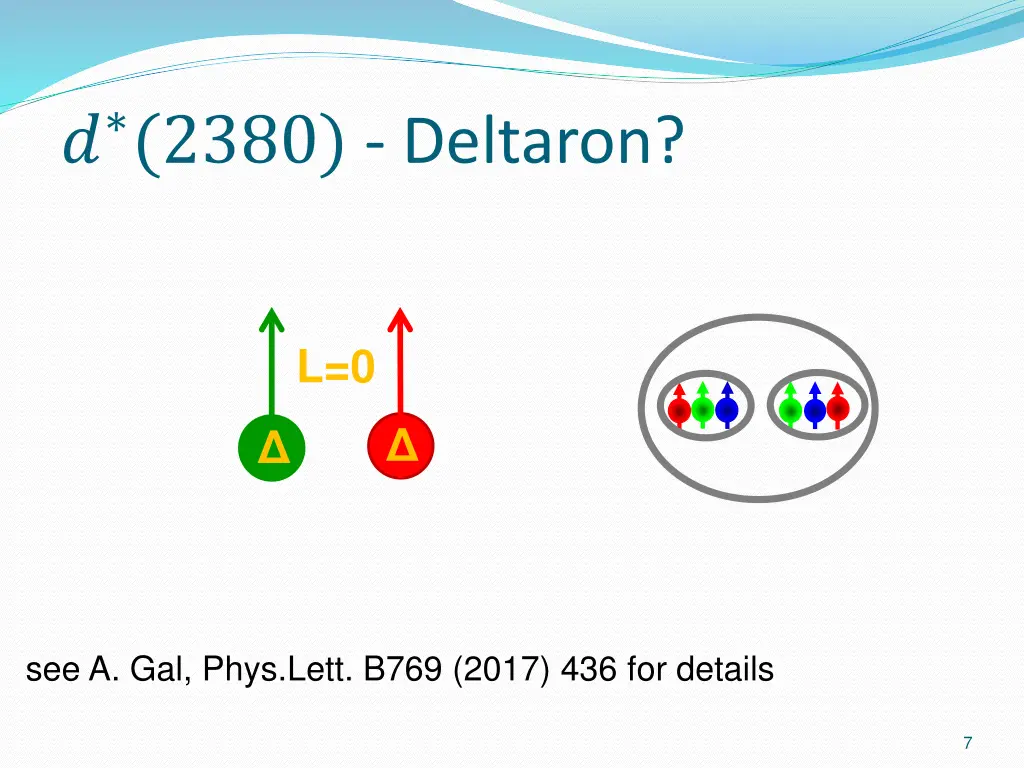
?(2380) - Deltaron? L=0 see A. Gal, Phys.Lett. B769 (2017) 436 for details 7
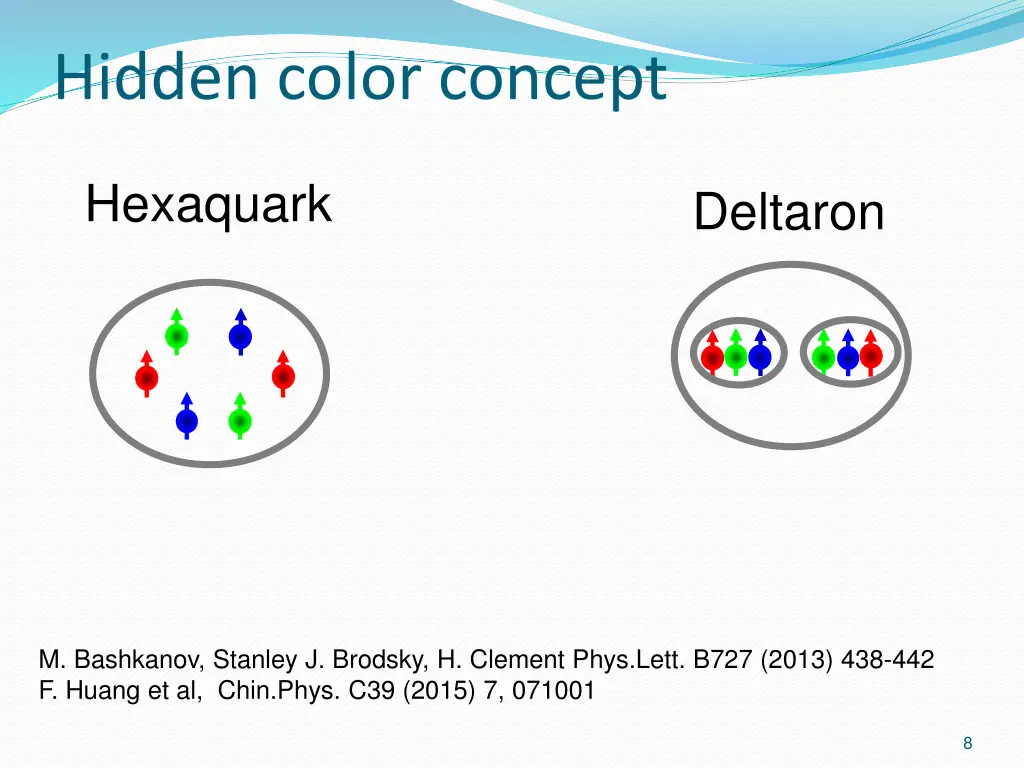
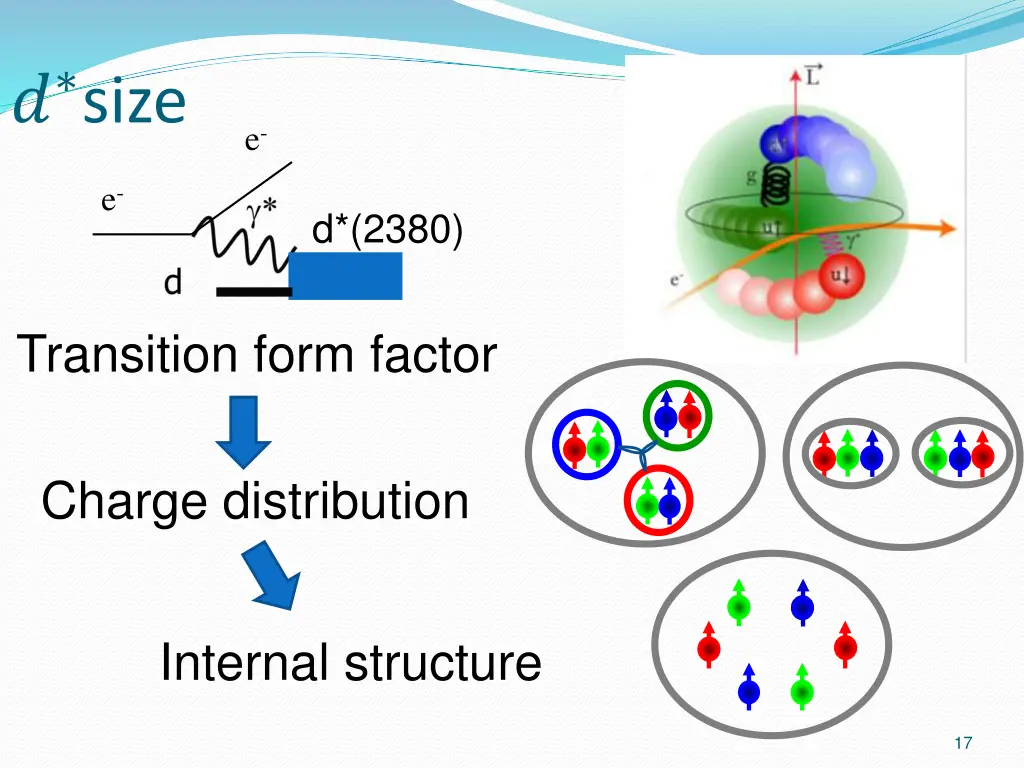
Hidden color concept Hexaquark Deltaron M. Bashkanov, Stanley J. Brodsky, H. Clement Phys.Lett. B727 (2013) 438-442 F. Huang et al, Chin.Phys. C39 (2015) 7, 071001 8
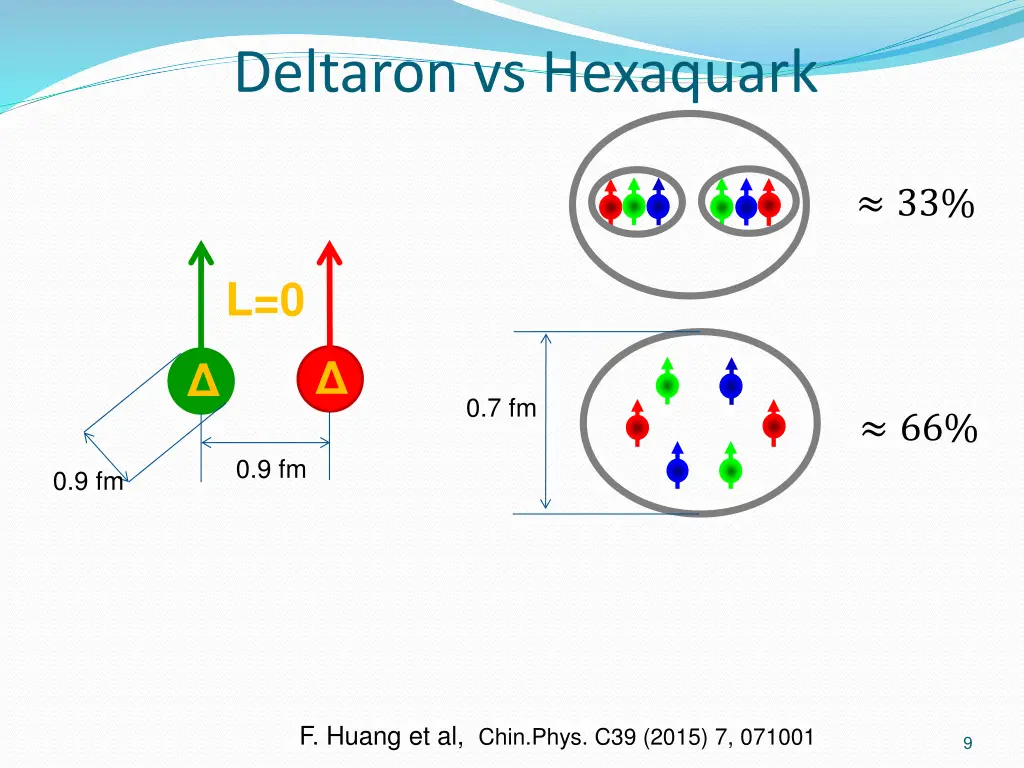
Deltaron vs Hexaquark 33% L=0 0.7 fm 66% 0.9 fm 0.9 fm F. Huang et al, Chin.Phys. C39 (2015) 7, 071001 9
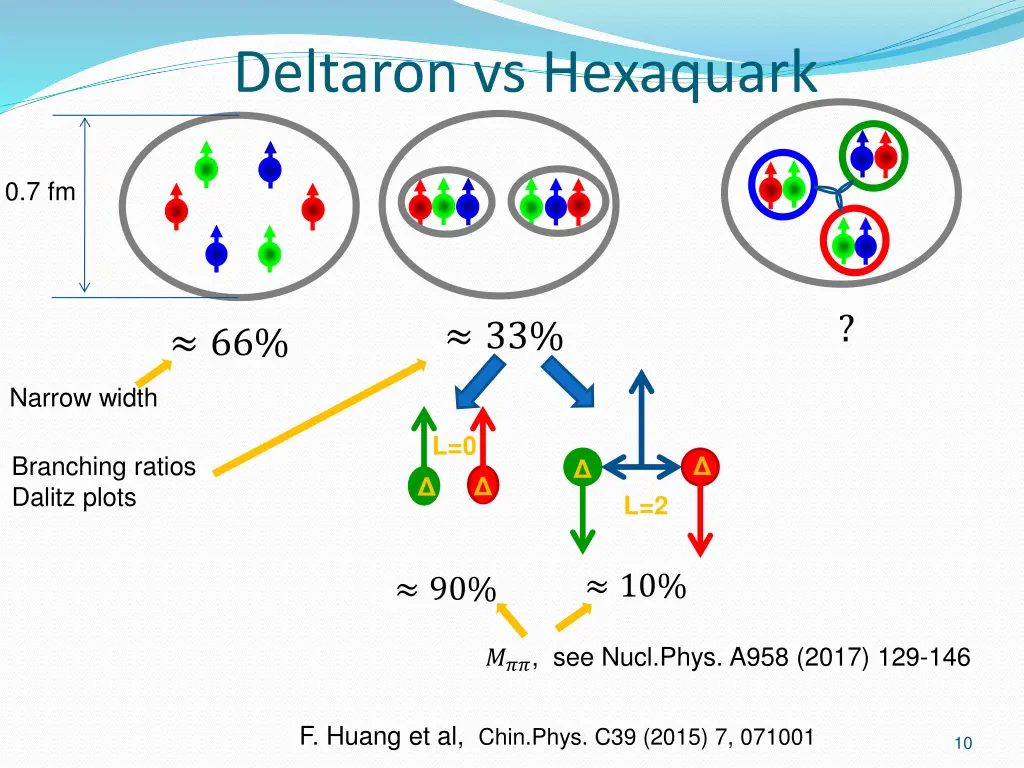
Deltaron vs Hexaquark 0.7 fm ? 33% 66% Narrow width L=0 Branching ratios Dalitz plots L=2 10% 90% ???, see Nucl.Phys. A958 (2017) 129-146 F. Huang et al, Chin.Phys. C39 (2015) 7, 071001 10
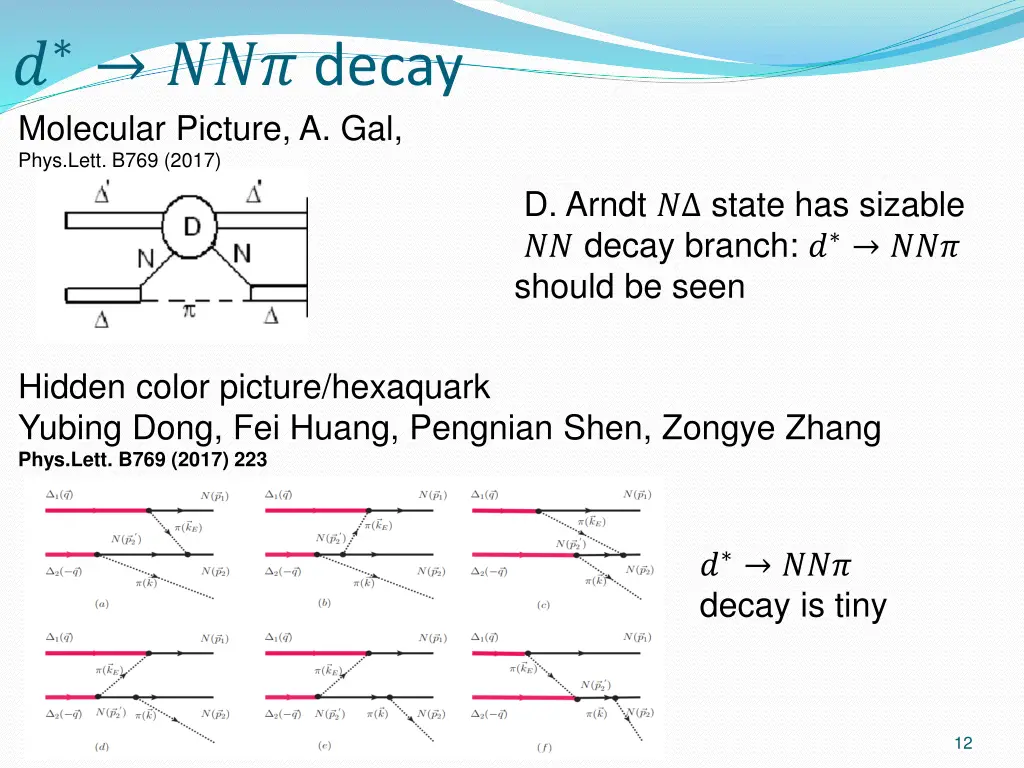
? ??? decay Molecular Picture, A. Gal, Phys.Lett. B769 (2017) D. Arndt ? state has sizable ?? decay branch: ? ??? should be seen Hidden color picture/hexaquark Yubing Dong, Fei Huang, Pengnian Shen, Zongye Zhang Phys.Lett. B769 (2017) 223 ? ??? decay is tiny 12
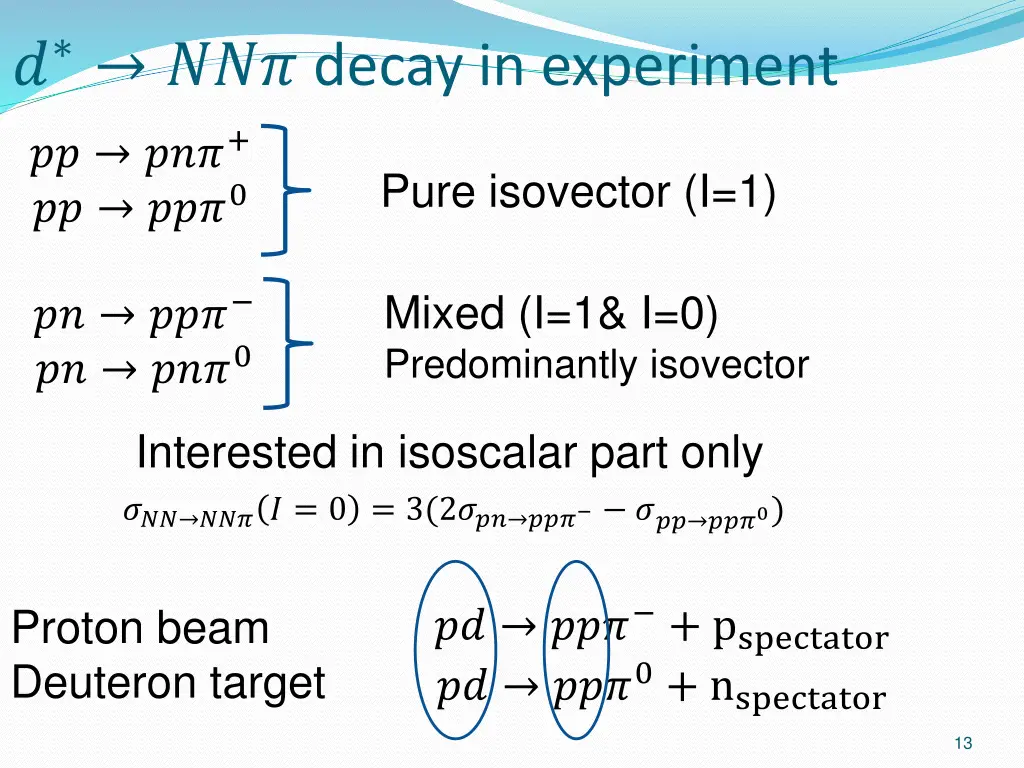
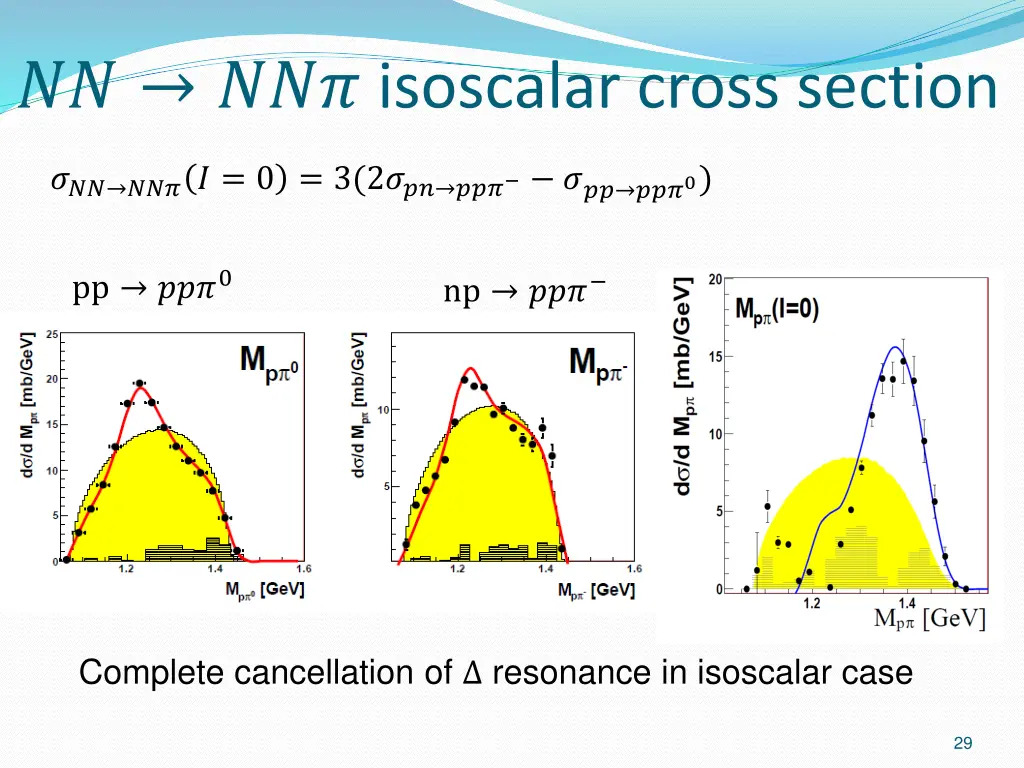
? ??? decay in experiment ?? ???+ ?? ???0 Pure isovector (I=1) Mixed (I=1& I=0) Predominantly isovector ?? ??? ?? ???0 Interested in isoscalar part only ??? ???? = 0 = 3(2??? ??? ??? ???0) ?? ??? + pspectator ?? ???0+ nspectator Proton beam Deuteron target 13
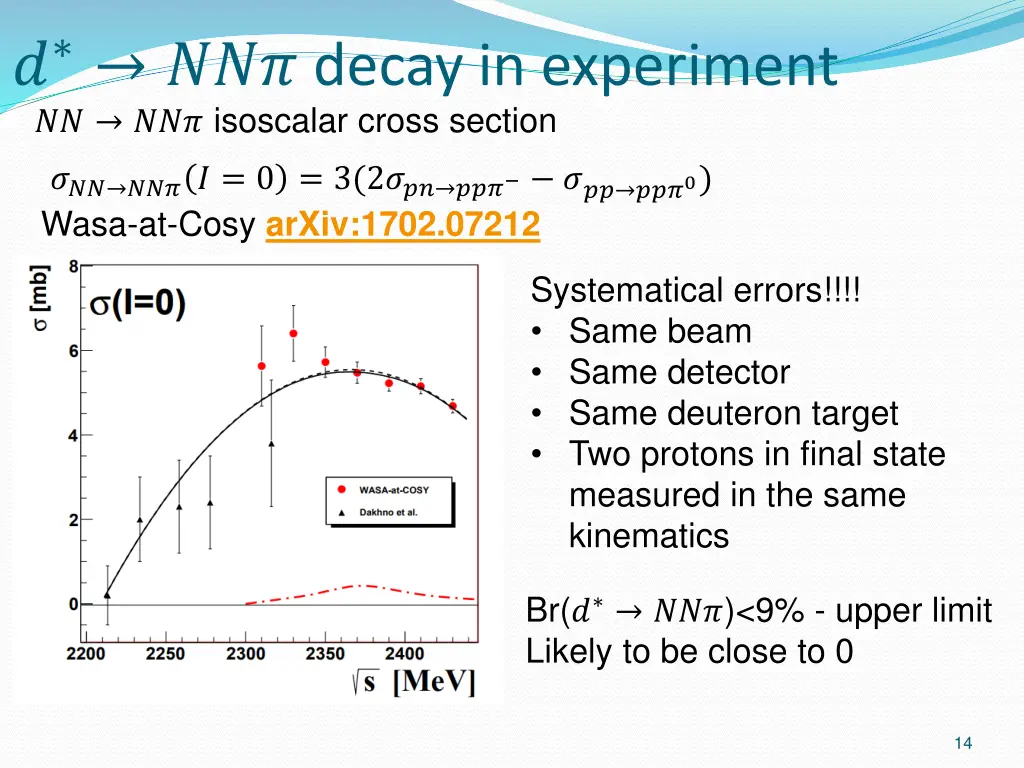
? ??? decay in experiment ?? ??? isoscalar cross section ??? ???? = 0 = 3(2??? ??? ??? ???0) Wasa-at-Cosy arXiv:1702.07212 arXiv:1702.07212 Systematical errors!!!! Same beam Same detector Same deuteron target Two protons in final state measured in the same kinematics Br(? ???)<9% - upper limit Likely to be close to 0 14
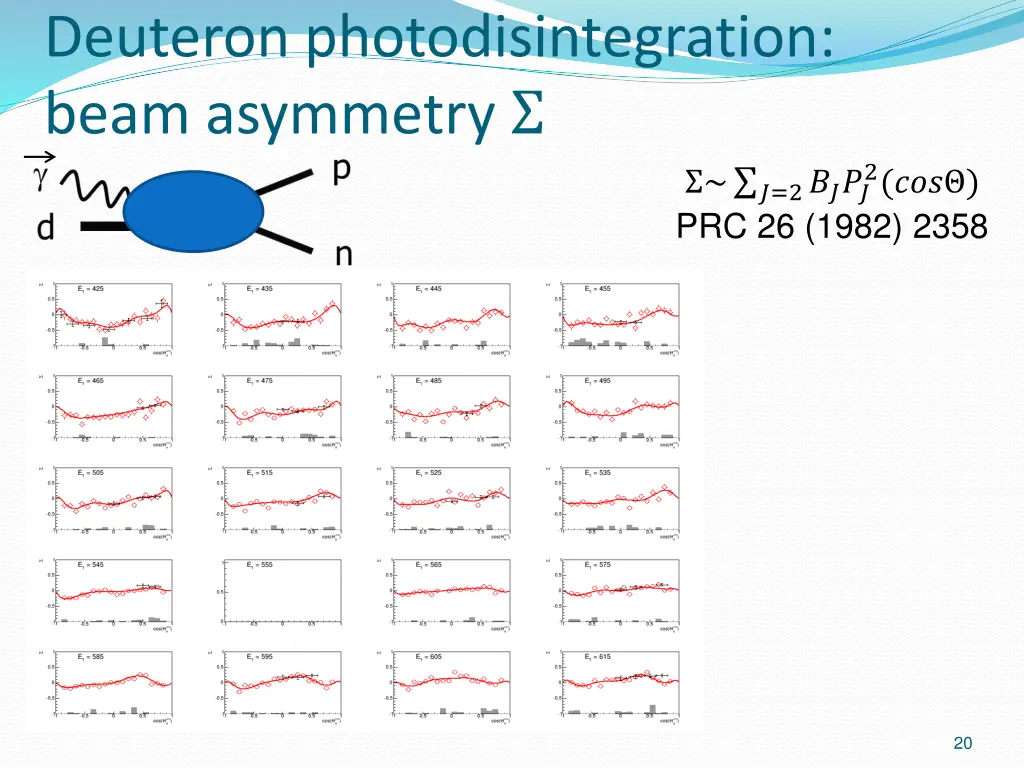
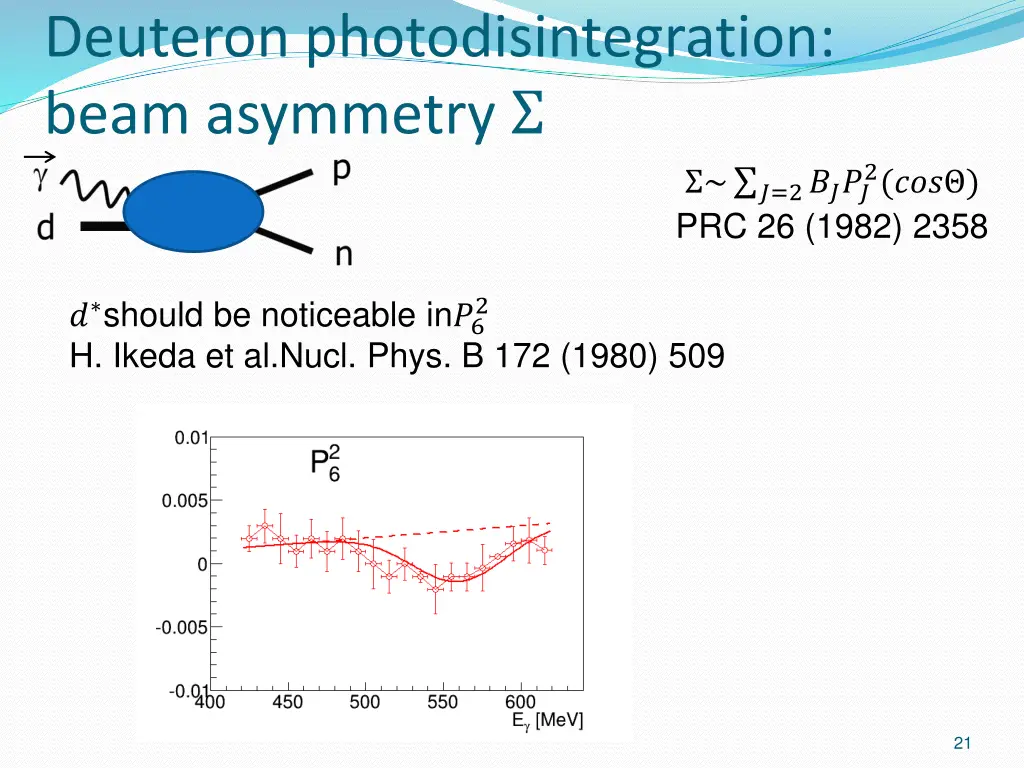
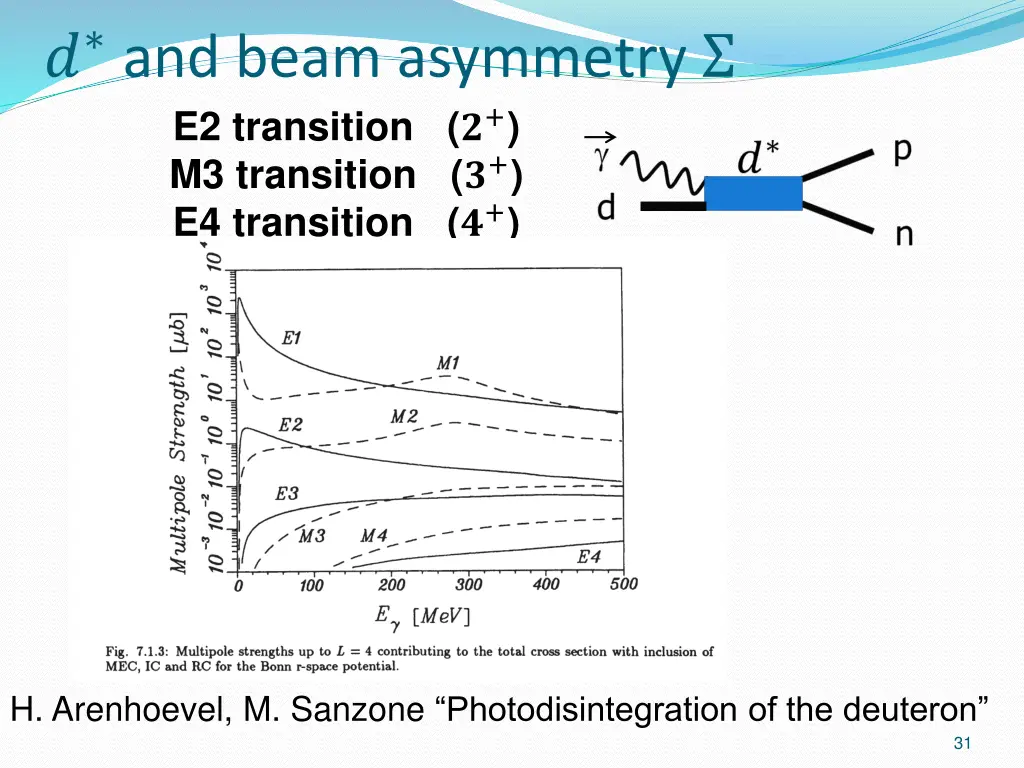
Deuteron photodisintegration: beam asymmetry ~ ?=2????2(??? ) PRC 26 (1982) 2358 ? should be noticeable in?6 H. Ikeda et al.Nucl. Phys. B 172 (1980) 509 2 21
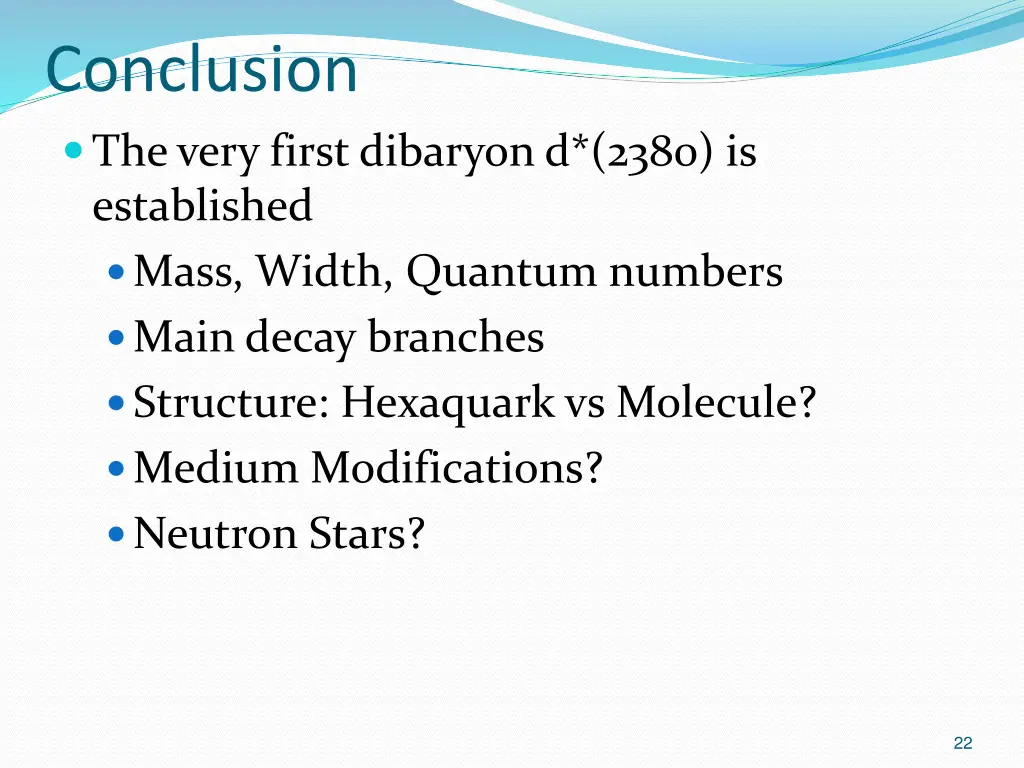
Conclusion The very first dibaryon d*(2380) is established Mass, Width, Quantum numbers Main decay branches Structure: Hexaquark vs Molecule? Medium Modifications? Neutron Stars? 22
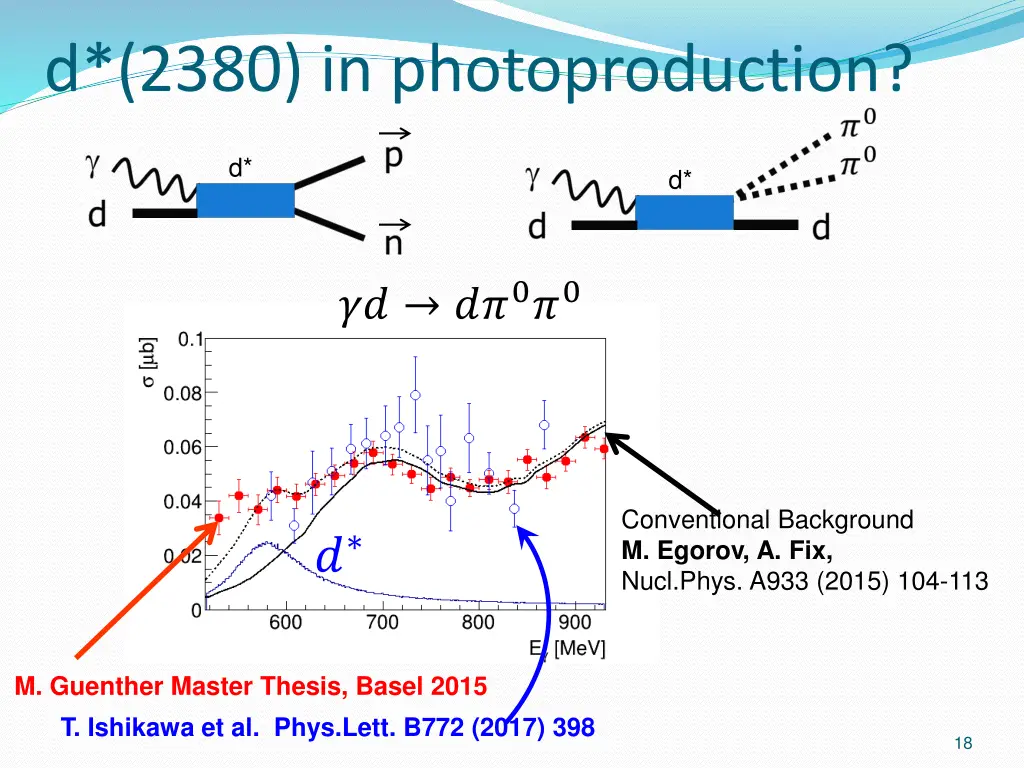
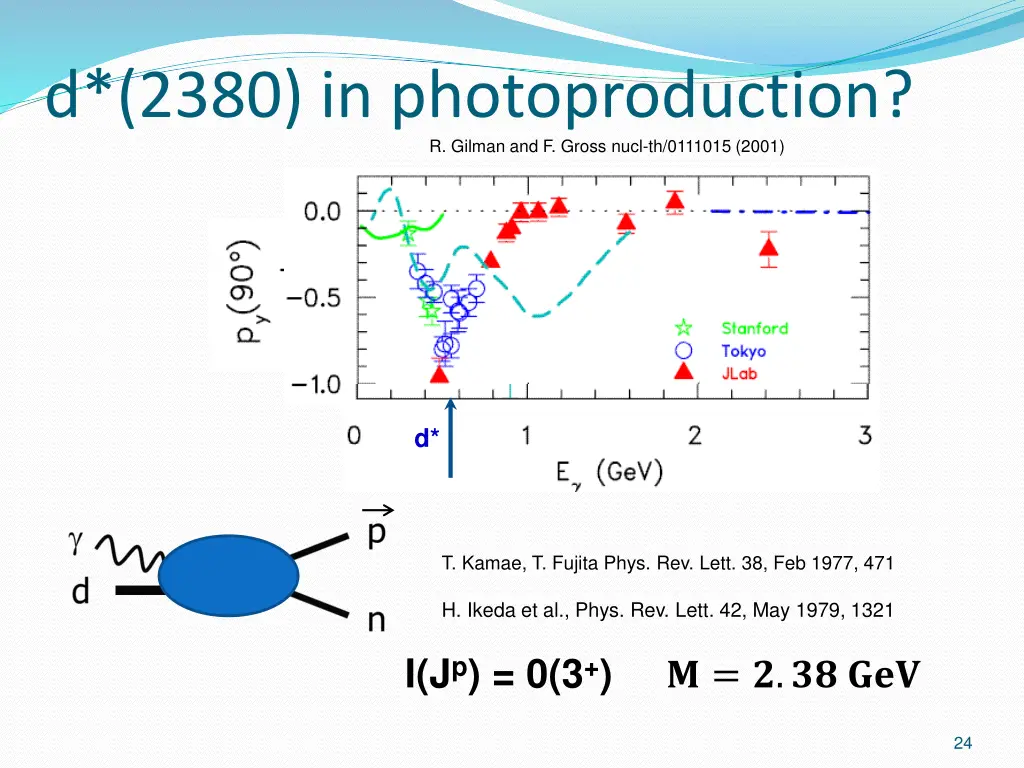
d*(2380) in photoproduction? R. Gilman and F. Gross nucl-th/0111015 (2001) d* T. Kamae, T. Fujita Phys. Rev. Lett. 38, Feb 1977, 471 H. Ikeda et al., Phys. Rev. Lett. 42, May 1979, 1321 I(Jp) = 0(3+) ? = ?.?? ??? 24
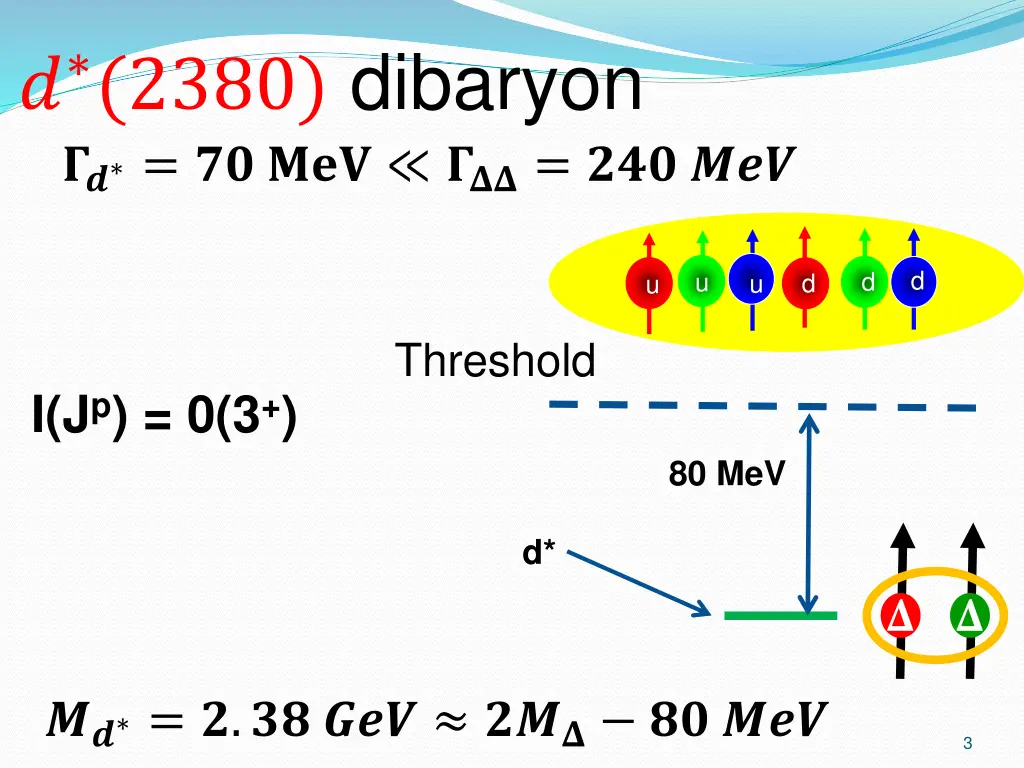
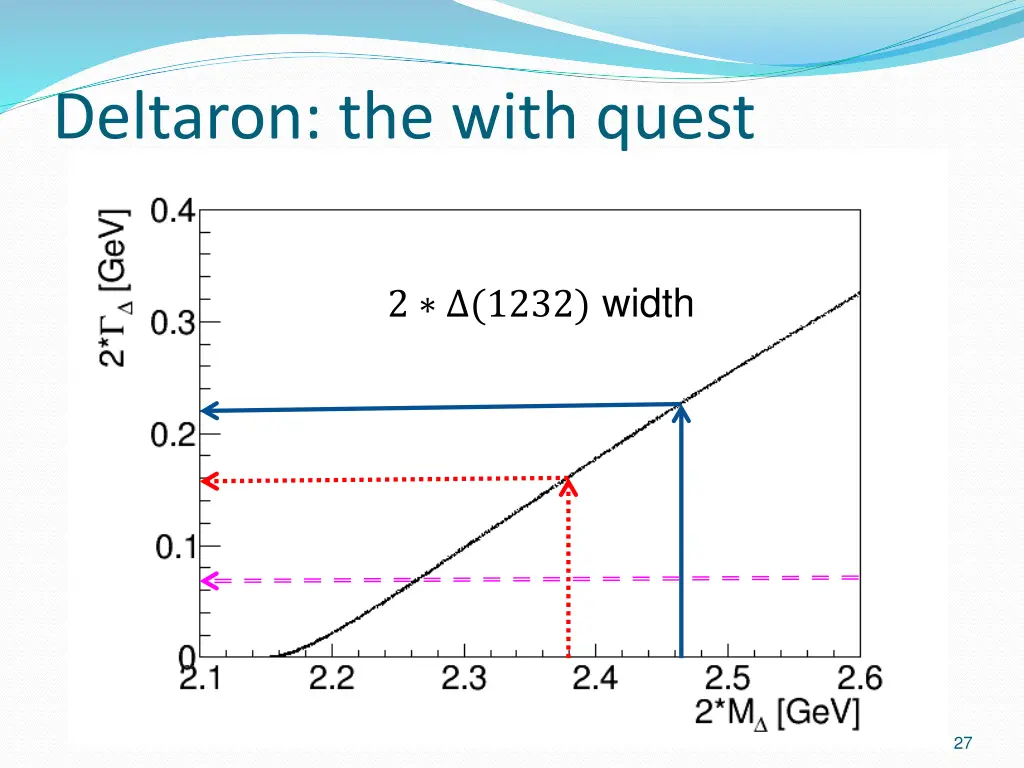
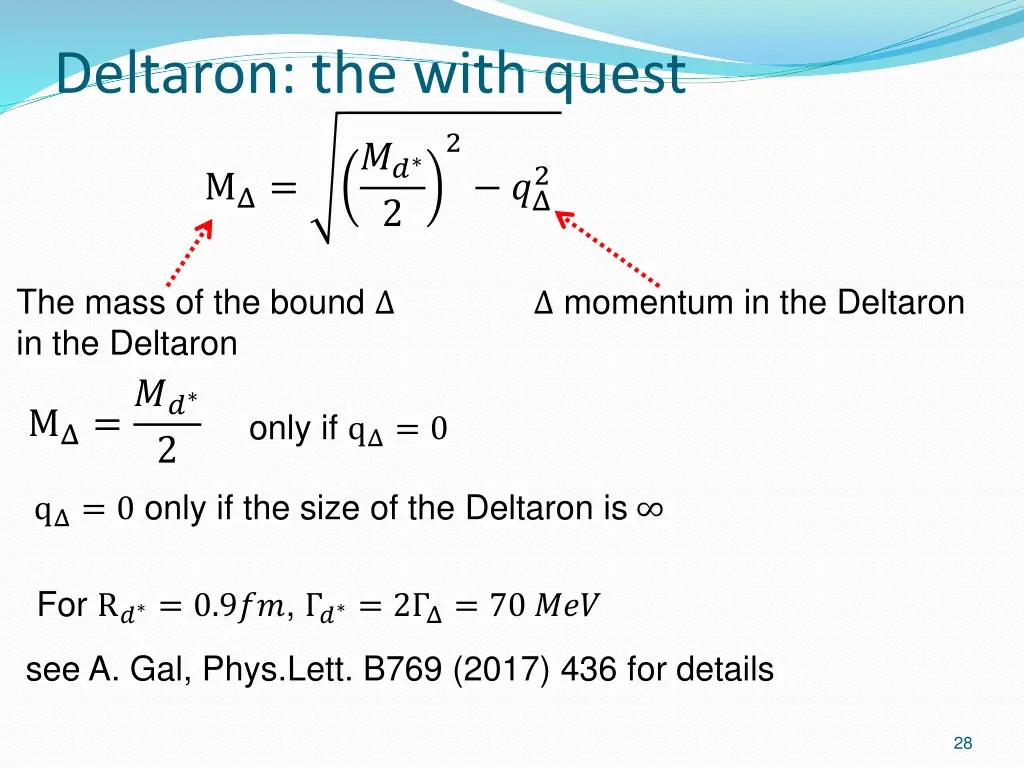
Deltaron: the with quest 2 ?? 2 2 M = ? The mass of the bound in the Deltaron M =?? 2 q = 0 only if the size of the Deltaron is momentum in the Deltaron only if q = 0 For R? = 0.9??, ? = 2 = 70 ??? see A. Gal, Phys.Lett. B769 (2017) 436 for details 28
?? ??? isoscalar cross section ??? ???? = 0 = 3(2??? ??? ??? ???0) pp ???0 np ??? Complete cancellation of resonance in isoscalar case 29
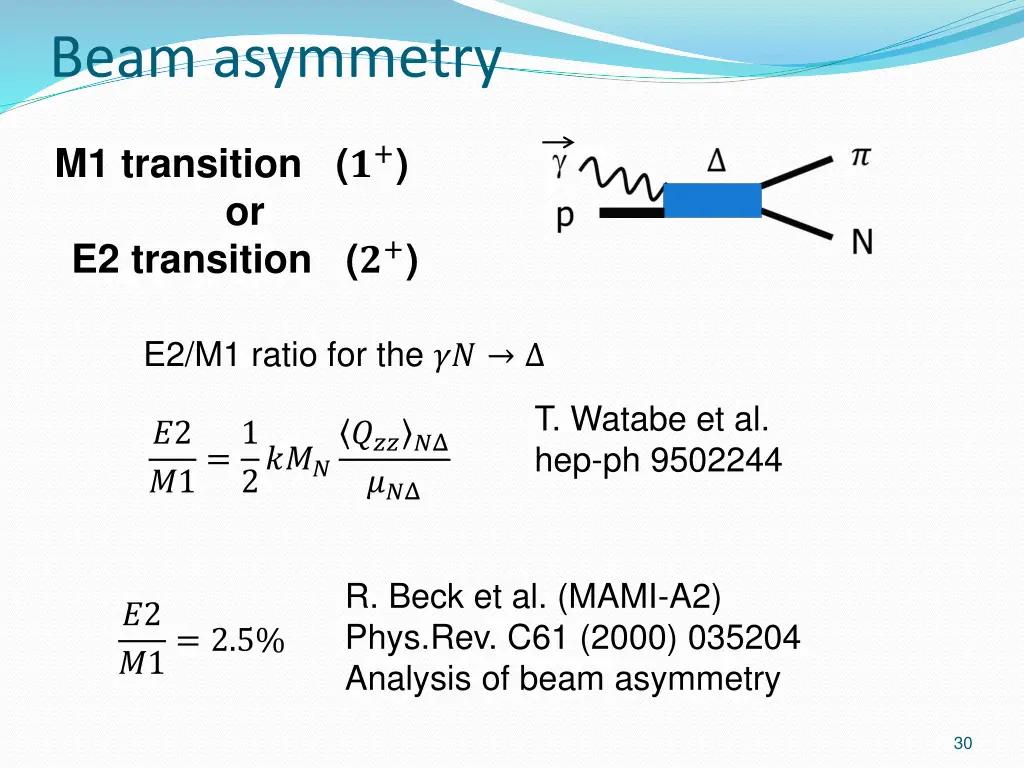
Beam asymmetry M1 transition (?+) or E2 transition (?+) E2/M1 ratio for the ?? T. Watabe et al. hep-ph 9502244 ?2 ?1=1 ??? ? ?? 2??? R. Beck et al. (MAMI-A2) Phys.Rev. C61 (2000) 035204 Analysis of beam asymmetry ?2 ?1= 2.5% 30
? and beam asymmetry E2 transition (?+) M3 transition (?+) E4 transition (?+) H. Arenhoevel, M. Sanzone Photodisintegration of the deuteron 31
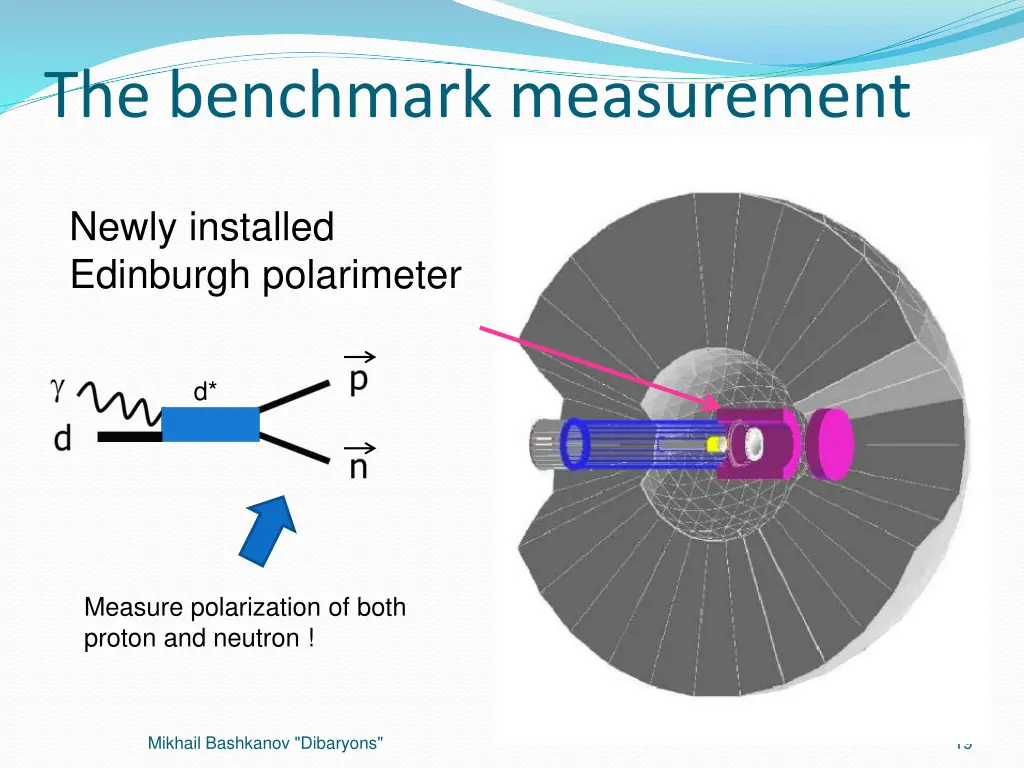
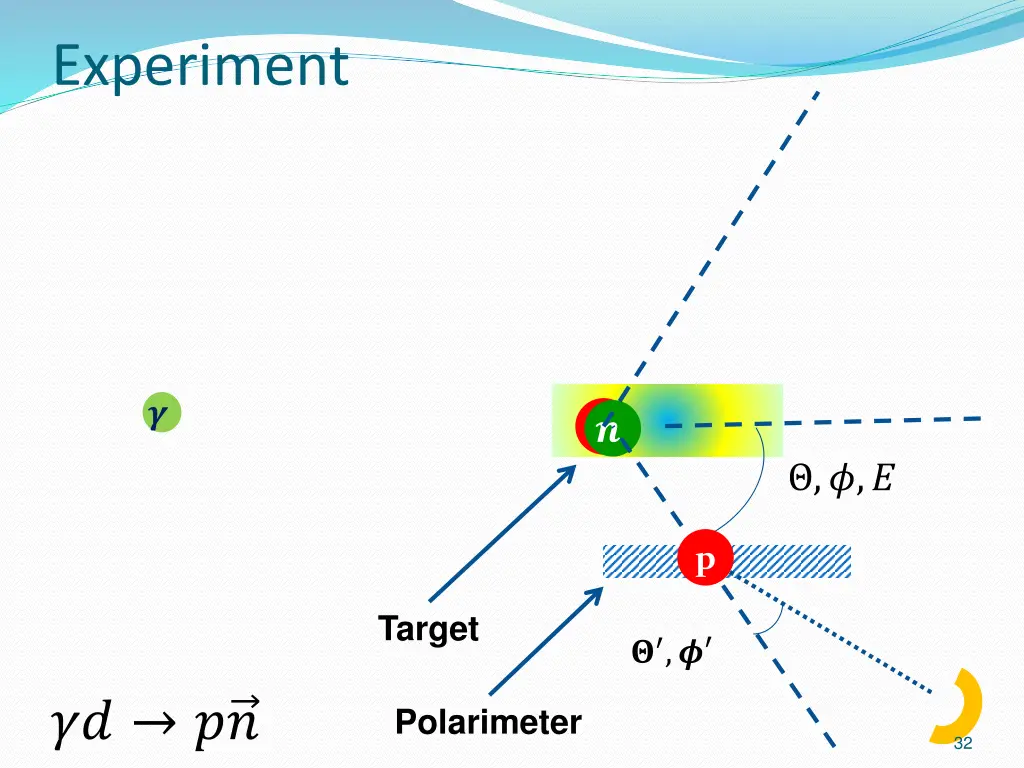
Experiment ? p ? ,?,? p Target ? ,? ?? ?? Polarimeter 32