Explore the existence and uniqueness of solutions of ordinary differential equations, distinguishing between linear and nonlinear equations. Theorems and examples illustrate how solutions are guaranteed based on continuity conditions, providing insights into solving initial value problems.
Please find below an Image/Link to download the presentation.
The content on the website is provided AS IS for your information and personal use only. It may not be sold, licensed, or shared on other websites without obtaining consent from the author. If you encounter any issues during the download, it is possible that the publisher has removed the file from their server.
You are allowed to download the files provided on this website for personal or commercial use, subject to the condition that they are used lawfully. All files are the property of their respective owners.
The content on the website is provided AS IS for your information and personal use only. It may not be sold, licensed, or shared on other websites without obtaining consent from the author.
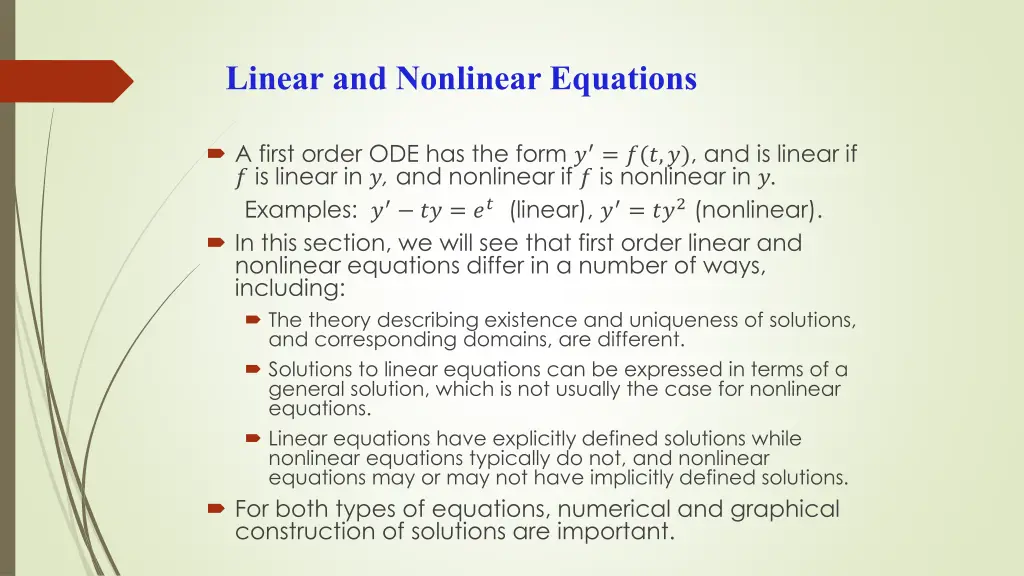
Linear and Nonlinear Equations A first order ODE has the form ? = ?(?,?), and is linear if ? is linear in ?, and nonlinear if ? is nonlinear in ?. Examples: ? ?? = ??(linear), ? = ??2(nonlinear). In this section, we will see that first order linear and nonlinear equations differ in a number of ways, including: The theory describing existence and uniqueness of solutions, and corresponding domains, are different. Solutions to linear equations can be expressed in terms of a general solution, which is not usually the case for nonlinear equations. Linear equations have explicitly defined solutions while nonlinear equations typically do not, and nonlinear equations may or may not have implicitly defined solutions. For both types of equations, numerical and graphical construction of solutions are important.
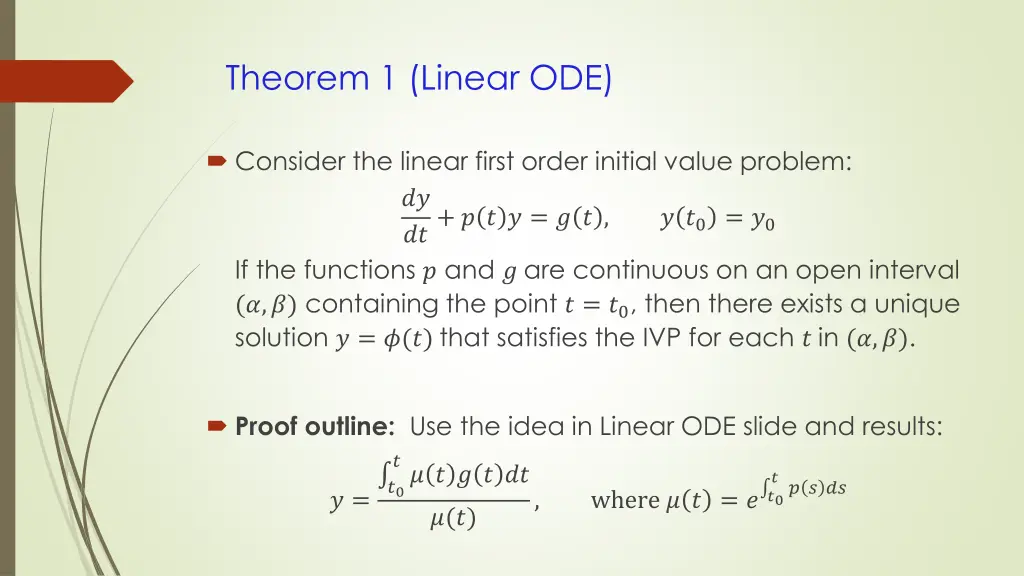
Theorem 1 (Linear ODE) Consider the linear first order initial value problem: ?? ??+ ? ? ? = ? ? , If the functions ? and ? are continuous on an open interval (?,?) containing the point ? = ?0, then there exists a unique solution ? = ?(?) that satisfies the IVP for each ? in (?,?). ? ?0 = ?0 Proof outline: Use the idea in Linear ODE slide and results: ?? ? ? ? ?? ?0 ?? ? ?? where ? ? = ? ?0 ? = , ?(?)
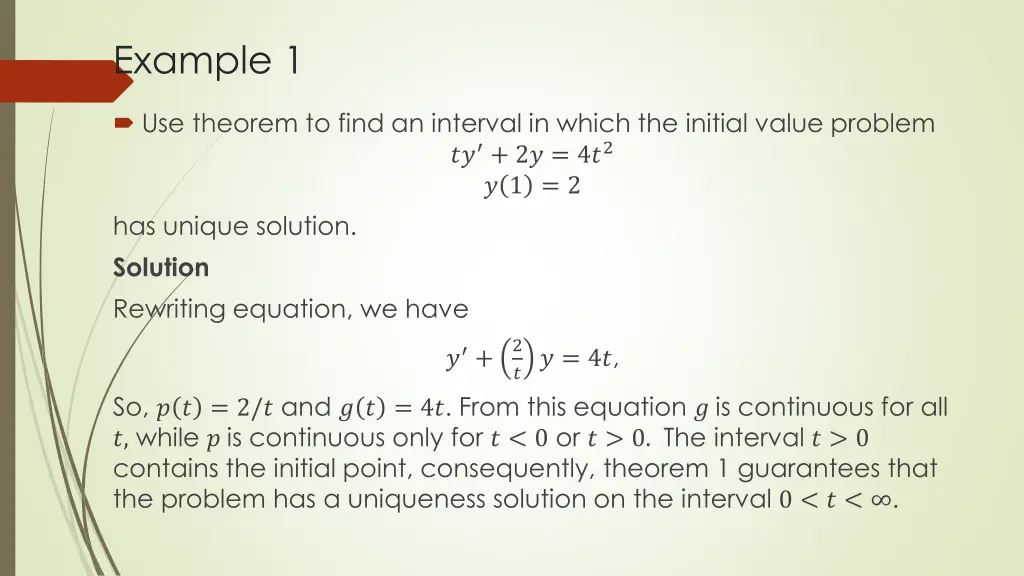
Example 1 Use theorem to find an interval in which the initial value problem ?? + 2? = 4?2 ? 1 = 2 has unique solution. Solution Rewriting equation, we have 2 ?? = 4?, ? + So, ? ? = 2/? and ? ? = 4?. From this equation ? is continuous for all ?, while ? is continuous only for ? < 0 or ? > 0. The interval ? > 0 contains the initial point, consequently, theorem 1 guarantees that the problem has a uniqueness solution on the interval 0 < ? < .
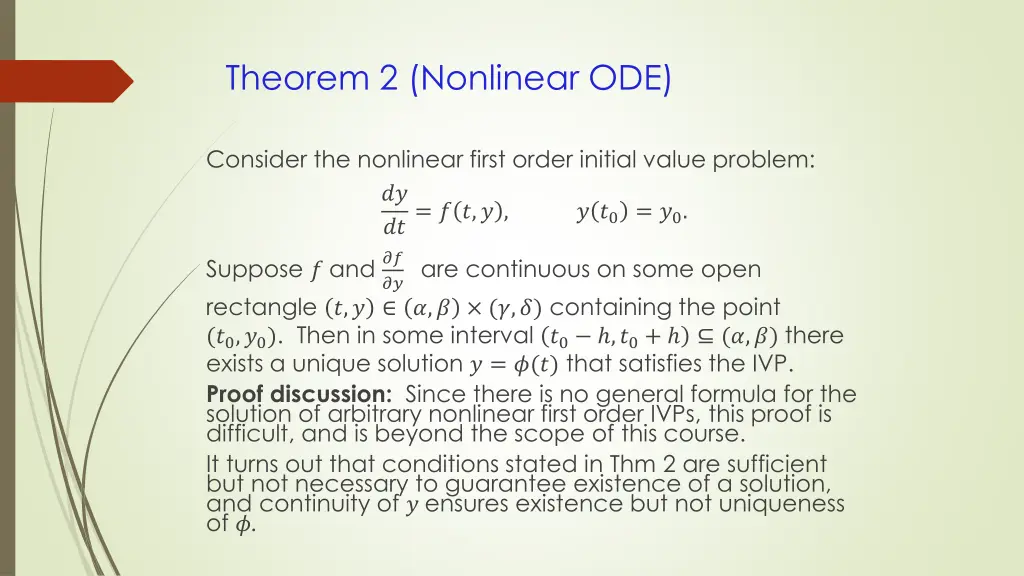
Theorem 2 (Nonlinear ODE) Consider the nonlinear first order initial value problem: ?? ??= ? ?,? , Suppose ? and ?? rectangle ?,? ?,? (?,?) containing the point (?0,?0). Then in some interval ?0 ,?0+ (?,?) there exists a unique solution ? = ?(?) that satisfies the IVP. Proof discussion: Since there is no general formula for the solution of arbitrary nonlinear first order IVPs, this proof is difficult, and is beyond the scope of this course. It turns out that conditions stated in Thm 2 are sufficient but not necessary to guarantee existence of a solution, and continuity of ? ensures existence but not uniqueness of ?. ? ?0 = ?0. ??are continuous on some open
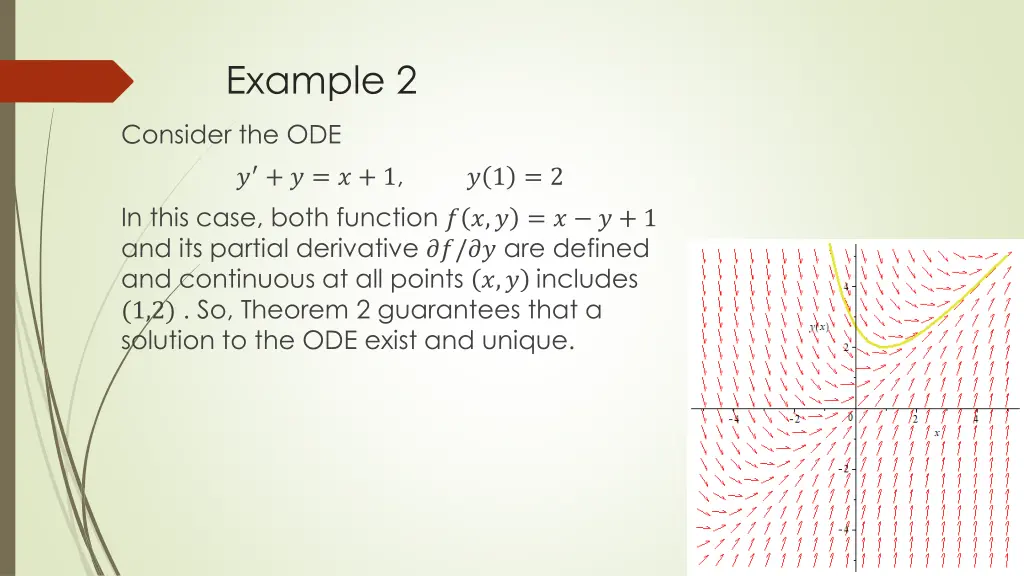
Example 2 Consider the ODE ? + ? = ? + 1, ? 1 = 2 In this case, both function ? ?,? = ? ? + 1 and its partial derivative ??/?? are defined and continuous at all points ?,? includes (1,2) . So, Theorem 2 guarantees that a solution to the ODE exist and unique.
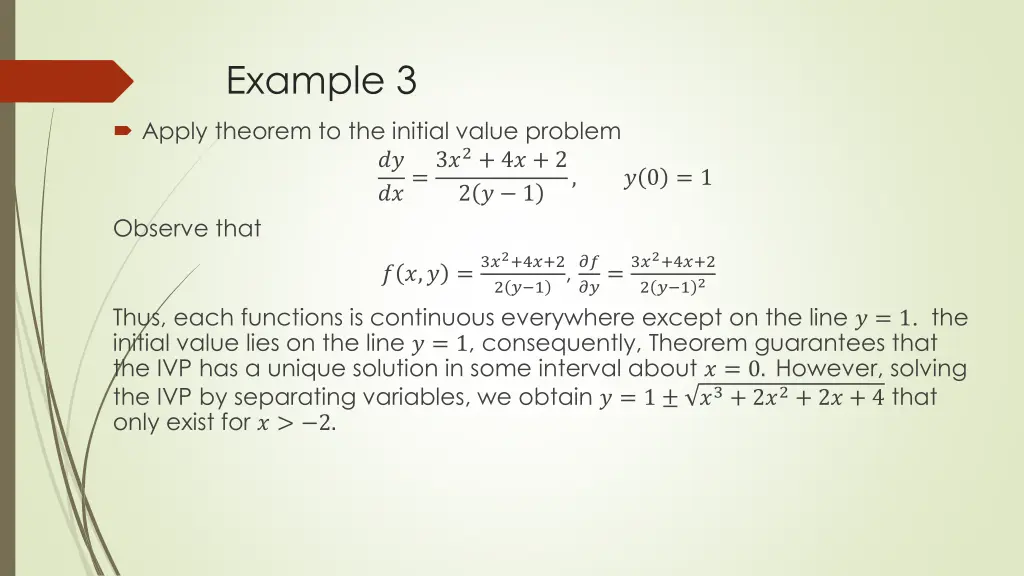
Example 3 Apply theorem to the initial value problem ?? ??=3?2+ 4? + 2 2 ? 1 , ? 0 = 1 Observe that ? ?,? =3?2+4?+2 ??=3?2+4?+2 2 ? 12 , ?? 2 ? 1 Thus, each functions is continuous everywhere except on the line ? = 1. the initial value lies on the line ? = 1, consequently, Theorem guarantees that the IVP has a unique solution in some interval about ? = 0. However, solving the IVP by separating variables, we obtain ? = 1 ?3+ 2?2+ 2? + 4 that only exist for ? > 2.
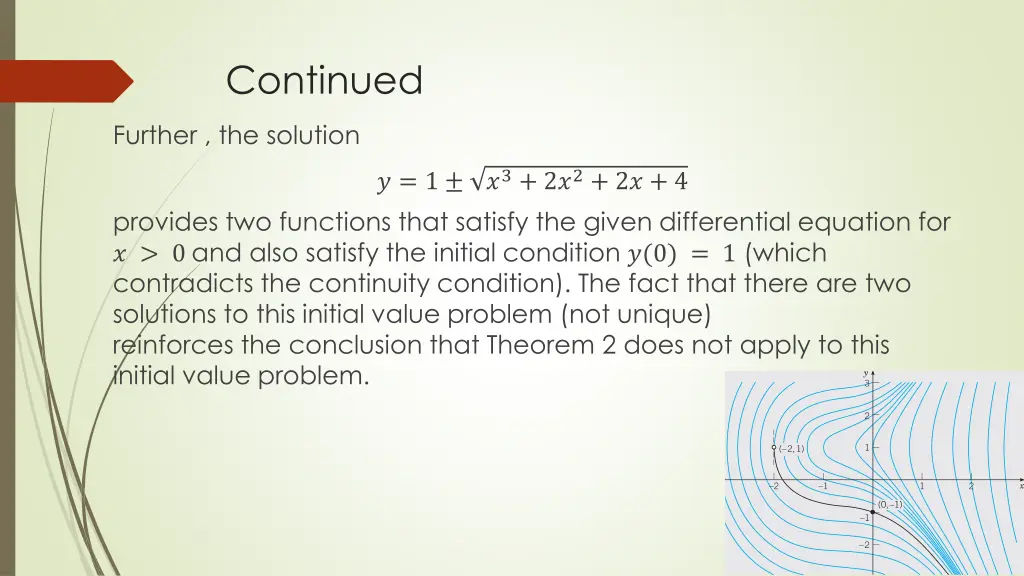
Continued Further , the solution ? = 1 ?3+ 2?2+ 2? + 4 provides two functions that satisfy the given differential equation for ? > 0 and also satisfy the initial condition ?(0) = 1 (which contradicts the continuity condition). The fact that there are two solutions to this initial value problem (not unique) reinforces the conclusion that Theorem 2 does not apply to this initial value problem.
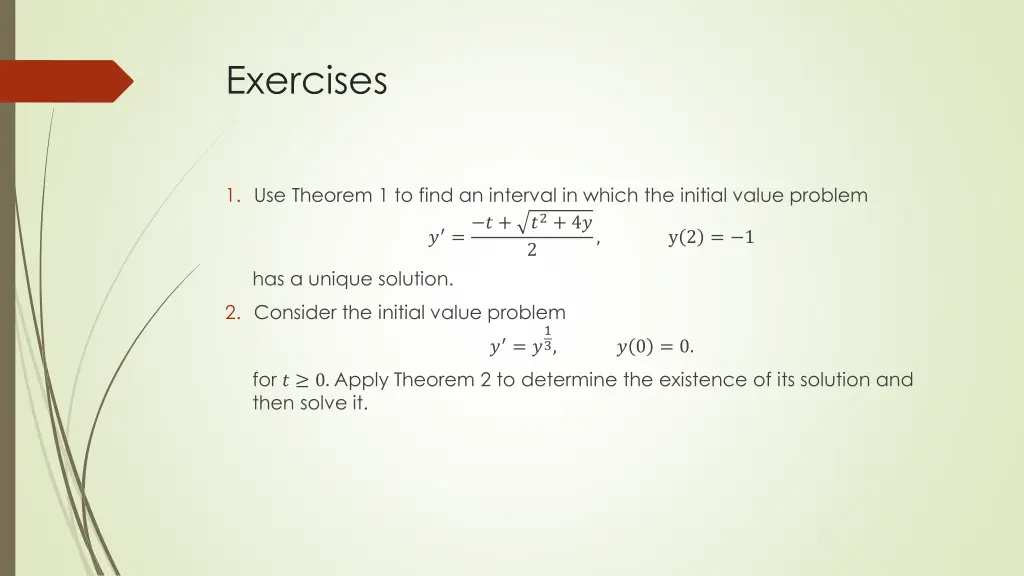
Exercises 1. Use Theorem 1 to find an interval in which the initial value problem ? = ? + 2 has a unique solution. ?2+ 4? , y 2 = 1 2. Consider the initial value problem 1 3, ? = ? ? 0 = 0. for ? 0. Apply Theorem 2 to determine the existence of its solution and then solve it.