Development of digital school culture for scientific literacy society in science education. Explore dimensions of digital transformations in schools focusing on teacher and school readiness, strategy and leadership, digital learning and teaching, and technological infrastructure.
Please find below an Image/Link to download the presentation.
The content on the website is provided AS IS for your information and personal use only. It may not be sold, licensed, or shared on other websites without obtaining consent from the author. If you encounter any issues during the download, it is possible that the publisher has removed the file from their server.
You are allowed to download the files provided on this website for personal or commercial use, subject to the condition that they are used lawfully. All files are the property of their respective owners.
The content on the website is provided AS IS for your information and personal use only. It may not be sold, licensed, or shared on other websites without obtaining consent from the author.
E N D
Presentation Transcript
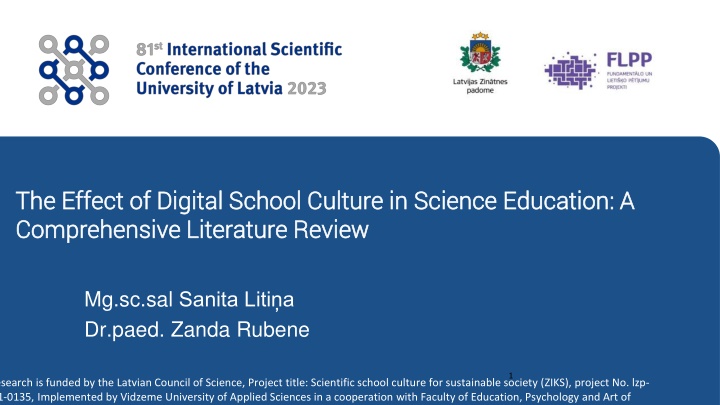
The The Effect Effect of of Digital Comprehensive Comprehensive Literature Digital School Culture School Culture i in n Science Literature Review Review Science Education Education: A : A Mg.sc.sal Sanita Liti a Dr.paed. Zanda Rubene 1 This research is funded by the Latvian Council of Science, Project title: Scientific school culture for sustainable society (ZIKS), project No. lzp- 2021/1-0135, Implemented by Vidzeme University of Applied Sciences in a cooperation with Faculty of Education, Psychology and Art of University of Latvia.
Introduction The development of science, technology, and global society requires continuous change in schools. One of the most prominent examples is the integration of the digital culture and the school culture, creating a "digital school culture". In the digital era, schools are agents in ensuring that all students benefit from digital technology to support the needs of digital and scientific literacy (Setyawan, 2022). Students who can understand scientific facts and the relationship between science, technology and society and implement their knowledge in solving real-life problems are called a scientific literacy society. Scientific literacy aims to develop skills and creativity based on relevant scientific knowledge and scientific evidence for decision making and problem-solving (OECD, 2018). Scientific literacy is critical in twenty-first-century education, because students need to apply the skills in everyday life. Scientific literacy is the determinant of the success of student learning (Jufrida et al., 2019; Pratiwi et al., 2019) Scientific literacy as the ability to fully involve oneself in a process associated with everyday life (Fives at al., 2014) 2
The ability to deal with technology Communication via electronic means Digital culture Access to information The ability to build a virtual relationship (Pavel, 2010) 3
Digital culture Digital culture are all relatively new terms that are today widely used in scientific and popular literature. Culture today should be understood as an open and dynamic process that is based on interactive communication, and we cannot think of it as an enclosed system which makes up a cultural mosaic with other similar or diverse cultural systems Digital culture is described as a participatory culture where users do not only consume information but also contribute in a variety of ways. Digital culture today frames our experience of the world around us and provides us with a complex set of digital tools for organizing novel relations of information and global-local cultural interaction 4
Dimensions of Digital Transformations in Schools Teacher readness (Employees) School readness (Organization) Strategy and Leadership Digital learning and teaching Culture Knowledge/Skills in dealing with digital technologies Sufficiant technological infrastructure and equipment Existence and implementation of a digital strategy Digital platforms, e-learning offerings Openness to new technologies Managers promote digitalization with priority Working with digital devices in classroom settings Usage of devices and services Functioning IT support Openness for change Open Analysis of new technologies Digital learning and teaching Digital education as an overall goal communication, mutual support Attitudes Democratic leadership style, creative freedom grante Practices of the teaching community Data-driven teaching and learning Readiness for further training Ifenthaler & Egloffstein, 2020 Petkoet al. 2018 The term digital transformation describes the profound structural change of the working world through digital technologies such as mobile, networked devices, cloud computing, digital networking, social media, internet of things, big data, artificial intelligence, and robotics (Bosch et al., 2018) 5
Digital school culture In digital school culture, adults become guides and pioneers. Students become directors of metacognitive Learning untethered, student-centric, and connected practices and (Crompton&Burke 2015). learning pedagogical learning and The use of new technologies changes the way of school culture. In knowledge creation, learning and innovation become the milestone through support of digitalization school culture (Aksal, 2016) learners. becomes this respect, in structures best Digital school culture is a fluid culture based on the interaction of elements from both school digital culture, as opposed to school culture digital medium (Setyawan, 2022) the in culture and through a 6
Objective The present comprehensive literature review aims to provide an overview of relevant research regarding components of digital school culture in science education. 7
Identifying items Four databases were used to conduct the scoping literature review: EBSCO, ERIC, Scopus and Web of Science. The data was carried out on November 1, 2022, with the keywords digital school culture , scientific literacy , digital school culture in science education from 2009 until 2022. Inclusion and exclusion criteria Criteria Included Excluded Time frame 2009-2022 Before 2009 and after 2022 Publication type Online peer-reviewed articles Policy documents, books, reports Focus Studies with a primary focus on Articles focusing on other components components of digital school culture in science education Language English Other languages Target population Articles focusing on schools students Articles focusing on higher education students 8
Author (Year), Country Research design Components of digital school culture to affect science education Alneyadi, S. S. (2019) United Arab Emirates Qualitative, focus group design Digital technologies and tool (Virtual labs) Al-Rsa'I (2013) Jordan Mixed-design Digital technologies and tool (Website technology) Digital curriculum Dana Craciun & Madalin Bunoiu, 2019 Romania Mixed-design Digital technologies and tool (Digital science comics) Harrison et al. (2009) UK Qualitative Digital technologies and tool (Virtual labs) Korkman & Metin (2021) Turkey Quantitative Pedagogical practices with digital technology Inquiry based online collaborative learning Quasi-experimental design Nurwahidah et al. (2017) Indonesia Quantitative Pedagogical practices with digital technology (Project based learning model with an Android) Quasi-experimental design Putri et al., (2022). Indonesia Quantitative Digital technologies and tool (Flip pdf-based digital book media) Pre-Experimental Design Risniawati et al. (2020) Indonesia Mixed-design Digital learning system (E-learning media) Suryanti et al., (2021) Indonesia Mixed-design Digital technologies and tool (Gadgetbased interactive multimedia) 9
Author (Year), Country Research design Components of digital school culture to affect science education Alneyadi, S. S. (2019) United Arab Emirates Qualitative, focus group design Digital technologies and tool (Virtual labs) Al-Rsa'I (2013) Jordan Mixed-design Digital technologies and tool (Website technology) Digital curriculum Dana Craciun & Madalin Bunoiu, 2019 Romania Mixed-design Digital technologies and tool (Digital science comics) Harrison et al. (2009) UK Qualitative Digital technologies and tool (Virtual labs) Korkman & Metin (2021) Turkey Quantitative Pedagogical practices with digital technology Inquiry based online collaborative learning Quasi-experimental design Nurwahidah et al. (2017) Indonesia Quantitative Pedagogical practices with digital technology (Project based learning model with an Android) Quasi-experimental design Putri et al., (2022). Indonesia Quantitative Digital technologies and tool (Flip pdf-based digital book media) Pre-Experimental Design Risniawati et al. (2020) Indonesia Mixed-design Digital learning system (E-learning media) Suryanti et al., (2021) Indonesia Mixed-design Digital technologies and tool (Gadgetbased interactive multimedia) 10
Key findigs from Comprehensive review Digital curriculum supports information culture of learners and helps to prepare them to technology- directed-world, if it is designed and developed properly (Mckenzie, 2000) Mastery of technology through digital literacy in educators has an influence on the readiness of learning administration that supports increasing scientific literacy (Sari et al., 2021) Online learning with android can improve students' scientific literacy in aspects of science knowledge (Nurwahidah et al. 2017) Develop of e-learning media can improve students science literacy (Risniawati et al 2020) Gadget Based Interactive Multimedia is compatible as an alternative learning media to improve elementary students' scientific literacy (Suryanti et al., 2021) Online collaborative inquiry- based learning method is more effective on students' scientific process skills than inquiry-based collaborative learning (Korkman & Metin 2021) Practical work activities using VLs had positive impact on increasing students scientific knowledge, scientific process (Alneyadi, 2019) 11
Key Components of digital school culture in science education Scientific literacy Digital environments (to support their students learning); Pedagogical practices with digital technology Digital learning system Digital Digital curriculum Digital Competence technologies and tool 12
Conclusion So far, research shows that digital school culture components have not been widely studied, including the impact on science education. The construct of digital school culture can help to understand the global factors that contribute to the transformation process related to the school environment, including science education. The digital competencies of teachers and students play an essential role in related change processes of innovative digital school model development. The discovered components of digital school culture in the review could be helpful for both schools and education policymakers on school improvement, the creation of innovations, and digital technology in education as a particular case of innovations and learning. 13
References Aksal F. A. Are headmasters digital leaders in school culture? Education and Science/ Egitim ve Bilim. 2015, 40(182), 77 86. Crompton, Helen and Burke, Diane, "School Culture for the Mobile Digital Age" (2015). Teaching & Learning Faculty Publications. 27. Danang Dwi Harmoko, Digital Literacy As a Solution To Improve the Quality of Indonesia S Human Resources, Research and Development Journal Of Education 7, no. 2 (2021): 413 23, http://dx.doi.org/10.30998/rdje.v7i2.10569. Ifenthaler, D., & Egloffstein, M. (2020). Development and implementation of a maturity model of digital transformation. TechTrends, 64(2), 302 309. https://doi.org/10.1007/s11528-019-00457-4. OECD. en.pdf?expires=1648109214&id=id&accname=guest&checksum=96F9 A33E6FBCAE1E3FC8462507E2E044 (2018). PISA 2018 Draft analytical Frameworks. In OECD (Issue May 2016). https://www.oecdilibrary.org/docserver/b25efab8- Fives, H., Huebner, W., Birnbaum, A. S., & Nicolich, M. (2014). Developing a measure of scientific literacy for middle school students. Science Education, 98(4), 549 580. https://doi.org/10.1002/sce.21115 Pratiwi, S. N., Cari, C., & Aminah, N. S. (2019). The 21st century science learning with student science literacy. Jurnal Materi Dan Pembelajaran Fisika (JMPF), 9, 34 42. https://doi.org/10.20961/jmp f.v9i1.31612 Putri, I.B.K. ., & Wulandari, F. (2022). Scientific Literacy Skill Through Digital Media Professional Pdf Flip Based Book in Elementary School. Jurnal Penelitian Pendidikan IPA, 8(5), 2266 2271. https://doi.org/10.29303/jppipa.v8i5.2181 Jufrida, J., Basuki, F. R., Kurniawan, W., Pangestu, M. D., & Fitaloka, O. (2019). Scientific literacy and science learning achievement at junior high school. International Journal of Evaluation and Research in Education, 8(4), 630 636. https://doi.org/10.11591/ijere.v8i4.20312 Petko, D., Prasse, D., & Cantieni, A. (2018b). The interplay of school readiness and teacher readiness for educational technology integration: a structural equation model. Computers in the Schools, 35(1), 1 18. https://doi.org/10.1080/07380569.2018.1428007. S. Suryanti, Wahono Widodo, and Yoyok Yermiandhoko, Gadget-Based Interactive Multimedia on Socio-Scientific Issues to Improve Elementary Students Scientific Literacy, International Journal of Interactive Mobile Technologies 15, no. 1 (2021): 56 69, https://doi.org/10.3991/IJIM.V15I01.13675 14
Paldies par uzmanbu! This research is developed in the frame of the project Scientific school culture for sustainable society (ZIKS) lzp-2021/1-0135 15