Digital India to
CMAI Association of India, in collaboration with various organizations, is driving the initiative to transform India through Digital India. This program focuses on empowering citizens digitally, enhancing online infrastructure, and increasing Internet connectivity to make government services easily accessible. The vision is to create a digitally empowered society and knowledge economy in India.

Uploaded on | 1 Views
Download Presentation

Please find below an Image/Link to download the presentation.
The content on the website is provided AS IS for your information and personal use only. It may not be sold, licensed, or shared on other websites without obtaining consent from the author. If you encounter any issues during the download, it is possible that the publisher has removed the file from their server.
You are allowed to download the files provided on this website for personal or commercial use, subject to the condition that they are used lawfully. All files are the property of their respective owners.
The content on the website is provided AS IS for your information and personal use only. It may not be sold, licensed, or shared on other websites without obtaining consent from the author.
E N D
Presentation Transcript
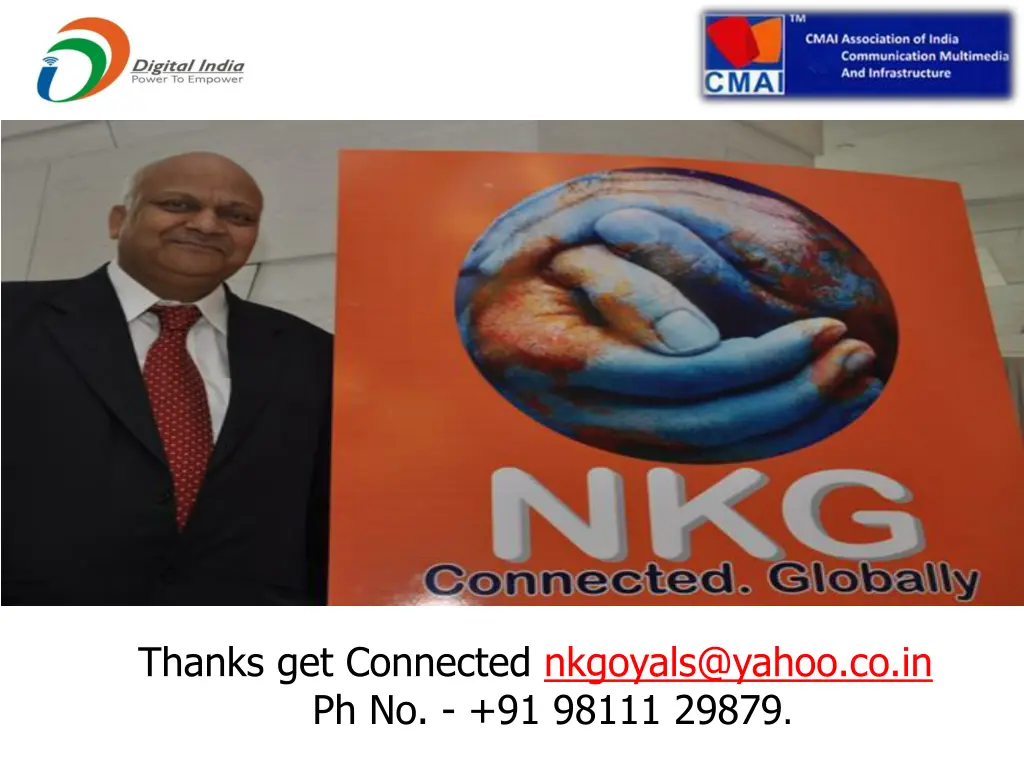
Digital India to Transform India Key Note Presentation by Prof NK Goyal President : CMAI Association of India Advisor : Gujarat Technical University Director : North Gujarat University, center of Excellence for Make in India , Skill India, Digital India , ESDM Chairman : Telecom Equipment Manufacturing Association of India(TEMA) Founder Member : Council of Electronic Hardware Association of India (CEHA) Vice Chairman : ITU APT, Affiliate ITU Geneva National Seminar on Digital India : An Initiative to transform Nation 7thApril, 2016, IMS Ghaziabad
About CMAI CMAI prime Integrated Association of India representing all verticals of ICE, telecom sector of India in India having more than 54 MOUs with International organizations, with branch offices in Japan, Korea, Singapore, Taiwan, China and Malaysia. It offers one window service for information dissemination, guidance on setting up businesses in India. It connects to Industries, Government, Trade and Business It is involved in policy formulations with Government and other stake holders for Technology manufacturing It is developing scientific knowledge and practical means for protecting human ecology and environment from the harmful effects of environmental hazards like e waste, radiation etc. It assists manufacturers to maximize competitiveness in the domestic and international markets. It also offers consultancy services on turn key basis through its member companies Innovations, Indigenous
Where we are? India on fastest growth in world India faced with unique situations and diversity, culture, disparities in income, education, living standards, employment One of concern to reach every citizen, make processes, smooth and corruption free Policies to empower and develop citizens Digital growth beyond expectations..internet, mobile India is continuously facing cyber threats like cyber warfare, cyber terrorism and cyber espionage. Lack of requisite skills, trainings and expertise
What is Digital India? A Programme to transform India into a digitally empower society & knowledge economy. Digital empowerment of citizens: Universal digital literacy; All digital resources universally accessible; All Government documents/certificates to be available on the Cloud; Availability of digital resources/services in Indian languages; Collaborative digital platforms for participative governance; Portability of all entitlements for individuals through the cloud. To ensure that Government services are made available to citizens electronically by improving online infrastructure and by increasing Internet connectivity or by making the country digitally empowered in the field of technology.
What is Digital India..contd. It is an Umbrella Programme covering many departments. It weaves together a large number of ideas and thoughts into a single, comprehensive vision so that each of them is seen as part of a larger goal. Each individual element stands on its own. But is also part of the larger picture. It is coordinated by DeitY, implemented by the entire government. The weaving together makes the Mission transformative in totality The Programme: Pulls together many existing schemes. These schemes will be restructured and re-focused. They will be implemented in a synchronized manner. Many elements are only process improvements with minimal cost. The common branding of programmes as Digital India highlights their transformative impact.
Vision of Digital India Centered on 3 Key Areas Digital Infrastructure as a Utility to Every Citizen Governance & Services on Demand Digital Empowerment of Citizens
Vision Area 1: Infrastructure as a Utility to Every Citizen High speed internet as a core utility Cradle to grave digital identity -unique, lifelong, online, authenticable Mobile phone & Bank account enabling participation in digital & financial space Easy access to a Common Service Centre Shareable private space on a public cloud Safe and secure Cyber-space
Vision Area 2: Governance & Services On Demand Seamlessly integrated across departments or jurisdictions Services available in real time from online &mobile platform All citizen entitlements to be available on the cloud Services digitally transformed for improving Ease of Doing Business Making financial transactions electronic & cashless Leveraging GIS for decision support systems & development
Vision Area 3: Digital Empowerment of Citizens Universal Digital Literacy Universally accessible digital resources All documents/ certificates to be available on cloud Availability of digital resources / services in Indian languages Collaborative digital platforms for participative governance Portability of all entitlements through cloud
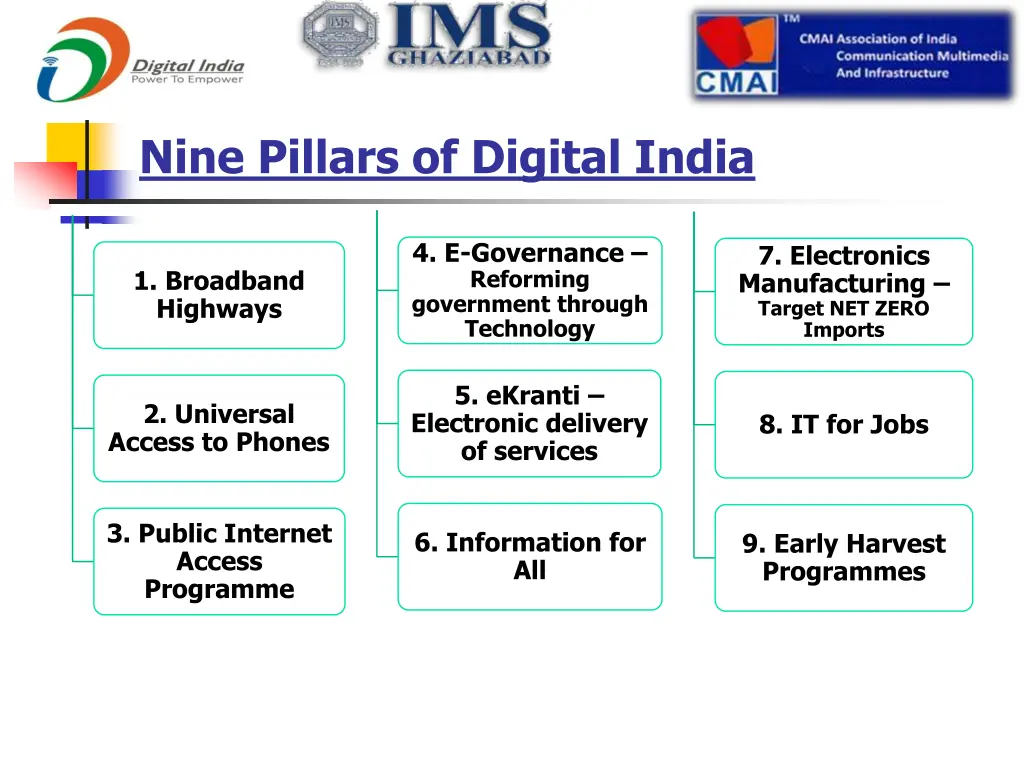
Nine Pillars of Digital India Electronics Manufacturing 4. E-Governance Reforming government through Technology 7. Electronics Manufacturing Target NET ZERO Imports 1. Broadband Highways 5. eKranti Electronic delivery of services 2. Universal Access to Phones 8. IT for Jobs 3. Public Internet Access Programme 6. Information for All 9. Early Harvest Programmes
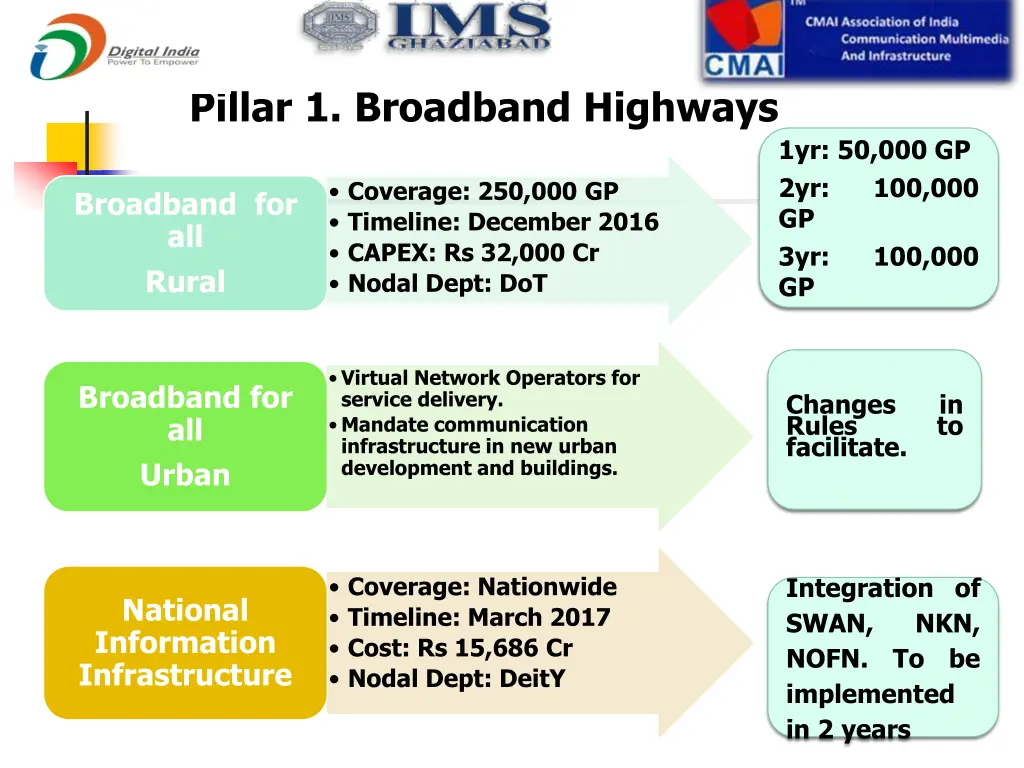
Pillar 1. Broadband Highways 1yr: 50,000 GP 2yr: 100,000 GP 3yr: 100,000 GP Coverage: 250,000 GP Timeline: December 2016 CAPEX: Rs 32,000 Cr Nodal Dept: DoT Broadband for all Rural Virtual Network Operators for service delivery. Mandate communication infrastructure in new urban development and buildings. Broadband for all Urban Changes Rules facilitate. in to Coverage: Nationwide Timeline: March 2017 Cost: Rs 15,686 Cr Nodal Dept: DeitY Integration of SWAN, NOFN. To be implemented in 2 years National Information Infrastructure NKN,
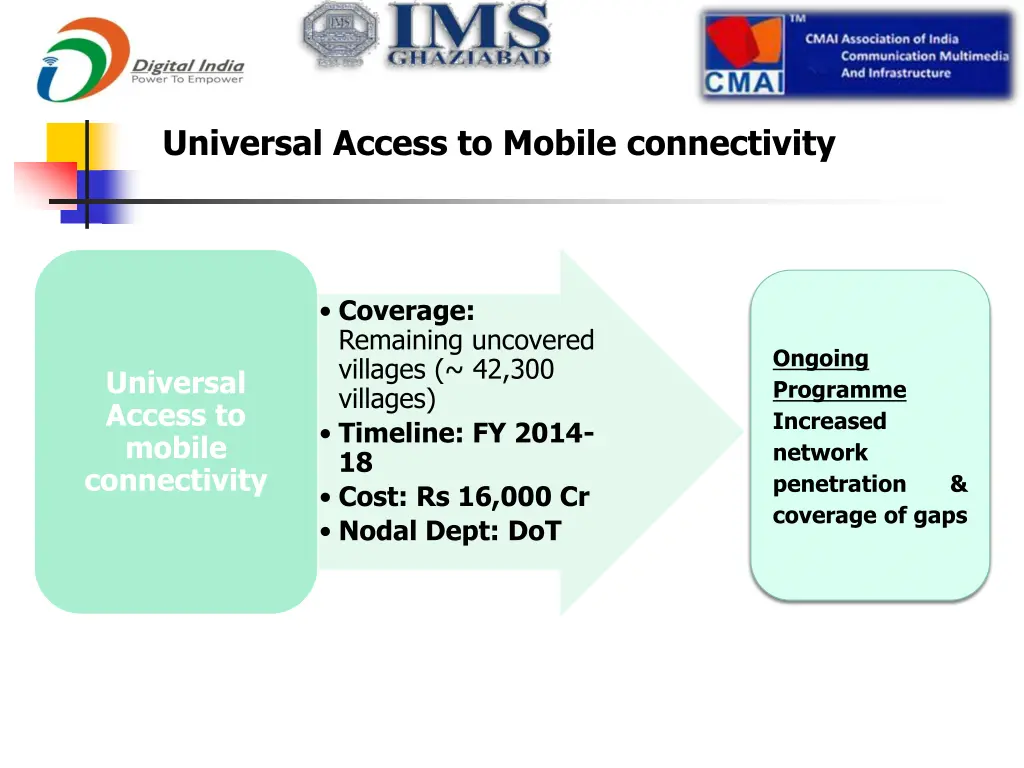
Pillar 2. Universal Access to Mobile connectivity Coverage: Remaining uncovered villages (~ 42,300 villages) Timeline: FY 2014- 18 Cost: Rs 16,000 Cr Nodal Dept: DoT Ongoing Programme Increased network penetration coverage of gaps Universal Access to mobile connectivity &
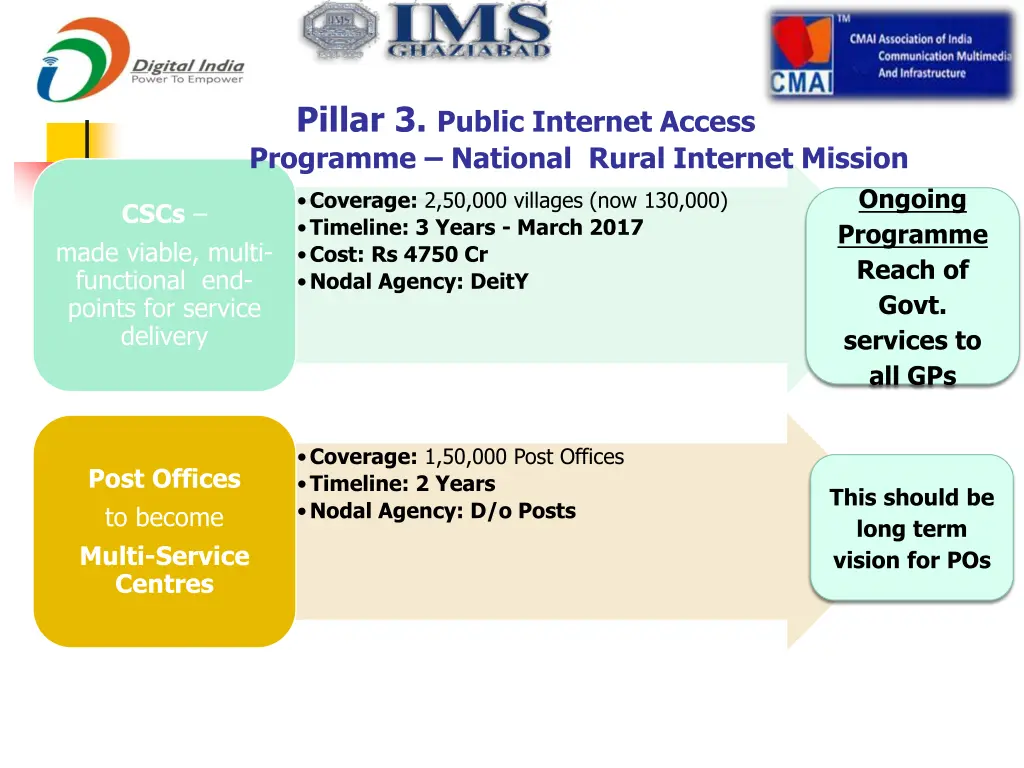
Pillar 3. Public Internet Access Programme National Rural Internet Mission Ongoing Programme Reach of Govt. services to all GPs Coverage: 2,50,000 villages (now 130,000) Timeline: 3 Years - March 2017 Cost: Rs 4750 Cr Nodal Agency: DeitY CSCs made viable, multi- functional end- points for service delivery Coverage: 1,50,000 Post Offices Timeline: 2 Years Nodal Agency: D/o Posts Post Offices to become Multi-Service Centres This should be long term vision for POs
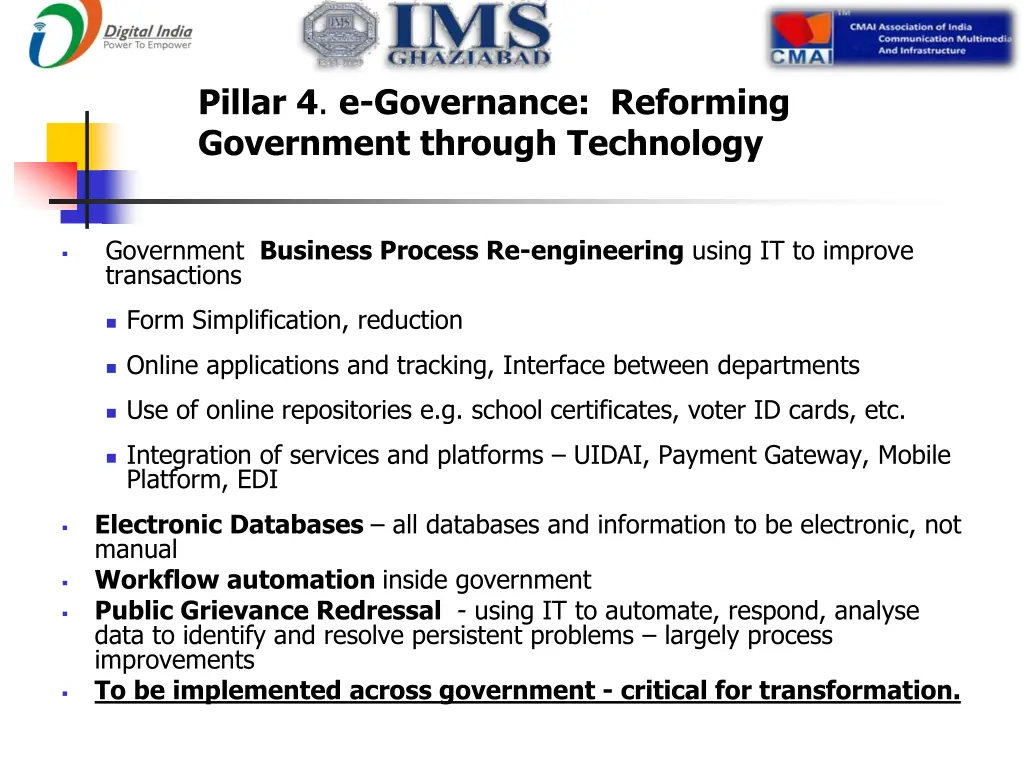
Pillar 4. e-Governance: Reforming Government through Technology Government Business Process Re-engineering using IT to improve transactions Form Simplification, reduction Online applications and tracking, Interface between departments Use of online repositories e.g. school certificates, voter ID cards, etc. Integration of services and platforms UIDAI, Payment Gateway, Mobile Platform, EDI Electronic Databases all databases and information to be electronic, not manual Workflow automation inside government Public Grievance Redressal - using IT to automate, respond, analyse data to identify and resolve persistent problems largely process improvements To be implemented across government - critical for transformation.
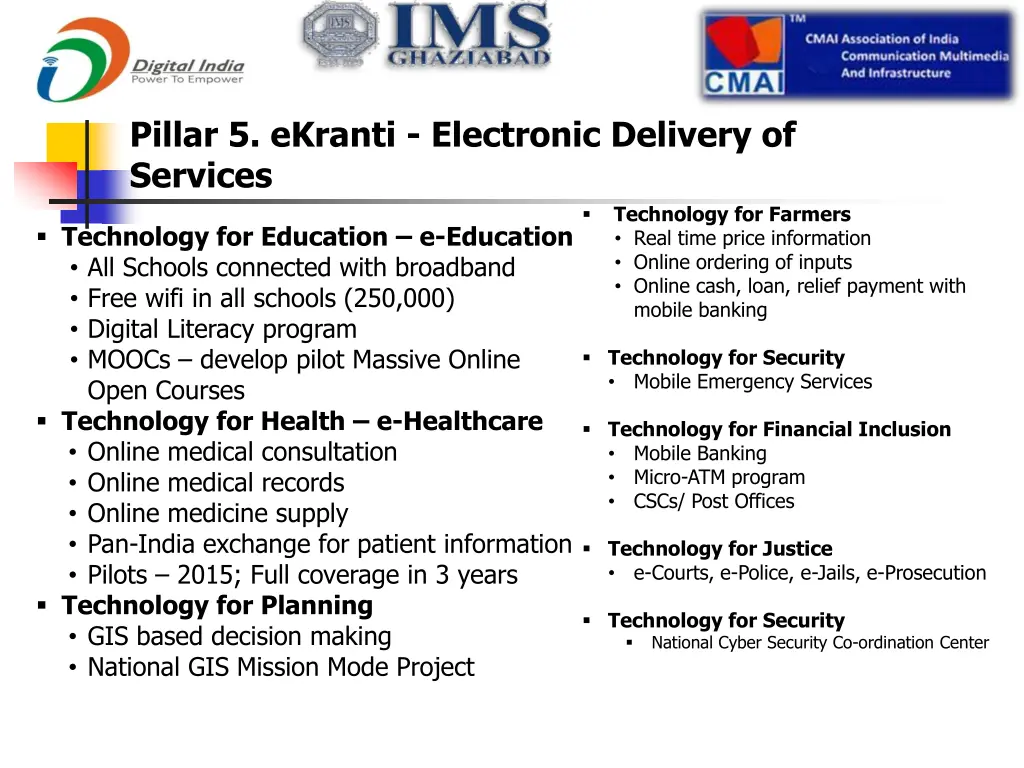
Pillar 5. eKranti - Electronic Delivery of Services Technology for Farmers Real time price information Online ordering of inputs Online cash, loan, relief payment with mobile banking Technology for Education e-Education All Schools connected with broadband Free wifi in all schools (250,000) Digital Literacy program MOOCs develop pilot Massive Online Open Courses Technology for Health e-Healthcare Online medical consultation Online medical records Online medicine supply Pan-India exchange for patient information Pilots 2015; Full coverage in 3 years Technology for Planning GIS based decision making National GIS Mission Mode Project Technology for Security Mobile Emergency Services Technology for Financial Inclusion Mobile Banking Micro-ATM program CSCs/ Post Offices Technology for Justice e-Courts, e-Police, e-Jails, e-Prosecution Technology for Security National Cyber Security Co-ordination Center
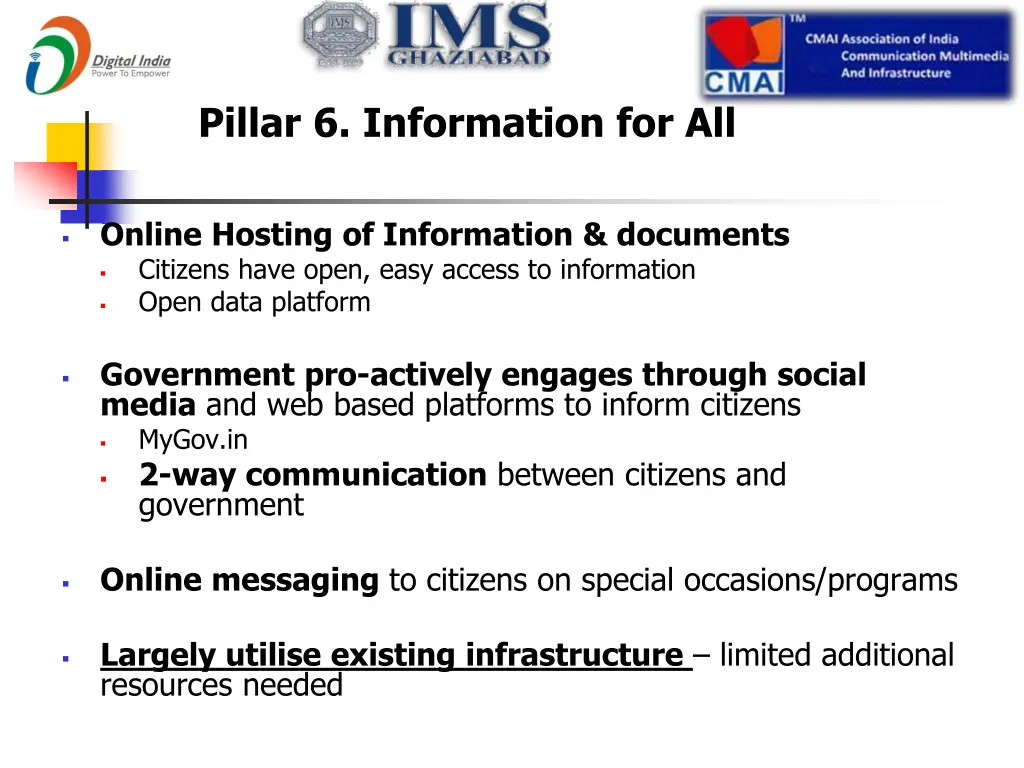
Pillar 6. Information for All Online Hosting of Information & documents Citizens have open, easy access to information Open data platform Government pro-actively engages through social media and web based platforms to inform citizens MyGov.in 2-way communication between citizens and government Online messaging to citizens on special occasions/programs Largely utilise existing infrastructure limited additional resources needed
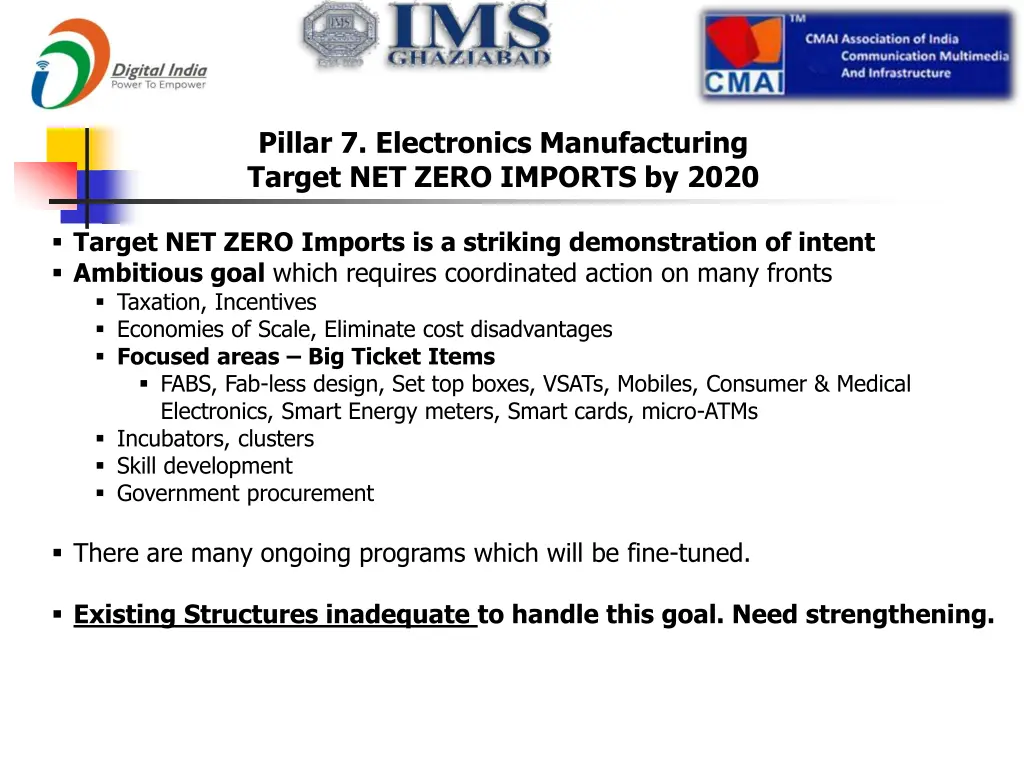
Pillar 7. Electronics Manufacturing Target NET ZERO IMPORTS by 2020 Target NET ZERO Imports is a striking demonstration of intent Ambitious goal which requires coordinated action on many fronts Taxation, Incentives Economies of Scale, Eliminate cost disadvantages Focused areas Big Ticket Items FABS, Fab-less design, Set top boxes, VSATs, Mobiles, Consumer & Medical Electronics, Smart Energy meters, Smart cards, micro-ATMs Incubators, clusters Skill development Government procurement There are many ongoing programs which will be fine-tuned. Existing Structures inadequate to handle this goal. Need strengthening.
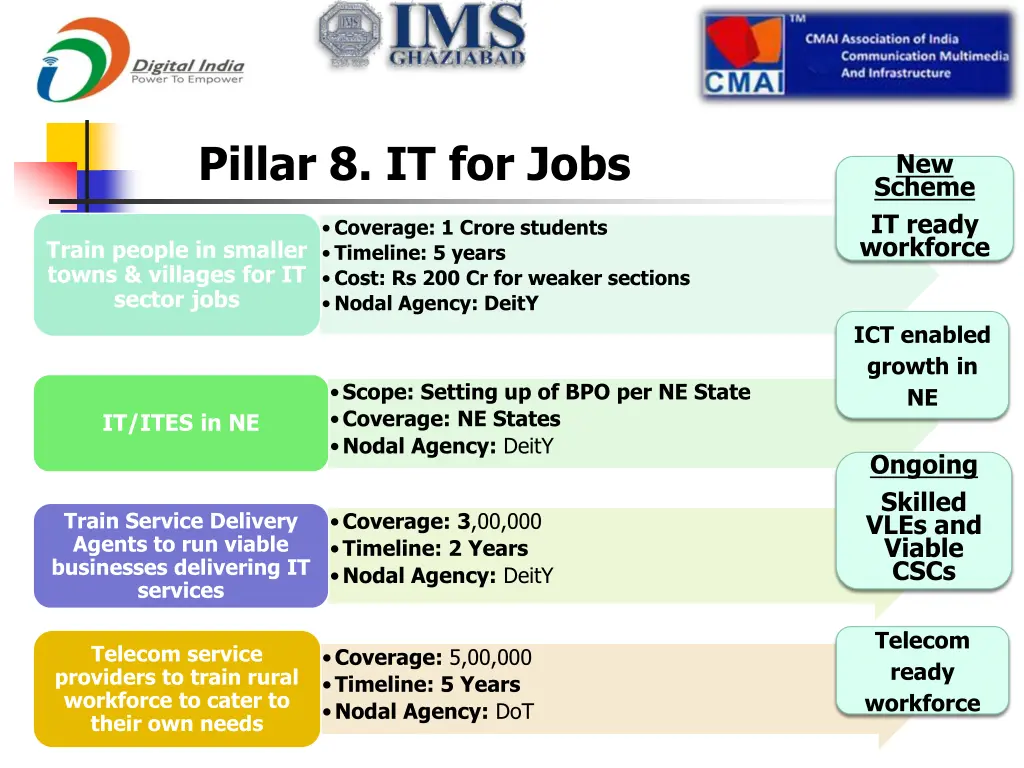
Pillar 8. IT for Jobs New Scheme IT ready workforce Coverage: 1 Crore students Timeline: 5 years Cost: Rs 200 Cr for weaker sections Nodal Agency: DeitY Train people in smaller towns & villages for IT sector jobs ICT enabled growth in NE Scope: Setting up of BPO per NE State Coverage: NE States Nodal Agency: DeitY IT/ITES in NE Ongoing Skilled VLEs and Viable CSCs Train Service Delivery Agents to run viable businesses delivering IT services Coverage: 3,00,000 Timeline: 2 Years Nodal Agency: DeitY Telecom ready workforce Telecom service providers to train rural workforce to cater to their own needs Coverage: 5,00,000 Timeline: 5 Years Nodal Agency: DoT
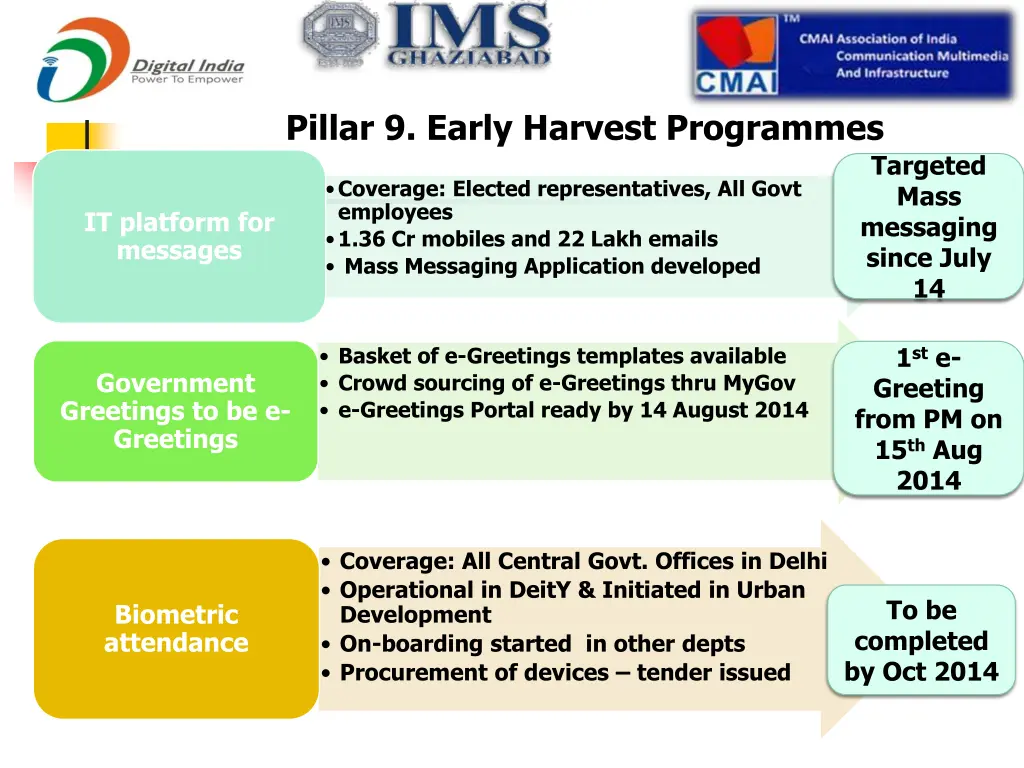
Pillar 9. Early Harvest Programmes Targeted Mass messaging since July 14 Coverage: Elected representatives, All Govt employees 1.36 Cr mobiles and 22 Lakh emails Mass Messaging Application developed IT platform for messages 1st e- Greeting from PM on 15th Aug 2014 Basket of e-Greetings templates available Crowd sourcing of e-Greetings thru MyGov e-Greetings Portal ready by 14 August 2014 Government Greetings to be e- Greetings Coverage: All Central Govt. Offices in Delhi Operational in DeitY & Initiated in Urban Development On-boarding started in other depts Procurement of devices tender issued To be completed by Oct 2014 Biometric attendance
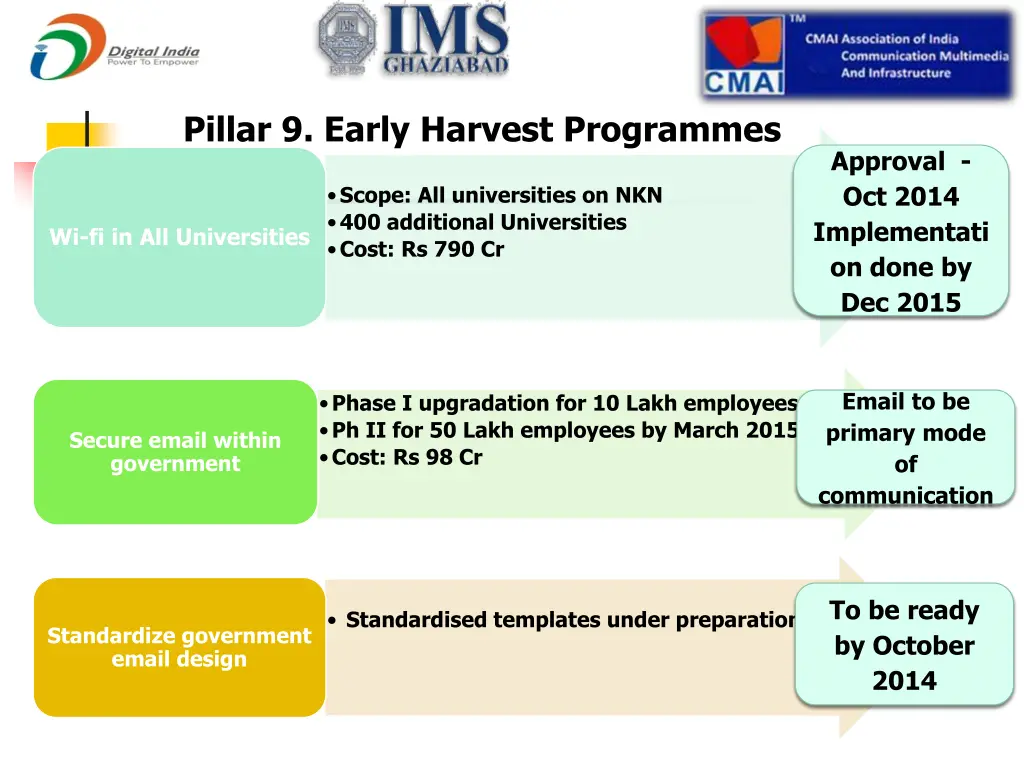
Pillar 9. Early Harvest Programmes Approval - Oct 2014 Implementati on done by Dec 2015 Scope: All universities on NKN 400 additional Universities Cost: Rs 790 Cr Wi-fi in All Universities Email to be primary mode of communication Phase I upgradation for 10 Lakh employees done Ph II for 50 Lakh employees by March 2015 Cost: Rs 98 Cr Secure email within government To be ready by October 2014 Standardised templates under preparation Standardize government email design
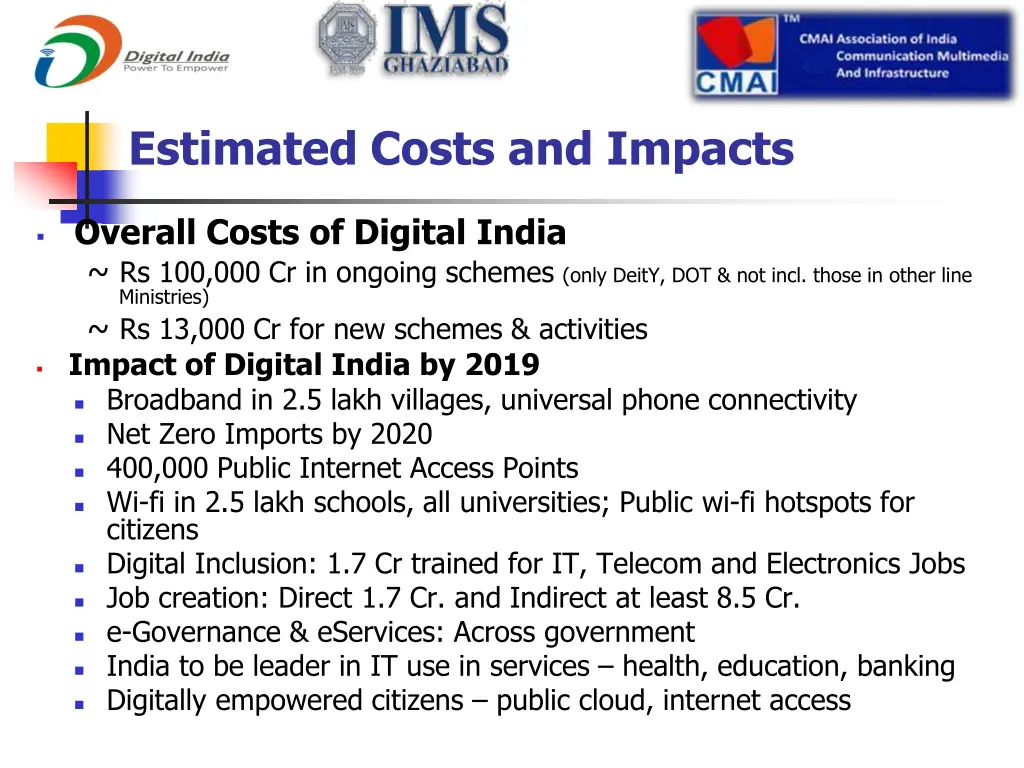
Estimated Costs and Impacts Overall Costs of Digital India ~ Rs 100,000 Cr in ongoing schemes (only DeitY, DOT & not incl. those in other line Ministries) ~ Rs 13,000 Cr for new schemes & activities Impact of Digital India by 2019 Broadband in 2.5 lakh villages, universal phone connectivity Net Zero Imports by 2020 400,000 Public Internet Access Points Wi-fi in 2.5 lakh schools, all universities; Public wi-fi hotspots for citizens Digital Inclusion: 1.7 Cr trained for IT, Telecom and Electronics Jobs Job creation: Direct 1.7 Cr. and Indirect at least 8.5 Cr. e-Governance & eServices: Across government India to be leader in IT use in services health, education, banking Digitally empowered citizens public cloud, internet access
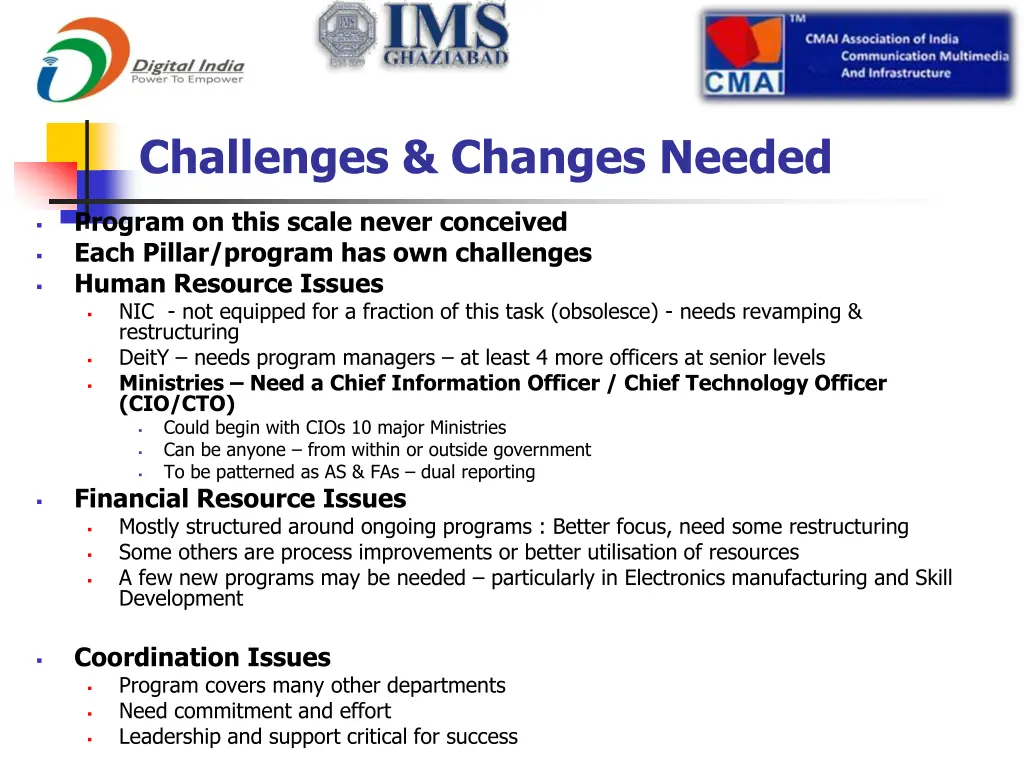
Challenges & Changes Needed Program on this scale never conceived Each Pillar/program has own challenges Human Resource Issues NIC - not equipped for a fraction of this task (obsolesce) - needs revamping & restructuring DeitY needs program managers at least 4 more officers at senior levels Ministries Need a Chief Information Officer / Chief Technology Officer (CIO/CTO) Could begin with CIOs 10 major Ministries Can be anyone from within or outside government To be patterned as AS & FAs dual reporting Financial Resource Issues Mostly structured around ongoing programs : Better focus, need some restructuring Some others are process improvements or better utilisation of resources A few new programs may be needed particularly in Electronics manufacturing and Skill Development Coordination Issues Program covers many other departments Need commitment and effort Leadership and support critical for success
CMAI Roles in Start Up India Coordination with Make in India and Digital India. Facilitating a vibrant entrepreneurial ecosystem. Platform for Entrepreneurs, Financers, Mentors and other Stakeholders to engage and collaborate across the World, to share ideas, best practices, develop solution and partnerships that benefit India. Showcase Economic, Social and Cultural contribution of entrepreneurs. Collaborative approach Entrepreneurship and Youth Empowerment.
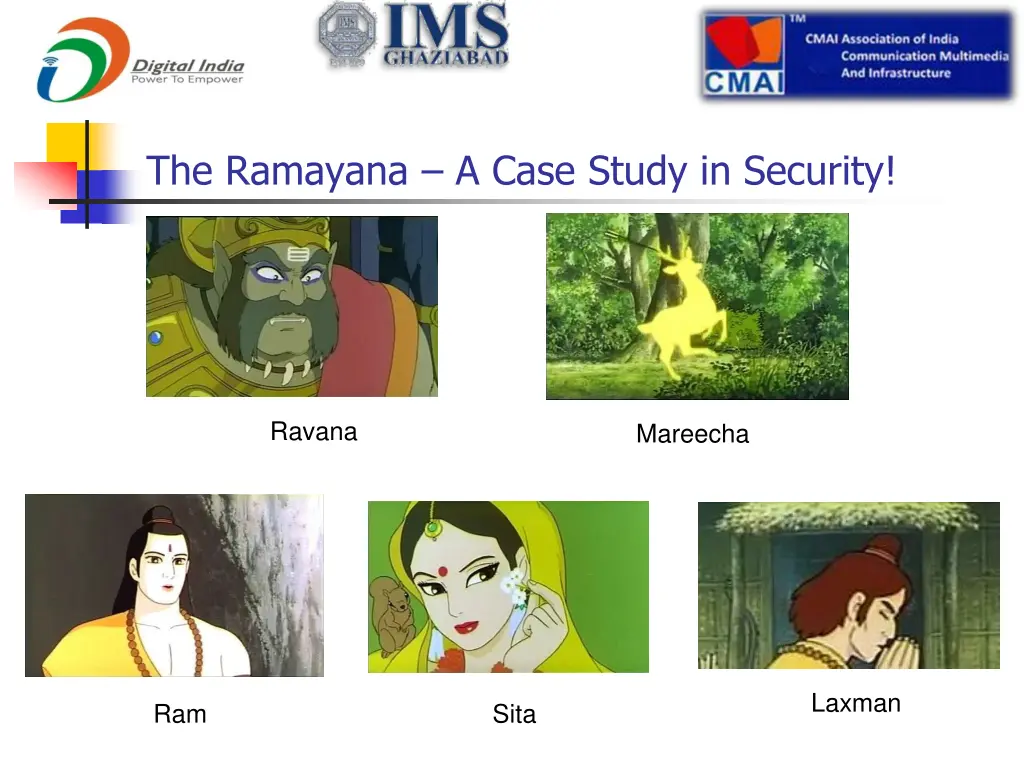
The Ramayana A Case Study in Security! Ravana Mareecha Laxman Ram Sita
The Ramayana - Forensic Analysis Key to Ravana s success was: Spoofing of identities Spear-Pfishing unsuspecting victim Lacking security-awareness in victims
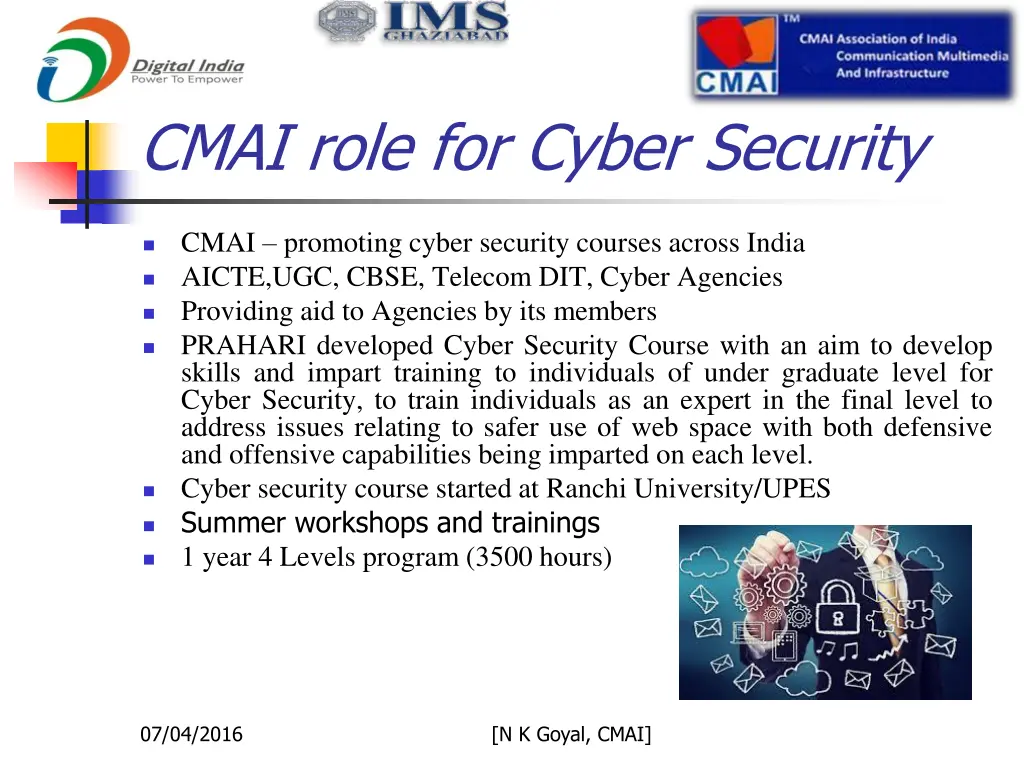
CMAI role for Cyber Security CMAI promoting cyber security courses across India AICTE,UGC, CBSE, Telecom DIT, Cyber Agencies Providing aid to Agencies by its members PRAHARI developed Cyber Security Course with an aim to develop skills and impart training to individuals of under graduate level for Cyber Security, to train individuals as an expert in the final level to address issues relating to safer use of web space with both defensive and offensive capabilities being imparted on each level. Cyber security course started at Ranchi University/UPES Summer workshops and trainings 1 year 4 Levels program (3500 hours) 07/04/2016 [N K Goyal, CMAI]
Thanks get Connected nkgoyals@yahoo.co.in Ph No. - +91 98111 29879.