Explore the role of the High Council of Justice in Belgium and the digitalisation process of the justice system, including opportunities for efficiency, challenges in mentality shifts, and risks of privacy issues and biases in AI tools. Learn about the current state of affairs and the need for interdisciplinary collaboration in advancing legal technology.
Please find below an Image/Link to download the presentation.
The content on the website is provided AS IS for your information and personal use only. It may not be sold, licensed, or shared on other websites without obtaining consent from the author. If you encounter any issues during the download, it is possible that the publisher has removed the file from their server.
You are allowed to download the files provided on this website for personal or commercial use, subject to the condition that they are used lawfully. All files are the property of their respective owners.
The content on the website is provided AS IS for your information and personal use only. It may not be sold, licensed, or shared on other websites without obtaining consent from the author.
E N D
Presentation Transcript
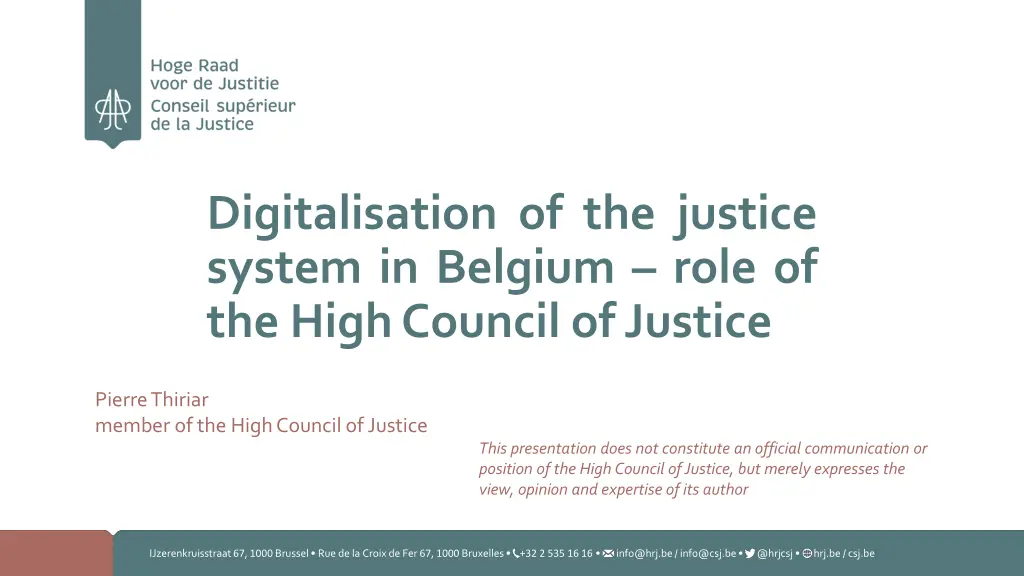
Digitalisation of the justice system in Belgium role of the HighCouncil ofJustice Pierre Thiriar member of the High Council of Justice This presentation does not constitute an official communication or position of the High Council of Justice, but merely expresses the view, opinion and expertise of its author IJzerenkruisstraat 67, 1000Brussel Rue de la Croix de Fer 67, 1000Bruxelles +32 2 535 16 16 info@hrj.be / info@csj.be @hrjcsj hrj.be / csj.be
Outline of this presentation opportunities, challenges and risks of the digitalisation of justice legal framework and state of affairs in Belgium watchdog function of the High Council of Justice in the interest of the citizens
opportunities, challenges and risks are common to all legal systems great added value of international exchange of expertise, knowledge and insights on this topics requires interaction, common effort between law, computer sciences, social sciences, philosophy of law and ethics
opportunities e.g. increased efficiency of the judiciary, more and quicker judicial decisions at a lower cost e.g. greater predictability of the outcome of the judicial process, which may encourage more law-abiding behaviour e.g. greater uniformity of judicial decisions which may contribute to a greater degree of equality of treatment of all persons subject to legal proceedings
challenges e.g. change of mentality in the judiciary and of lawyers e.g. providing technical knowledge and expertise to lawyers on the possibilities and limitations of digital technologies e.g. changing the wheel of a moving bus
risks e.g. privacy issues when a mass of privacy sensitive digital data and metadata are produced and exchanged during the judicial process: data is the new gold e.g. biases in artificial intelligence tools and black box phenomenon of judicial algorithms e.g. access to justice for the digitally illiterate and dehumanization of the judicial process, guarantying procedural fairness
legal framework and state of affairs in Belgium the digitalisation of justice in Belgium is still in its infancy so far only conversion of paperwork and communication into digital tools and digital channels no digitalisation of the work processes of the judiciary themselves no plans for the actual digitalisation of the work processes of the judiciary in the foreseeable future
legal framework Phoenix Act: Wet van 10 augustus 2005 tot oprichting van het informatiesysteem Phenix (Belgian Official Journal, 1 September 2005) this project was never completed, at a cost of 28 million euros (based on the termination of the lawsuit against Unisys in April 2020) was never replaced by another comprehensive law on the digitalisation of justice, which means that the executive remains completely free in this matter
state of affairs in Belgium CBB (Centraal Bestand Beslagberichten) or Central register of notices of impoundment, delegation, transfer, settlement of collective debts and protests (Act 29 May 2000) is a digital database established in 2011, centralising all the above-mentioned notices and accessible to lawyers, notaries and bailiffs It is administered by the National Chamber of Bailiffs under the control of the judiciary from 1 October 2018 the fee to be paid per search in the CBB was reduced from 2 euros to 0,50 euro
state of affairs in Belgium e-Deposit is a secure electronic communication tool between the judiciary and litigants and their lawyers; it allows the exchange of decisions, documents, briefs, petitions and submissions between courts and litigants and their lawyers was developed by the judiciary itself and has been operational since February 2015 its use is completely free of charge for the parties and their lawyers
state of affairs in Belgium VAJA is a central database of judgments and court decisions in MS-Word version, in machine-readable PDF-a version and the scanned PDF with the signatures of the judges and registrars was developed by the judiciary itself and has been operational since January 2014 the free public access to this database via a webapp (which is already fully developed) was stopped by the previous Minister of Justice in 2017, without substantive justification
state of affairs in Belgium Dipladis a commercial company established on 19 December 2014 by the French- and German-language and the Dutch-language Bar Associations, which are its shareholders Diplad owns and manages among others REGSOL and DPA REGSOL is a central register of solvency; through this digital platform, creditors, their agents and interested parties can start, consult or follow up open insolvency files managed by the Belgian enterprise courts REGSOL is a goldmine of data on solvency of all Belgian companies and entrepreneurs
state of affairs in Belgium DPA (Digital Platform for Attorneys) is an online platform that enables automation and digitalisation of communication between lawyers and the judiciary and other authorities one of the components of DPA is DPA-deposit which is a mere relay or gateway (pass-through) between lawyers and e-Deposit DPA-deposit is not free of charge
state of affairs in Belgium The rates for DPA-deposit are as follows (from 1 Februari 2022): 5 euros for sending legal briefs 5 euro for sending evidence files 1,15 euro for sending petitions and submissions 1,15 euro for sending a letter to the court
state of affairs in Belgium By Royal Decree of 9 October 2018 (this is a regulatory provision of the executive power in Belgium), lawyers were obliged to communicate with e-Deposit via the paying DPA-Deposit and lawyers were prohibited from using the free e-Deposit directly this regulatory provision was annulled by the Council of State (Raadvan State / Conseil d tat) by decision of 12 December 2019
state of affairs in Belgium annual results Diplad: - 2015 - 2016 - 2017 - 2018 - 2019 - 2020 loss loss profit loss loss loss 961,956 euros 1,522,475 euros 462,907 euros 411,497 euros 8,440 euros 277,271 euros Diplad is said to have a debt of more than 8 million euros, guaranteed by the French- and German-language and the Dutch-language Bar Associations
state of affairs in Belgium European Commission: the digitalisation of legal systems is an important objective to be pursued as part of a reinvigoration of European democracy and in line with the political priority of a Europe fit for the digital age 137 million euros European support for digitalisation of Belgian justice Belgium advances the investment and European support is conditional on achieving certain results
state of affairs in Belgium Belgian Council of Ministers of 4 February 2022 launches two public tenders for: 1. public procurement for the Digital Transformation Plan of Justice (governance, ICT architecture, programme, project, change and communication management, audit, risk management); this framework contract will run for a total of 4 years 2. public procurement for the development of a database of judgments and court decisions; planned duration 2 to 5 years and budget 5 million euros
watchdog function HCJ origins of the HighCouncil ofJustice: the Dutroux case 1996 Belgian Constitution, Article 151, 2: For Belgium, there is one High Council of Justice. In exercising its competences, the High Council of Justice respects the independence [ofthe judges] asprovidedunder 1 the HCJ is not a member of any of the three powers (legislative, executive or judicial) andcarries outits functionsin complete independence.
watchdog function HCJ 44 members with a one-time renewable mandate of 4 years and 43 staff members 3 taskseffectively carried outsince 2August2000: - appointing(andtraining) judgesandmembers of the prosecution service - external control of the judiciary: handling of complaints, specific investigations, audits - advice on legislation and law reforms: improvement of the administration of justice
watchdog function HCJ digitalisation of justice has ramifications in all areas of action of the HCJ: selection of judicial personnel, functioning of the judiciary and advice on future legislation that s why the HCJ wants to follow up the digitalisation of justice very closely in the interest ofcitizens that s why the HCJ has integrated this theme in her multi-annual plan 2020-2024
watchdog function HCJ This theme was included in our multi-annual plan in the following terms: The digitalisation of justice is a toppriority for several actors in the field. The task of the HCJ is to look after the interests of citizens, in particular by: (1) mapping the various digitalisation projects underway; (2) developing a vision on the use of new technologies, with particular attention to the (ethical) conditions for the use of artificial intelligence; (3) considering, in consultation with the other actors in the field, the creation of a database of case law accessible tothe public.
watchdog function HCJ the HCJ has conducted a broad audit of various courts and prosecutors' offices to assess the impact of the covid crisis on the administration of justice, with a particular focus on the use of technological tools (such as video conferencing) during this crisis when dealing with individual complaints from citizens, the HCJ pays particular attention to problems of access to justice, communication and information exchange that mayresult from alitigant'sdigital illiteracy
watchdog function HCJ when specific courts or prosecutors offices are audited, particular attention is paid to the impact of the use of certain digital tools (e.g. MaCH) on the operation of this courtoroffice finally, when advising on new legislation (e.g. on video recording of interrogations or exceptional measures in case of sanitary crisis), the HCJ pays particular attention to the impact of digital technologies on the rights of citizens
conclusion the digitalisation of justice has an impact on the effectiveness of fundamentalrights andthe guarantee of the rule oflaw the ECHR considered in S. and MARPER v. THE UNITED KINGDOM that any state claiming a pioneering role in the development of new technologies has a special responsibility to "strike the right balance" in the use of new techniques against the essential interests of privacy and the rights of citizens