Discrete Math: Rules of Inference Exercise 5
This exercise explores a classic argument in logic: "All men are mortal. Socrates is a man. Therefore, Socrates is mortal." It identifies the rules of inference involved, primarily universal instantiation and modus ponens. By applying these rules, we derive conclusions based on established premises. The relevance of these rules in formal reasoning is crucial for understanding logical arguments and their structure.

Download Presentation

Please find below an Image/Link to download the presentation.
The content on the website is provided AS IS for your information and personal use only. It may not be sold, licensed, or shared on other websites without obtaining consent from the author.If you encounter any issues during the download, it is possible that the publisher has removed the file from their server.
You are allowed to download the files provided on this website for personal or commercial use, subject to the condition that they are used lawfully. All files are the property of their respective owners.
The content on the website is provided AS IS for your information and personal use only. It may not be sold, licensed, or shared on other websites without obtaining consent from the author.
E N D
Presentation Transcript
Discrete Math: Rules of Inference Exercise 5
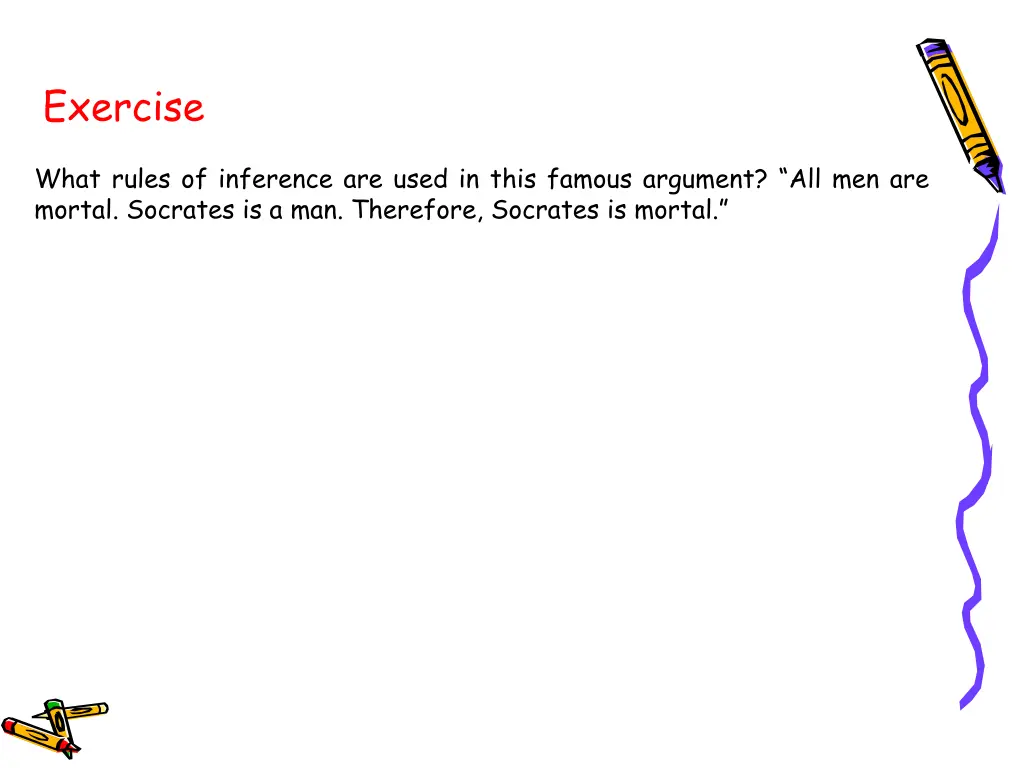
Exercise What rules of inference are used in this famous argument? All men are mortal. Socrates is a man. Therefore, Socrates is mortal.
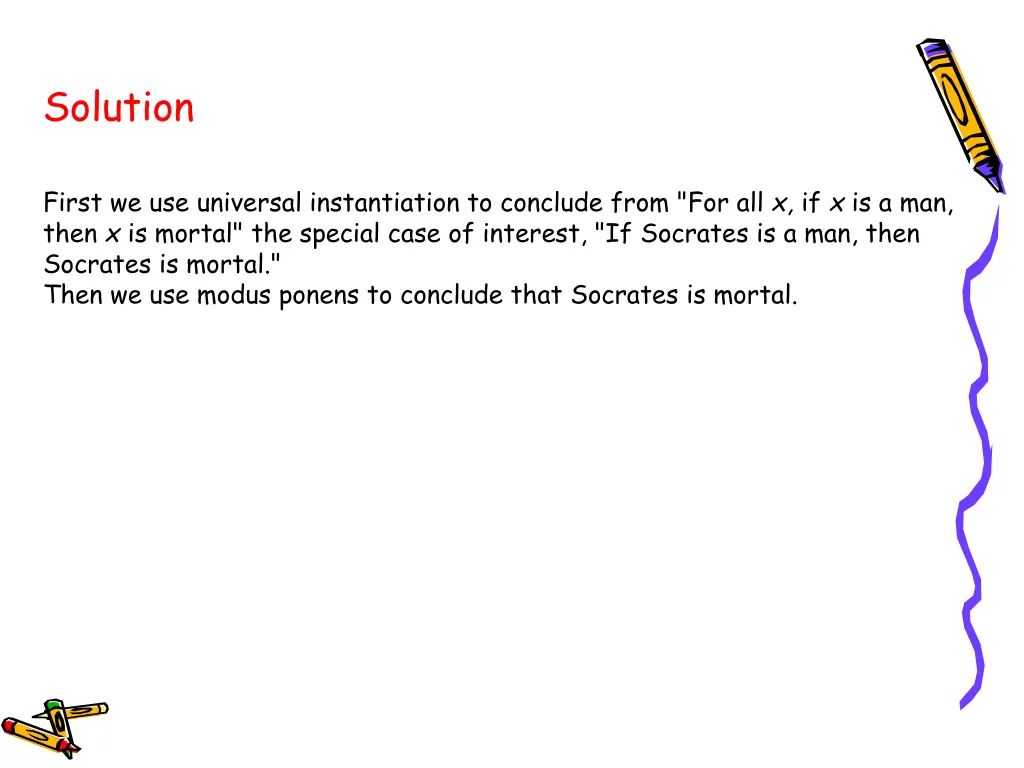
Solution First we use universal instantiation to conclude from "For all x, if x is a man, then x is mortal" the special case of interest, "If Socrates is a man, then Socrates is mortal." Then we use modus ponens to conclude that Socrates is mortal.
References Discrete Mathematics and Its Applications, McGraw-Hill; 7th edition (June 26, 2006). Kenneth Rosen Discrete Mathematics An Open Introduction, 2nd edition. Oscar Le in A Short Course in Discrete Mathematics, 01 Dec 2004, Edward Bender & S. Gill Williamson