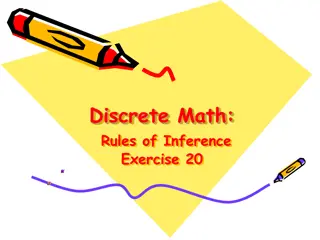
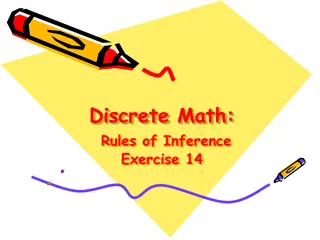
Discrete Math Rules of Inference Exercise on Socrates
This exercise illustrates the valid argument form known as modus ponens through the example of Socrates. It states that if Socrates is human, then he is mortal. Given the premise that Socrates is human, the conclusion must follow that Socrates is mortal. The assessment confirms that if the premises are true, the conclusion is also true, showcasing the foundational principles of logical reasoning in discrete mathematics.

Download Presentation

Please find below an Image/Link to download the presentation.
The content on the website is provided AS IS for your information and personal use only. It may not be sold, licensed, or shared on other websites without obtaining consent from the author.If you encounter any issues during the download, it is possible that the publisher has removed the file from their server.
You are allowed to download the files provided on this website for personal or commercial use, subject to the condition that they are used lawfully. All files are the property of their respective owners.
The content on the website is provided AS IS for your information and personal use only. It may not be sold, licensed, or shared on other websites without obtaining consent from the author.
E N D
Presentation Transcript
Discrete Math: Rules of Inference Exercise 1
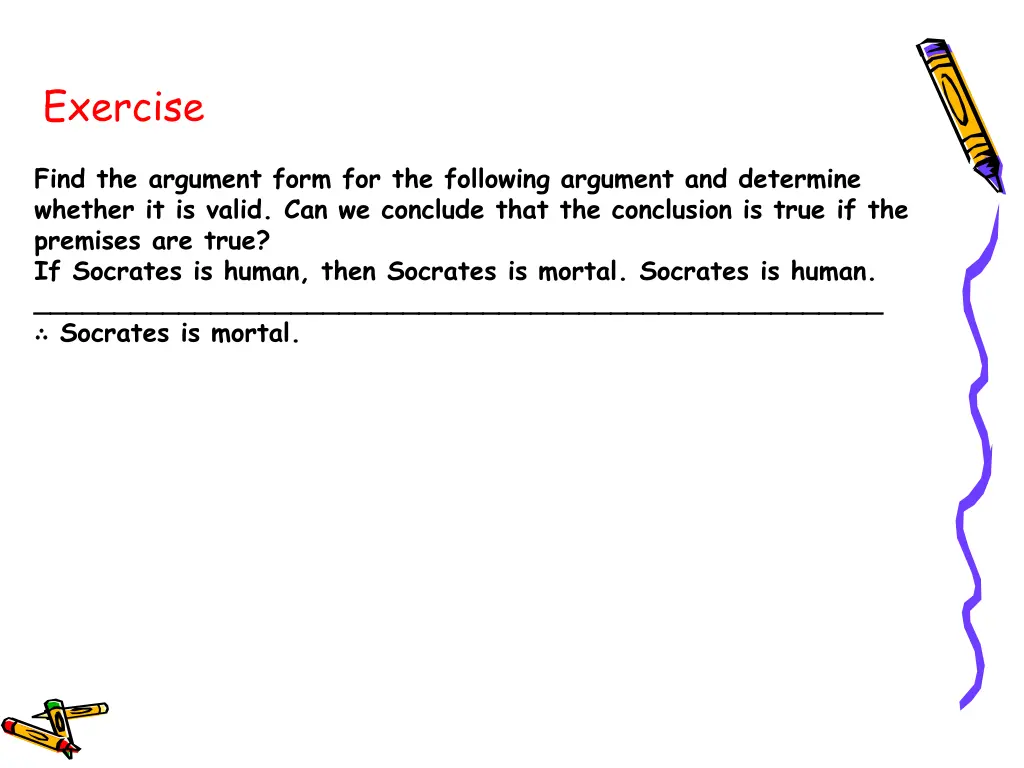
Exercise Find the argument form for the following argument and determine whether it is valid. Can we conclude that the conclusion is true if the premises are true? If Socrates is human, then Socrates is mortal. Socrates is human. _____________________________________________________ Socrates is mortal.
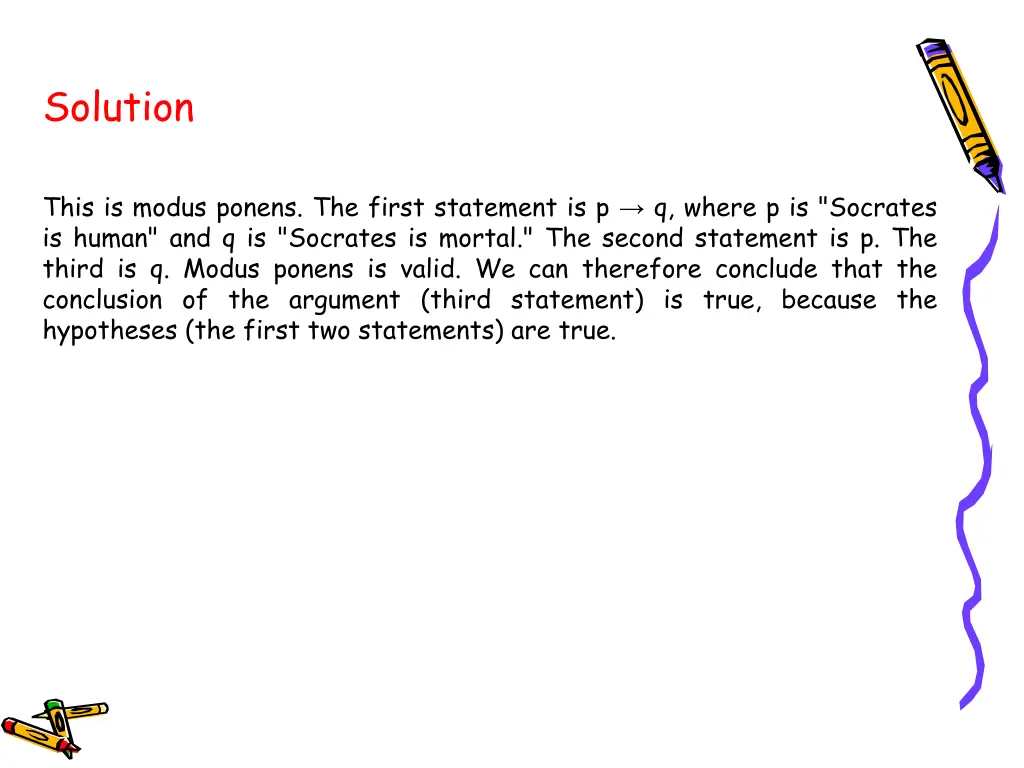
Solution This is modus ponens. The first statement is p q, where p is "Socrates is human" and q is "Socrates is mortal." The second statement is p. The third is q. Modus ponens is valid. We can therefore conclude that the conclusion of the argument (third statement) is true, because the hypotheses (the first two statements) are true.
References Discrete Mathematics and Its Applications, McGraw-Hill; 7th edition (June 26, 2006). Kenneth Rosen Discrete Mathematics An Open Introduction, 2nd edition. Oscar Le in A Short Course in Discrete Mathematics, 01 Dec 2004, Edward Bender & S. Gill Williamson