Discriminative Latent Variable Model for Online Clustering
Explore a novel discriminative latent variable model, Latent Left-Linking Model (L3M), for jointly learning metric and clustering in online clustering tasks. Learn about the efficient learning algorithm, likelihood computation, and more in this informative study.

Download Presentation

Please find below an Image/Link to download the presentation.
The content on the website is provided AS IS for your information and personal use only. It may not be sold, licensed, or shared on other websites without obtaining consent from the author. If you encounter any issues during the download, it is possible that the publisher has removed the file from their server.
You are allowed to download the files provided on this website for personal or commercial use, subject to the condition that they are used lawfully. All files are the property of their respective owners.
The content on the website is provided AS IS for your information and personal use only. It may not be sold, licensed, or shared on other websites without obtaining consent from the author.
E N D
Presentation Transcript
A Discriminative Latent Variable Model for Online Clustering Rajhans Samdani, Kai-Wei Chang, Dan Roth Department of Computer Science University of Illinois at Urbana-Champaign
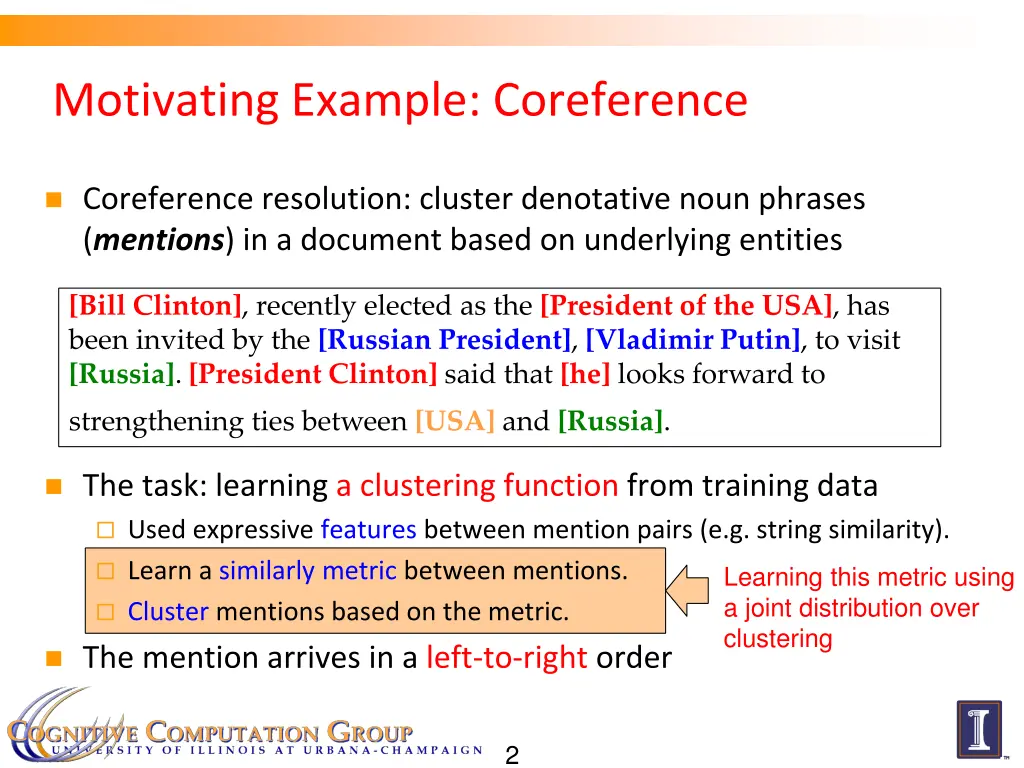
Motivating Example: Coreference Coreference resolution: cluster denotative noun phrases (mentions) in a document based on underlying entities [Bill Clinton], recently elected as the [President of the USA], has been invited by the [Russian President], [Vladimir Putin], to visit [Russia]. [President Clinton] said that [he] looks forward to strengthening ties between [USA]and [Russia]. The task: learning a clustering function from training data Used expressive features between mention pairs (e.g. string similarity). Learn a similarly metric between mentions. Learning this metric using a joint distribution over clustering Cluster mentions based on the metric. The mention arrives in a left-to-right order 2
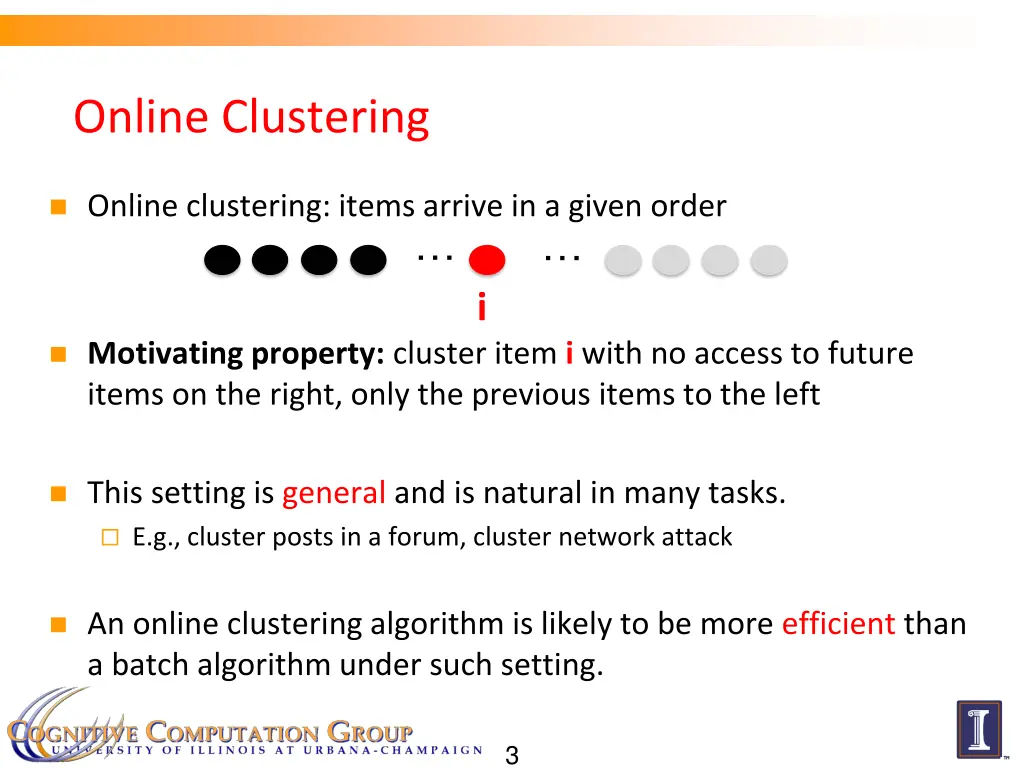
Online Clustering Online clustering: items arrive in a given order i Motivating property: cluster item i with no access to future items on the right, only the previous items to the left This setting is general and is natural in many tasks. E.g., cluster posts in a forum, cluster network attack An online clustering algorithm is likely to be more efficient than a batch algorithm under such setting. 3
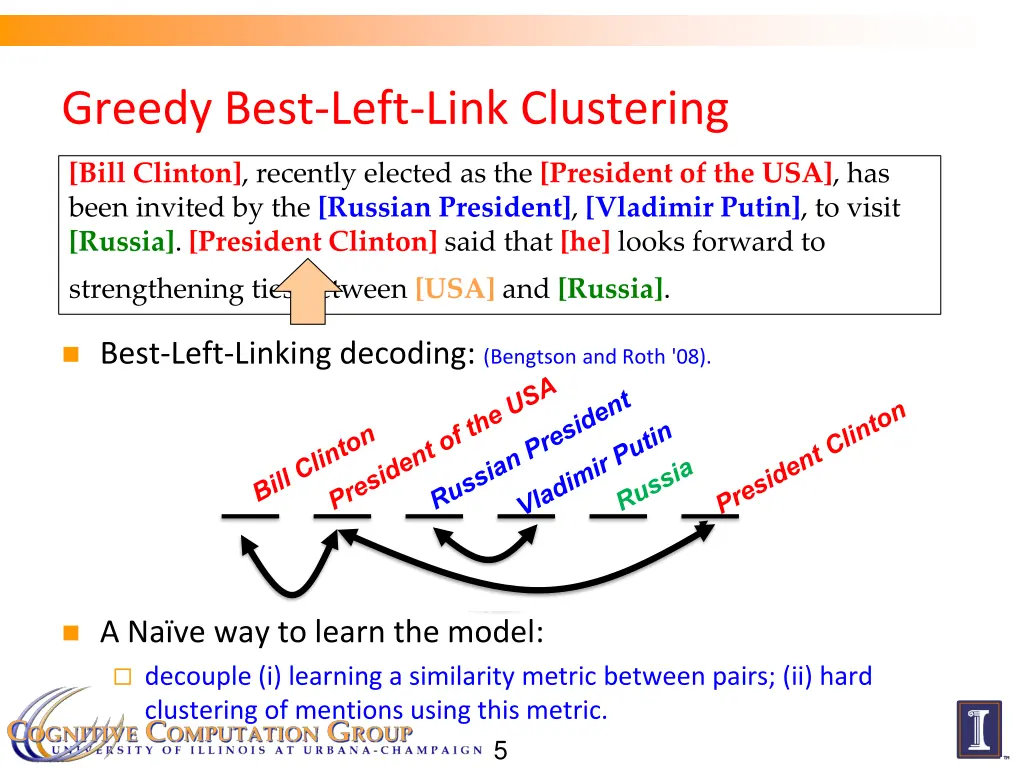
Greedy Best-Left-Link Clustering [Bill Clinton], recently elected as the [President of the USA], has been invited by the [Russian President], [Vladimir Putin], to visit [Russia]. [President Clinton] said that [he] looks forward to strengthening ties between [USA] and [Russia]. Best-Left-Linking decoding: (Bengtson and Roth '08). A Na ve way to learn the model: decouple (i) learning a similarity metric between pairs; (ii) hard clustering of mentions using this metric. 5
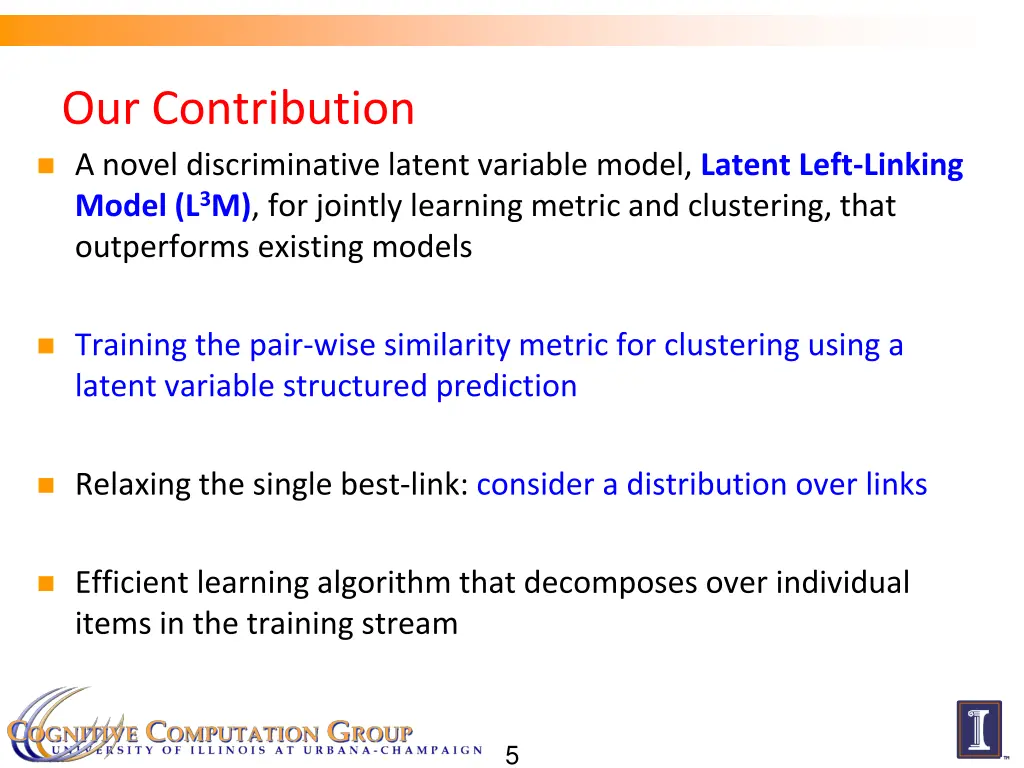
Our Contribution A novel discriminative latent variable model, Latent Left-Linking Model (L3M), for jointly learning metric and clustering, that outperforms existing models Training the pair-wise similarity metric for clustering using a latent variable structured prediction Relaxing the single best-link: consider a distribution over links Efficient learning algorithm that decomposes over individual items in the training stream 5
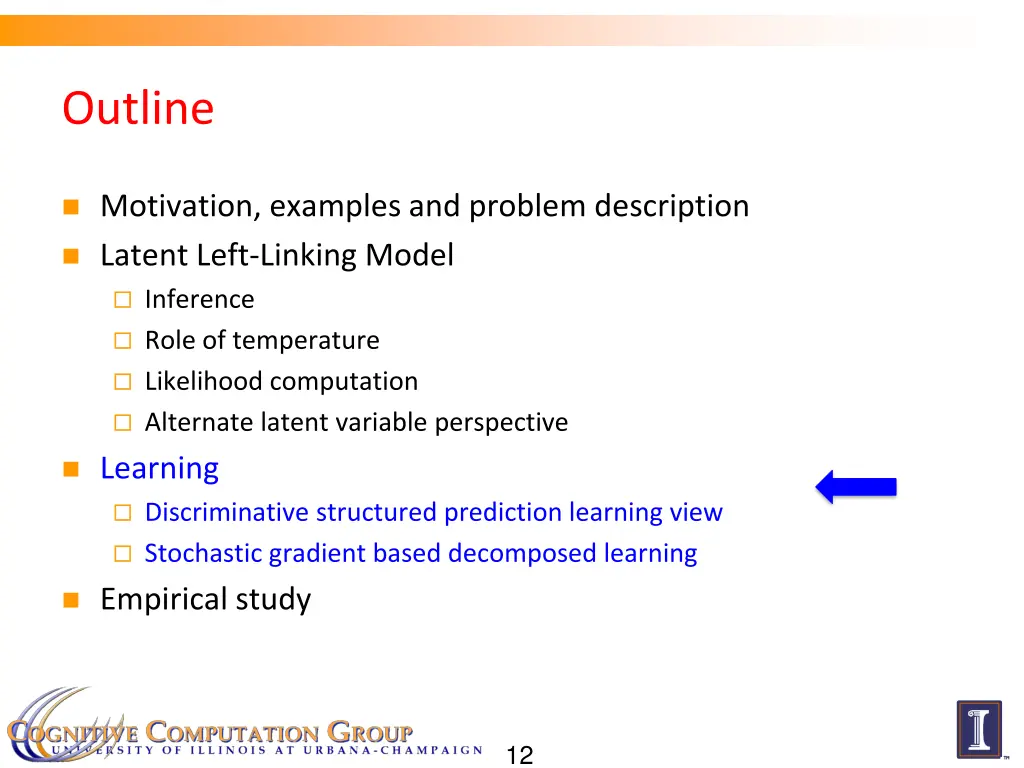
Outline Motivation, examples and problem description Latent Left-Linking Model (L3M) Likelihood computation Inference Role of temperature Alternate latent variable perspective Learning Discriminative structured prediction learning view Stochastic gradient based decomposed learning Empirical study 6
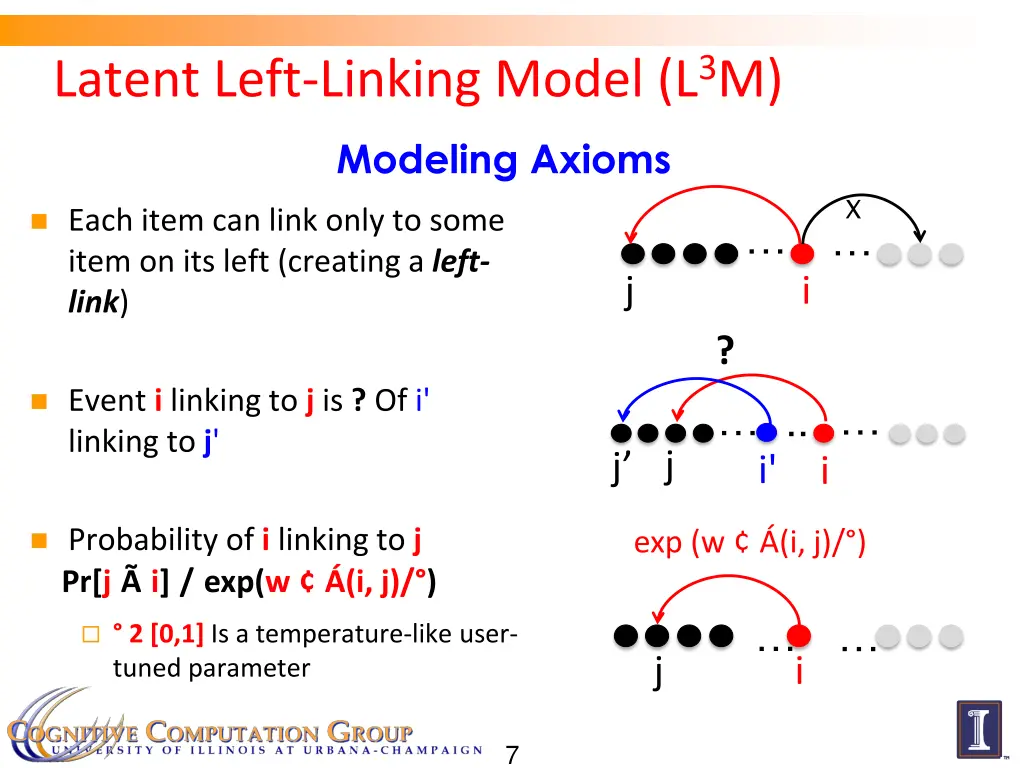
Latent Left-Linking Model (L3M) Modeling Axioms X Each item can link only to some item on its left (creating a left- link) j i ? Event i linking to j is ? Of i' linking to j' .. i j j i' exp (w (i, j)/ ) Probability of i linking to j Pr[j i]/exp(w (i, j)/ ) 2 [0,1] Is a temperature-like user- tuned parameter j i 7
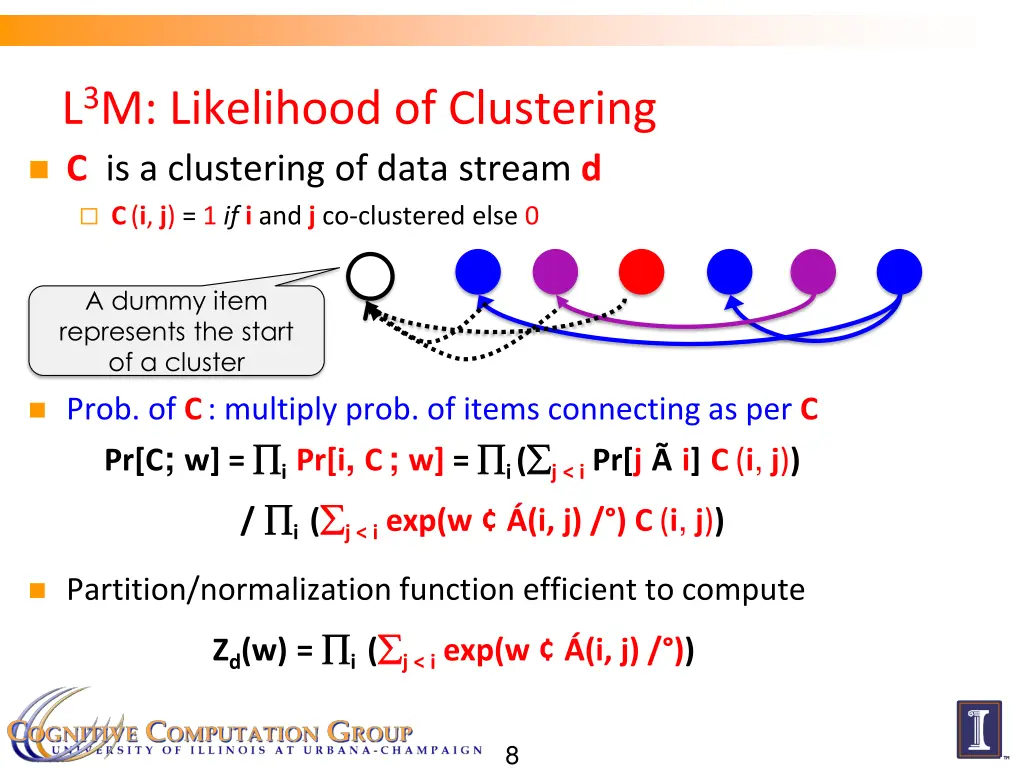
L3M: Likelihood of Clustering C is a clustering of data stream d C(i, j) = 1 ifi and j co-clustered else 0 A dummy item represents the start of a cluster Prob. of C: multiply prob. of items connecting as per C Pr[C; w] = iPr[i, C; w] = i ( j< i Pr[j i]C(i, j)) / i( j< i exp(w (i, j) / ) C(i, j)) Partition/normalization function efficient to compute Zd(w)= i( j< i exp(w (i, j) / )) 8
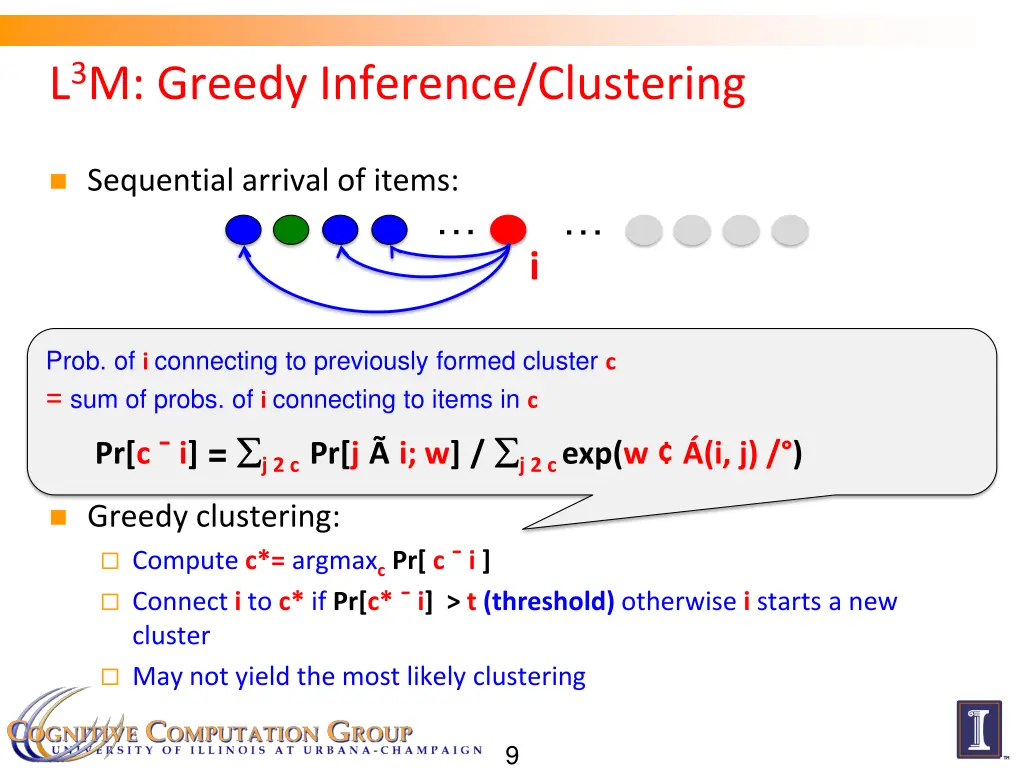
L3M: Greedy Inference/Clustering Sequential arrival of items: i Prob. of i connecting to previously formed cluster c = sum of probs. of i connecting to items in c: Pr[c i] = j2 c Pr[j i; w]/ j2 c exp(w (i, j) / ) Greedy clustering: Compute c*= argmaxc Pr[ c i ] Connect i to c* if Pr[c* i] > t (threshold) otherwise i starts a new cluster May not yield the most likely clustering 9
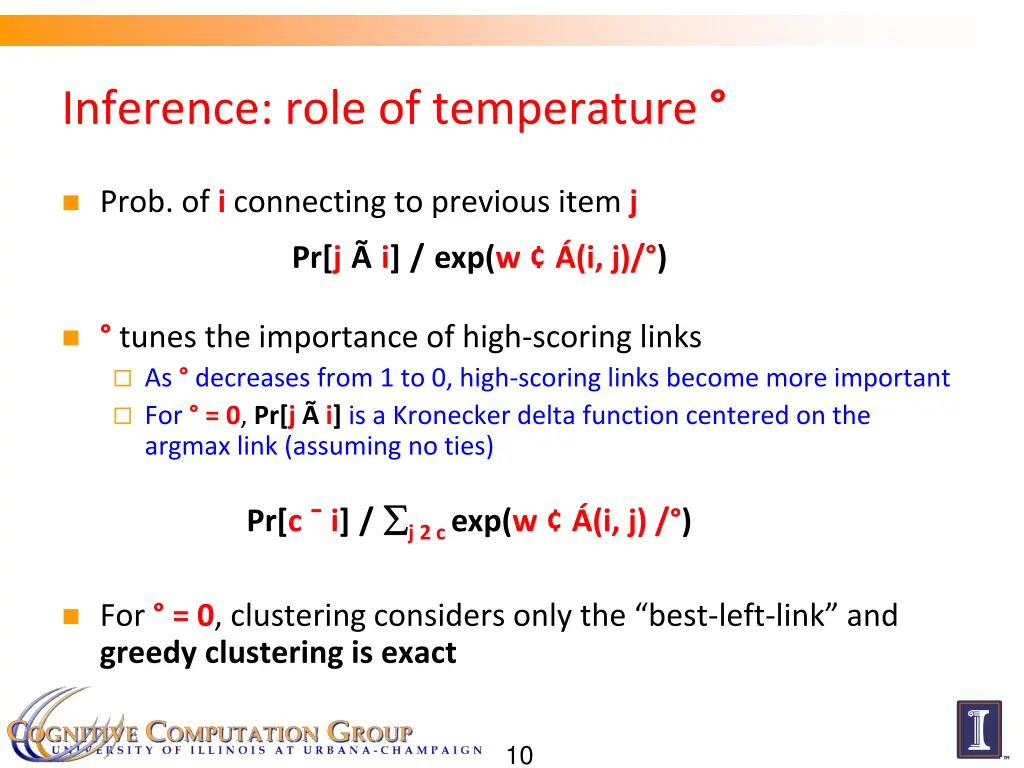
Inference: role of temperature Prob. of i connecting to previous item j Pr[j i]/exp(w (i, j)/ ) tunes the importance of high-scoring links As decreases from 1 to 0, high-scoring links become more important For = 0, Pr[j i] is a Kronecker delta function centered on the argmax link (assuming no ties) Pr[c i]/ j2 c exp(w (i, j) / ) For = 0, clustering considers only the best-left-link and greedy clustering is exact 10
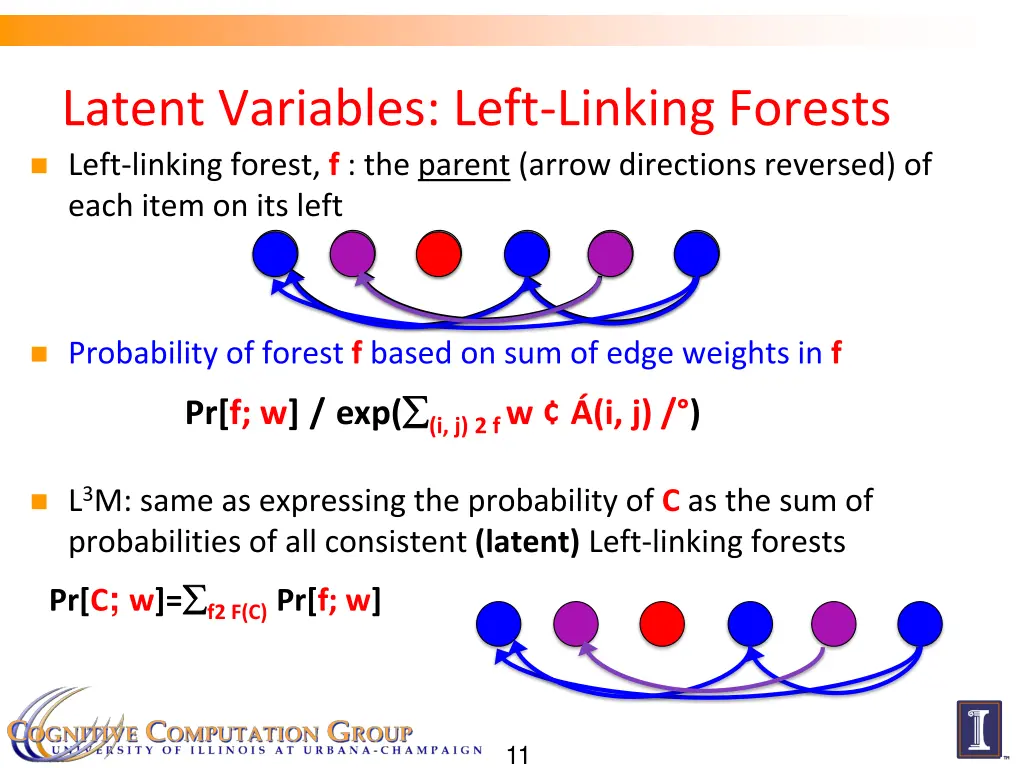
Latent Variables: Left-Linking Forests Left-linking forest, f : the parent (arrow directions reversed) of each item on its left Probability of forest f based on sum of edge weights in f Pr[f; w]/exp( (i, j)2 f w (i, j) / ) L3M: same as expressing the probability of C as the sum of probabilities of all consistent (latent) Left-linking forests Pr[C; w]= f2 F(C)Pr[f; w] 11
Outline Motivation, examples and problem description Latent Left-Linking Model Inference Role of temperature Likelihood computation Alternate latent variable perspective Learning Discriminative structured prediction learning view Stochastic gradient based decomposed learning Empirical study 12
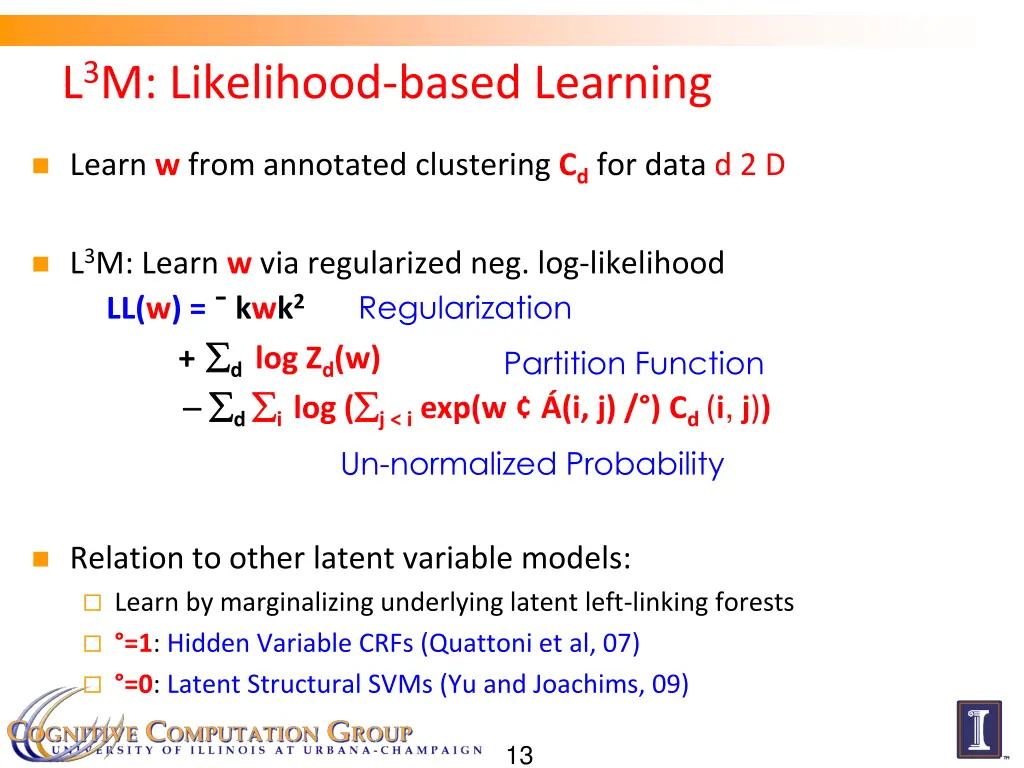
L3M: Likelihood-based Learning Learn w from annotated clustering Cd for data d 2 D L3M: Learn w via regularized neg. log-likelihood LL(w) = kwk2 + d log Zd(w) d ilog ( j< i exp(w (i, j) / ) Cd(i, j)) Un-normalized Probability Regularization Partition Function Relation to other latent variable models: Learn by marginalizing underlying latent left-linking forests =1: Hidden Variable CRFs (Quattoni et al, 07) =0: Latent Structural SVMs (Yu and Joachims, 09) 13
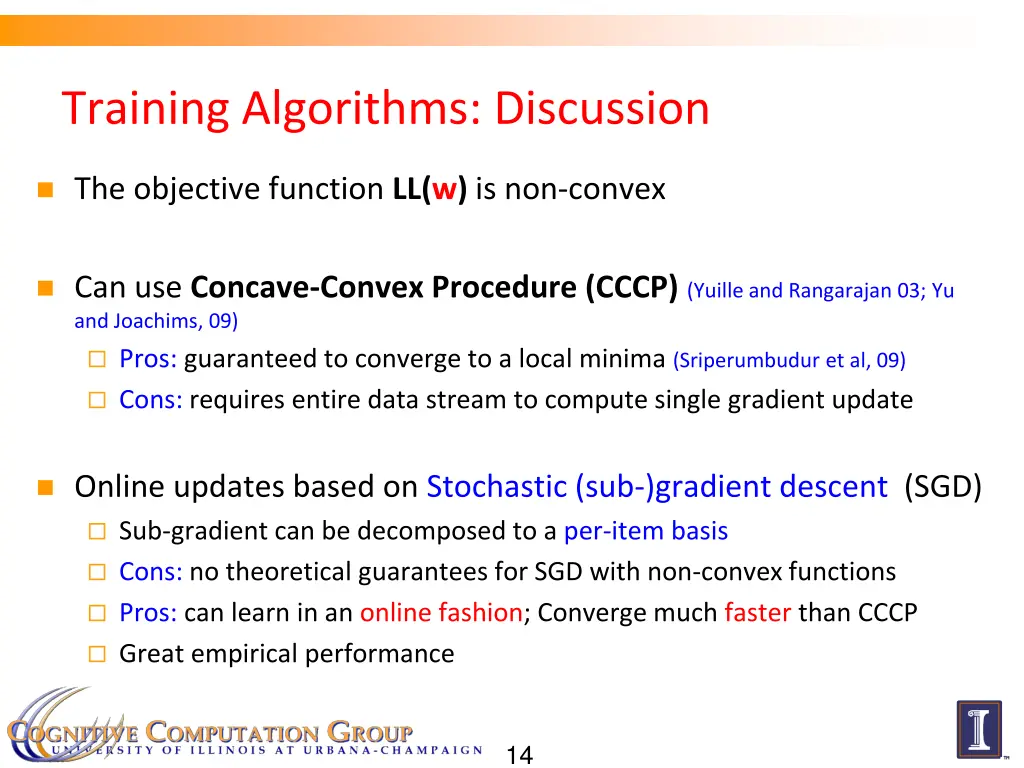
Training Algorithms: Discussion The objective function LL(w) is non-convex Can use Concave-Convex Procedure (CCCP) (Yuille and Rangarajan 03; Yu and Joachims, 09) Pros: guaranteed to converge to a local minima (Sriperumbudur et al, 09) Cons: requires entire data stream to compute single gradient update Online updates based on Stochastic (sub-)gradient descent (SGD) Sub-gradient can be decomposed to a per-item basis Cons: no theoretical guarantees for SGD with non-convex functions Pros: can learn in an online fashion; Converge much faster than CCCP Great empirical performance 14
Outline Motivation, examples and problem description Latent Left-Linking Model Inference Role of temperature Likelihood computation Alternate latent variable perspective Learning Discriminative structured prediction learning view Stochastic gradient based decomposed learning Empirical study 15
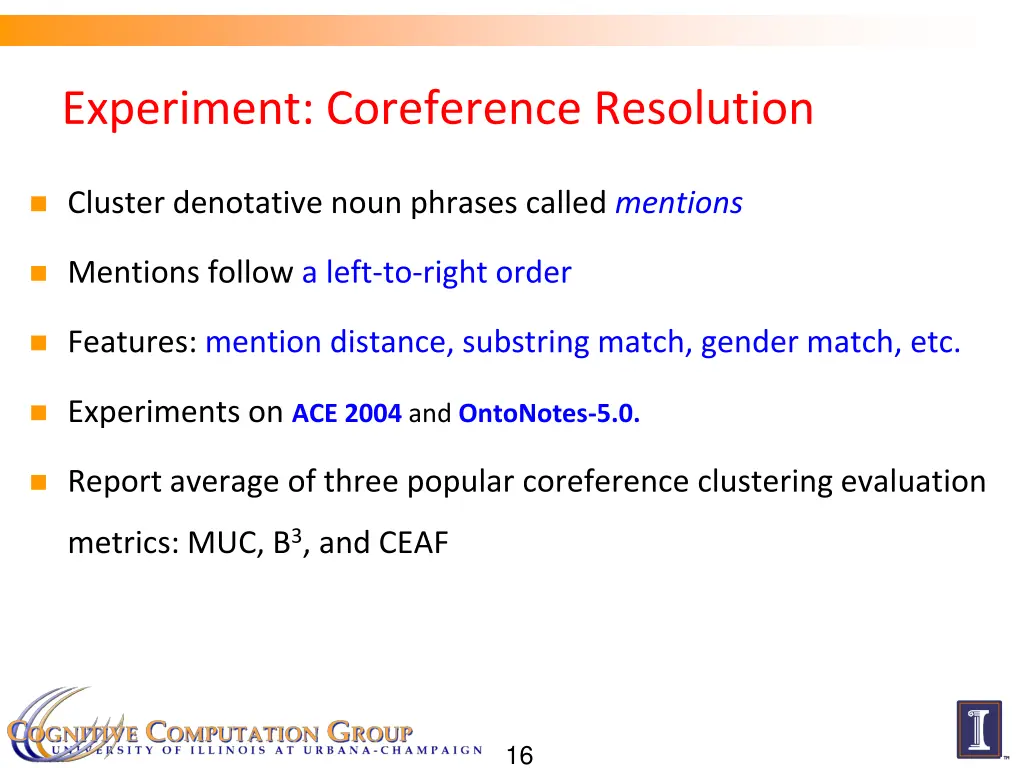
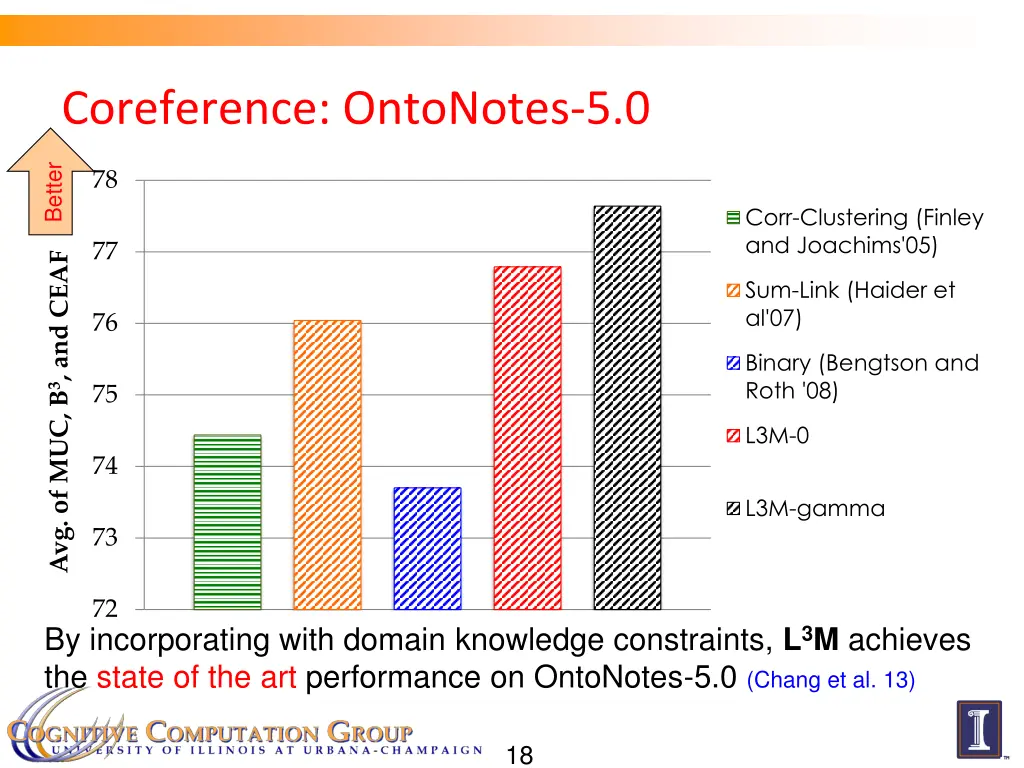
Experiment: Coreference Resolution Cluster denotative noun phrases called mentions Mentions follow a left-to-right order Features: mention distance, substring match, gender match, etc. Experiments on ACE 2004 and OntoNotes-5.0. Report average of three popular coreference clustering evaluation metrics: MUC, B3, and CEAF 16
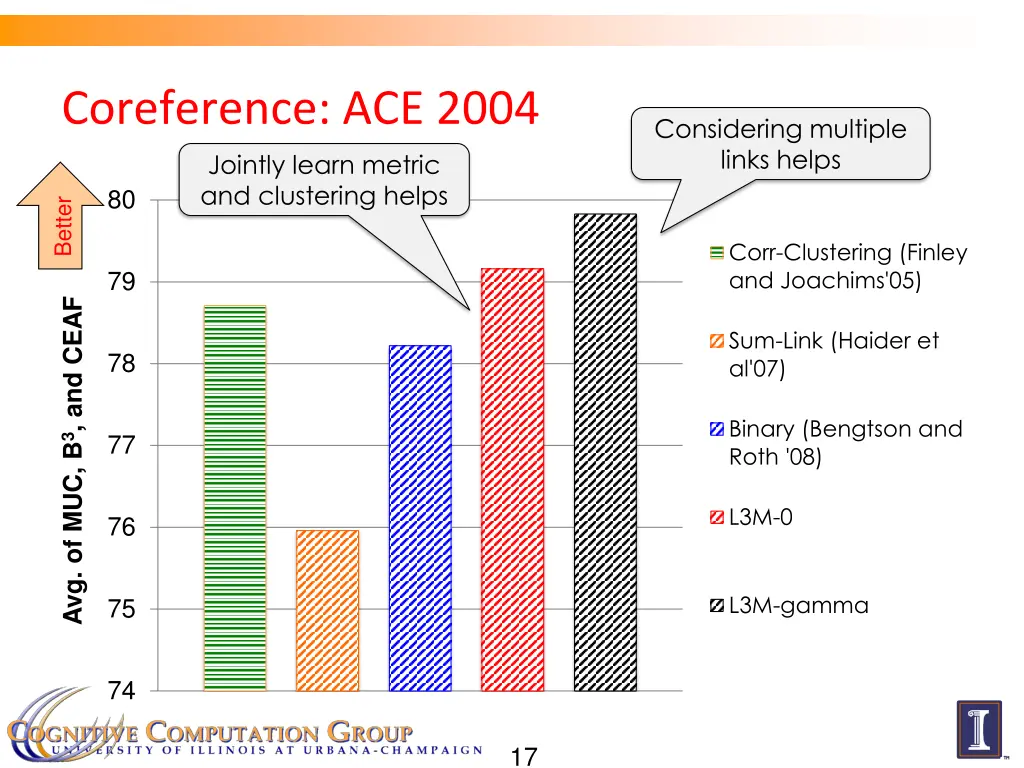
Coreference: ACE 2004 Jointly learn metric and clustering helps Better Considering multiple links helps 80 Corr-Clustering (Finley and Joachims'05) 79 Avg. of MUC, B3, and CEAF Sum-Link (Haider et al'07) 78 Binary (Bengtson and Roth '08) 77 L3M-0 76 L3M-gamma 75 74 17
Coreference: OntoNotes-5.0 Better 78 Corr-Clustering (Finley and Joachims'05) 77 Avg. of MUC, B3, and CEAF Sum-Link (Haider et al'07) 76 Binary (Bengtson and Roth '08) 75 L3M-0 74 L3M-gamma 73 72 By incorporating with domain knowledge constraints, L3M achieves the state of the art performance on OntoNotes-5.0 (Chang et al. 13) 18
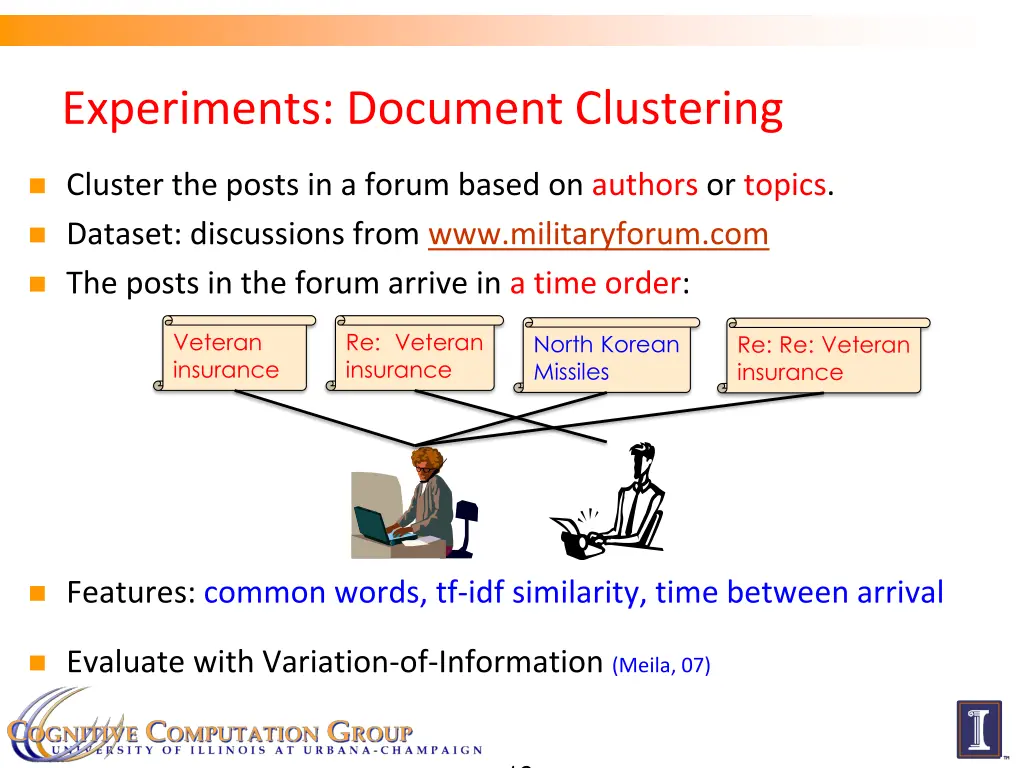
Experiments: Document Clustering Cluster the posts in a forum based on authors or topics. Dataset: discussions from www.militaryforum.com The posts in the forum arrive in a time order: Veteran insurance Re: Veteran insurance North Korean Missiles Re: Re: Veteran insurance Features: common words, tf-idf similarity, time between arrival Evaluate with Variation-of-Information (Meila, 07) 19
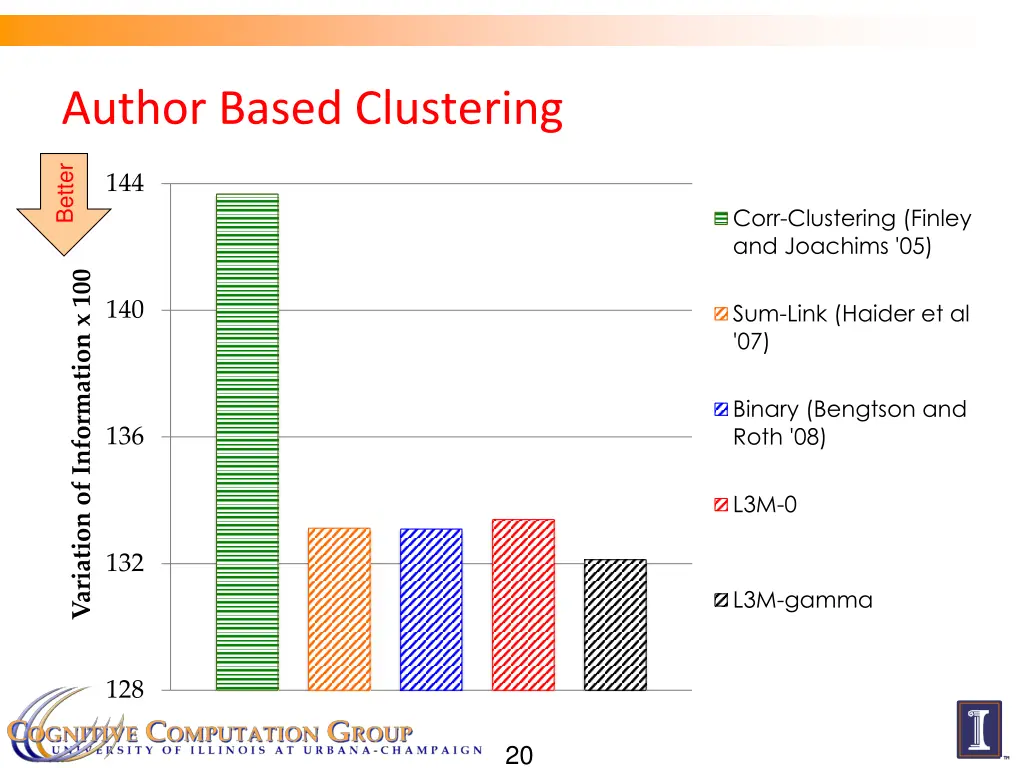
Author Based Clustering Better 144 Corr-Clustering (Finley and Joachims '05) Variation of Information x 100 Sum-Link (Haider et al '07) 140 Binary (Bengtson and Roth '08) 136 L3M-0 132 L3M-gamma 128 20
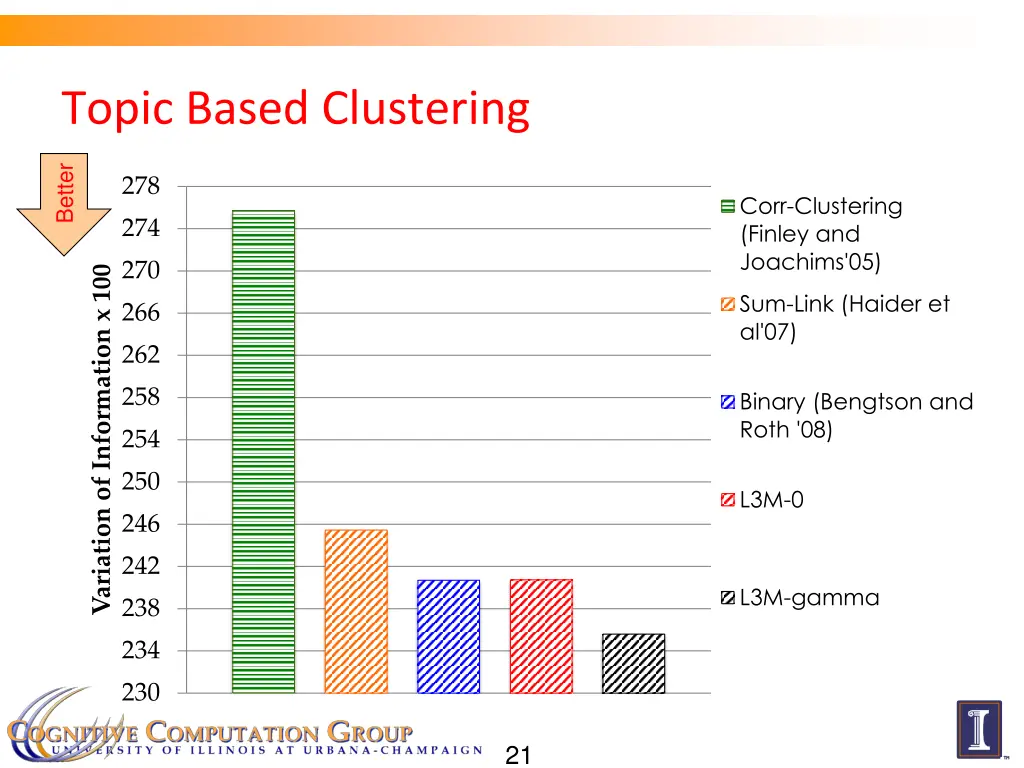
Topic Based Clustering Better 278 Corr-Clustering (Finley and Joachims'05) 274 270 Variation of Information x 100 Sum-Link (Haider et al'07) 266 262 258 Binary (Bengtson and Roth '08) 254 250 L3M-0 246 242 L3M-gamma 238 234 230 21
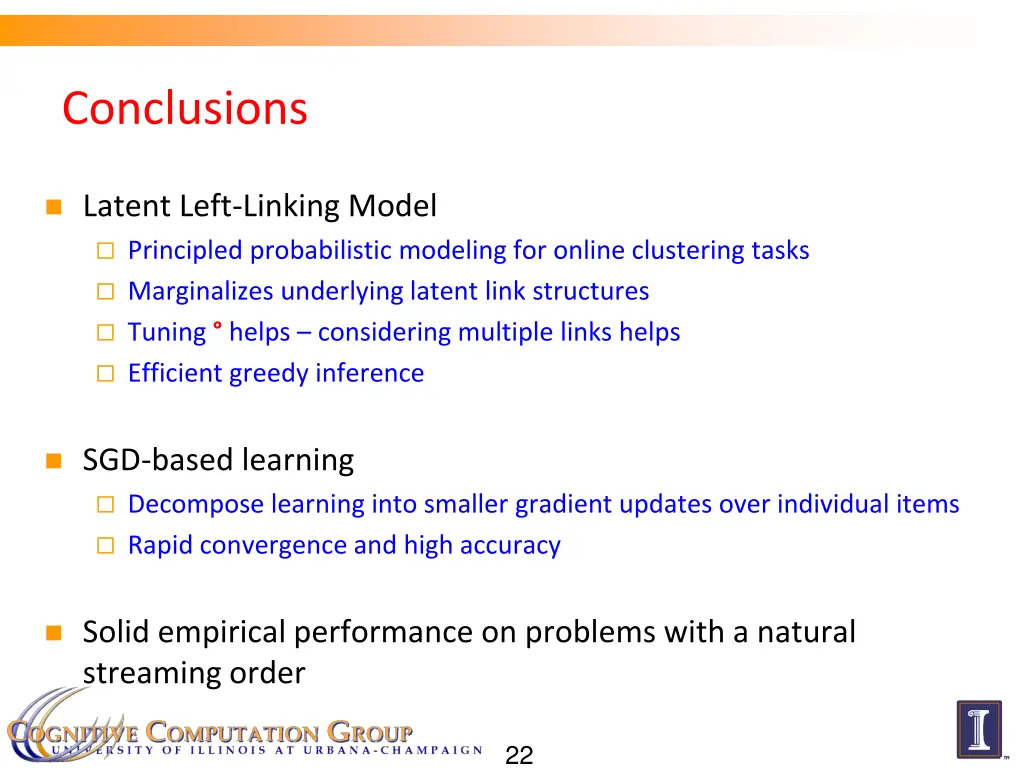
Conclusions Latent Left-Linking Model Principled probabilistic modeling for online clustering tasks Marginalizes underlying latent link structures Tuning helps considering multiple links helps Efficient greedy inference SGD-based learning Decompose learning into smaller gradient updates over individual items Rapid convergence and high accuracy Solid empirical performance on problems with a natural streaming order 22