Disseminating, Tracking, and Evaluating New Knowledge in P&OJennifer L. Flagg
The Center on Knowledge Translation for Technology Transfer at the University at Buffalo focuses on disseminating, tracking, and evaluating new knowledge in the field of Public Health & Health Professions. Funded by NIDRR, US Department of Education, PR# H133A060028. Learn more at kt4tt.buffalo.edu.

Download Presentation

Please find below an Image/Link to download the presentation.
The content on the website is provided AS IS for your information and personal use only. It may not be sold, licensed, or shared on other websites without obtaining consent from the author.If you encounter any issues during the download, it is possible that the publisher has removed the file from their server.
You are allowed to download the files provided on this website for personal or commercial use, subject to the condition that they are used lawfully. All files are the property of their respective owners.
The content on the website is provided AS IS for your information and personal use only. It may not be sold, licensed, or shared on other websites without obtaining consent from the author.
E N D
Presentation Transcript
Disseminating, Tracking and Evaluating New Knowledge in P&O Jennifer L. Flagg Center on Knowledge Translation for Technology Transfer http://kt4tt.buffalo.edu School of Public Health & Health Professions University at Buffalo (SUNY) Funded by NIDRR, US Department of Education, PR# H133A060028
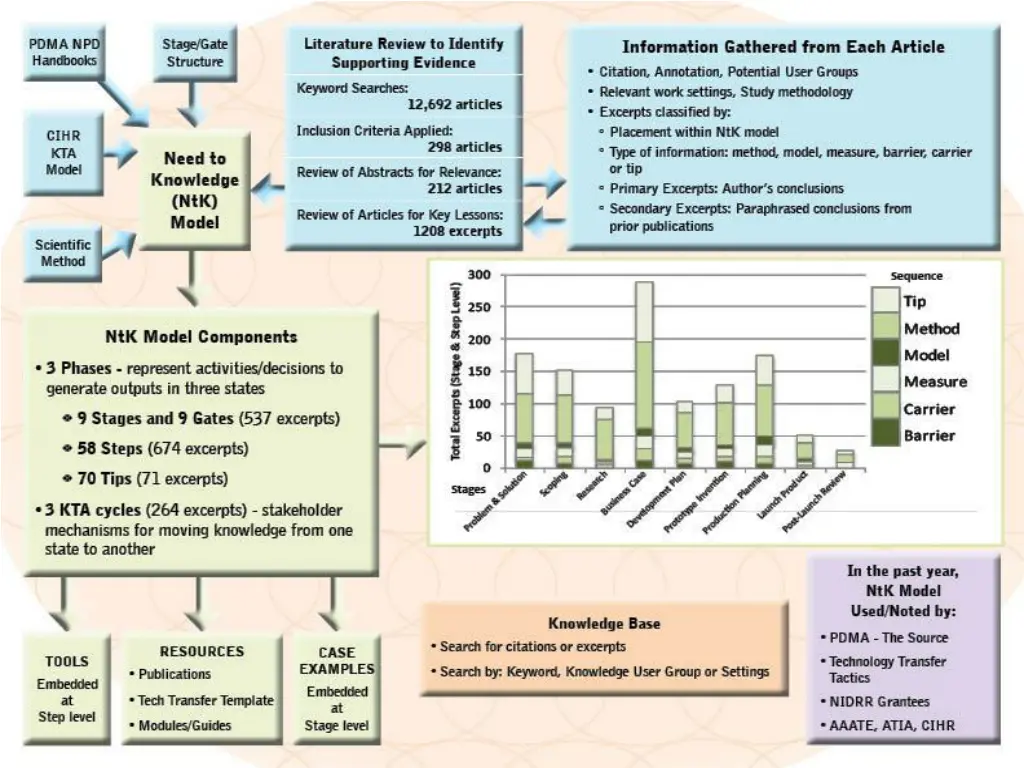
Three KT Tools Need to Knowledge (NtK Model) Knowledge Value Mapping (KVM) Level Of Knowledge Use Survey (LOKUS)
Focus of Need to Knowledge Model The NtK Model is relevant to government sponsors and grantees of Research & Development projects which are expected to create technology-based Innovations, capable of generating beneficial socio-economic impacts, and do so in the near term future. The NtK Model is not relevant to government sponsors or grantees of basic or inquiry-driven R&D projects, with no explicit intent to generate socio-economic impacts, nor expectations for application in any specific field or in any defined timeframe.
R&D for Innovation Each Method has own rigor and jargon. Actors are trained and operate in one method and over-value that method. Academic & Government sectors dominate policy at expense of Industry. Methods are actually inter-dependent.
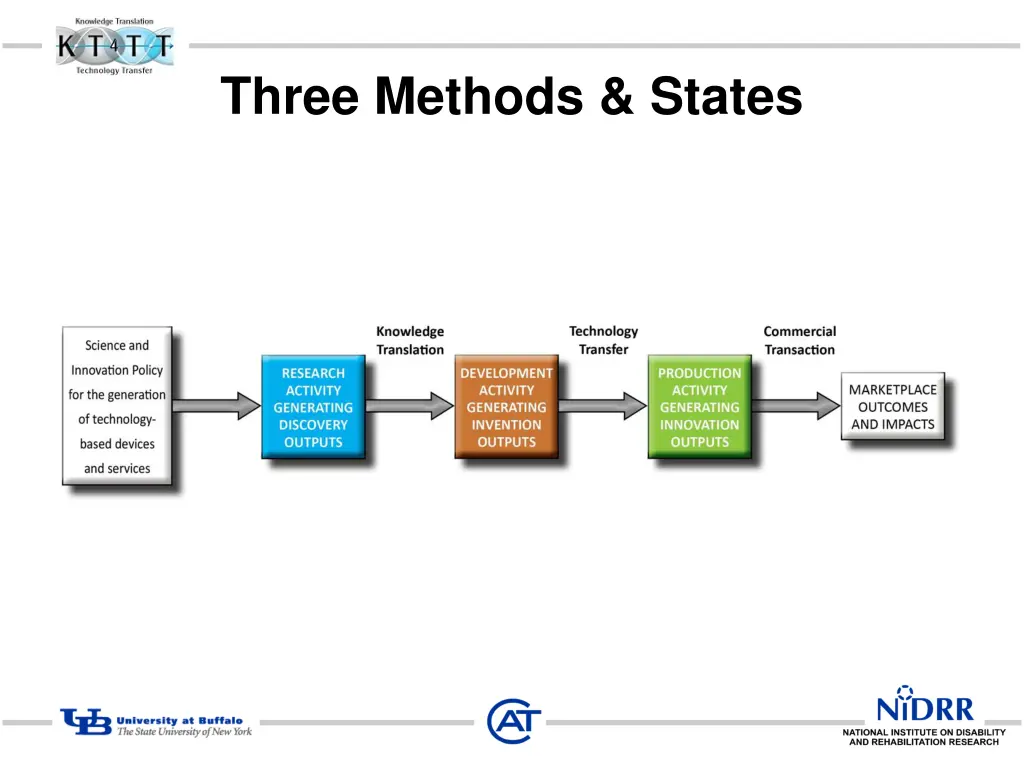
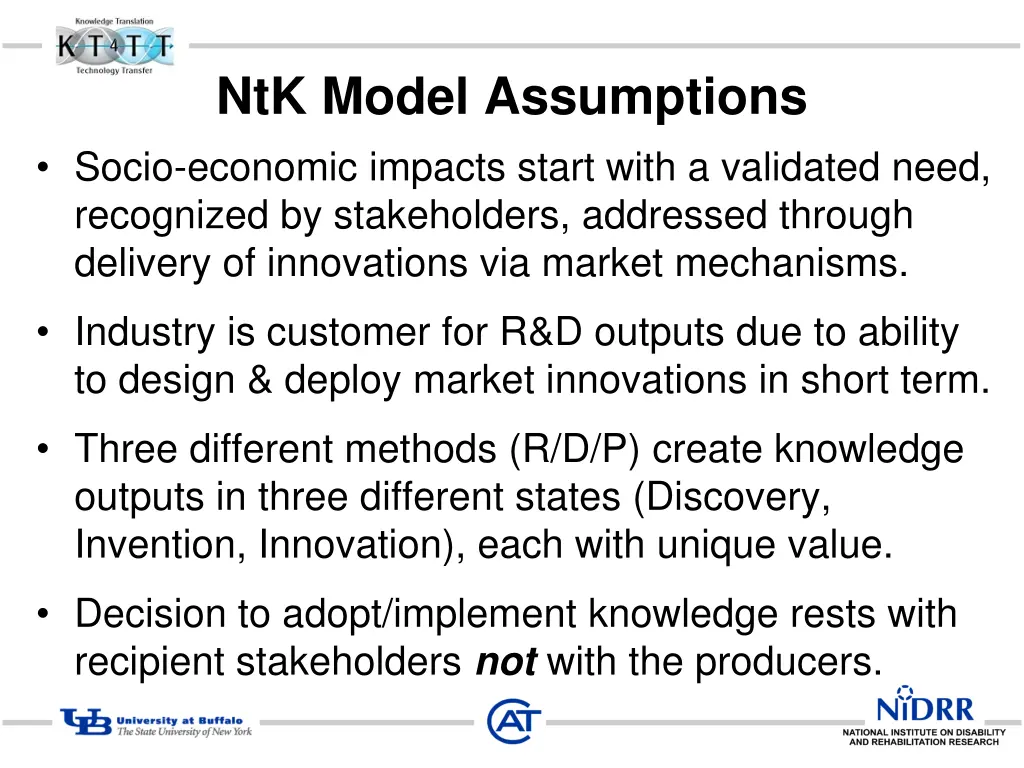
NtK Model Assumptions Socio-economic impacts start with a validated need, recognized by stakeholders, addressed through delivery of innovations via market mechanisms. Industry is customer for R&D outputs due to ability to design & deploy market innovations in short term. Three different methods (R/D/P) create knowledge outputs in three different states (Discovery, Invention, Innovation), each with unique value. Decision to adopt/implement knowledge rests with recipient stakeholders not with the producers.
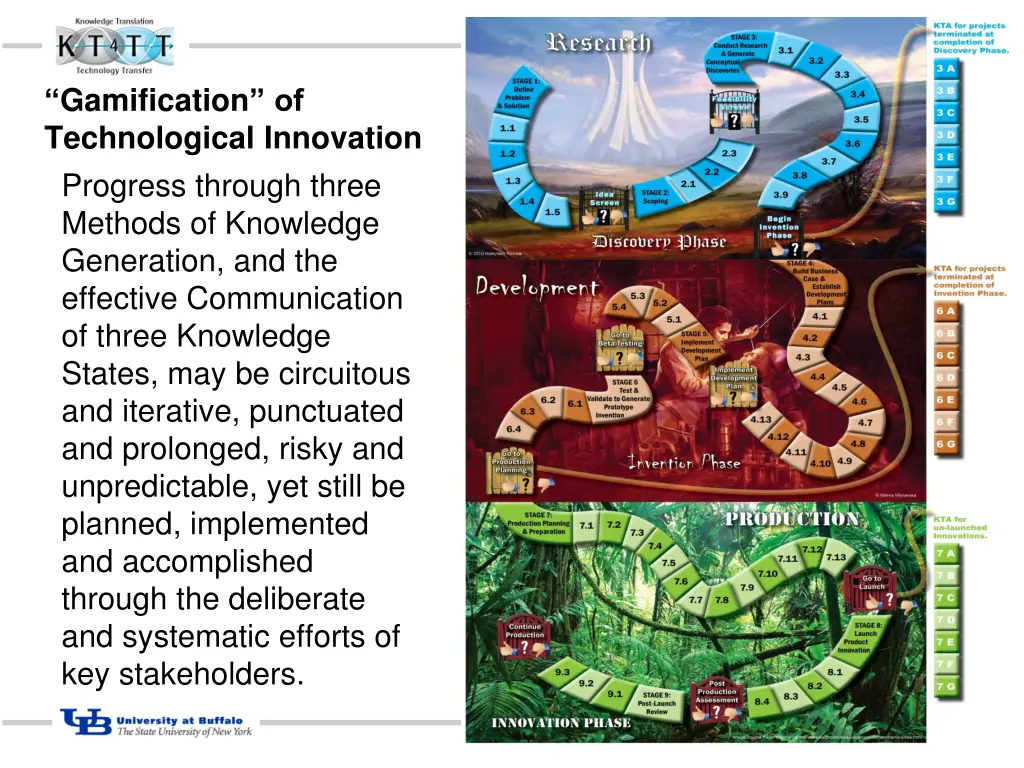
Gamification of Technological Innovation Progress through three Methods of Knowledge Generation, and the effective Communication of three Knowledge States, may be circuitous and iterative, punctuated and prolonged, risky and unpredictable, yet still be planned, implemented and accomplished through the deliberate and systematic efforts of key stakeholders.
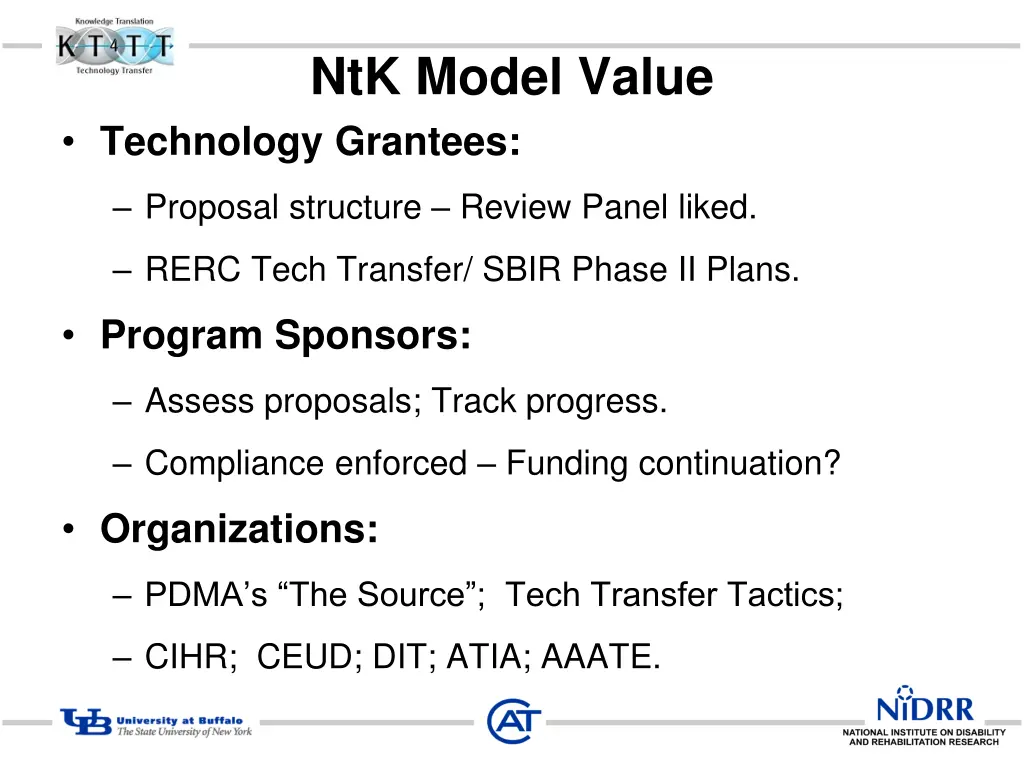
NtK Model Value Technology Grantees: Proposal structure Review Panel liked. RERC Tech Transfer/ SBIR Phase II Plans. Program Sponsors: Assess proposals; Track progress. Compliance enforced Funding continuation? Organizations: PDMA s The Source ; Tech Transfer Tactics; CIHR; CEUD; DIT; ATIA; AAATE.
Knowledge Value Mapping Questionnaire Reaching Target Audiences efficiently and effectively
New Requirements Sponsors & Grantees tasked with: Communicating findings to non-traditional audiences. Demonstrating evidence of knowledge use. New unfunded mandates to: Translate findings into appropriate language and formats. Identify channels for communication.
Rationale for KVM Reach diverse and non-traditional audiences. Communicate findings efficiently and effectively under current constraints. Employ broker organizations with appropriate membership. Understand how each values research to properly tailor message.
AT: Six Stakeholder Groups Researchers (Scientist & Engineer) Clinicians (Therapist/Educator/Counselor) Consumers (PWD & Family Member) Manufacturers (OEM & VAR) Policy Implementers (government/agency/ program administrator)? Brokers (attorney/employer/consultant)
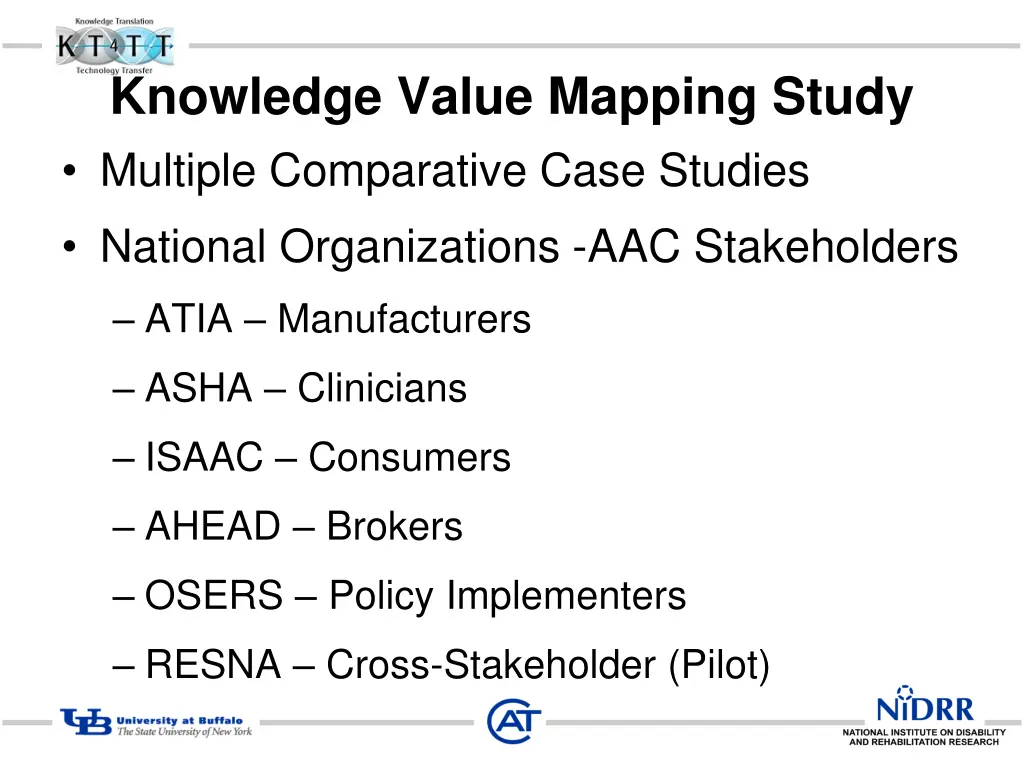
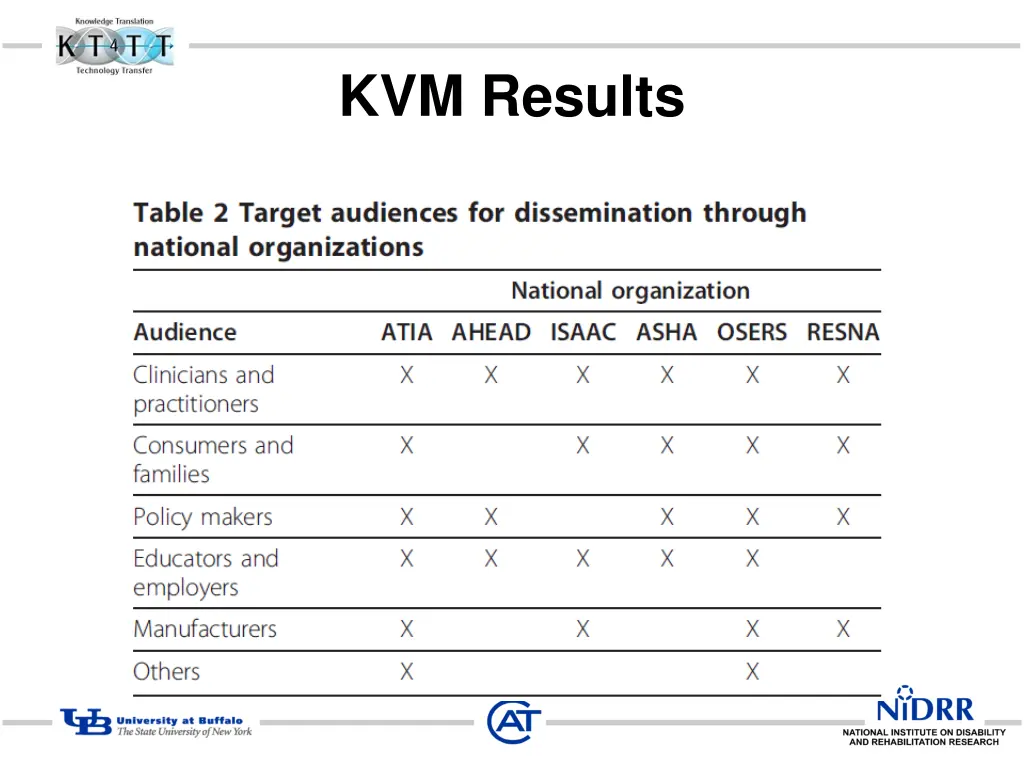
Knowledge Value Mapping Study Multiple Comparative Case Studies National Organizations -AAC Stakeholders ATIA Manufacturers ASHA Clinicians ISAAC Consumers AHEAD Brokers OSERS Policy Implementers RESNA Cross-Stakeholder (Pilot)
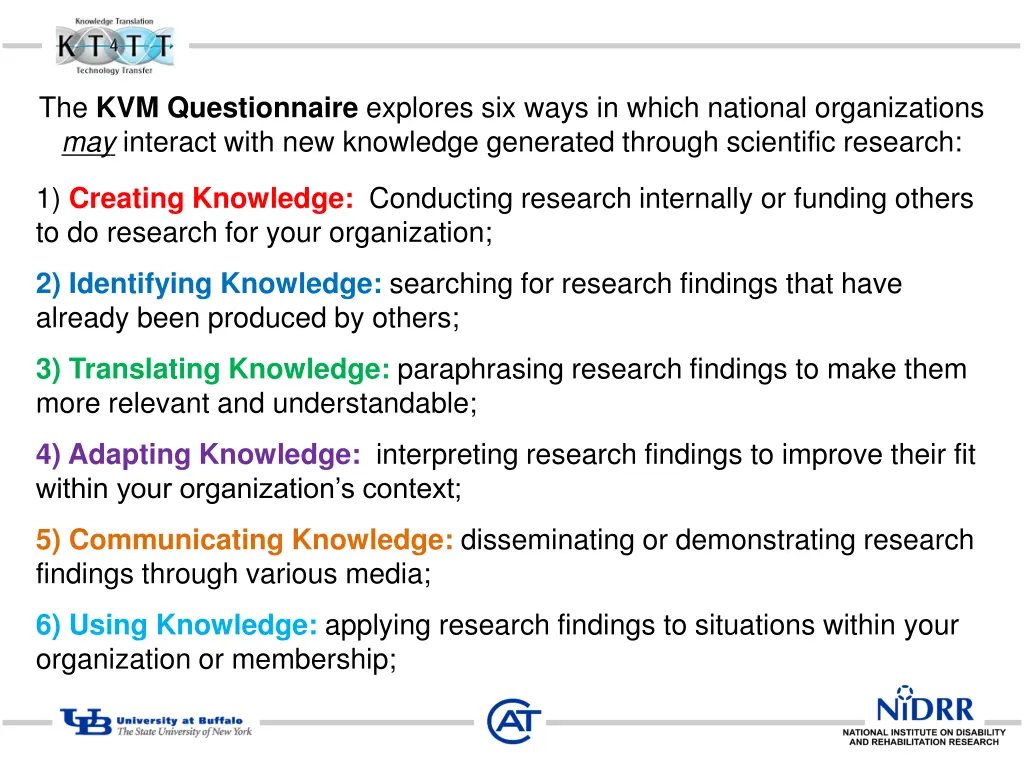
The KVM Questionnaire explores six ways in which national organizations may interact with new knowledge generated through scientific research: 1) Creating Knowledge: Conducting research internally or funding others to do research for your organization; 2) Identifying Knowledge: searching for research findings that have already been produced by others; 3) Translating Knowledge: paraphrasing research findings to make them more relevant and understandable; 4) Adapting Knowledge: interpreting research findings to improve their fit within your organization s context; 5) Communicating Knowledge: disseminating or demonstrating research findings through various media; 6) Using Knowledge: applying research findings to situations within your organization or membership;
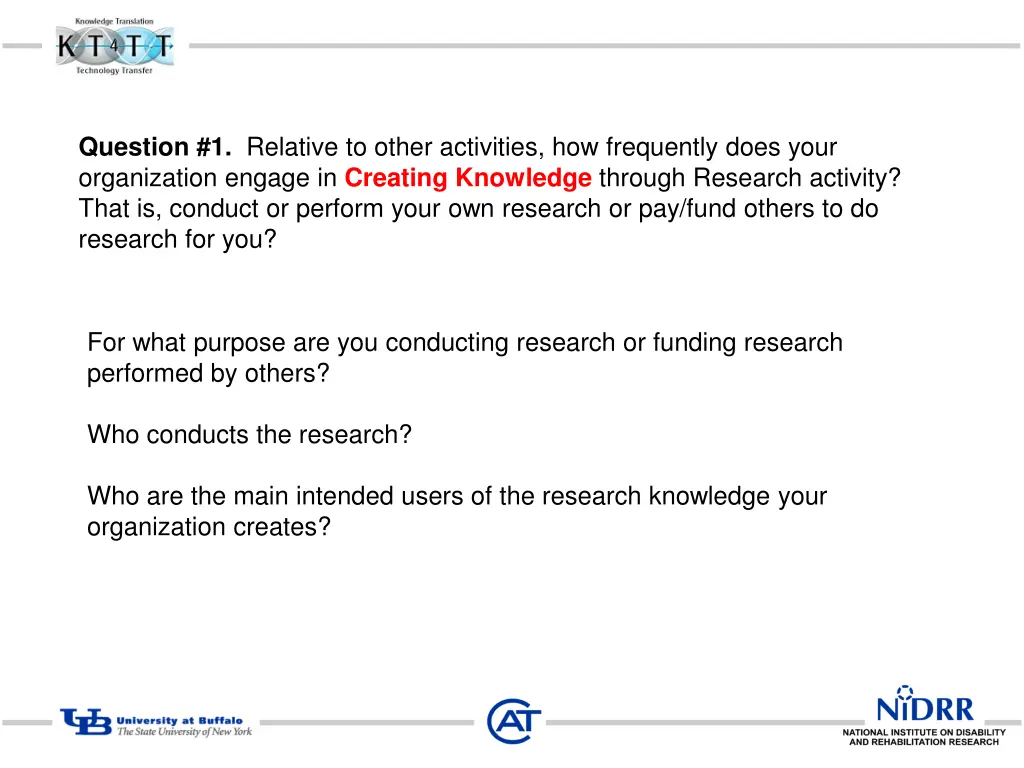
Question #1. Relative to other activities, how frequently does your organization engage in Creating Knowledge through Research activity? That is, conduct or perform your own research or pay/fund others to do research for you? For what purpose are you conducting research or funding research performed by others? Who conducts the research? Who are the main intended users of the research knowledge your organization creates?
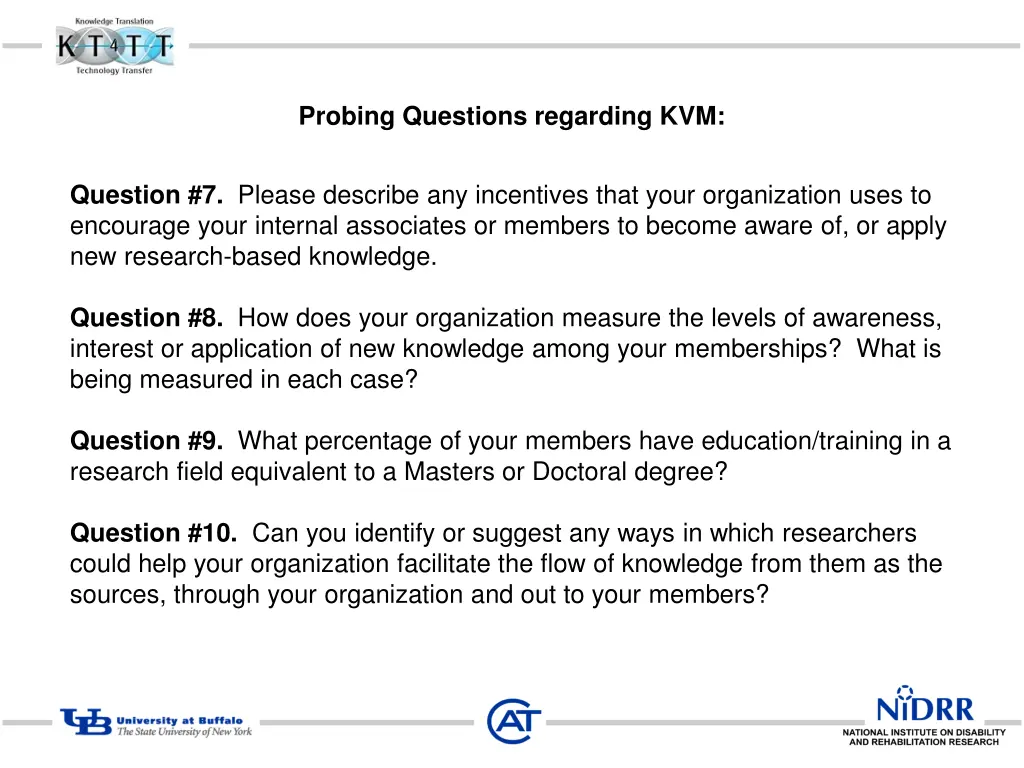
Probing Questions regarding KVM: Question #7. Please describe any incentives that your organization uses to encourage your internal associates or members to become aware of, or apply new research-based knowledge. Question #8. How does your organization measure the levels of awareness, interest or application of new knowledge among your memberships? What is being measured in each case? Question #9. What percentage of your members have education/training in a research field equivalent to a Masters or Doctoral degree? Question #10. Can you identify or suggest any ways in which researchers could help your organization facilitate the flow of knowledge from them as the sources, through your organization and out to your members?
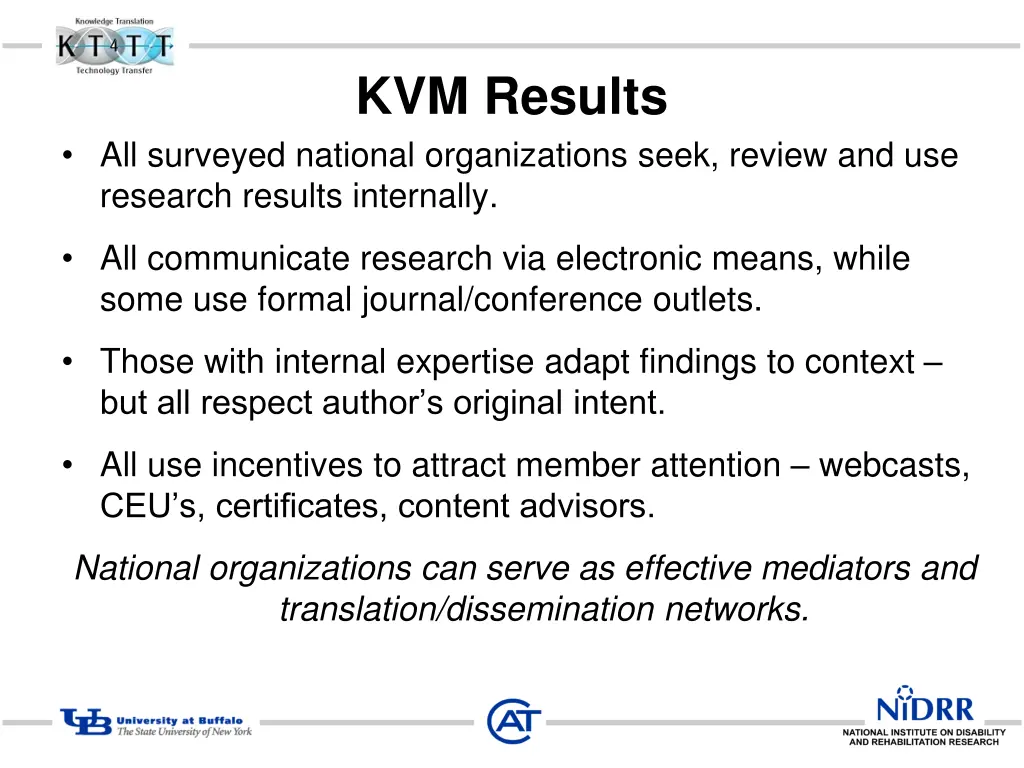
KVM Results All surveyed national organizations seek, review and use research results internally. All communicate research via electronic means, while some use formal journal/conference outlets. Those with internal expertise adapt findings to context but all respect author s original intent. All use incentives to attract member attention webcasts, CEU s, certificates, content advisors. National organizations can serve as effective mediators and translation/dissemination networks.
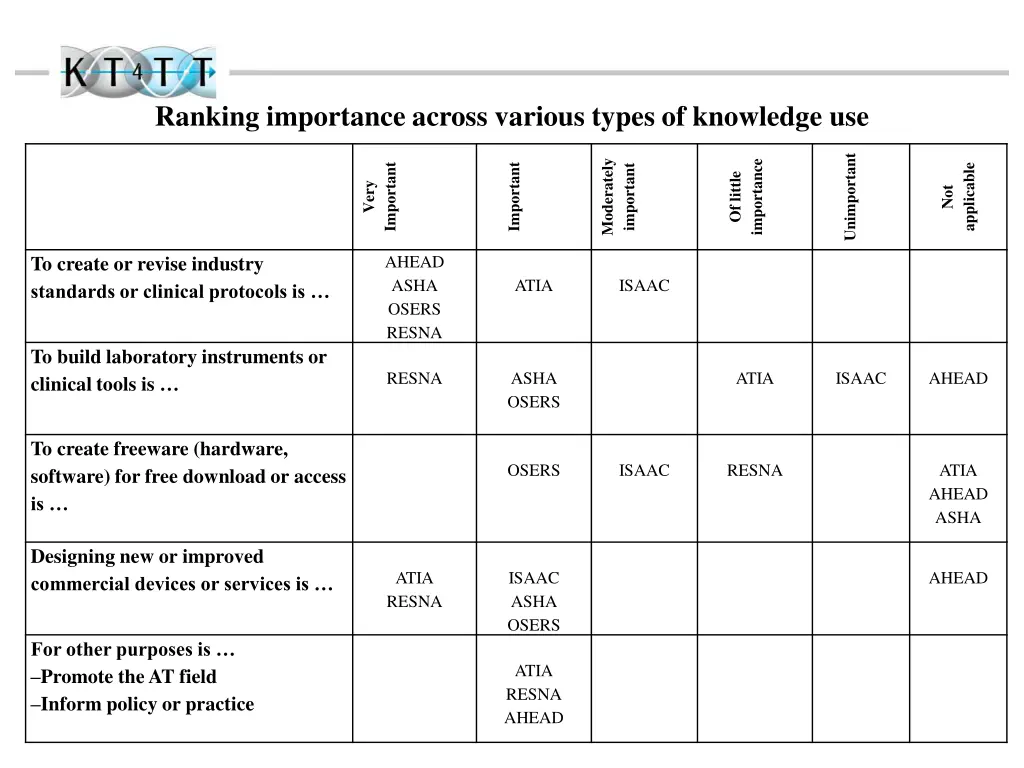
Ranking importance across various types of knowledge use Unimportant Moderately importance Important Important applicable important Of little Very Not To create or revise industry standards or clinical protocols is AHEAD ASHA OSERS RESNA ATIA ISAAC To build laboratory instruments or clinical tools is RESNA ASHA OSERS ATIA ISAAC AHEAD To create freeware (hardware, software) for free download or access is OSERS ISAAC RESNA ATIA AHEAD ASHA Designing new or improved commercial devices or services is ATIA RESNA ISAAC ASHA OSERS AHEAD For other purposes is Promote the AT field Inform policy or practice ATIA RESNA AHEAD
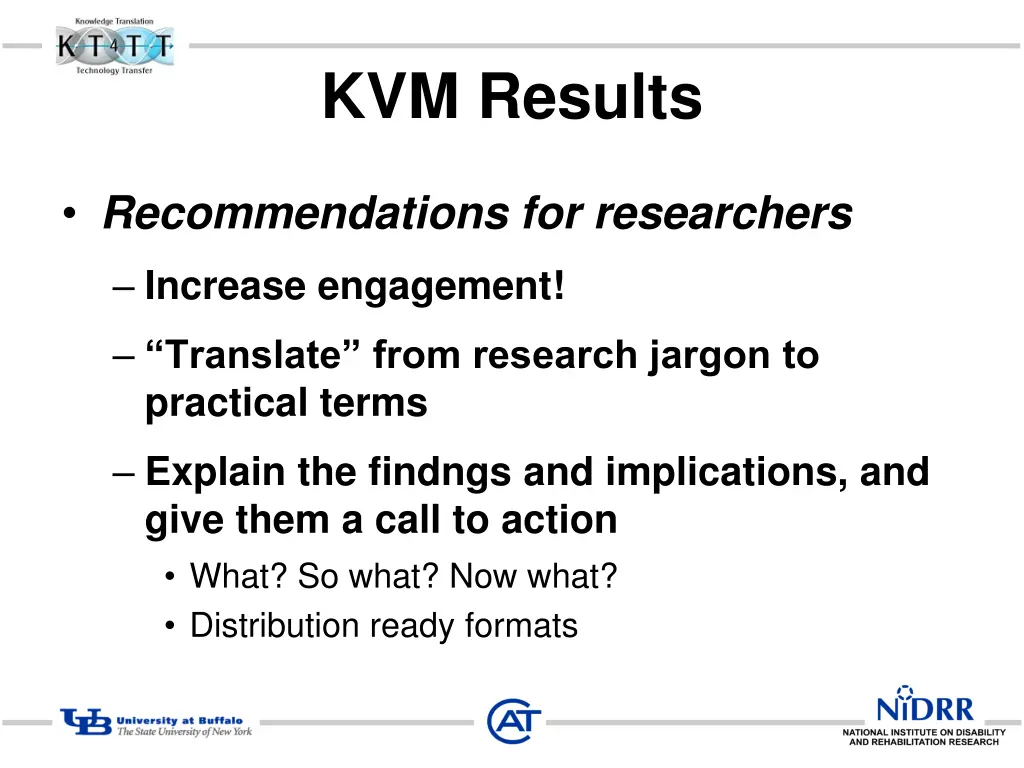
KVM Results Recommendations for researchers Increase engagement! Translate from research jargon to practical terms Explain the findngs and implications, and give them a call to action What? So what? Now what? Distribution ready formats
LOKUS Level Of Knowledge Use Survey No existing instrument fit study purpose. Created LOKUS Questionnaire for web-based self-report (VOVICI). Five Levels; each containing multiple types, dimensions and activities. Psychometric analysis shows LOKUS to be valid and reliable for measuring change in level of knowledge use.
Purpose of the KT intervention studies Problem: Sub-optimal level of demonstrated impact from R&D investment, so OMB mandates Federal programs demonstrate evidence of uptake & use. Solution: NIDRR selected Knowledge Translation as model and method to generate evidence. Challenge: Identify KT best practice models that are : Effective: increase K use by relevant stakeholders; Feasible : easy to implement; and Useful: K producers (technology grantees) can document evidence of impact from their project outputs Purpose: Develop and evaluate KT intervention strategies that are feasible for use by technology R&D projects and effective in increasing use of new knowledge by potential users.
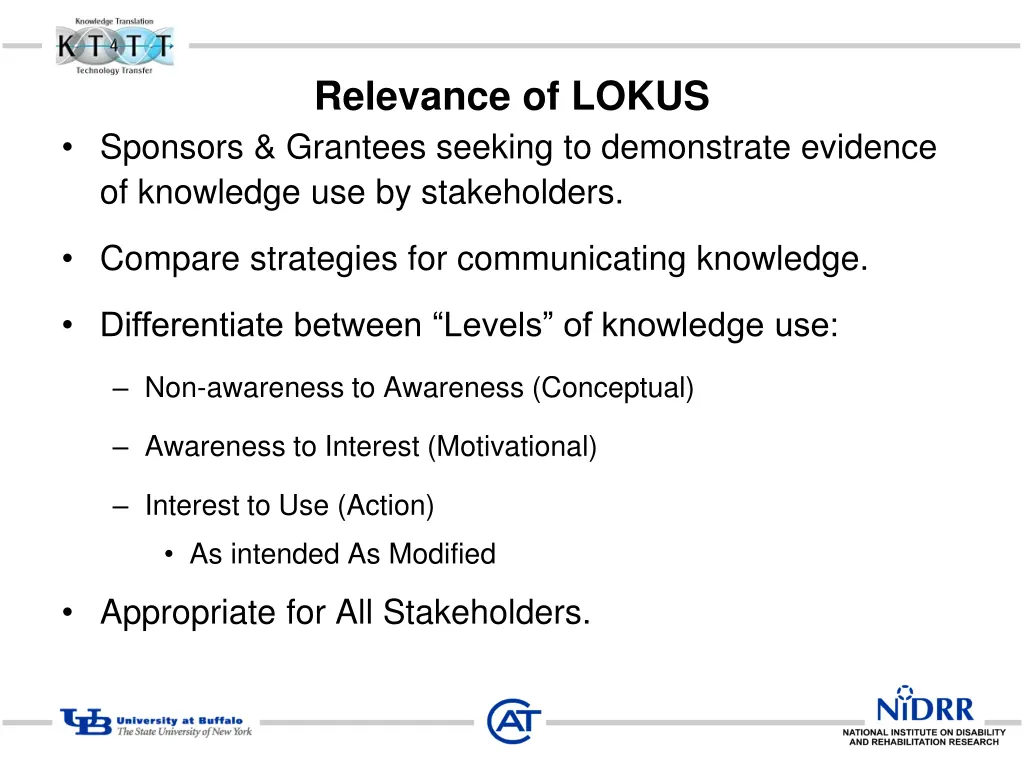
Relevance of LOKUS Sponsors & Grantees seeking to demonstrate evidence of knowledge use by stakeholders. Compare strategies for communicating knowledge. Differentiate between Levels of knowledge use: Non-awareness to Awareness (Conceptual) Awareness to Interest (Motivational) Interest to Use (Action) As intended As Modified Appropriate for All Stakeholders.
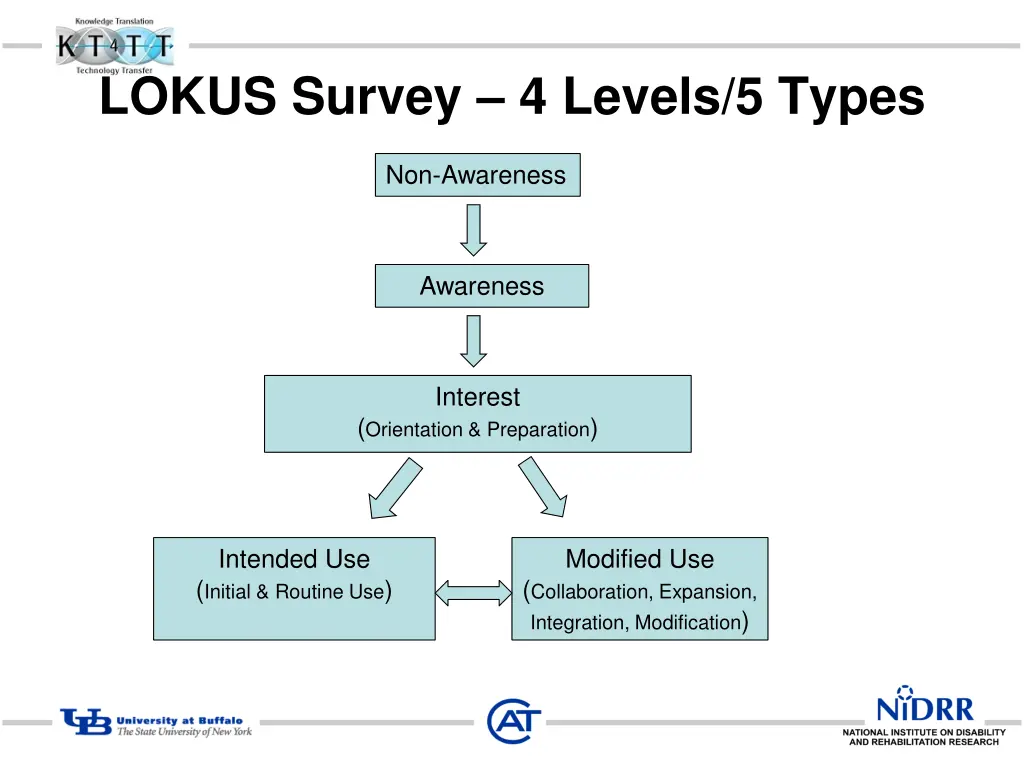
LOKUS Survey 4 Levels/5 Types Non-Awareness Awareness Interest (Orientation & Preparation) Intended Use (Initial & Routine Use) Modified Use (Collaboration, Expansion, Integration, Modification)
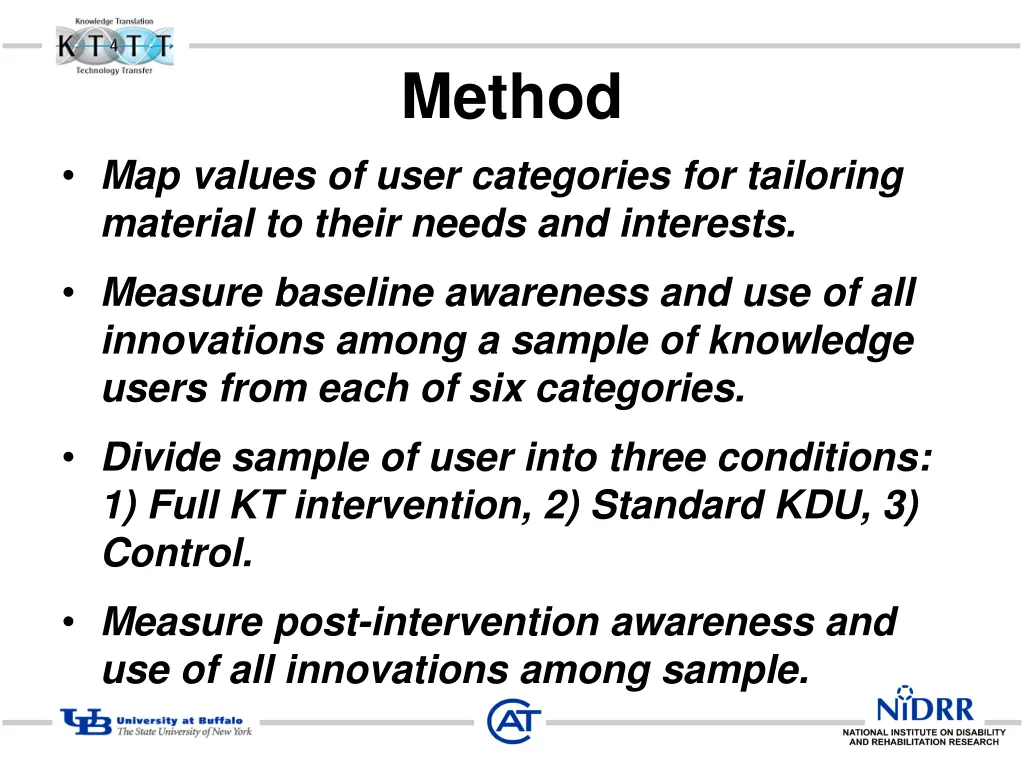
Method Map values of user categories for tailoring material to their needs and interests. Measure baseline awareness and use of all innovations among a sample of knowledge users from each of six categories. Divide sample of user into three conditions: 1) Full KT intervention, 2) Standard KDU, 3) Control. Measure post-intervention awareness and use of all innovations among sample.
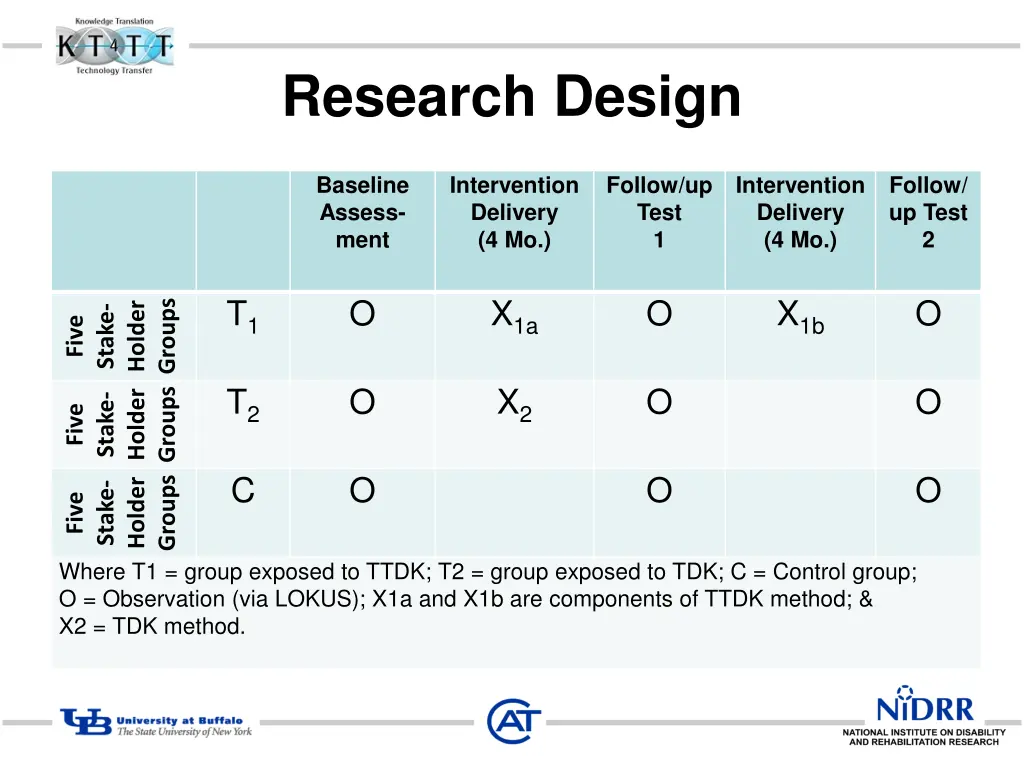
Research Design Baseline Assess- ment Intervention Delivery (4 Mo.) Follow/up Test 1 Intervention Delivery (4 Mo.) Follow/ up Test 2 T1 O X1a O X1b O Holder Holder Holder Stake- Groups Groups Groups Five T2 O X2 O O Stake- Five C O O O Stake- Five Where T1 = group exposed to TTDK; T2 = group exposed to TDK; C = Control group; O = Observation (via LOKUS); X1a and X1b are components of TTDK method; & X2 = TDK method.
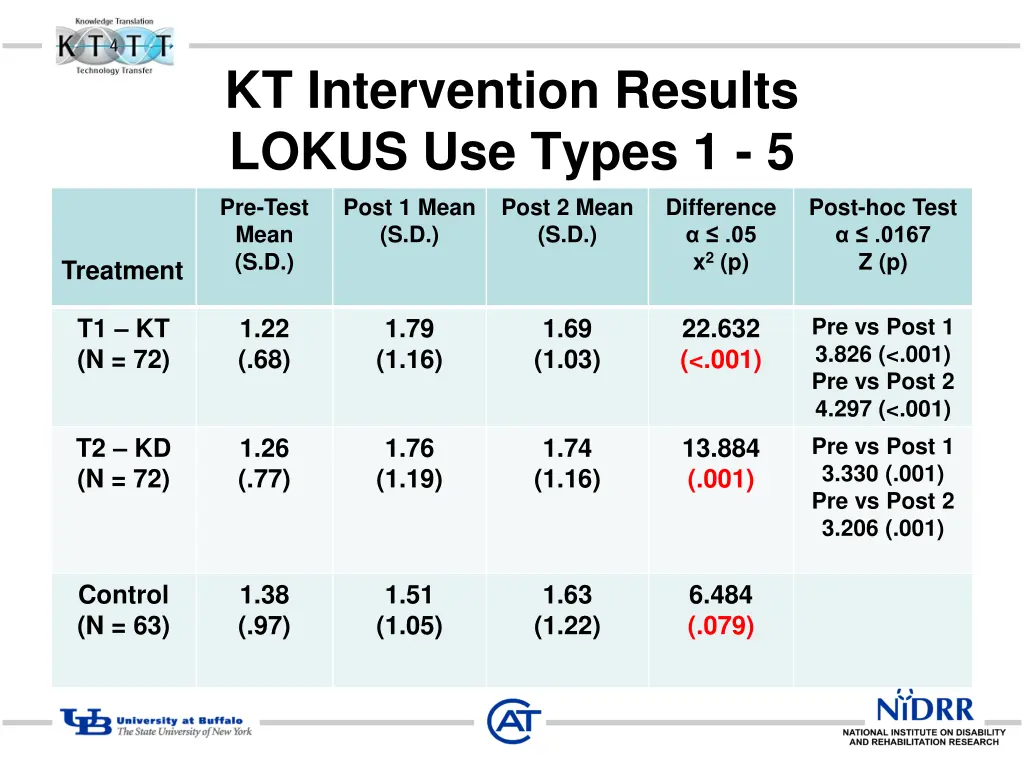
KT Intervention Results LOKUS Use Types 1 - 5 Pre-Test Mean (S.D.) Post 1 Mean (S.D.) Post 2 Mean (S.D.) Difference .05 x2 (p) Post-hoc Test .0167 Z (p) Treatment T1 KT (N = 72) 1.22 (.68) 1.79 (1.16) 1.69 (1.03) 22.632 (<.001) Pre vs Post 1 3.826 (<.001) Pre vs Post 2 4.297 (<.001) Pre vs Post 1 3.330 (.001) Pre vs Post 2 3.206 (.001) T2 KD (N = 72) 1.26 (.77) 1.76 (1.19) 1.74 (1.16) 13.884 (.001) Control (N = 63) 1.38 (.97) 1.51 (1.05) 1.63 (1.22) 6.484 (.079)
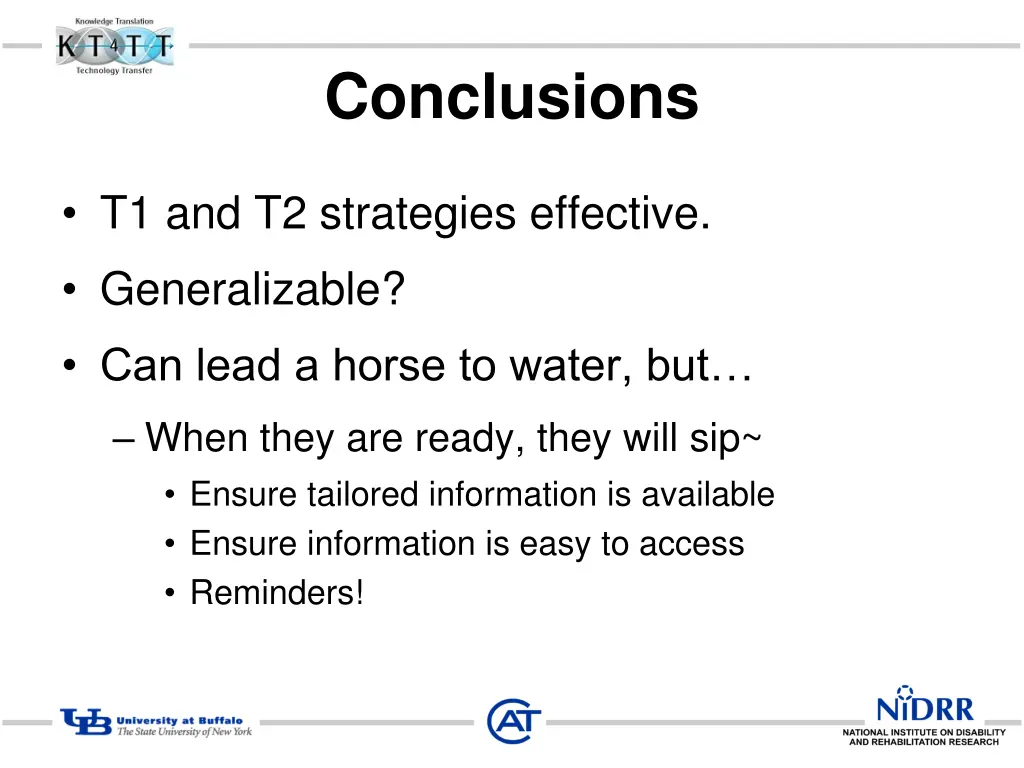
Conclusions T1 and T2 strategies effective. Generalizable? Can lead a horse to water, but When they are ready, they will sip~ Ensure tailored information is available Ensure information is easy to access Reminders!
Key Take Aways NtK Model useful for planning R&D projects when socio-economic impact is the goal. KVM provides insights regarding how to reach stakeholder groups. LOKUS can be used to determine uptake and use of new knowledge. Information about all tools and projects available at: http://kt4tt.buffalo.edu
ACKNOWLEDGEMENT This is a presentation of the Center on Knowledge Translation for Technology Transfer, which is funded by the National Institute on Disability and Rehabilitation Research, U.S. Department of Education, under grant #H133A080050. The opinions contained in this presentation are those of the grantee and do not necessarily reflect those of the U.S. Department of Education.