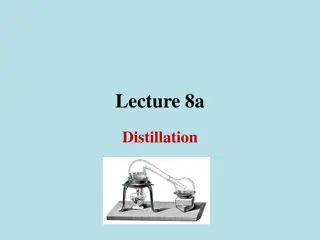
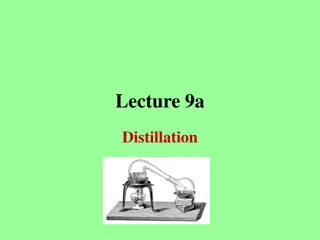
Learn about distillation as a unit operation in chemical engineering, which involves separating components in a liquid mixture through vaporization and condensation. Explore the concept of ideal solutions and real solutions, along with the properties and examples of each. Understand the volatility of substances in solutions and how it is defined.
Please find below an Image/Link to download the presentation.
The content on the website is provided AS IS for your information and personal use only. It may not be sold, licensed, or shared on other websites without obtaining consent from the author. If you encounter any issues during the download, it is possible that the publisher has removed the file from their server.
You are allowed to download the files provided on this website for personal or commercial use, subject to the condition that they are used lawfully. All files are the property of their respective owners.
The content on the website is provided AS IS for your information and personal use only. It may not be sold, licensed, or shared on other websites without obtaining consent from the author.
E N D
Presentation Transcript
Dr. GarimaJoshi Assistant Professor Department of Pharmaceutical Sciences, MLSU III Sem, Unit operation
Distillation is an unit operation which involves separation of a vaporizable component from a multi-component system and subsequent condensation of vapours. It is a process of separating the component substances from a liquid mixture by selective evaporation and condensation. It is defined as the separation of the components of a liquid mixture by a process involving vaporization and subsequent condensation at another place.
Separation of volatile oils- cloves(Eugenolcomprises 72- 90%, Vanilin, acetyl eugenol). Separation of drugs obtained from plant and animal sources-Vit. A from fish liver oil. Purification of organic solvents-absolute alcohol (100%). Purification of drugs obtained from chemical process. Manufacture of official preparations -sprit of nitrous ether, sprit of ammonia, D.water and water for inj. Quality control methods-Alcohol content in elixir(4-40%). Refining of petroleum products- Petroleum ether 60,80. Recovery of solvents-synthesis.
Ideal Solution (Perfect solution) Ideal solution is defined as the one in which there is no change in the properties of components other than dilution, when they mixed to form a solution. Property of ideal solution Total volume of solution is equal to sum of volumes of each component .No heat absorbed and No heat evolved. No Chemical reaction in-between. Final volume of solution represents additive property of individual components. Follow Raoult s law .
Real Solution Most system shows varying degree of deviation from raoult s law, depending on nature of liquids and temperature. These solution are known as real solution. Property of Real solution Heat may absorbed or evolved Chemical reaction occurs in-between Final volume of solution represents additive property of individual components Don t Follow Raoult s law Example Carbon tetra-chloride + Cyclohexane Choroform+ Acetone
The volatility of any substance in solution may be defined as the equilibrium partial pressure of substance in vapour phase divided by the mole fraction of substance in the solution. For example, a substance A in a liquid mixture has partial pressure PA and its concentration in the mixture is XA on mole fraction scale. Partial vapour pressure of A Volatility of component A, = Mole fraction XA of A in solution vA = PA/XA The volatility of a material in the pure state is equal to the vapour pressure of the material.
Consider a liquid mixture containing two component A and B, In such case, the volatility of one component is expressed in terms of second as below, Relative Volatility ( ) = Volatility of component A (VA) ____________________ Volatility of component B (VB) = VA/VB
Vapor pressure -It is defined as the pressure exerted by a vapor in thermodynamic equilibrium with its condensed phases (solid or liquid) at a given temperature in a closed system. The equilibrium vapor pressure is an indication of a liquid's evaporation rate.