Explore the regulator's viewpoint on DLT applications in the financial sector, discussing key features, regulatory approaches, drivers in the financial landscape, actual applications, pros and cons of DLT, and the comparison between unrestricted and restricted DLT arrangements. Learn about the potential benefits, risks, and considerations in adopting DLT technology in the financial industry.
Please find below an Image/Link to download the presentation.
The content on the website is provided AS IS for your information and personal use only. It may not be sold, licensed, or shared on other websites without obtaining consent from the author. If you encounter any issues during the download, it is possible that the publisher has removed the file from their server.
You are allowed to download the files provided on this website for personal or commercial use, subject to the condition that they are used lawfully. All files are the property of their respective owners.
The content on the website is provided AS IS for your information and personal use only. It may not be sold, licensed, or shared on other websites without obtaining consent from the author.
AGENDA 1 DLT applications in the financial system: relevant features DLT and market structure: competition, monopoly or what else? 2 3 The regulators approach BANCA D ITALIA EUROSISTEMA 2
DLT applications in the financial landscape: the main drivers Demand and supply factors for fintech innovations 1) Regulatory and economic pressure on the financial industry - increased kap constraints, liquidity ratios, credit concentration ratios, - increased competition, technology, low interest rates, pressure on profits incentives for tech innovations that generate new revenues/reduce costs 2) Shifting consumers preferences BANCA D ITALIA EUROSISTEMA 3
Actual and perspective DLT applications in the financial landscape - Payment systems Virtual currencies Cash and securities settlement systems Remittances - Markets Interbank trading Financial trading - Collateral management - Deposit, lending and Kap raising - Insurance BANCA D ITALIA EUROSISTEMA 4
Pros and cons of DLT Potential DLT benefits Reduced complexity Higher end-to-end processing speed ( prompt availability of assets and funds) Less need for reconciliation across multiple (record keeping) infrastructures Higher transparency in transaction record keeping Stronger network resilience (through distributed data mgmt) Financial inclusion But costs and risks, too: Uncertainties about operational and security issues Lack of interoperability (with existing infrastructures) and issues about scalability Uncertainties about the soundness of the legal basis (e.g. settlement finality) and ... about the robustness of the governance fmk Issues about data integrity and privacy Possibile illicit uses Both micro and macrofinancial risks BANCA D ITALIA EUROSISTEMA 5
Unrestricted vs restricted DLT arrangements In an unrestricted set up: open access ( new types of participants), distributed validation procols less tiering, but scalability + info security issues (difficult to reach consensus .with an increasing number of the nodes: more resiliency, but longer latency settlement and operational (including cyber) risk mgmt more complex (e.g. reliance on TPSP) governance weaknesses (more difficult to ensure compliance with AML, CFT, KYC) among a large # of unknown entities) No one size fits all , but financial institutions and regulators are focussing on restricted DLT (closed set of participants), and/or the establishment of a system administrator , with the final goal of maintaining trust in the system BANCA D ITALIA EUROSISTEMA 6
AGENDA DLT applications in finance: the relevant features 1 DLT and market structure: competition, monopoly or what else? 2 3 The regulators approach BANCA D ITALIA EUROSISTEMA 7
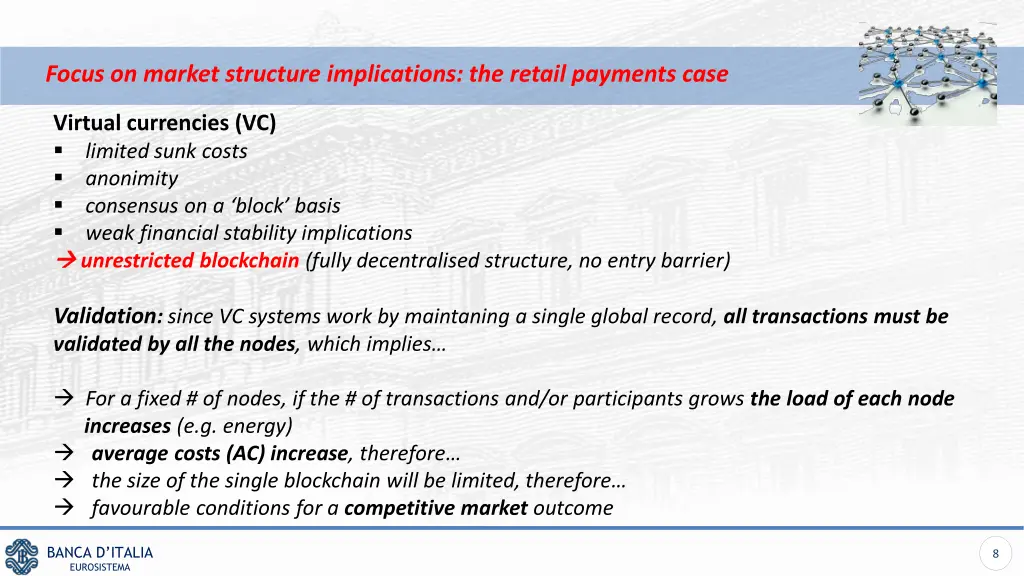
Focus on market structure implications: the retail payments case Virtual currencies (VC) limited sunk costs anonimity consensus on a block basis weak financial stability implications unrestricted blockchain (fully decentralised structure, no entry barrier) Validation: since VC systems work by maintaning a single global record, all transactions must be validated by all the nodes, which implies For a fixed # of nodes, if the # of transactions and/or participants grows the load of each node increases (e.g. energy) average costs (AC) increase, therefore the size of the single blockchain will be limited, therefore favourable conditions for a competitive market outcome BANCA D ITALIA EUROSISTEMA 8
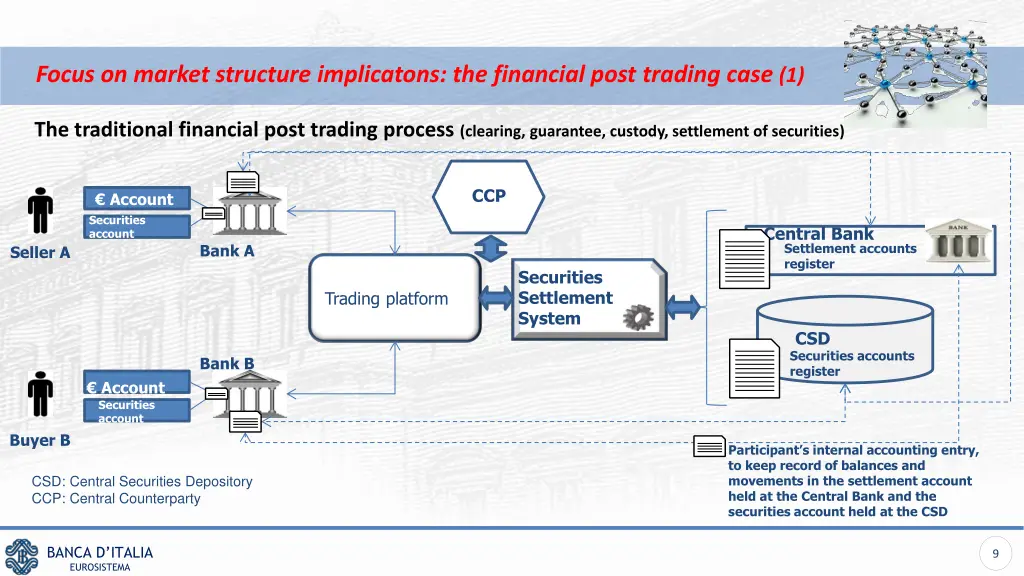
Focus on market structure implicatons: the financial post trading case (1) The traditional financial post trading process (clearing, guarantee, custody, settlement of securities) CCP Account Securities account Central Bank Settlement accounts register Bank A Seller A Securities Settlement System Trading platform CSD Securities accounts register Bank B Account Securities account Buyer B Participant s internal accounting entry, to keep record of balances and movements in the settlement account held at the Central Bank and the securities account held at the CSD CSD: Central Securities Depository CCP: Central Counterparty BANCA D ITALIA EUROSISTEMA 9
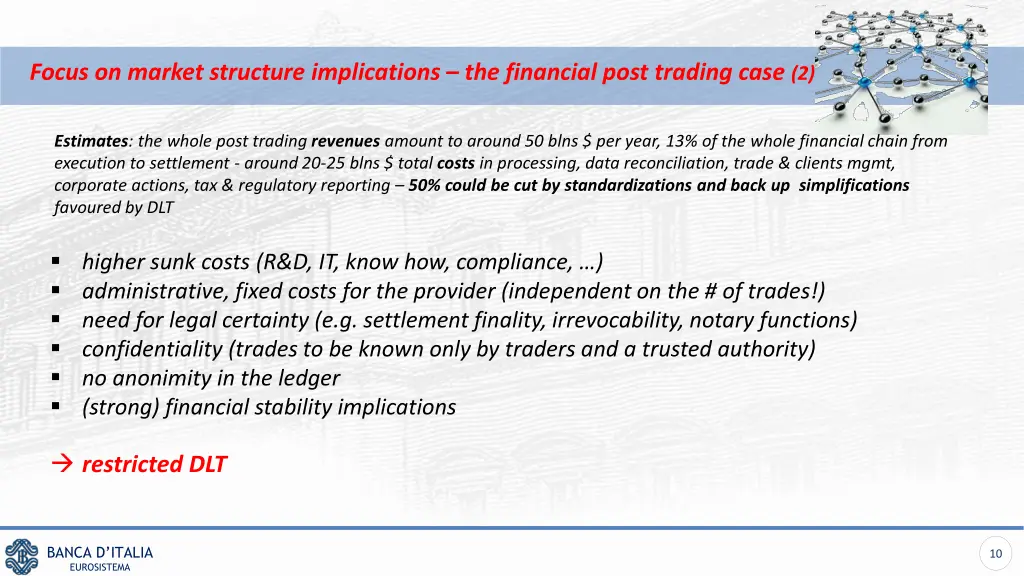
Focus on market structure implications the financial post trading case (2) Estimates: the whole post trading revenues amount to around 50 blns $ per year, 13% of the whole financial chain from execution to settlement - around 20-25 blns $ total costs in processing, data reconciliation, trade & clients mgmt, corporate actions, tax & regulatory reporting 50% could be cut by standardizations and back up simplifications favoured by DLT higher sunk costs (R&D, IT, know how, compliance, ) administrative, fixed costs for the provider (independent on the # of trades!) need for legal certainty (e.g. settlement finality, irrevocability, notary functions) confidentiality (trades to be known only by traders and a trusted authority) no anonimity in the ledger (strong) financial stability implications restricted DLT BANCA D ITALIA EUROSISTEMA 10
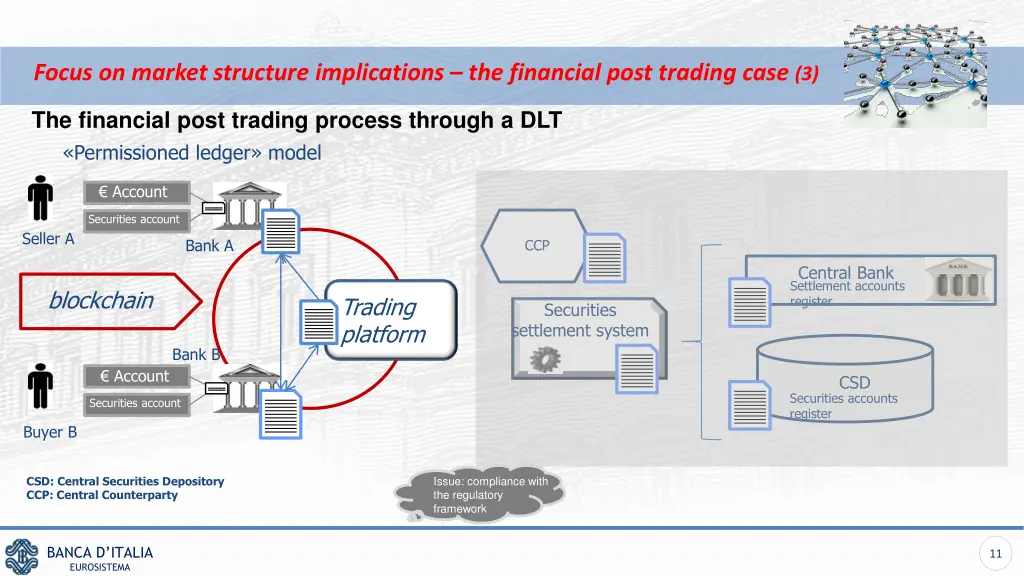
Focus on market structure implications the financial post trading case (3) The financial post trading process through a DLT Permissioned ledger model Account Securities account Seller A Bank A CCP Central Bank Settlement accounts register blockchain Trading platform Securities settlement system Bank B Account CSD Securities accounts register Securities account Buyer B CSD: Central Securities Depository CCP: Central Counterparty Issue: compliance with the regulatory framework BANCA D ITALIA EUROSISTEMA 11
Focus on market structure implications the financial post trading case (4) Validation in a post trading DL - no PoW, notary design utilizes a trusted authority, by which: consensus is reached on an individual transaction basis (rather than in blocks!), and validation can be done using only a partial history of DL transactions (not all the blocks!) (BoE, 2017) Costs do not increase proportionally with the size of the blocks; this and high sunk costs imply AC decrease with the network size Moreover, strong network externalities in the post trading industry (more generally, in wholesale payment systems) But decrasing AC + network externalities create Conditions for concentration in a DL based post trading industry (oligo/monopoly) From a CCP/CSD centered to a DL-service provider centered monopoly?? BANCA D ITALIA EUROSISTEMA 12
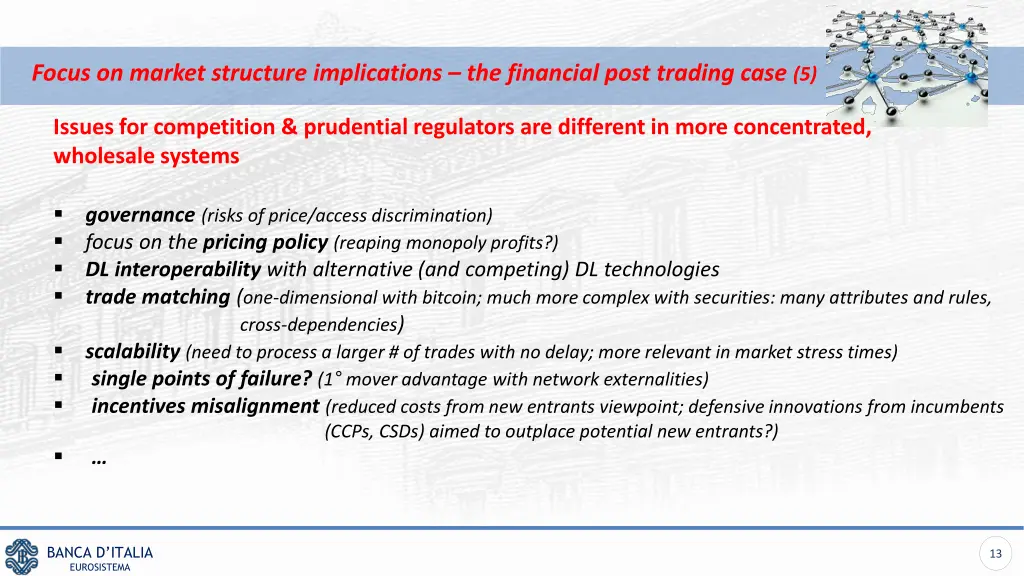
Focus on market structure implications the financial post trading case (5) Issues for competition & prudential regulators are different in more concentrated, wholesale systems governance (risks of price/access discrimination) focus on the pricing policy(reaping monopoly profits?) DL interoperability with alternative (and competing) DL technologies trade matching (one-dimensional with bitcoin; much more complex with securities: many attributes and rules, cross-dependencies) scalability (need to process a larger # of trades with no delay; more relevant in market stress times) single points of failure? (1 mover advantage with network externalities) incentives misalignment (reduced costs from new entrants viewpoint; defensive innovations from incumbents (CCPs, CSDs) aimed to outplace potential new entrants?) BANCA D ITALIA EUROSISTEMA 13
AGENDA DLT applications in finance: the relevant features 1 DLT and market structure: competition, monopoly or what else? 2 3 The regulators approach BANCA D ITALIA EUROSISTEMA 14
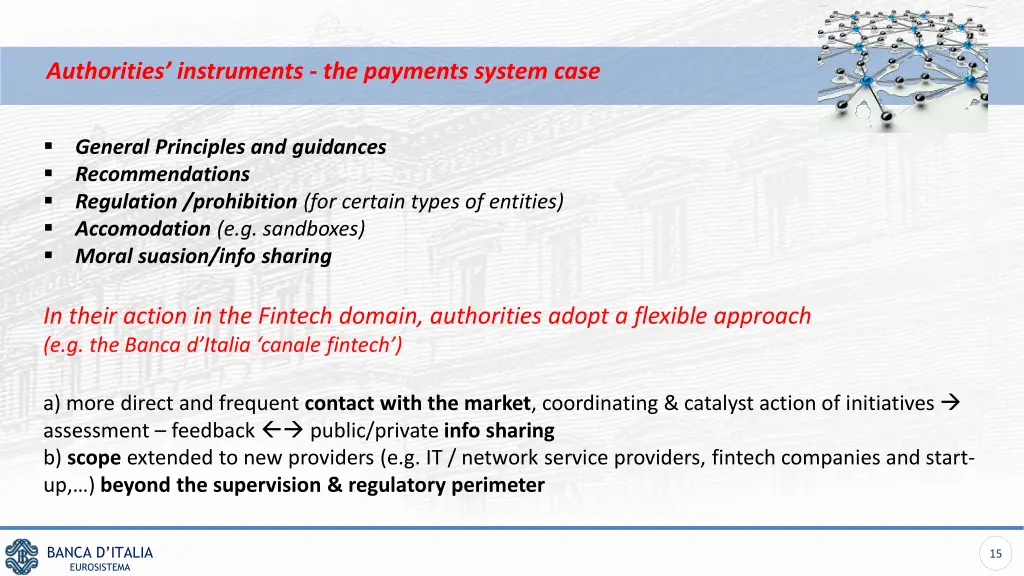
Authorities instruments - the payments system case General Principles and guidances Recommendations Regulation /prohibition (for certain types of entities) Accomodation (e.g. sandboxes) Moral suasion/info sharing In their action in the Fintech domain, authorities adopt a flexible approach (e.g. the Banca d Italia canale fintech ) a) more direct and frequent contact with the market, coordinating & catalyst action of initiatives assessment feedback public/private info sharing b) scope extended to new providers (e.g. IT / network service providers, fintech companies and start- up, ) beyond the supervision & regulatory perimeter BANCA D ITALIA EUROSISTEMA 15
Authorities objectives the payments system case System integrity - technical soundness: optimize the trade off btw usability and safety, promote innovation but not at the expense of users trust in the system as a whole governance soundness legal robustness - - Financial stability (both macro and micro risks) Cost efficiency User s protection (transparency, non discrimination, ) Contrast to illicit uses of the system BANCA D ITALIA EUROSISTEMA 16
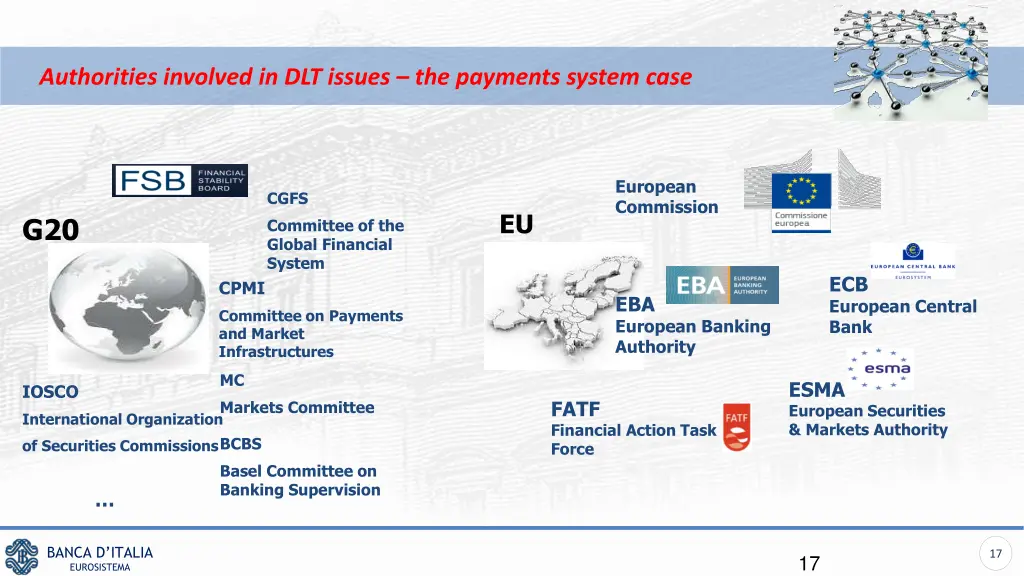
Authorities involved in DLT issues the payments system case European Commission CGFS EU G20 Committee of the Global Financial System ECB European Central Bank CPMI EBA European Banking Authority Committee on Payments and Market Infrastructures MC ESMA European Securities & Markets Authority IOSCO FATF Financial Action Task Force Markets Committee International Organization BCBS of Securities Commissions Basel Committee on Banking Supervision BANCA D ITALIA EUROSISTEMA 17 17
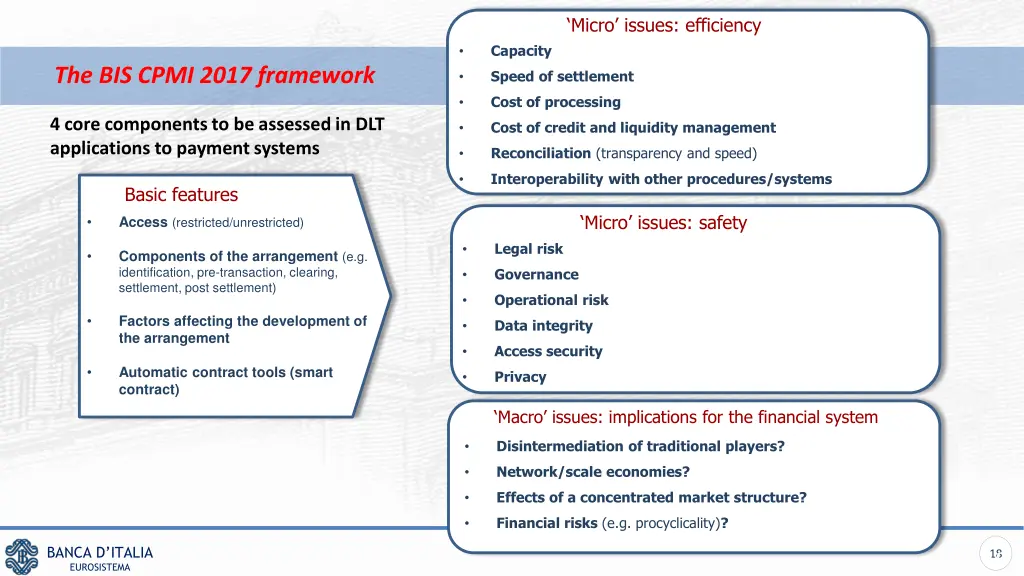
Micro issues: efficiency Capacity The BIS CPMI 2017 framework Speed of settlement Cost of processing 4 core components to be assessed in DLT applications to payment systems Cost of credit and liquidity management Reconciliation (transparency and speed) Interoperability with other procedures/systems Basic features Micro issues: safety Access (restricted/unrestricted) Legal risk Components of the arrangement (e.g. identification, pre-transaction, clearing, settlement, post settlement) Governance Operational risk Factors affecting the development of the arrangement Data integrity Access security Automatic contract tools (smart contract) Privacy Macro issues: implications for the financial system Disintermediation of traditional players? Network/scale economies? Effects of a concentrated market structure? Financial risks (e.g. procyclicality)? BANCA D ITALIA EUROSISTEMA 18 18