Discover how leading seed companies in India are using AI and data analytics to create high-yield, climate-resilient seeds. Learn the benefits for farmers, the role of seed suppliers, and the future of smart seed technology.
Please find below an Image/Link to download the presentation.
The content on the website is provided AS IS for your information and personal use only. It may not be sold, licensed, or shared on other websites without obtaining consent from the author. If you encounter any issues during the download, it is possible that the publisher has removed the file from their server.
You are allowed to download the files provided on this website for personal or commercial use, subject to the condition that they are used lawfully. All files are the property of their respective owners.
The content on the website is provided AS IS for your information and personal use only. It may not be sold, licensed, or shared on other websites without obtaining consent from the author.
E N D
Presentation Transcript
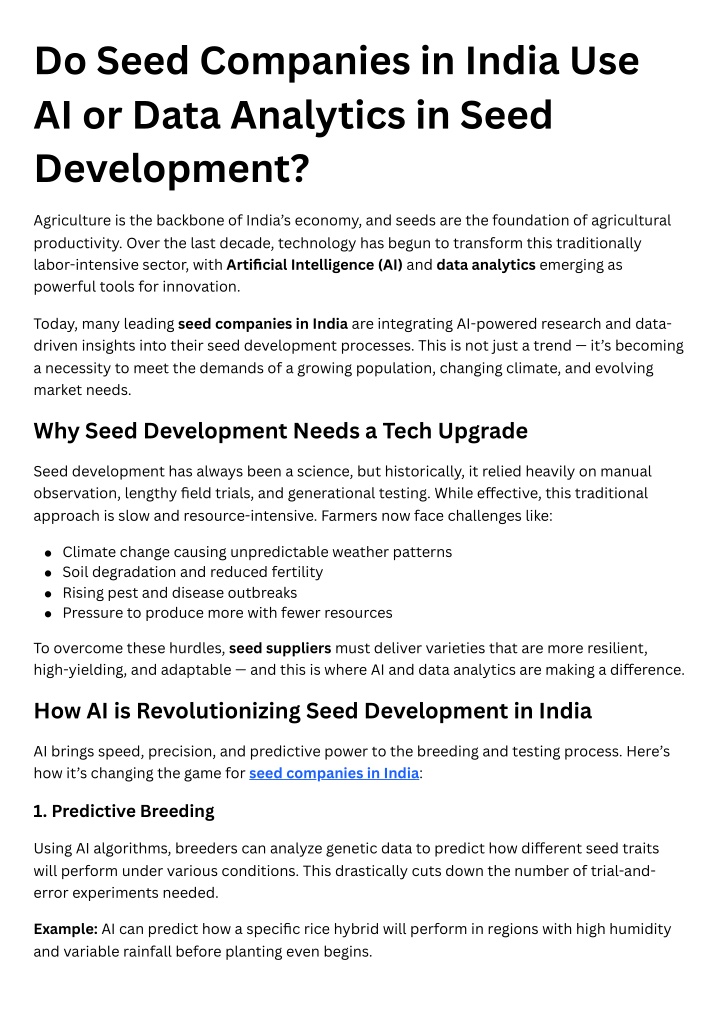
Do Seed Companies in India Use AI or Data Analytics in Seed Development? Agriculture is the backbone of India s economy, and seeds are the foundation of agricultural productivity. Over the last decade, technology has begun to transform this traditionally labor-intensive sector, with Artificial Intelligence (AI) and data analytics emerging as powerful tools for innovation. Today, many leading seed companies in India are integrating AI-powered research and data- driven insights into their seed development processes. This is not just a trend it s becoming a necessity to meet the demands of a growing population, changing climate, and evolving market needs. Why Seed Development Needs a Tech Upgrade Seed development has always been a science, but historically, it relied heavily on manual observation, lengthy field trials, and generational testing. While effective, this traditional approach is slow and resource-intensive. Farmers now face challenges like: Climate change causing unpredictable weather patterns Soil degradation and reduced fertility Rising pest and disease outbreaks Pressure to produce more with fewer resources To overcome these hurdles, seed suppliers must deliver varieties that are more resilient, high-yielding, and adaptable and this is where AI and data analytics are making a difference. How AI is Revolutionizing Seed Development in India AI brings speed, precision, and predictive power to the breeding and testing process. Here s how it s changing the game for seed companies in India: 1. Predictive Breeding Using AI algorithms, breeders can analyze genetic data to predict how different seed traits will perform under various conditions. This drastically cuts down the number of trial-and- error experiments needed. Example: AI can predict how a specific rice hybrid will perform in regions with high humidity and variable rainfall before planting even begins.
2. Shortening the Breeding Cycle Traditionally, developing a new seed variety can take 8 12 years. AI tools can identify optimal genetic combinations faster, potentially cutting development time by half. 3. Early Disease Detection Machine learning models can scan seed batches using high-resolution imaging to detect diseases invisible to the human eye. This ensures only healthy seeds are distributed, improving germination rates and yields for farmers. 4. Climate Adaptation AI-driven climate simulations help design seeds for extreme weather drought-tolerant, flood-resistant, or heat-tolerant varieties which is critical for India s diverse agricultural zones. Data Analytics: Turning Field Data into Action While AI handles predictions, data analytics processes massive datasets collected from: Field trials across multiple states Soil and weather monitoring sensors Farmer feedback and yield reports This information allows seed suppliers to make evidence-based decisions. 1. Yield Optimization By studying yield performance under different conditions, companies can refine seeds to achieve maximum productivity. 2. Demand Forecasting Analytics tools can predict which seeds will be in demand next season based on past sales, climate forecasts, and market trends, helping companies optimize inventory. 3. Sustainability Insights Data analytics helps track water usage, fertilizer requirements, and pesticide needs for each seed variety, enabling eco-friendly farming recommendations. Real-World Applications by Seed Companies in India Several Indian and global seed brands are already leveraging AI and analytics: Hybrid Rice Breeding: Companies use AI to select high-yield traits while maintaining grain quality.
Vegetable Seed Development: Analytics helps identify disease-resistant tomato, chili, and okra varieties for specific states. Smart Farmer Advisory Platforms: Integrated apps provide farmers with seed-specific cultivation advice based on real-time weather data. These practices are helping seed companies in India not just meet domestic demand but also expand their presence in global agricultural markets. Benefits for Farmers Farmers are at the heart of these innovations. By combining AI with analytics, seed suppliers can deliver: 1. 2. 3. 4. Higher Yields Seeds bred with data-backed precision produce more per acre. Risk Reduction Farmers can choose varieties suited to their local climate and soil. Cost E?ciency Reduced crop failures and better input efficiency improve profitability. Knowledge Access Digital tools provide step-by-step guidance for optimal seed performance. Challenges and Considerations While the integration of AI and analytics is promising, some challenges remain: High Initial Costs: Developing AI systems and data infrastructure can be expensive. Data Accuracy: Inaccurate or incomplete data can lead to poor recommendations. Farmer Awareness: Many small-scale farmers are still unfamiliar with these technologies. However, as adoption grows and costs decrease, more seed companies in India will embrace this digital transformation. The Future: Smart Seeds for a Smart India The next decade could see the rise of "smart seeds" varieties developed entirely with AI insights, tested with precision agriculture tools, and supported by real-time digital farming assistance. Imagine a seed packet that comes with a QR code a farmer scans it and instantly receives a customized cultivation plan based on their farm s GPS location, soil data, and weather forecast. This vision is closer than we think. Final Thoughts Yes, seed companies in India are increasingly using AI and data analytics in seed development. This technology-driven approach is making seed research faster, more precise, and more aligned with the needs of modern agriculture.