Dose Limits and Radiation Protection in Medical Imaging
Learn about dose limits, equivalent dose, and the importance of knowing and adhering to recommended limits to protect individuals from excessive radiation exposure in medical imaging systems. Discover the benefits of understanding equivalent dose and the regulations set by ICRP to ensure safety in occupational and public exposure scenarios.

Uploaded on | 0 Views
Download Presentation

Please find below an Image/Link to download the presentation.
The content on the website is provided AS IS for your information and personal use only. It may not be sold, licensed, or shared on other websites without obtaining consent from the author. If you encounter any issues during the download, it is possible that the publisher has removed the file from their server.
You are allowed to download the files provided on this website for personal or commercial use, subject to the condition that they are used lawfully. All files are the property of their respective owners.
The content on the website is provided AS IS for your information and personal use only. It may not be sold, licensed, or shared on other websites without obtaining consent from the author.
E N D
Presentation Transcript
AL Department of Medical Physics The fourth Stage AL- -Mustaqbal Department of Medical Physics The fourth Stage Mustaqbal University College University College Radiation Protection LECTURE TEN : LECTURE TEN : Dose limits Dose limits Medical Imaging Systems Asst. prof . Dr Forat Hamzah Dr. AmeenAlwan
LECTURE TEN Dose limits Equivalent dose Benefits of knowing the equivalent dose Dose Limits Recommended by ICRP 2
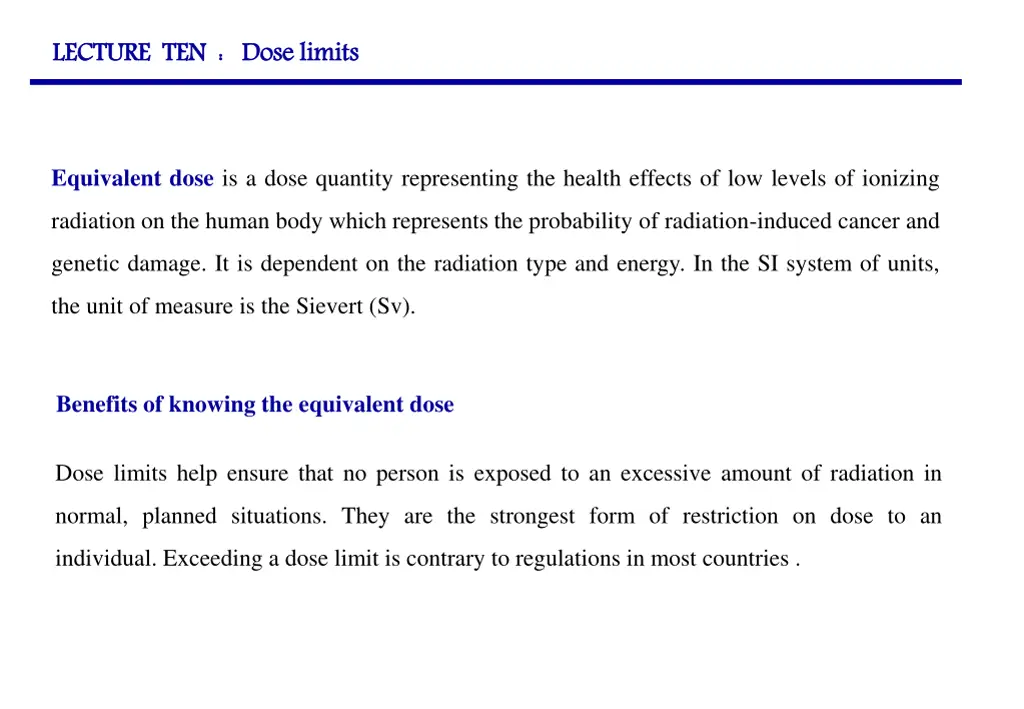
LECTURE TEN : Dose limits LECTURE TEN : Dose limits Equivalent dose is a dose quantity representing the health effects of low levels of ionizing radiation on the human body which represents the probability of radiation-induced cancer and genetic damage. It is dependent on the radiation type and energy. In the SI system of units, the unit of measure is the Sievert (Sv). Benefits of knowing the equivalent dose Dose limits help ensure that no person is exposed to an excessive amount of radiation in normal, planned situations. They are the strongest form of restriction on dose to an individual. Exceeding a dose limit is contrary to regulations in most countries .
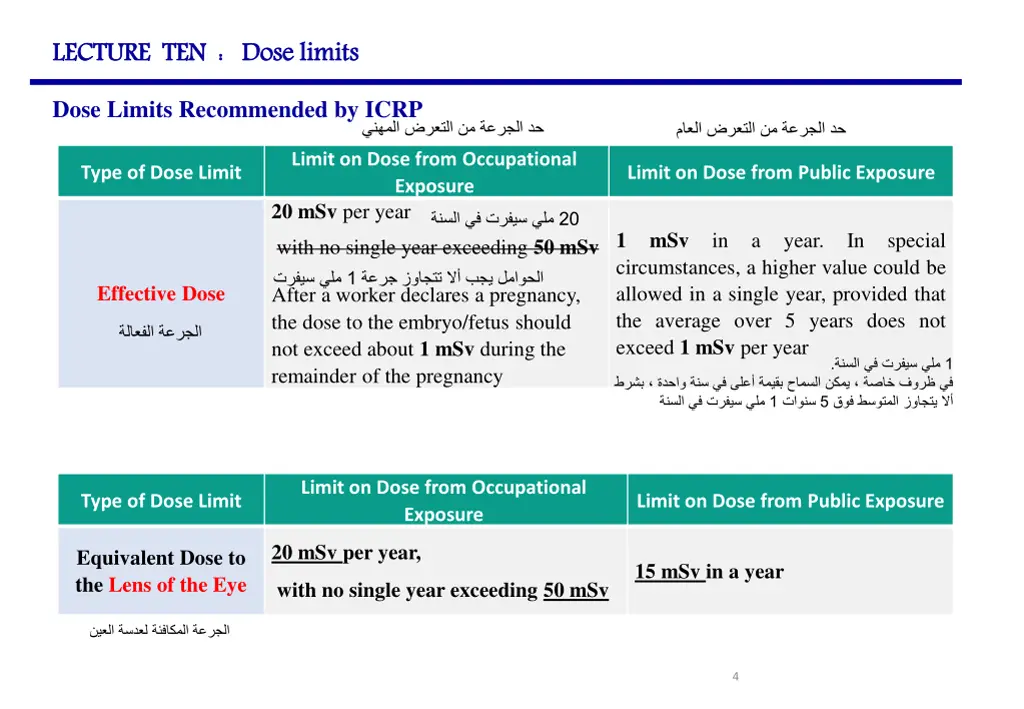
LECTURE TEN : Dose limits LECTURE TEN : Dose limits Dose Limits Recommended by ICRP Limit on Dose from Occupational Exposure 20 mSv per year Type of Dose Limit Limit on Dose from Public Exposure 20 1 circumstances, a higher value could be allowed in a single year, provided that the average over 5 years does not exceed 1 mSv per year mSv in a year. In special with no single year exceeding 50 mSv 1 Effective Dose After a worker declares a pregnancy, the dose to the embryo/fetus should not exceed about 1 mSv during the remainder of the pregnancy . 1 1 5 Limit on Dose from Occupational Exposure Type of Dose Limit Limit on Dose from Public Exposure 20 mSv per year, Equivalent Dose to the Lens of the Eye 15 mSv in a year with no single year exceeding 50 mSv 4
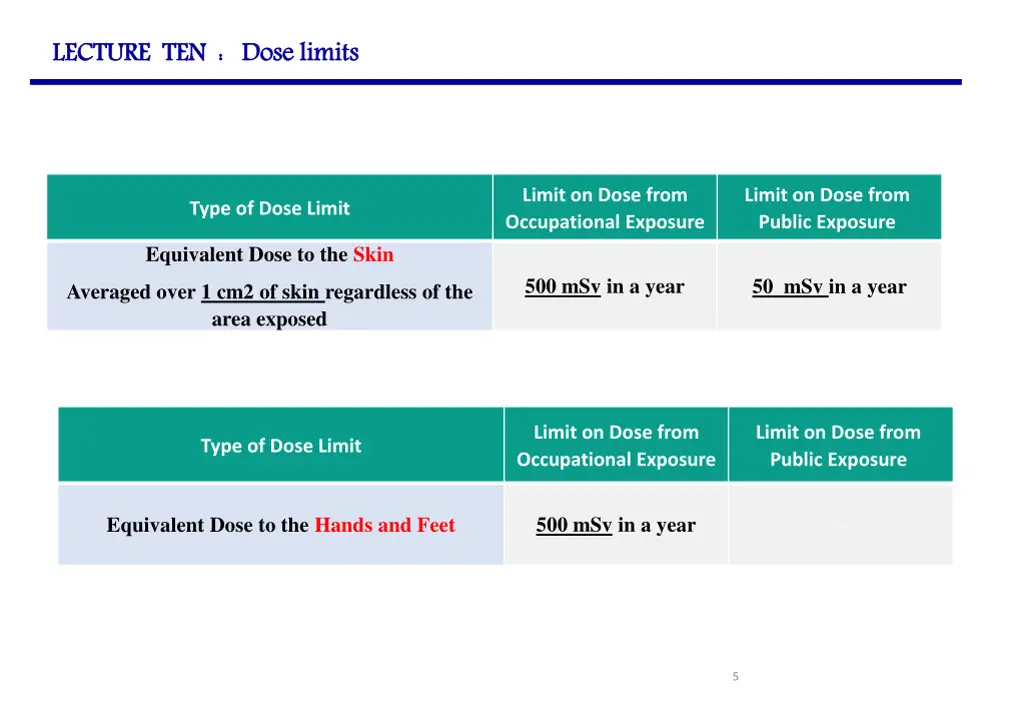
LECTURE TEN : Dose limits LECTURE TEN : Dose limits Limit on Dose from Occupational Exposure Limit on Dose from Public Exposure Type of Dose Limit Equivalent Dose to the Skin 500 mSv in a year 50 mSv in a year Averaged over 1 cm2 of skin regardless of the area exposed Limit on Dose from Occupational Exposure Limit on Dose from Public Exposure Type of Dose Limit 500 mSv in a year Equivalent Dose to the Hands and Feet - 5
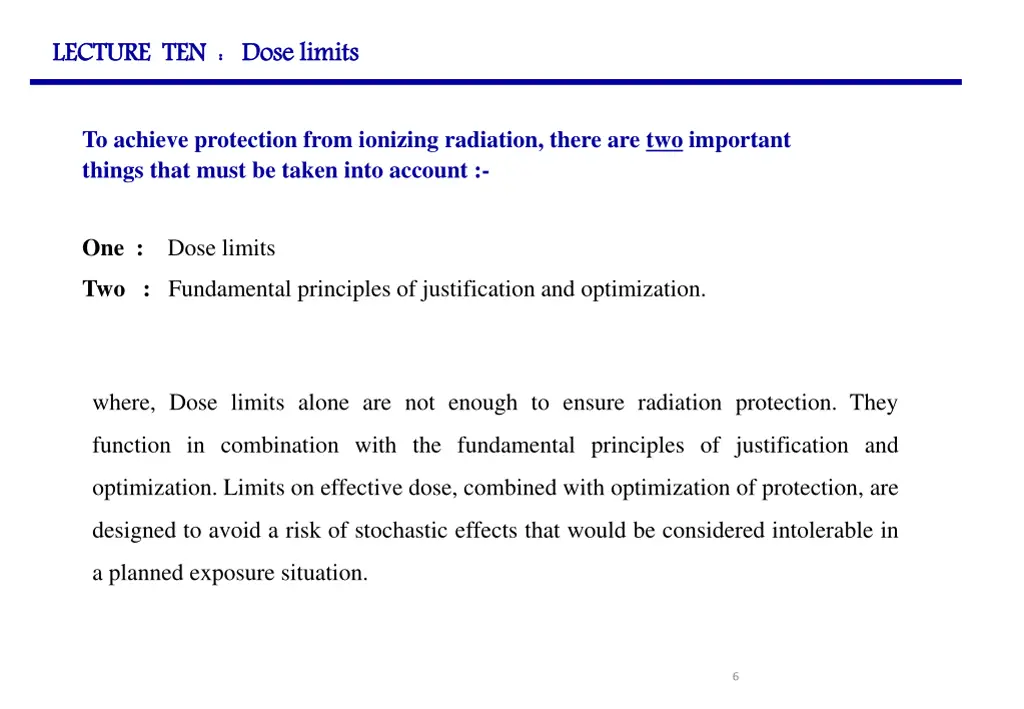
LECTURE TEN : Dose limits LECTURE TEN : Dose limits To achieve protection from ionizing radiation, there are two important things that must be taken into account :- One : Dose limits Two : Fundamental principles of justification and optimization. where, Dose limits alone are not enough to ensure radiation protection. They function in combination with the fundamental principles of justification and optimization. Limits on effective dose, combined with optimization of protection, are designed to avoid a risk of stochastic effects that would be considered intolerable in a planned exposure situation. 6