Dual Harm Prevalence Among Male Prisoners
This study examines the prevalence and characteristics of dual harm - involving both self-harm and assault - among male prisoners. It explores the link between exposure to violence and self-harm, as well as the implications for service response strategies and risk factors for dual harm prisoners. The research aims to compare demographic variables, offense types, incident rates, and punitive regimes among different groups of prisoners.

Download Presentation

Please find below an Image/Link to download the presentation.
The content on the website is provided AS IS for your information and personal use only. It may not be sold, licensed, or shared on other websites without obtaining consent from the author.If you encounter any issues during the download, it is possible that the publisher has removed the file from their server.
You are allowed to download the files provided on this website for personal or commercial use, subject to the condition that they are used lawfully. All files are the property of their respective owners.
The content on the website is provided AS IS for your information and personal use only. It may not be sold, licensed, or shared on other websites without obtaining consent from the author.
E N D
Presentation Transcript
Dual Harm: Prevalence and characteristics amongst male prisoners Dr Karen Slade Associate Professor in Applied Forensic Psychology Nottingham Trent University
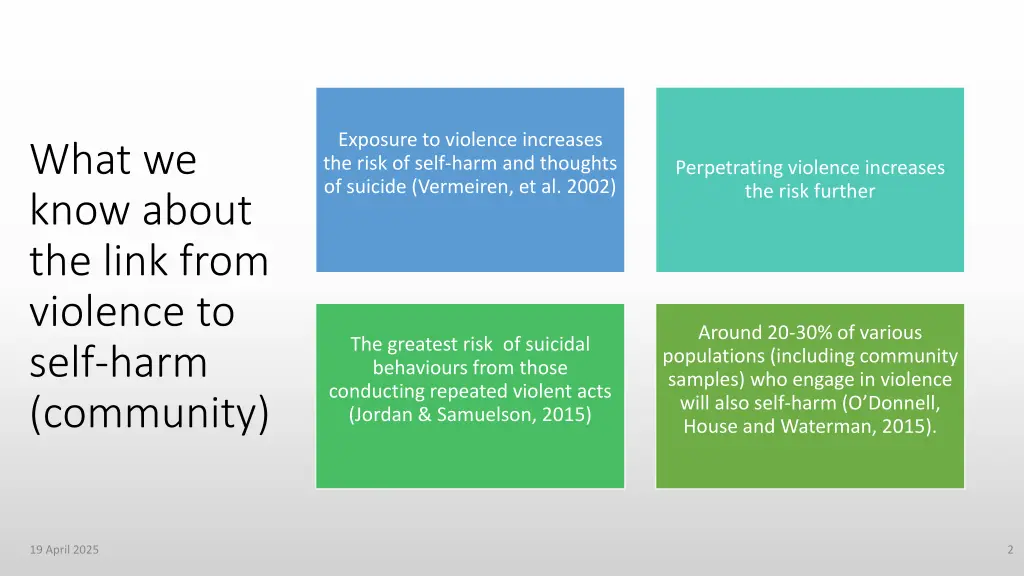
Exposure to violence increases the risk of self-harm and thoughts of suicide (Vermeiren, et al. 2002) What we know about the link from violence to self-harm (community) Perpetrating violence increases the risk further Around 20-30% of various populations (including community samples) who engage in violence will also self-harm (O Donnell, House and Waterman, 2015). The greatest risk of suicidal behaviours from those conducting repeated violent acts (Jordan & Samuelson, 2015) 19 April 2025 2
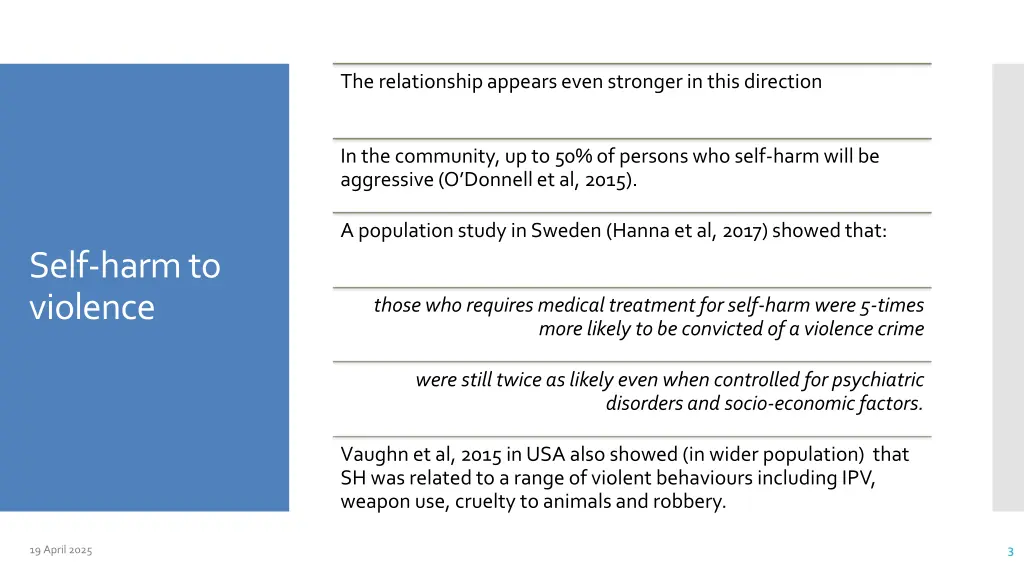
The relationship appears even stronger in this direction In the community, up to 50% of persons who self-harm will be aggressive (O Donnell et al, 2015). A population study in Sweden (Hanna et al, 2017) showed that: Self-harm to violence those who requires medical treatment for self-harm were 5-times more likely to be convicted of a violence crime were still twice as likely even when controlled for psychiatric disorders and socio-economic factors. Vaughn et al, 2015 in USA also showed (in wider population) that SH was related to a range of violent behaviours including IPV, weapon use, cruelty to animals and robbery. 3 19 April 2025
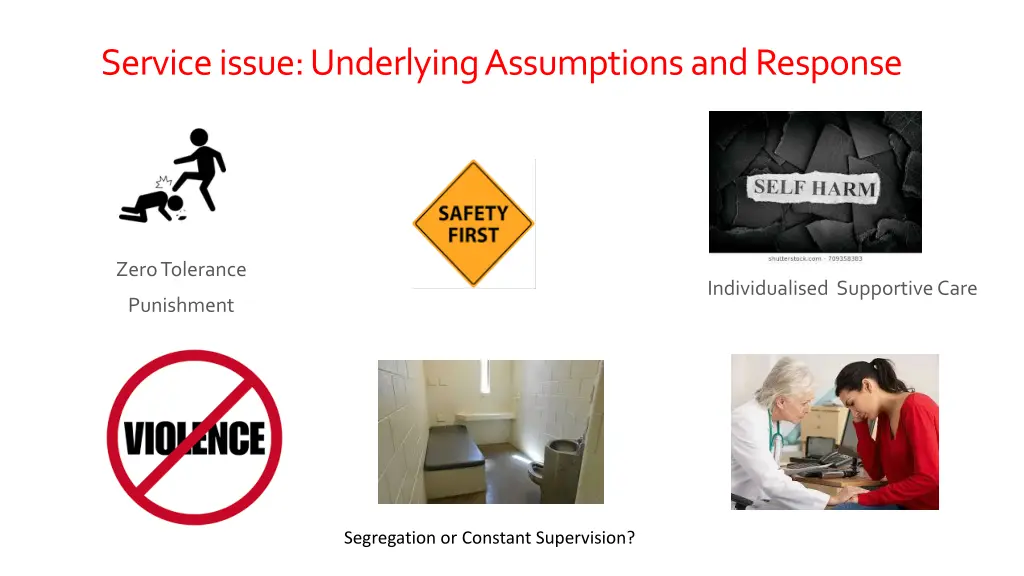
Service issue: Underlying Assumptions and Response Zero Tolerance Individualised Supportive Care Punishment Segregation or Constant Supervision?
To explore risk factors for dual harm prisoners. This study will compare sole self-harm, sole assault and dual harm prisoners: To explore demographic variables and offence types To explore incident rates, incident types and (where applicable) rates of restrictive punishment regimes. To explore any differences in methods or lethality of self-harm. Aims
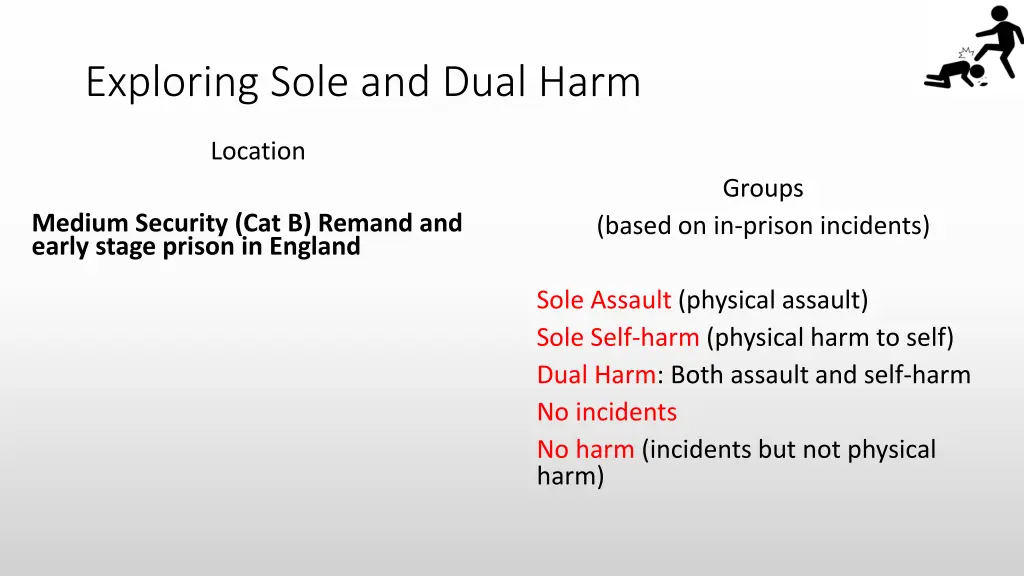
Exploring Sole and Dual Harm Location Groups Medium Security (Cat B) Remand and early stage prison in England (based on in-prison incidents) Sole Assault (physical assault) Sole Self-harm (physical harm to self) Dual Harm: Both assault and self-harm No incidents No harm (incidents but not physical harm)
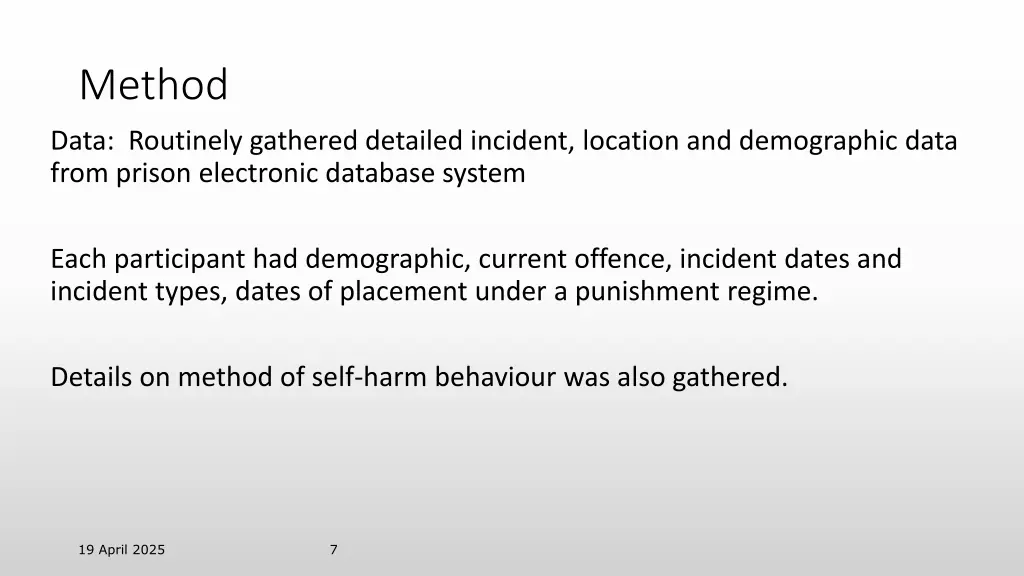
Method Data: Routinely gathered detailed incident, location and demographic data from prison electronic database system Each participant had demographic, current offence, incident dates and incident types, dates of placement under a punishment regime. Details on method of self-harm behaviour was also gathered. 19 April 2025 7
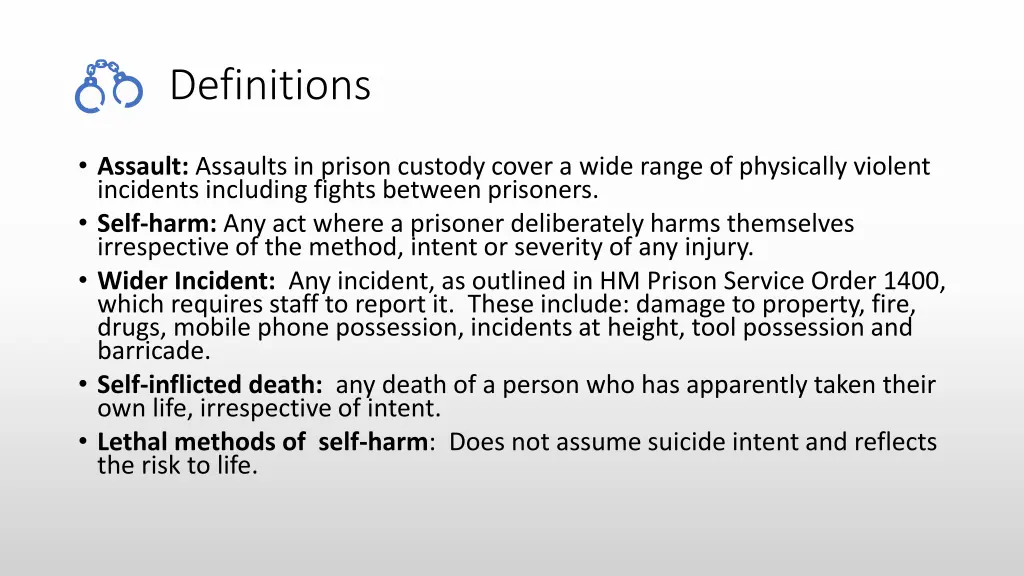
Definitions Assault: Assaults in prison custody cover a wide range of physically violent incidents including fights between prisoners. Self-harm: Any act where a prisoner deliberately harms themselves irrespective of the method, intent or severity of any injury. Wider Incident: Any incident, as outlined in HM Prison Service Order 1400, which requires staff to report it. These include: damage to property, fire, drugs, mobile phone possession, incidents at height, tool possession and barricade. Self-inflicted death: any death of a person who has apparently taken their own life, irrespective of intent. Lethal methods of self-harm: Does not assume suicide intent and reflects the risk to life.
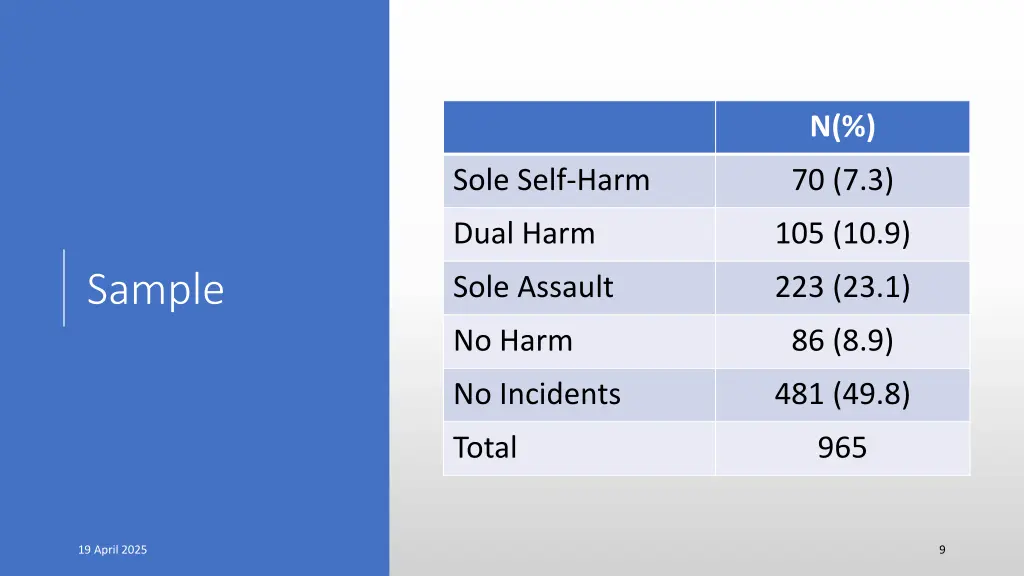
N(%) Sole Self-Harm 70 (7.3) Dual Harm 105 (10.9) Sample Sole Assault 223 (23.1) No Harm 86 (8.9) No Incidents 481 (49.8) Total 965 19 April 2025 9
Rate of wider incidents (per person year)
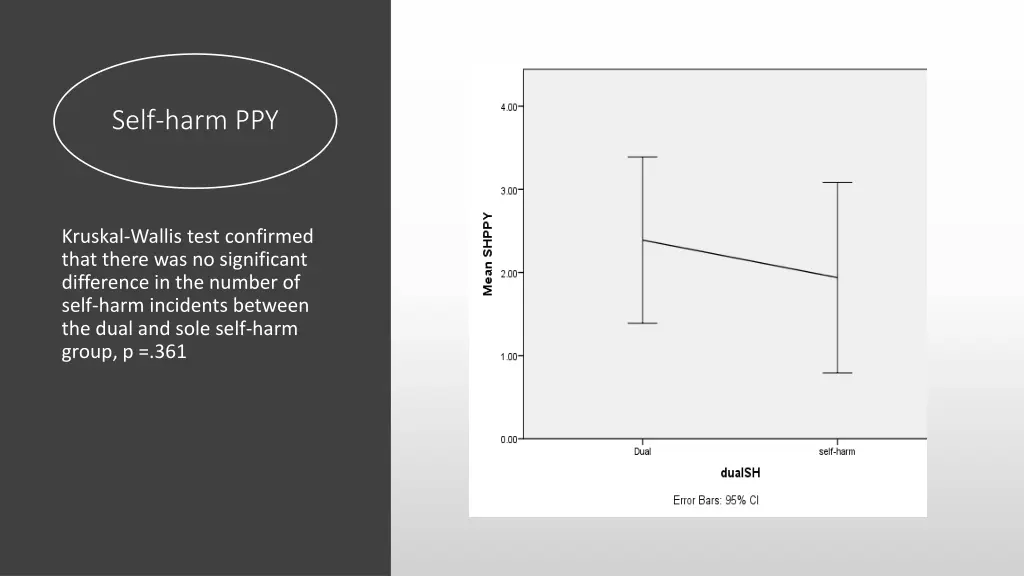
Self-harm PPY Kruskal-Wallis test confirmed that there was no significant difference in the number of self-harm incidents between the dual and sole self-harm group, p =.361
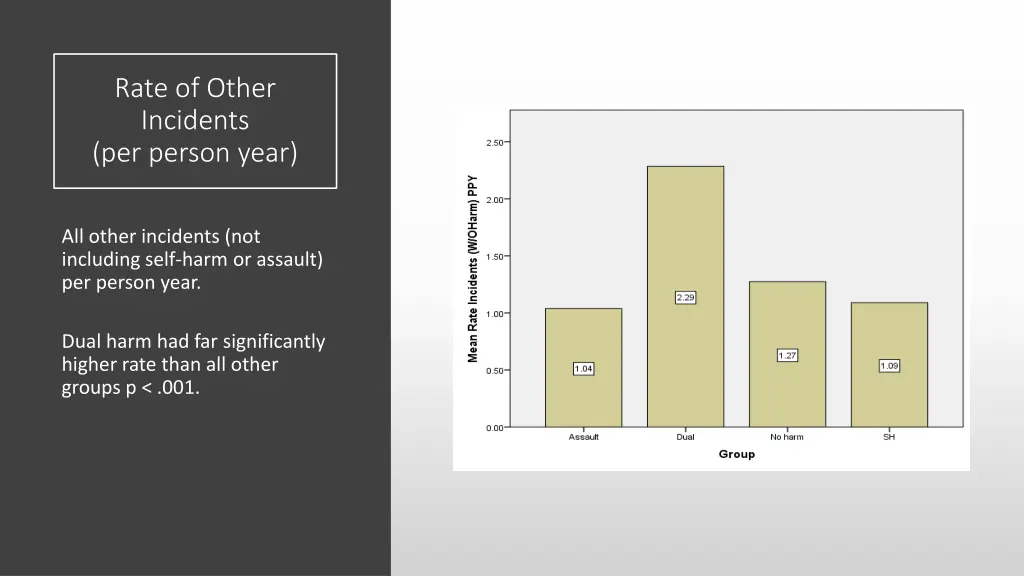
Rate of Other Incidents (per person year) All other incidents (not including self-harm or assault) per person year. Dual harm had far significantly higher rate than all other groups p < .001.
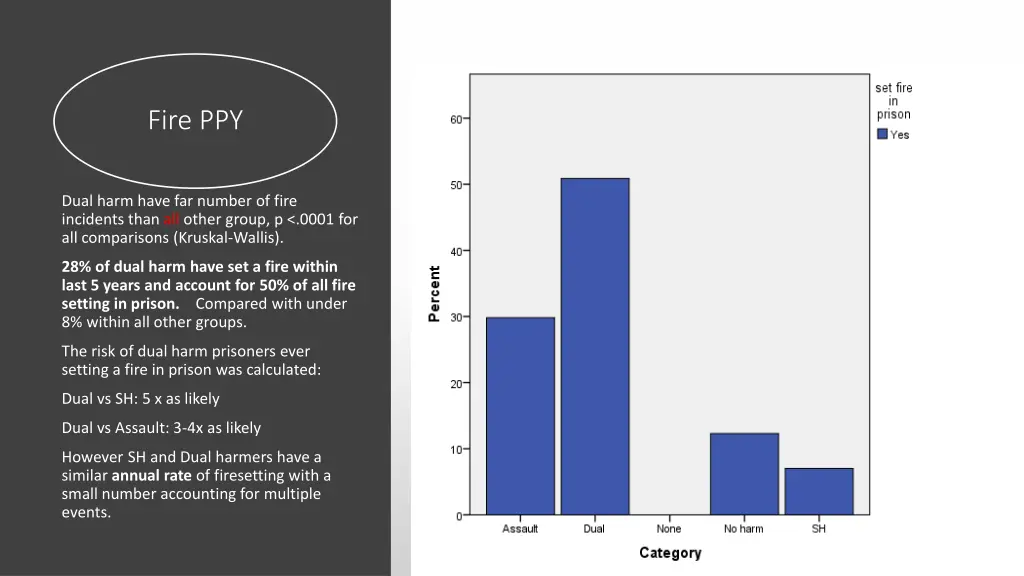
Fire PPY Dual harm have far number of fire incidents than all other group, p <.0001 for all comparisons (Kruskal-Wallis). 28% of dual harm have set a fire within last 5 years and account for 50% of all fire setting in prison. Compared with under 8% within all other groups. The risk of dual harm prisoners ever setting a fire in prison was calculated: Dual vs SH: 5 x as likely Dual vs Assault: 3-4x as likely However SH and Dual harmers have a similar annual rate of firesetting with a small number accounting for multiple events.
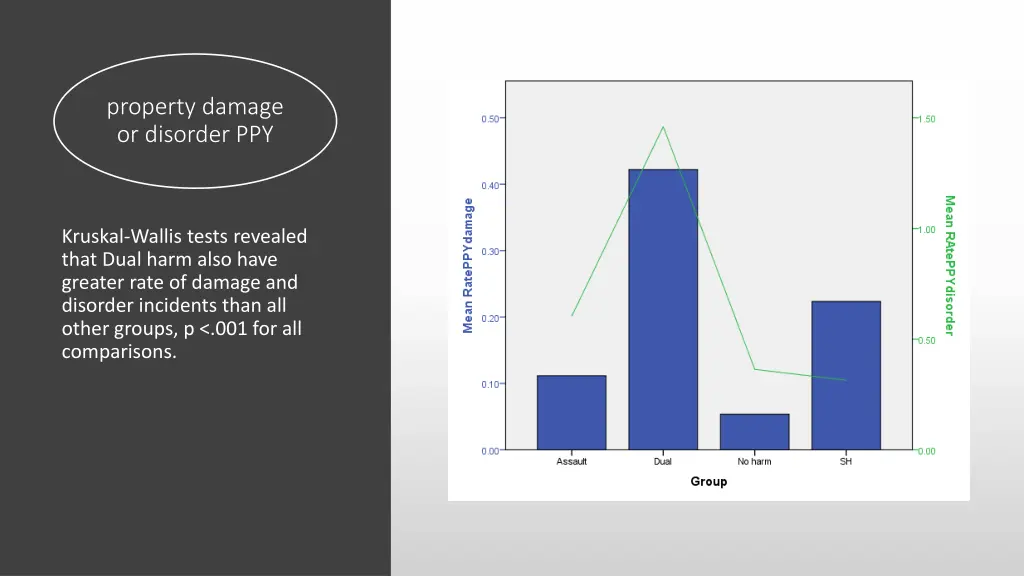
property damage or disorder PPY Kruskal-Wallis tests revealed that Dual harm also have greater rate of damage and disorder incidents than all other groups, p <.001 for all comparisons.
Dual Harm Lethal methods of self-harm
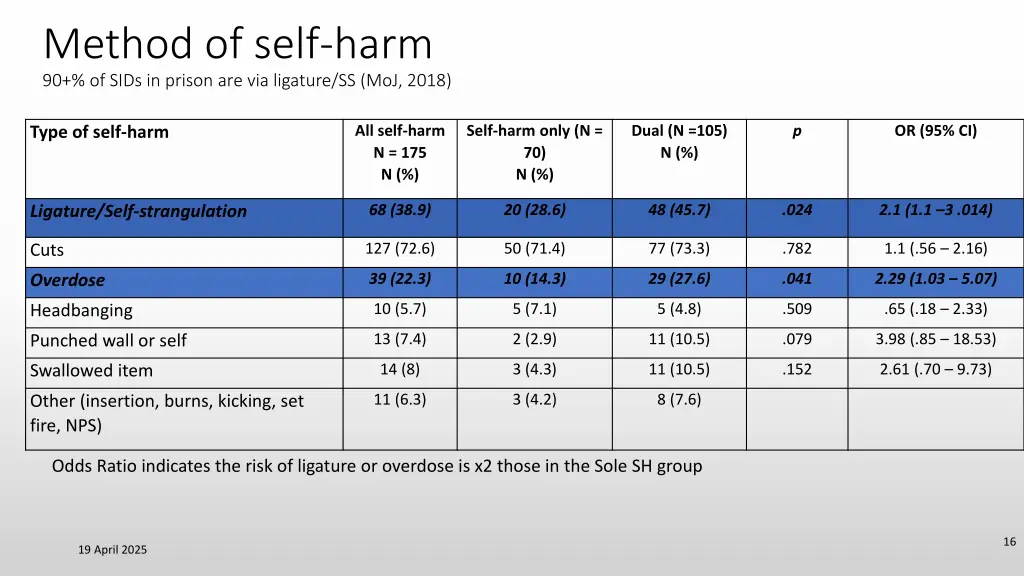
Method of self-harm 90+% of SIDs in prison are via ligature/SS (MoJ, 2018) All self-harm N = 175 N (%) Self-harm only (N = 70) N (%) Dual (N =105) N (%) p OR (95% CI) Type of self-harm 68 (38.9) 20 (28.6) 48 (45.7) .024 2.1 (1.1 3 .014) Ligature/Self-strangulation 127 (72.6) 50 (71.4) 77 (73.3) .782 1.1 (.56 2.16) Cuts 39 (22.3) 10 (14.3) 29 (27.6) .041 2.29 (1.03 5.07) Overdose 10 (5.7) 5 (7.1) 5 (4.8) .509 .65 (.18 2.33) Headbanging 13 (7.4) 2 (2.9) 11 (10.5) .079 3.98 (.85 18.53) Punched wall or self 14 (8) 3 (4.3) 11 (10.5) .152 2.61 (.70 9.73) Swallowed item 11 (6.3) 3 (4.2) 8 (7.6) Other (insertion, burns, kicking, set fire, NPS) Odds Ratio indicates the risk of ligature or overdose is x2 those in the Sole SH group 16 19 April 2025
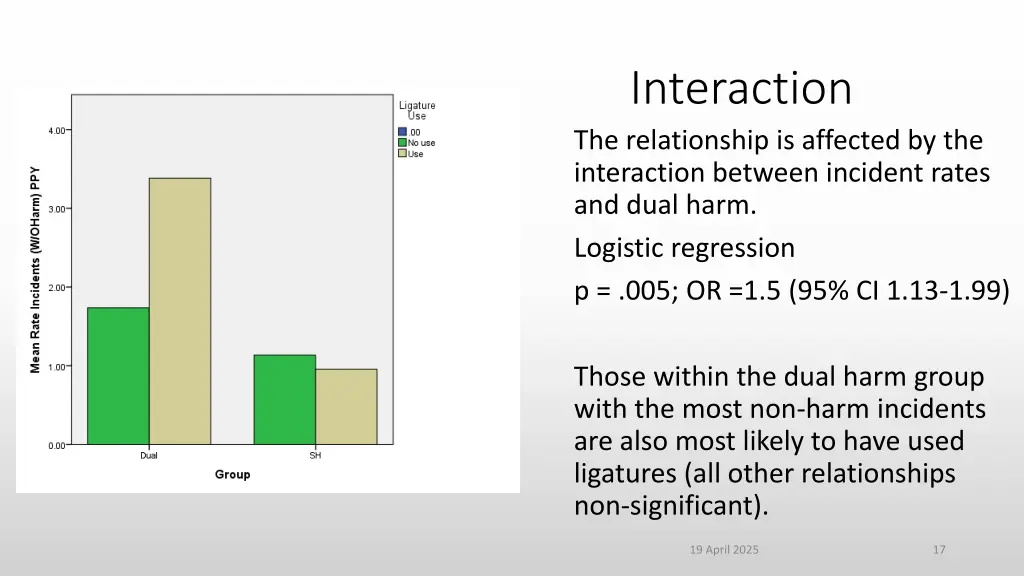
Interaction The relationship is affected by the interaction between incident rates and dual harm. Logistic regression p = .005; OR =1.5 (95% CI 1.13-1.99) Those within the dual harm group with the most non-harm incidents are also most likely to have used ligatures (all other relationships non-significant). 19 April 2025 17
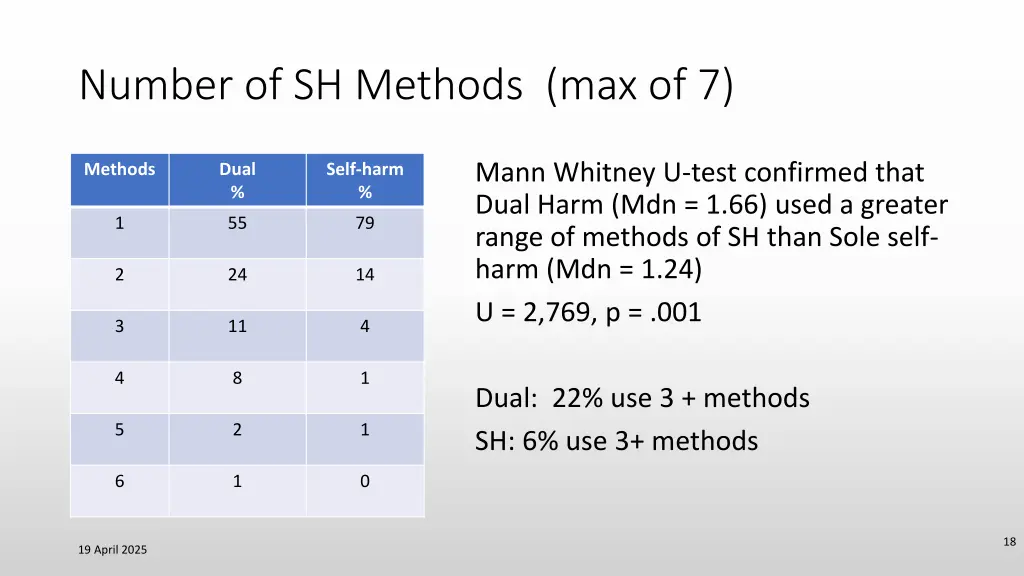
Number of SH Methods (max of 7) Mann Whitney U-test confirmed that Dual Harm (Mdn = 1.66) used a greater range of methods of SH than Sole self- harm (Mdn = 1.24) U = 2,769, p = .001 Methods Dual % Self-harm % 1 55 79 2 24 14 3 11 4 4 8 1 Dual: 22% use 3 + methods SH: 6% use 3+ methods 5 2 1 6 1 0 18 19 April 2025
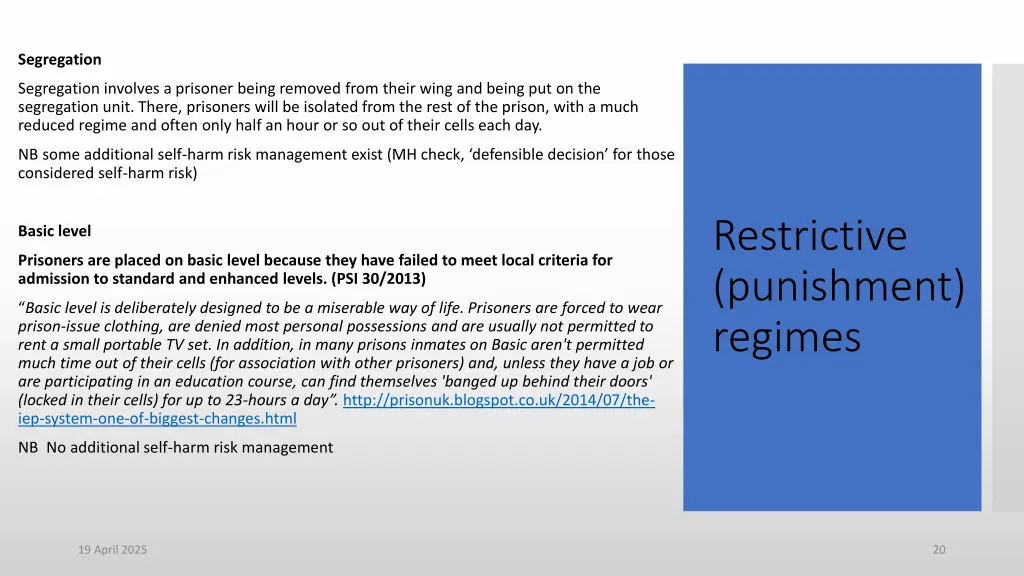
Segregation Segregation involves a prisoner being removed from their wing and being put on the segregation unit. There, prisoners will be isolated from the rest of the prison, with a much reduced regime and often only half an hour or so out of their cells each day. NB some additional self-harm risk management exist (MH check, defensible decision for those considered self-harm risk) Restrictive (punishment) regimes Basic level Prisoners are placed on basic level because they have failed to meet local criteria for admission to standard and enhanced levels. (PSI 30/2013) Basic level is deliberately designed to be a miserable way of life. Prisoners are forced to wear prison-issue clothing, are denied most personal possessions and are usually not permitted to rent a small portable TV set. In addition, in many prisons inmates on Basic aren't permitted much time out of their cells (for association with other prisoners) and, unless they have a job or are participating in an education course, can find themselves 'banged up behind their doors' (locked in their cells) for up to 23-hours a day . http://prisonuk.blogspot.co.uk/2014/07/the- iep-system-one-of-biggest-changes.html NB No additional self-harm risk management 19 April 2025 20
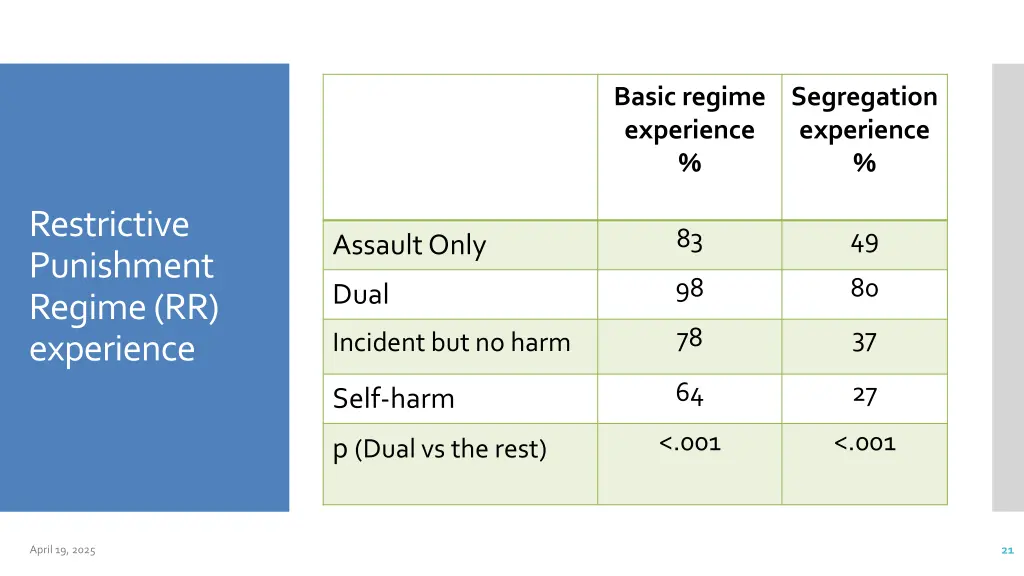
Basic regime experience % Segregation experience % Restrictive Punishment Regime (RR) experience 83 49 Assault Only 98 80 Dual 78 37 Incident but no harm 64 27 Self-harm <.001 <.001 p (Dual vs the rest) 21 April 19, 2025
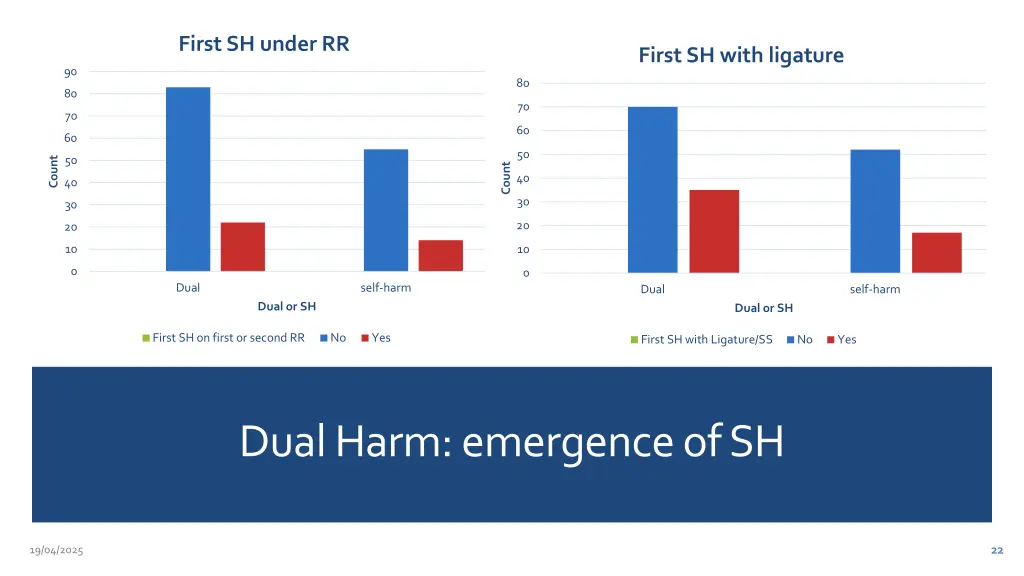
First SH under RR First SH with ligature 90 80 80 70 70 60 60 50 50 Count Count 40 40 30 30 20 20 10 10 0 0 Dual self-harm Dual self-harm Dual or SH Dual or SH First SH on first or second RR No Yes First SH with Ligature/SS No Yes Dual Harm: emergence of SH 22 19/04/2025
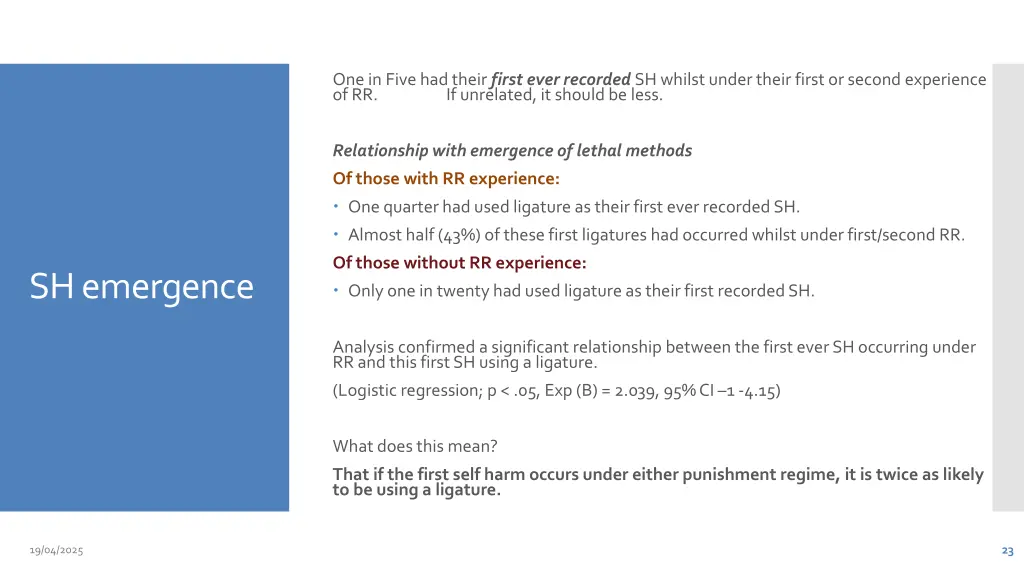
One in Five had their first ever recorded SH whilst under their first or second experience of RR. If unrelated, it should be less. Relationship with emergence of lethal methods Of those with RR experience: One quarter had used ligature as their first ever recorded SH. Almost half (43%) of these first ligatures had occurred whilst under first/second RR. Of those without RR experience: Only one in twenty had used ligature as their first recorded SH. SH emergence Analysis confirmed a significant relationship between the first ever SH occurring under RR and this first SH using a ligature. (Logistic regression; p < .05, Exp (B) = 2.039, 95% CI 1 -4.15) What does this mean? That if the first self harm occurs under either punishment regime, it is twice as likely to be using a ligature. 23 19/04/2025
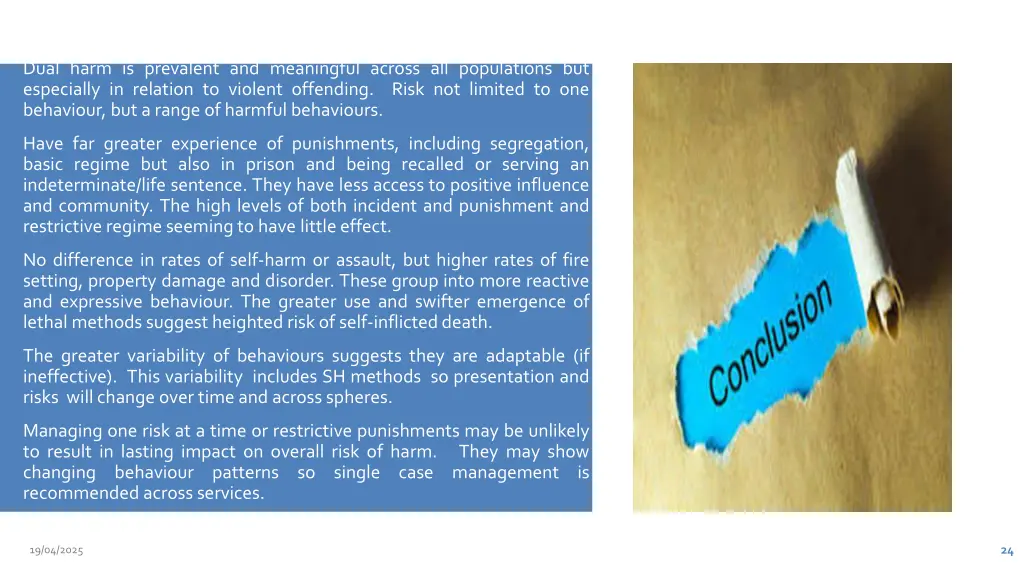
Dual harm is prevalent and meaningful across all populations but especially in relation to violent offending. Risk not limited to one behaviour, but a range of harmful behaviours. Have far greater experience of punishments, including segregation, basic regime but also in prison and being recalled or serving an indeterminate/life sentence. They have less access to positive influence and community. The high levels of both incident and punishment and restrictive regime seeming to have little effect. No difference in rates of self-harm or assault, but higher rates of fire setting, property damage and disorder. These group into more reactive and expressive behaviour. The greater use and swifter emergence of lethal methods suggest heighted risk of self-inflicted death. The greater variability of behaviours suggests they are adaptable (if ineffective). This variability includes SH methods so presentation and risks will change over time and across spheres. Managing one risk at a time or restrictive punishments may be unlikely to result in lasting impact on overall risk of harm. They may show changing behaviour patterns so single case management is recommended across services. 24 19/04/2025
Previous paper: Slade, K. (2017) Dual Harm: An exploration of the presence and characteristics for dual violence and self-harm behaviour in prison. Journal of Criminal Psychology (8 (2), pp. 97-111. Please contact me if you d like the slides, papers or interested in research avenues: karen.slade@ntu.ac.uk 25 19 April 2025