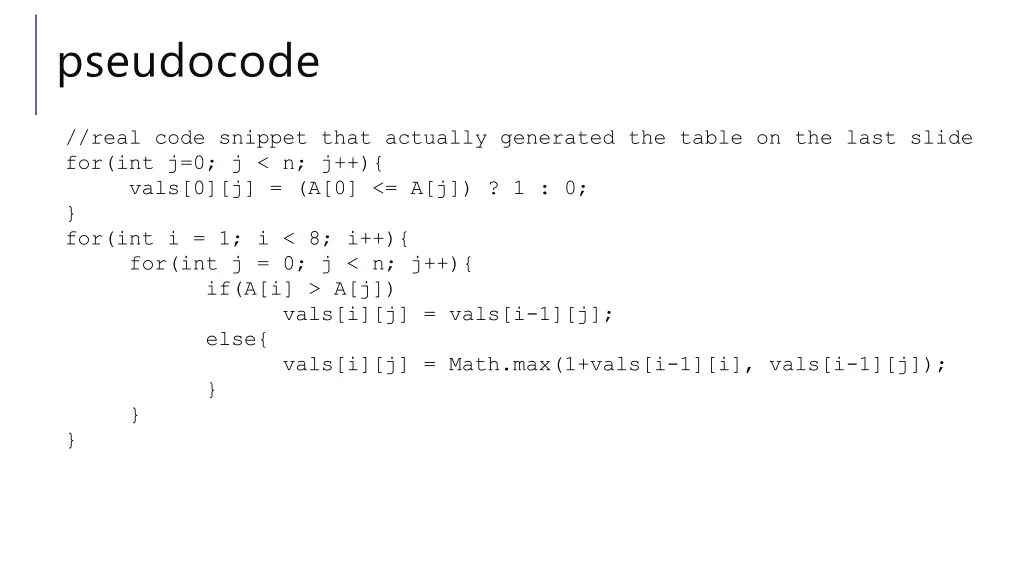
Explore the concept of dynamic programming on trees to solve the Longest Increasing Subsequence problem efficiently. Understand the decision-making process for each element and the recursive approach involved. Learn how to determine the optimal sequence with a detailed recurrence relation and memoization structure. Dive into examples and illustrations to grasp the methodology effectively.
Please find below an Image/Link to download the presentation.
The content on the website is provided AS IS for your information and personal use only. It may not be sold, licensed, or shared on other websites without obtaining consent from the author. If you encounter any issues during the download, it is possible that the publisher has removed the file from their server.
You are allowed to download the files provided on this website for personal or commercial use, subject to the condition that they are used lawfully. All files are the property of their respective owners.
The content on the website is provided AS IS for your information and personal use only. It may not be sold, licensed, or shared on other websites without obtaining consent from the author.
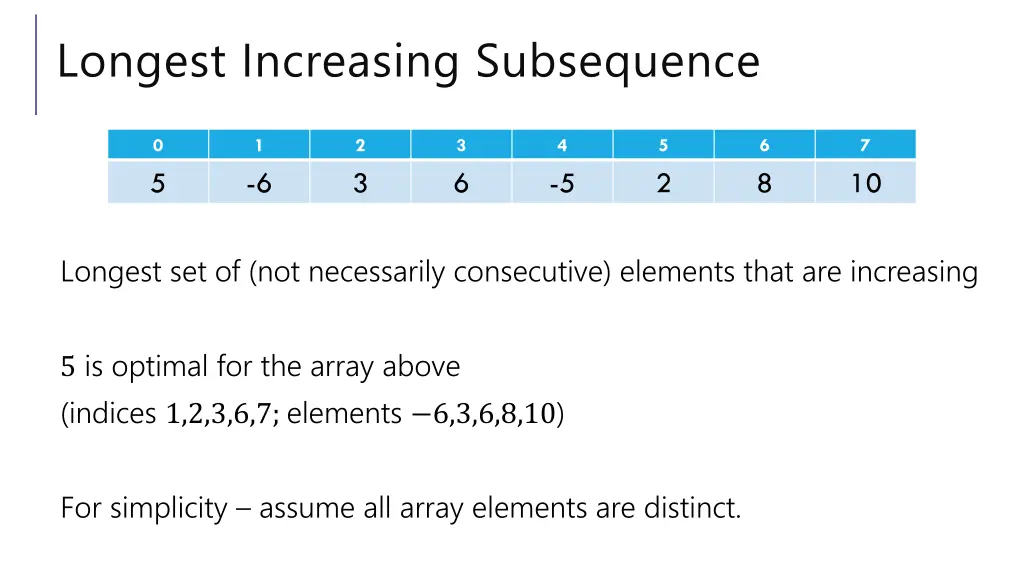
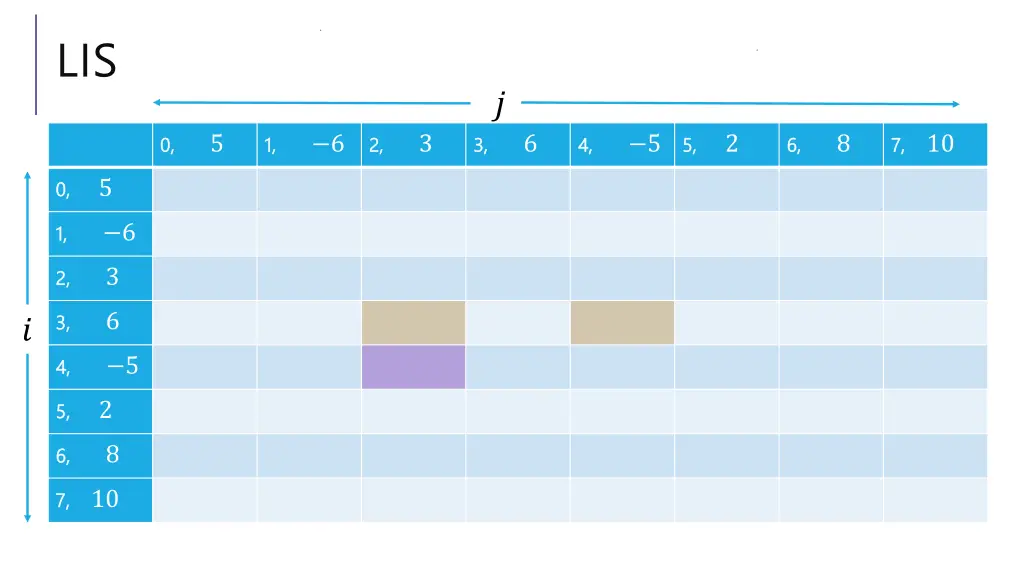
Longest Increasing Subsequence 0 5 1 2 3 3 6 4 5 2 6 8 7 -6 -5 10 Longest set of (not necessarily consecutive) elements that are increasing 5 is optimal for the array above (indices 1,2,3,6,7; elements 6,3,6,8,10) For simplicity assume all array elements are distinct.
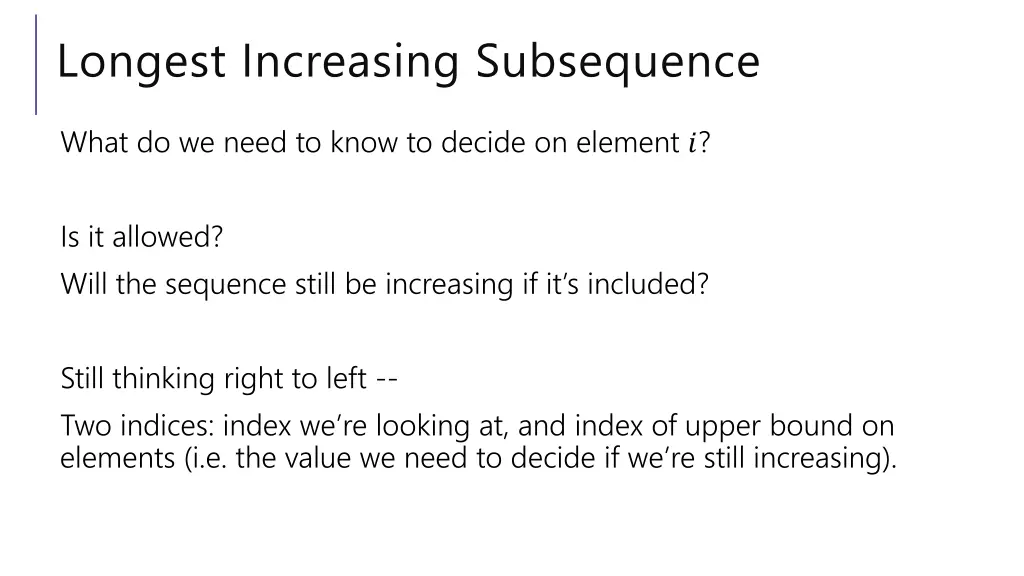
Longest Increasing Subsequence What do we need to know to decide on element ?? Is it allowed? Will the sequence still be increasing if it s included? Still thinking right to left -- Two indices: index we re looking at, and index of upper bound on elements (i.e. the value we need to decide if we re still increasing).
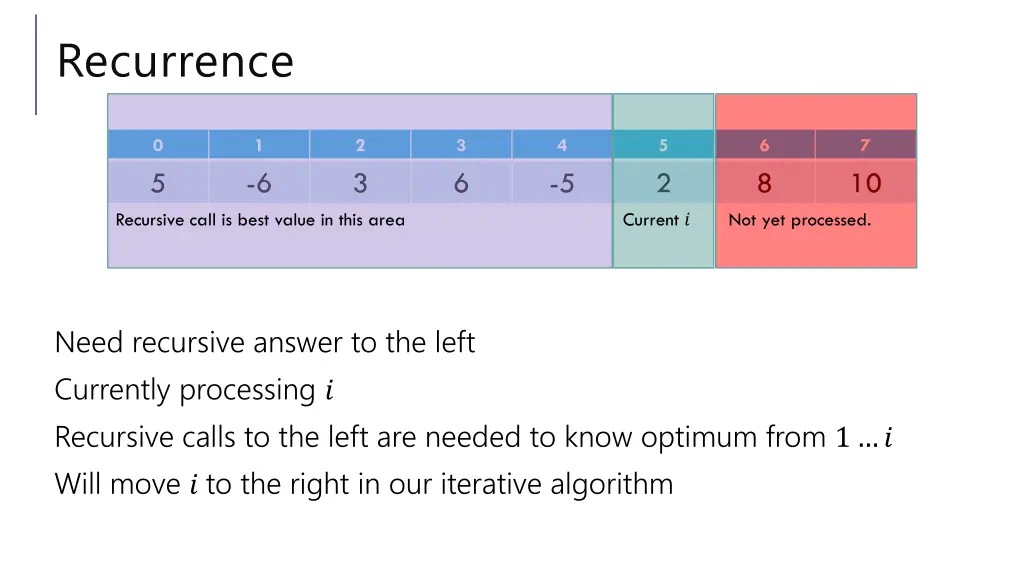
Recurrence 0 5 1 2 3 3 6 4 5 2 6 8 7 -6 -5 10 Recursive call is best value in this area Current ? Not yet processed. Need recursive answer to the left Currently processing ? Recursive calls to the left are needed to know optimum from 1 ? Will move ? to the right in our iterative algorithm
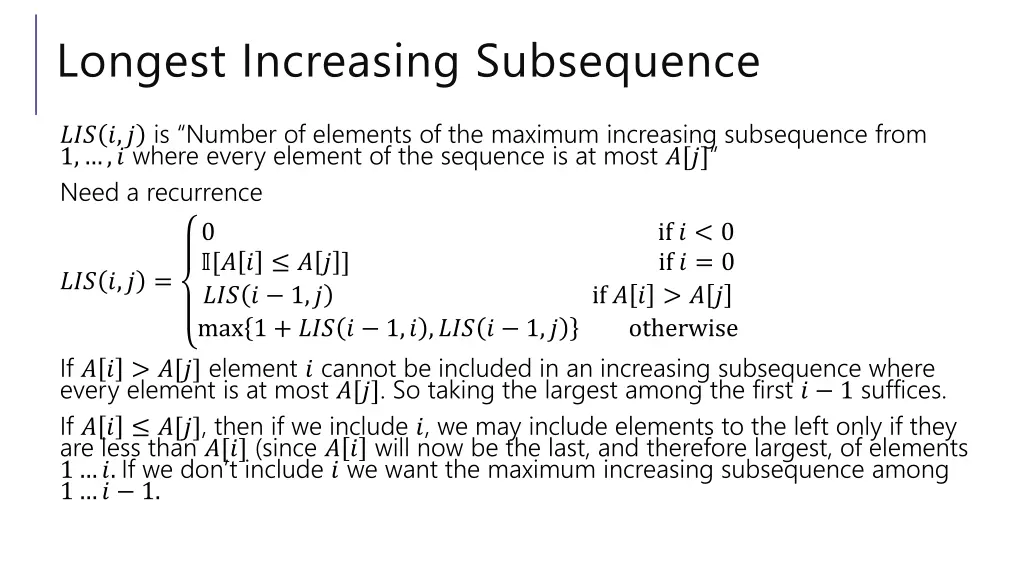
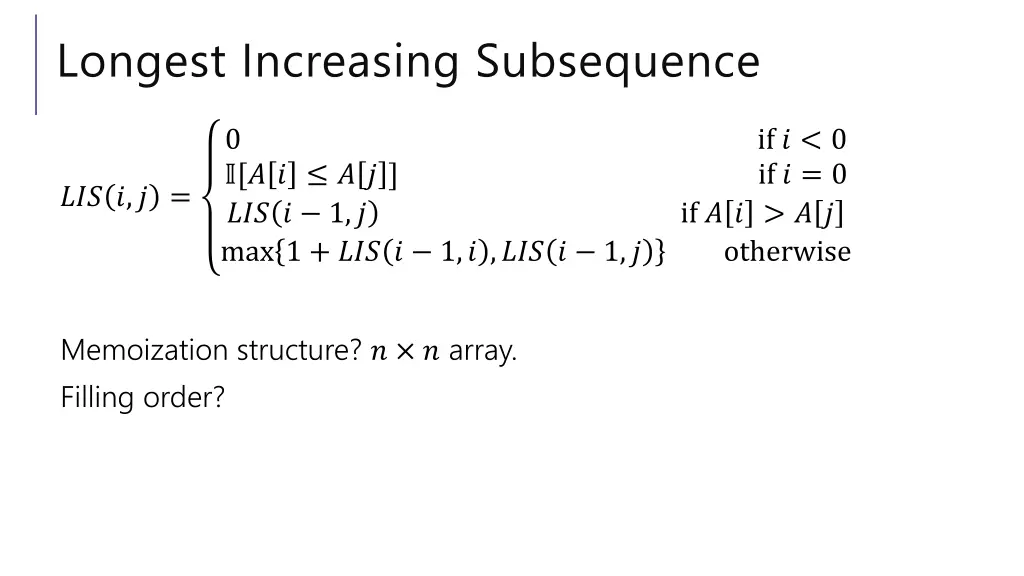
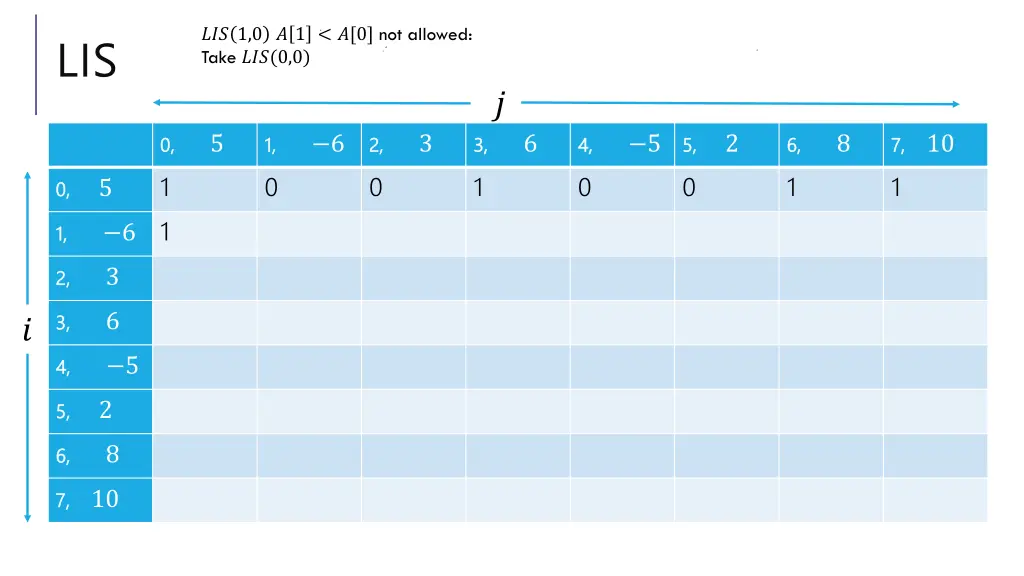
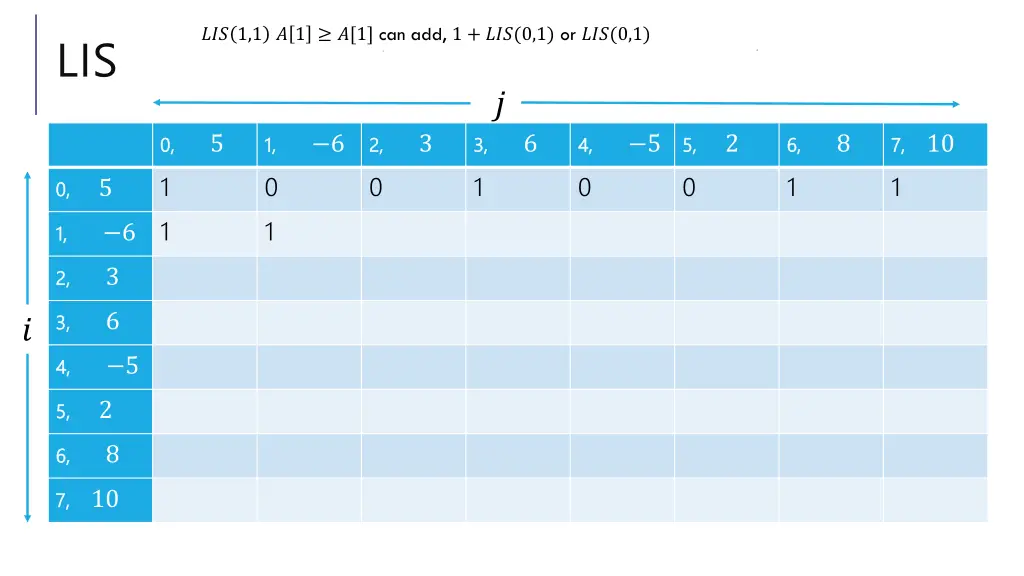
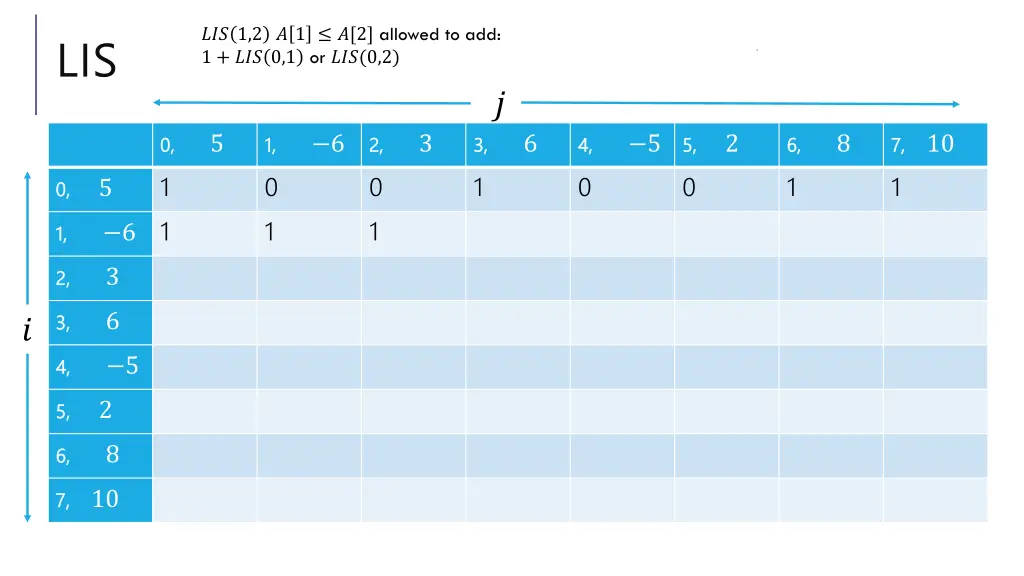
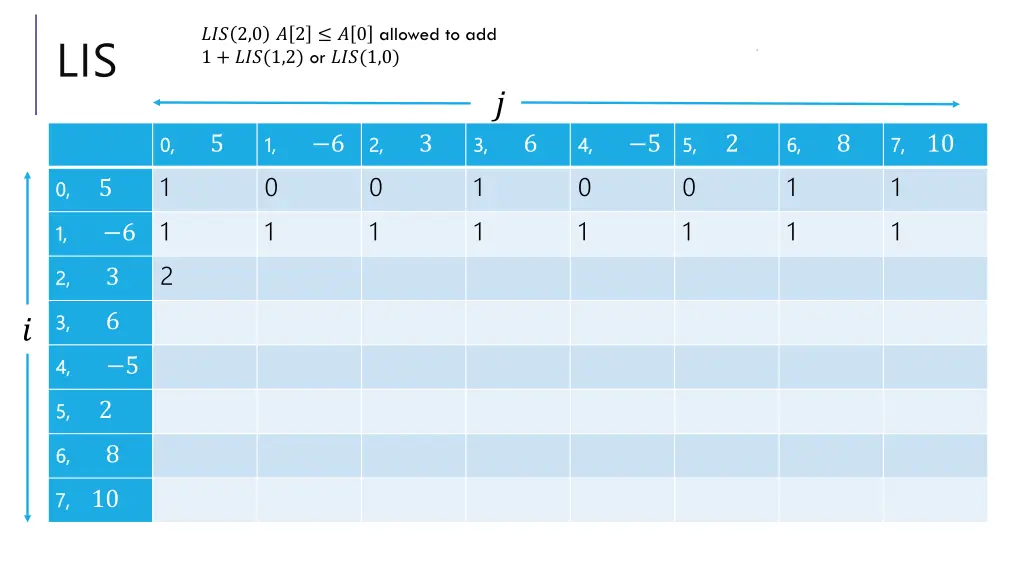
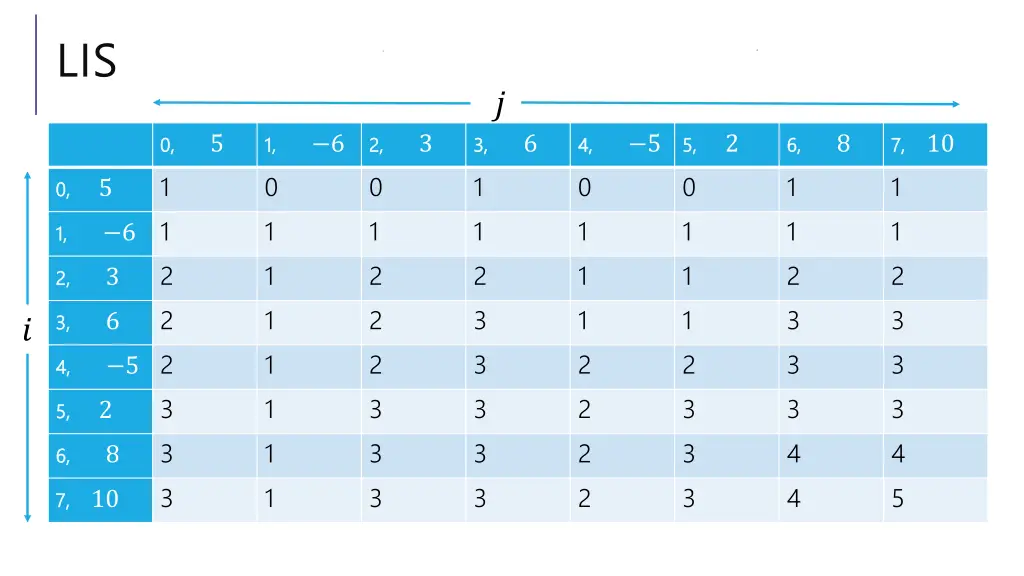
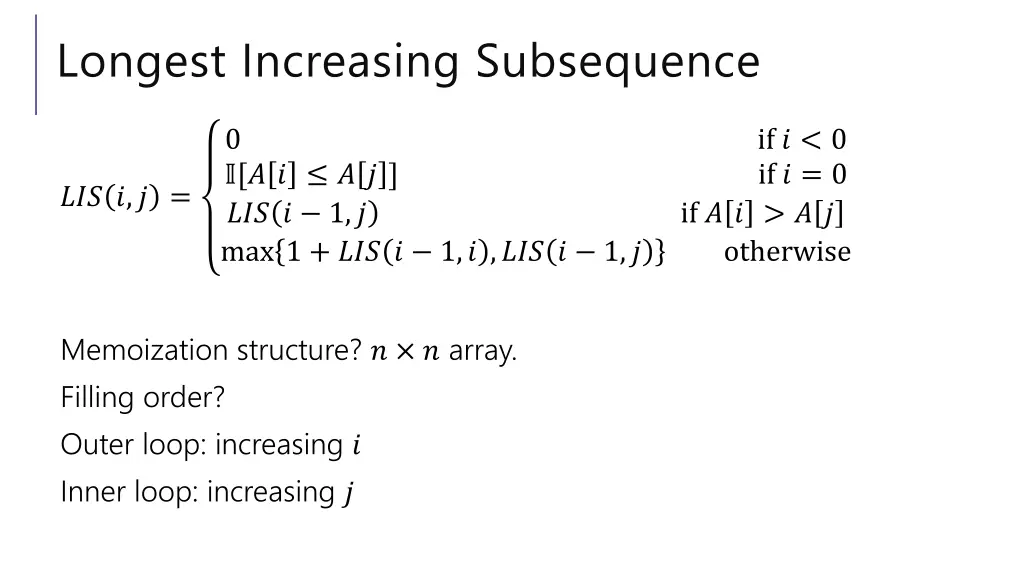
Longest Increasing Subsequence ??? ?,?is Number of elements of the maximum increasing subsequence from 1, ,? where every element of the sequence is at most ?[?] Need a recurrence 0 ?[? ? ? ? ] ??? ? 1,? max 1 + ??? ? 1,? ,??? ? 1,? If ? ? > ?[?] element ? cannot be included in an increasing subsequence where every element is at most ?[?]. So taking the largest among the first ? 1 suffices. If ? ? ?[?], then if we include ?, we may include elements to the left only if they are less than ?[?] (since ? ? will now be the last, and therefore largest, of elements 1 ?. If we don t include ? we want the maximum increasing subsequence among 1 ? 1. if ? < 0 if ? = 0 ??? ?,? = if ? ? > ? ? otherwise
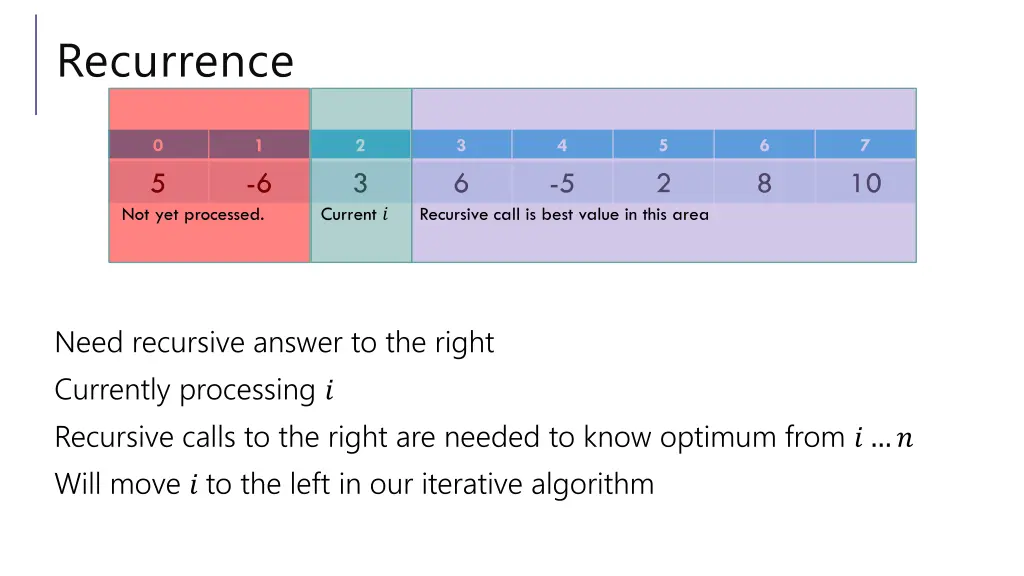
Recurrence 0 5 1 2 3 3 6 4 5 2 6 8 7 -6 -5 10 Not yet processed. Current ? Recursive call is best value in this area Need recursive answer to the right Currently processing ? Recursive calls to the right are needed to know optimum from ? ? Will move ? to the left in our iterative algorithm
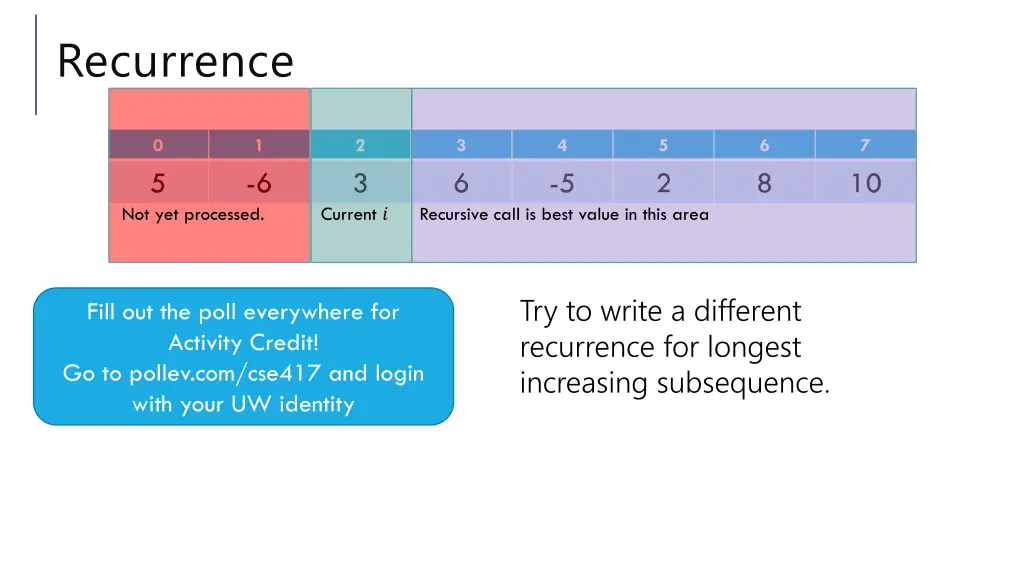
Recurrence 0 5 1 2 3 3 6 4 5 2 6 8 7 -6 -5 10 Not yet processed. Current ? Recursive call is best value in this area Try to write a different recurrence for longest increasing subsequence. Fill out the poll everywhere for Activity Credit! Go to pollev.com/cse417 and login with your UW identity
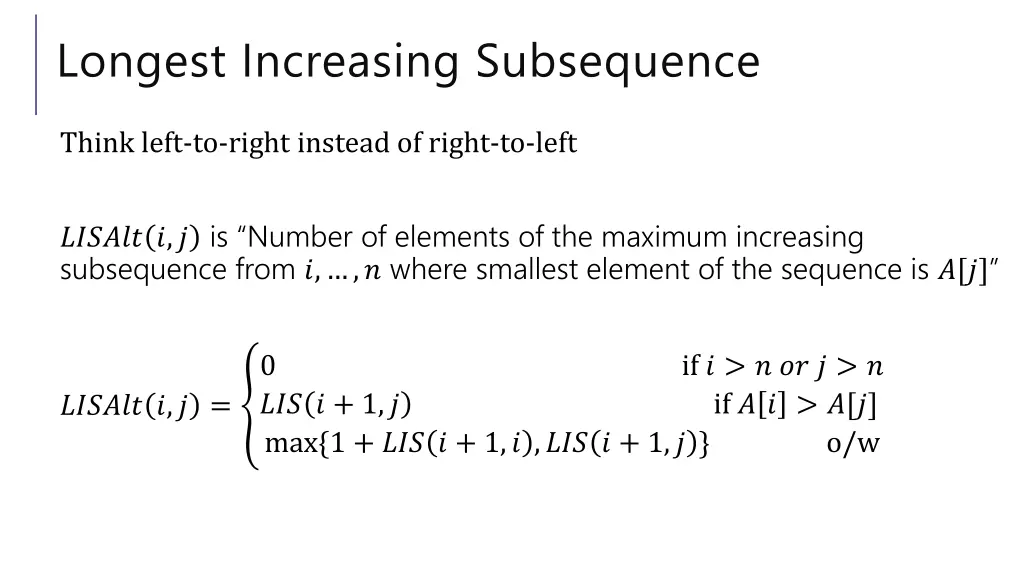
Longest Increasing Subsequence Think left-to-right instead of right-to-left ?????? ?,?is Number of elements of the maximum increasing subsequence from ?, ,? where smallest element of the sequence is ?[?] 0 ??? ? + 1,? max{1 + ??? ? + 1,? ,??? ? + 1,? } if ? > ? ?? ? > ? if ? ? > ?[?] ?????? ?,? = o/w
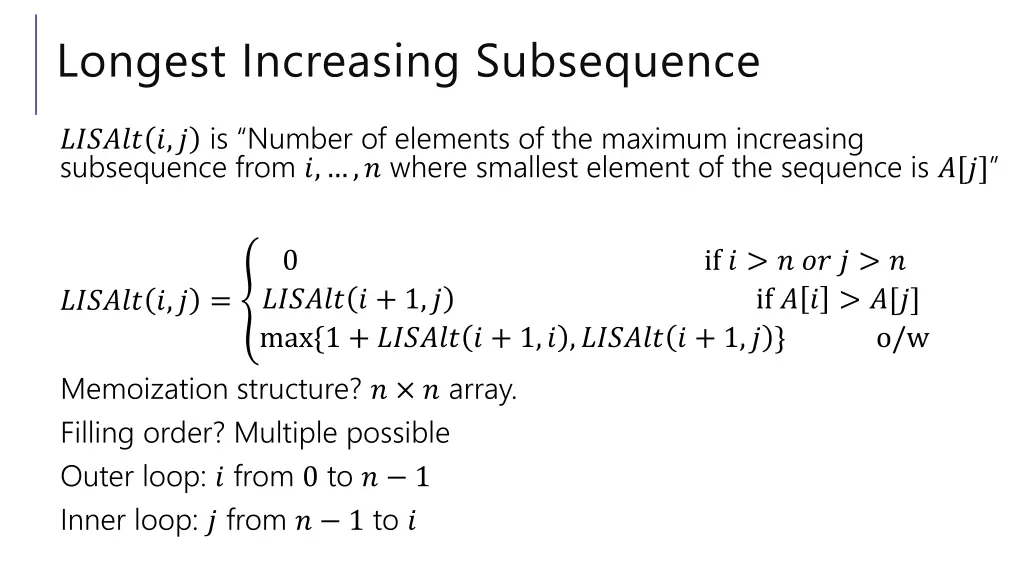
Longest Increasing Subsequence ?????? ?,?is Number of elements of the maximum increasing subsequence from ?, ,? where smallest element of the sequence is ?[?] 0 if ? > ? ?? ? > ? if ? ? > ?[?] ?????? ? + 1,? max{1 + ?????? ? + 1,? ,?????? ? + 1,? } Memoization structure? ? ? array. Filling order? Multiple possible Outer loop: ? from 0 to ? 1 Inner loop: ? from ? 1 to ? ?????? ?,? = o/w
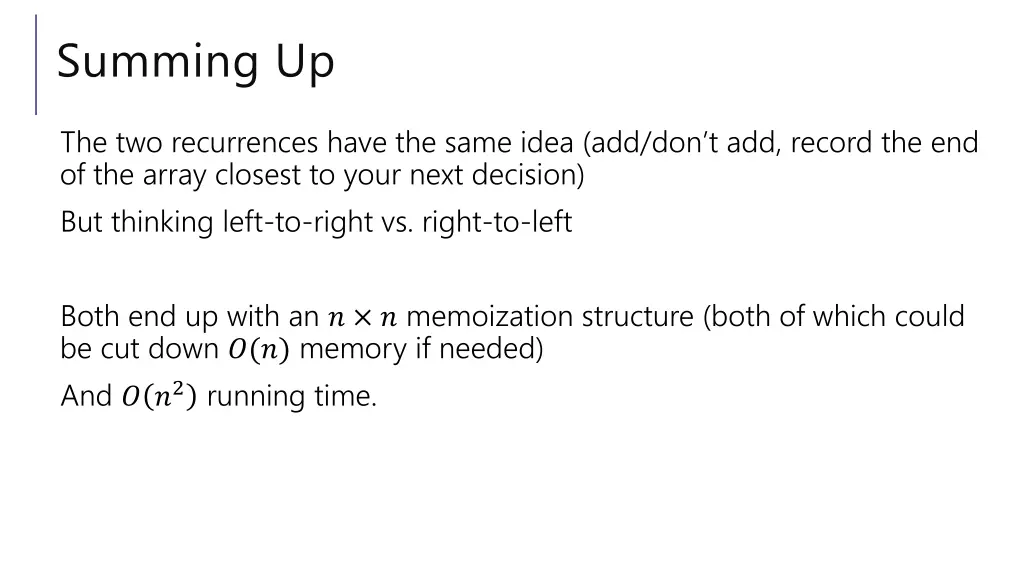
Summing Up The two recurrences have the same idea (add/don t add, record the end of the array closest to your next decision) But thinking left-to-right vs. right-to-left Both end up with an ? ? memoization structure (both of which could be cut down ?(?) memory if needed) And ? ?2 running time.
But Wait! Theres more Another recurrence at the end of these slides for more practice. Instead of thinking do I include this element or not? for each element, Ask what s the next element or equivalently what s the longest subsequence starting from me Get a different recurrence, but not a better running time.
Takeaways When designing a dynamic program, we sometimes need to introduce a second variable, that doesn t appear in the program Or a second recurrence that mixes with the first if other decisions affect what s optimal (beyond which problem you look at) There might be more than one program available.
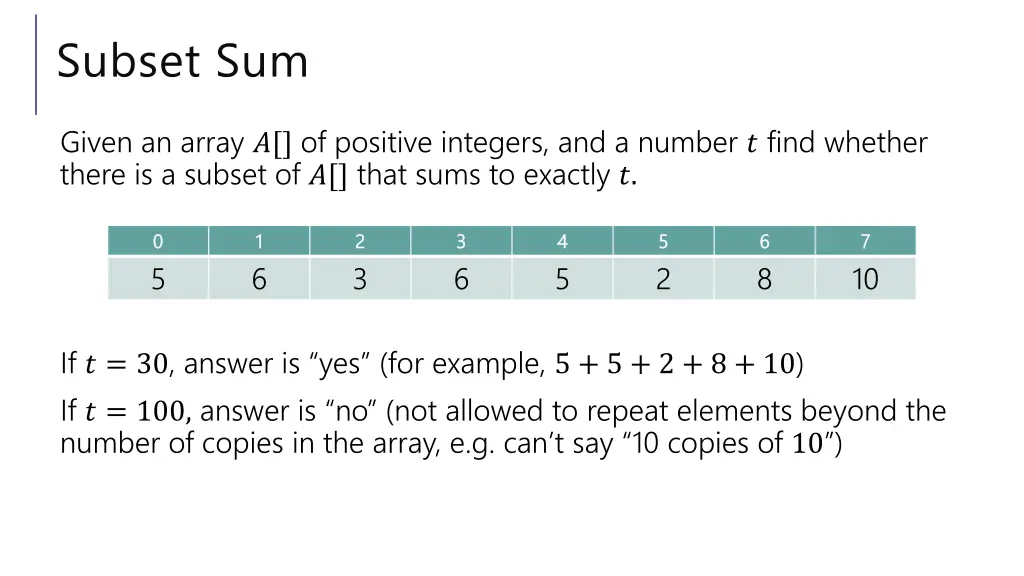
Subset Sum Given an array ?[] of positive integers, and a number ? find whether there is a subset of ?[] that sums to exactly ?. 0 0 5 1 1 6 2 2 3 3 3 6 4 4 5 5 5 2 6 6 8 7 7 10 If ? = 30, answer is yes (for example, 5 + 5 + 2 + 8 + 10) If ? = 100,answer is no (not allowed to repeat elements beyond the number of copies in the array, e.g. can t say 10 copies of 10 )
Subset Sum Write an English description of what you want to calculate Write a recurrence Give a sentence or two (in English) of why your recurrence should work.
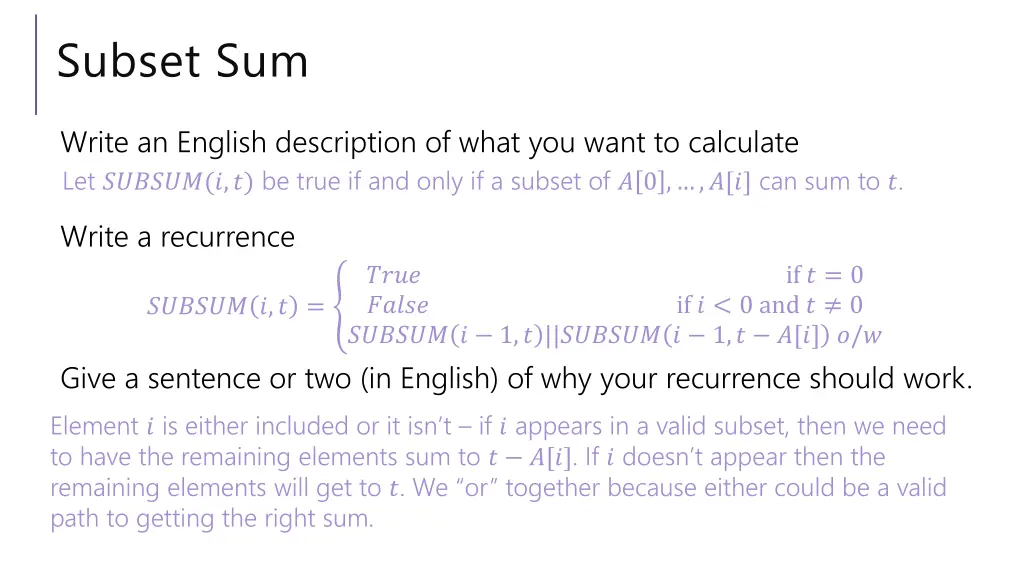
Subset Sum Write an English description of what you want to calculate Let ??????(?,?) be true if and only if a subset of ? 0 , ,?[?] can sum to ?. Write a recurrence ???? ????? ?????? ? 1,? ||?????? ? 1,? ?[?] ?/? if ? = 0 if ? < 0 and ? 0 ?????? ?,? = Give a sentence or two (in English) of why your recurrence should work. Element ?is either included or it isn t if ? appears in a valid subset, then we need to have the remaining elements sum to ? ?[?]. If ?doesn t appear then the remaining elements will get to ?. We or together because either could be a valid path to getting the right sum.
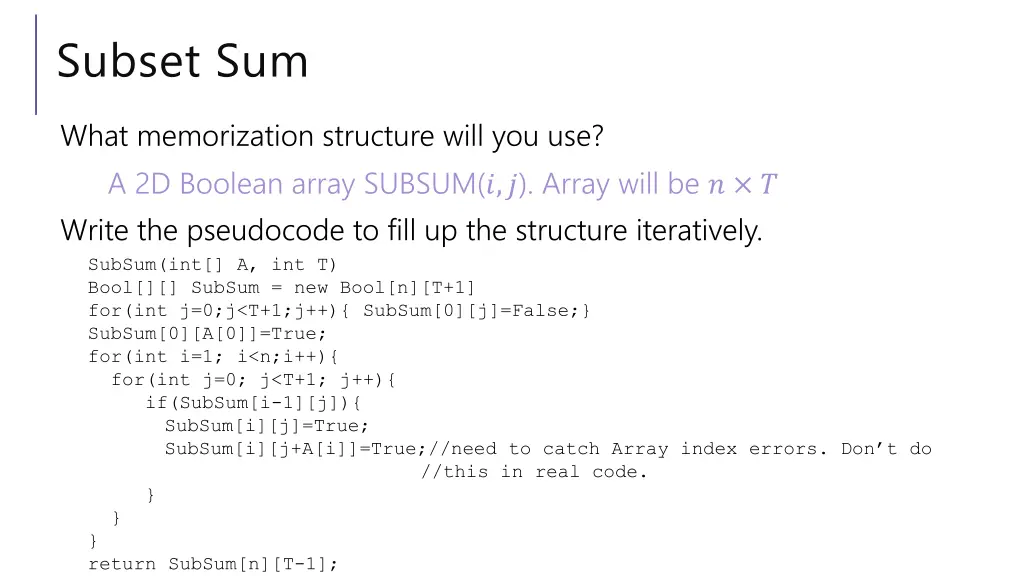
Subset Sum What memorization structure will you use? A 2D Boolean array SUBSUM(?,?). Array will be ? ? Write the pseudocode to fill up the structure iteratively. SubSum(int[] A, int T) Bool[][] SubSum = new Bool[n][T+1] for(int j=0;j<T+1;j++){ SubSum[0][j]=False;} SubSum[0][A[0]]=True; for(int i=1; i<n;i++){ for(int j=0; j<T+1; j++){ if(SubSum[i-1][j]){ SubSum[i][j]=True; SubSum[i][j+A[i]]=True;//need to catch Array index errors. Don t do //this in real code. } } } return SubSum[n][T-1];
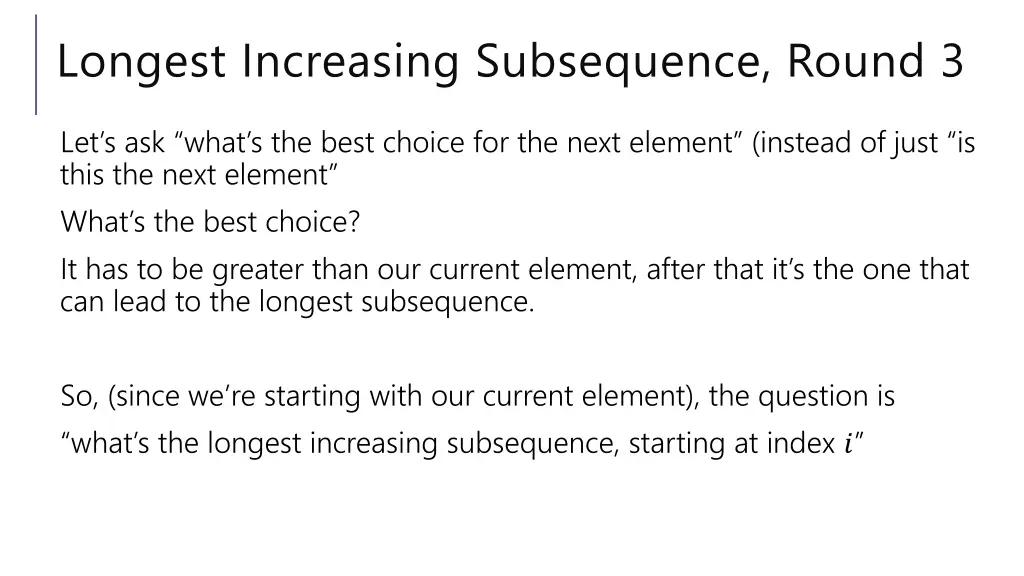
Longest Increasing Subsequence, Round 3 Let s ask what s the best choice for the next element (instead of just is this the next element What s the best choice? It has to be greater than our current element, after that it s the one that can lead to the longest subsequence. So, (since we re starting with our current element), the question is what s the longest increasing subsequence, starting at index ?
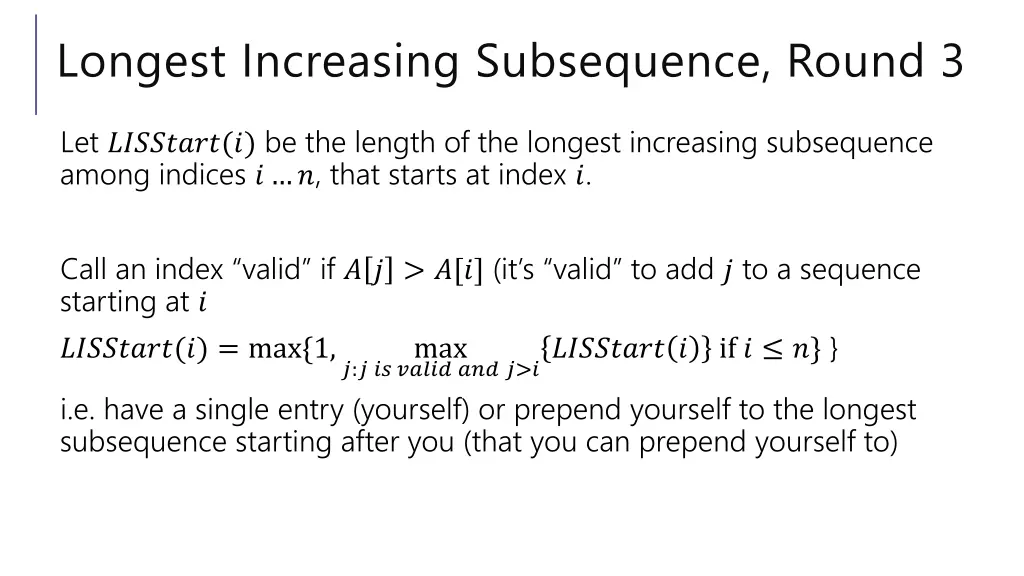
Longest Increasing Subsequence, Round 3 Let ????????(?) be the length of the longest increasing subsequence among indices ? ?, that starts at index ?. Call an index valid if ? ? > ?[?](it s valid to add ? to a sequence starting at ? ?:? ?? ????? ??? ?>????????? ? if ? ?} } i.e. have a single entry (yourself) or prepend yourself to the longest subsequence starting after you (that you can prepend yourself to) ????????(?) = max{1, max
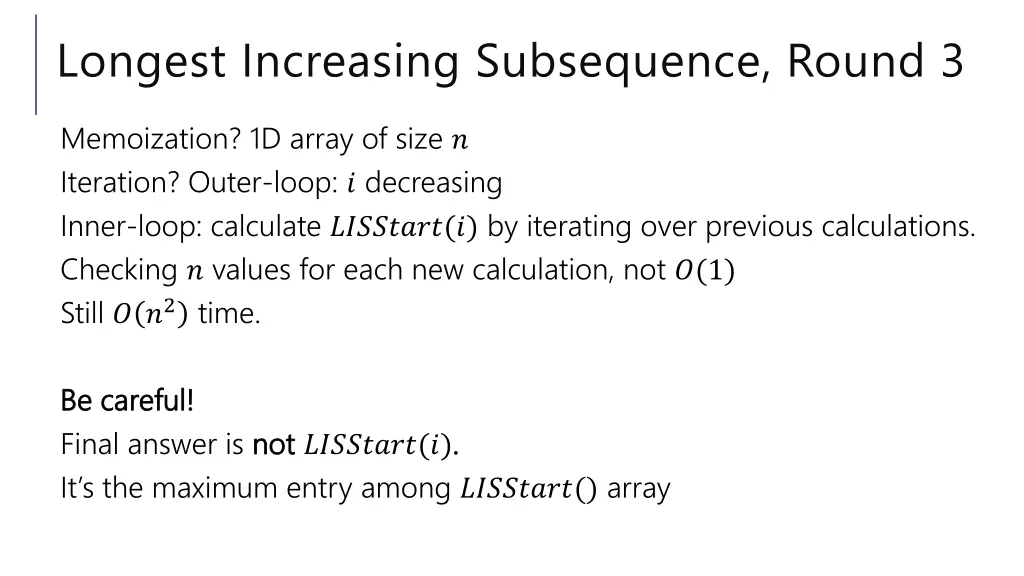
Longest Increasing Subsequence, Round 3 Memoization? 1D array of size ? Iteration? Outer-loop: ? decreasing Inner-loop: calculate ????????(?) by iterating over previous calculations. Checking ? values for each new calculation, not ?(1) Still ? ?2 time. Be careful! Be careful! Final answer is not It s the maximum entry among ????????() array not ????????(?). .
DP on Trees Trees are recursive structures A tree is a root node, with zero or more children Each of which are roots of trees Since DP is smart recursion (recursion where we save values) Recursive functions/calculations are really common.
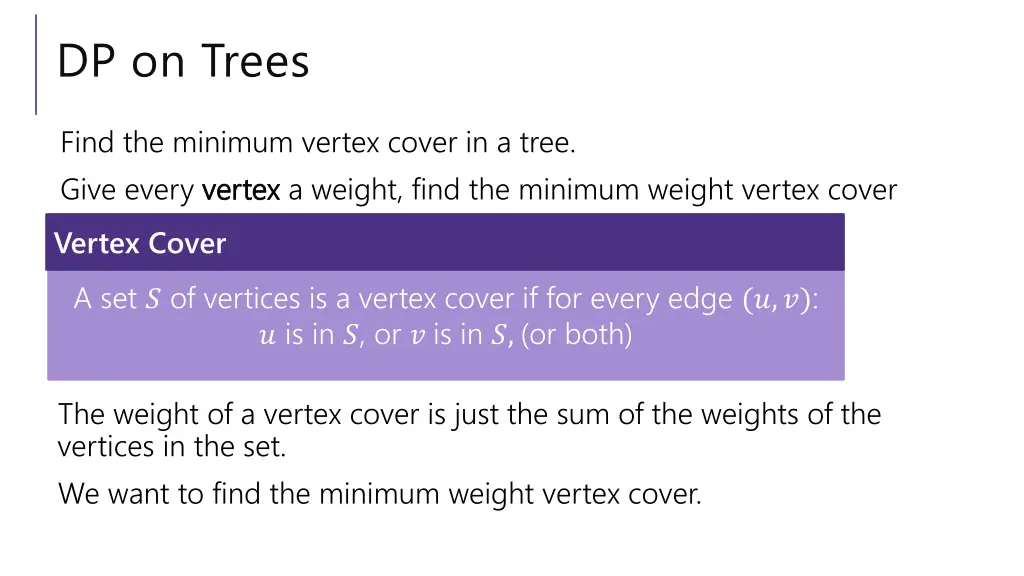
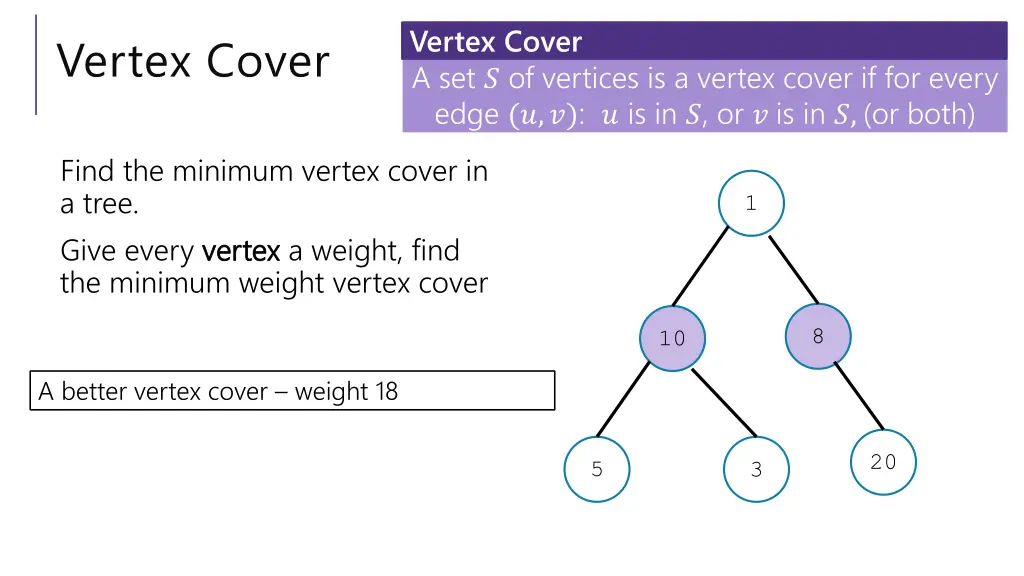
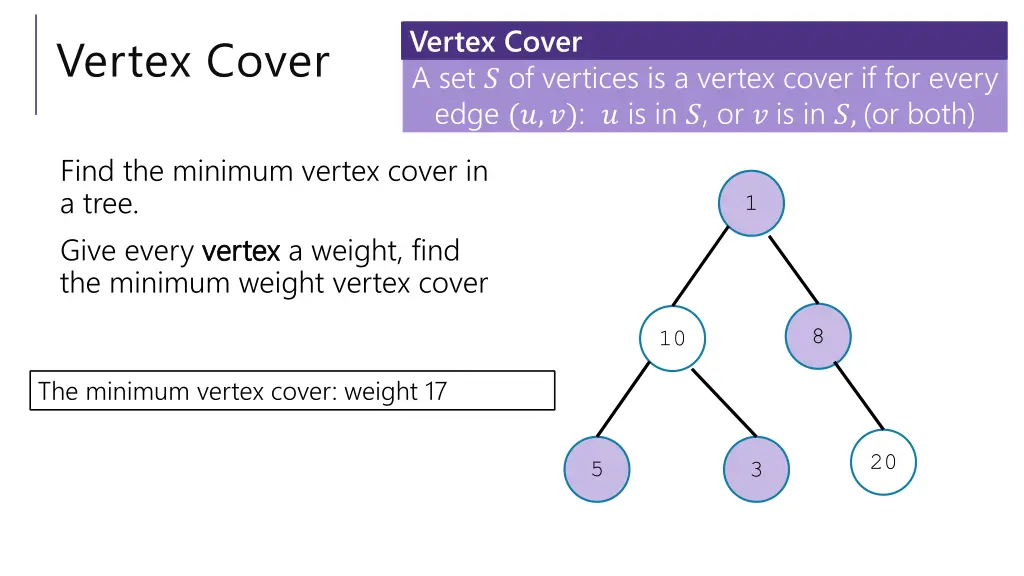
DP on Trees Find the minimum vertex cover in a tree. Give every vertex vertex a weight, find the minimum weight vertex cover Vertex Cover A set ? of vertices is a vertex cover if for every edge (?,?): ? is in ?, or ? is in ?, (or both) The weight of a vertex cover is just the sum of the weights of the vertices in the set. We want to find the minimum weight vertex cover.
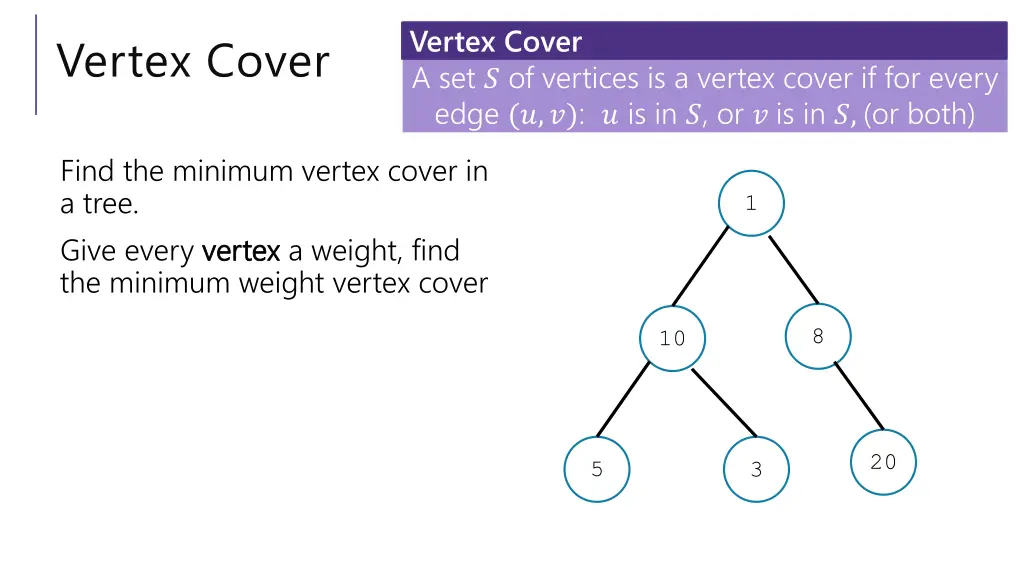
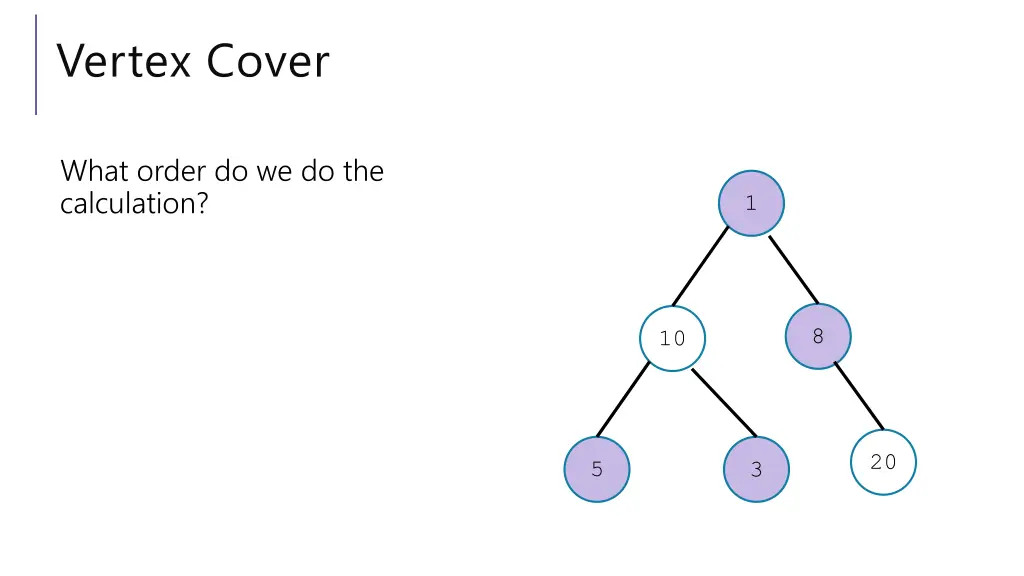
Vertex Cover Vertex Cover A set ? of vertices is a vertex cover if for every edge (?,?): ? is in ?, or ? is in ?, (or both) Find the minimum vertex cover in a tree. Give every vertex vertex a weight, find the minimum weight vertex cover 1 8 10 20 5 3
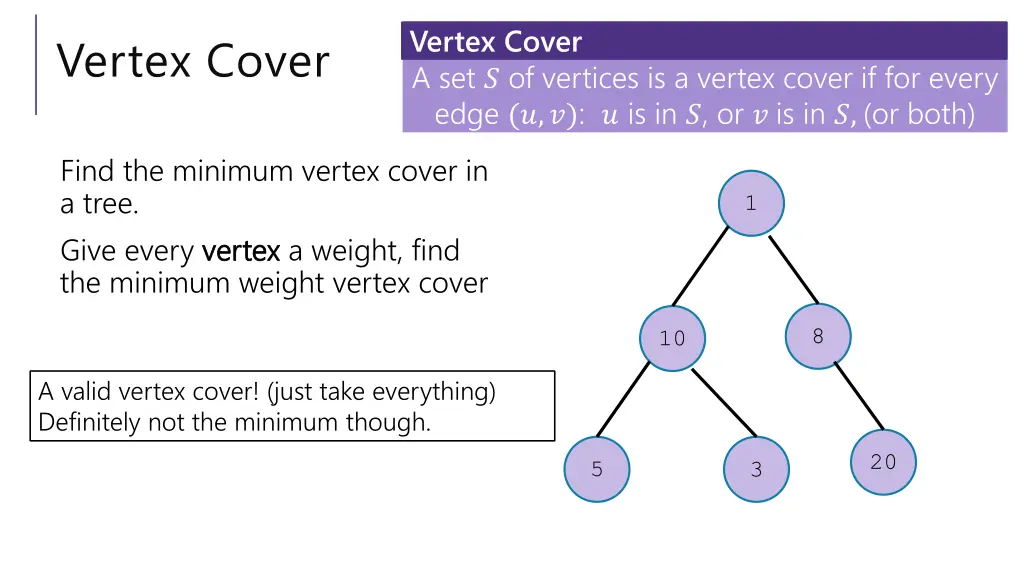
Vertex Cover Vertex Cover A set ? of vertices is a vertex cover if for every edge (?,?): ? is in ?, or ? is in ?, (or both) Find the minimum vertex cover in a tree. Give every vertex vertex a weight, find the minimum weight vertex cover 1 8 10 A valid vertex cover! (just take everything) Definitely not the minimum though. 20 5 3
Vertex Cover Vertex Cover A set ? of vertices is a vertex cover if for every edge (?,?): ? is in ?, or ? is in ?, (or both) Find the minimum vertex cover in a tree. Give every vertex vertex a weight, find the minimum weight vertex cover 1 8 10 A better vertex cover weight 18 20 5 3
Vertex Cover Vertex Cover A set ? of vertices is a vertex cover if for every edge (?,?): ? is in ?, or ? is in ?, (or both) Find the minimum vertex cover in a tree. Give every vertex vertex a weight, find the minimum weight vertex cover 1 8 10 The minimum vertex cover: weight 17 20 5 3
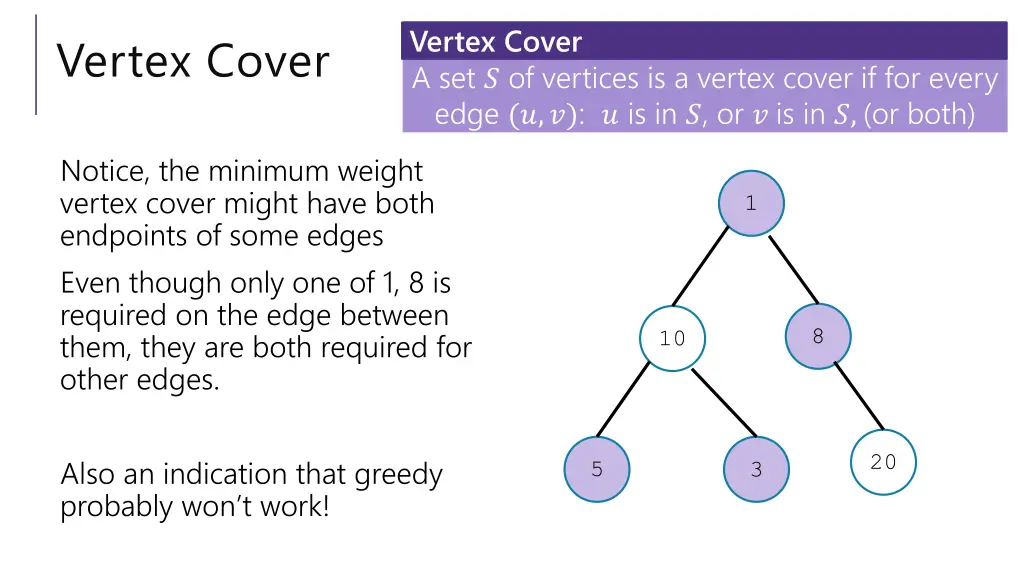
Vertex Cover Vertex Cover A set ? of vertices is a vertex cover if for every edge (?,?): ? is in ?, or ? is in ?, (or both) Notice, the minimum weight vertex cover might have both endpoints of some edges Even though only one of 1, 8 is required on the edge between them, they are both required for other edges. 1 8 10 20 Also an indication that greedy probably won t work! 5 3
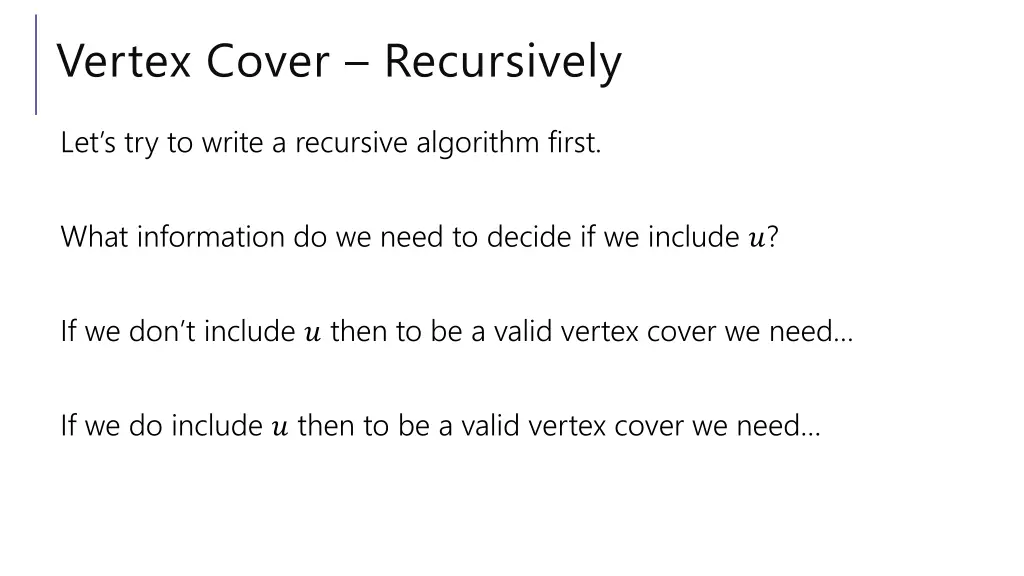
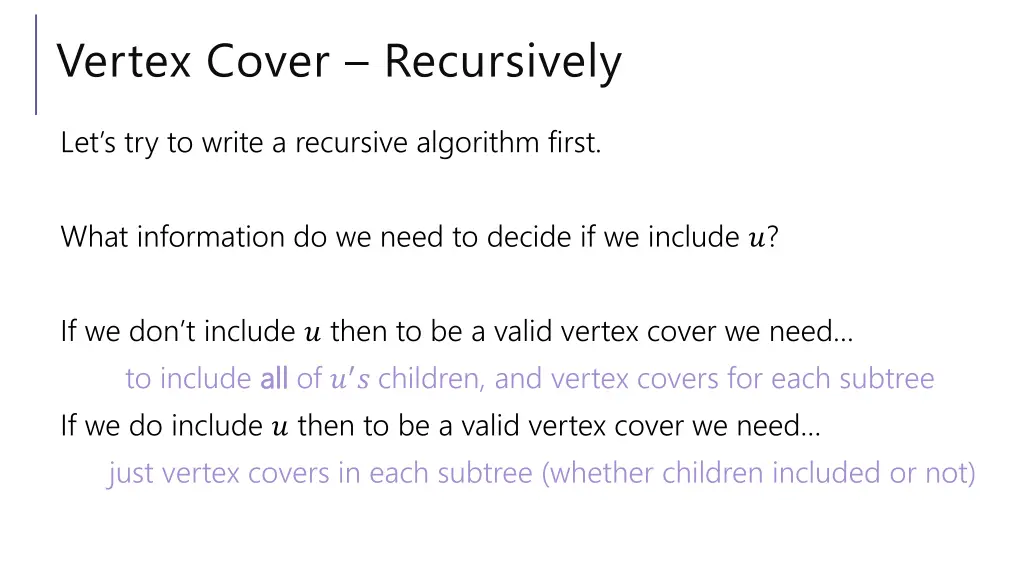
Vertex Cover Recursively Let s try to write a recursive algorithm first. What information do we need to decide if we include ?? If we don t include ?then to be a valid vertex cover we need If we do include ?then to be a valid vertex cover we need
Vertex Cover Recursively Let s try to write a recursive algorithm first. What information do we need to decide if we include ?? If we don t include ?then to be a valid vertex cover we need to include all all of ? ? children, and vertex covers for each subtree If we do include ?then to be a valid vertex cover we need just vertex covers in each subtree (whether children included or not)
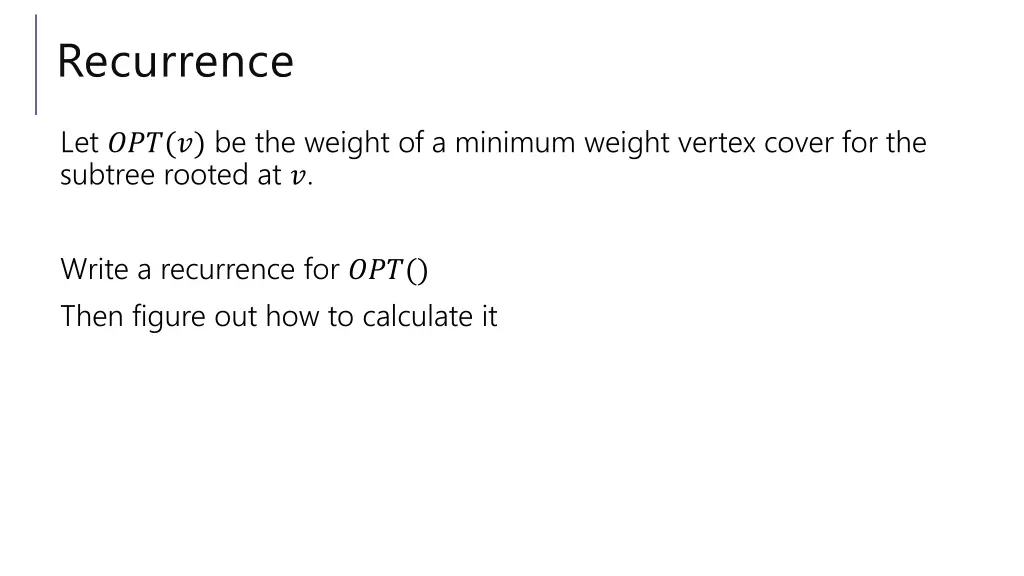
Recurrence Let ???(?) be the weight of a minimum weight vertex cover for the subtree rooted at ?. Write a recurrence for ???() Then figure out how to calculate it
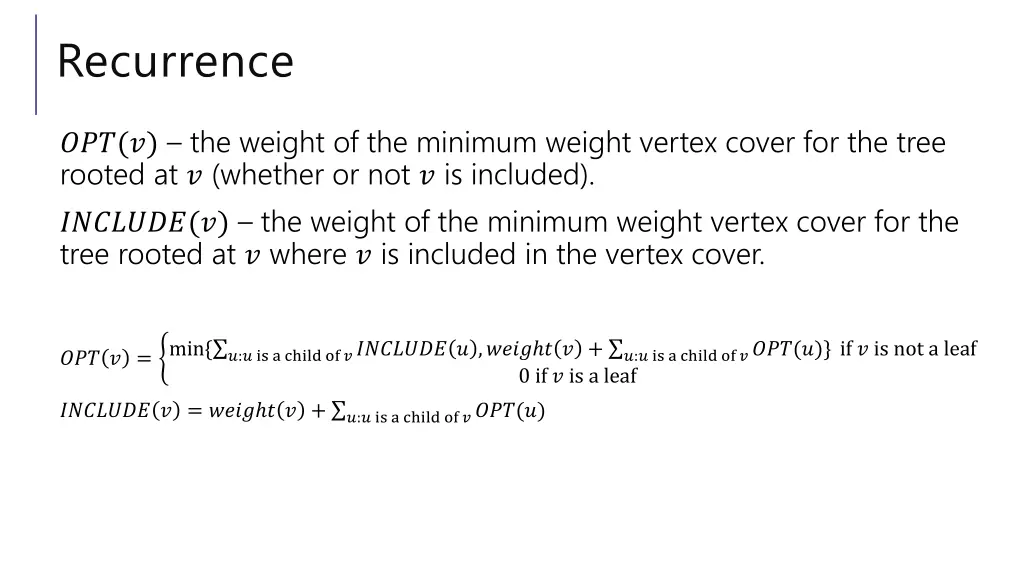
Recurrence ???(?) the weight of the minimum weight vertex cover for the tree rooted at ? (whether or not ? is included). ???????(?) the weight of the minimum weight vertex cover for the tree rooted at ? where ? is included in the vertex cover. ??? ? = min{ ?:? is a child of ???????? ? ,???? ? ? + ?:? is a child of ????(?)} if ? is not a leaf 0 if ? is a leaf ??????? ? = ???? ? ? + ?:? is a child of ????(?)
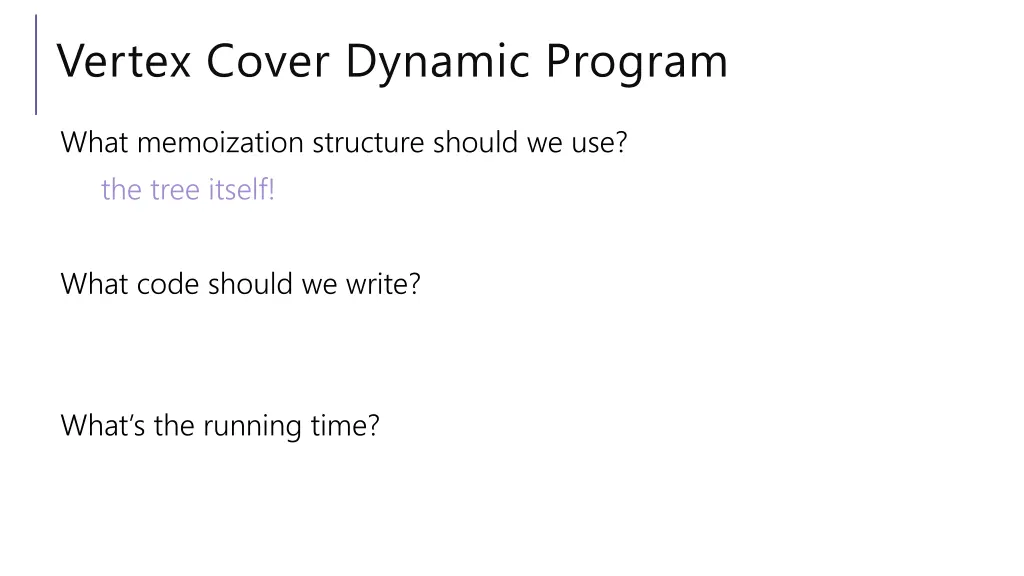
Vertex Cover Dynamic Program What memoization structure should we use? What code should we write? What s the running time?
Vertex Cover Dynamic Program What memoization structure should we use? the tree itself! What code should we write? What s the running time?
Vertex Cover What order do we do the calculation? 1 8 10 20 5 3
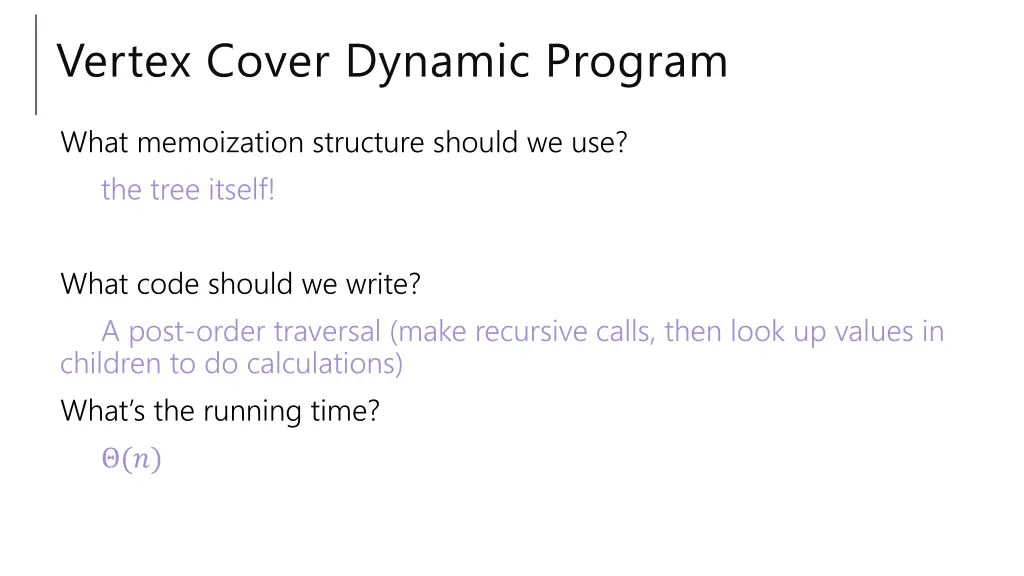
Vertex Cover Dynamic Program What memoization structure should we use? the tree itself! What code should we write? A post-order traversal (make recursive calls, then look up values in children to do calculations) What s the running time? (?)
DP Design Notes We haven t done a single proof for DP We won t ask you to do one. DP proofs are almost always just the code does the recurrence But that just moves the correctness question why is the recurrence correct? And the proof of the recurrence being correct is almost always I included all the cases I d rather you focus on checking it than trying to explain it.
DP history So why is it called dynamic programming? programming is an old-timey meaning of the word. It means scheduling Like a conference has a program of who speaks where when. Or a television executive decides on the nightly programming (what show airs when).
DP history So dynamic dynamic? The phrase dynamic programming was popularized by Richard Bellman (we ll see one of his algorithms on Monday) He was a researcher, funded by the U.S. military . But the Secretary of Defense [as Bellman tells it] hated research. And hated math even more. So Bellman needed a description of his research that everyone
DP history Dynamic Dynamic Is actually an accurate adjective what we think is the best option (include/exclude) can change over time. Even better It s impossible to use the word dynamic in a pejorative sense It was something not even a Congressman could object to.