Explore the E2E data volume transfer time analytics implemented in 5G networks to assist with AI/ML-based services. Topics covered include latency performance analytics, NWDAF services enhancement, and UE-specific data transfer time statistics. Understand how AF can leverage these analytics for Federated Learning Operations.
Please find below an Image/Link to download the presentation.
The content on the website is provided AS IS for your information and personal use only. It may not be sold, licensed, or shared on other websites without obtaining consent from the author. If you encounter any issues during the download, it is possible that the publisher has removed the file from their server.
You are allowed to download the files provided on this website for personal or commercial use, subject to the condition that they are used lawfully. All files are the property of their respective owners.
The content on the website is provided AS IS for your information and personal use only. It may not be sold, licensed, or shared on other websites without obtaining consent from the author.
E N D
Presentation Transcript
3GPP TSG SA WG2 pre-meeting #156e E-meeting, 17th-21st April 2023 Agenda: 9.9.2 AIMLsys KI#7 discussion: OAM inputs for the E2E data volume transfer time analytics A potential issue with some of the proposed inputs
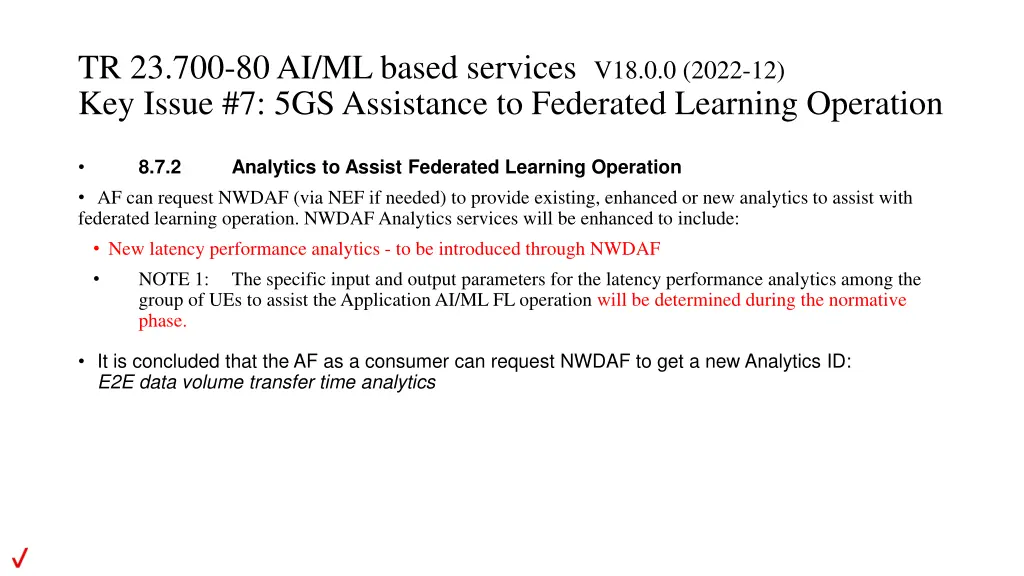
TR 23.700-80 AI/ML based services V18.0.0 (2022-12) Key Issue #7: 5GS Assistance to Federated Learning Operation 8.7.2 Analytics to Assist Federated Learning Operation AF can request NWDAF (via NEF if needed) to provide existing, enhanced or new analytics to assist with federated learning operation. NWDAF Analytics services will be enhanced to include: New latency performance analytics - to be introduced through NWDAF NOTE 1: The specific input and output parameters for the latency performance analytics among the group of UEs to assist the Application AI/ML FL operation will be determined during the normative phase. It is concluded that the AF as a consumer can request NWDAF to get a new Analytics ID: E2E data volume transfer time analytics
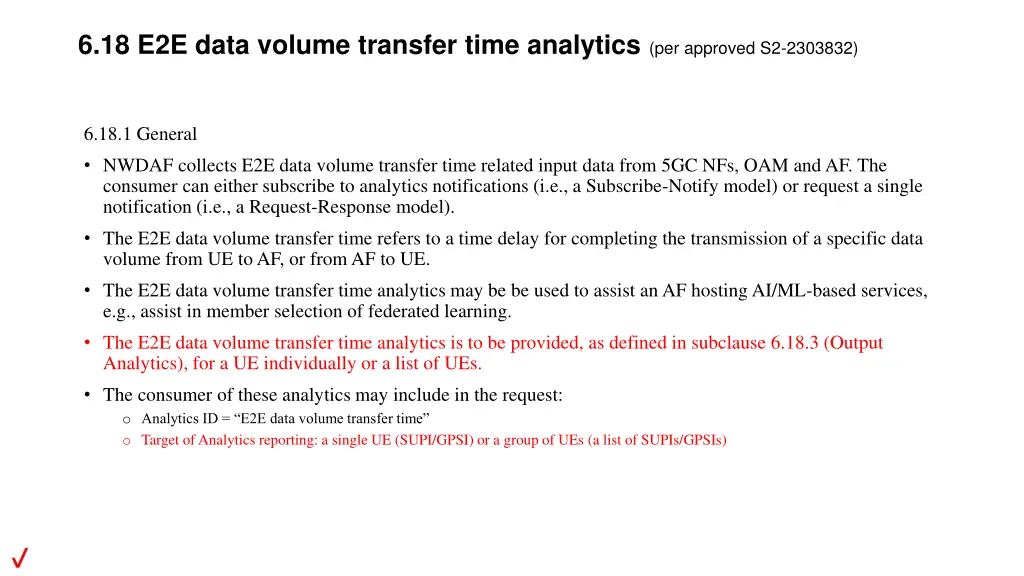
6.18 E2E data volume transfer time analytics (per approved S2-2303832) 6.18.1 General NWDAF collects E2E data volume transfer time related input data from 5GC NFs, OAM and AF. The consumer can either subscribe to analytics notifications (i.e., a Subscribe-Notify model) or request a single notification (i.e., a Request-Response model). The E2E data volume transfer time refers to a time delay for completing the transmission of a specific data volume from UE to AF, or from AF to UE. The E2E data volume transfer time analytics may be be used to assist an AF hosting AI/ML-based services, e.g., assist in member selection of federated learning. The E2E data volume transfer time analytics is to be provided, as defined in subclause 6.18.3 (Output Analytics), for a UE individually or a list of UEs. The consumer of these analytics may include in the request: o Analytics ID = E2E data volume transfer time o Target of Analytics reporting: a single UE (SUPI/GPSI) or a group of UEs (a list of SUPIs/GPSIs)
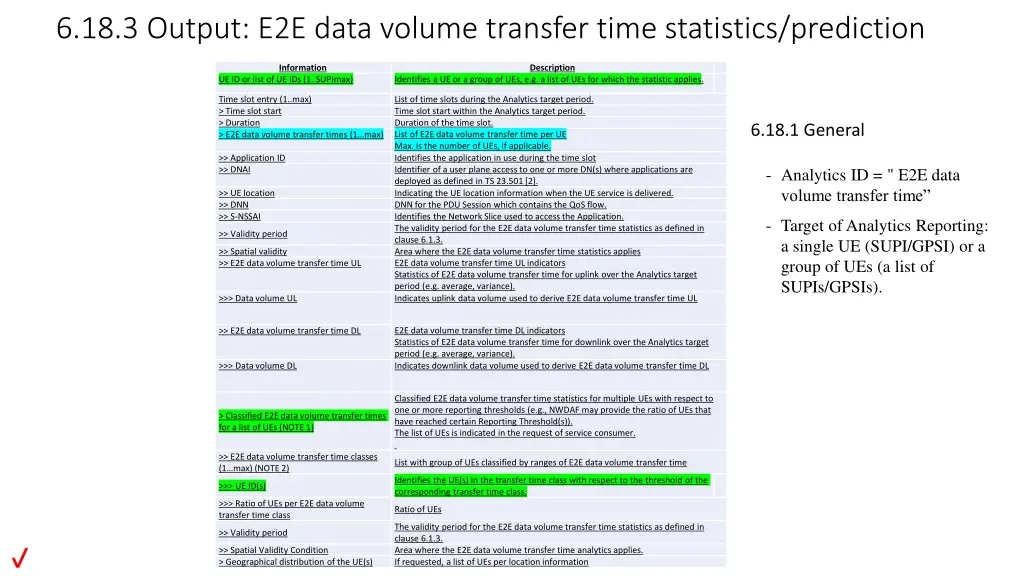
6.18.3 Output: E2E data volume transfer time statistics/prediction Information Description UE ID or list of UE IDs (1..SUPImax) Identifies a UE or a group of UEs, e.g. a list of UEs for which the statistic applies. Time slot entry (1..max) > Time slot start > Duration > E2E data volume transfer times (1 max) List of time slots during the Analytics target period. Time slot start within the Analytics target period. Duration of the time slot. List of E2E data volume transfer time per UE Max. is the number of UEs, if applicable. Identifies the application in use during the time slot Identifier of a user plane access to one or more DN(s) where applications are deployed as defined in TS 23.501[2]. Indicating the UE location information when the UE service is delivered. DNN for the PDU Session which contains the QoS flow. Identifies the Network Slice used to access the Application. The validity period for the E2E data volume transfer time statistics as defined in clause 6.1.3. Area where the E2E data volume transfer time statistics applies E2E data volume transfer time UL indicators Statistics of E2E data volume transfer time for uplink over the Analytics target period (e.g. average, variance). Indicates uplink data volume used to derive E2E data volume transfer time UL 6.18.1 General >> Application ID >> DNAI - Analytics ID = " E2E data volume transfer time >> UE location >> DNN >> S-NSSAI - Target of Analytics Reporting: a single UE (SUPI/GPSI) or a group of UEs (a list of SUPIs/GPSIs). >> Validity period >> Spatial validity >> E2E data volume transfer time UL >>> Data volume UL E2E data volume transfer time DL indicators Statistics of E2E data volume transfer time for downlink over the Analytics target period (e.g. average, variance). Indicates downlink data volume used to derive E2E data volume transfer time DL >> E2E data volume transfer time DL >>> Data volume DL Classified E2E data volume transfer time statistics for multiple UEs with respect to one or more reporting thresholds (e.g., NWDAF may provide the ratio of UEs that have reached certain Reporting Threshold(s)). The list of UEs is indicated in the request of service consumer. > Classified E2E data volume transfer times for a list of UEs (NOTE 1) >> E2E data volume transfer time classes (1 max) (NOTE 2) List with group of UEs classified by ranges of E2E data volume transfer time Identifies the UE(s) in the transfer time class with respect to the threshold of the corresponding transfer time class. >>> UE ID(s) >>> Ratio of UEs per E2E data volume transfer time class Ratio of UEs The validity period for the E2E data volume transfer time statistics as defined in clause 6.1.3. Area where the E2E data volume transfer time analytics applies. If requested, a list of UEs per location information >> Validity period >> Spatial Validity Condition > Geographical distribution of the UE(s)
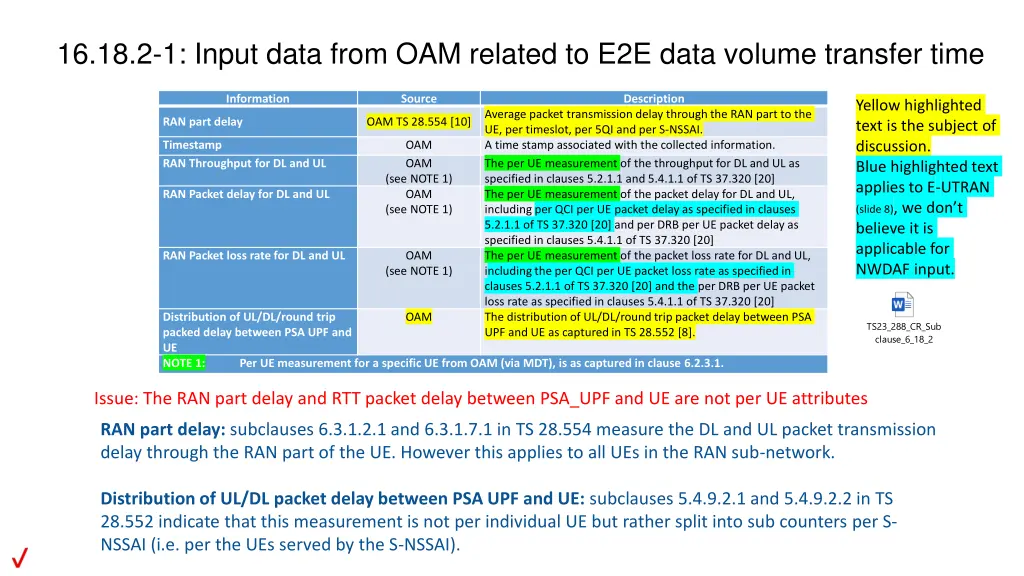
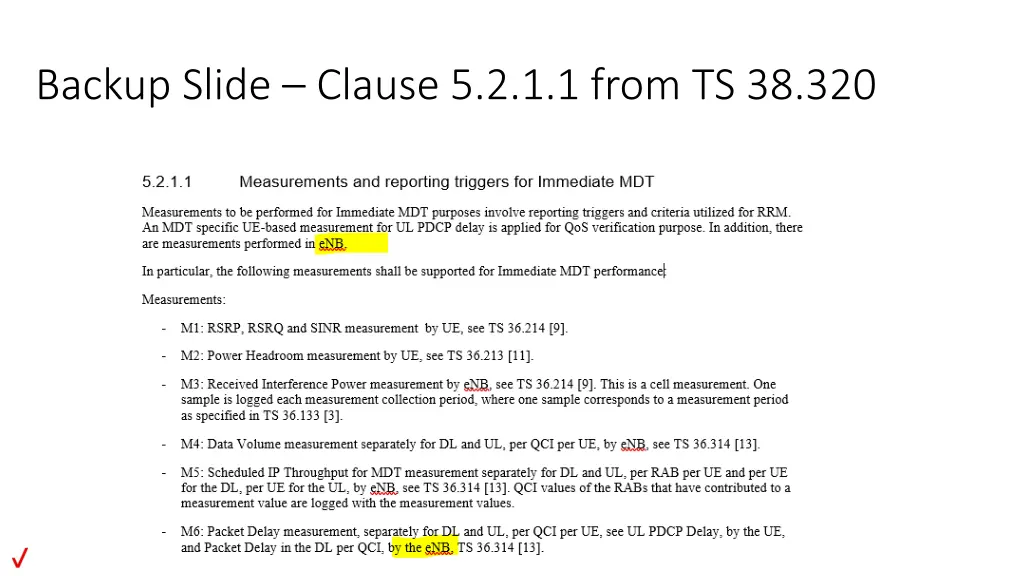
16.18.2-1: Input data from OAM related to E2E data volume transfer time Information Source Description Yellow highlighted text is the subject of discussion. Blue highlighted text applies to E-UTRAN (slide 8), we don t believe it is applicable for NWDAF input. Average packet transmission delay through the RAN part to the UE, per timeslot, per 5QI and per S-NSSAI. A time stamp associated with the collected information. The per UE measurement of the throughput for DL and UL as specified in clauses 5.2.1.1 and 5.4.1.1 of TS 37.320 [20] The per UE measurement of the packet delay for DL and UL, including per QCI per UE packet delay as specified in clauses 5.2.1.1 of TS 37.320 [20] and per DRB per UE packet delay as specified in clauses 5.4.1.1 of TS 37.320 [20] The per UE measurement of the packet loss rate for DL and UL, including the per QCI per UE packet loss rate as specified in clauses 5.2.1.1 of TS 37.320 [20] and the per DRB per UE packet loss rate as specified in clauses 5.4.1.1 of TS 37.320 [20] The distribution of UL/DL/round trip packet delay between PSA UPF and UE as captured in TS 28.552 [8]. RAN part delay OAM TS 28.554 [10] Timestamp RAN Throughput for DL and UL OAM OAM (see NOTE 1) OAM (see NOTE 1) RAN Packet delay for DL and UL RAN Packet loss rate for DL and UL OAM (see NOTE 1) Distribution of UL/DL/round trip packed delay between PSA UPF and UE NOTE 1: Per UE measurement for a specific UE from OAM (via MDT), is as captured in clause 6.2.3.1. OAM TS23_288_CR_Sub clause_6_18_2 Issue: The RAN part delay and RTT packet delay between PSA_UPF and UE are not per UE attributes RAN part delay: subclauses 6.3.1.2.1 and 6.3.1.7.1 in TS 28.554 measure the DL and UL packet transmission delay through the RAN part of the UE. However this applies to all UEs in the RAN sub-network. Distribution of UL/DL packet delay between PSA UPF and UE: subclauses 5.4.9.2.1 and 5.4.9.2.2 in TS 28.552 indicate that this measurement is not per individual UE but rather split into sub counters per S- NSSAI (i.e. per the UEs served by the S-NSSAI).
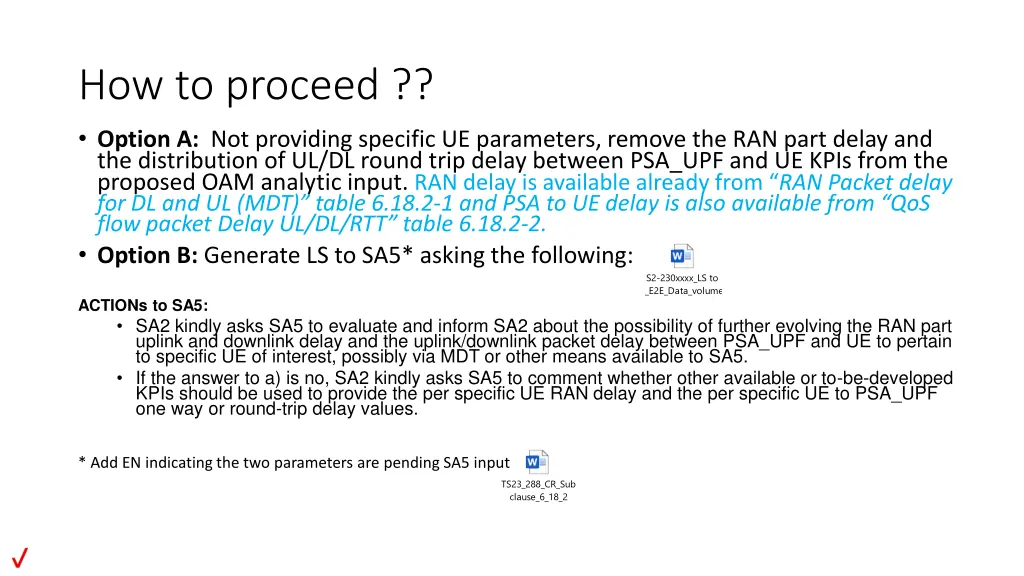
How to proceed ?? Option A: Not providing specific UE parameters, remove the RAN part delay and the distribution of UL/DL round trip delay between PSA_UPF and UE KPIs from the proposed OAM analytic input. RAN delay is available already from RAN Packet delay for DL and UL (MDT) table 6.18.2-1 and PSA to UE delay is also available from QoS flow packet Delay UL/DL/RTT table 6.18.2-2. Option B: Generate LS to SA5* asking the following: S2-230xxxx_LS to SA5_E2E_Data_volume_tra ACTIONs to SA5: SA2 kindly asks SA5 toevaluate and inform SA2 about the possibility of further evolving the RAN part uplink and downlink delay and the uplink/downlink packet delay between PSA_UPF and UE to pertain to specific UE of interest, possibly via MDT or other means available to SA5. If the answer to a) is no, SA2 kindly asks SA5 to comment whether other available or to-be-developed KPIs should be used to provide the per specific UE RAN delay and the per specific UE to PSA_UPF one way or round-trip delay values. * Add EN indicating the two parameters are pending SA5 input TS23_288_CR_Sub clause_6_18_2
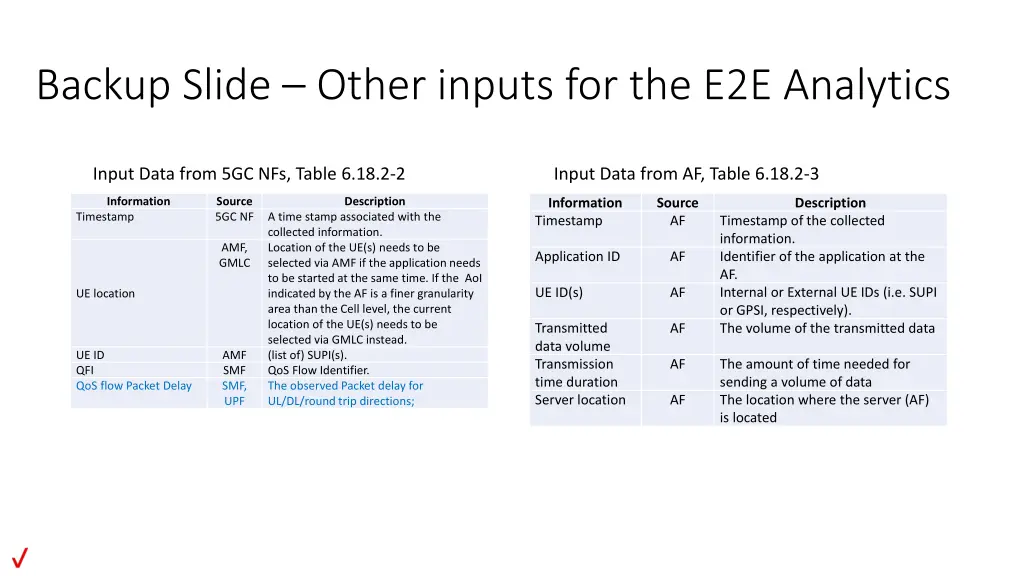
Backup Slide Other inputs for the E2E Analytics Input Data from 5GC NFs, Table 6.18.2-2 Input Data from AF, Table 6.18.2-3 Information Timestamp Source 5GC NF A time stamp associated with the collected information. AMF, GMLC selected via AMF if the application needs to be started at the same time. If the AoI indicated by the AF is a finer granularity area than the Cell level, the current location of the UE(s) needs to be selected via GMLC instead. AMF (list of) SUPI(s). SMF QoS Flow Identifier. SMF, UPF UL/DL/round trip directions; Description Information Timestamp Source AF Description Timestamp of the collected information. Identifier of the application at the AF. Internal or External UE IDs (i.e. SUPI or GPSI, respectively). The volume of the transmitted data Location of the UE(s) needs to be Application ID AF UE ID(s) AF UE location Transmitted data volume Transmission time duration Server location AF UE ID QFI QoS flow Packet Delay The amount of time needed for sending a volume of data The location where the server (AF) is located AF The observed Packet delay for AF