Economic Mobility Initiatives for Low-Income Women in Washington D.C.
Addressing significant barriers to economic mobility faced by low-income women in Washington D.C. through educational interventions and policy options to enhance access to quality jobs and entrepreneurship opportunities, ultimately aiming for financial stability and upward mobility.

Download Presentation

Please find below an Image/Link to download the presentation.
The content on the website is provided AS IS for your information and personal use only. It may not be sold, licensed, or shared on other websites without obtaining consent from the author. If you encounter any issues during the download, it is possible that the publisher has removed the file from their server.
You are allowed to download the files provided on this website for personal or commercial use, subject to the condition that they are used lawfully. All files are the property of their respective owners.
The content on the website is provided AS IS for your information and personal use only. It may not be sold, licensed, or shared on other websites without obtaining consent from the author.
E N D
Presentation Transcript
Low-Income Womens Economic Mobility in Washington D.C. Ackeem Evans, Uduak Nkanga, Amiri Yalda, Isabel Mubiru, Mustapha Sarge
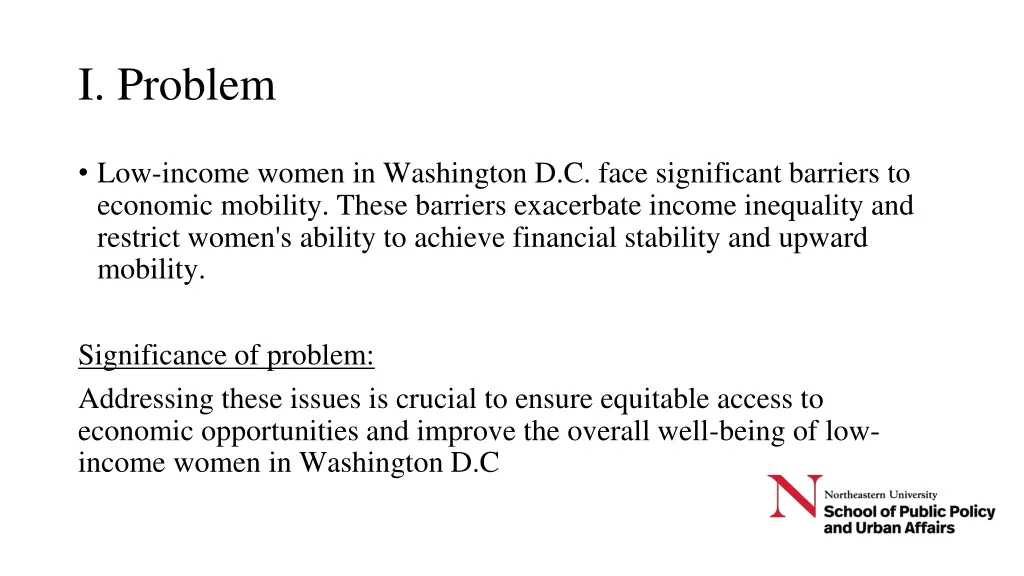
I. Problem Low-income women in Washington D.C. face significant barriers to economic mobility. These barriers exacerbate income inequality and restrict women's ability to achieve financial stability and upward mobility. Significance of problem: Addressing these issues is crucial to ensure equitable access to economic opportunities and improve the overall well-being of low- income women in Washington D.C
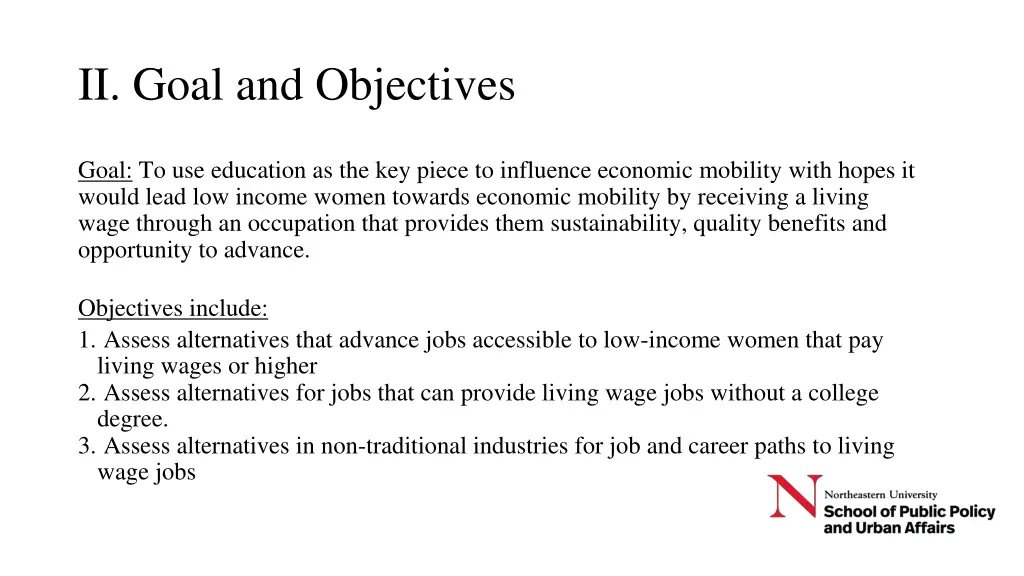
II. Goal and Objectives Goal: To use education as the key piece to influence economic mobility with hopes it would lead low income women towards economic mobility by receiving a living wage through an occupation that provides them sustainability, quality benefits and opportunity to advance. Objectives include: 1. Assess alternatives that advance jobs accessible to low-income women that pay living wages or higher 2. Assess alternatives for jobs that can provide living wage jobs without a college degree. 3. Assess alternatives in non-traditional industries for job and career paths to living wage jobs
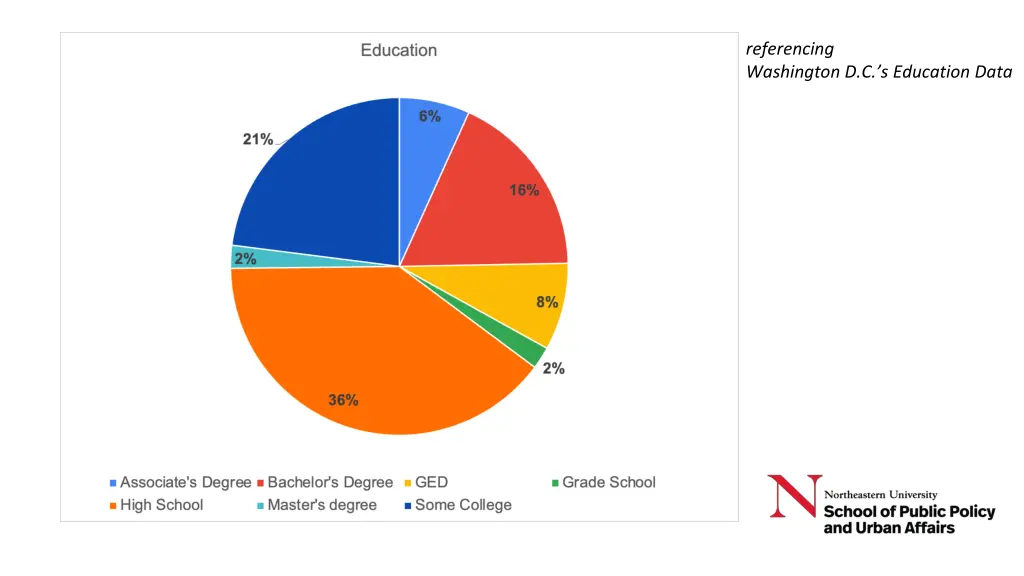
referencing Washington D.C. s Education Data
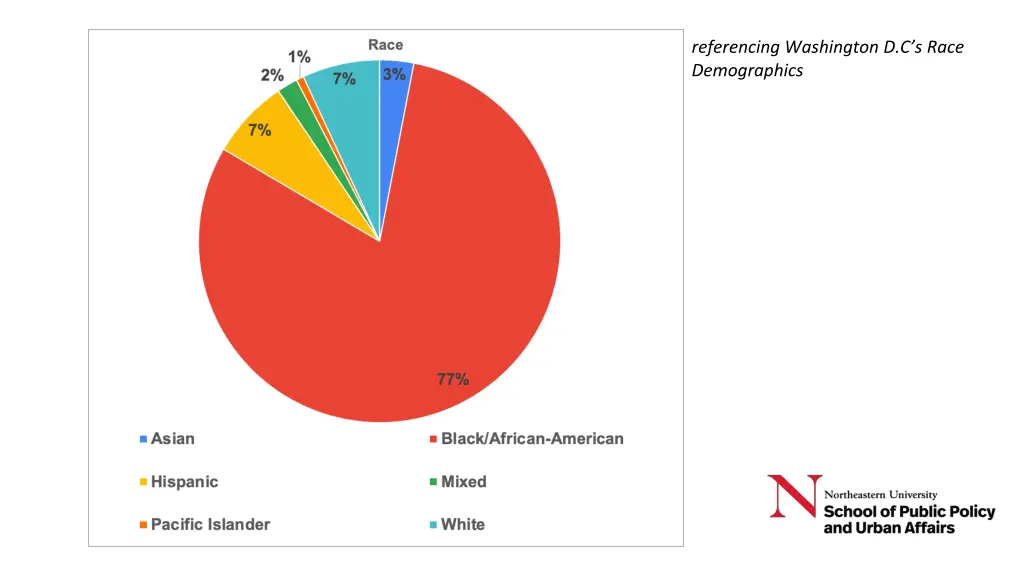
referencing Washington D.Cs Race Demographics
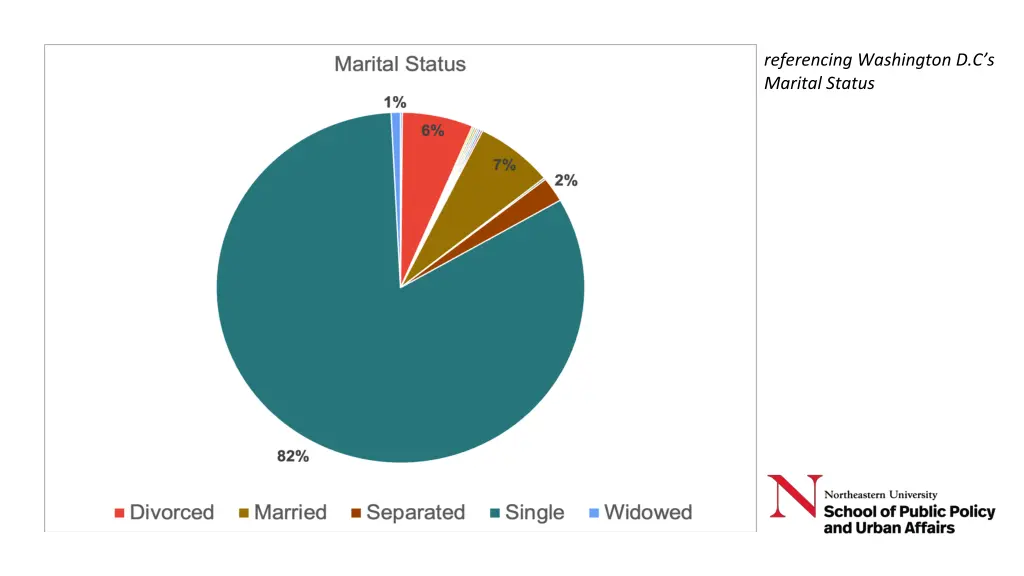
referencing Washington D.Cs Marital Status
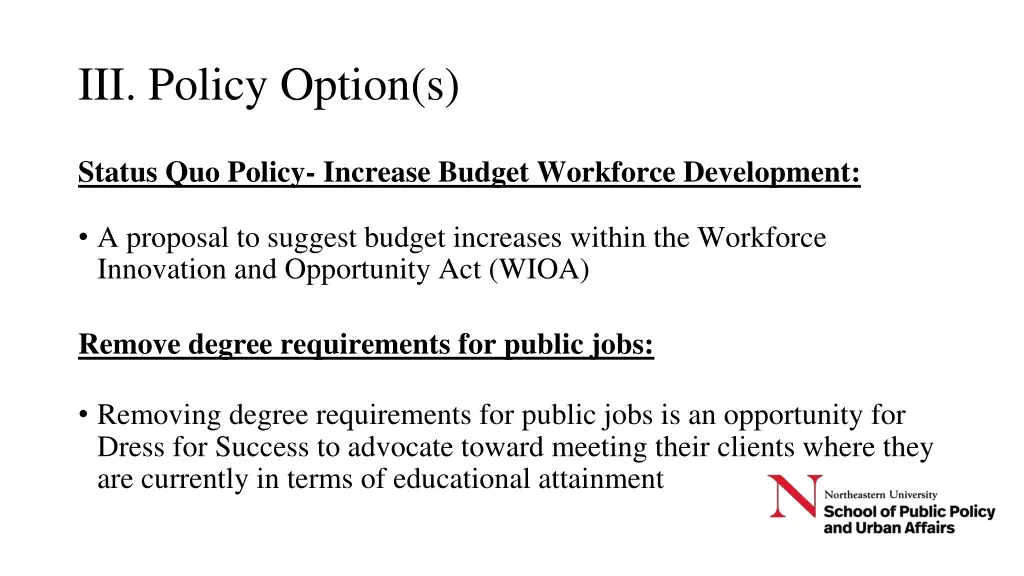
III. Policy Option(s) Status Quo Policy- Increase Budget Workforce Development: A proposal to suggest budget increases within the Workforce Innovation and Opportunity Act (WIOA) Remove degree requirements for public jobs: Removing degree requirements for public jobs is an opportunity for Dress for Success to advocate toward meeting their clients where they are currently in terms of educational attainment
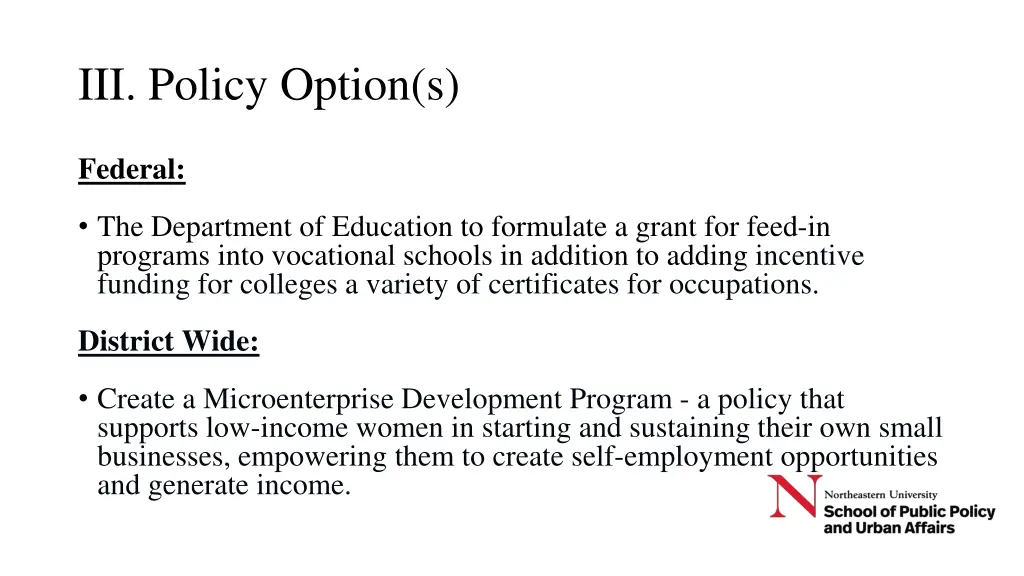
III. Policy Option(s) Federal: The Department of Education to formulate a grant for feed-in programs into vocational schools in addition to adding incentive funding for colleges a variety of certificates for occupations. District Wide: Create a Microenterprise Development Program - a policy that supports low-income women in starting and sustaining their own small businesses, empowering them to create self-employment opportunities and generate income.
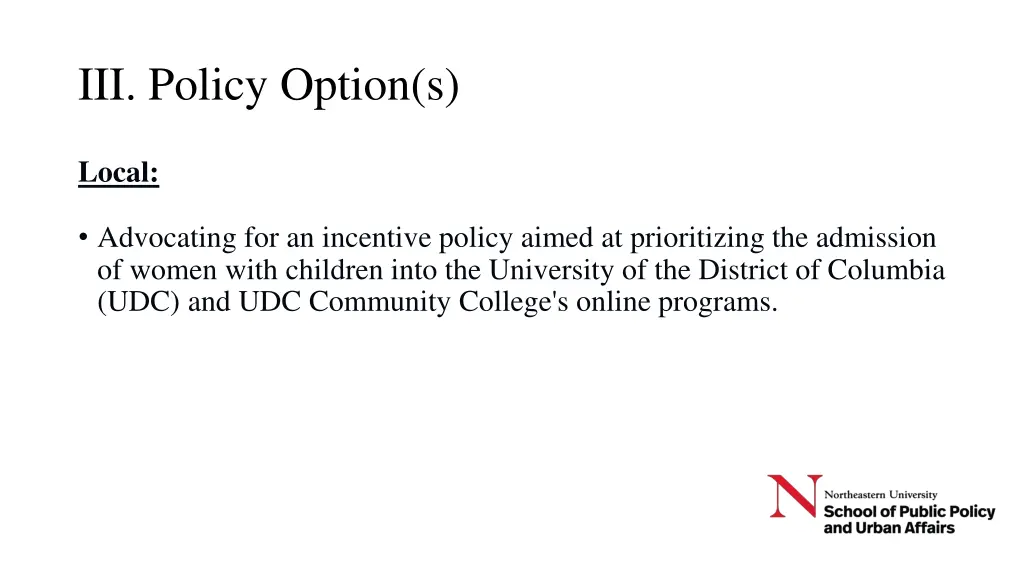
III. Policy Option(s) Local: Advocating for an incentive policy aimed at prioritizing the admission of women with children into the University of the District of Columbia (UDC) and UDC Community College's online programs.
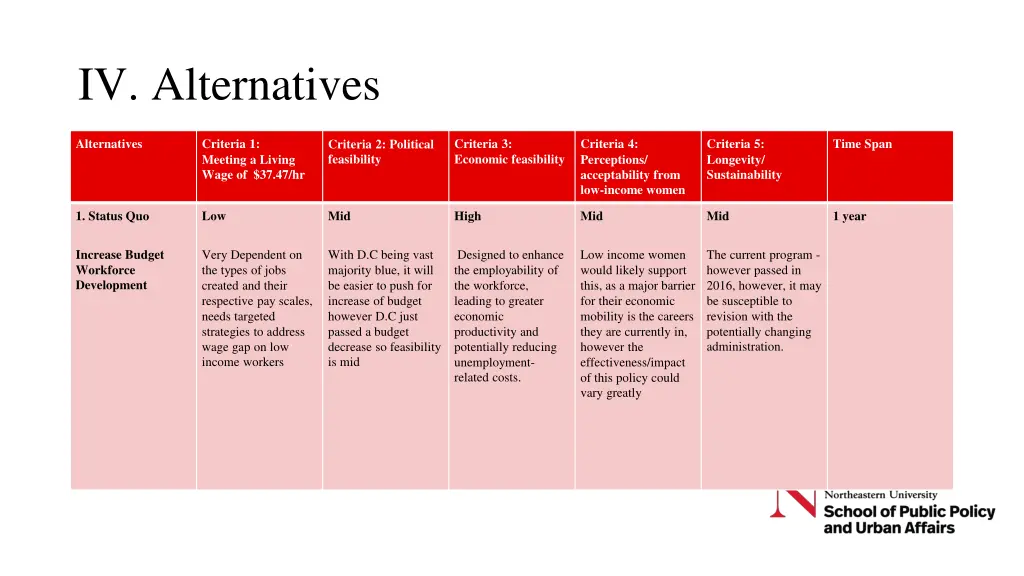
IV. Alternatives Alternatives Criteria 1: Meeting a Living Wage of $37.47/hr Criteria 3: Economic feasibility Criteria 4: Perceptions/ acceptability from low-income women Criteria 5: Longevity/ Sustainability Time Span Criteria 2: Political feasibility 1. Status Quo Low Mid High Mid Mid 1 year Increase Budget Workforce Development Very Dependent on the types of jobs created and their respective pay scales, needs targeted strategies to address wage gap on low income workers With D.C being vast majority blue, it will be easier to push for increase of budget however D.C just passed a budget decrease so feasibility is mid Designed to enhance the employability of the workforce, leading to greater economic productivity and potentially reducing unemployment- related costs. Low income women would likely support this, as a major barrier for their economic mobility is the careers they are currently in, however the effectiveness/impact of this policy could vary greatly The current program - however passed in 2016, however, it may be susceptible to revision with the potentially changing administration.
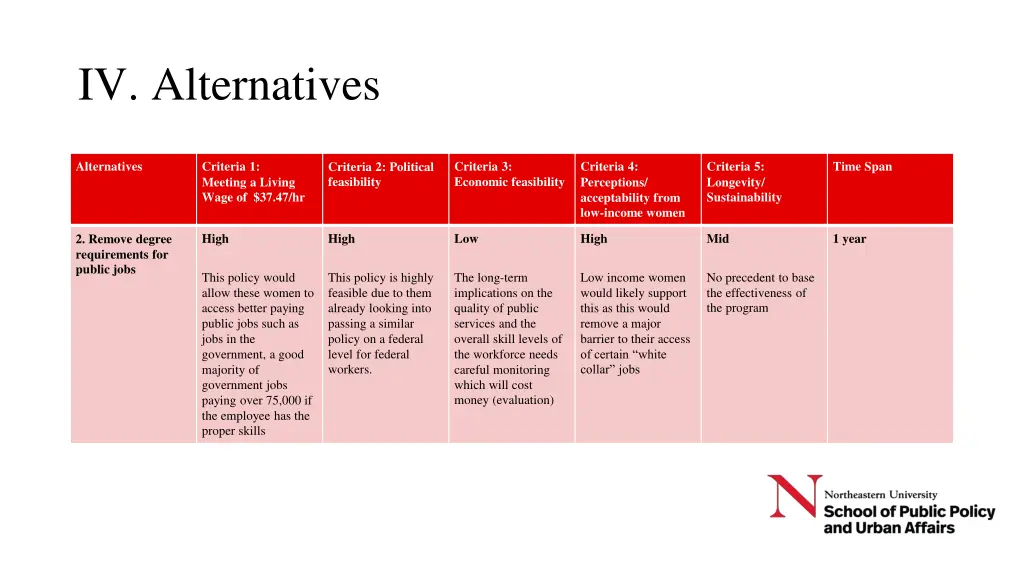
IV. Alternatives Alternatives Criteria 1: Meeting a Living Wage of $37.47/hr Criteria 3: Economic feasibility Criteria 4: Perceptions/ acceptability from low-income women Criteria 5: Longevity/ Sustainability Time Span Criteria 2: Political feasibility High High Low High Mid 1 year 2. Remove degree requirements for public jobs This policy would allow these women to access better paying public jobs such as jobs in the government, a good majority of government jobs paying over 75,000 if the employee has the proper skills This policy is highly feasible due to them already looking into passing a similar policy on a federal level for federal workers. The long-term implications on the quality of public services and the overall skill levels of the workforce needs careful monitoring which will cost money (evaluation) Low income women would likely support this as this would remove a major barrier to their access of certain white collar jobs No precedent to base the effectiveness of the program
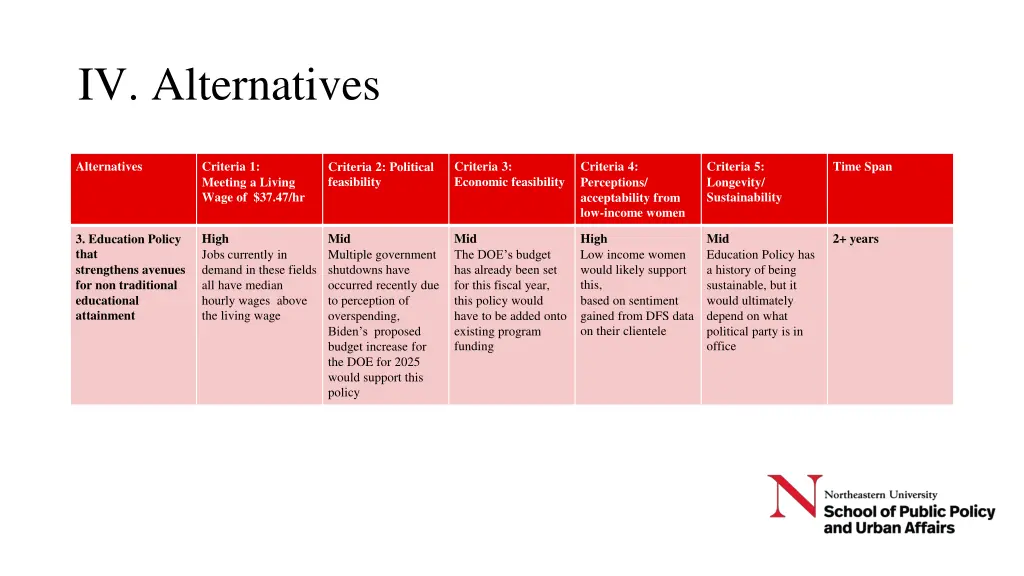
IV. Alternatives Alternatives Criteria 1: Meeting a Living Wage of $37.47/hr Criteria 3: Economic feasibility Criteria 4: Perceptions/ acceptability from low-income women Criteria 5: Longevity/ Sustainability Time Span Criteria 2: Political feasibility High Jobs currently in demand in these fields all have median hourly wages above the living wage Mid Multiple government shutdowns have occurred recently due to perception of overspending, Biden s proposed budget increase for the DOE for 2025 would support this policy Mid The DOE s budget has already been set for this fiscal year, this policy would have to be added onto existing program funding High Low income women would likely support this, based on sentiment gained from DFS data on their clientele Mid Education Policy has a history of being sustainable, but it would ultimately depend on what political party is in office 2+ years 3. Education Policy that strengthens avenues for non traditional educational attainment
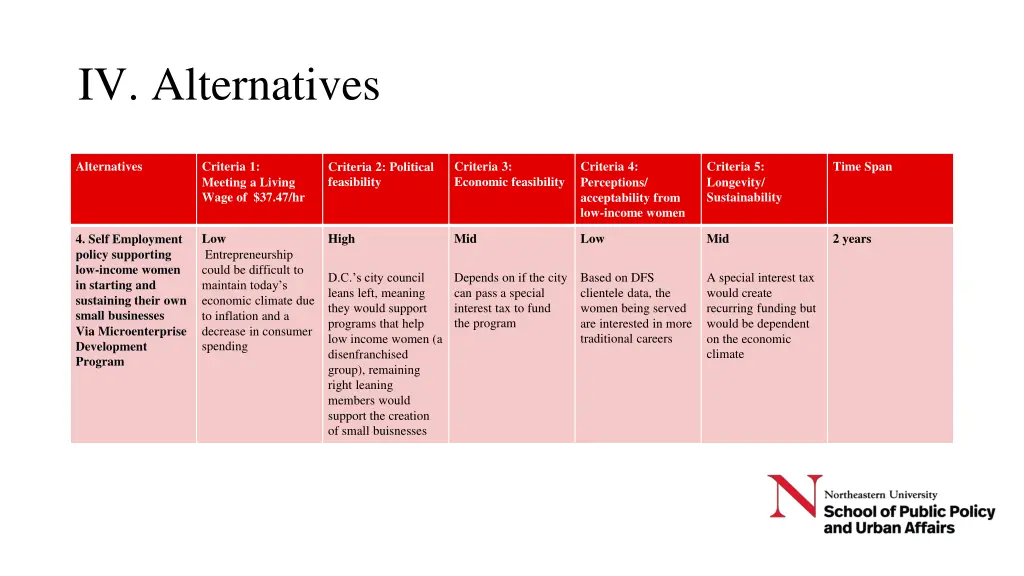
IV. Alternatives Alternatives Criteria 1: Meeting a Living Wage of $37.47/hr Criteria 3: Economic feasibility Criteria 4: Perceptions/ acceptability from low-income women Criteria 5: Longevity/ Sustainability Time Span Criteria 2: Political feasibility Low Entrepreneurship could be difficult to maintain today s economic climate due to inflation and a decrease in consumer spending High Mid Low Mid 2 years 4. Self Employment policy supporting low-income women in starting and sustaining their own small businesses Via Microenterprise Development Program Depends on if the city can pass a special interest tax to fund the program Based on DFS clientele data, the women being served are interested in more traditional careers A special interest tax would create recurring funding but would be dependent on the economic climate D.C. s city council leans left, meaning they would support programs that help low income women (a disenfranchised group), remaining right leaning members would support the creation of small buisnesses
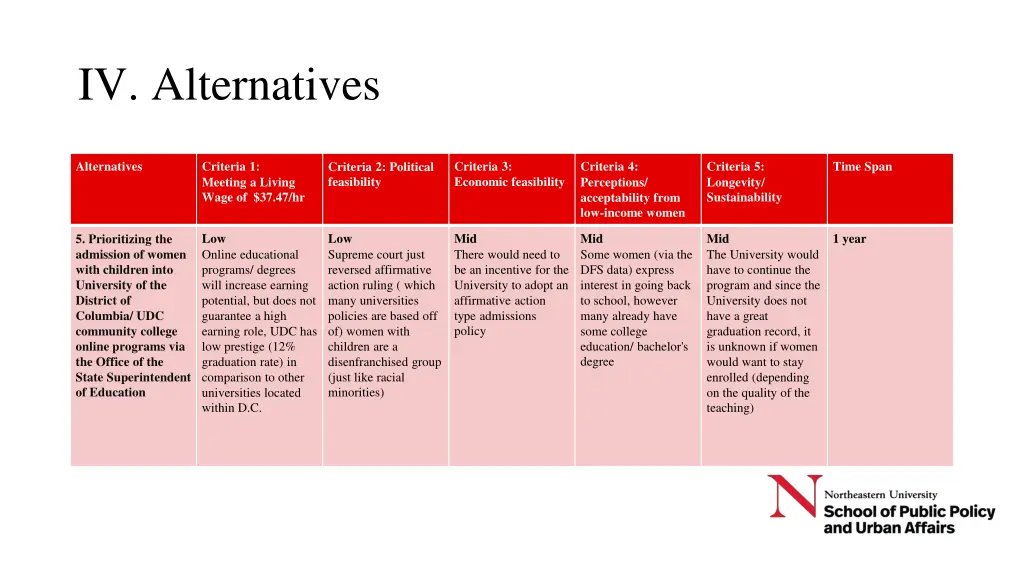
IV. Alternatives Alternatives Criteria 1: Meeting a Living Wage of $37.47/hr Criteria 3: Economic feasibility Criteria 4: Perceptions/ acceptability from low-income women Criteria 5: Longevity/ Sustainability Time Span Criteria 2: Political feasibility Low Online educational programs/ degrees will increase earning potential, but does not guarantee a high earning role, UDC has low prestige (12% graduation rate) in comparison to other universities located within D.C. Low Supreme court just reversed affirmative action ruling ( which many universities policies are based off of) women with children are a disenfranchised group (just like racial minorities) Mid There would need to be an incentive for the University to adopt an affirmative action type admissions policy Mid Some women (via the DFS data) express interest in going back to school, however many already have some college education/ bachelor's degree Mid The University would have to continue the program and since the University does not have a great graduation record, it is unknown if women would want to stay enrolled (depending on the quality of the teaching) 1 year 5. Prioritizing the admission of women with children into University of the District of Columbia/ UDC community college online programs via the Office of the State Superintendent of Education
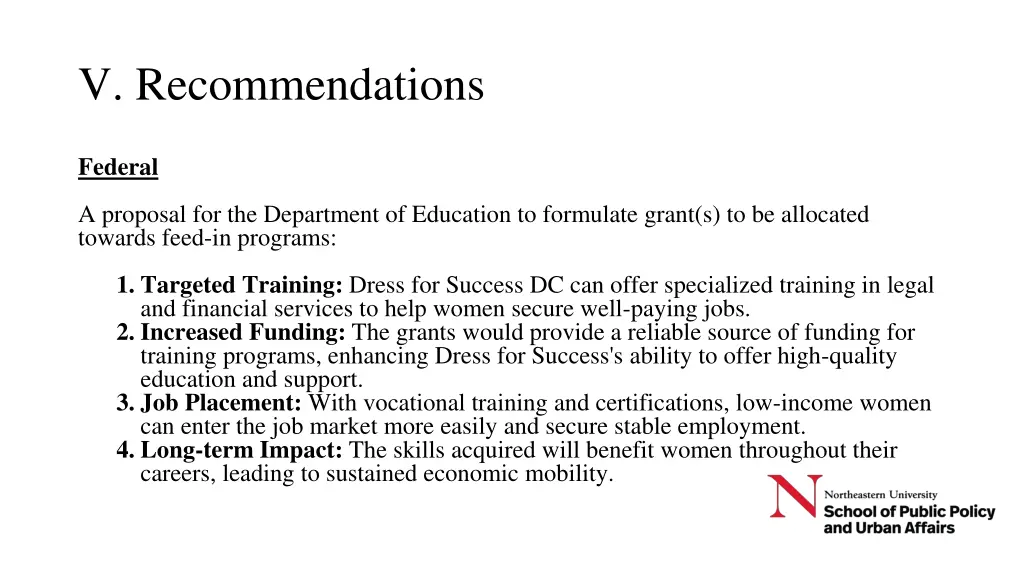
V. Recommendations Federal A proposal for the Department of Education to formulate grant(s) to be allocated towards feed-in programs: 1. Targeted Training: Dress for Success DC can offer specialized training in legal and financial services to help women secure well-paying jobs. 2. Increased Funding: The grants would provide a reliable source of funding for training programs, enhancing Dress for Success's ability to offer high-quality education and support. 3. Job Placement: With vocational training and certifications, low-income women can enter the job market more easily and secure stable employment. 4. Long-term Impact: The skills acquired will benefit women throughout their careers, leading to sustained economic mobility.
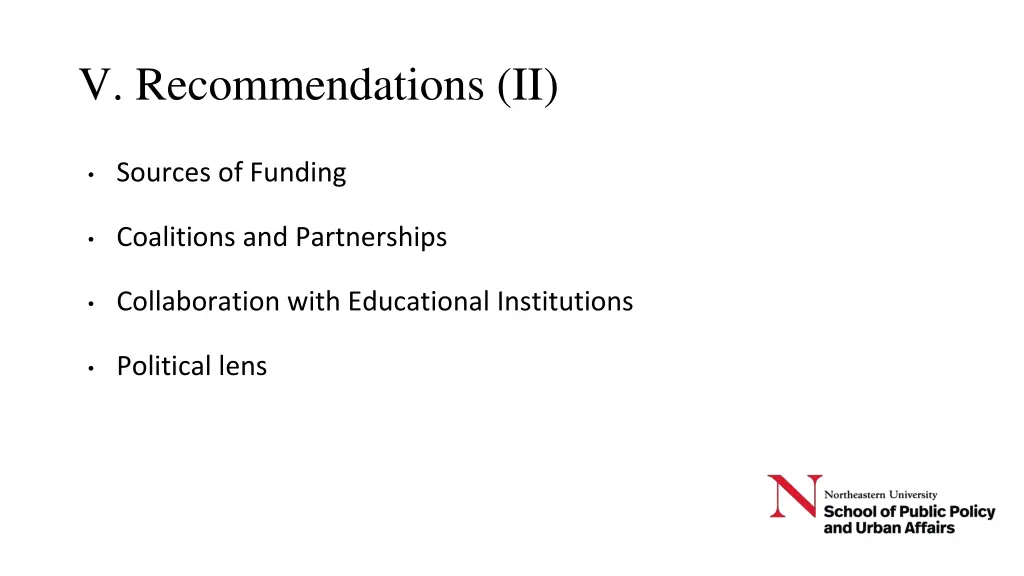
V. Recommendations (II) Sources of Funding Coalitions and Partnerships Collaboration with Educational Institutions Political lens