Explore the impact of economic regulations on employment growth in Sub-Saharan Africa, addressing jobless growth concerns and the role of regulatory institutions in fostering balanced development. The study delves into how regulations may affect formal sector employment in the context of output changes and demographic transitions.
Please find below an Image/Link to download the presentation.
The content on the website is provided AS IS for your information and personal use only. It may not be sold, licensed, or shared on other websites without obtaining consent from the author. If you encounter any issues during the download, it is possible that the publisher has removed the file from their server.
You are allowed to download the files provided on this website for personal or commercial use, subject to the condition that they are used lawfully. All files are the property of their respective owners.
The content on the website is provided AS IS for your information and personal use only. It may not be sold, licensed, or shared on other websites without obtaining consent from the author.
E N D
Presentation Transcript
Economic regulation and employment elasticities of output growth in Sub- Saharan Africa Abidemi C. Adegboye1, Monday I. Egharevba2and Joel Edafe2 1. Department of Economics and Statistics, University of Benin, P.M.B. 1154, Benin City, Nigeria (Ph.D Candidate) [Corresponding author: cornabi@gmail.com; +2347033227614] 2. Department of Finance and Economics, Benson Idahosa University, Benin City, Nigeria
Outline Outline Introduction Data Presentation Methodology Empirical Analysis Conclusion
Introduction Introduction Economic growth Productive employment Poverty reduction Productive employment will only ensue from growth if (Kuznets, 1946; Lewis, 1954; Chenery, 1960; Agenor & Montiel, 2008): the growth is accompanied by structural transformation the growth occurs in all the sectors simultaneously demographic transition accompanies growth there are institutional setups that facilitate labour absorption in the economy due to economic dualism
Introduction Introduction Jobless growth in sub-Sharan Africa (SSA) economies More of employment, rather tha unemployment problem in SSA Presence of duality and market segmentations in developing economies which may lead to irregularities that may not be self- adjusting (Krueger, 1983; Agenor & Montiel, 2008), requiring institutional regulations Population dynamics in the SSA region present an emphatic consideration in employment In pursuing employment enhancing growth, regulatory institutions could have strategic roles population control, factor reallocation, and aiding balanced growth
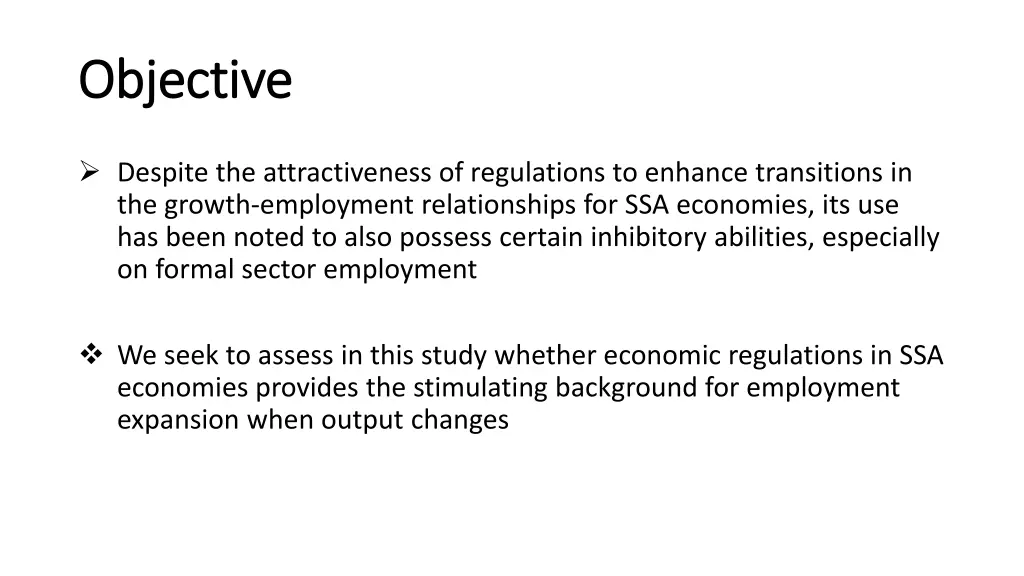
Objective Objective Despite the attractiveness of regulations to enhance transitions in the growth-employment relationships for SSA economies, its use has been noted to also possess certain inhibitory abilities, especially on formal sector employment We seek to assess in this study whether economic regulations in SSA economies provides the stimulating background for employment expansion when output changes
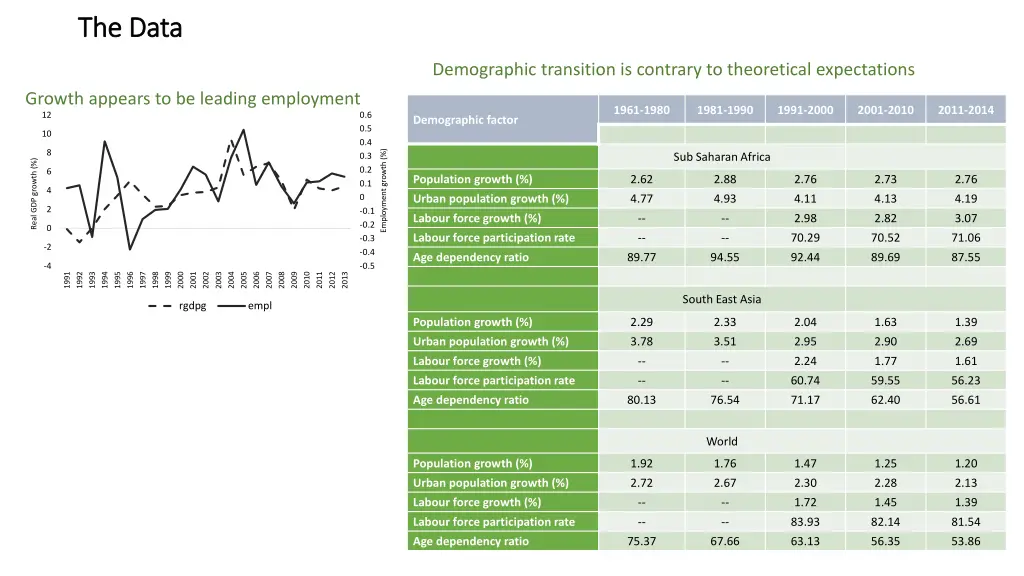
The Data The Data Demographic transition is contrary to theoretical expectations Growth appears to be leading employment 12 1961-1980 1981-1990 1991-2000 2001-2010 2011-2014 0.6 Demographic factor 0.5 10 0.4 8 Employment growth (%) Sub Saharan Africa 0.3 Real GDP growth (%) 0.2 6 Population growth (%) 2.62 2.88 2.76 2.73 2.76 0.1 4 0 Urban population growth (%) 4.77 4.93 4.11 4.13 4.19 2 -0.1 Labour force growth (%) -- -- 2.98 2.82 3.07 -0.2 0 Labour force participation rate -- -- 70.29 70.52 71.06 -0.3 -2 -0.4 Age dependency ratio 89.77 94.55 92.44 89.69 87.55 -4 -0.5 1991 1992 1993 1994 1995 1996 1997 1998 1999 2000 2001 2002 2003 2004 2005 2006 2007 2008 2009 2010 2011 2012 2013 South East Asia rgdpg empl Population growth (%) 2.29 2.33 2.04 1.63 1.39 Urban population growth (%) 3.78 3.51 2.95 2.90 2.69 Labour force growth (%) -- -- 2.24 1.77 1.61 Labour force participation rate -- -- 60.74 59.55 56.23 Age dependency ratio 80.13 76.54 71.17 62.40 56.61 World Population growth (%) 1.92 1.76 1.47 1.25 1.20 Urban population growth (%) 2.72 2.67 2.30 2.28 2.13 Labour force growth (%) -- -- 1.72 1.45 1.39 Labour force participation rate -- -- 83.93 82.14 81.54 Age dependency ratio 75.37 67.66 63.13 56.35 53.86
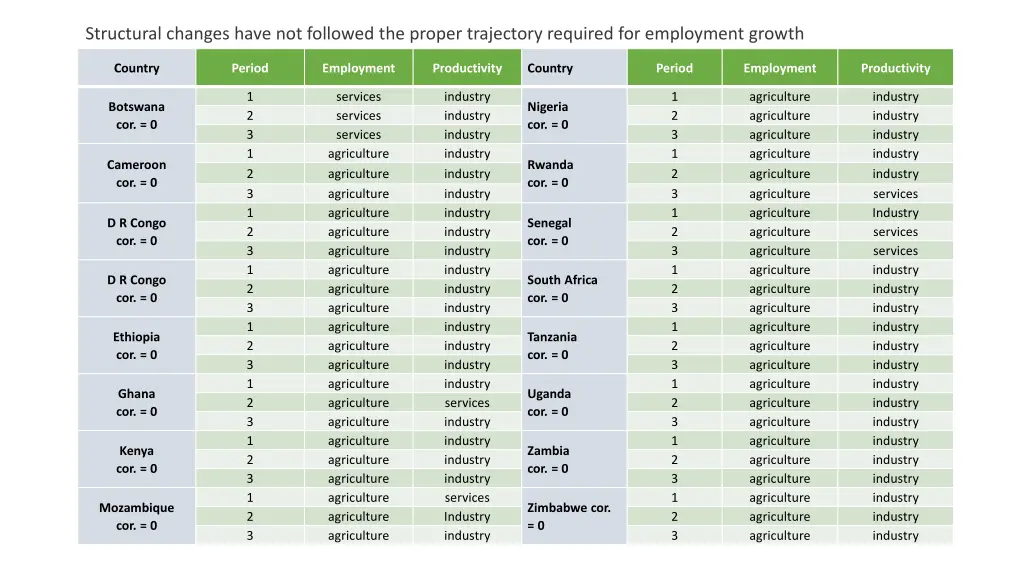
Structural changes have not followed the proper trajectory required for employment growth Country Period Employment Productivity Country Period Employment Productivity 1 2 3 1 2 3 1 2 3 1 2 3 1 2 3 1 2 3 1 2 3 1 2 3 services services services agriculture agriculture agriculture agriculture agriculture agriculture agriculture agriculture agriculture agriculture agriculture agriculture agriculture agriculture agriculture agriculture agriculture agriculture agriculture agriculture agriculture industry industry industry industry industry industry industry industry industry industry industry industry industry industry industry industry services industry industry industry industry services Industry industry 1 2 3 1 2 3 1 2 3 1 2 3 1 2 3 1 2 3 1 2 3 1 2 3 agriculture agriculture agriculture agriculture agriculture agriculture agriculture agriculture agriculture agriculture agriculture agriculture agriculture agriculture agriculture agriculture agriculture agriculture agriculture agriculture agriculture agriculture agriculture agriculture industry industry industry industry industry services Industry services services industry industry industry industry industry industry industry industry industry industry industry industry industry industry industry Botswana cor. = 0 Nigeria cor. = 0 Cameroon cor. = 0 Rwanda cor. = 0 D R Congo cor. = 0 Senegal cor. = 0 D R Congo cor. = 0 South Africa cor. = 0 Ethiopia cor. = 0 Tanzania cor. = 0 Ghana cor. = 0 Uganda cor. = 0 Kenya cor. = 0 Zambia cor. = 0 Mozambique cor. = 0 Zimbabwe cor. = 0
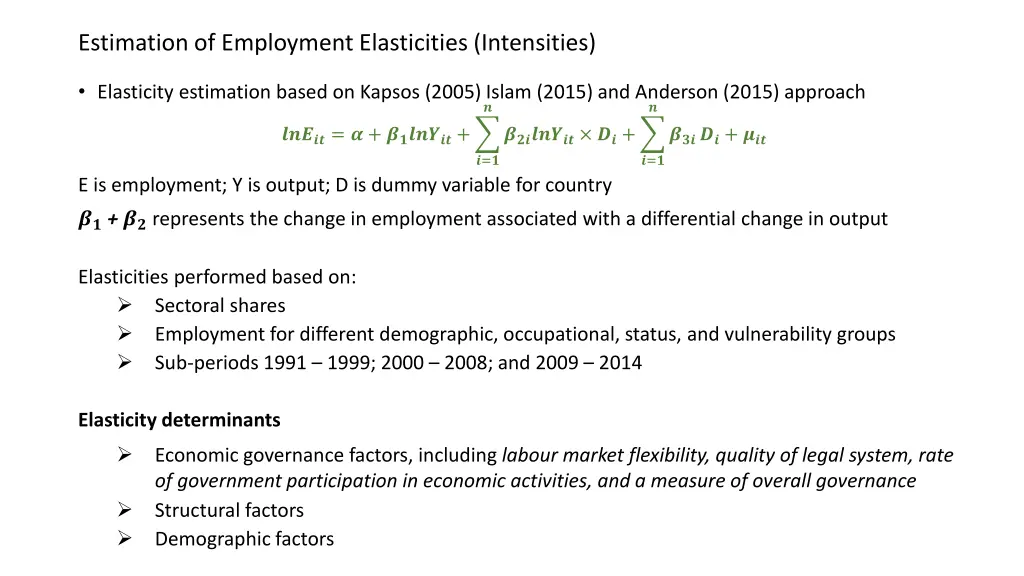
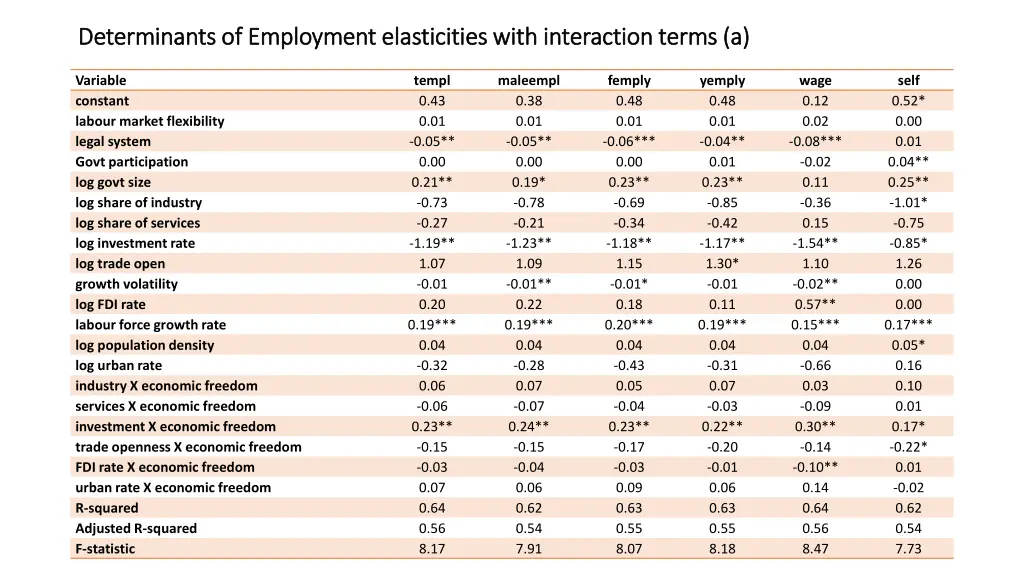
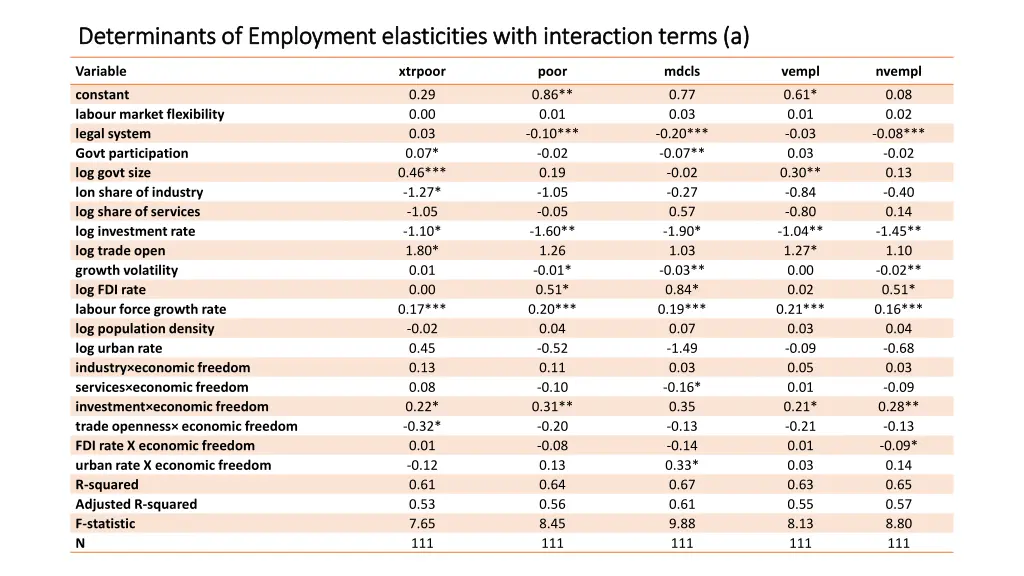
Estimation of Employment Elasticities (Intensities) Elasticity estimation based on Kapsos (2005) Islam (2015) and Anderson (2015) approach ? ? ?????= ? + ???????+ ???????? ??+ ?????+ ??? ?=? ?=? E is employment; Y is output; D is dummy variable for country ?? + ??represents the change in employment associated with a differential change in output Elasticities performed based on: Sectoral shares Employment for different demographic, occupational, status, and vulnerability groups Sub-periods 1991 1999; 2000 2008; and 2009 2014 Elasticity determinants Economic governance factors, including labour market flexibility, quality of legal system, rate of government participation in economic activities, and a measure of overall governance Structural factors Demographic factors
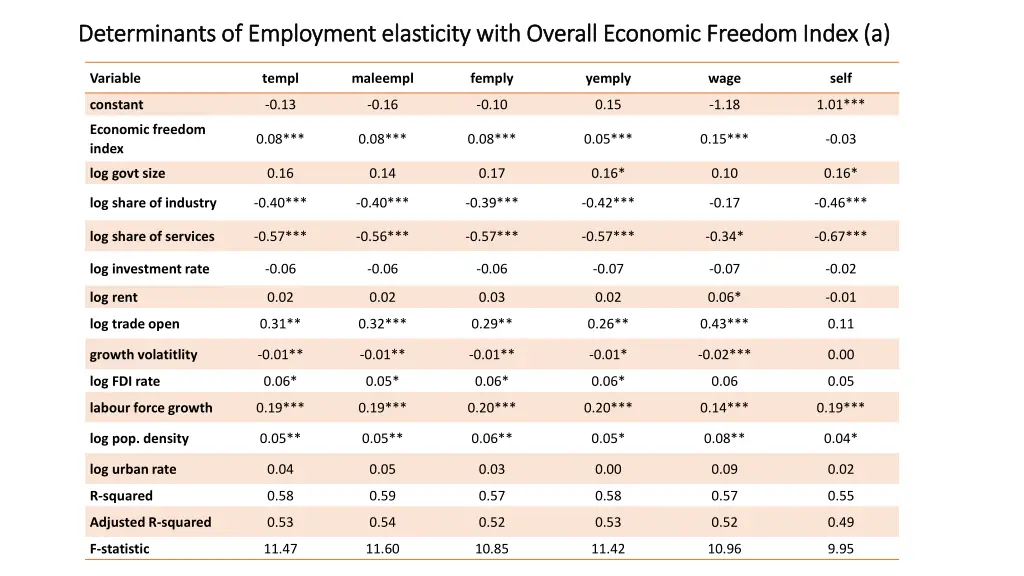
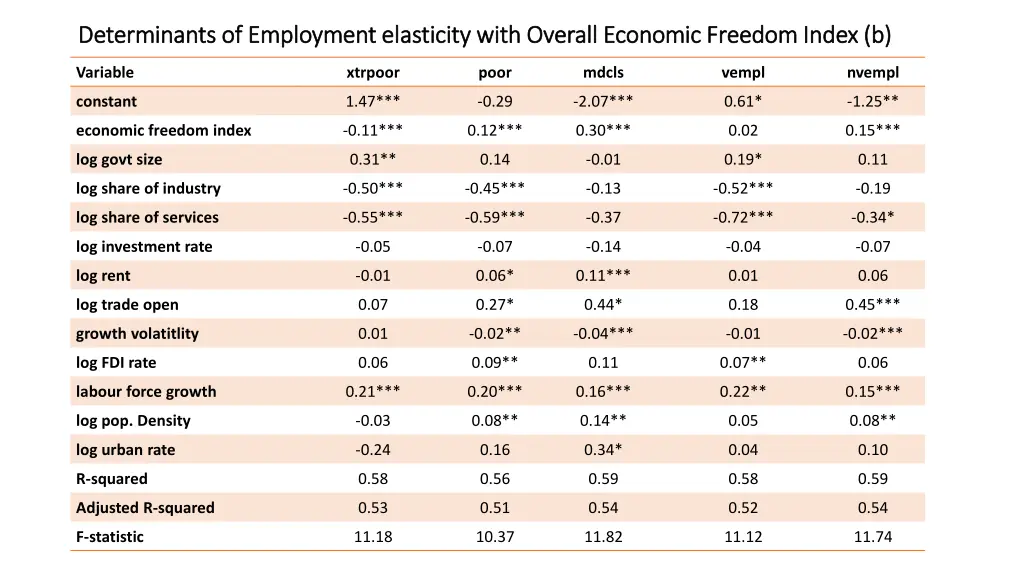
Estimation Procedures Estimation Procedures Due to the endogeneity between employment and output, the elasticity equations are estimated using an instrumental variable technique. In particular, the Two Stage Least Squares technique is adopted for the estimation and the first lag of output is used as instrument in the estimation. In estimating determinants of elasticity of employment the Feasible Generalised Least Squares estimation technique (FGLS) is better suited to produce unbiased and consistent estimation. The estimations used data for 37 sub-Saharan Africa countries for the period 2000 to 2014 based on data availability
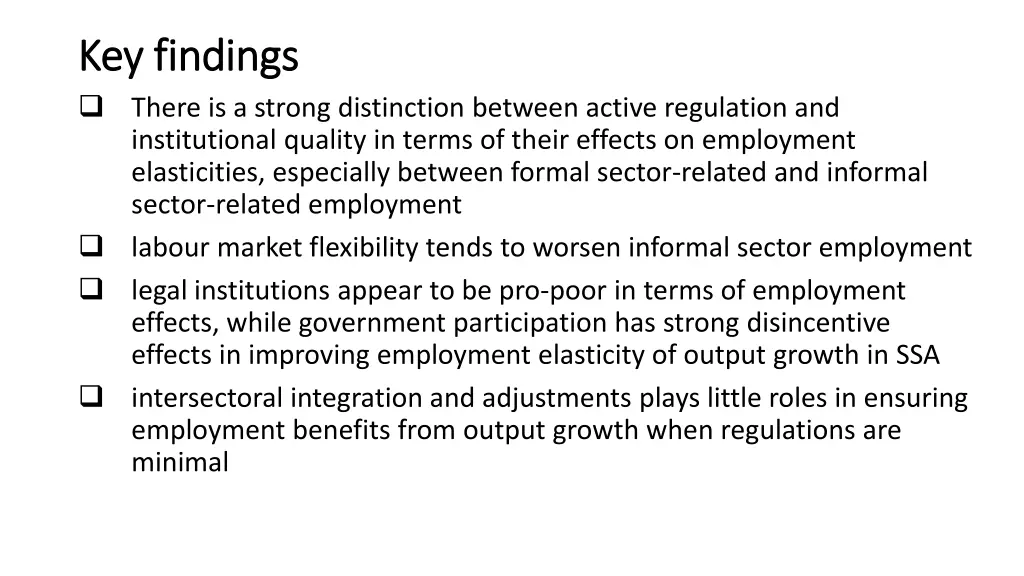
Key findings Key findings There is a strong distinction between active regulation and institutional quality in terms of their effects on employment elasticities, especially between formal sector-related and informal sector-related employment labour market flexibility tends to worsen informal sector employment legal institutions appear to be pro-poor in terms of employment effects, while government participation has strong disincentive effects in improving employment elasticity of output growth in SSA intersectoral integration and adjustments plays little roles in ensuring employment benefits from output growth when regulations are minimal
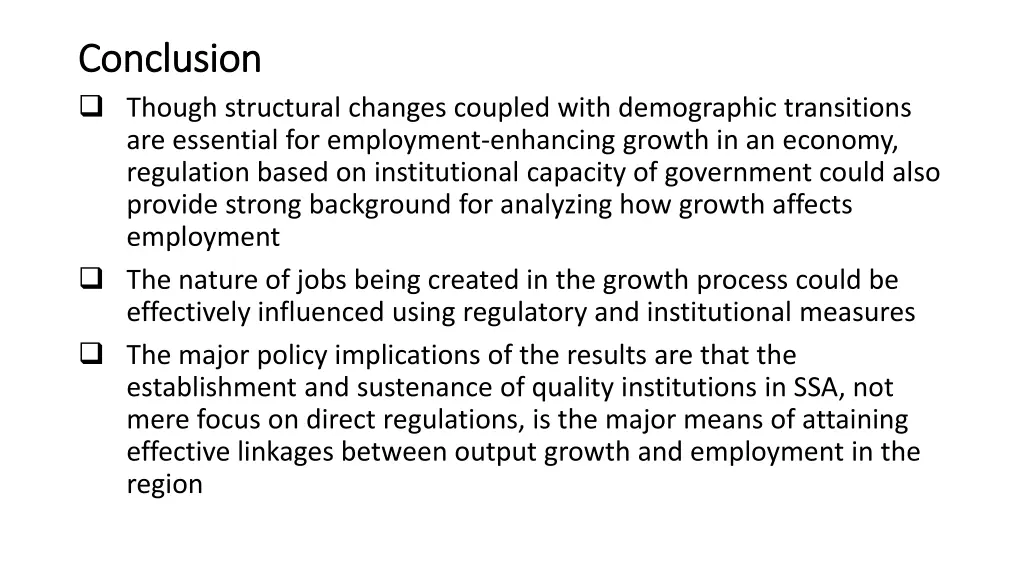
Conclusion Conclusion Though structural changes coupled with demographic transitions are essential for employment-enhancing growth in an economy, regulation based on institutional capacity of government could also provide strong background for analyzing how growth affects employment The nature of jobs being created in the growth process could be effectively influenced using regulatory and institutional measures The major policy implications of the results are that the establishment and sustenance of quality institutions in SSA, not mere focus on direct regulations, is the major means of attaining effective linkages between output growth and employment in the region
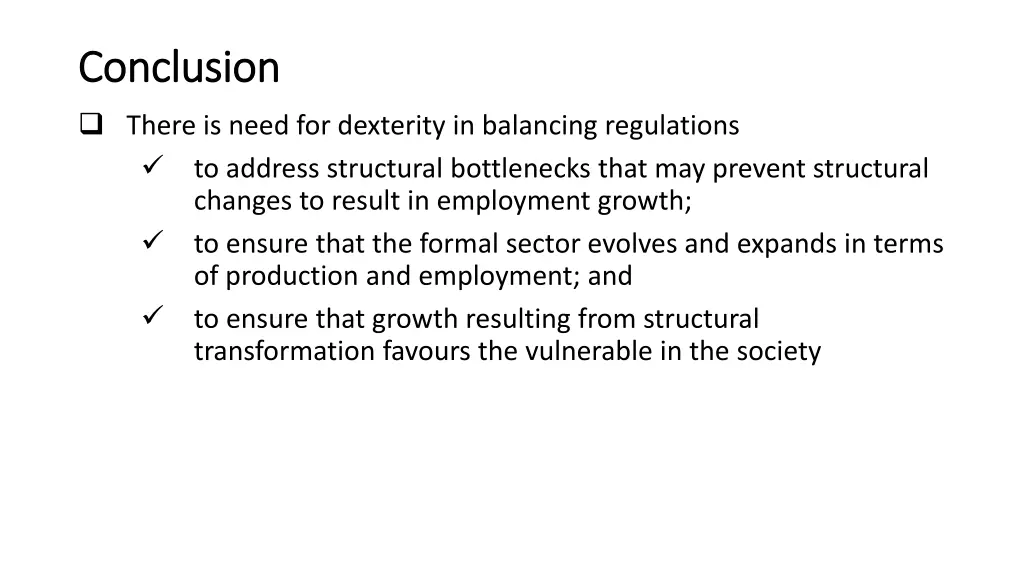
Conclusion Conclusion There is need for dexterity in balancing regulations to address structural bottlenecks that may prevent structural changes to result in employment growth; to ensure that the formal sector evolves and expands in terms of production and employment; and to ensure that growth resulting from structural transformation favours the vulnerable in the society