Explore the economics of higher education through human capital theory, signalling theory, and the impact of education on earnings. Delve into evidence of returns to higher education in the UK, cohort effects, and related research to gain insight into the economic implications of pursuing higher education.
Please find below an Image/Link to download the presentation.
The content on the website is provided AS IS for your information and personal use only. It may not be sold, licensed, or shared on other websites without obtaining consent from the author. If you encounter any issues during the download, it is possible that the publisher has removed the file from their server.
You are allowed to download the files provided on this website for personal or commercial use, subject to the condition that they are used lawfully. All files are the property of their respective owners.
The content on the website is provided AS IS for your information and personal use only. It may not be sold, licensed, or shared on other websites without obtaining consent from the author.
E N D
Presentation Transcript
EC326 Topics in Applied Economics 2b Topic 2: Economics of Higher Education Robin Naylor EC236: Economics of HE, 2014-15 1
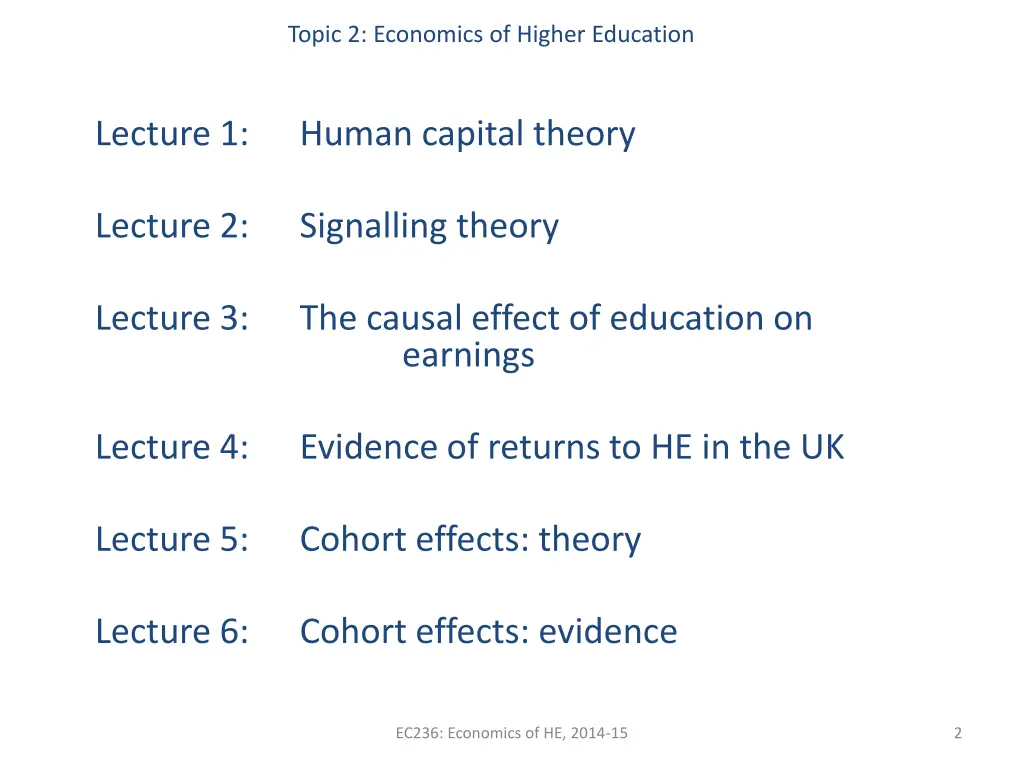
Topic 2: Economics of Higher Education Lecture 1: Human capital theory Lecture 2: Signalling theory Lecture 3: The causal effect of education on earnings Lecture 4: Evidence of returns to HE in the UK Lecture 5: Cohort effects: theory Lecture 6: Cohort effects: evidence EC236: Economics of HE, 2014-15 2
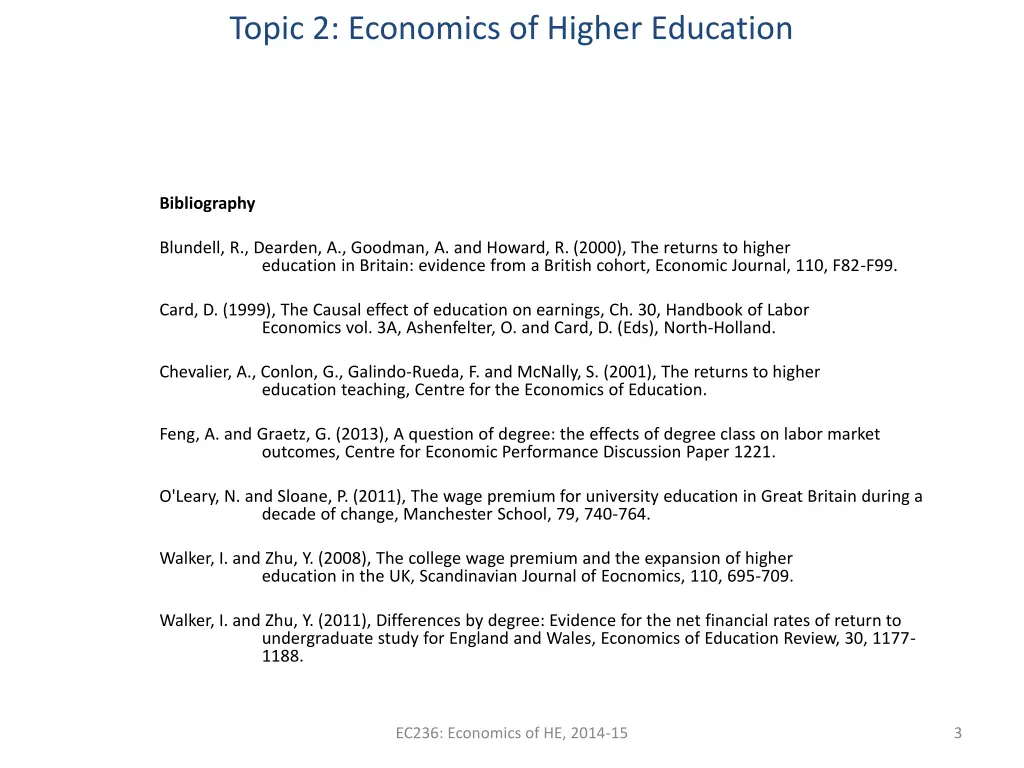
Topic 2: Economics of Higher Education Bibliography Blundell, R., Dearden, A., Goodman, A. and Howard, R. (2000), The returns to higher education in Britain: evidence from a British cohort, Economic Journal, 110, F82-F99. Card, D. (1999), The Causal effect of education on earnings, Ch. 30, Handbook of Labor Economics vol. 3A, Ashenfelter, O. and Card, D. (Eds), North-Holland. Chevalier, A., Conlon, G., Galindo-Rueda, F. and McNally, S. (2001), The returns to higher education teaching, Centre for the Economics of Education. Feng, A. and Graetz, G. (2013), A question of degree: the effects of degree class on labor market outcomes, Centre for Economic Performance Discussion Paper 1221. O'Leary, N. and Sloane, P. (2011), The wage premium for university education in Great Britain during a decade of change, Manchester School, 79, 740-764. Walker, I. and Zhu, Y. (2008), The college wage premium and the expansion of higher education in the UK, Scandinavian Journal of Eocnomics, 110, 695-709. Walker, I. and Zhu, Y. (2011), Differences by degree: Evidence for the net financial rates of return to undergraduate study for England and Wales, Economics of Education Review, 30, 1177- 1188. EC236: Economics of HE, 2014-15 3
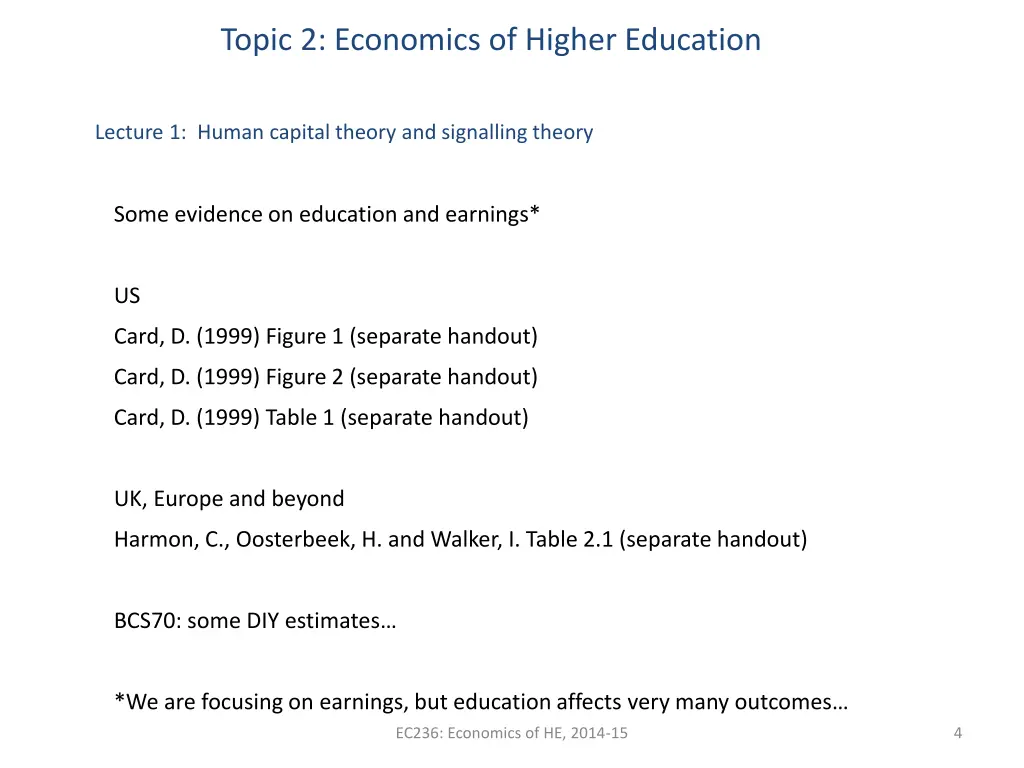
Topic 2: Economics of Higher Education Lecture 1: Human capital theory and signalling theory Some evidence on education and earnings* US Card, D. (1999) Figure 1 (separate handout) Card, D. (1999) Figure 2 (separate handout) Card, D. (1999) Table 1 (separate handout) UK, Europe and beyond Harmon, C., Oosterbeek, H. and Walker, I. Table 2.1 (separate handout) BCS70: some DIY estimates *We are focusing on earnings, but education affects very many outcomes EC236: Economics of HE, 2014-15 4
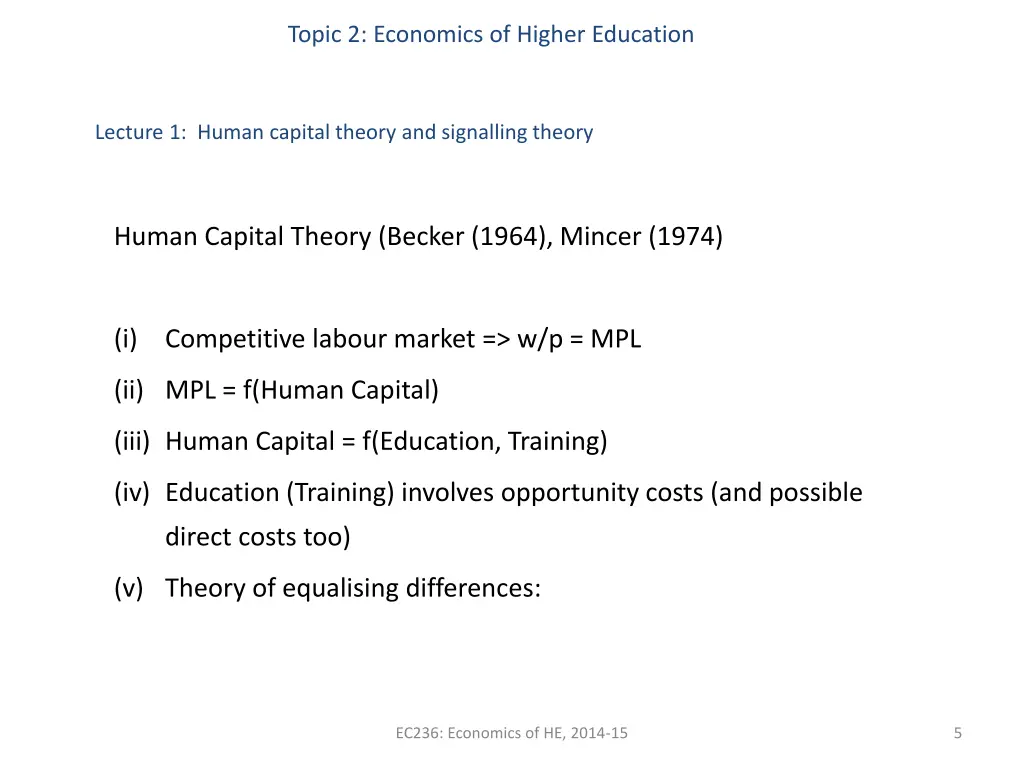
Topic 2: Economics of Higher Education Lecture 1: Human capital theory and signalling theory Human Capital Theory (Becker (1964), Mincer (1974) (i) Competitive labour market => w/p = MPL (ii) MPL = f(Human Capital) (iii) Human Capital = f(Education, Training) (iv) Education (Training) involves opportunity costs (and possible direct costs too) (v) Theory of equalising differences: EC236: Economics of HE, 2014-15 5
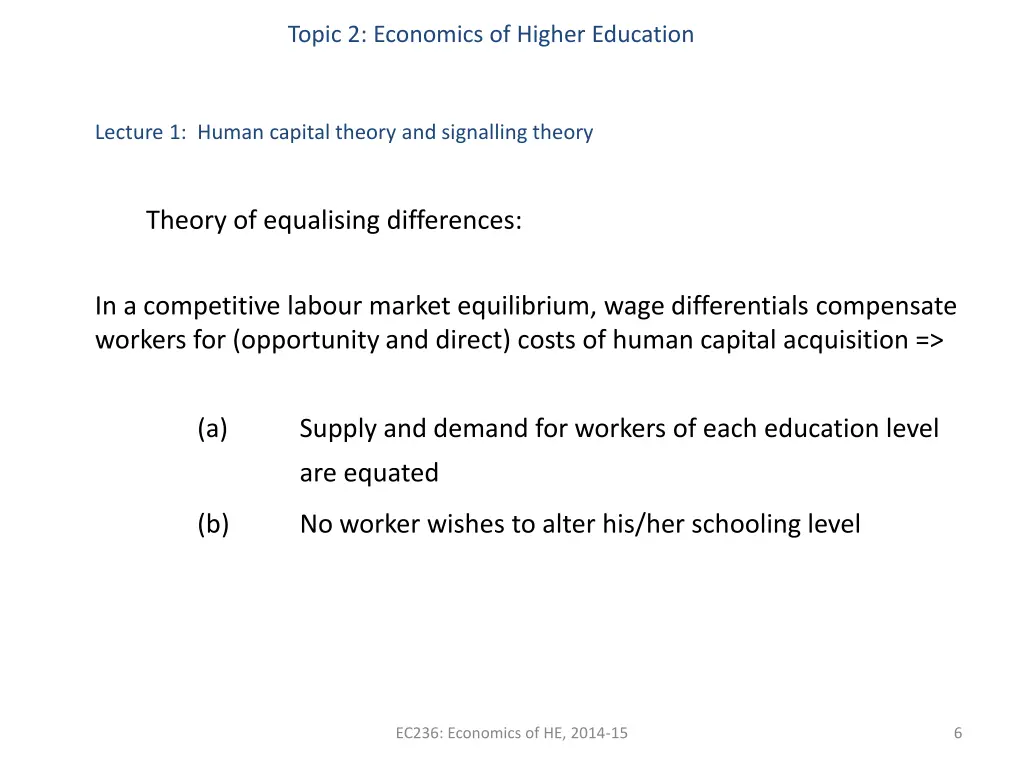
Topic 2: Economics of Higher Education Lecture 1: Human capital theory and signalling theory Theory of equalising differences: In a competitive labour market equilibrium, wage differentials compensate workers for (opportunity and direct) costs of human capital acquisition => (a) Supply and demand for workers of each education level are equated (b) No worker wishes to alter his/her schooling level EC236: Economics of HE, 2014-15 6
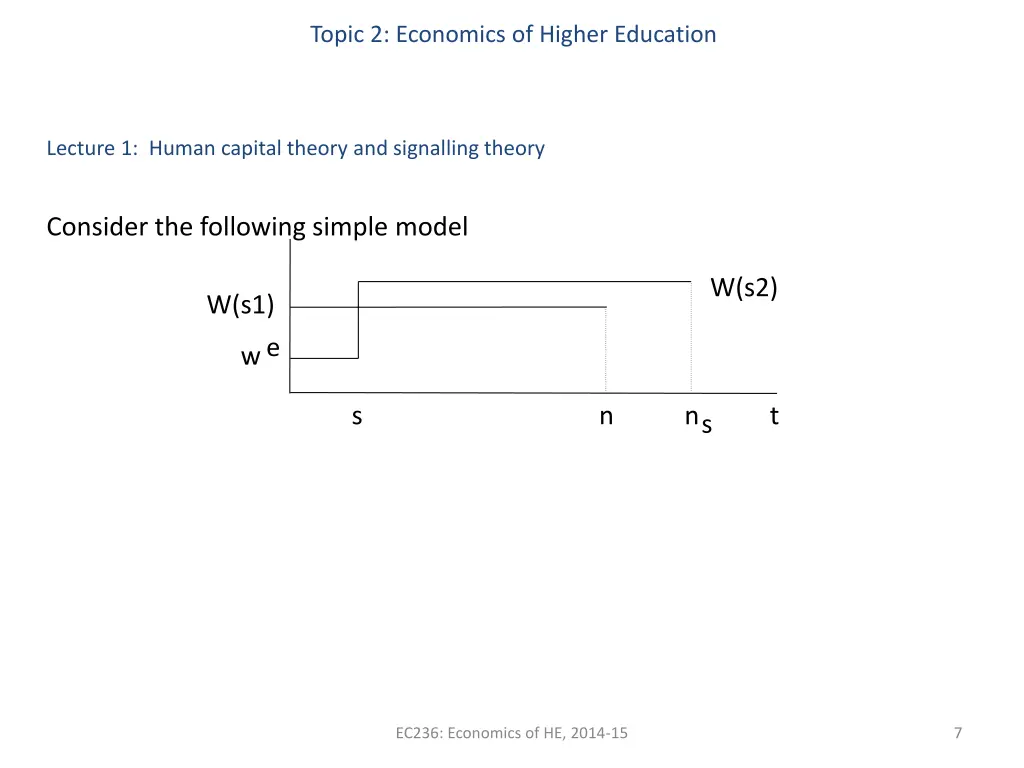
Topic 2: Economics of Higher Education Lecture 1: Human capital theory and signalling theory Consider the following simple model W(s2) W(s1) we s n ns t EC236: Economics of HE, 2014-15 7
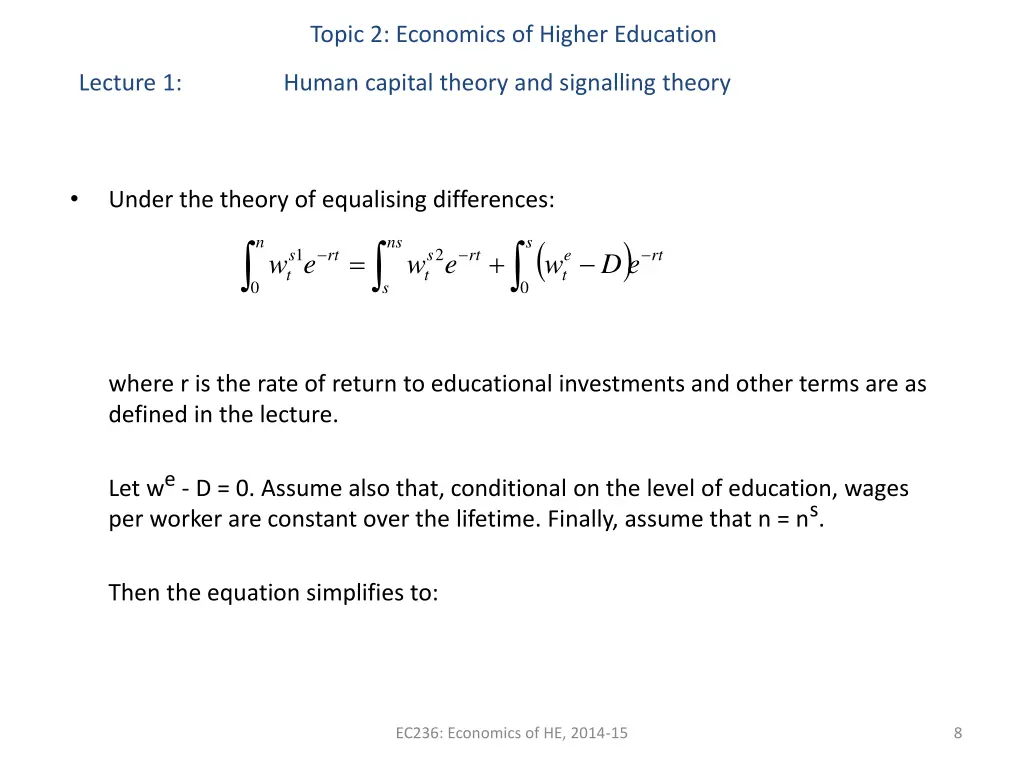
Topic 2: Economics of Higher Education Lecture 1: Human capital theory and signalling theory Under the theory of equalising differences: 0 ( ) e n ns s = + 1 2 s t rt s t rt e t rt w e w e w D 0 s where r is the rate of return to educational investments and other terms are as defined in the lecture. Let we - D = 0. Assume also that, conditional on the level of education, wages per worker are constant over the lifetime. Finally, assume that n = ns. Then the equation simplifies to: EC236: Economics of HE, 2014-15 8
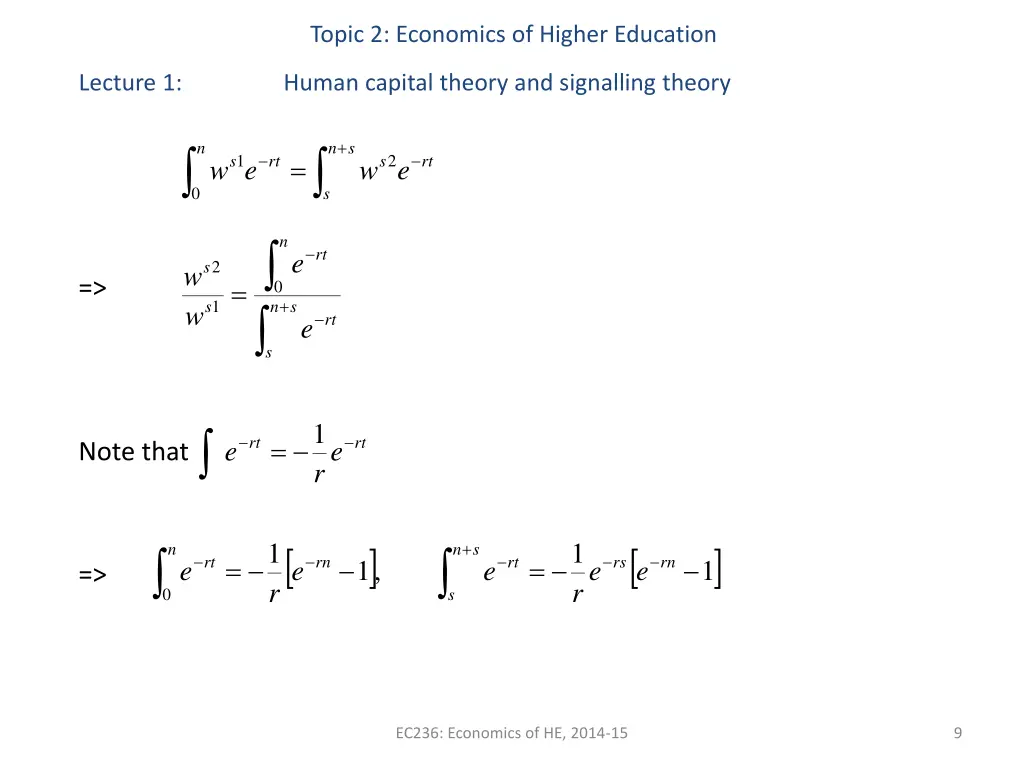
Topic 2: Economics of Higher Education Lecture 1: Human capital theory and signalling theory + n n s = 1 2 s rt s rt w e w e 0 s n n rt e 2 s w = => 0 + 1 s s w rt e s 1 = rt rt e e Note that r , 1 1 r 1 + n n s 0 = = rt rn rt rs rn 1 e e e e e => r s EC236: Economics of HE, 2014-15 9
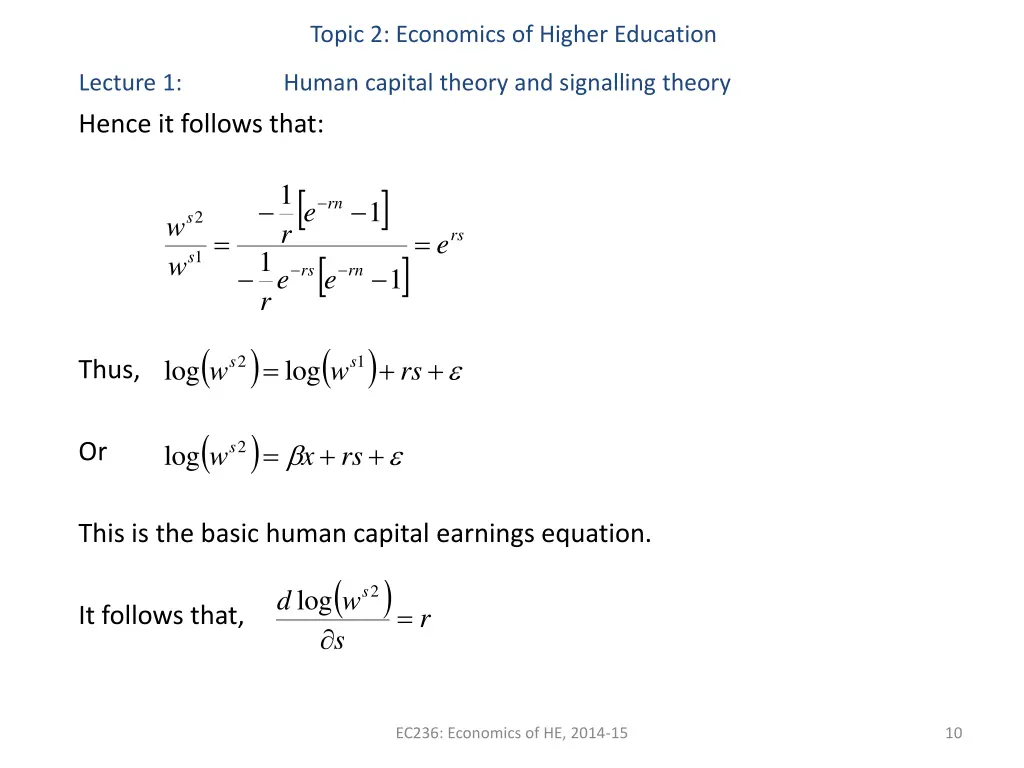
Topic 2: Economics of Higher Education Lecture 1: Human capital theory and signalling theory Hence it follows that: 1 rn 1 e 2 s w r = = rs e 1 1 s w rs rn 1 e e r ( ) ( ) = + + 2 1 s s log log w w rs Thus, ( ) = + + ws2 Or log x rs This is the basic human capital earnings equation. ( s ) 2 s log d w = r It follows that, EC236: Economics of HE, 2014-15 10
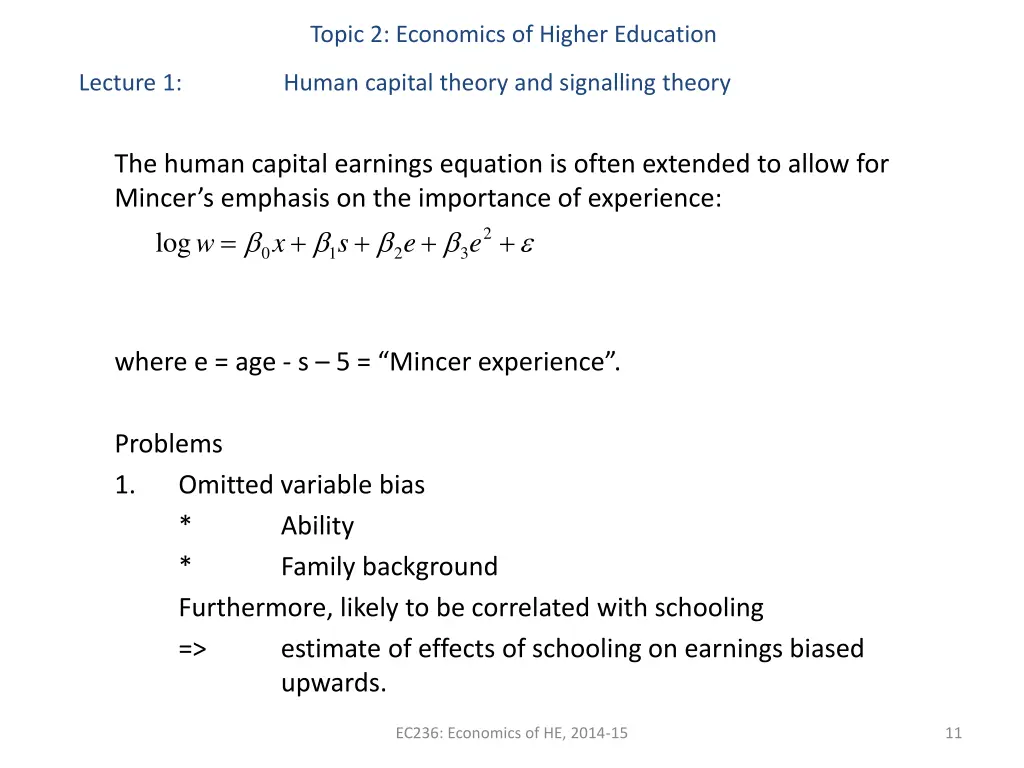
Topic 2: Economics of Higher Education Lecture 1: Human capital theory and signalling theory The human capital earnings equation is often extended to allow for Mincer s emphasis on the importance of experience: + + + + = 3 2 1 0 log e e s x w 2 where e = age - s 5 = Mincer experience . Problems 1. Omitted variable bias * Ability * Family background Furthermore, likely to be correlated with schooling => estimate of effects of schooling on earnings biased upwards. EC236: Economics of HE, 2014-15 11
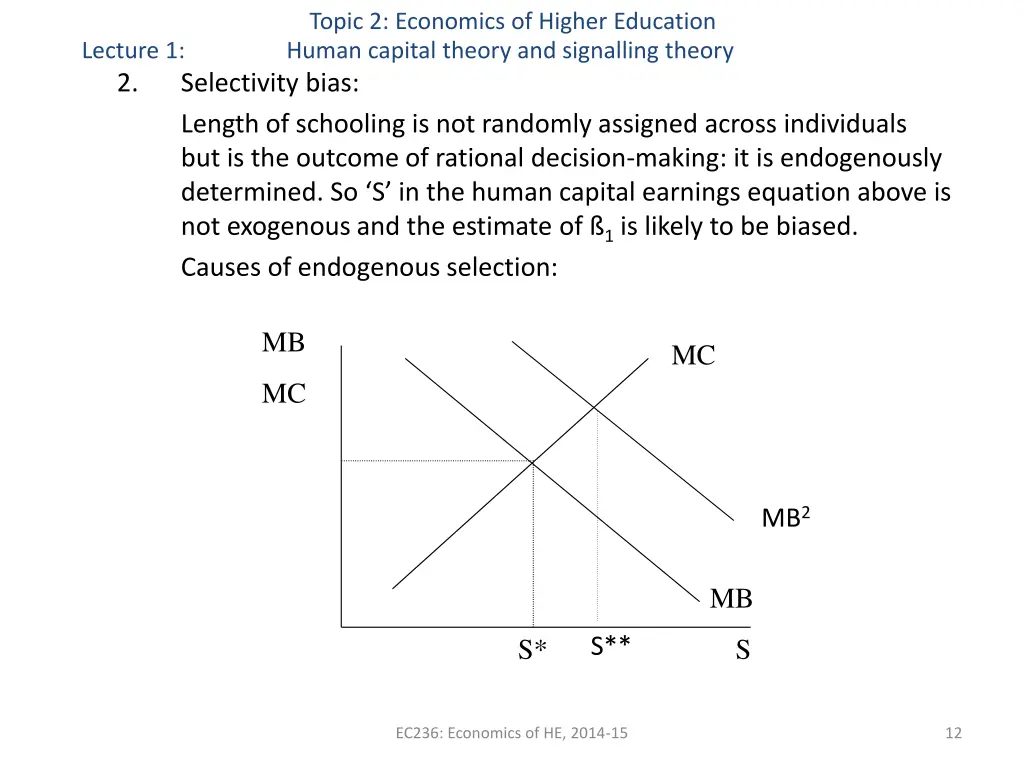
Topic 2: Economics of Higher Education Human capital theory and signalling theory Lecture 1: 2. Selectivity bias: Length of schooling is not randomly assigned across individuals but is the outcome of rational decision-making: it is endogenously determined. So S in the human capital earnings equation above is not exogenous and the estimate of 1 is likely to be biased. Causes of endogenous selection: MB MC MC MB2 MB S* S S** EC236: Economics of HE, 2014-15 12
Topic 2: Economics of Higher Education Lecture 1: Human capital theory and signalling theory Why might MB shift up to the right? Family background Alternatively, why might MC shift down to the right? Family background (access to capital) Ability From your lecture notes in either EC226 or EC203, you will have seen that OLS yields biased or inconsistent estimates if a relevant RHS variable is either omitted or is endogenous. You will also have seen that the use of Instrumental Variables is one possible way around this. You should check your EC226/203 notes on this material. In our context, an IV would be a variable which is correlated with schooling but which does not exert an independent effect on earnings. EC236: Economics of HE, 2014-15 13
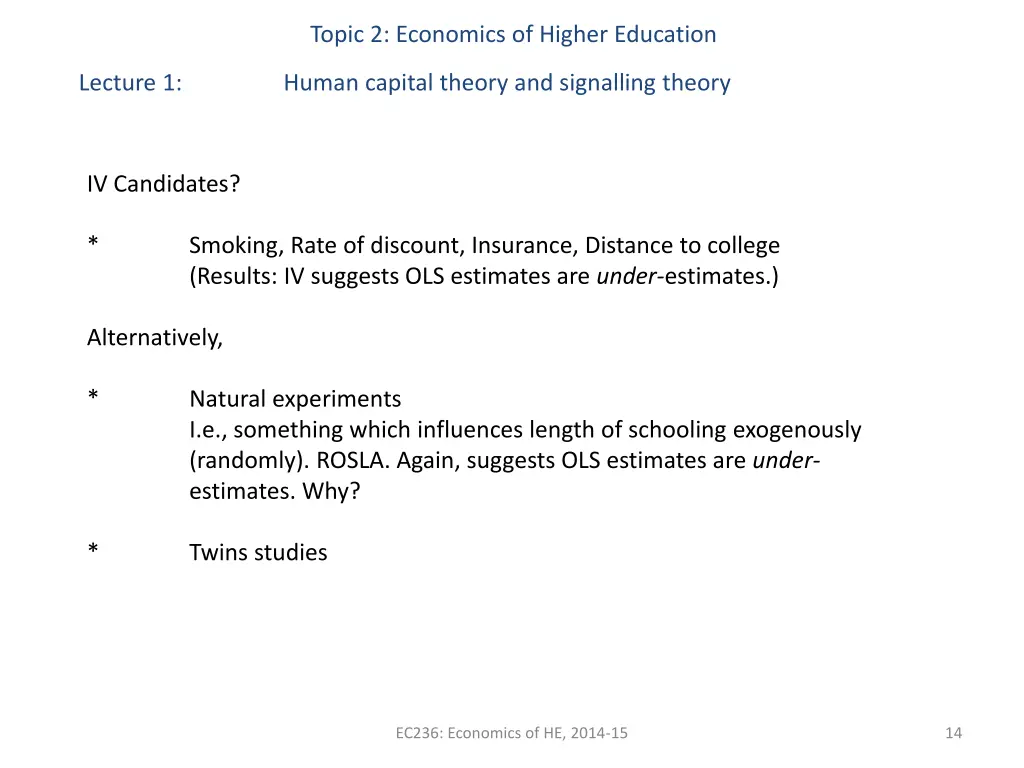
Topic 2: Economics of Higher Education Lecture 1: Human capital theory and signalling theory IV Candidates? * Smoking, Rate of discount, Insurance, Distance to college (Results: IV suggests OLS estimates are under-estimates.) Alternatively, * Natural experiments I.e., something which influences length of schooling exogenously (randomly). ROSLA. Again, suggests OLS estimates are under- estimates. Why? * Twins studies EC236: Economics of HE, 2014-15 14
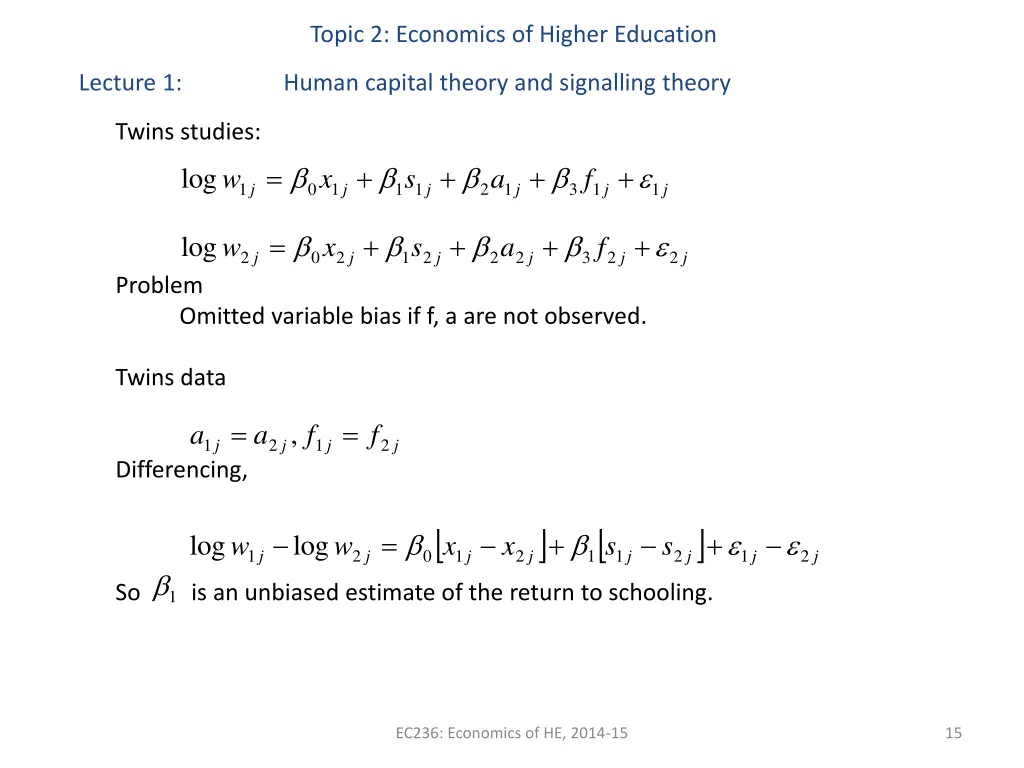
Topic 2: Economics of Higher Education Lecture 1: Human capital theory and signalling theory Twins studies: = + + + + log w x s a f 1 0 1 1 1 2 1 3 1 1 j j j j j j = + + + + log w x s a f 2 0 2 1 2 2 2 3 2 2 j j j j j j Problem Omitted variable bias if f, a are not observed. Twins data = = , a a f f 1 2 1 2 j j j j Differencing, = + + log log w w x x s s 1 2 0 1 2 1 1 2 1 2 j j j j j j j j So is an unbiased estimate of the return to schooling. 1 EC236: Economics of HE, 2014-15 15
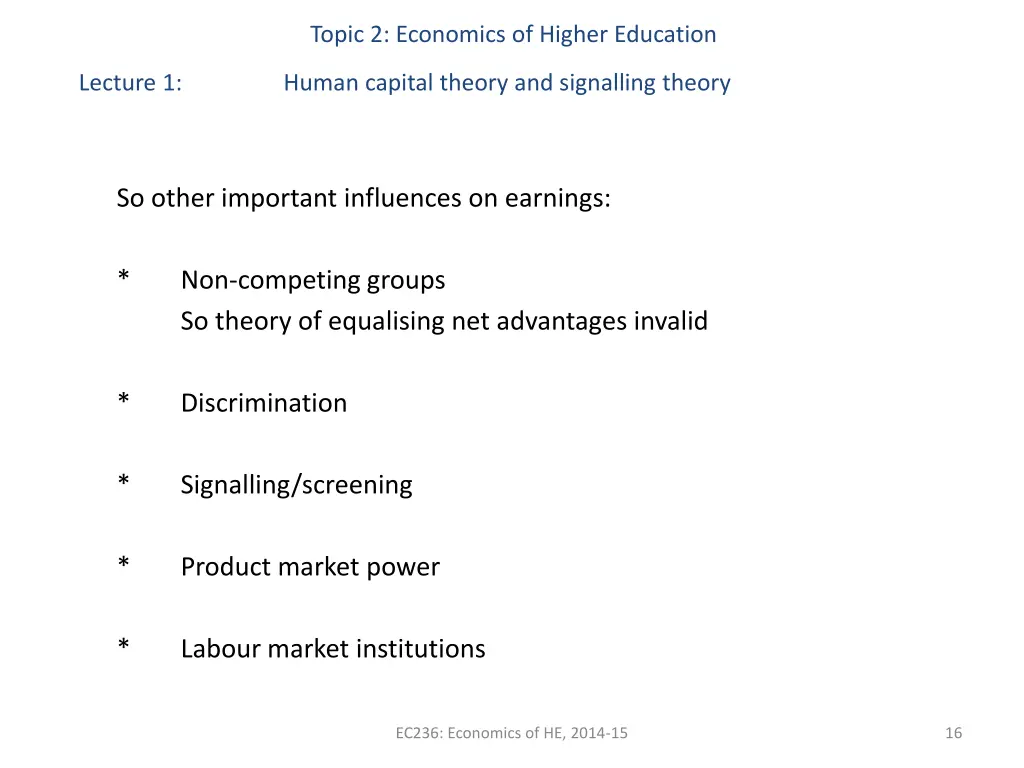
Topic 2: Economics of Higher Education Lecture 1: Human capital theory and signalling theory So other important influences on earnings: * Non-competing groups So theory of equalising net advantages invalid * Discrimination * Signalling/screening * Product market power * Labour market institutions EC236: Economics of HE, 2014-15 16
Topic 2: Economics of Higher Education Lecture 2: Signalling Theory Spence, QJE, 1973 Phelps, AER, 1972 Arrow, Theory f Discrimination, 1973 EC236: Economics of HE, 2014-15 17
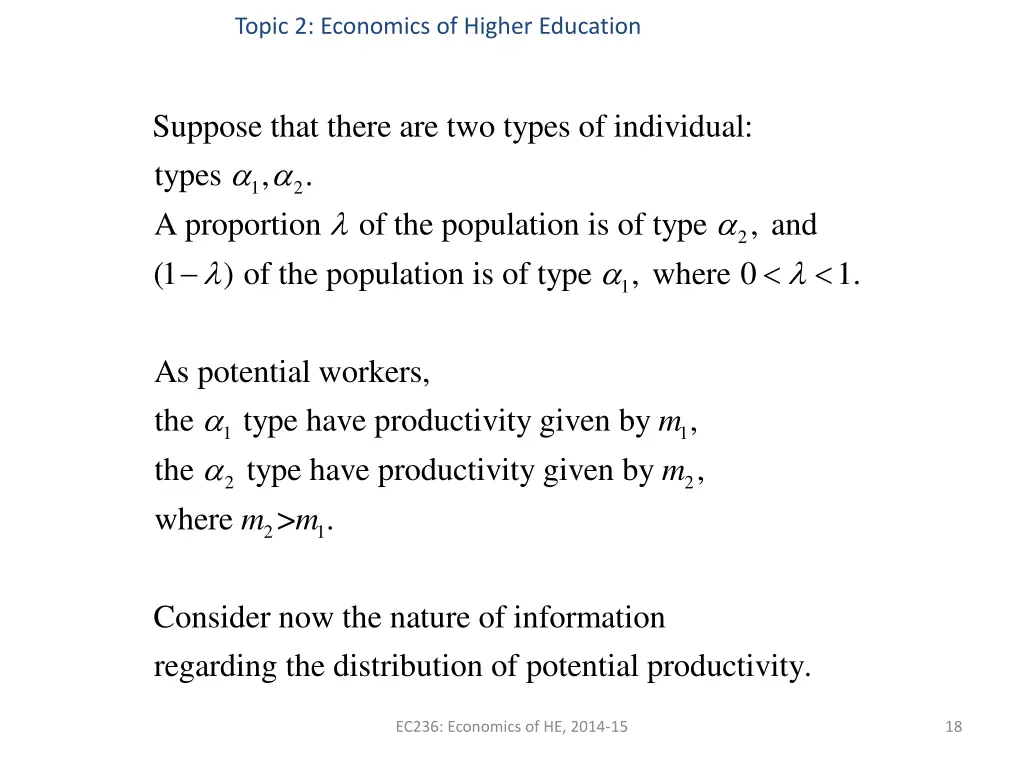
Topic 2: Economics of Higher Education Suppose that there are two types of individual: types , . A proportion of the population is of type (1 ) of the population is of type 1 2 , and 2 , where 0 1. 1 As potential workers, the type have the type have productivity given by where > . m m productivity given by , m m 1 1 , 2 2 2 1 Consider now the nature of information regarding the distribution of potential productivity. EC236: Economics of HE, 2014-15 18
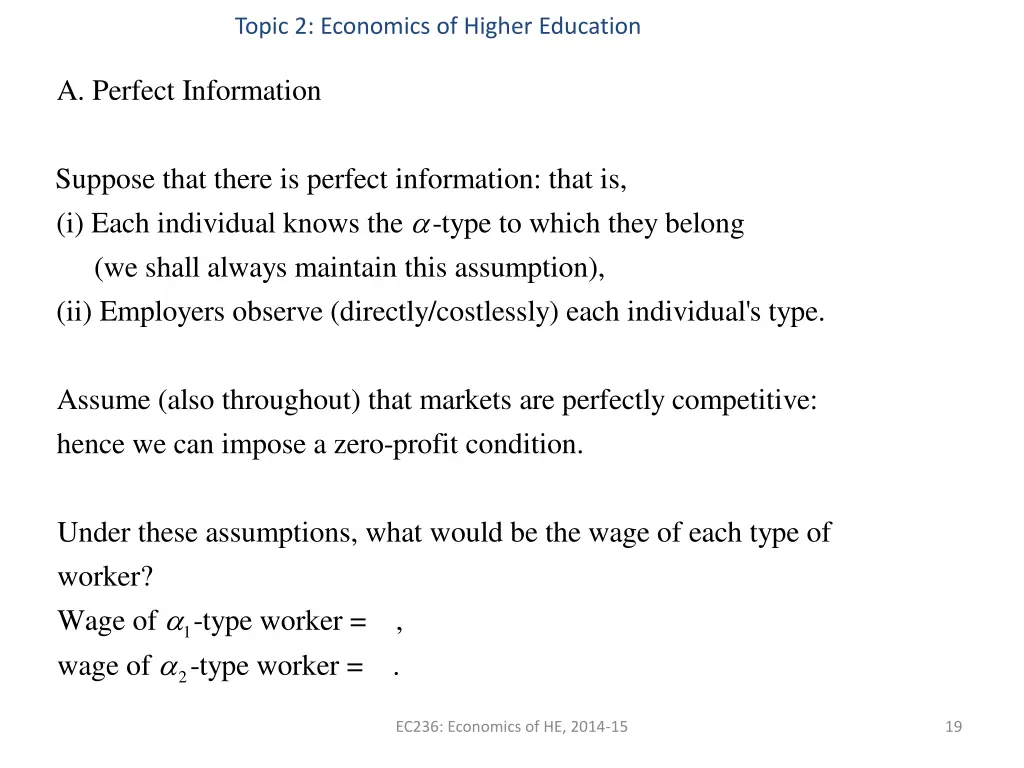
Topic 2: Economics of Higher Education A. Perfect Information Suppose that there is perfect information: that is, (i) Each individual knows the -type to which they belong (we shall always maintain this assumption), (ii) Employers observe (directly/costlessly) each individual's type. Assume (also throughout) that markets are perfectly competitive: hence we can impose a zero-profit condition. Under these assumptions, what would be the wag worker? Wage of -type worker = , wage of -type worker = . e of each type of 1 2 EC236: Economics of HE, 2014-15 19
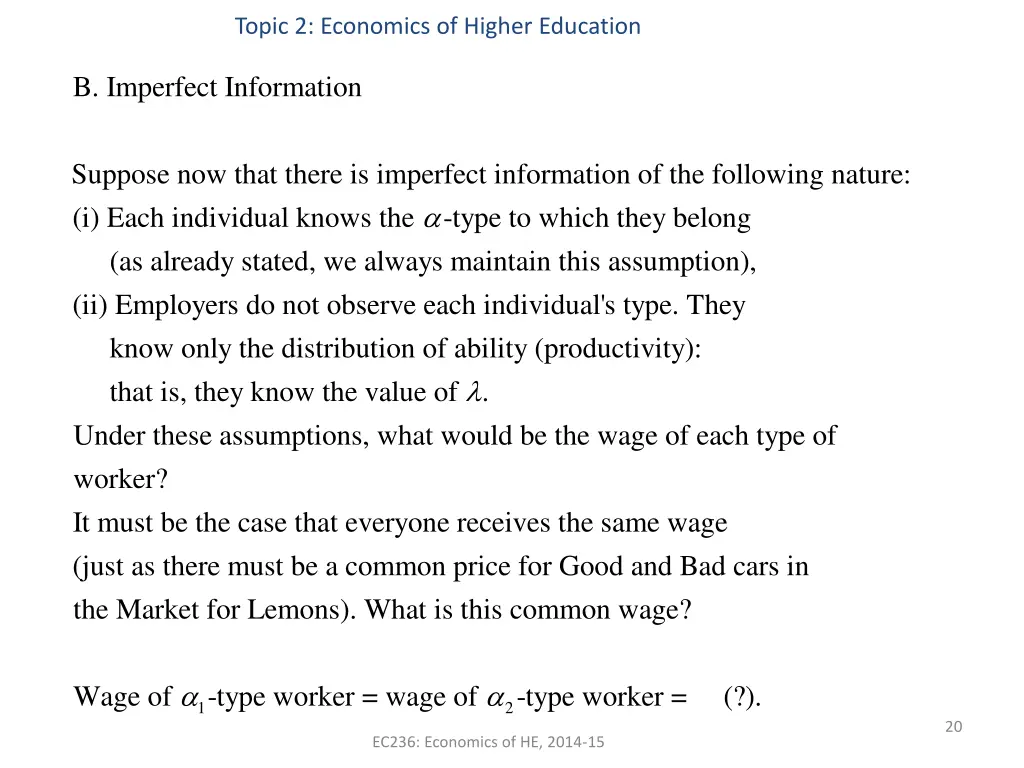
Topic 2: Economics of Higher Education B. Imperfect Information Suppose now that there is imperfect information of the following nature: (i) Each individual knows the -type to which they belong (as already stated, we always maintain thi (ii) Employers do not observe each individual's type. They know only the distribution of ability (productivity): that is, they know the value of . Under these assumptions, what w ould be the wage of each type of worker? It must be the case that everyone receives the same wage (just as there must be a common price for Good and Bad cars in the Market for Lemons). What is this common s assumption), wage? Wage of -type worker = wage of -type worker = (?). 1 2 20 EC236: Economics of HE, 2014-15
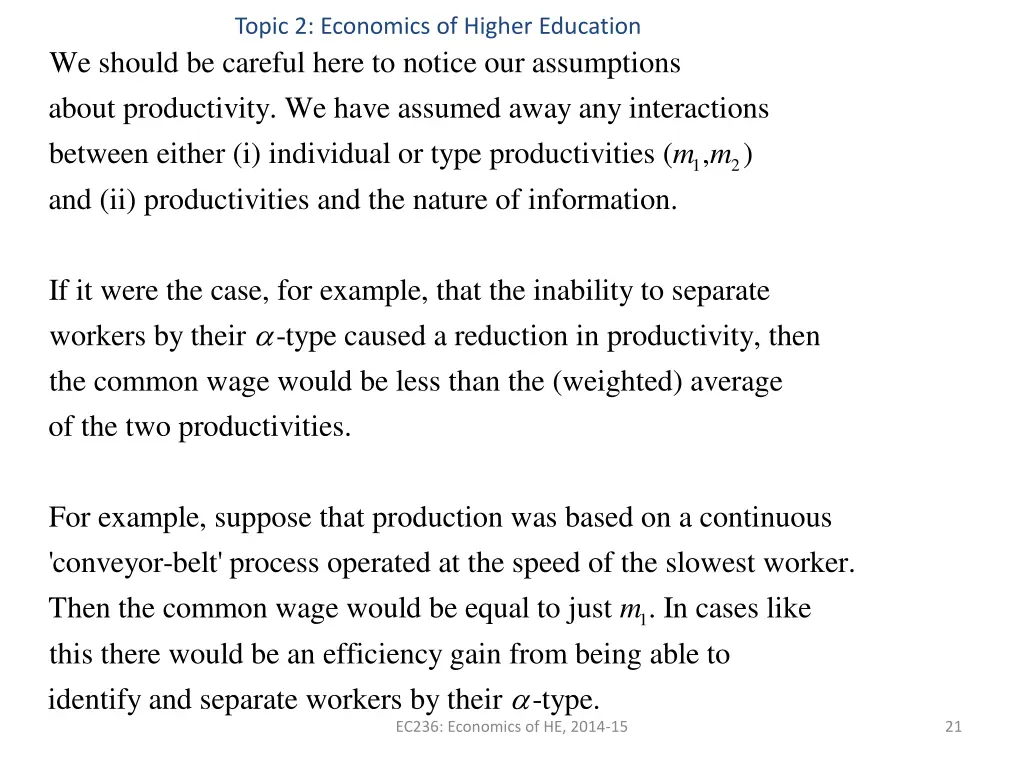
Topic 2: Economics of Higher Education We should be careful here to notice our assumptions about productivity. We have assumed away any interactions between either (i) individual or type productivities ( and (ii) productivities and the nature of information. , ) m m 1 2 If it were the case, for example, that the inability to separate workers by their -type caused a reduction in productivity, then the common wage would be less than the (weighted) of the two productivities. average For example, suppose that production was based on a continuous 'conveyor-belt' process operated at the speed of the slowest worker. Then the common wage would be equal this there would be an efficiency gain from being able to identify and separate workers by their -type. to just . In cases like m 1 EC236: Economics of HE, 2014-15 21
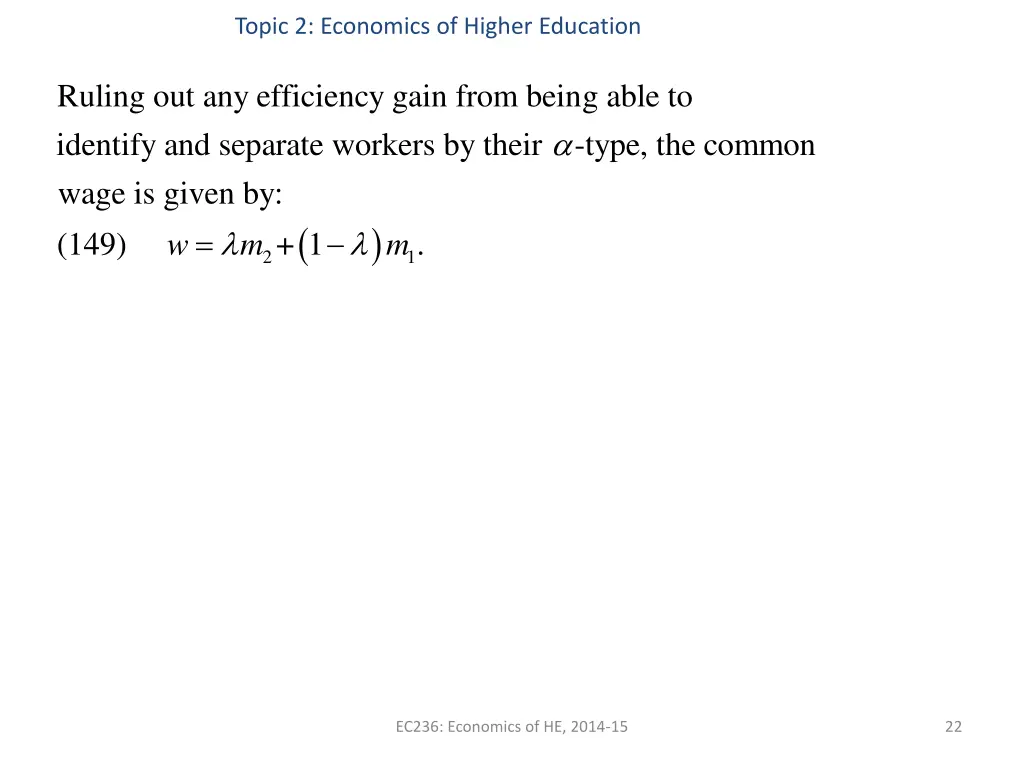
Topic 2: Economics of Higher Education Ruling out any efficiency gain from being able to identify and separate workers by their -type, the common wage is given by: (149) + 1 . w m m = ( ) 2 1 EC236: Economics of HE, 2014-15 22
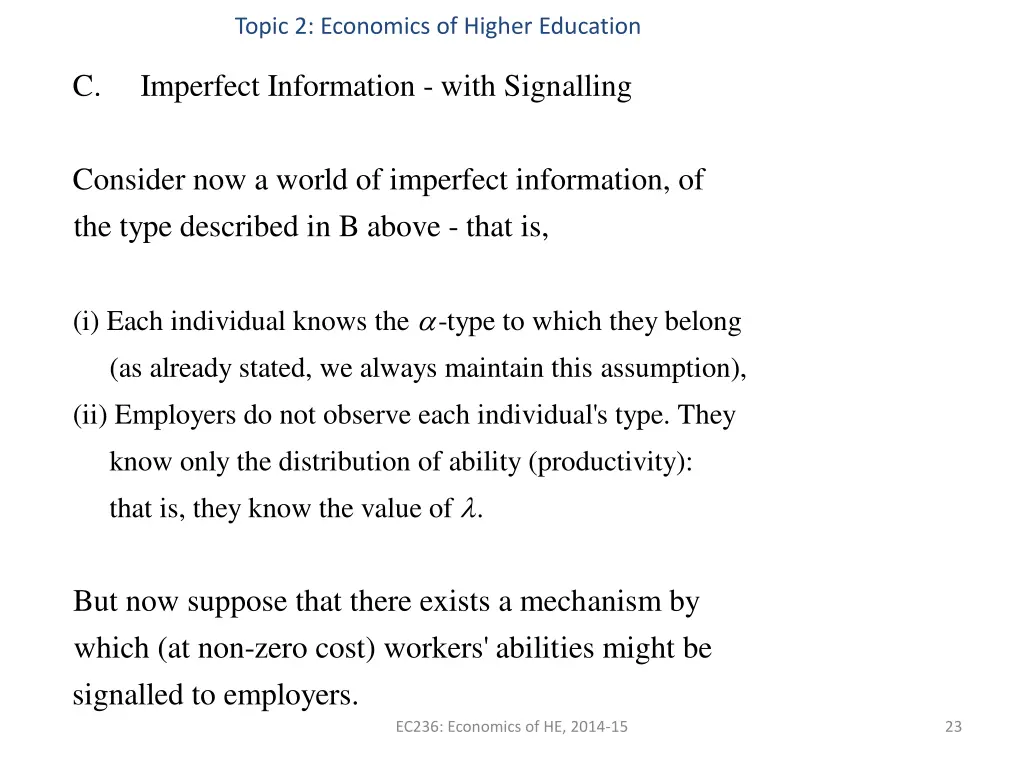
Topic 2: Economics of Higher Education C. Imperfect Information - with Signalling Consider now a world of imperfect information, of the type described in B above - that is, (i) Each individual knows the -type to which they belong (as already stated, we always maintain this assumption), (ii) Employers do not observe each individual's type. They know only the distribution of ability (productivity): that is, they know the value of . But now suppose that there exists a mechanism by which (at non-zero cost) workers' abilities might be signalled to employers. EC236: Economics of HE, 2014-15 23
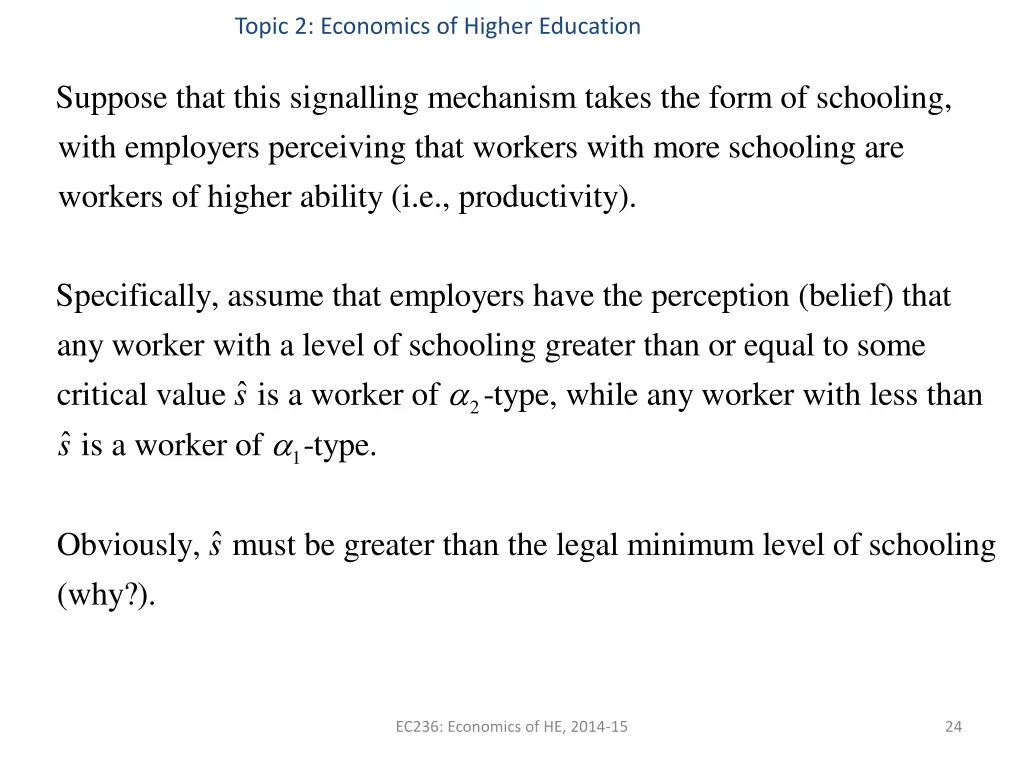
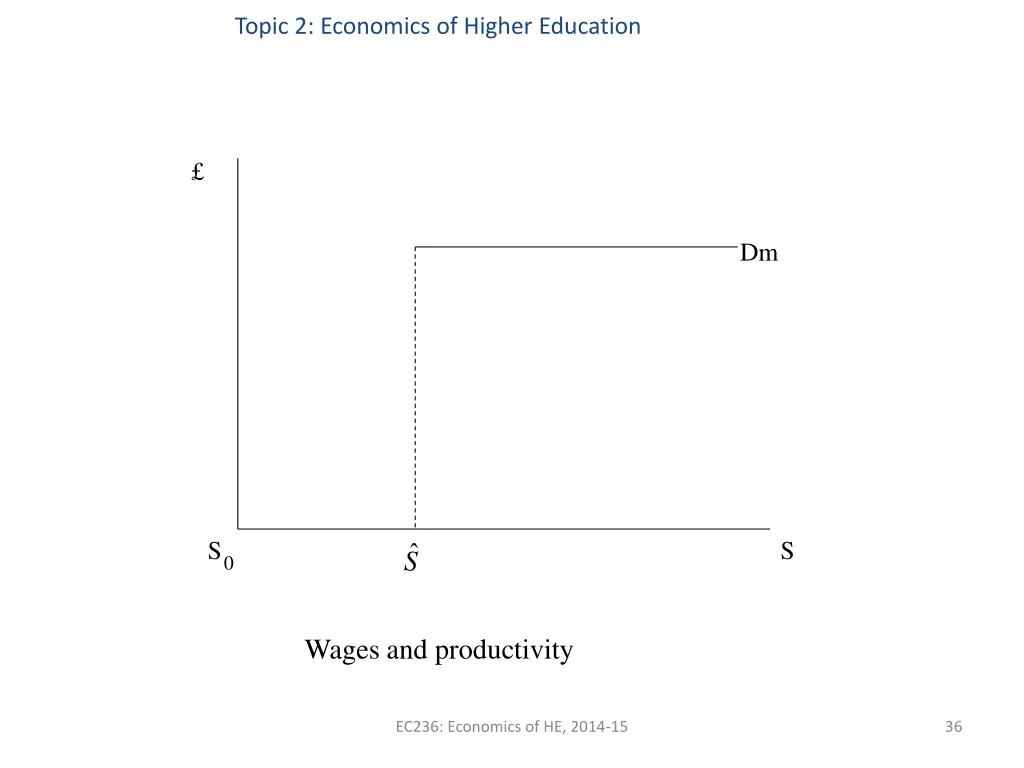
Topic 2: Economics of Higher Education Suppose that this signalling mechanism takes the form of schooling, with employers perceiving that workers with more schooling are workers of higher ability (i.e., productivity). Specifically, assume th any worker with a level of schooling greater than or equal to some critical value is a worker of -type, while any worker with less than is a worker s 1 of -type. at employers have the perception (belief) that s 2 s Obviously, must be greater than the legal minimum level of schooling (why?). EC236: Economics of HE, 2014-15 24
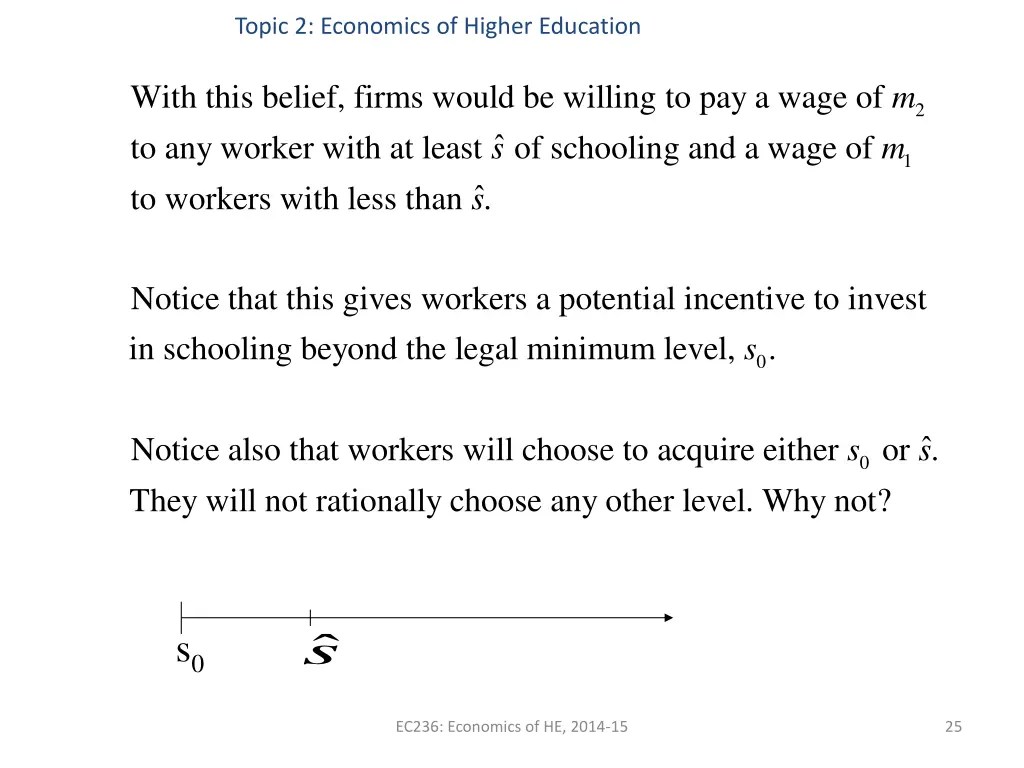
Topic 2: Economics of Higher Education With this belief, firms would be willing to pay a wage of to any worker with at least of schooling and a wage of to workers with less than . s m m 2 s 1 Notice that this gives workers a potential incentiv in schooling beyond the legal minimum level, . e to invest s 0 s Notice also that workers will choose to acquire either or . They will not rationally choose any other level. Why not? s 0 s0 s EC236: Economics of HE, 2014-15 25
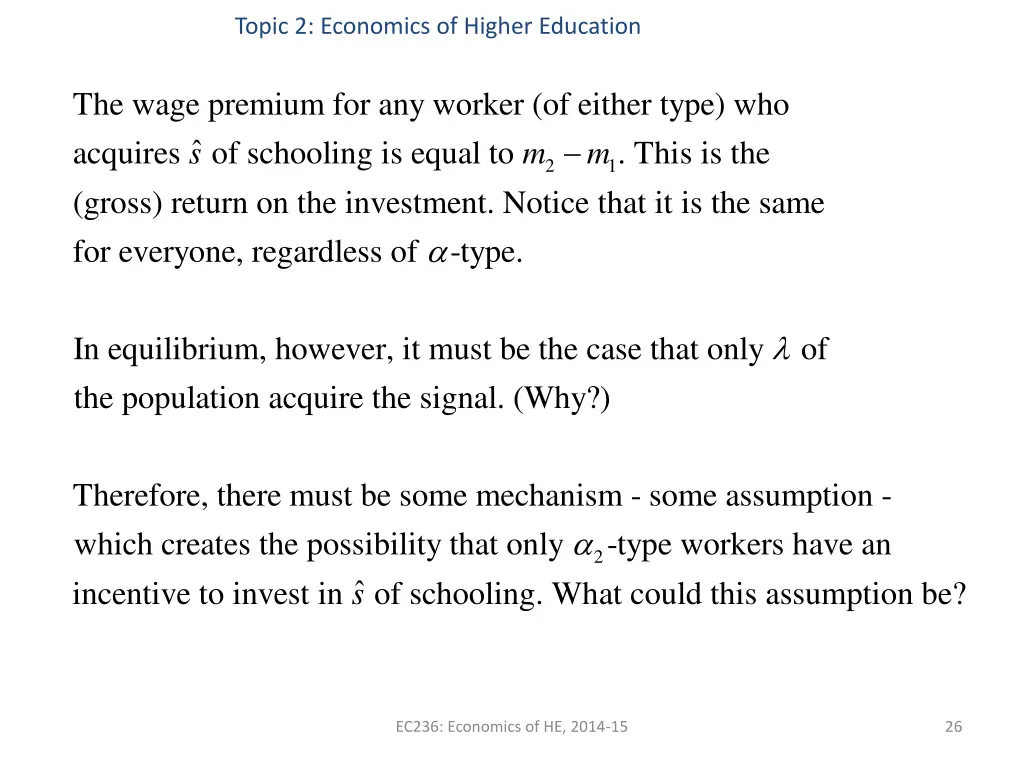
Topic 2: Economics of Higher Education The wage premium for any worker (of either type) who acquires of schooling is equal to (gross) return on the investment. Notice that it is the same for everyone, regardless of -ty . This is the s m m 2 1 pe. In equilibrium, however, it must be the case that only of the population acquire the signal. (Why?) Therefore, there must be some mechanism - some assumption - which creates the possibility that on incentive to invest in of schooling. What could this assumption be? s ly -type workers have an 2 EC236: Economics of HE, 2014-15 26
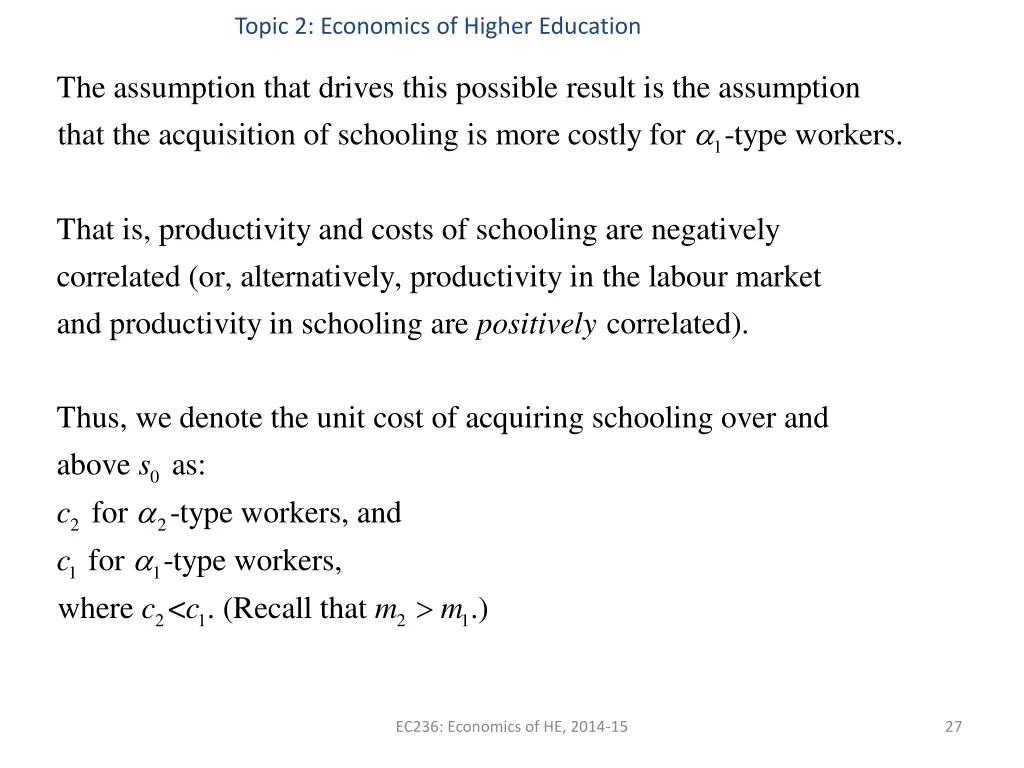
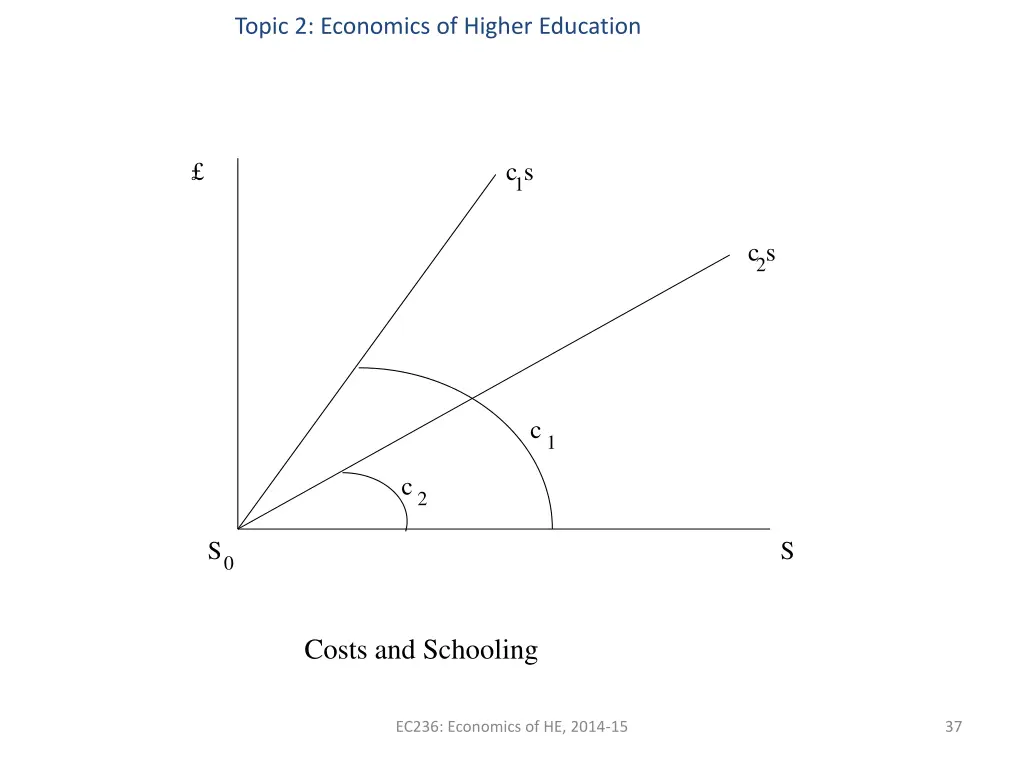
Topic 2: Economics of Higher Education The assumption that drives this possible result is the assumption that the acquisition of schooling is more costly for -type workers. 1 That is, productivity and costs of schooling are negatively correla ted (or, alternatively, productivity in the labour market and productivity in schooling are correlated). positively Thus, we denote the unit cost of acquiring schooling over and above as: for -ty c pe workers, and for -type workers, where < . (Recall that c c m m s 0 2 2 c 1 1 .) 2 1 2 1 EC236: Economics of HE, 2014-15 27
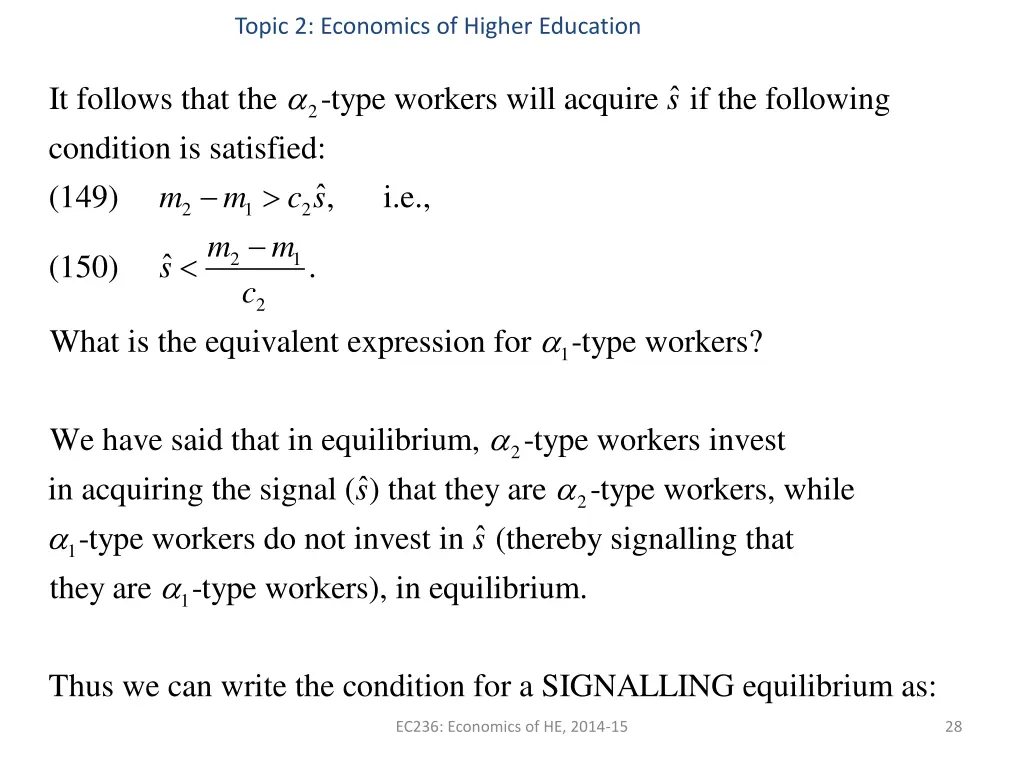
Topic 2: Economics of Higher Education s It follows that the condition is satisfied: (149) m -type workers will acquire if the following 2 , i.e., m c s m 2 1 2 m s (150) . 2 1 c 2 What is the equivalent expression for -type workers? 1 We in acquiring the signal ( ) that they are -type workers do not invest in (thereby signalling that they are -type wo rkers), in equilibrium. have said that in equilibrium, -type workers invest -type workers, while 2 s 2 s 1 1 Thus we can write the condition for a SIGNALLING equilibrium as: EC236: Economics of HE, 2014-15 28
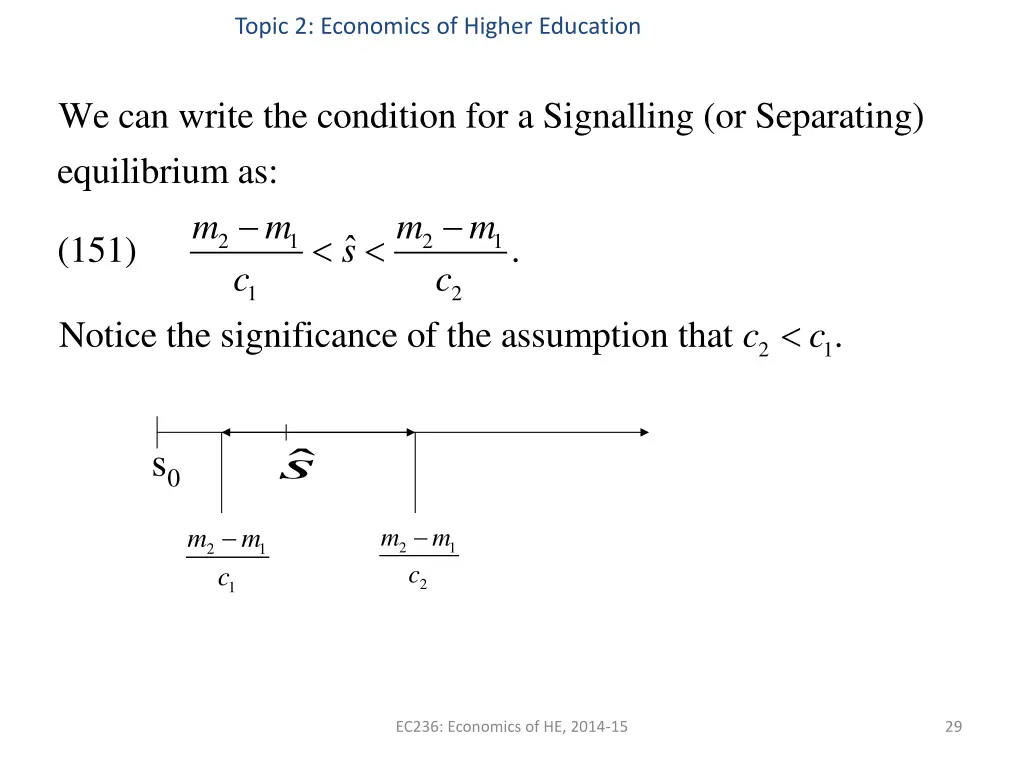
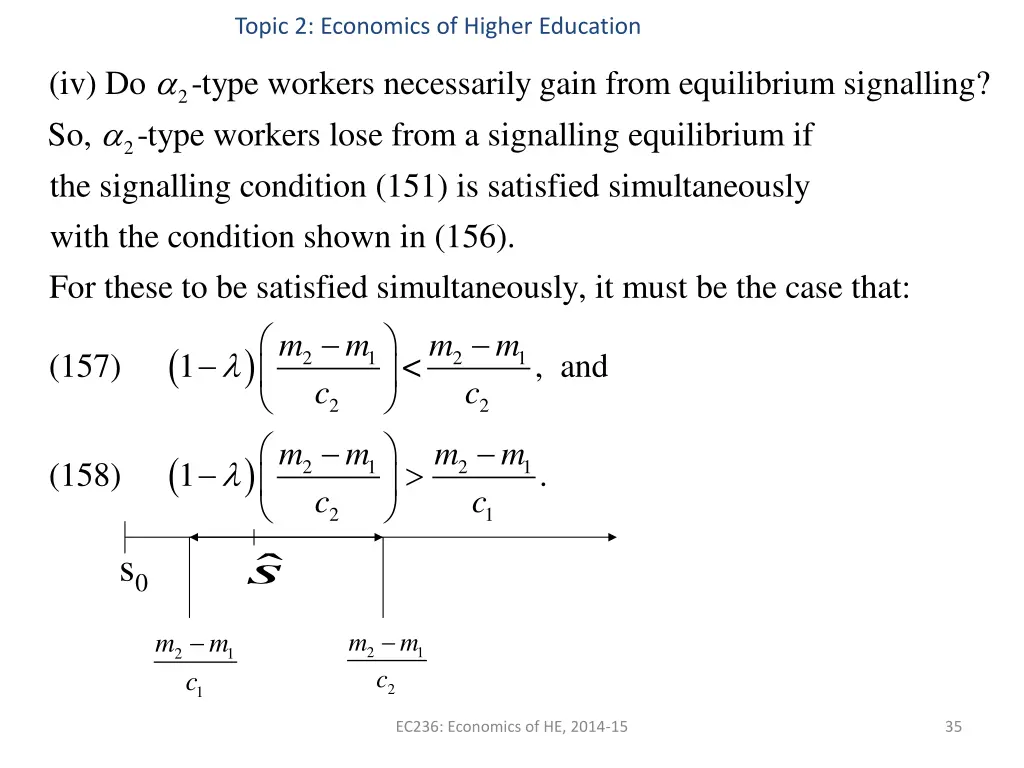
Topic 2: Economics of Higher Education We can write the condition for a Signalling (or Separating) equilibrium as: m m m m s c c (151) . 2 1 2 1 1 2 Notice the significance of the assumption that . c c 2 1 s0 s m m m m 2 1 2 1 c c 2 1 EC236: Economics of HE, 2014-15 29
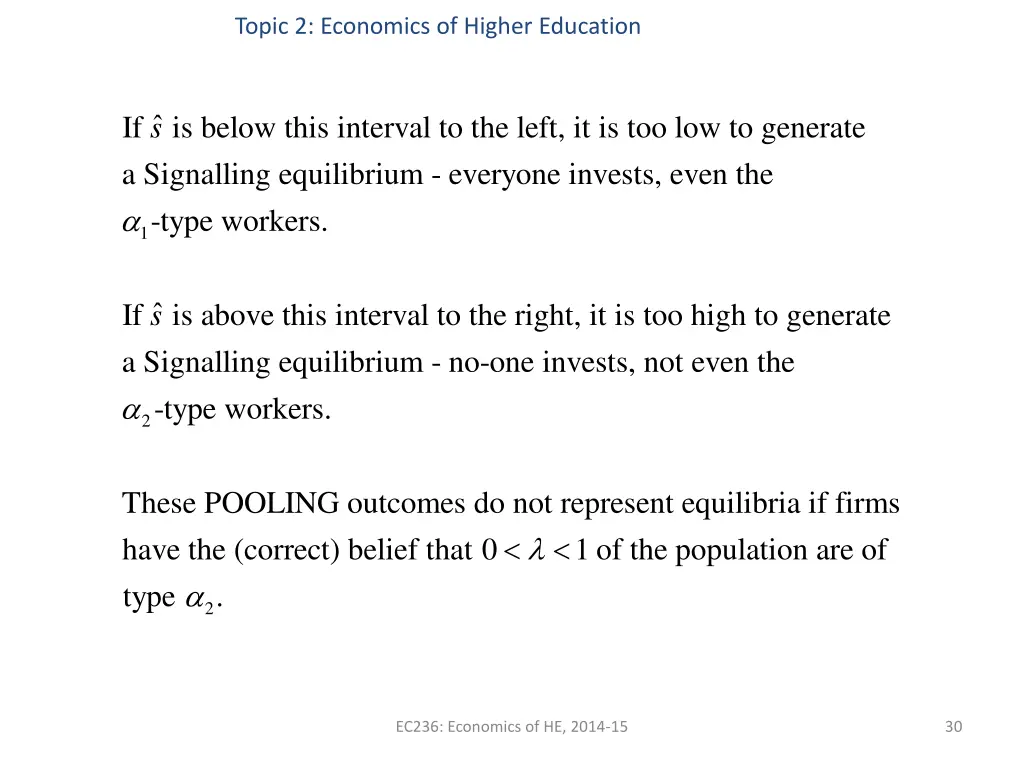
Topic 2: Economics of Higher Education s If is below this interval to the left, it is too low to generate a Signalling equilibrium - everyone invests, even the -type workers. If is above this interval to the right, it is too high to g s a Signalling equilibrium - no-one invests, not even the -type workers. 1 enerate 2 These POOLING outcomes do not represent equilibria if firms have the (correct) belief that 0 ty 2 pe . 1 of the population are of EC236: Economics of HE, 2014-15 30
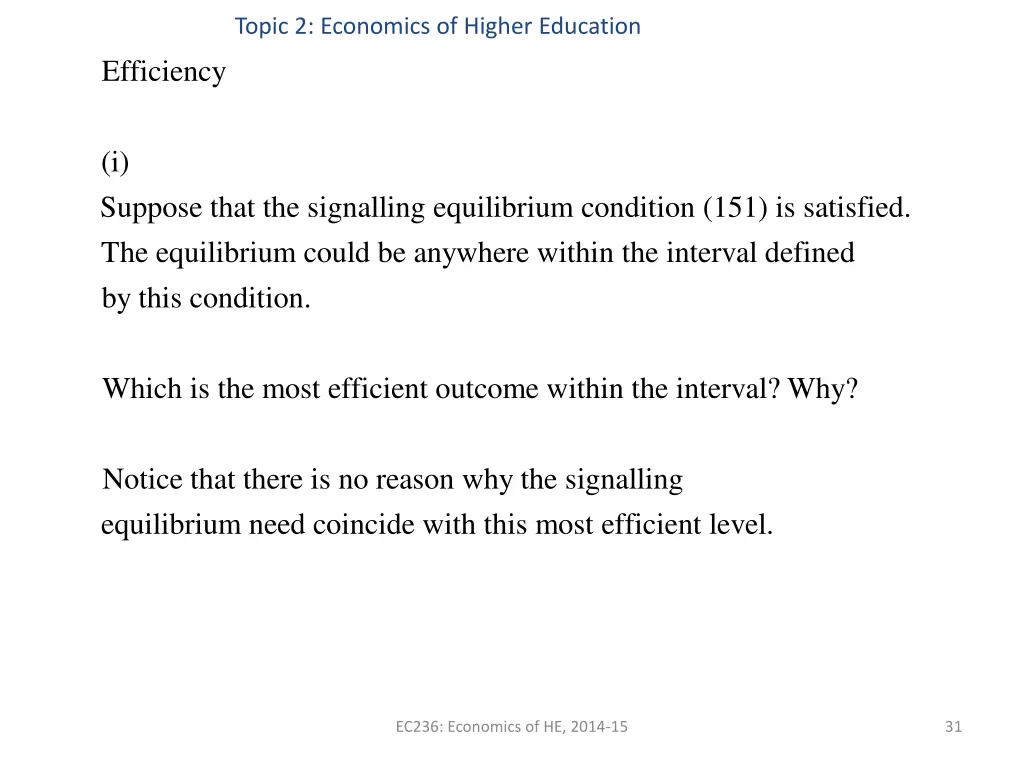
Topic 2: Economics of Higher Education Efficiency (i) Suppose that the signalling equilibrium condition (151) is satisfied. The equilibrium could be anywhere within the interval defined by this condition. Which is the most efficient outcome within the interval? Why? Notice that there is no reason why the signalling equilibrium need coincide with this most efficient level. EC236: Economics of HE, 2014-15 31
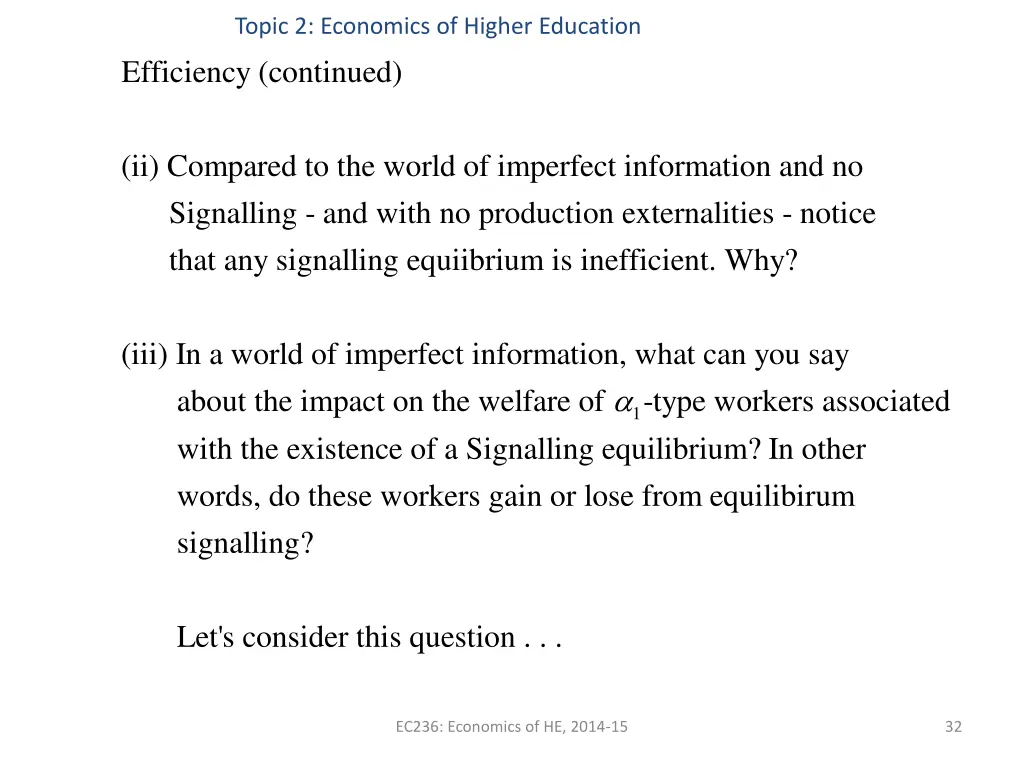
Topic 2: Economics of Higher Education Efficiency (continued) (ii) Compared to the world of imperfect information and no Signalling - and with no production externalities - notice that any signalling equiibrium is inefficient. Why ? (iii) In a world of imperfect information, what can you say about the impact on the welfare of with the existence of a Signalling equilibrium? In other w ords, do these workers gain or lose from equilibirum signalling? -type workers associated 1 Let's consider this question . . . EC236: Economics of HE, 2014-15 32
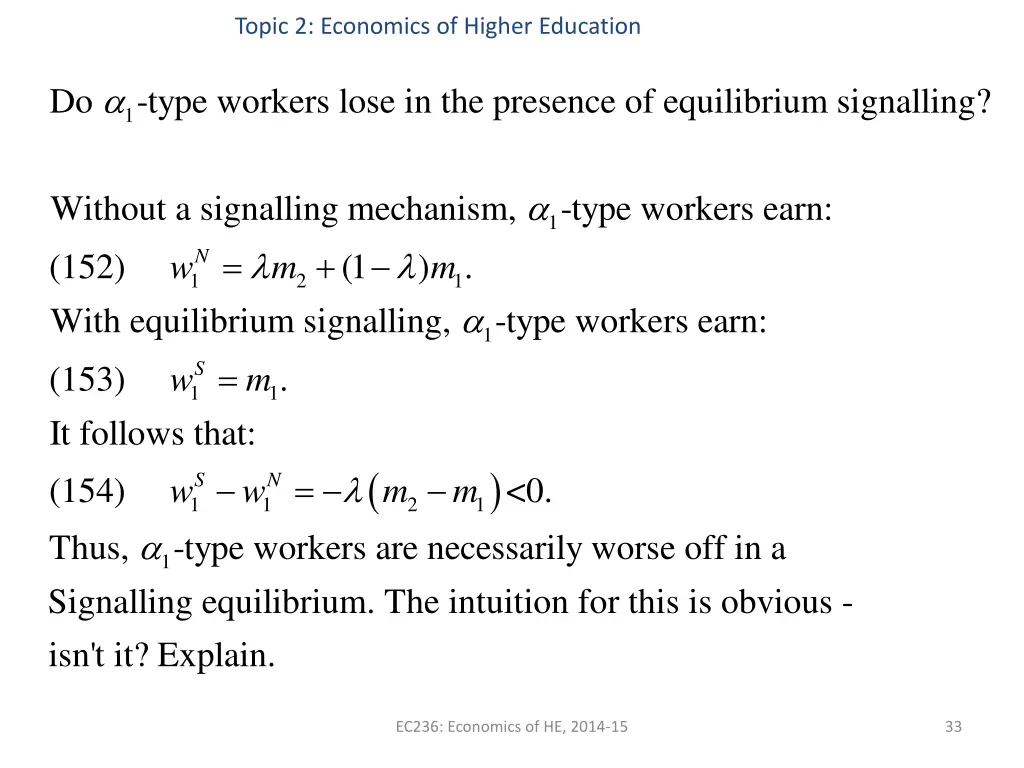
Topic 2: Economics of Higher Education Do -type workers lose in the presence of equilibrium signalling? 1 Without a signalling mechanism, = -type workers earn: 1 + N (152) With equilibrium signalling, = (1 ) . w m m 1 2 1 -type workers earn: 1 S (153) It follows that: (154) Thus, Signalling equilibrium. The intuition for this is obvious - isn't it? Explain. . w m 1 1 ( ) = S N <0. w w m m 1 1 2 1 -type workers are necessarily worse off in a 1 EC236: Economics of HE, 2014-15 33
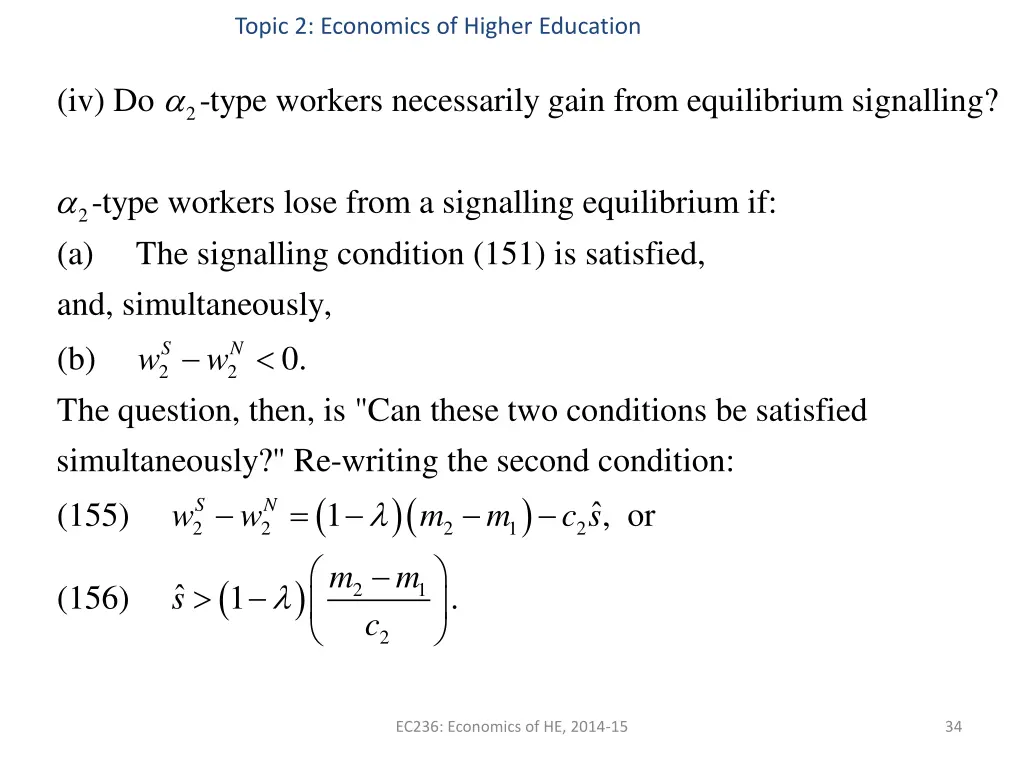
Topic 2: Economics of Higher Education (iv) Do -type workers necessarily gain from equilibrium signalling? 2 -type workers lose from a signalling equilibrium if: (a) The signalling condition (151) is satisfied, and, simultaneously, (b) 2 2 0. The question, then, is "Can these two conditions be satisfied simultaneously?" Re-writing the second condition: (155) 1 w w m = 2 S N w w ( )( ) S N , or m c s 2 2 2 1 2 m m ( ) s (156) 1 . 2 1 c 2 EC236: Economics of HE, 2014-15 34
Topic 2: Economics of Higher Education (iv) Do So, the signalling condition (151) is satisfied simultaneously with the condit ion shown in (156). For these to be satisfied simultaneously, it must be the case that: s0 s -type workers necessarily gain from equilibrium signalling? -type workers lose from a signalling equilibrium if 2 2 m m m m ( ) (157) 1 < , and 2 1 2 1 c c 2 2 m m m m ( ) (158) 1 . 2 1 2 1 c c 2 1 m m m m 2 1 2 1 c c 2 1 EC236: Economics of HE, 2014-15 35
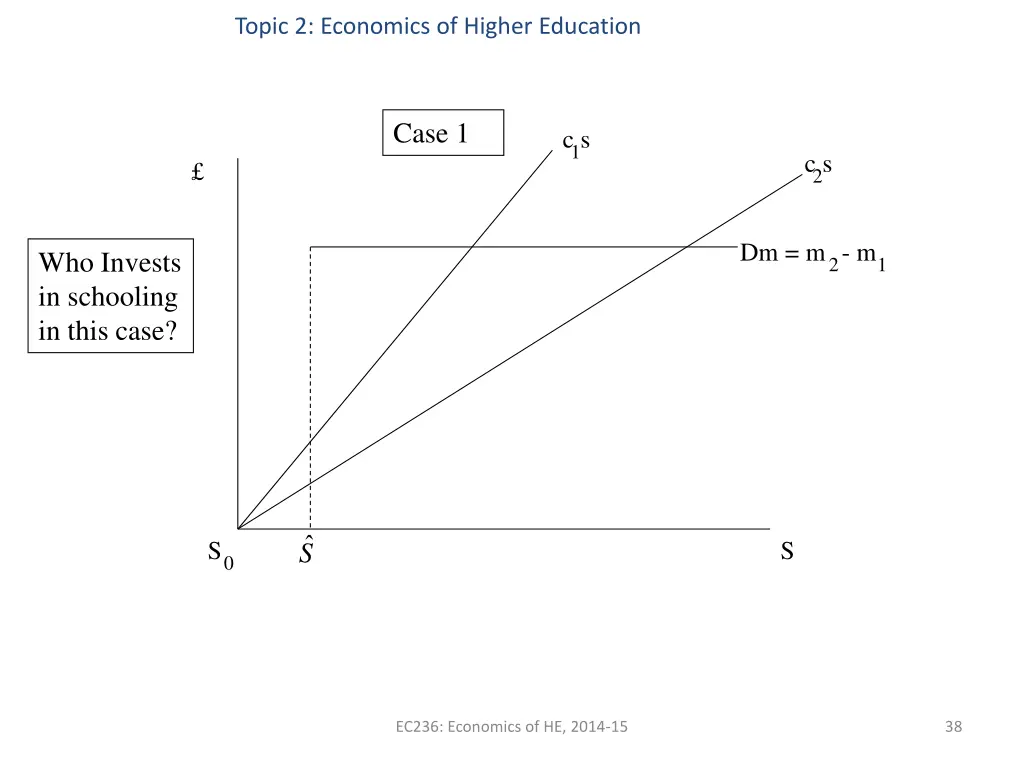
Topic 2: Economics of Higher Education Case 1 c s 1 2c s Dm = m - m Who Invests in schooling in this case? 2 1 S S S 0 EC236: Economics of HE, 2014-15 38
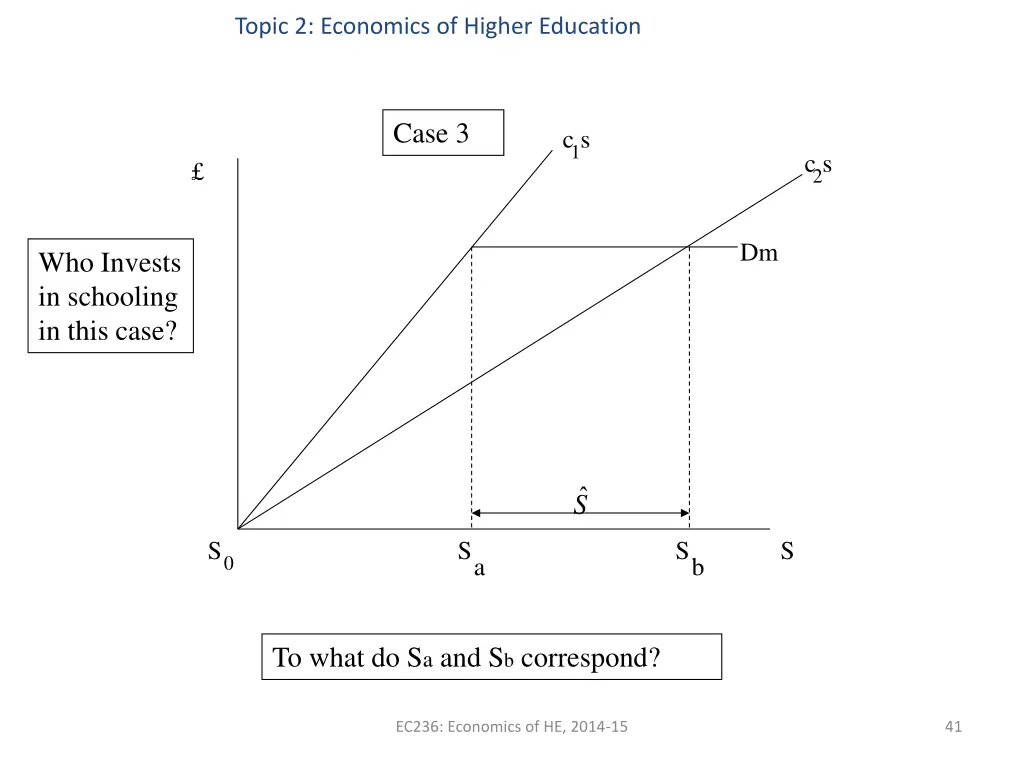
Topic 2: Economics of Higher Education Case 3 c s 1 2c s Dm Who Invests in schooling in this case? S S Sa S S 0 b To what do Sa and Sb correspond? EC236: Economics of HE, 2014-15 41
Topic 2: Economics of Higher Education Signalling: is it sustainable in the long run? Employer Learning (Altonji and Pierret, QJE, 2001) (Farber and Gibbons, QJE, 1996) Statistical Discrimination in the Short-run Evidence? (Layard and Psacharopoulos, JPE, 1974) (Riley, JPE, 1979) (Feng and Graetz (2013): see subsequent lecture) EC236: Economics of HE, 2014-15 42