Ecosystem Services and Socio-Economics Integration
In-depth exploration of Ecosystem Services and Socio-Economics integration, focusing on the value generated by ecological goods and services, and the impact on rural communities. Detailed assessment steps and scenario consequences are analyzed to evaluate potential changes.

Download Presentation

Please find below an Image/Link to download the presentation.
The content on the website is provided AS IS for your information and personal use only. It may not be sold, licensed, or shared on other websites without obtaining consent from the author.If you encounter any issues during the download, it is possible that the publisher has removed the file from their server.
You are allowed to download the files provided on this website for personal or commercial use, subject to the condition that they are used lawfully. All files are the property of their respective owners.
The content on the website is provided AS IS for your information and personal use only. It may not be sold, licensed, or shared on other websites without obtaining consent from the author.
E N D
Presentation Transcript
ECOSYSTEM SERVICES DWA CORPORATE IDENTITY Presented by: Johan Maree Deputy Director: Media Production Greg Huggins 12 December 2012
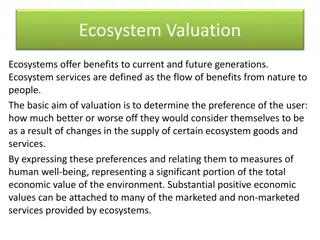
Ecological Goods & Services Attributes (EGSA) EGSA are the goods and services provided by the river (and associated ecological systems) that result in a value being produced for consumers. EGSA are now referred to as Ecosystem Services. Provisioning services are the most familiar category of benefit, often referred to as ecosystem goods , such as foods, fuels, fibres, medicine, etc., that are in many cases directly consumed. Other services include cultural services (ritual use of rivers, aesthetic or historical importance) regulating services (e.g. water quality inputs), and supporting services (e.g. nutrient formation)
Socio and Rural Economics Brief in this study is to look at two separate components (packages)of the overall Socio-Economics but to integrate in final analysis. Package 1- Economics linked to market and broader economic parameters Package 2 Ecosystem Goods and Services/Ecological Goods and Services Attributes (EGSA), Ecological Infrastructure = Ecosystem Services
Socio and Rural Economics Our approach: Water abstracted from the river and utilised/value added falls within the ambit of economics Water that remains in the river but provides goods/services that generate value falls within the ambit of Ecosystem Services
SCENARIO CONSEQUENCES: ASSESSMENT STEPS STEP 1 STEP 2 Analyse the site status quo. Identify the communities likely to derive benefits from ESS List the range of ESS available Populate Ecosystem list and generate spreadsheet
SCENARIO CONSEQUENCES: ASSESSMENT STEPS STEP 3: EVALUATE CHANGE PER SC STEP 4: AGGREGATE THE STEP ID the potential change that each of the key ESS may undergo in each of the scenarios. Change is measured against a base score of 1 represents the current situation. The potential change will be noted as a factor, EG, no change = 1, a 50% increase = 1.5, and a 20% decrease = 0.8. Each category rated out of 1 Sum the numbers of each service, divide by number of services, and rate each service out of 1
SCENARIO CONSEQUENCES: ASSESSMENT STEPS STEP 5 WEIGHTING STEP 6 REACH WEIGHTING Weigh each category Category weight is normalised to 1 E.g. all services equal weight then Provisioning = 0.25, Regulating = 0.25, Cultural = 0.25, Supporting = 0.25. The SCI score generated as first steps in determine reach importance revisited. Score out of 5 - acts as weighting - normalised back to a score of 1
MKOMAZI CONSEQUENCES Abundance of some importance fish sp decrease under some scenarios (eg yellow fish). Riparian veg: Minor increase in some woodies. Mostly no change in utilisation. Sc 2 most impact. WQ: No change except waste assimilation. Geomorph: Mostly no change as river deeply incised with few floodplains. Estuary possible impacts on some sc, especially 2, related to water quality, recreation, fishing
MVOTI CONSEQUENCES Abundance of some importance fish sp decrease under some scenarios (eg yellow fish). Riparian veg: Some increase in abundance in reeds, sedges etc in some scenarios, mostly no change WQ: No change except for Sc 3 potential for disease. Geomorph: Reduced base flows and floods flood attenuation, improvement of floodplain cultivation, etc small increase in utilisation
CONCLUSIONS Changes are small at the Mkomazi and negative. I.e., although the utilisation is important, scenarios have minor impact on ESS. Utilisation in the Mvoti mostly no change or very small improvements. Weighting must still be included. Estuary analysis must still be undertaken. Doubtful whether any significant changes of this estimate.