Effective Communication Strategies for Engaging College Students
Learn about the impact of texting on communication with college students, including research findings on the effectiveness of text messaging in student engagement and task completion. Discover how adjusting communication strategies can support diverse student populations and enhance academic success.

Download Presentation

Please find below an Image/Link to download the presentation.
The content on the website is provided AS IS for your information and personal use only. It may not be sold, licensed, or shared on other websites without obtaining consent from the author. If you encounter any issues during the download, it is possible that the publisher has removed the file from their server.
You are allowed to download the files provided on this website for personal or commercial use, subject to the condition that they are used lawfully. All files are the property of their respective owners.
The content on the website is provided AS IS for your information and personal use only. It may not be sold, licensed, or shared on other websites without obtaining consent from the author.
E N D
Presentation Transcript
Communicating with the Next Generation of College Students A Roundtable Discussion with Rebecca Schreiber-Reis, Dickinson College
Ten Texts to College Chapter 5, Summer Melt by Benjamin L. Castleman and Lindsay C. Page Texting is the primary method of communication for today s teens and young adults (Lenhardt, A.) Texts provide manageable bursts of information- nudges to complete tasks Behavioral economists have observed that long lists- such as missing items emails- cause us to procrastinate (Madrian, B.C. & Shea, D.F) Nudges have been used successfully to encourage personal savings, and as reminders for vaccinations. (Thaler, R. & Sunstein, C.; Karlan, D. McConnell, M., Mullainathan, S., & Zinman, J.; Stockwell, M.S., Kharbanda, E.O., Martinez, R.A., Vargas, C.Y., Vawdrey, D.K., & Camargo, S.)
Research Findings Summer Melt uAspire (Boston, MA) found that students who did not respond to emails and phone calls, responded rapidly to text messages Responses were especially high for texts related to financial aid and billing Fewer than 4% of students opted out of text messaging Minnesota Office of Higher Education noted that students who chose to receive emails were less responsive, and responded later, than those who selected text-based communications
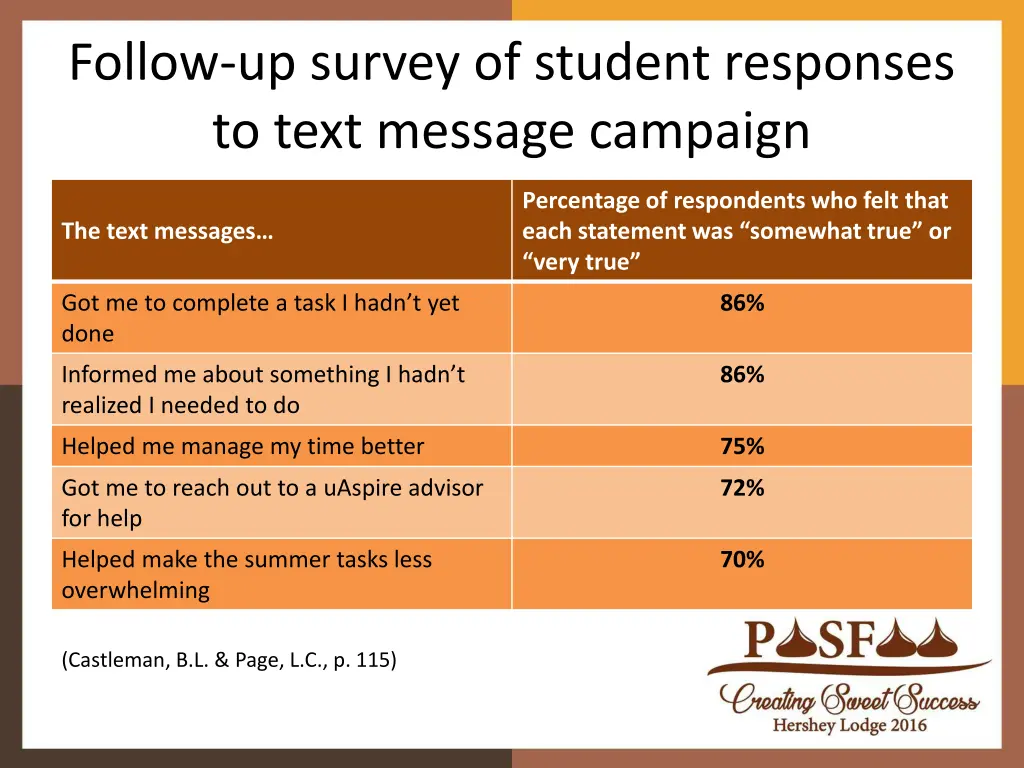
Follow-up survey of student responses to text message campaign Percentage of respondents who felt that each statement was somewhat true or very true The text messages Got me to complete a task I hadn t yet done 86% Informed me about something I hadn t realized I needed to do 86% Helped me manage my time better 75% Got me to reach out to a uAspire advisor for help 72% Helped make the summer tasks less overwhelming 70% (Castleman, B.L. & Page, L.C., p. 115)
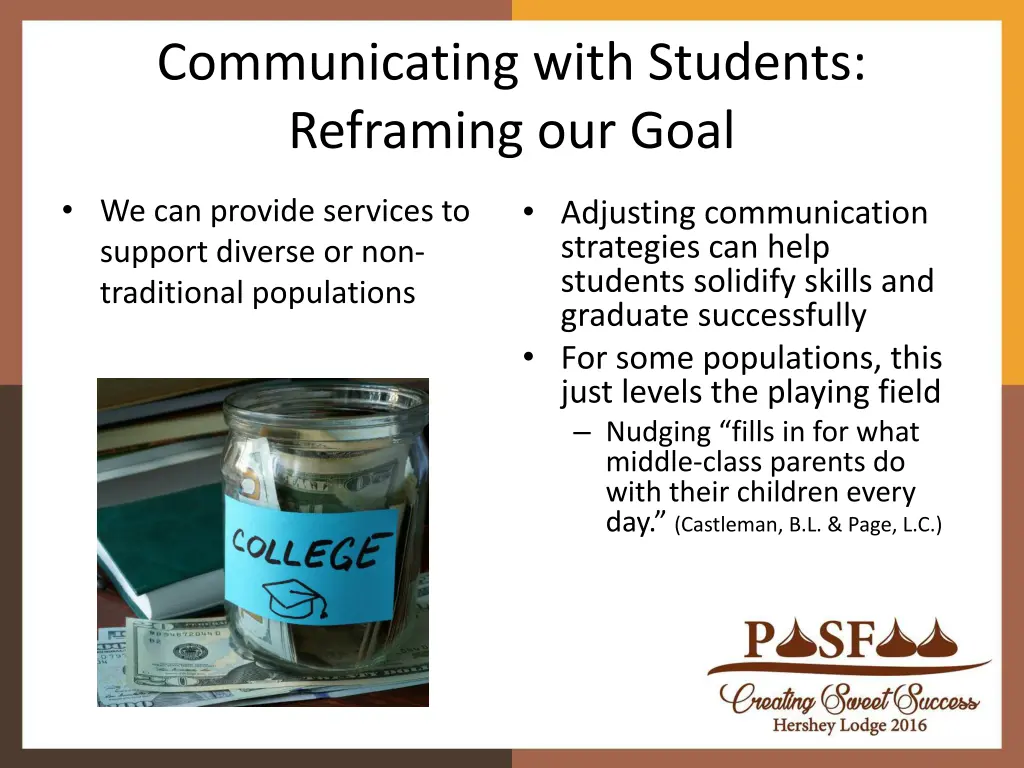
Communicating with Students: Reframing our Goal We can provide services to support diverse or non- traditional populations Adjusting communication strategies can help students solidify skills and graduate successfully For some populations, this just levels the playing field Nudging fills in for what middle-class parents do with their children every day. (Castleman, B.L. & Page, L.C.)
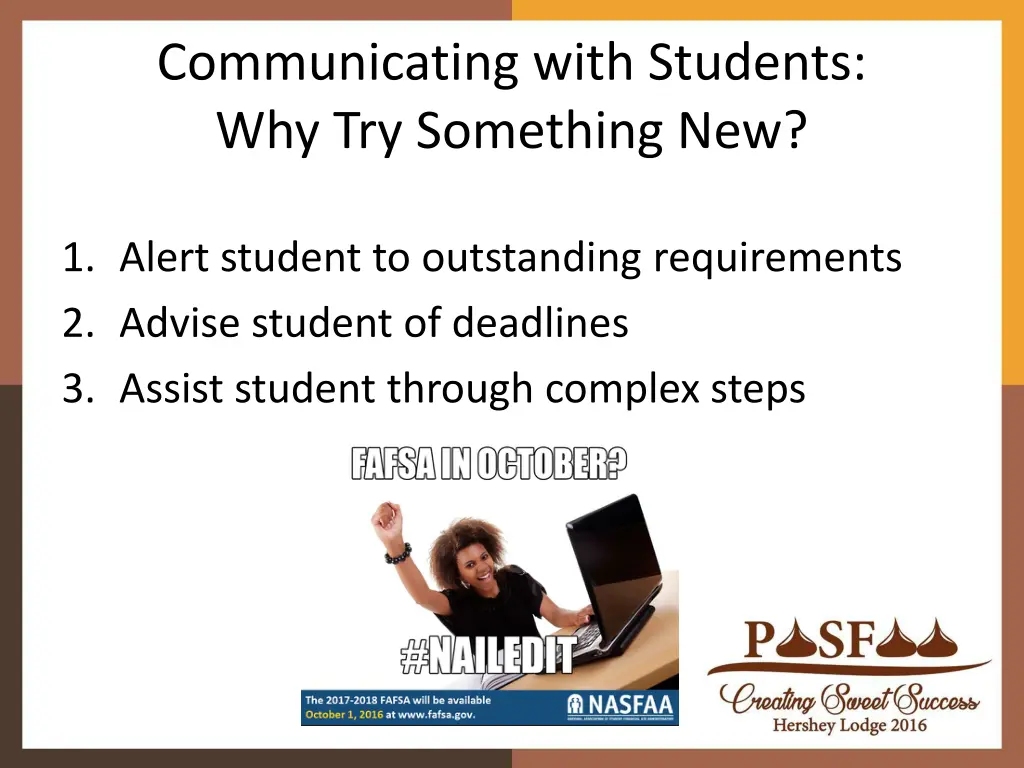
Communicating with Students: Why Try Something New? 1. Alert student to outstanding requirements 2. Advise student of deadlines 3. Assist student through complex steps
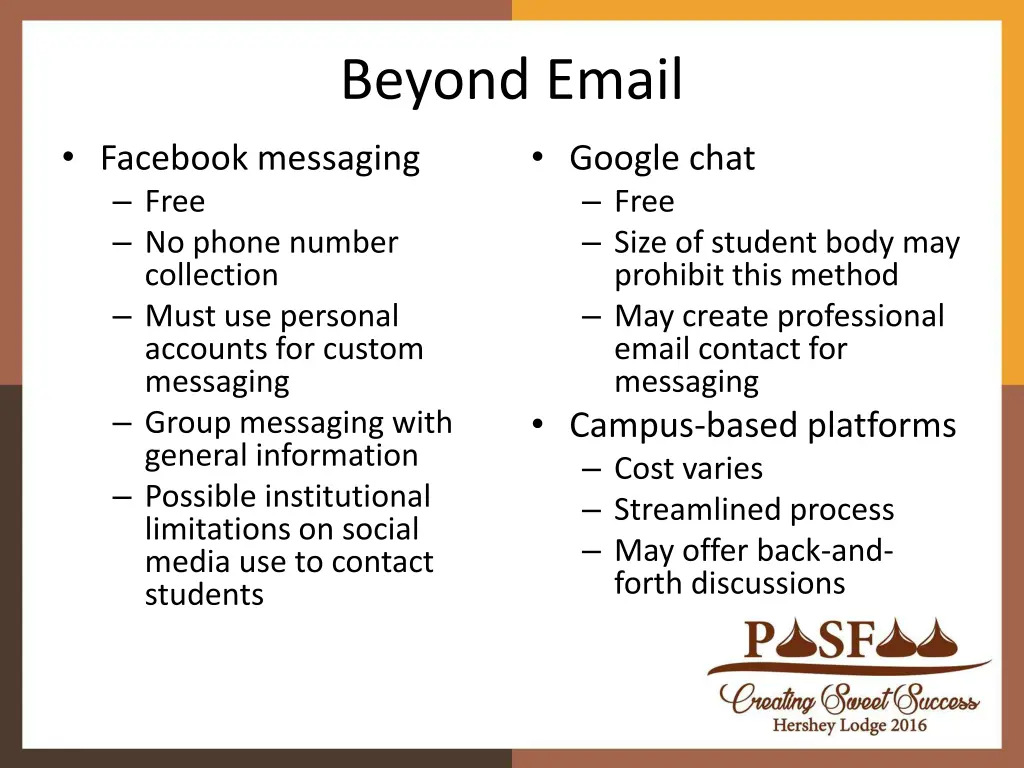
Beyond Email Facebook messaging Free No phone number collection Must use personal accounts for custom messaging Group messaging with general information Possible institutional limitations on social media use to contact students Google chat Free Size of student body may prohibit this method May create professional email contact for messaging Campus-based platforms Cost varies Streamlined process May offer back-and- forth discussions
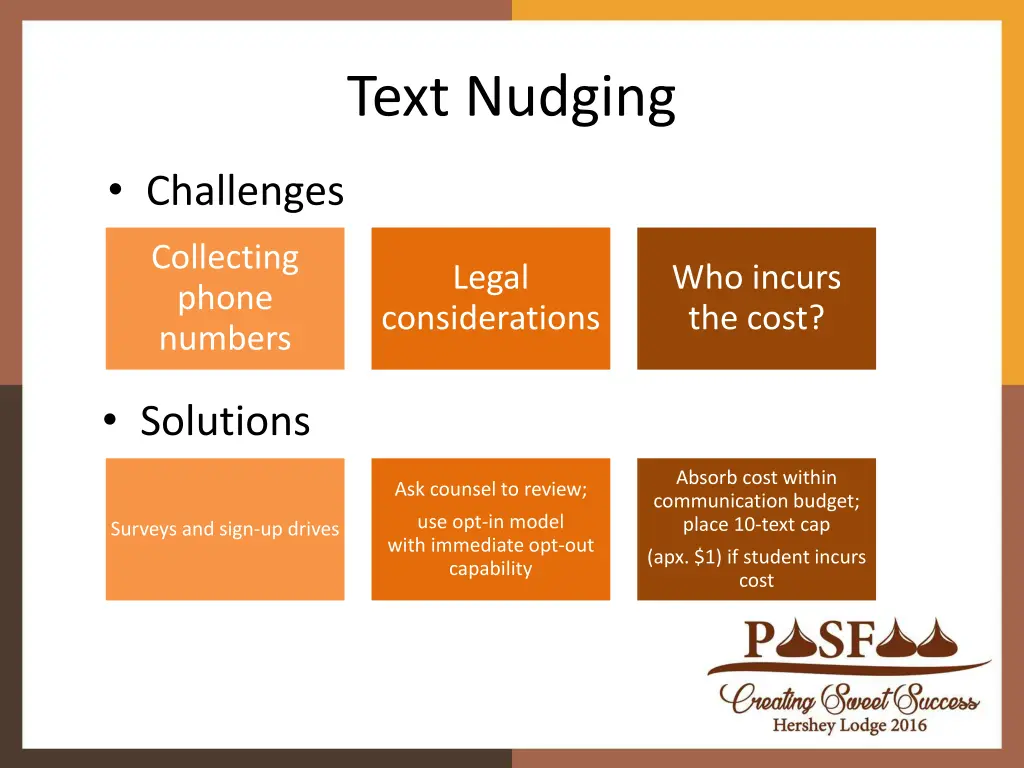
Text Nudging Challenges Collecting phone numbers Legal Who incurs the cost? considerations Solutions Absorb cost within communication budget; place 10-text cap Ask counsel to review; use opt-in model with immediate opt-out capability Surveys and sign-up drives (apx. $1) if student incurs cost
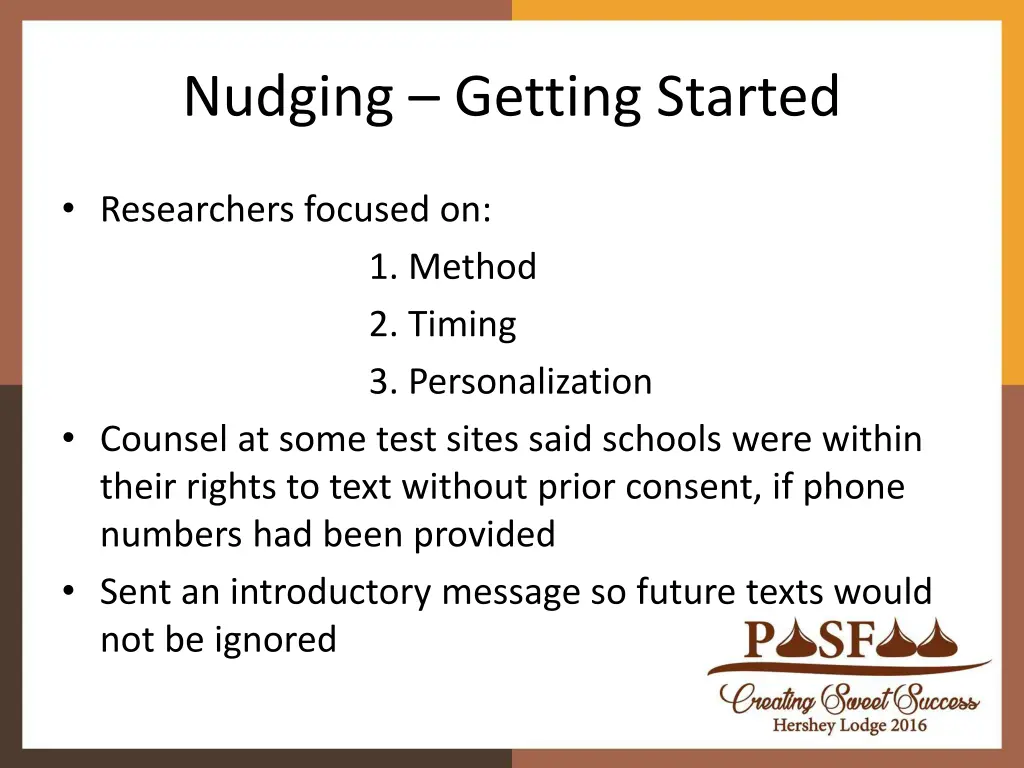
Nudging Getting Started Researchers focused on: Counsel at some test sites said schools were within their rights to text without prior consent, if phone numbers had been provided Sent an introductory message so future texts would not be ignored 1. Method 2. Timing 3. Personalization
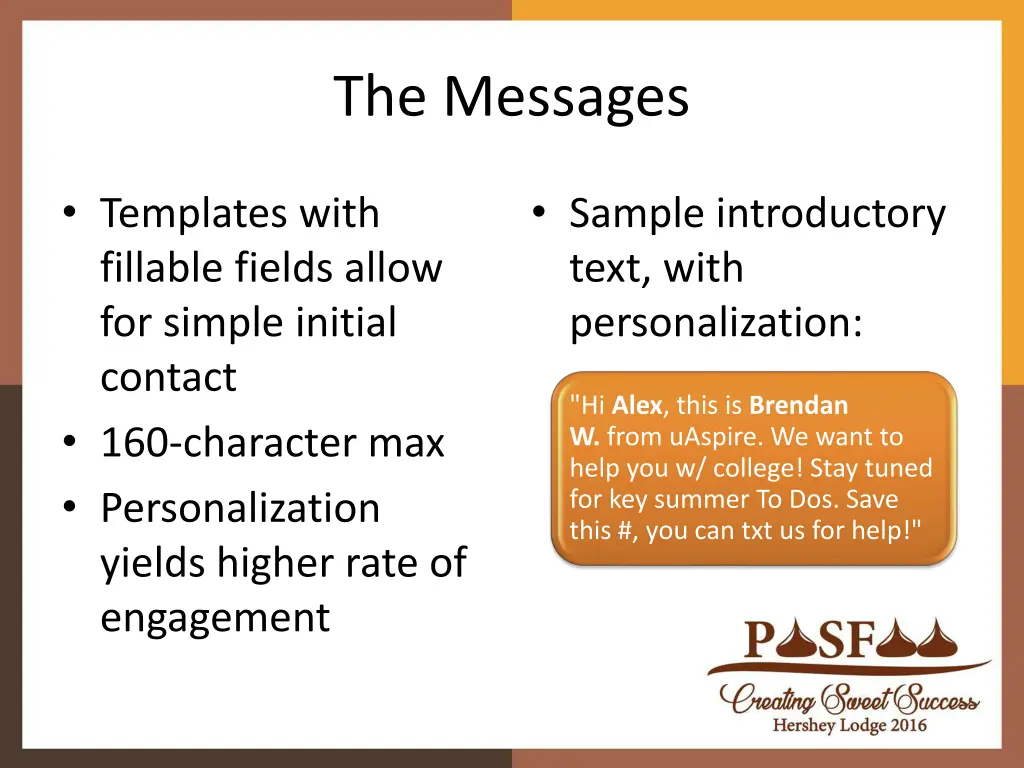
The Messages Templates with fillable fields allow for simple initial contact 160-character max Personalization yields higher rate of engagement Sample introductory text, with personalization: "Hi Alex, this is Brendan W. from uAspire. We want to help you w/ college! Stay tuned for key summer To Dos. Save this #, you can txt us for help!"
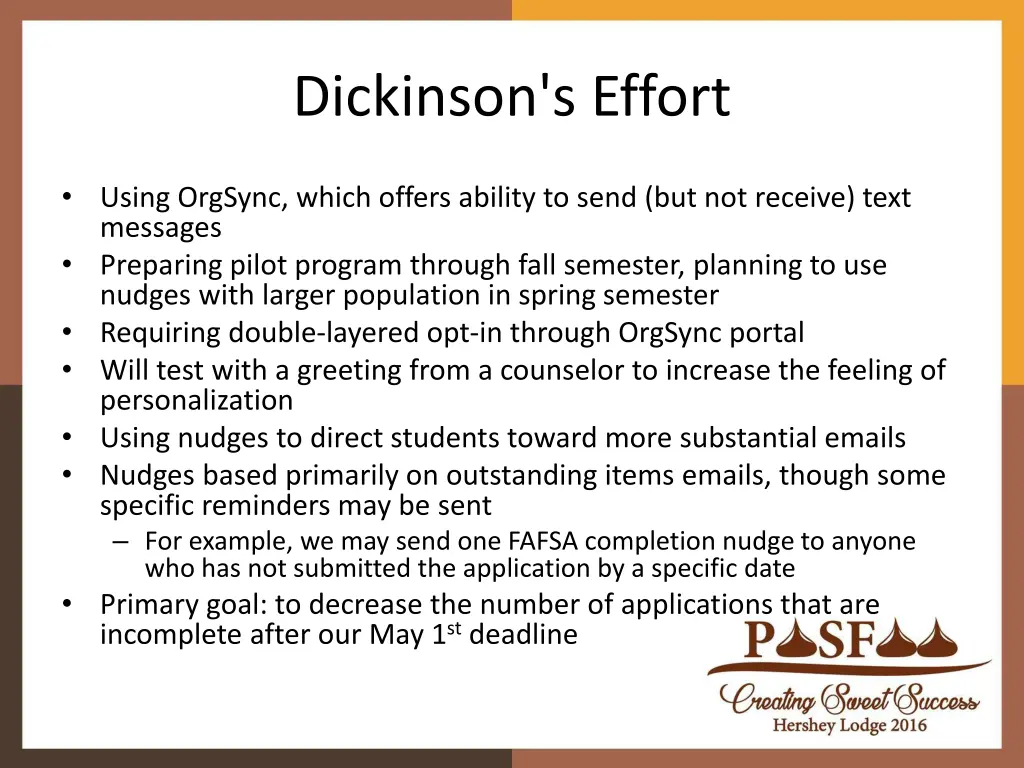
Dickinson's Effort Using OrgSync, which offers ability to send (but not receive) text messages Preparing pilot program through fall semester, planning to use nudges with larger population in spring semester Requiring double-layered opt-in through OrgSync portal Will test with a greeting from a counselor to increase the feeling of personalization Using nudges to direct students toward more substantial emails Nudges based primarily on outstanding items emails, though some specific reminders may be sent For example, we may send one FAFSA completion nudge to anyone who has not submitted the application by a specific date Primary goal: to decrease the number of applications that are incomplete after our May 1st deadline
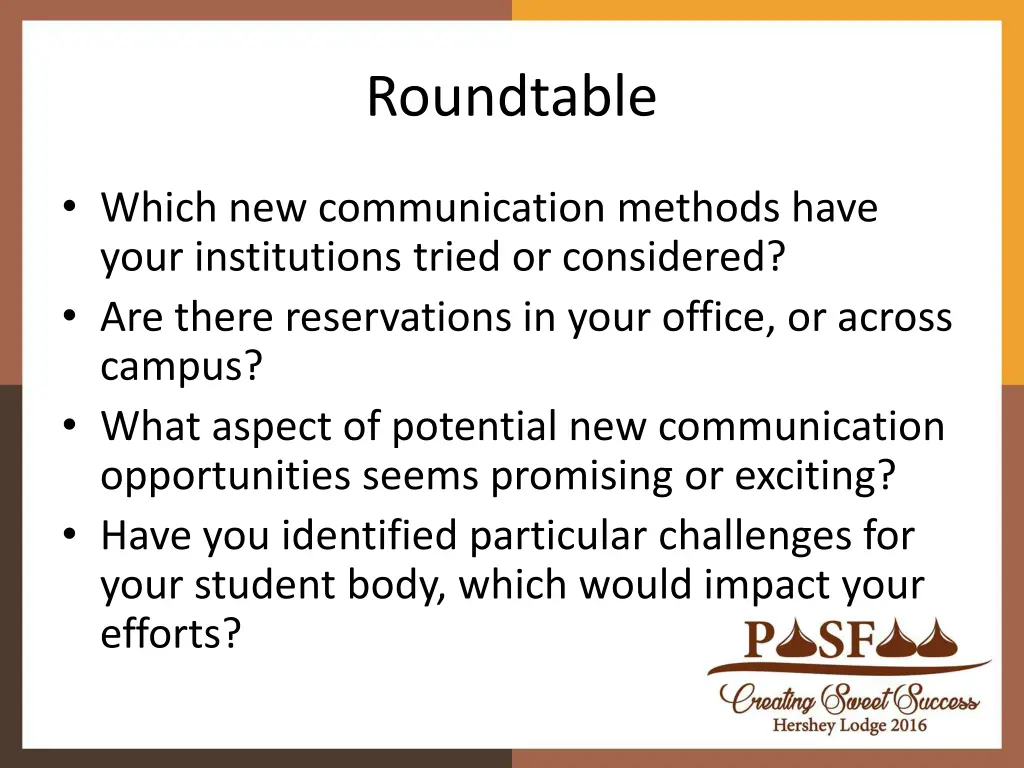
Roundtable Which new communication methods have your institutions tried or considered? Are there reservations in your office, or across campus? What aspect of potential new communication opportunities seems promising or exciting? Have you identified particular challenges for your student body, which would impact your efforts?
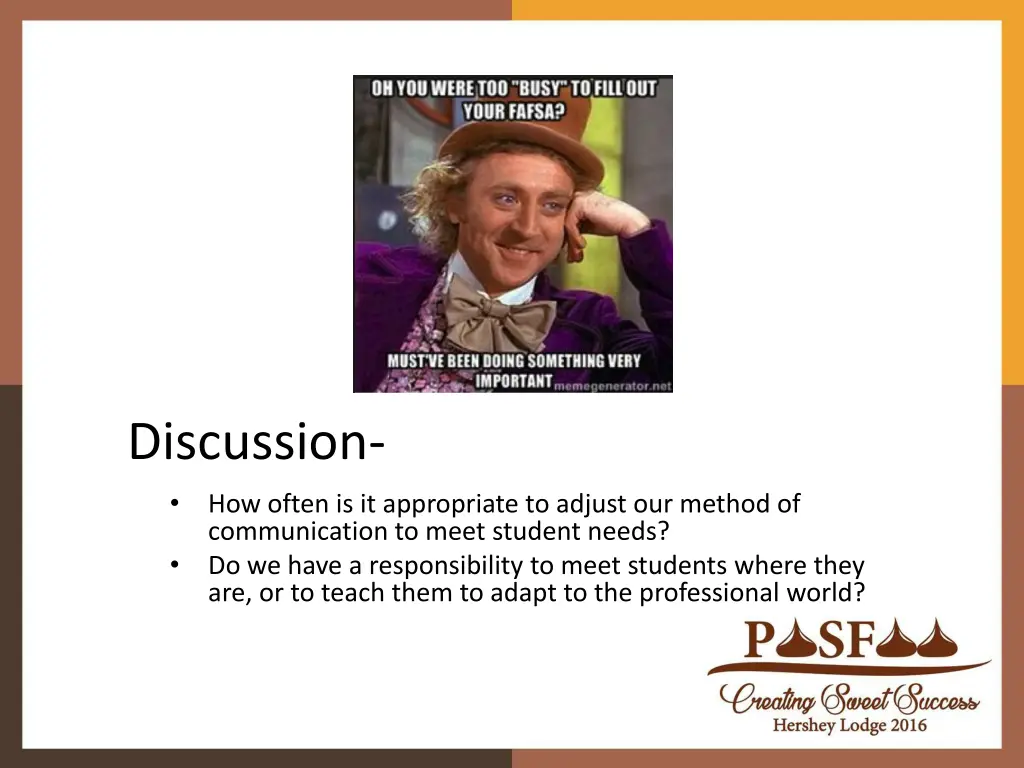
Discussion- How often is it appropriate to adjust our method of communication to meet student needs? Do we have a responsibility to meet students where they are, or to teach them to adapt to the professional world?
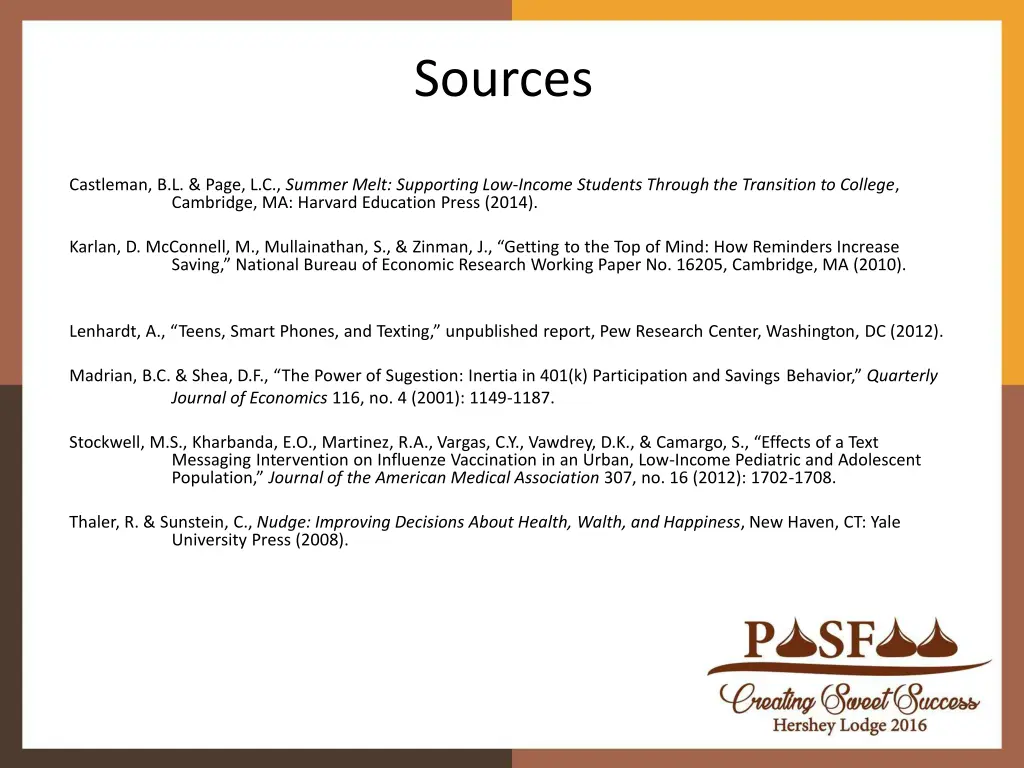
Sources Castleman, B.L. & Page, L.C., Summer Melt: Supporting Low-Income Students Through the Transition to College, Cambridge, MA: Harvard Education Press (2014). Karlan, D. McConnell, M., Mullainathan, S., & Zinman, J., Getting to the Top of Mind: How Reminders Increase Saving, National Bureau of Economic Research Working Paper No. 16205, Cambridge, MA (2010). Lenhardt, A., Teens, Smart Phones, and Texting, unpublished report, Pew Research Center, Washington, DC (2012). Madrian, B.C. & Shea, D.F., The Power of Sugestion: Inertia in 401(k) Participation and Savings Behavior, Quarterly Journal of Economics 116, no. 4 (2001): 1149-1187. Stockwell, M.S., Kharbanda, E.O., Martinez, R.A., Vargas, C.Y., Vawdrey, D.K., & Camargo, S., Effects of a Text Messaging Intervention on Influenze Vaccination in an Urban, Low-Income Pediatric and Adolescent Population, Journal of the American Medical Association 307, no. 16 (2012): 1702-1708. Thaler, R. & Sunstein, C., Nudge: Improving Decisions About Health, Walth, and Happiness, New Haven, CT: Yale University Press (2008).