Effective Developmental Conversations with Parents for Better Outcomes
Enhance child development through meaningful conversations with parents/caregivers. Learn to address common concerns, benefits of standardized screening, and ways to support families effectively. Discover how early screening can lead to improved outcomes and create strong connections between families and agency staff.

Download Presentation

Please find below an Image/Link to download the presentation.
The content on the website is provided AS IS for your information and personal use only. It may not be sold, licensed, or shared on other websites without obtaining consent from the author. If you encounter any issues during the download, it is possible that the publisher has removed the file from their server.
You are allowed to download the files provided on this website for personal or commercial use, subject to the condition that they are used lawfully. All files are the property of their respective owners.
The content on the website is provided AS IS for your information and personal use only. It may not be sold, licensed, or shared on other websites without obtaining consent from the author.
E N D
Presentation Transcript
DEVELOPMENTAL SCREENING: Developmental Conversations with Parents/Caregivers EARLY SCREENING, BETTER OUTCOMES: Developmental Screening & Referral Toolkit for Family Serving Agencies
Developmental Conversations Staff working at our agency develop close relationships with young children and their parents. Developmental conversations between staff members and parents can: Support developmental progress. Enhance parent-child relationships. Provide linkage to needed resources. Strengthen connections between families and staff members. 2 EARLY SCREENING, BETTER OUTCOMES: Developmental Screening & Referral Toolkit for Family Serving Agencies
How do you talk to families about their child s development? 3 EARLY SCREENING, BETTER OUTCOMES: Developmental Screening & Referral Toolkit for Family Serving Agencies
What are the hardest parts of those conversations? What, if anything, slows you down or prevents you from having those conversations? 4 EARLY SCREENING, BETTER OUTCOMES: Developmental Screening & Referral Toolkit for Family Serving Agencies
Common Concerns What if I m wrong? What if the family gets angry with me? I don t know how they will react. The family isn t ready yet. I don t know where to refer them. Referrals go to a black hole. 5 EARLY SCREENING, BETTER OUTCOMES: Developmental Screening & Referral Toolkit for Family Serving Agencies
What are the benefits of conducting standardized developmental screening and discussing results with parents? 6 EARLY SCREENING, BETTER OUTCOMES: Developmental Screening & Referral Toolkit for Family Serving Agencies
Standardized Screening Facilitates Developmental Conversations All families benefit For children with typical development, screening Helps parents understand child development. Assists parents learn ways to support their child s continued progress. Provides the opportunity for anticipatory guidance. Communicates that the staff member is interested in the child s development. Provides reassurance when all is well. 7 EARLY SCREENING, BETTER OUTCOMES: Developmental Screening & Referral Toolkit for Family Serving Agencies
Standardized Screening Facilitates Developmental Conversations All families benefit . . . For children with delays in development, screening Leads to linkage to early intervention services that can change the developmental trajectory. Helps families move into action. Shifts parental expectations and attributions. Provides opportunity for staff member to support family in addressing developmental delays. 8 EARLY SCREENING, BETTER OUTCOMES: Developmental Screening & Referral Toolkit for Family Serving Agencies
Standardized Screening Facilitates Developmental Conversations All staff members benefit . . . For staff members with less experience with child development, a standardized tool Helps identify subtle delays. For staff members with extensive experience with child development, a standardized tool Helps frame conversations with parents about identified delays. 9 EARLY SCREENING, BETTER OUTCOMES: Developmental Screening & Referral Toolkit for Family Serving Agencies
Benefits of Early Intervention Early intervention services provided by age 3 show significant developmental gains. Early intervention reduces the severity of deficits associated with developmental delay. Children with developmental delay who develop language and symbolic play before age 5 are: Likely to be placed in a regular classroom. Show improvements in communication, adaptive skills and social-emotional development. 10 EARLY SCREENING, BETTER OUTCOMES: Developmental Screening & Referral Toolkit for Family Serving Agencies
Frequently Asked Questions Regarding Screening Results Q: What if the parent is concerned about development, but the score on standardized screening is normal? A: The concerns of the parent should be taken seriously. A discussion with the parent will help specify what the concern is and help to determine the appropriate follow up. It may be that the parent does not have age- or developmentally-appropriate expectations of the child. A parent may also see daily behaviors that are concerning but have not been addressed by any of the screening questions. If, after discussion with the parent, there is still a concern, determine with the family what type of referral would be appropriate. 11 EARLY SCREENING, BETTER OUTCOMES: Developmental Screening & Referral Toolkit for Family Serving Agencies
Frequently Asked Questions Regarding Screening Results Q: What if the screening score is abnormal, but the provider feels the child s development is typical? A: Follow-up by the staff member is indicated. Staff member can review specific items on the questionnaire to see if the parent understood them. Staff member can explore further through direct assessment of child and/or follow-up questions with parent to determine if there is a possible delay. If in doubt, follow-up in a shorter interval and re-screen. 12 EARLY SCREENING, BETTER OUTCOMES: Developmental Screening & Referral Toolkit for Family Serving Agencies
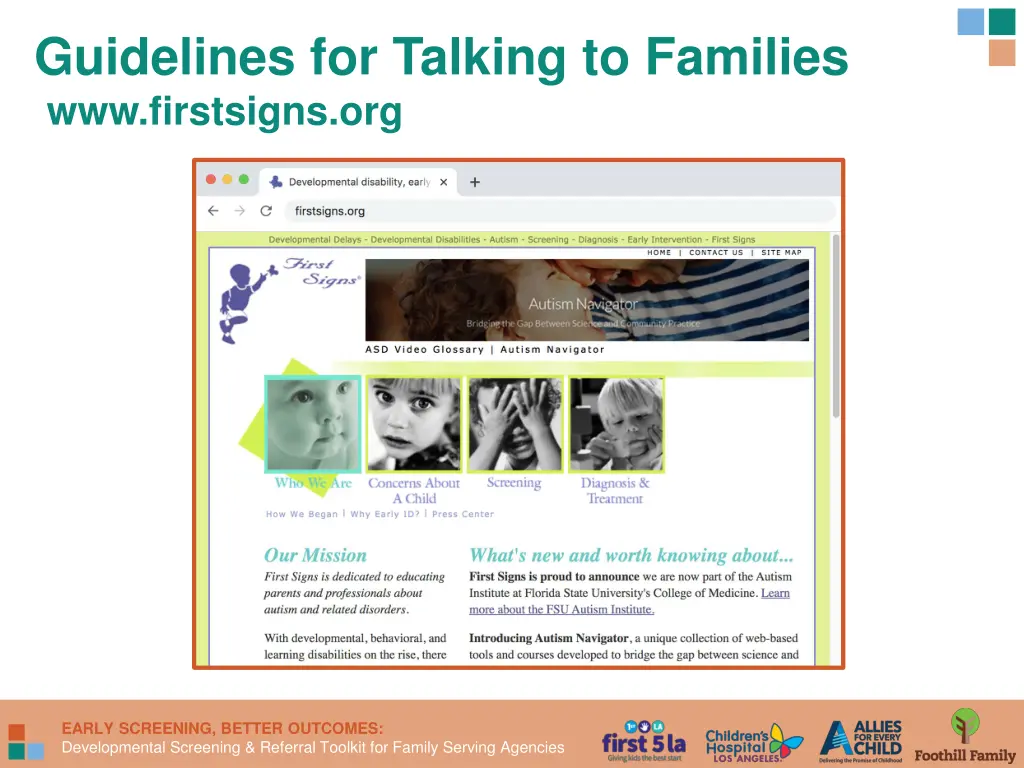
Guidelines for Talking to Families www.firstsigns.org EARLY SCREENING, BETTER OUTCOMES: Developmental Screening & Referral Toolkit for Family Serving Agencies
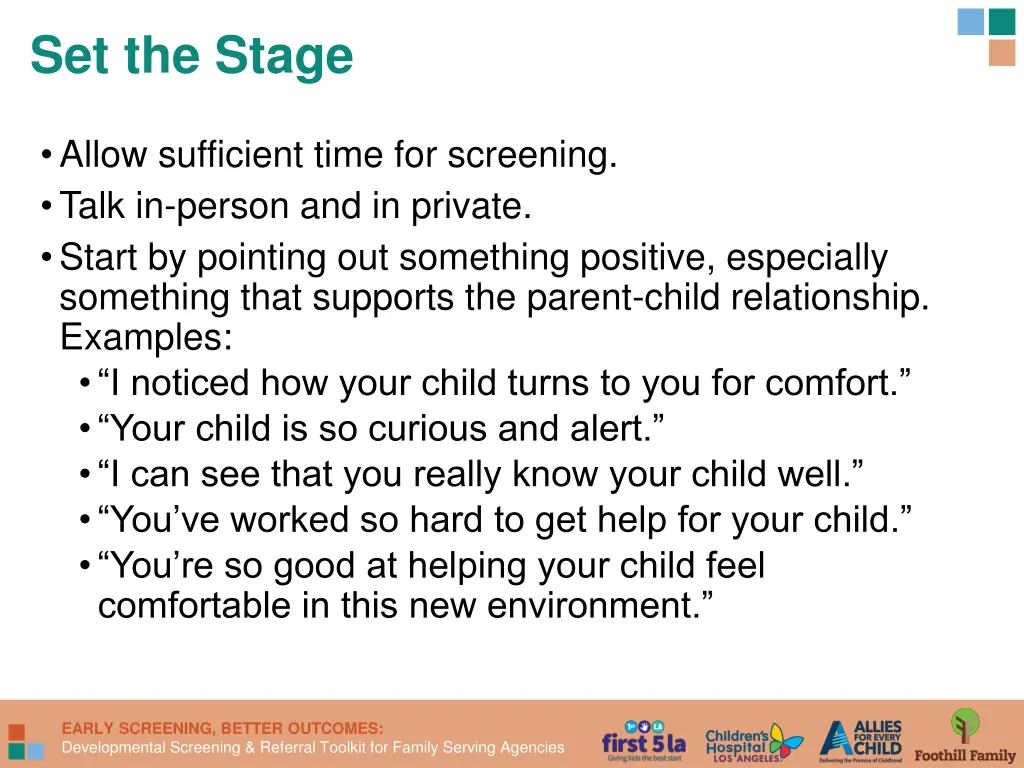
Set the Stage Allow sufficient time for screening. Talk in-person and in private. Start by pointing out something positive, especially something that supports the parent-child relationship. Examples: I noticed how your child turns to you for comfort. Your child is so curious and alert. I can see that you really know your child well. You ve worked so hard to get help for your child. You re so good at helping your child feel comfortable in this new environment. EARLY SCREENING, BETTER OUTCOMES: Developmental Screening & Referral Toolkit for Family Serving Agencies
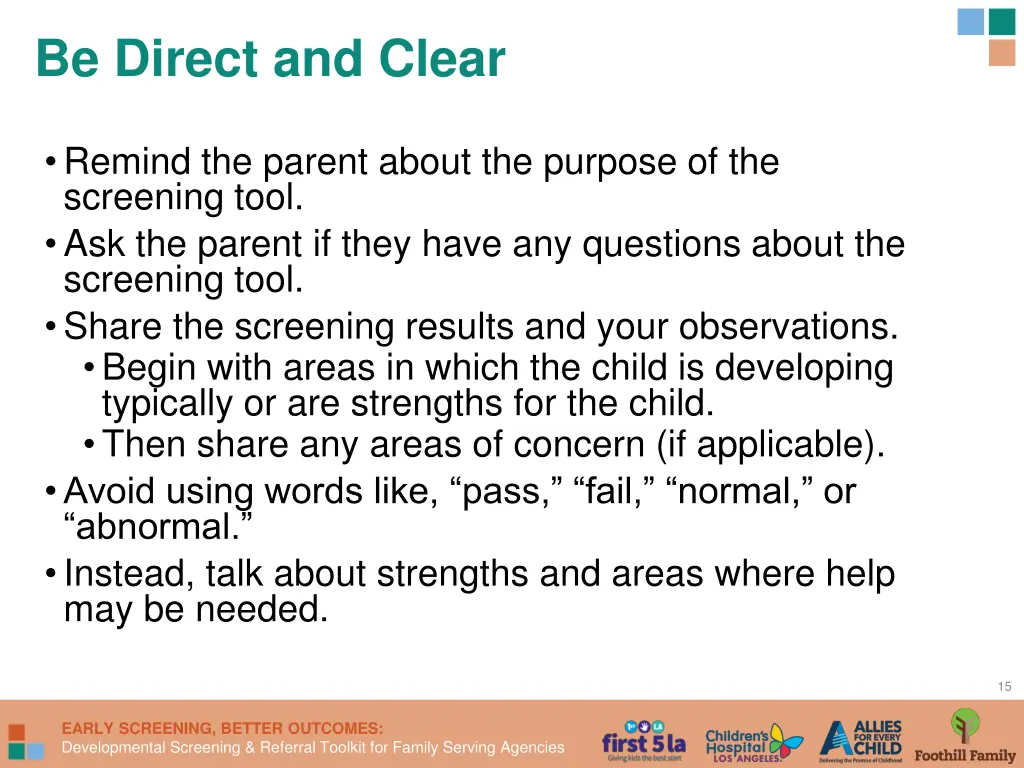
Be Direct and Clear Remind the parent about the purpose of the screening tool. Ask the parent if they have any questions about the screening tool. Share the screening results and your observations. Begin with areas in which the child is developing typically or are strengths for the child. Then share any areas of concern (if applicable). Avoid using words like, pass, fail, normal, or abnormal. Instead, talk about strengths and areas where help may be needed. 15 EARLY SCREENING, BETTER OUTCOMES: Developmental Screening & Referral Toolkit for Family Serving Agencies
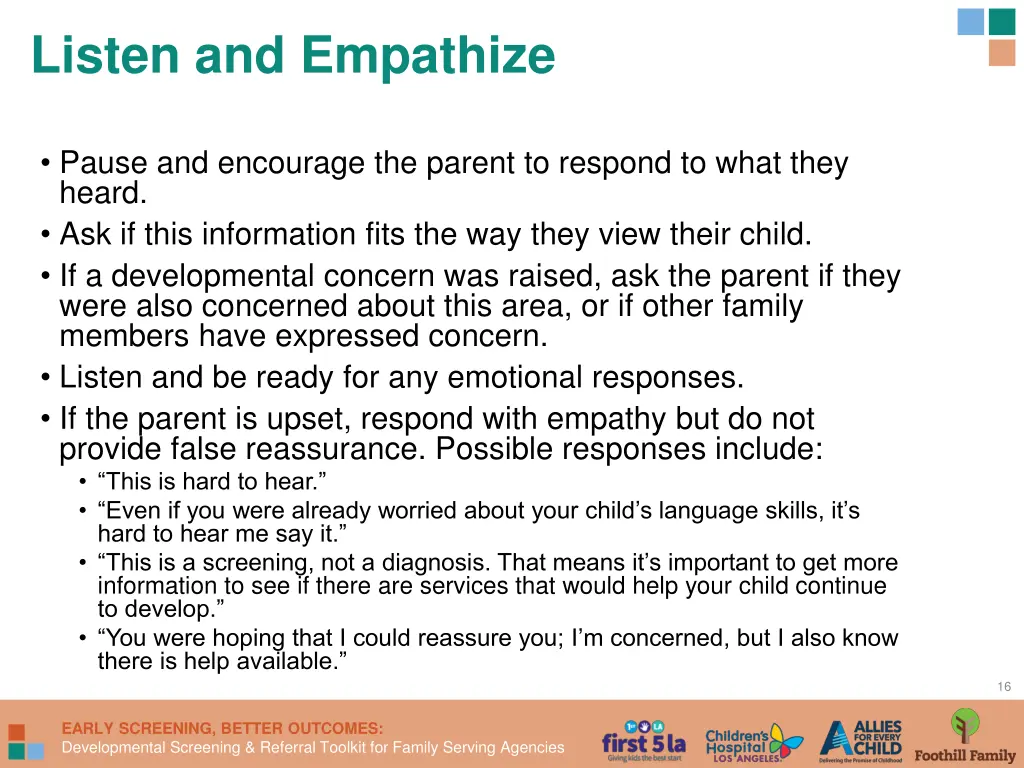
Listen and Empathize Pause and encourage the parent to respond to what they heard. Ask if this information fits the way they view their child. If a developmental concern was raised, ask the parent if they were also concerned about this area, or if other family members have expressed concern. Listen and be ready for any emotional responses. If the parent is upset, respond with empathy but do not provide false reassurance. Possible responses include: This is hard to hear. Even if you were already worried about your child s language skills, it s hard to hear me say it. This is a screening, not a diagnosis. That means it s important to get more information to see if there are services that would help your child continue to develop. You were hoping that I could reassure you; I m concerned, but I also know there is help available. 16 EARLY SCREENING, BETTER OUTCOMES: Developmental Screening & Referral Toolkit for Family Serving Agencies
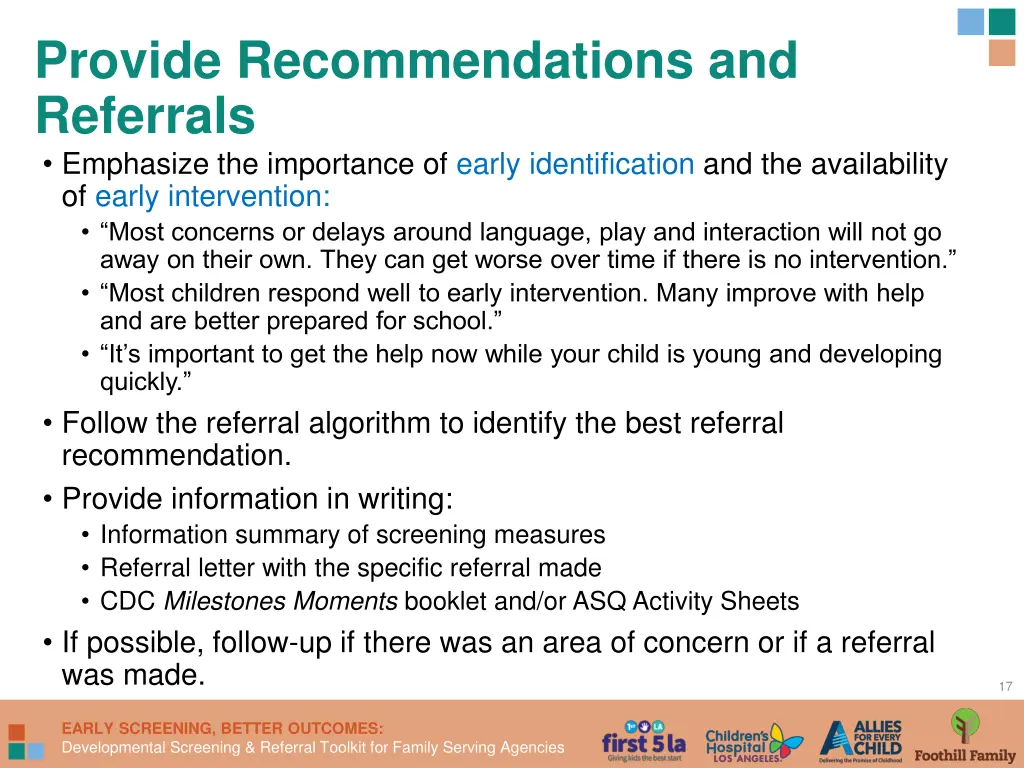
Provide Recommendations and Referrals Emphasize the importance of early identification and the availability of early intervention: Most concerns or delays around language, play and interaction will not go away on their own. They can get worse over time if there is no intervention. Most children respond well to early intervention. Many improve with help and are better prepared for school. It s important to get the help now while your child is young and developing quickly. Follow the referral algorithm to identify the best referral recommendation. Provide information in writing: Information summary of screening measures Referral letter with the specific referral made CDC Milestones Moments booklet and/or ASQ Activity Sheets If possible, follow-up if there was an area of concern or if a referral was made. 17 EARLY SCREENING, BETTER OUTCOMES: Developmental Screening & Referral Toolkit for Family Serving Agencies
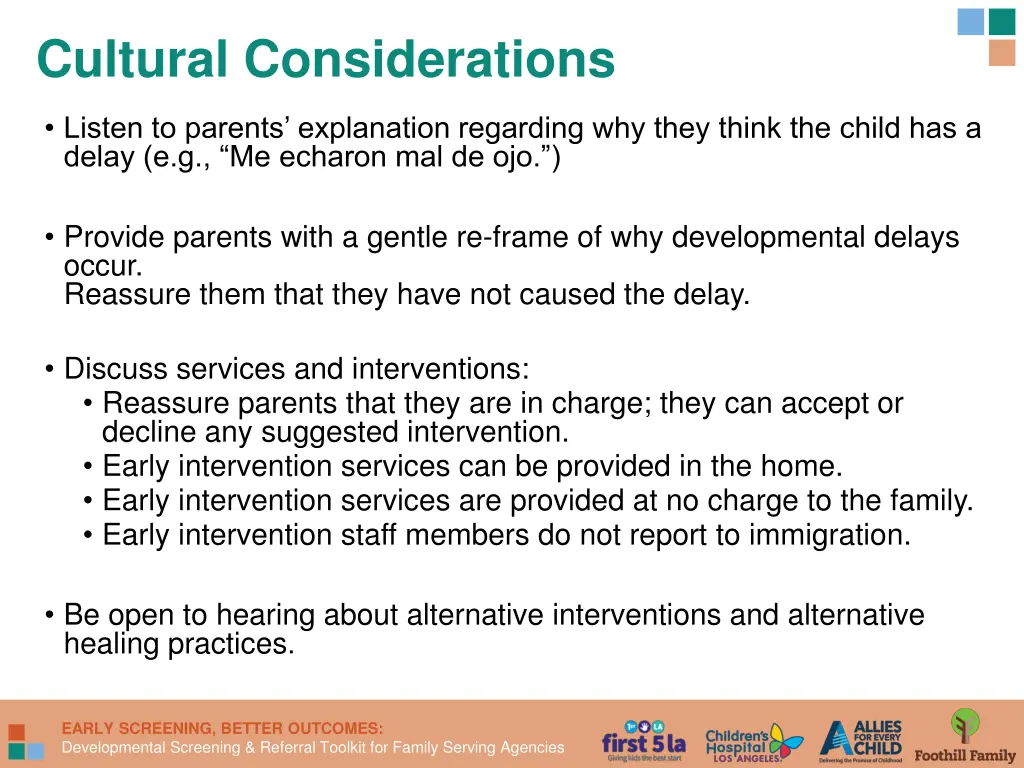
Cultural Considerations Listen to parents explanation regarding why they think the child has a delay (e.g., Me echaron mal de ojo. ) Provide parents with a gentle re-frame of why developmental delays occur. Reassure them that they have not caused the delay. Discuss services and interventions: Reassure parents that they are in charge; they can accept or decline any suggested intervention. Early intervention services can be provided in the home. Early intervention services are provided at no charge to the family. Early intervention staff members do not report to immigration. Be open to hearing about alternative interventions and alternative healing practices. EARLY SCREENING, BETTER OUTCOMES: Developmental Screening & Referral Toolkit for Family Serving Agencies
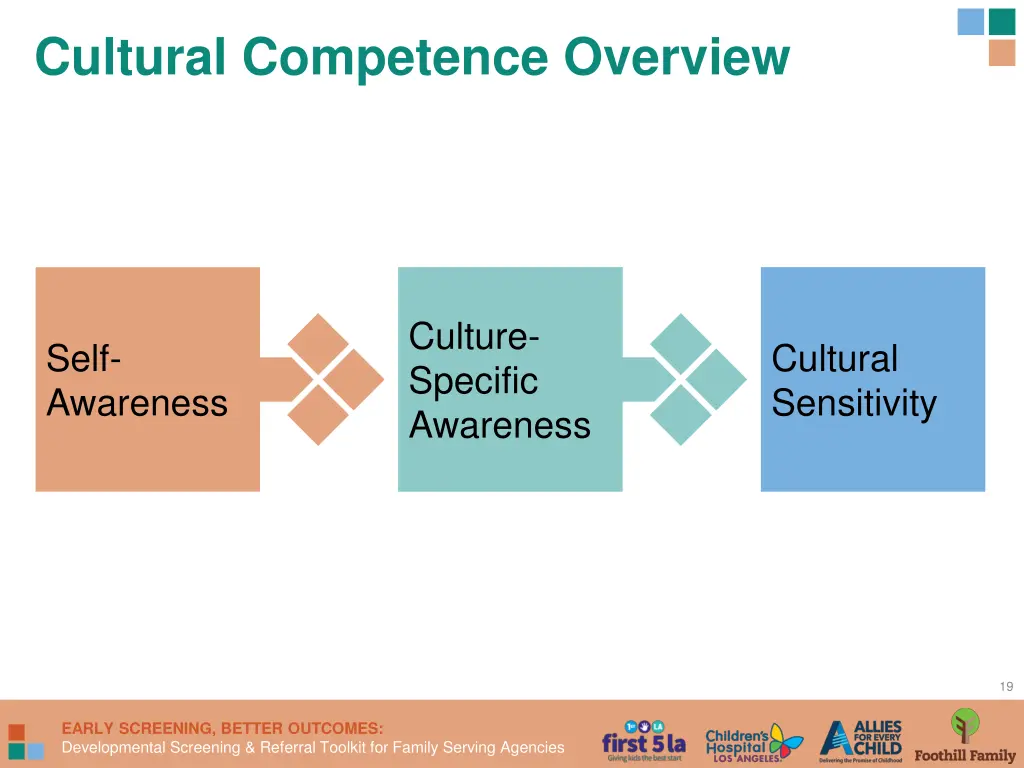
Cultural Competence Overview Culture- Specific Awareness Self- Awareness Cultural Sensitivity 19 EARLY SCREENING, BETTER OUTCOMES: Developmental Screening & Referral Toolkit for Family Serving Agencies
Cultural Competence Learn about one s own roots. Examine values, behaviors, beliefs and customs of one s own cultural heritage. Learn about others cultures and values. Consider diversity within and between cultural groups. Make no assumptions about concerns, priorities and resources. 20 EARLY SCREENING, BETTER OUTCOMES: Developmental Screening & Referral Toolkit for Family Serving Agencies
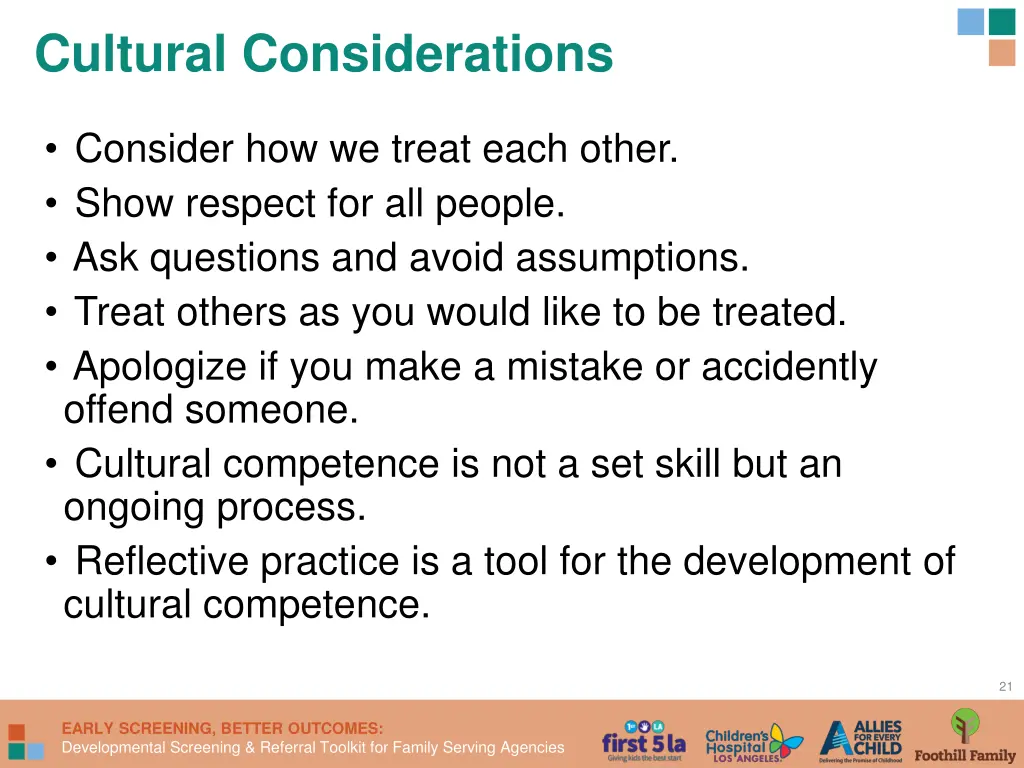
Cultural Considerations Consider how we treat each other. Show respect for all people. Ask questions and avoid assumptions. Treat others as you would like to be treated. Apologize if you make a mistake or accidently offend someone. Cultural competence is not a set skill but an ongoing process. Reflective practice is a tool for the development of cultural competence. 21 EARLY SCREENING, BETTER OUTCOMES: Developmental Screening & Referral Toolkit for Family Serving Agencies
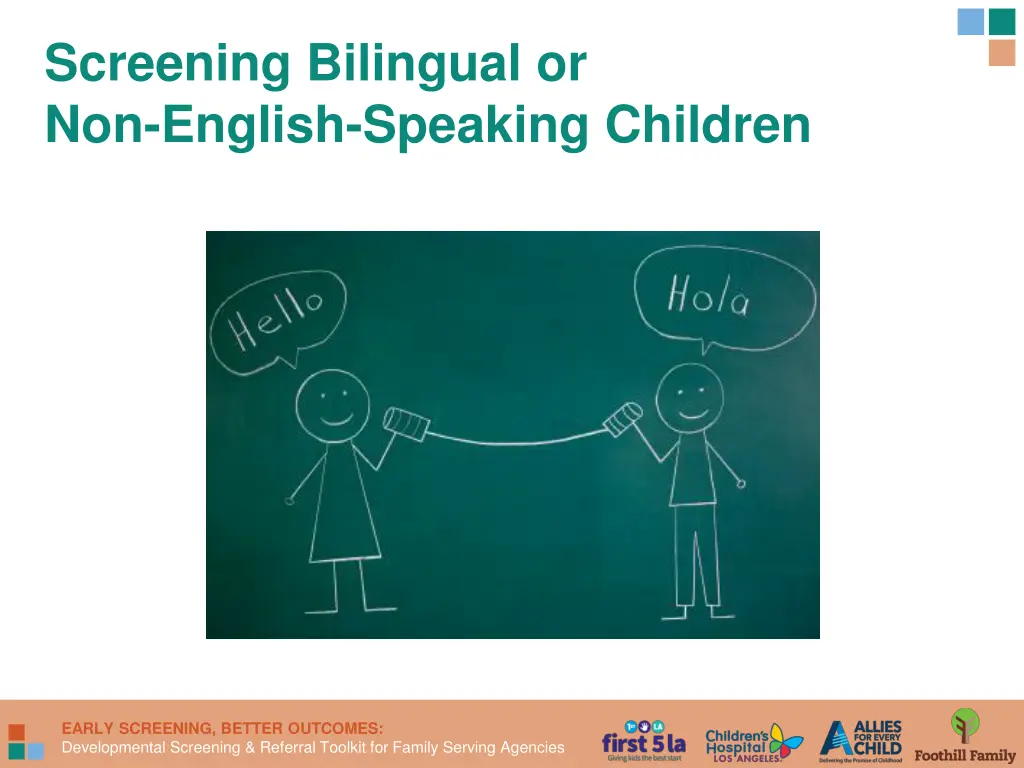
Screening Bilingual or Non-English-Speaking Children EARLY SCREENING, BETTER OUTCOMES: Developmental Screening & Referral Toolkit for Family Serving Agencies
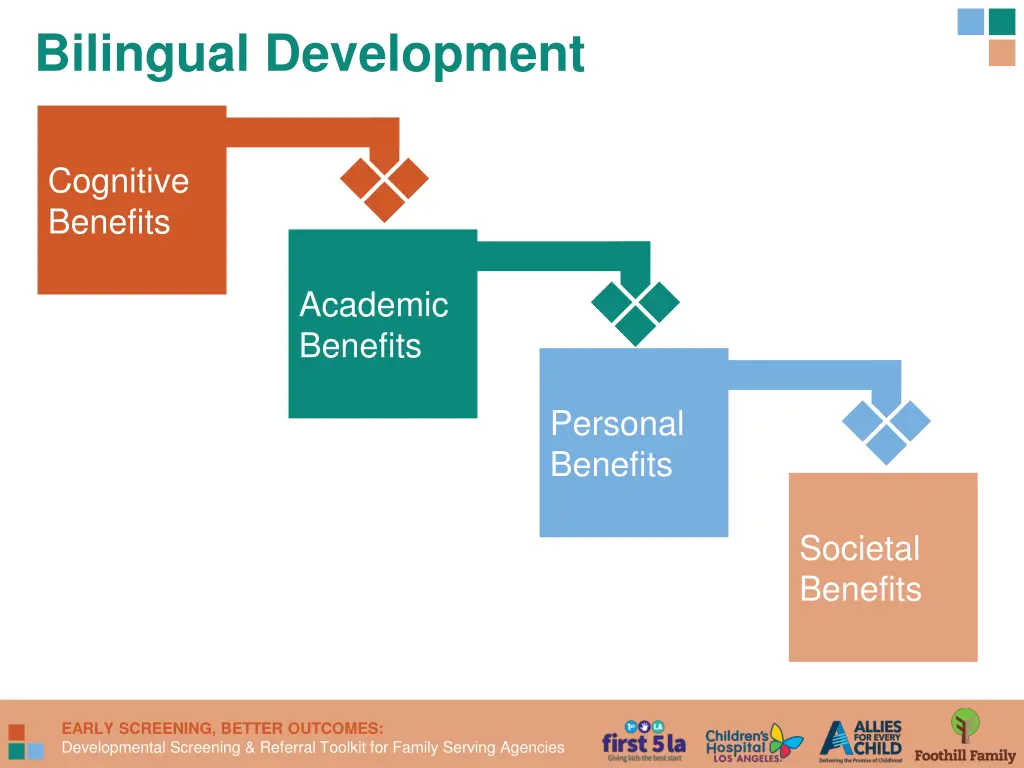
Bilingual Development Cognitive Benefits Academic Benefits Personal Benefits Societal Benefits EARLY SCREENING, BETTER OUTCOMES: Developmental Screening & Referral Toolkit for Family Serving Agencies
MYTHS AND FACTS About Bilingualism 24
MYTH 1 Bilingual children s language development will be delayed. 25 EARLY SCREENING, BETTER OUTCOMES: Developmental Screening & Referral Toolkit for Family Serving Agencies
FACT Language milestones are the same for bilingual and monolingual children. Classic study of 25 Spanish-English bilingual children and 35 children from monolingual homes. Language milestones were tracked from ages 8 to 30 months. Combining vocabulary in both languages, bilingual children had the same vocabulary as monolingual ones. If a bilingual child is not reaching typical milestones, seek help! It s not because he or she is being exposed to 2 languages. 26 EARLY SCREENING, BETTER OUTCOMES: Developmental Screening & Referral Toolkit for Family Serving Agencies
MYTH 2 Children are confused by exposure to two languages. 27 EARLY SCREENING, BETTER OUTCOMES: Developmental Screening & Referral Toolkit for Family Serving Agencies
FACT Some children may show cross-linguistic influence rules from the more dominant language may get applied incorrectly in the less dominant language. Code-switching between languages is common. This is a typical part of bilingual language development. Children are good at figuring out when/with whom they should use which language. Code-switching/code-mixing is not a sign of confusion or delay. 28 EARLY SCREENING, BETTER OUTCOMES: Developmental Screening & Referral Toolkit for Family Serving Agencies
MYTH 3 Children with developmental delays or autism will have more delays if exposed to two languages. 29 EARLY SCREENING, BETTER OUTCOMES: Developmental Screening & Referral Toolkit for Family Serving Agencies
FACT Children do not show additional delays when exposed to more than one language. In studies of children with autism, Down syndrome, and specific language impairment: No difference in language development was found between bilingual vs. monolingual children. Even if a child has delays, exposure to more than one language is not harmful. 30 EARLY SCREENING, BETTER OUTCOMES: Developmental Screening & Referral Toolkit for Family Serving Agencies
Encourage Bilingual Language Development Advising parents to switch to a non-native language in the home can: Negatively impact family relationships, as language is strongly connected with family culture. Cause communication breakdowns. Lead to parental stress. Lead to parents providing a less rich language model to their child. EARLY SCREENING, BETTER OUTCOMES: Developmental Screening & Referral Toolkit for Family Serving Agencies
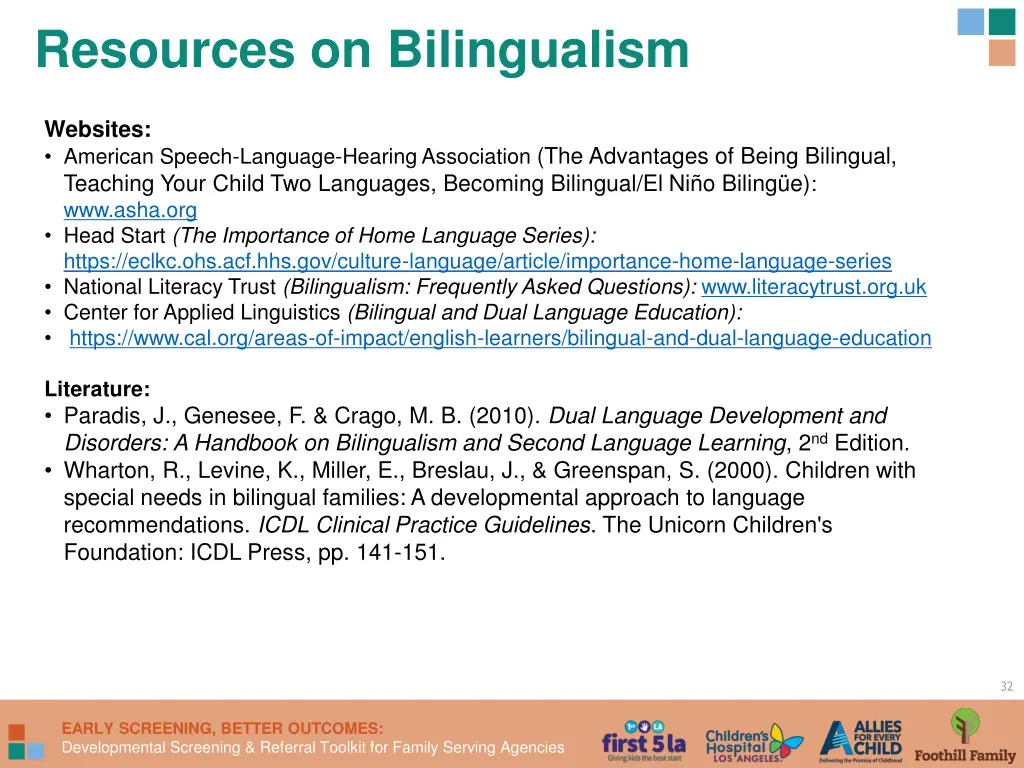
Resources on Bilingualism Websites: American Speech-Language-Hearing Association (The Advantages of Being Bilingual, Teaching Your Child Two Languages, Becoming Bilingual/El Ni o Biling e): www.asha.org Head Start (The Importance of Home Language Series): https://eclkc.ohs.acf.hhs.gov/culture-language/article/importance-home-language-series National Literacy Trust (Bilingualism: Frequently Asked Questions): www.literacytrust.org.uk Center for Applied Linguistics (Bilingual and Dual Language Education): https://www.cal.org/areas-of-impact/english-learners/bilingual-and-dual-language-education Literature: Paradis, J., Genesee, F. & Crago, M. B. (2010). Dual Language Development and Disorders: A Handbook on Bilingualism and Second Language Learning, 2nd Edition. Wharton, R., Levine, K., Miller, E., Breslau, J., & Greenspan, S. (2000). Children with special needs in bilingual families: A developmental approach to language recommendations. ICDL Clinical Practice Guidelines. The Unicorn Children's Foundation: ICDL Press, pp. 141-151. 32 EARLY SCREENING, BETTER OUTCOMES: Developmental Screening & Referral Toolkit for Family Serving Agencies
Practice Talking to Parents About Screening Results 33
Martha, age 9 months Martha is a 9-month-old girl. Her mother brings her to an intake appointment. She does not complete the screening questionnaire. She says, Martha is a baby and she s doing fine. You know that Martha was removed for four weeks from her parents care due to domestic violence. Martha is now reunified with her mother. How would you address the mother s concerns about completing the measure? Practice talking to Martha s mother about the screening process. 34 EARLY SCREENING, BETTER OUTCOMES: Developmental Screening & Referral Toolkit for Family Serving Agencies
Robert, age 24 months Robert is a 24-month-old boy. His father completed the ASQ-3and ASQ:SE-2. However, he did not report any concerns about Robert and was not aware that Robert had delays. Results from the ASQ-3 indicated delays on the following scales: Communication, Fine and Gross Motor, and Problem-Solving. Robert s father became upset when you started sharing the results. Practice sharing screening results with Robert s father. 35 EARLY SCREENING, BETTER OUTCOMES: Developmental Screening & Referral Toolkit for Family Serving Agencies
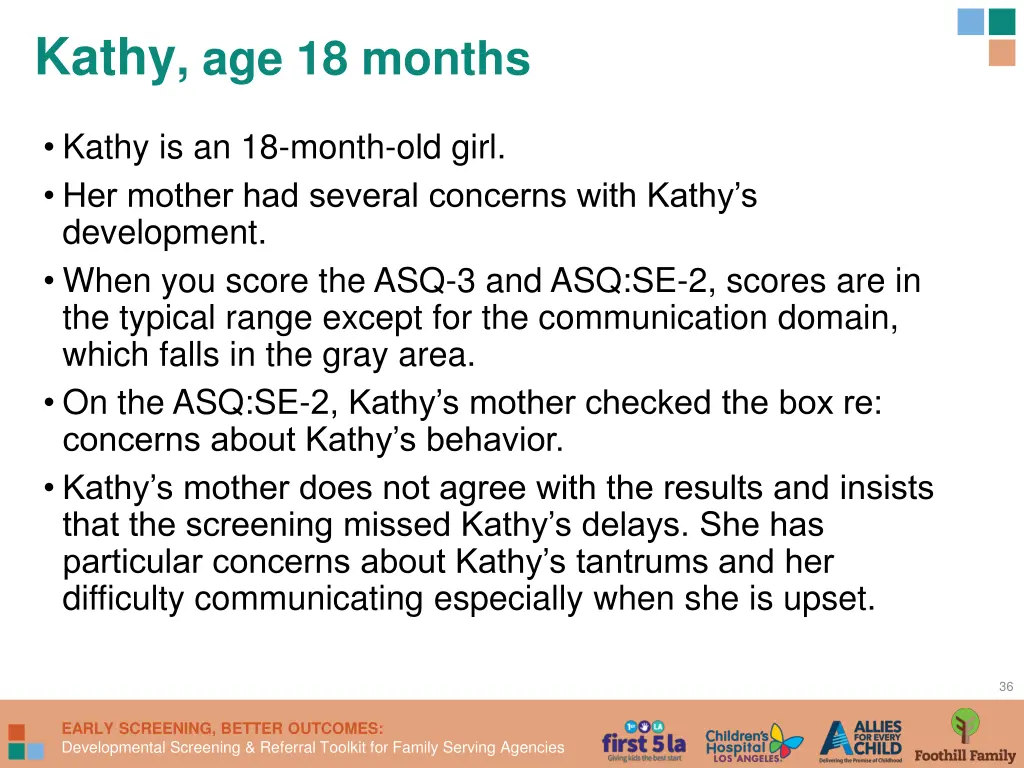
Kathy, age 18 months Kathy is an 18-month-old girl. Her mother had several concerns with Kathy s development. When you score the ASQ-3 and ASQ:SE-2, scores are in the typical range except for the communication domain, which falls in the gray area. On the ASQ:SE-2, Kathy s mother checked the box re: concerns about Kathy s behavior. Kathy s mother does not agree with the results and insists that the screening missed Kathy s delays. She has particular concerns about Kathy s tantrums and her difficulty communicating especially when she is upset. 36 EARLY SCREENING, BETTER OUTCOMES: Developmental Screening & Referral Toolkit for Family Serving Agencies