Effective Strategies for Implementing Stretch and Challenge Practices
Explore pedagogical approaches, share effective strategies, and reflect on implementation to enhance stretch and challenge practices in classrooms. Engage in staff audits, discussions, coaching conversations, and scheme modifications to support student autonomy and excellence.

Download Presentation

Please find below an Image/Link to download the presentation.
The content on the website is provided AS IS for your information and personal use only. It may not be sold, licensed, or shared on other websites without obtaining consent from the author. If you encounter any issues during the download, it is possible that the publisher has removed the file from their server.
You are allowed to download the files provided on this website for personal or commercial use, subject to the condition that they are used lawfully. All files are the property of their respective owners.
The content on the website is provided AS IS for your information and personal use only. It may not be sold, licensed, or shared on other websites without obtaining consent from the author.
E N D
Presentation Transcript
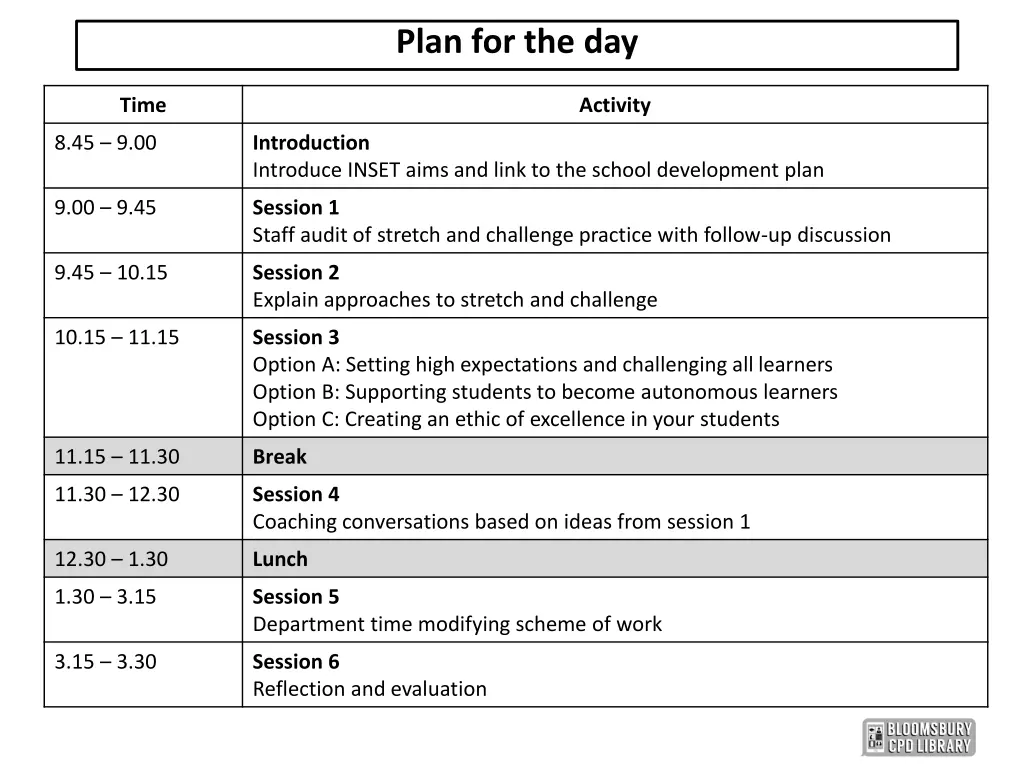
Plan for the day Time Activity 8.45 9.00 Introduction Introduce INSET aims and link to the school development plan 9.00 9.45 Session 1 Staff audit of stretch and challenge practice with follow-up discussion 9.45 10.15 Session 2 Explain approaches to stretch and challenge 10.15 11.15 Session 3 Option A: Setting high expectations and challenging all learners Option B: Supporting students to become autonomous learners Option C: Creating an ethic of excellence in your students 11.15 11.30 Break 11.30 12.30 Session 4 Coaching conversations based on ideas from session 1 12.30 1.30 Lunch 1.30 3.15 Session 5 Department time modifying scheme of work 3.15 3.30 Session 6 Reflection and evaluation
STRETCH AND CHALLENGE INSET aims 1. To understand the different pedagogical approaches to stretch and challenge. 2. To share effective strategies based on research. 3. To reflect on how to implement these strategies with our own classes. 4. To modify current schemes of work in light of approaches and strategies discussed in earlier sessions.
STRETCH AND CHALLENGE Session 1: Stretch and challenge audit How confident are you in planning and delivering effective stretch and challenge for all of your students? Complete your stretch and challenge audit to judge your starting point for today s INSET and consider how you would like to move forward with your practice.
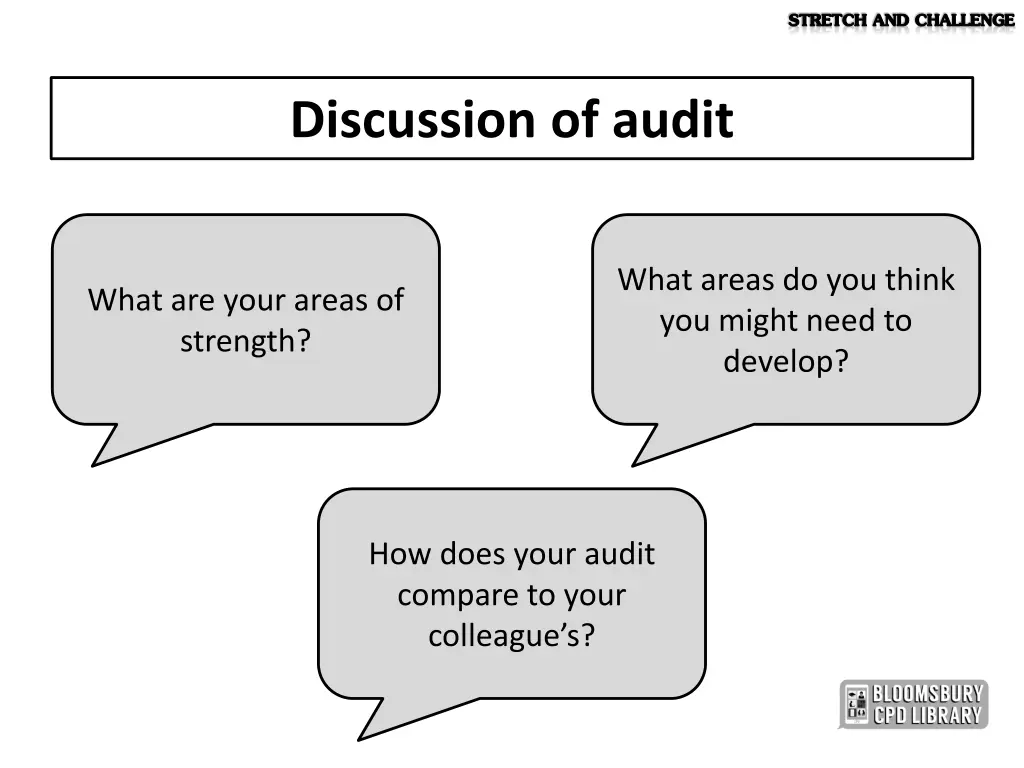
STRETCH AND CHALLENGE Discussion of audit What areas do you think you might need to develop? What are your areas of strength? How does your audit compare to your colleague s?
STRETCH AND CHALLENGE Session 2: Approaches to stretch and challenge Look at the cards with different approaches teachers could use to ensure all students are appropriately challenged in your lessons. Which approaches do you use already? What are the pros and cons of using each approach?
STRETCH AND CHALLENGE Approaches to stretch and challenge Now as a department, think of the schemes of work you teach. Which approaches are embedded into your schemes of work? Which approaches need further consideration in your schemes of work? This will be the focus of your department time this afternoon.
STRETCH AND CHALLENGE Session 3: Specific workshops Option A developing stretch and challenge practice Setting high expectations and challenging all learners. Option B securing stretch and challenge practice Supporting students to become autonomous learners. Option C embedding stretch and challenge practice Creating an ethic of excellence in your students.
STRETCH AND CHALLENGE Session 3: Option A: Aims Developing stretch and challenge practice Setting high expectations and challenging all learners. Aims: To explore the importance of framing and sharing lesson objectives and outcomes with students. To explore the importance of framing and sharing success criteria with students. To explore the importance of task design to ensure all students can meet their learning objective.
STRETCH AND CHALLENGE Session 3 Option A: Questions Questions for discussion: What is the difference between an objective and an outcome? How do you frame your objective and outcomes to ensure they offer challenge? How do you share your objective and outcomes with your students?
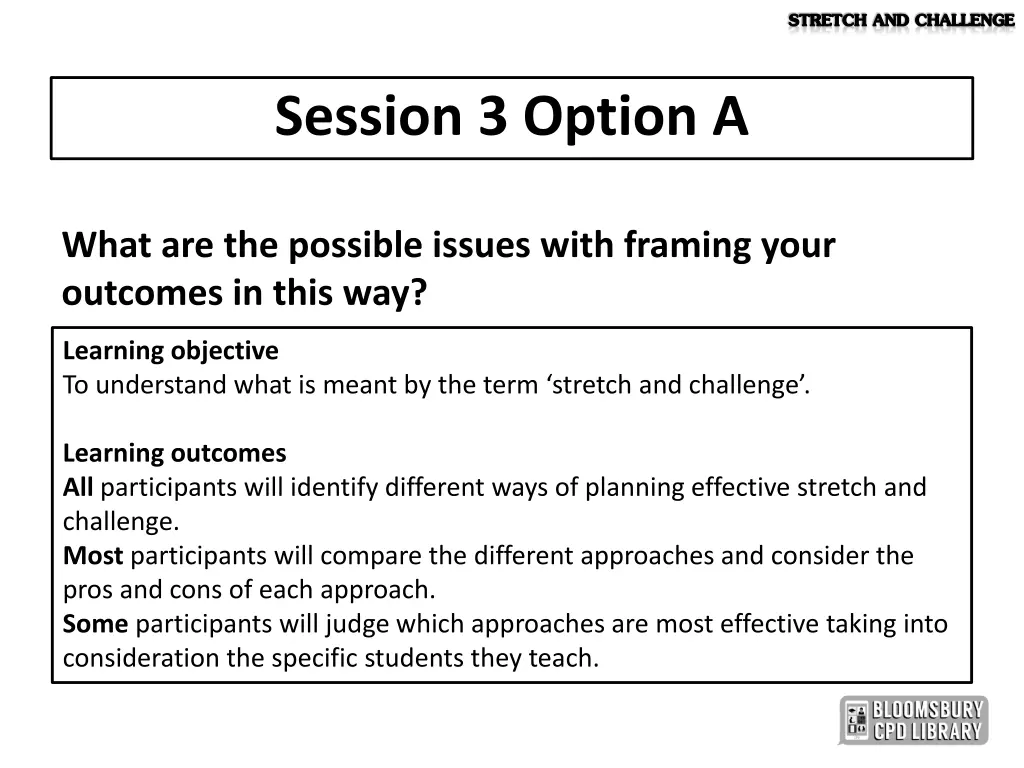
STRETCH AND CHALLENGE Session 3 Option A What are the possible issues with framing your outcomes in this way? Learning objective To understand what is meant by the term stretch and challenge . Learning outcomes All participants will identify different ways of planning effective stretch and challenge. Most participants will compare the different approaches and consider the pros and cons of each approach. Some participants will judge which approaches are most effective taking into consideration the specific students they teach.
STRETCH AND CHALLENGE Session 3 Option A What is your reaction to John Hattie speaking about challenging all students? www.youtube.com/watch?v=Gz-_DyMj2iQ Discuss with the person sitting next to you how you decide what would be a series of challenging outcomes for the full range of students you teach?
STRETCH AND CHALLENGE Session 3 Option A What is your reaction to Dylan Wiliam speaking about the role of formative assessment in challenging students? www.youtube.com/watch?v=B3HRvFsZHoo (until 1.45 mins)
STRETCH AND CHALLENGE Session 3 Option A Why is forming success criteria important in stretching students to achieve well? Listen to John Hattie discussing the importance of success criteria in accelerating learning. www.youtube.com/watch?v=dvzeou_u2hM Discuss with the person sitting next to you the ways in which you visibly construct success criteria. How do you show students that the different aspects of the criteria become progressively more challenging?
STRETCH AND CHALLENGE Session 3 Option A: Practice task Think of a topic you are going to teach next week and a piece of work you would assess and give feedback on. Construct the success criteria for it now. After, you will have to explain to the person sitting next to you the following: What is the assessment? What would be the ingredients of an excellent example of this assessment? How have you broken this down to help the students unpick how to get there? What choices have you made visually to help the students make use of the criteria and understand how to challenge themselves?
STRETCH AND CHALLENGE Session 3 Option A: Practice task Think of a topic you are going to teach next week and the key learning objective. Consider the range of learners in your class. What levels of challenge can you build into a task to help all students meet their learning objective? After, you will have to explain to the person sitting next to you the following: What are the fundamentals of the task that you would expect all students to do? How can you tweak the task to offer further support for those students who may struggle? How can you tweak the task to offer further stretch for those students who are finding it too easy? Remember that offering more of the same is not stretching students cognitively. Likewise, making students do something easy isn t supporting them; it s lowering your expectations.
Session 3 Option A: Reflection Aims: To explore the importance of framing and sharing lesson objectives and outcomes with students. To explore the importance of framing and sharing success criteria with students. To explore the importance of task design to ensure all students can meet their learning objective. Individual reflection In the next session, you will be in a coaching partnership to explore how these strategies could work with particular classes you teach. Take a minute to think about which strategies you want to work on and with whom.
STRETCH AND CHALLENGE Session 3 Option B: Aims Securing stretch and challenge practice Supporting students to become autonomous learners. Aims: To explore the importance of collaborative working in developing independence from the teacher. To explore the importance of developing resilience when students are struggling. To explore the importance of scaffolds and when to use them to support students.
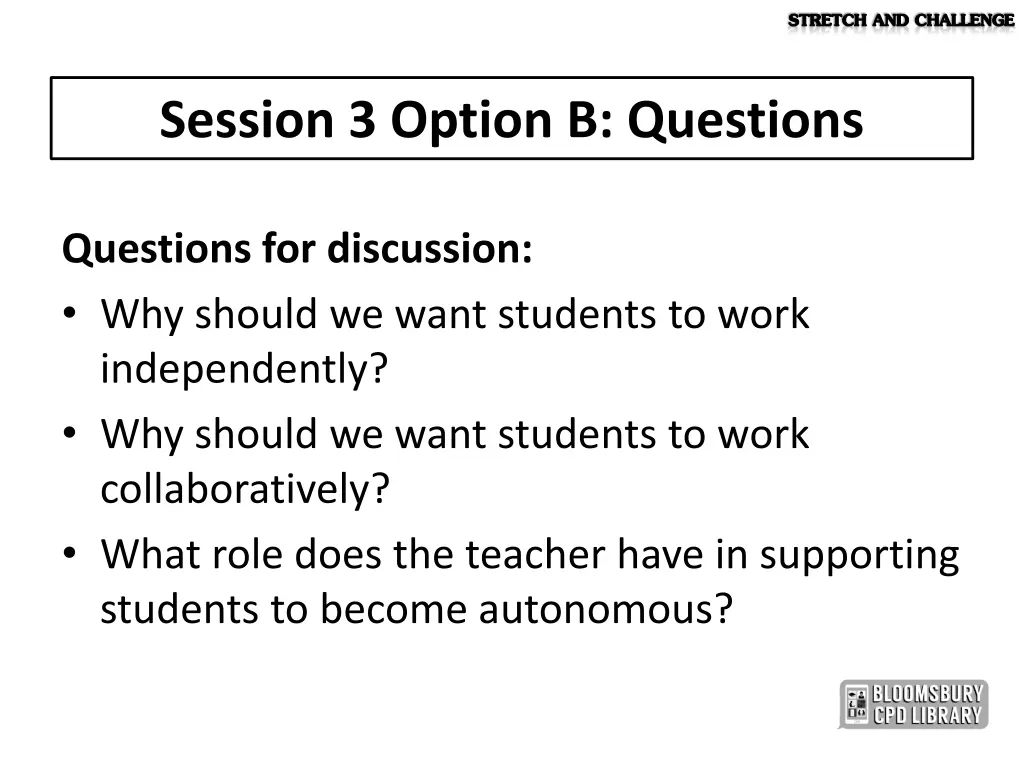
STRETCH AND CHALLENGE Session 3 Option B: Questions Questions for discussion: Why should we want students to work independently? Why should we want students to work collaboratively? What role does the teacher have in supporting students to become autonomous?
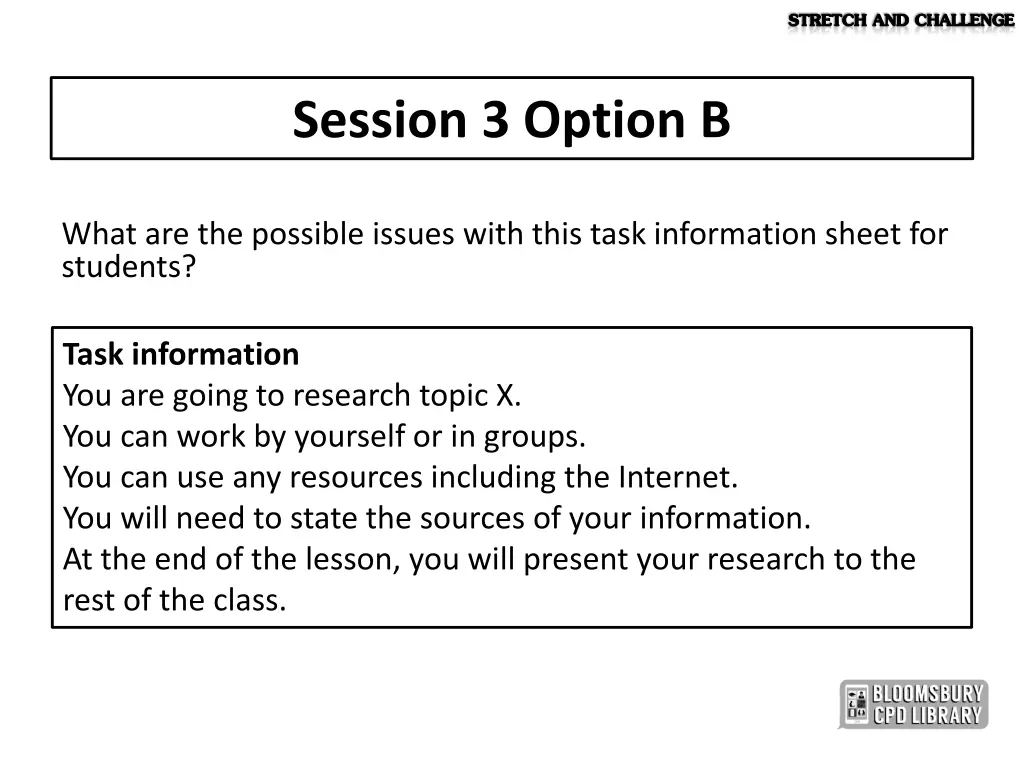
STRETCH AND CHALLENGE Session 3 Option B What are the possible issues with this task information sheet for students? Task information You are going to research topic X. You can work by yourself or in groups. You can use any resources including the Internet. You will need to state the sources of your information. At the end of the lesson, you will present your research to the rest of the class.
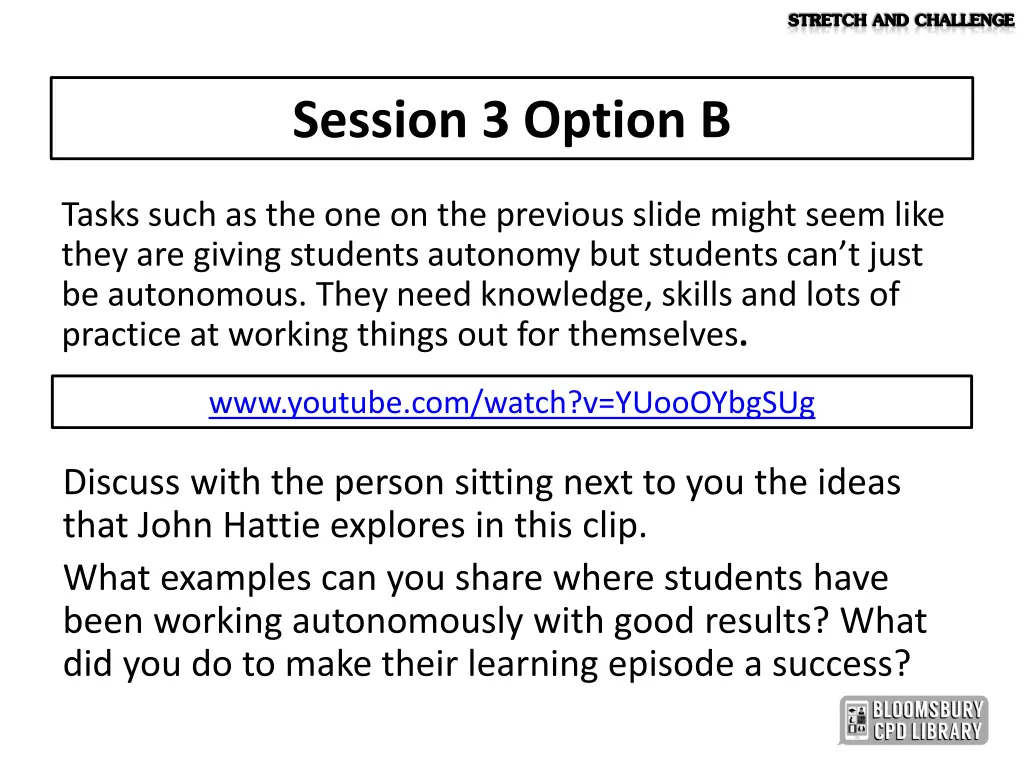
STRETCH AND CHALLENGE Session 3 Option B Tasks such as the one on the previous slide might seem like they are giving students autonomy but students can t just be autonomous. They need knowledge, skills and lots of practice at working things out for themselves. www.youtube.com/watch?v=YUooOYbgSUg Discuss with the person sitting next to you the ideas that John Hattie explores in this clip. What examples can you share where students have been working autonomously with good results? What did you do to make their learning episode a success?
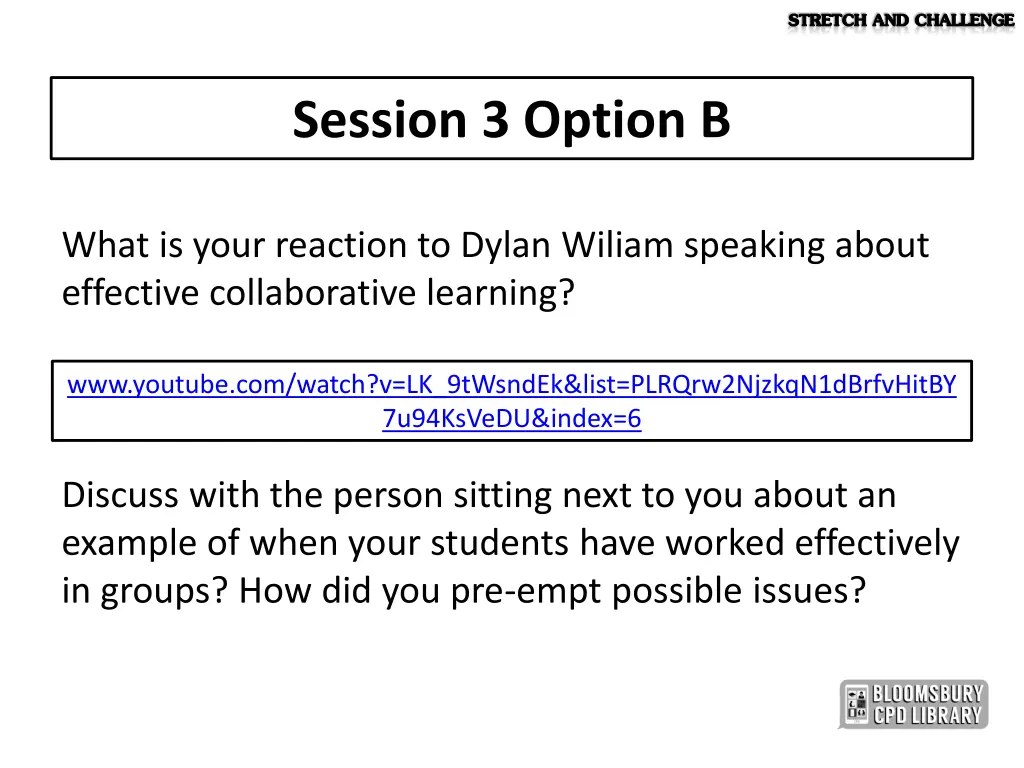
STRETCH AND CHALLENGE Session 3 Option B What is your reaction to Dylan Wiliam speaking about effective collaborative learning? www.youtube.com/watch?v=LK_9tWsndEk&list=PLRQrw2NjzkqN1dBrfvHitBY 7u94KsVeDU&index=6 Discuss with the person sitting next to you about an example of when your students have worked effectively in groups? How did you pre-empt possible issues?
STRETCH AND CHALLENGE Session 3 Option B: Practice task Think of a topic you are going to teach next week and the learning outcomes. Modify this learning so that it becomes a collaborative learning episode as opposed to students working individually directed by the teacher. After, you will have to explain to the person sitting next to you the following: What was the original task? How are you establishing group goals? How are you establishing individual accountability? How have you structured and scaffolded the task so that students have some autonomy and are not looking for you to spoon-feed them?
STRETCH AND CHALLENGE Session 3 Option B When students are required to work independently, there is an element of risk involved as the teacher is stepping back. Students will need to be resilient when faced with learning they find difficult. Listen to Carol Dweck speak about the importance of mindset. www.youtube.com/watch?v=wh0OS4MrN3E Discuss with the person sitting next to you the ideas that Carol Dweck explores in this clip. What strategies could you use to help students become more resilient when they find learning difficult?
STRETCH AND CHALLENGE Session 3 Option B: Practice task Think of a topic you are going to teach and something that students normally find quite difficult to do. Create a series of scaffolds that students can use to help them work independently and persevere when they begin to struggle. After, you will have to explain to the person sitting next to you the following: What scaffold have you provided for students who are really out of their comfort zone and would normally require a lot of teacher input? What scaffold have you provided for students who are anxious about starting but are fine once they ve got started? What scaffold have you provided for students who generally work well by themselves but often don t get to the more advanced level of thinking? What strategies will you use to ensure that some students don t rely on the scaffold if they are capable of working without one?
STRETCH AND CHALLENGE Session 3 Option B: Reflection Aims: To explore the importance of collaborative working in developing independence from the teacher. To explore the importance of developing resilience when students are struggling. To explore the importance of scaffolds and when to use them to support students. Individual reflection In the next session, you will be in a coaching partnership to explore how these strategies could work with particular classes you teach. Take a minute to think about which strategies you want to work on and with whom.
STRETCH AND CHALLENGE Session 3 Option C: Aims Embedding stretch and challenge practice Creating an ethic of excellence in your students. Aims: To explore the importance of sharing examples of excellence with students. To explore the importance of creating a culture of critique with students. To explore the importance of students taking responsibility for developing their own learning.
STRETCH AND CHALLENGE Session 3 Option C: Questions Questions for discussion: What are the hallmarks of an excellent piece of work in your subject? What are the difficulties in getting students to self- and peer-assess? How can students be forced to take greater responsibility for their own learning?
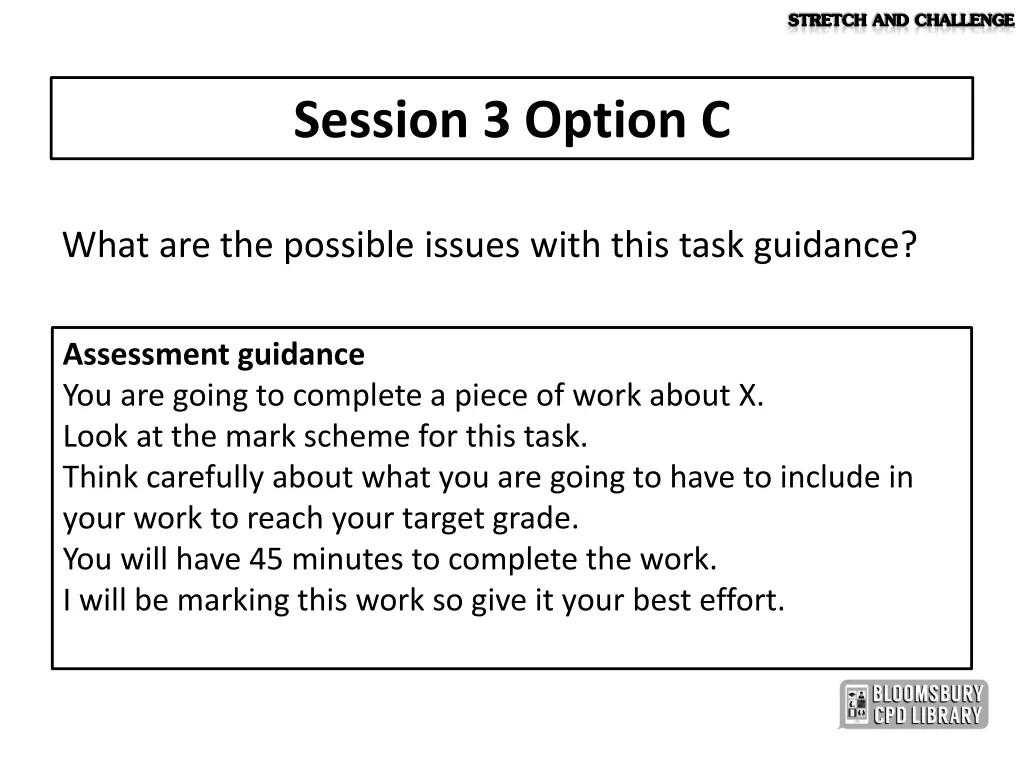
STRETCH AND CHALLENGE Session 3 Option C What are the possible issues with this task guidance? Assessment guidance You are going to complete a piece of work about X. Look at the mark scheme for this task. Think carefully about what you are going to have to include in your work to reach your target grade. You will have 45 minutes to complete the work. I will be marking this work so give it your best effort.
STRETCH AND CHALLENGE Session 3 Option C What is your reaction to John Hattie speaking about teaching methods that have the most impact on student achievement? www.youtube.com/watch?v=TD_yQNk7X3w (5.44 - 12.17) Discuss with the person sitting next to you about how you set up your classroom to allow students to learn and reach for excellence. What constraints are there that might hinder teachers from this ideal that Hattie discusses in this clip?
STRETCH AND CHALLENGE Session 3 Option C: Practice task Think about the expectations you share with your students about what you want them to be like in your lessons. Consider what language you would need to use to make explicit to students that you are only interested in them creating excellent work. Draft out a set of subject-specific expectations to share with a class you teach. After, you will have to explain to the person sitting next to you the following: What would an excellent student in your subject be able to know and do? What have you prioritised as important? What language have you used to show that excellence can be achieved in your class? What would you have to change in your current classroom practice and routines to enable a culture of excellence?
STRETCH AND CHALLENGE Session 3 Option C What is your reaction to this clip of Ron Berger explaining the process of critique and how it can create excellence? [https://www.youtube.com/watch?v=1znB1ox0_EI] Discuss with the person sitting next to you the benefits of creating a culture of critique in a class? How might this be more useful than more general peer assessment strategies we are used to using?
STRETCH AND CHALLENGE Session 3 Option C: Practice task Think about an assessment in a scheme of work you teach. Begin with the end and describe all the features that would make the work excellent. Then break down the stages to give specific feedback to help a student get to that point of excellence. After, you will have to explain to the person sitting next to you the following: What are the hallmarks of excellence? Which aspects do students struggle with normally? How can this feedback help them to overcome these moments of difficulty?
STRETCH AND CHALLENGE Session 3 Option C What is your reaction to this clip of Dylan Wiliam talking about teacher feedback and the impact it can have on students achievement? What routines do you use with your students to support them in taking responsibility for improving their learning. www.youtube.com/watch?v=MzDuiqaGqAY Now listen to this study carried out by Carol Dweck about the use of praise. Do any of the findings surprise you? www.youtube.com/watch?v=NWv1VdDeoRY
STRETCH AND CHALLENGE Session 3 Option C: Reflection Aims: To explore the importance of sharing examples of excellence with students. To explore the importance of creating a culture of critique with students. To explore the importance of students taking responsibility for developing their own learning. Individual reflection In the next session, you will be in a coaching partnership to explore how these strategies could work with particular classes you teach. Take a minute to think about which strategies you want to work on and with whom.
STRETCH AND CHALLENGE Session 4: Coaching conversations Aims: To reflect on your current practice for providing challenge for all learners. To coach another member of staff to move forward with their stretch and challenge provision to improve student outcomes. To receive coaching from another member of staff to move forward with your stretch and challenge provision to improve student outcomes.
STRETCH AND CHALLENGE Research into effectiveness of coaching The reflection promoted by effective mentoring and coaching approaches in turn encourages a collaborative learning culture in organisations. For schools, this is particularly important, as it may alleviate some of the sense of professional isolation. Mentoring and coaching activities may be more influential when they fit the wider context of an organisation, and/or when they are part of a wider programme of professional development. (Lord et al. (2008), Mentoring and Coaching for Professionals: A Study of the Research Evidence, NFER, p. viii)
STRETCH AND CHALLENGE Tips for effective coaching conversations Do not give your partner the answers! Actively listen to what they are saying and read between the lines. Ask open-ended questions that will encourage them to reflect on their practice. Encourage them to consider a range of options. Get them to commit to trying something and articulate what impact they hope it will have on the students.
STRETCH AND CHALLENGE Deciding on a focus Think back to the first session. What was your takeaway from the session something that grabbed you as important about your practice. What do you want to focus on with a particular class? This is going to form the basis of your coaching conversation. Share now with your coaching partner what you have chosen.
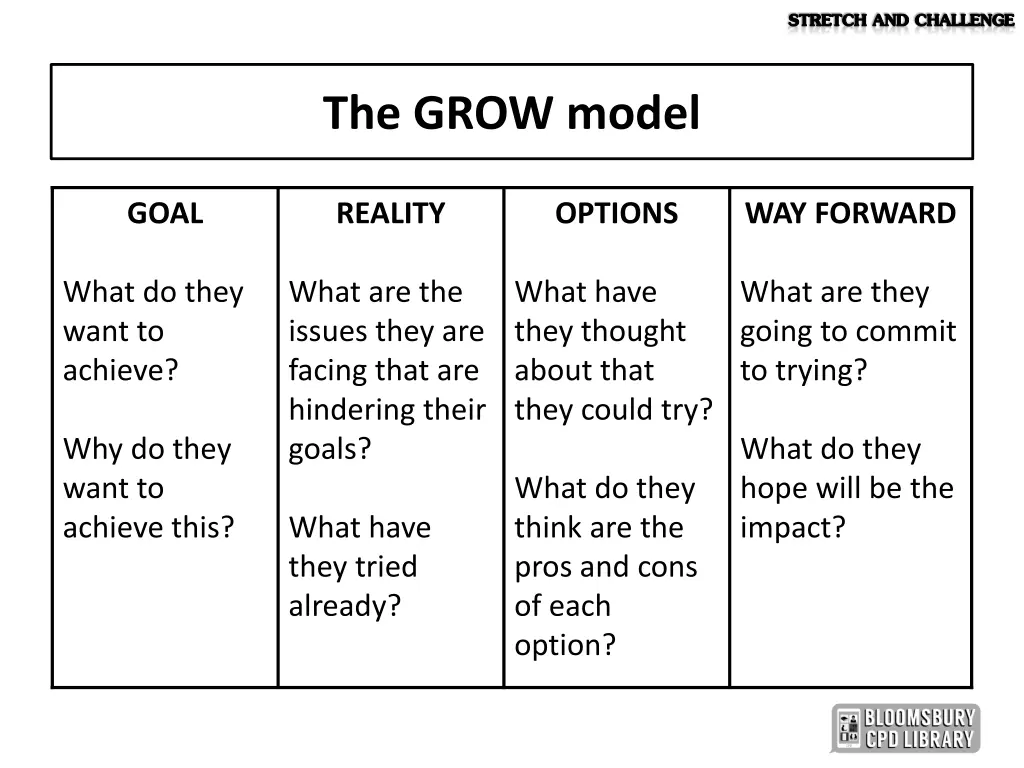
STRETCH AND CHALLENGE The GROW model GOAL REALITY OPTIONS WAY FORWARD What do they want to achieve? What are the issues they are facing that are hindering their goals? What have they thought about that they could try? What are they going to commit to trying? Why do they want to achieve this? What do they hope will be the impact? What do they think are the pros and cons of each option? What have they tried already?
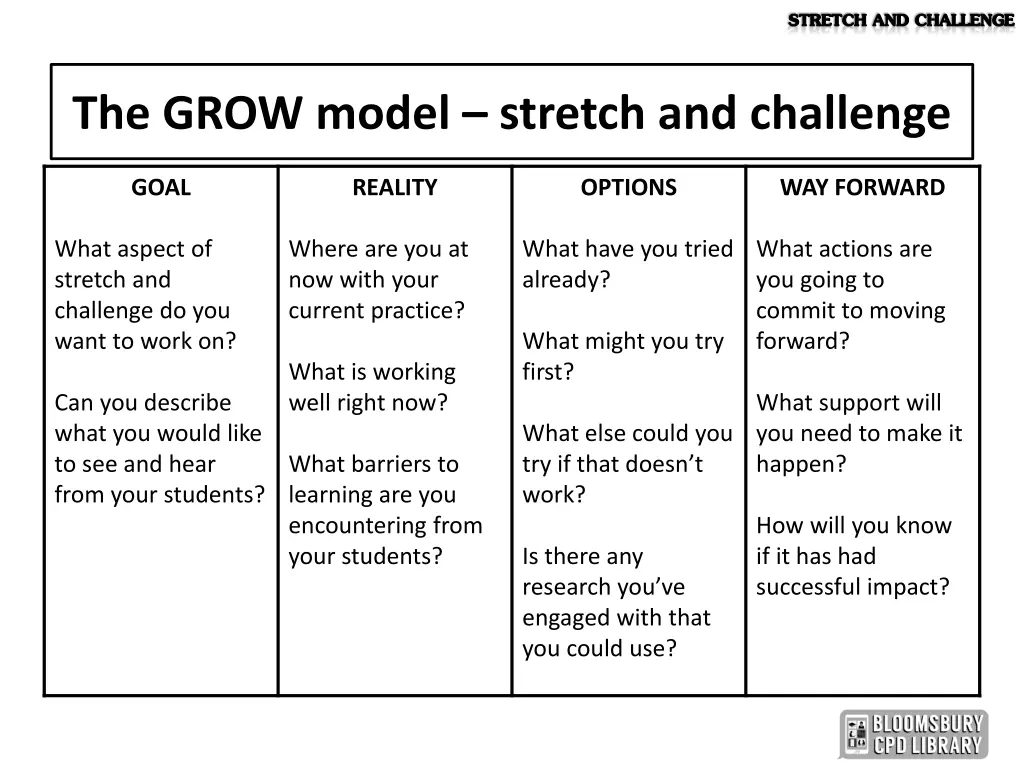
STRETCH AND CHALLENGE The GROW model stretch and challenge GOAL REALITY OPTIONS WAY FORWARD What aspect of stretch and challenge do you want to work on? Where are you at now with your current practice? What have you tried already? What actions are you going to commit to moving forward? What might you try first? What is working well right now? Can you describe what you would like to see and hear from your students? What support will you need to make it happen? What else could you try if that doesn t work? What barriers to learning are you encountering from your students? How will you know if it has had successful impact? Is there any research you ve engaged with that you could use?
STRETCH AND CHALLENGE Coaching to develop stretch and challenge practice The rest of the session will be split into two to allow each person in the coaching pair to be coached. At the end of the session, each person will write down and pass to the CPD leader what they are going to be working on over the term. This will be achieved through participation in the range of CPD opportunities we have available at school.
STRETCH AND CHALLENGE Session 5: Modifying schemes of work Aims: To share with colleagues what has been learnt from earlier sessions and how this might affect the department s approach to providing effective stretch and challenge. To reflect on the stretch and challenge provided in your existing scheme of work. To modify aspects of your existing scheme of work to increase the level of challenge all students experience in your subject.
STRETCH AND CHALLENGE Session 5: Modifying schemes of work Staff will now work in departments to modify an existing scheme of work. Use the table provided to guide you in what you should focus on to develop the learning experiences for all students in your subject. At the end of the session, the head of department will pass the completed table to their SLT line manager to be discussed at SLT meeting.
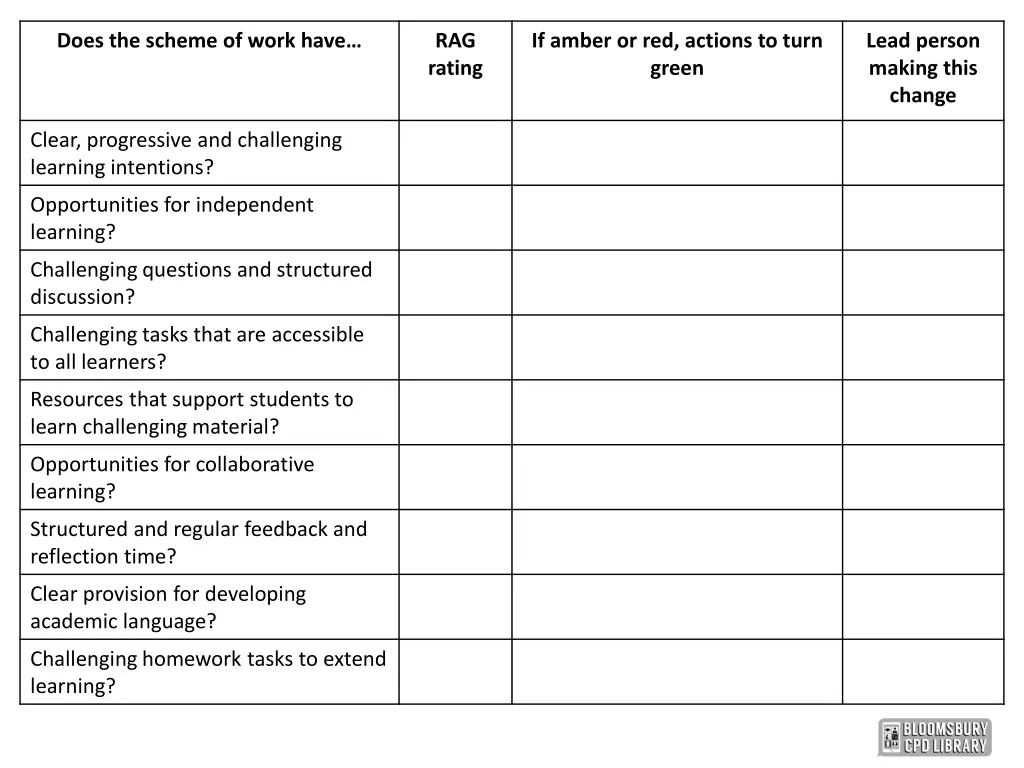
Does the scheme of work have RAG rating If amber or red, actions to turn green Lead person making this change Clear, progressive and challenging learning intentions? Opportunities for independent learning? Challenging questions and structured discussion? Challenging tasks that are accessible to all learners? Resources that support students to learn challenging material? Opportunities for collaborative learning? Structured and regular feedback and reflection time? Clear provision for developing academic language? Challenging homework tasks to extend learning?
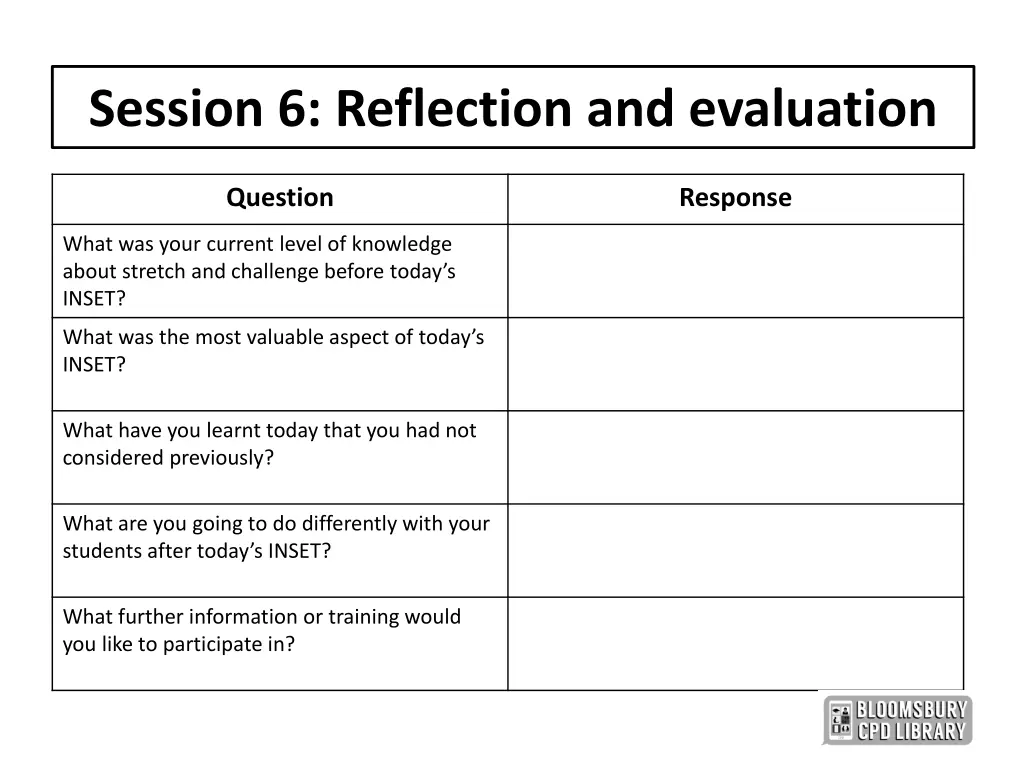
STRETCH AND CHALLENGE Session 6: Reflection and evaluation Aims: To reflect on what has been learnt in today s INSET. To consider how the ideas from today will shape teachers practice. To commit to follow-up actions to carry the learning from today forward into the classroom.
Session 6: Reflection and evaluation Question Response What was your current level of knowledge about stretch and challenge before today s INSET? What was the most valuable aspect of today s INSET? What have you learnt today that you had not considered previously? What are you going to do differently with your students after today s INSET? What further information or training would you like to participate in?