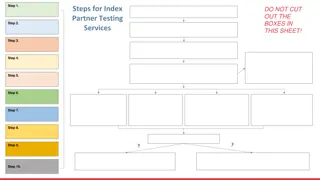
Discover the essential components of providing index testing services by the National AIDS & STI Control Programme. Learn when and where to offer these services, address challenges, and identify potential risks. Find out who should provide index testing services and where they should be offered to maximize effectiveness in HIV care.
Please find below an Image/Link to download the presentation.
The content on the website is provided AS IS for your information and personal use only. It may not be sold, licensed, or shared on other websites without obtaining consent from the author. If you encounter any issues during the download, it is possible that the publisher has removed the file from their server.
You are allowed to download the files provided on this website for personal or commercial use, subject to the condition that they are used lawfully. All files are the property of their respective owners.
The content on the website is provided AS IS for your information and personal use only. It may not be sold, licensed, or shared on other websites without obtaining consent from the author.
ll Learning objectives At the end of this session, participants should be able to: Identify when and where index testing services should be offered Address challenges with and fears about partner notification services Identify and address potential risks of partner notification services NATIONAL AIDS & STI CONTROL PROGRAMME (NASCP) - FEDERAL MINISTRY OF HEALTH
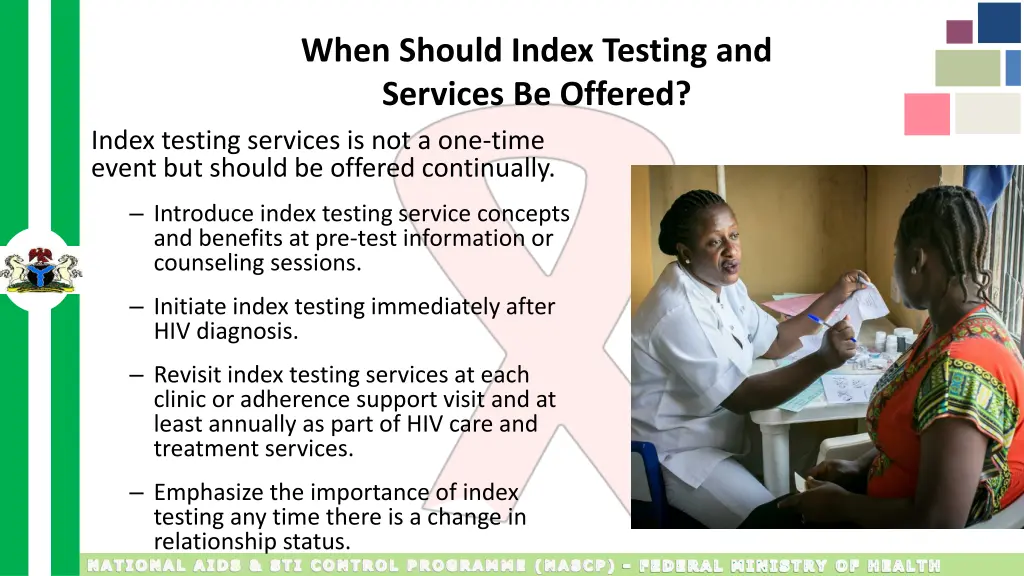
When Should Index Testing and Services Be Offered? Index testing services is not a one-time event but should be offered continually. Introduce index testing service concepts and benefits at pre-test information or counseling sessions. Initiate index testing immediately after HIV diagnosis. Revisit index testing services at each clinic or adherence support visit and at least annually as part of HIV care and treatment services. Emphasize the importance of index testing any time there is a change in relationship status. NATIONAL AIDS & STI CONTROL PROGRAMME (NASCP) - FEDERAL MINISTRY OF HEALTH
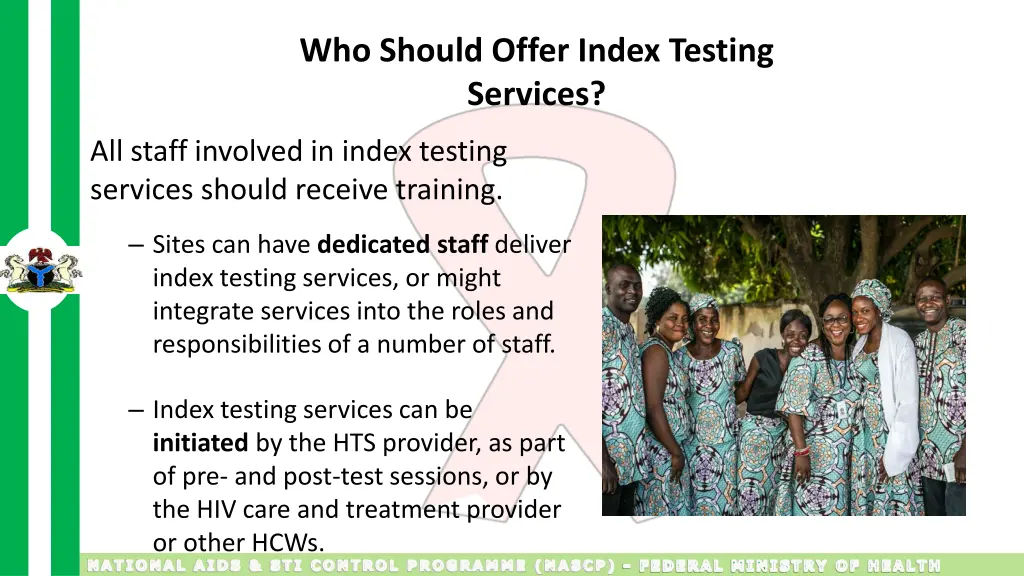
Who Should Offer Index Testing Services? All staff involved in index testing services should receive training. Sites can have dedicated staff deliver index testing services, or might integrate services into the roles and responsibilities of a number of staff. Index testing services can be initiated by the HTS provider, as part of pre- and post-test sessions, or by the HIV care and treatment provider or other HCWs. NATIONAL AIDS & STI CONTROL PROGRAMME (NASCP) - FEDERAL MINISTRY OF HEALTH
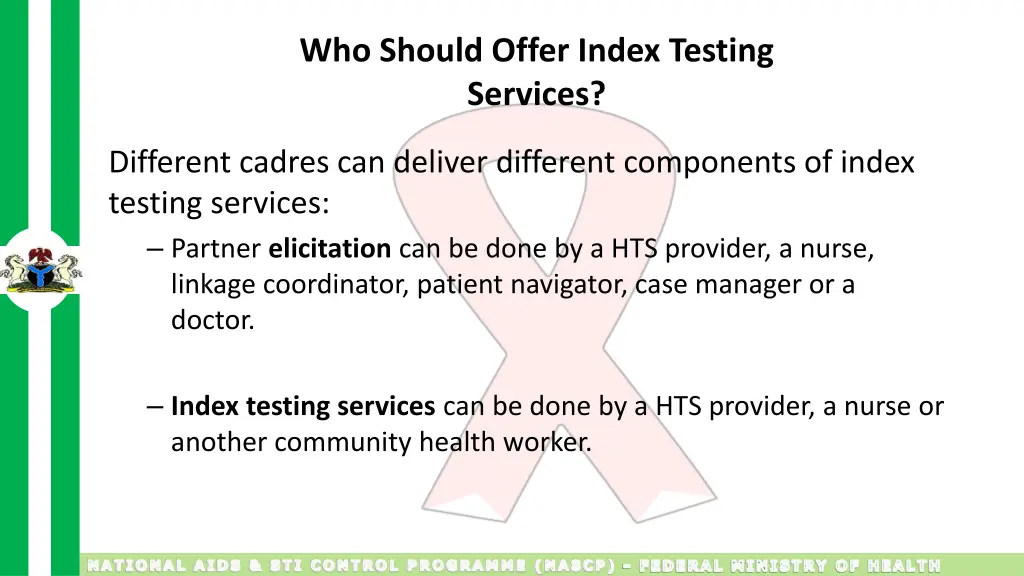
Who Should Offer Index Testing Services? Different cadres can deliver different components of index testing services: Partner elicitation can be done by a HTS provider, a nurse, linkage coordinator, patient navigator, case manager or a doctor. Index testing services can be done by a HTS provider, a nurse or another community health worker. NATIONAL AIDS & STI CONTROL PROGRAMME (NASCP) - FEDERAL MINISTRY OF HEALTH
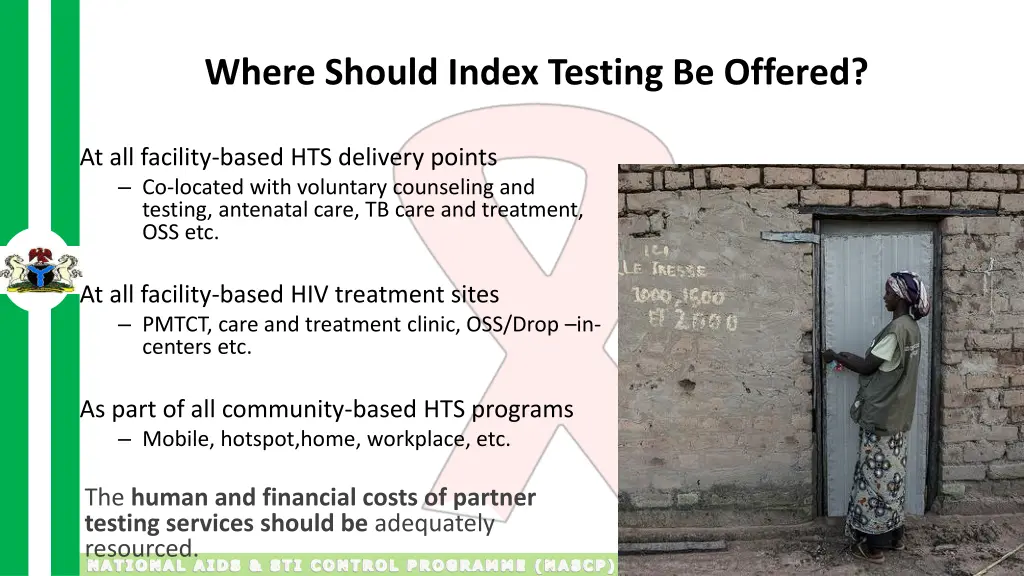
Where Should Index Testing Be Offered? At all facility-based HTS delivery points Co-located with voluntary counseling and testing, antenatal care, TB care and treatment, OSS etc. At all facility-based HIV treatment sites PMTCT, care and treatment clinic, OSS/Drop in- centers etc. As part of all community-based HTS programs Mobile, hotspot,home, workplace, etc. The human and financial costs of partner testing services should be adequately NATIONAL AIDS & STI CONTROL PROGRAMME (NASCP) - FEDERAL MINISTRY OF HEALTH resourced.
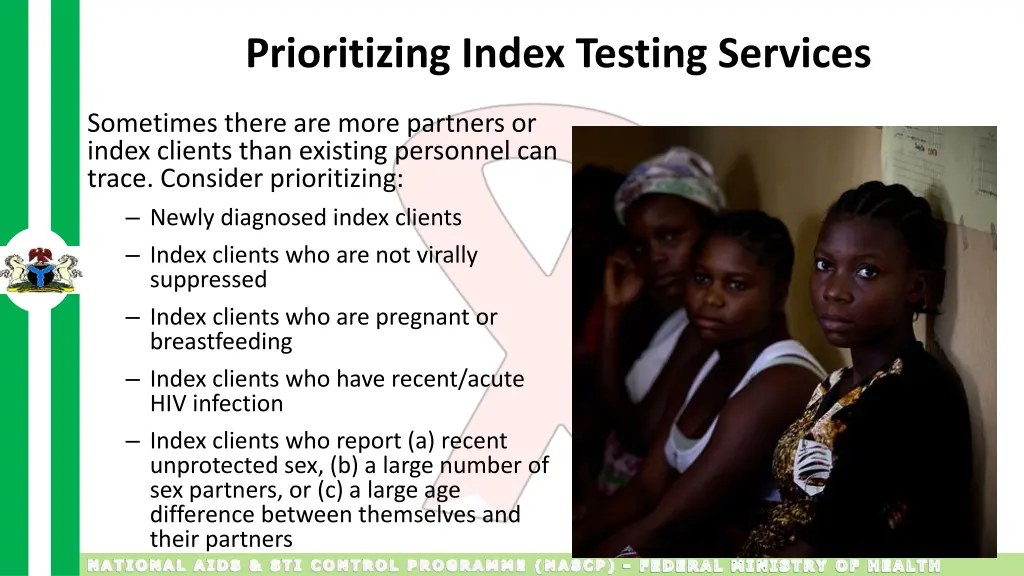
Prioritizing Index Testing Services Sometimes there are more partners or index clients than existing personnel can trace. Consider prioritizing: Newly diagnosed index clients Index clients who are not virally suppressed Index clients who are pregnant or breastfeeding Index clients who have recent/acute HIV infection Index clients who report (a) recent unprotected sex, (b) a large number of sex partners, or (c) a large age difference between themselves and their partners NATIONAL AIDS & STI CONTROL PROGRAMME (NASCP) - FEDERAL MINISTRY OF HEALTH
Considerations for Key Populations NATIONAL AIDS & STI CONTROL PROGRAMME (NASCP) - FEDERAL MINISTRY OF HEALTH
Where should index testing for KP be offered? Index testing should always be introduced during the pre-test counselling session at the following entry points: All vertical or KP-specific clinical service delivery points As part of community-based HTS All public health facility service delivery points NATIONAL AIDS & STI CONTROL PROGRAMME (NASCP) - FEDERAL MINISTRY OF HEALTH
Who should offer index testing to KPs? Healthcare workers in both Public/Private health facilities, community and KP-specific clinics Individuals should receive training on how to provide index testing services All service providers should be trained to adapt and routinize the KP classification tool in their settings KP classification helps clinicians to provide better care to KP Knowing KP status helps service providers know what types of partners to elicit (e.g., needle-sharing contacts) Documentation in client records should indicate whether or not index testing has been offered, and if partners/biological children have been elicited This will ensure follow up for elicitation at ART sites if refused at HIV diagnosis or if there are new partners over time NATIONAL AIDS & STI CONTROL PROGRAMME (NASCP) - FEDERAL MINISTRY OF HEALTH
Ways to prepare KP index cases for partner elicitation Countries should review current consent and referral scripts to ensure HIV+ KP clients are properly informed about index testing services Emphasize that partner elicitation is voluntary Emphasize protection of KP identity/information by facility staff Provide details of index testing services through materials at the HTS and ART sites Use KP-friendly posters and other written materials that advertise NATIONAL AIDS & STI CONTROL PROGRAMME (NASCP) - FEDERAL MINISTRY OF HEALTH the options for notifying partners.
Partner elicitation for KPs Where applicable, priority should be on eliciting non-paying special boyfriends of female and male sex workers These partners are at higher risk as they have an established form of non- protected and non-paying sexual relationship with the sex worker. Contact information is more easily obtained compared with paying clients Ensure that MSM are also asked about female partners All KP index clients should be asked about needle-sharing partners NATIONAL AIDS & STI CONTROL PROGRAMME (NASCP) - FEDERAL MINISTRY OF HEALTH
Biological children elicitation for KP Service providers should elicit all biological children (< 19 years) of KPs with unknown HIV status, and their place of domicile* and test them. Anecdotal evidence shows that children of FSW are left in the care of the FWS s mother who is usually domiciled in a different town. Ensure that all biological children of index FSW are linked to OVC program in the city where the children are located MOU with KP and OVC partners, 100% testing coverage of biological children of PLHIV Ensure that MSM and PWID are also asked about their biological children *A strong referral and treatment service linkage system should be in place before actively eliciting biological children of KPs, it could be either services co-located within a trusted KP community space or within an established network of health facilities which have undergone KP sensitization trainings. NATIONAL AIDS & STI CONTROL PROGRAMME (NASCP) - FEDERAL MINISTRY OF HEALTH
Other considerations (2) Participation in index testing and partner elicitation is voluntary KP clients may be hesitant to share partner information if they do not trust the service providers. Establishing trust and open communication is paramount. Healthcare workers should explore HIV self-testing (HIVST) when discussing partner notification options with KPs and PrEP. NATIONAL AIDS & STI CONTROL PROGRAMME (NASCP) - FEDERAL MINISTRY OF HEALTH
Other considerations (3) Members of key populations are often reluctant to identify their partners to providers, due to fear of stigma, discrimination and lack of confidentiality. WHO recommends that social network-based HIV testing approaches can be offered for key populations as part of a package of partner services. IPV and Index Testing NATIONAL AIDS & STI CONTROL PROGRAMME (NASCP) - FEDERAL MINISTRY OF HEALTH
THANK YOU FOR YOUR ATTENTION NATIONAL AIDS & STI CONTROL PROGRAMME (NASCP) - FEDERAL MINISTRY OF HEALTH