Effective Training Requirements Submission and Course Development Process
Explore the comprehensive End-to-End (E2E) process for submitting training requirements and developing courses within the Naval Education and Training Command. Learn about sources of training requirements, steps for submission, risk management assessment, and course development, delivery, and maintenance. Discover the significance of learning objectives and their functions in training programs.

Download Presentation

Please find below an Image/Link to download the presentation.
The content on the website is provided AS IS for your information and personal use only. It may not be sold, licensed, or shared on other websites without obtaining consent from the author. If you encounter any issues during the download, it is possible that the publisher has removed the file from their server.
You are allowed to download the files provided on this website for personal or commercial use, subject to the condition that they are used lawfully. All files are the property of their respective owners.
The content on the website is provided AS IS for your information and personal use only. It may not be sold, licensed, or shared on other websites without obtaining consent from the author.
E N D
Presentation Transcript
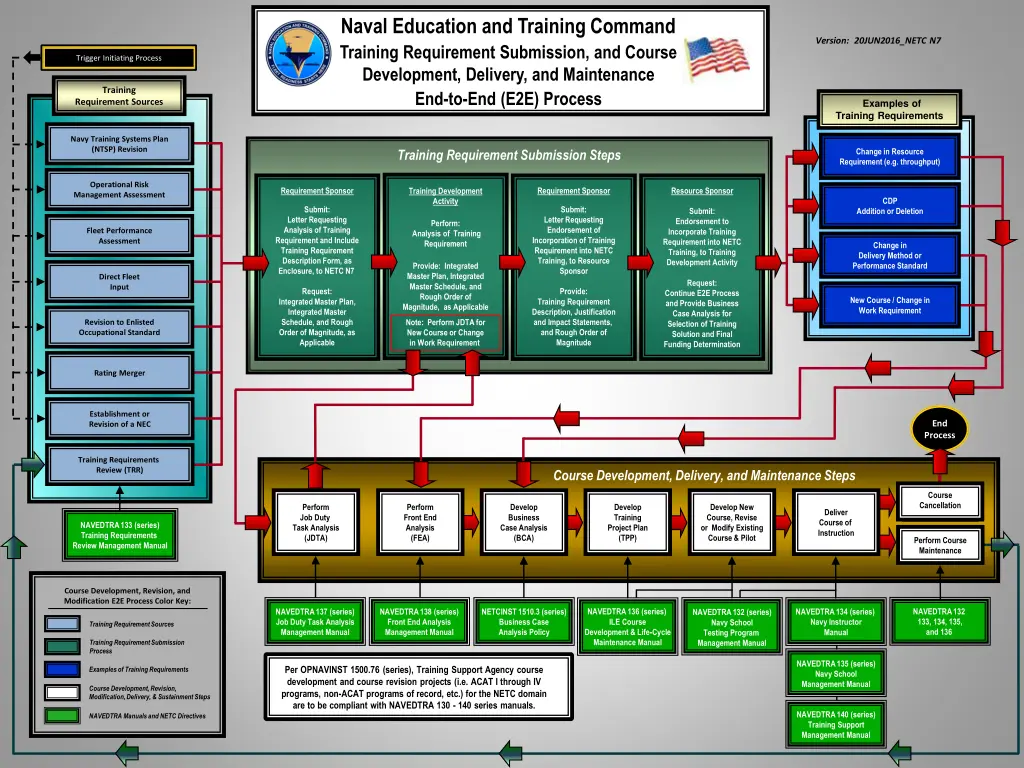
Naval Education and Training Command Training Requirement Submission, and Course Development, Delivery, and Maintenance End-to-End (E2E) Process Version: 20JUN2016_NETC N7 Trigger Initiating Process Training Examples of Training Requirements Requirement Sources Navy Training Systems Plan (NTSP) Revision Change in Resource Requirement (e.g. throughput) Training Requirement Submission Steps Operational Risk Management Assessment Requirement Sponsor Requirement Sponsor Resource Sponsor Training Development Activity CDP Submit: Submit: Submit: Addition or Deletion Letter Requesting Analysis of Training Requirement and Include Training Requirement Description Form, as Enclosure, to NETC N7 Letter Requesting Endorsement of Incorporation of Training Requirement into NETC Training, to Resource Sponsor Endorsement to Incorporate Training Requirement into NETC Training, to Training Development Activity Perform: Fleet Performance Assessment Analysis of Training Requirement Change in Delivery Method or Performance Standard Provide: Integrated Master Plan, Integrated Master Schedule, and Rough Order of Magnitude, as Applicable Direct Fleet Input Request: Request: Provide: Continue E2E Process and Provide Business Case Analysis for Selection of Training Solution and Final Funding Determination New Course / Change in Work Requirement Integrated Master Plan, Integrated Master Schedule, and Rough Order of Magnitude, as Applicable Training Requirement Description, Justification and Impact Statements, and Rough Order of Magnitude Note: Perform JDTA for New Course or Change in Work Requirement Revision to Enlisted Occupational Standard Rating Merger Establishment or Revision of a NEC End Process Training Requirements Review (TRR) Course Development, Delivery, and Maintenance Steps Course Cancellation Perform Job Duty Task Analysis (JDTA) Perform Front End Analysis (FEA) Develop Business Case Analysis (BCA) Develop Training Project Plan (TPP) Develop New Course, Revise or Modify Existing Course & Pilot Deliver Course of Instruction NAVEDTRA 133 (series) Training Requirements Review Management Manual Perform Course Maintenance Course Development, Revision, and Modification E2E Process Color Key: External Training Requirement Sources NAVEDTRA 132 133, 134, 135, and 136 NAVEDTRA 136 (series) ILE Course Development & Life-Cycle Maintenance Manual NAVEDTRA 137 (series) Job Duty Task Analysis Management Manual NAVEDTRA 138 (series) Front End Analysis Management Manual NETCINST 1510.3 (series) Business Case Analysis Policy NAVEDTRA 134 (series) Navy Instructor Manual NAVEDTRA 132 (series) Navy School Testing Program Management Manual Training Requirement Sources Training Requirement Submission Process OPNAV N1 Training Requirement Sources Examples of Training Requirements NAVEDTRA 135 (series) Navy School Management Manual OPNAV N1 Training Requirement Sources Per OPNAVINST 1500.76 (series), Training Support Agency course development and course revision projects (i.e. ACAT I through IV programs, non-ACAT programs of record, etc.) for the NETC domain are to be compliant with NAVEDTRA 130 - 140 series manuals. Course Development and Revision Process Modification, Delivery, & Sustainment Steps Course Development, Revision, NAVEDTRA 140 (series) Training Support Management Manual NAVEDTRA Manuals and NETC Directives
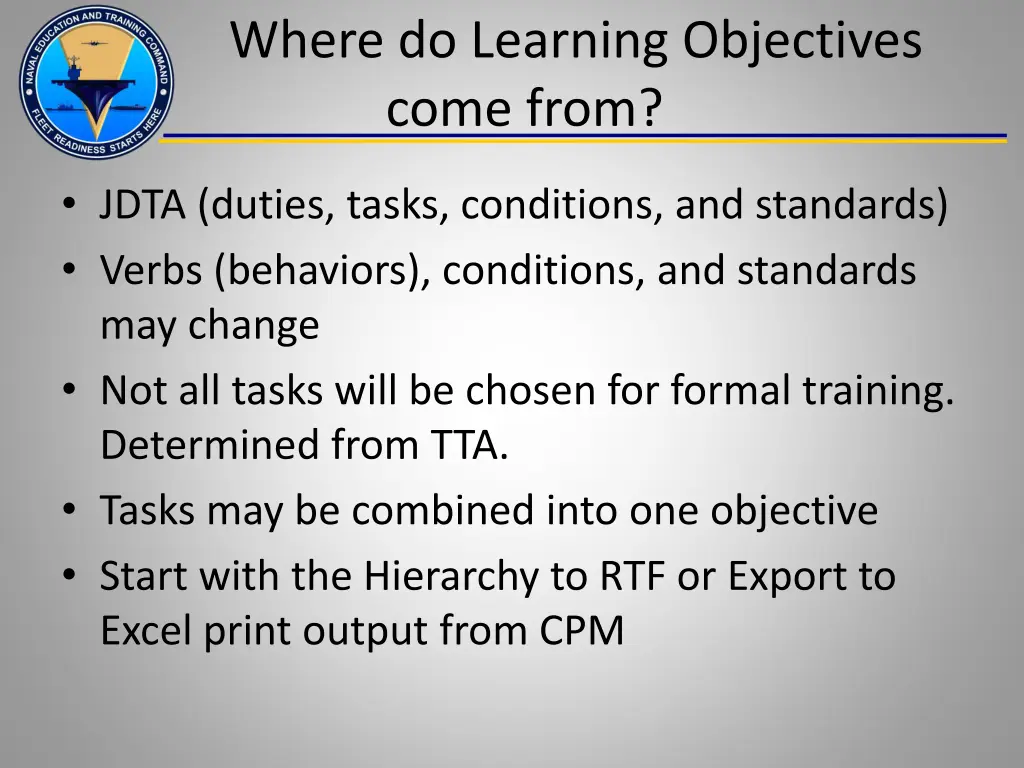
Where do Learning Objectives come from? JDTA (duties, tasks, conditions, and standards) Verbs (behaviors), conditions, and standards may change Not all tasks will be chosen for formal training. Determined from TTA. Tasks may be combined into one objective Start with the Hierarchy to RTF or Export to Excel print output from CPM
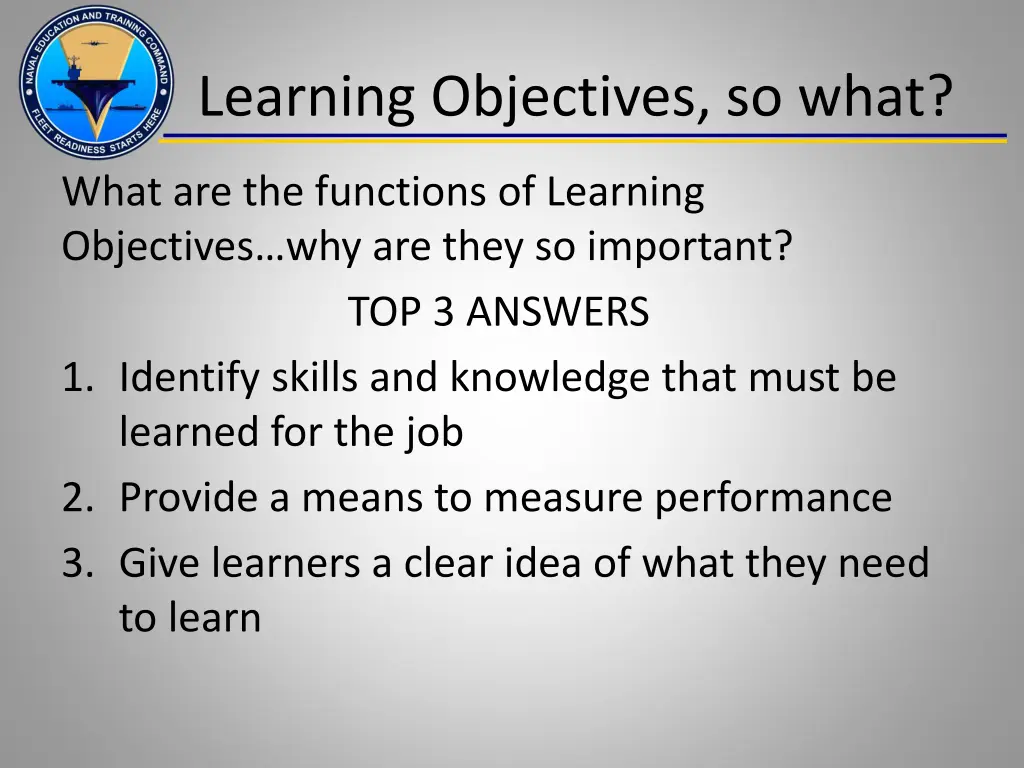
Learning Objectives, so what? What are the functions of Learning Objectives why are they so important? TOP 3 ANSWERS 1. Identify skills and knowledge that must be learned for the job 2. Provide a means to measure performance 3. Give learners a clear idea of what they need to learn
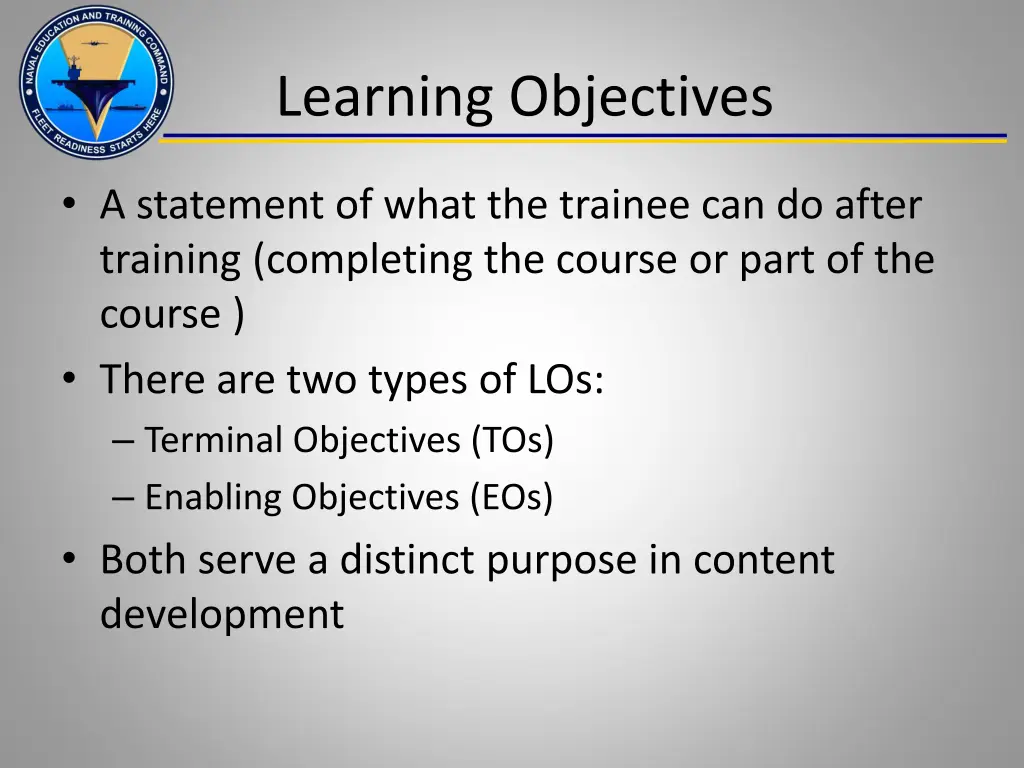
Learning Objectives A statement of what the trainee can do after training (completing the course or part of the course ) There are two types of LOs: Terminal Objectives (TOs) Enabling Objectives (EOs) Both serve a distinct purpose in content development
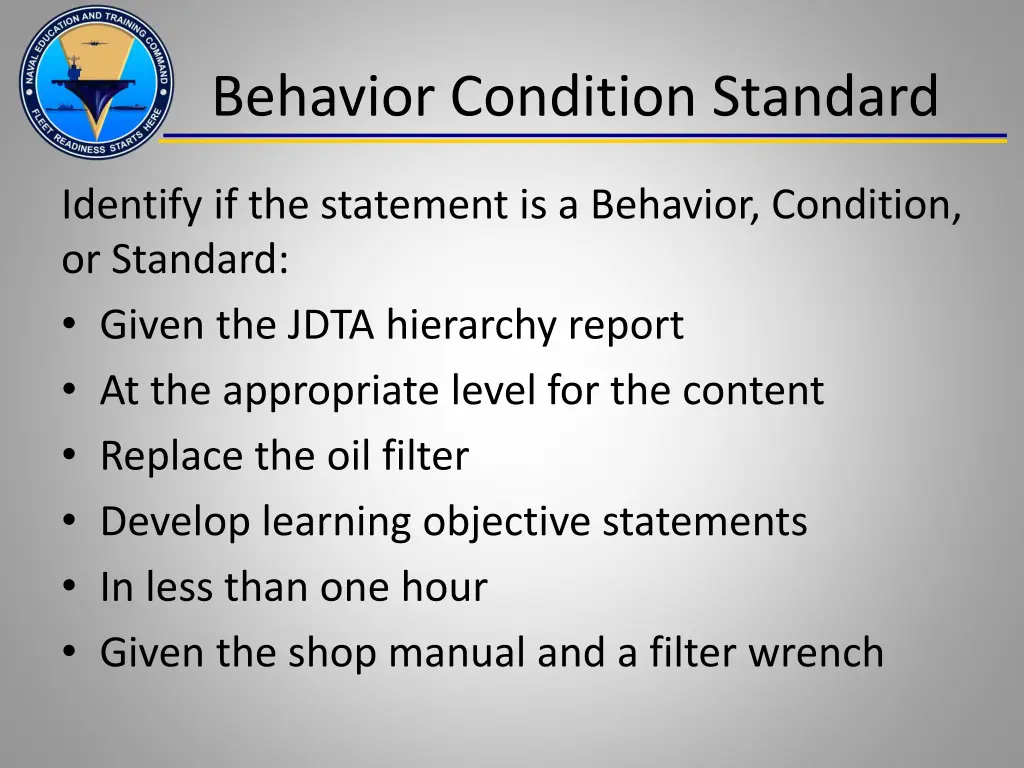
Behavior Condition Standard Identify if the statement is a Behavior, Condition, or Standard: Given the JDTA hierarchy report At the appropriate level for the content Replace the oil filter Develop learning objective statements In less than one hour Given the shop manual and a filter wrench
Learning Objective Guidelines Terminal objectives are generally developed from ________, where enabling learning objectives are developed from __________. A terminal objective is a major objective for a lesson and describes the overall learning outcome. ALL learning objectives must have:
Identify the TO and Purpose: 1. The Integrated Problems course is designed to help first year students develop effective skills in literature research and in verbal and written communication. 2. Given a set of clinical data, the first year student in Integrated Problems will be able to state a hypothesis and compose research questions.
More about TOs Is it acceptable for a TO to address one learning domain and its supporting EO to address another? True or False? EOs supporting a TO should contain a verb of equal or lesser complexity than the supported TO. Review 130B Vol I Section 8
Example TOs Which one of these is a TO? Perform Preventive Maintenance on the Radar Inspect the radar for visible defects What are some other examples of TOs?
If it were easy. Developing effective TOs and EOs can be difficult: JDTA duties and tasks TOs and EOs AIM I/II objectives TOs and EOs Badly aligned tasks in JDTA Indirectly supporting knowledge Subtasks Combined tasks
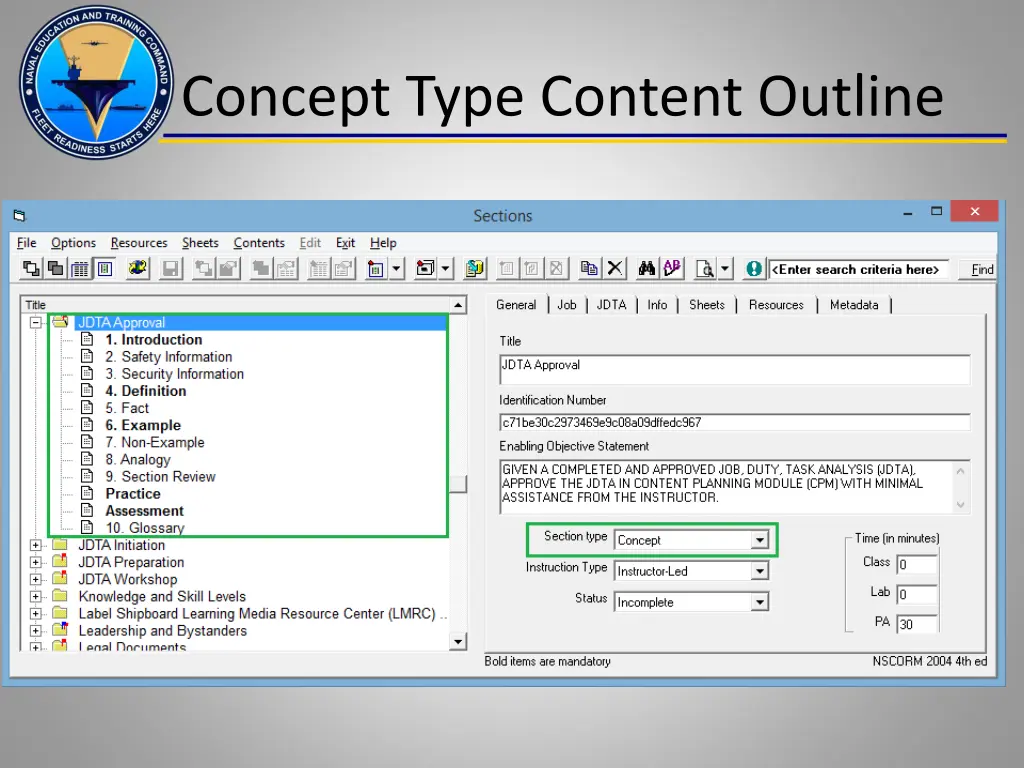
Enabling Objectives Describe specific behaviors (single activities) that must be learned or performed Supports a WHAT? Just like TOs, each enabling learning objective should contain: (THIS, THAT, and OTHER THING) Each EO is assigned a content type in CPM Determines development template in Learning Object Module What content types are available?
More things to think about At least 2 EOs per TO 1 EO per Section Content Type determines Section Elements TOs and EOs are assigned a learning domain, Psychomotor or Cognitive Assessments are built on EOs, therefore, EOs must be measurable
Building Learning Objectives Completed in CPM: TOs under Lessons EOs under Sections
Evaluating Learning Objectives Learning Objectives should be SMART: Specific Measurable Attainable Relevant Targeted
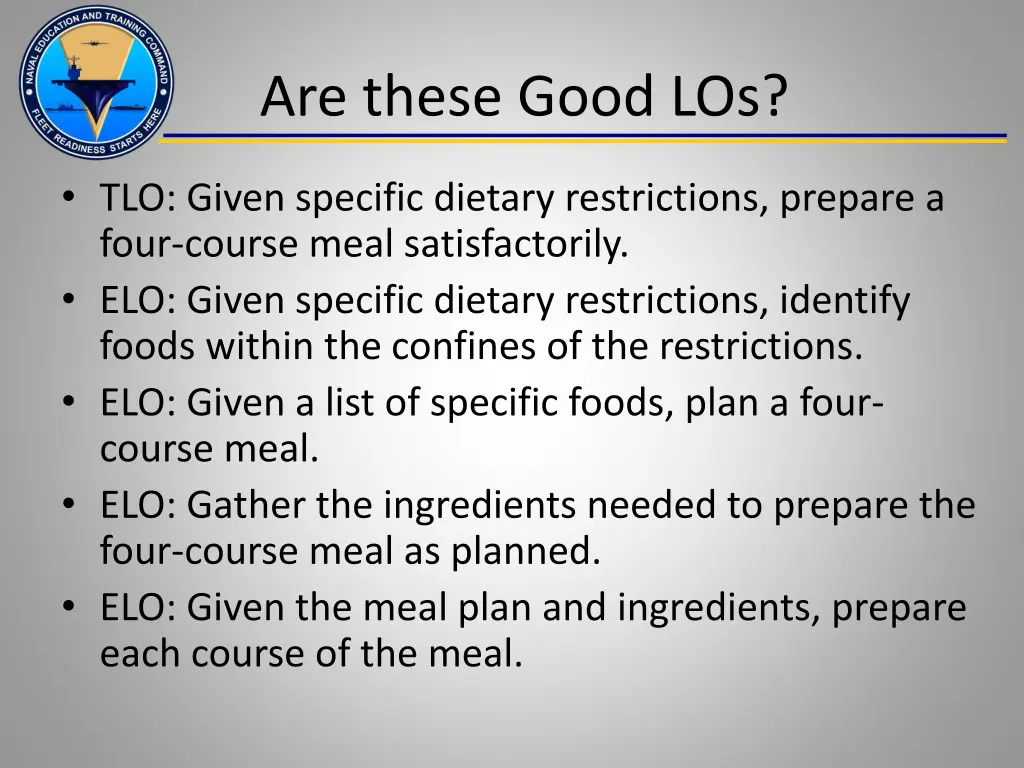
Are these Good LOs? TLO: Given specific dietary restrictions, prepare a four-course meal satisfactorily. ELO: Given specific dietary restrictions, identify foods within the confines of the restrictions. ELO: Given a list of specific foods, plan a four- course meal. ELO: Gather the ingredients needed to prepare the four-course meal as planned. ELO: Given the meal plan and ingredients, prepare each course of the meal.
Consider the Learning Domain If the course is about operating and maintaining a system, in what domain should most of the objectives be? If they are not, the objectives may need to be reevaluated.
Were done with LOs Terminal Learning Objectives Enabling Learning Objectives Evaluating Learning Objectives. Are there any questions before moving on to Assessments? Knowledge Check: Which Data Item Description (DiD) would require a review of a current course s mission statement and purpose? What are the two skill-based content types? If the verb in the objective is Evaluate or Create , in what domain and level is the objective? What is the purpose of TTA data? If the task is Build Stairs, what might a KSATR be?
Break Suggested readings prior to the lesson on Assessments include: Chapters 3, 4, and 5 in NAVEDTRA 132 (Performance and Knowledge Test Design)