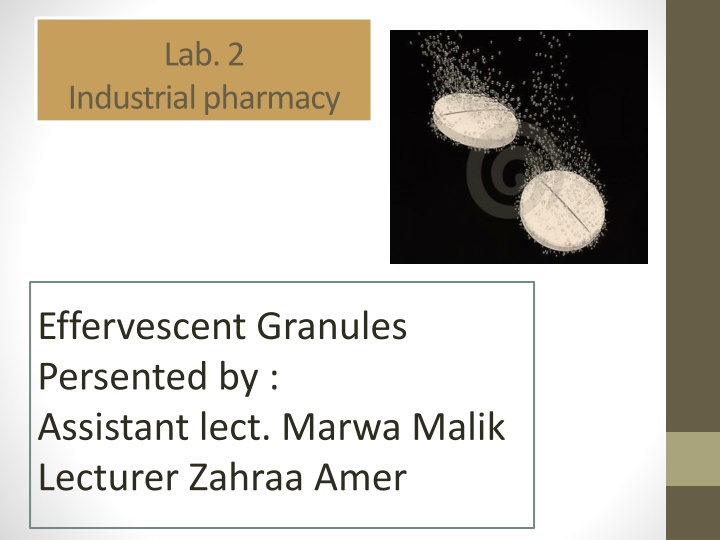
Effervescent granules are small particles containing medicinal substances that dissolve in water for easy consumption. They offer rapid onset of action, pleasant taste, and psychological comfort to patients. However, they have disadvantages like instability, inaccurate dose estimation, sodium overload risk, and potential drug interactions.
Please find below an Image/Link to download the presentation.
The content on the website is provided AS IS for your information and personal use only. It may not be sold, licensed, or shared on other websites without obtaining consent from the author. If you encounter any issues during the download, it is possible that the publisher has removed the file from their server.
You are allowed to download the files provided on this website for personal or commercial use, subject to the condition that they are used lawfully. All files are the property of their respective owners.
The content on the website is provided AS IS for your information and personal use only. It may not be sold, licensed, or shared on other websites without obtaining consent from the author.
E N D
Presentation Transcript
Lab. 2 Industrial pharmacy Effervescent Granules Persented by : Assistant lect. Marwa Malik Lecturer Zahraa Amer
Granule dosage form Small irregular particles ranging from 4-10 mesh size (4.76 - 2 mm) containing medicinal substances Effervescent granules Mixtures of medicinal agent with citric acid, tartaric acid and bicarbonate Note: Granules may be non-medical: Deluse granules (diatery supplements)
Dispensing Dissolving granules in water and taken during effervescence or immediately after. Type of drugs used in effervescent granules: Usually water soluble drugs 1- Alka seltzer: (Aspirin) minor aches, pains, inflammation, fever, headache. 2- Citrocarbonate: Urinary pH modifiers and to treat gastric antiacid.
Important notes for using granules: 1- By using granules or coarse particles of mixed powders rather than small powder particles the rate of solution is decreased violent and uncontrollable effervescence is prevented. 2- Sudden and rapid effervescence could overflow the glass and leave little residual carbonation in the solution.
3- Combination of citric acid and tartaric acids rather than either acid alone to avoid certain difficulties. A-Thus tartaric acid alone the resulting granules loss their firmness readily and crumble (Chalky and friable). B- while using citric acid alone result in a sticky mixture difficult granulate. when using to
Advantages: 1. Rapid onset of action (prepared as solution) rapid disintegration and dissolution. 2. Pleasant taste chemical reaction between acid and base lead to liberate CO2 which act as local anesthetic effect of oral cavity so mask the undesirable taste. 3. Psychological effect, patient comfort to it. 4. Provide alkaline solution, neutralization of a acidic drugs as aspirin (alkalinization of urine and increase excretion of drug which is acidic).
Disadvantages: 1. Unstable (absorb the water [moisture] from the atmosphere). It overcome packaging and compressing into dosage and put them in aluminum foil can be by tablet form 2. Not accurate dose estimation because the one who estimate the dose is the patient himself. 3. Sodium overload (these granules are not suitable for hypertensive patients) (not in plastic foil because it allow absorption of water moisture). the from 4. Have many drug-drug interaction.
Sources of acids 1.Natural (food) acids (citric acid, tartaric acid, malic acid, fumaric acid). Highly soluble in water and thus widely use in preparation of effervescent. 2. Anhydride acids (anhydrous citric acid and anhydrous tartaric acid) . When dissolved in water give hydrous acids. 3. phosphate, and sodium disulfide). Soluble at pH 4.5 otherwise they are strong acids. 4. Effervescent base: used mainly in the preparation of effervescent granules. Salts acids (disodium dihydrogen Na2CO3 used instead of NaHCO3 but the last is more effective because it s more soluble in water. Ciric acid 1 part Tartaric acid 2 part ??????3.44 part Total 6.44
Method of effervescent granules production 1. Formulation: a/ Amount of each material in the formulation. b/ Number of doses: usually 1 tsp. as ordinary dose which is equal to 5 gm of effervescent. No. of doses =total amount /wt .of each dose c/ The physico-chemical properties of each component. 2. Mixing: to get uniform distribution.
3. Moistening and granulation: use certain solvent to get paste through wet granulator. * In small amount we use sieve with suitable particle size instead of granulator. Methods of moistening and granulation A- Dry method (heat fusion method): Used in preparation of drugs which are not affected by heat (e.g. Mg Sulfate). During the heating process 60-80 C, the heat causes the release of 1 molecule of water of crystallization from the citric acid, which in turn dissolves a portion of powder mixture to prepare the moist mass and granulation, and thus consequent release of some carbon dioxide. 3 ?????? + + ?????? 3 ??O + 3 ??? + ????????? Citric acid 2 2 ?????? + + ?????? 2 ??O + 2 ??? + + ????????? Tartaric acid
B- Wet fusion method: Used to 1- prepare small amount of effervescent granules. 2- prepare compounds which are affected by heat. 1st mix the powder together and then add ethanol as moisture to get wet mass. Water can t be used as moisture because it reacts directly and end the reaction.
4. Drying: only for heat fusion method By using tray dryer 5. Packaging and storage (cool and dry place): Stored in a wide mouth bottle with colored glass, tightly closed and sealed to exclude air, and kept in a cool dry place. Note: Note: to get accurate dose granules may be pressured into tablet dosage form (e.g. Vit. C).
Experimental work: Prepare 25 gm of effervescent granules using 1.5 gm of Mg sulfate per dose as laxative. As known that effervescent granules composed of effervescent base and active ingredient (Mg sulfate). The steps of calculation: Find no. of doses No. of doses =total amount of granules /wt. of each dose =25/5 =5 Find the amount of active ingredient added to the total amount of effervescent granules (25gm ): 5 1.5=7.5 gm of Mg sulfate should be added 3. Find the wt. of each active constituent of effervescent base that should be added to the added to the formula. 25 -7.5=17.5 gm amount of the base.
For Citric acid, for Tartaric acid and for NaHCO3: Total gm of citric acid 6.4 1 17.5 x x =2.7 gm total gm of tartaric acid 6.4 2 17.5 x X =5.4 gm or 2 x 2.7 = 5.4 gm Total gm of NaHCO3 6.4 3.4 17.5 x x = 9.3 gm or 2.7 x 3.4=9.3
Procedure Heat fusion method: 1. Mix tartaric acid, NaHCO3, Mg sulfate together. 2. Heat citric acid in water bath at 60-80 c to release water crystallization till it becomes warm. 3. Immediately and directly add the above mixture to dish of citric acid with rapid mixing by hand till get the wet paste. 4. Sieving. 5. Drying.
wet fusion method: 1. Mix all ingredients including Tartaric acid, Citric acid, NaHCO3, and the ingredient Mg sulfate. 2. Add Alcohol (95%) drop by drop with the continuous mixing till we get a wet paste. 3. Sieving. 4. Drying. active