Addressing feedback overhead in multicast transmissions, this document from December 2020 proposes solutions to improve efficiency. It focuses on reducing transmission redundancies and enhancing reliability for large groups of recipients in IEEE 802.11 networks.
Please find below an Image/Link to download the presentation.
The content on the website is provided AS IS for your information and personal use only. It may not be sold, licensed, or shared on other websites without obtaining consent from the author. If you encounter any issues during the download, it is possible that the publisher has removed the file from their server.
You are allowed to download the files provided on this website for personal or commercial use, subject to the condition that they are used lawfully. All files are the property of their respective owners.
The content on the website is provided AS IS for your information and personal use only. It may not be sold, licensed, or shared on other websites without obtaining consent from the author.
E N D
Presentation Transcript
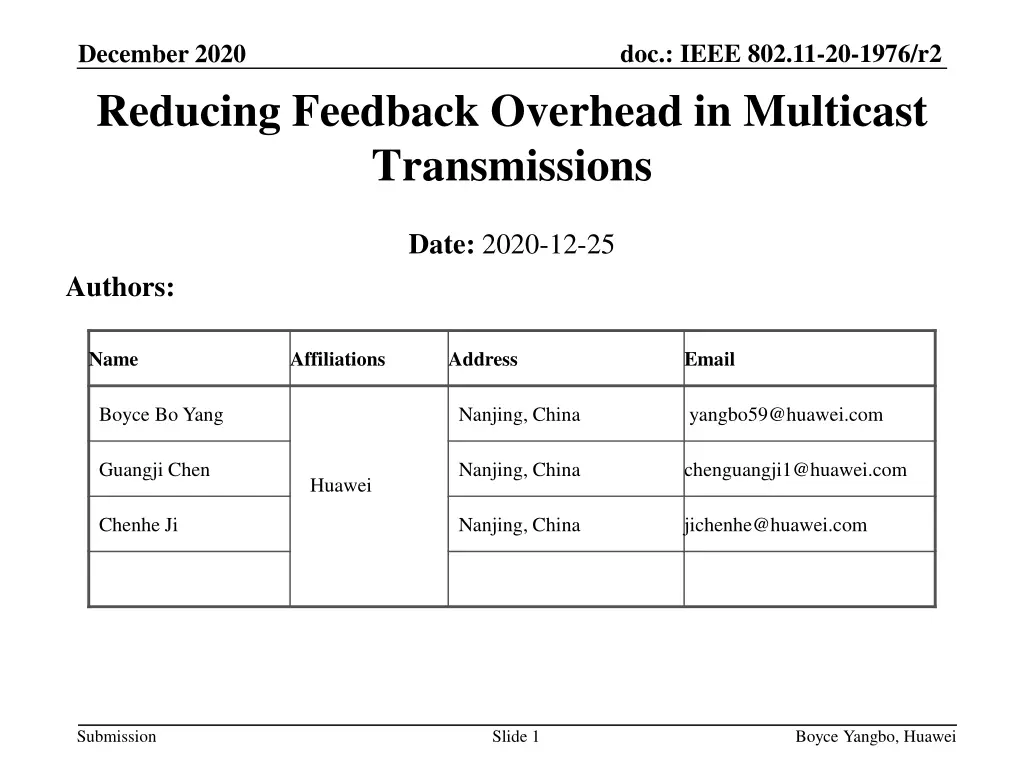
doc.: IEEE 802.11-20-1976/r2 December 2020 Reducing Feedback Overhead in Multicast Transmissions Date: 2020-12-25 Authors: Name Affiliations Address Email Boyce Bo Yang Nanjing, China yangbo59@huawei.com Guangji Chen Nanjing, China chenguangji1@huawei.com Huawei Chenhe Ji Nanjing, China jichenhe@huawei.com Submission Slide 1 Boyce Yangbo, Huawei
doc.: IEEE 802.11-20-1976/r2 December 2020 This doc is proposed to solve LB 252 CID 1096 CID 1096 Commenter Bo Yang LB 252 Draft Comment Proposed Change Add a mechanism as proposed in 1976r0 Resolution 1 802.11bc amendment shall provide a mechanism for an AP to solicit acknowledgment feedbacks from a large number of group-cast recipients more efficiently. Submission Slide 2 Boyce Yangbo, Huawei
doc.: IEEE 802.11-20-1976/r2 December 2020 Recall[1] 802.11 multicast properties Multicast / broadcast traffic is generally not retransmitted, because there is no acknowledgement Multicast / broadcast traffic is generally sent at a lowest common denominator rate, known as a basic rate. This might be as low as 6 Mbps, when unicast links are operating at 600 Mbps. Lower rate larger frame, less airtime for everything else. There are options to improve multicast reliability GroupCast with Retries (GCR) Directed Multicast Service (DMS) Submission Slide 3 Boyce Yangbo, Huawei
doc.: IEEE 802.11-20-1976/r2 December 2020 Efficiency of multicast to large number of recipients is low DMS(Direct Multicast Service) converts multicast to unicast, which is not efficient when the number of group recipients is large. GCR(Group Cast Retry) defines two polices for the transmission of group addressed frames GCR Block ACK Initiates BA agreement with each group member. Transmitting AP regularly sends BAR to the STAs Suited to small to medium number of group members GCR unsolicited retry Retransmit MSDU one or more times without soliciting uplink feedbacks to increase probability of success Suited to large number of group members The selection of MCS or retransmission times is arbitrary and unreliable Submission Slide 4 Boyce Yangbo, Huawei
doc.: IEEE 802.11-20-1976/r2 December 2020 GCR MU-BAR in 11ax GCR MU-BAR mechanism is defined in 11ax, taking advantage of OFDMA access. However, it s still not able to deal with the case of transmission to a large group of recipients. For a typical implementation of 40MHz BW, there are up to 18 RUs. 4 MU-BAR Triggers are needed to solicit BAs from each group transmission, if there are 60 recipients. MU BAR MU BAR MU BAR MU BAR Groupcast PPDU AP BA STA 1 BA STA 20 STA 40 BA STA 60 BA Submission Slide 5 Boyce Yangbo, Huawei
doc.: IEEE 802.11-20-1976/r2 December 2020 Observations on feedbacks of Multicast When an AP commences a group transmission, most of recipients can decode the multicast A-MSDU/MSDUs correctly, and a few can t. If the recipients decode every MSDU correctly, that is only one bit info. If the recipient doesn t decode every MSDU correctly, there are many possible error patterns, so a feedback bitmap is necessary for AP s scheduling(retransmission, link adaptation, etc) MU-BAR Trigger 4 MU-BAR Trigger 1 MU-BAR Trigger 3 BA bitmap with all 1s BA bitmap with at least one 0 MU-BAR Trigger 2 Submission Slide 6 Boyce Yangbo, Huawei
doc.: IEEE 802.11-20-1976/r2 December 2020 NDP Feedback can help reducing the number of BA responses The NDP feedback report allows an HE AP to collect feedback from multiple non-AP HE STAs [1]. The number of STAs solicited by one NFRP trigger frame is several times larger ????= 18 2?? (???????????? ???? + 1), i.e. ????= 72 for 40MHz BW if ???????????? ???? = 1. An AP can send a GCRNFRP Trigger frame after a multicast data frame A STA that decodes all MSDUs correctly would send a response on allocated NDP_TONE_SET_0 A STA that has errors would send a response on NDP_TONE_SET_1 or don t send any response at all. By NDP feedbacks, the AP would have a general knowledge on receiving status, i.e. which STA receives the multicast data frame successfully and which STA has errors. Then AP can use MU-BAR to solicit BA bitmaps from STAs that have errors. GCR NFRP MU BAR multicast PPDU AP NDP STAs 1 NDP BA STA 20 STA 40 NDP STA 60 NDP BA Submission Slide 7 Boyce Yangbo, Huawei
doc.: IEEE 802.11-20-1976/r2 December 2020 Evaluation on BA feedback overheads Simulation setup BW: 40MHz Num of STAs with decoding errors: <=18 MCS for Trigger/BA: 4 Observations: As shown in the figures, the gain is significant if there are more than 40 recipients (us (us 3000 3000 MF = 1 MF = 0 MU-BAR Proposed MU-BAR Proposed 2500 2500 2000 2000 1500 1500 1000 1000 500 500 0 0 200 185 170 155 140 125 110 95 80 65 50 35 20 Number of Recipients 200 185 170 155 140 125 110 95 80 65 50 35 20 Number of Recipients Submission Slide 8 Boyce Yangbo, Huawei
doc.: IEEE 802.11-20-1976/r2 December 2020 Minor changes to NFRP Trigger Use one of the reserved values in Feedback Type field to indicate a GRC acknowledgement request The starting sequence number and ending sequence number may also be needed in the modified NFRP Trigger frame Recipients that fail to decode the whole AMPDU may not know the first/latest sequence number that the AP has transmitted. User info of NFRP variant Trigger GCR ACK Starting Sequence Control UL Target Receive Power GCR ACK Sequence Span Feedback Type Multiplexing Flag Starting AID Reserved Reserved Bits: 12 9 4 7 7 1 16 8 Table 9-31k Feedback Type subfield encoding Table 9-31k Feedback Type subfield encoding Value Description Value Description 0 Resource request 0 Resource request 1 GCR acknowledgement request 1-15 Reserved 2-15 Reserved Submission Slide 9 Boyce Yangbo, Huawei
doc.: IEEE 802.11-20-1976/r2 December 2020 Proposed changes to spec text(1) 9.3.1.22.9 NFRP Trigger frame format Change Figure 9-64l as follows GCR ACK Starting Sequence Control GCR ACK Sequence Span UL Target Receive Power Feedback Type Multiplexing Flag Starting AID Reserved Reserved Bits: 12 9 4 7 7 1 16 8 Insert a new row in Table 9-31k (Feedback Type subfield encoding) as follows and update the Reserved row as appropriate Table 9-31k Feedback Type subfield encoding Value Description 1 GCR acknowledgement request Insert the following paragraphs at the end of this subclause The GCR ACK Starting Sequence subfield and the GCR ACK Ending Sequence subfield are optionally present if the value of the Feedback Type subfield is 1. The Starting Sequence Number subfield of the GCR Starting Sequence Control subfield contains the sequence number of the first MSDU or A-MSDU for which this NFRP frame is sent. The Fragment Number subfield of the GCR Starting Sequence Control subfield is set to 0. The GCR Sequence Span subfield indicates the number of MSDU/A-MSDUs that needs to be acknowledged, starting from the MADU/AMSDU with sequence number as indicated in GCR ACK Starting Sequence subfield. Submission Slide 10 Boyce Yangbo, Huawei
doc.: IEEE 802.11-20-1976/r2 December 2020 Proposed changes to spec text(2) 26.5.7 NDP feedback report procedure Inset new subclause following 26.5.7.4 NDP feedback report for a resource request as follows 26.5.7.5 NDP feedback report for a GCR acknowledgement request If the Feedback Type subfield in the User Info field of the NFRP Trigger frame is 1, a STA that is scheduled shall send an NDP feedback report response in order to signal to the AP that it is in the awake state and that it received all frames as indicated in NFRP Trigger frame. Each STA that is scheduled is assigned a STARTING_STS_NUM and an RU_TONE_SET_INDEX to transmit a FEEDBACK_STATUS bit. The meaning of the FEEDBACK_STATUS bit is defined in Table 26-3a (FEEDBACK_STATUS description): Table 26-3a FEEDBACK_STATUS description FEEDBACK_STATUS Condition The STA is in the awake state and reports acknowledgements of all frames as indicated in NFRP Trigger frame. 0 The STA is in the awake state and reports that at least one of the frames as indicated in NFRP Trigger frame is not correctly received. 1 Submission Slide 11 Boyce Yangbo, Huawei
doc.: IEEE 802.11-20-1976/r2 December 2020 Proposed changes to spec text(3) 9.4.2.248.2 HE MAC Capabilities Information field Change the corresponding part of Figure 9-788b as follows B24 B25 B26 B27 B28 B29 B30 B31 B32 Reserved GCR NDP feedback Report Support Maximum A-MPDU Length Exponent Extension Flexible TWT Schedule Support BSRP BQRP A-MPDU Aggregation A-MSDU Fragmentation Support Rx Control Frame To MultiBSS OM Control Support OFDMA RA Support Bits: 1 1 1 2 1 1 1 1 Insert a new row in Table 9-322a (Subfields of the HE MAC Capabilities Information field) as follows Table 9-322a Subfields of the HE MAC Capabilities Information field Subfield Definition Encoding For an AP, indicates support for the GCR NDP feedback report procedure. For a non-AP STA, indicates support for responding to an NFRP Trigger frame with feedback type equals to GCR acknowledgement request. GCR NDP Feedback Report Support Set to 1 if supported. Set to 0 otherwise Submission Slide 12 Boyce Yangbo, Huawei
doc.: IEEE 802.11-20-1976/r2 December 2020 Proposed changes to spec text(4) 9.4.2.248.2 HE MAC Capabilities Information field Change the following row in Table 9-322a (Subfields of the HE MAC Capabilities Information field) Table 9-322a Subfields of the HE MAC Capabilities Information field Subfield Definition Encoding For an AP, indicates support for the NDP feedback report procedure. For a non-AP STA, indicates support for responding to an NFRP Trigger frame with feedback type equals to Resource request. NDP Feedback Report Support Set to 1 if supported. Set to 0 otherwise. Submission Slide 13 Boyce Yangbo, Huawei
doc.: IEEE 802.11-20-1976/r2 December 2020 Summary We propose a method to reduce feedback overheads in case of high density multicast transmissions An AP uses modified NFRP trigger to solicit one bit info(whether all MSDUs are decoded successfully). Then the AP allocates RUs for STAs with decoding errors, the number of which would be much less. Submission Slide 14 Boyce Yangbo, Huawei
doc.: IEEE 802.11-20-1976/r2 December 2020 Straw Poll 1 Do you support adding the proposed text on slide 10-13 to 802.11bc Draft. Y/N/A Submission Slide 15 Boyce Yangbo, Huawei