Electromagnetic Properties of Insulating Materials in Solid-State Physics
Explore the modern theory of polarization and the concept of maximally localized Wannier functions in insulators. Learn about the electromagnetic properties of insulating materials, electric dipole moments, and the ambiguity of polarization. Discover how Wannier functions are formed from Bloch eigenstates and the construction process involved. Delve into the intricate relationship between bulk quantities and surface charges in crystalline dielectrics.

Download Presentation

Please find below an Image/Link to download the presentation.
The content on the website is provided AS IS for your information and personal use only. It may not be sold, licensed, or shared on other websites without obtaining consent from the author. If you encounter any issues during the download, it is possible that the publisher has removed the file from their server.
You are allowed to download the files provided on this website for personal or commercial use, subject to the condition that they are used lawfully. All files are the property of their respective owners.
The content on the website is provided AS IS for your information and personal use only. It may not be sold, licensed, or shared on other websites without obtaining consent from the author.
E N D
Presentation Transcript
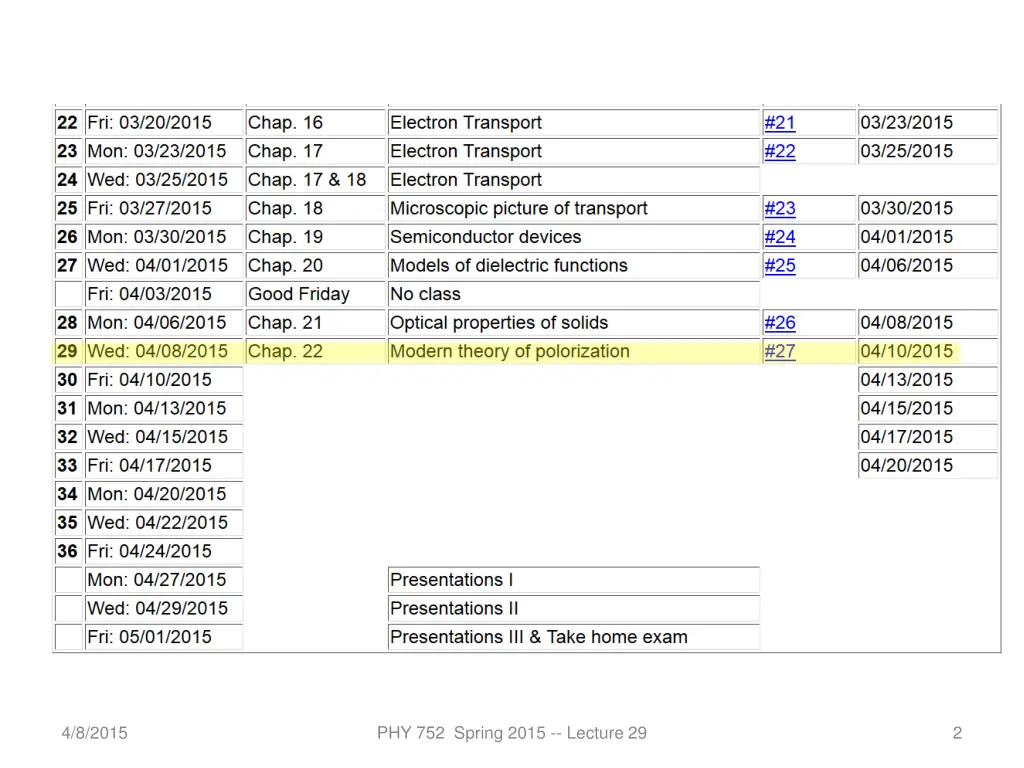
PHY 752 Solid State Physics 11-11:50 AM MWF Olin 107 Plan for Lecture 29: Chap. 22 in Marder & pdf file on Maximally Localized Wannier Functions Electromagnetic properties of insulators Modern theory of polarization 4/8/2015 PHY 752 Spring 2015 -- Lecture 29 1
4/8/2015 PHY 752 Spring 2015 -- Lecture 29 2
4/8/2015 PHY 752 Spring 2015 -- Lecture 29 3
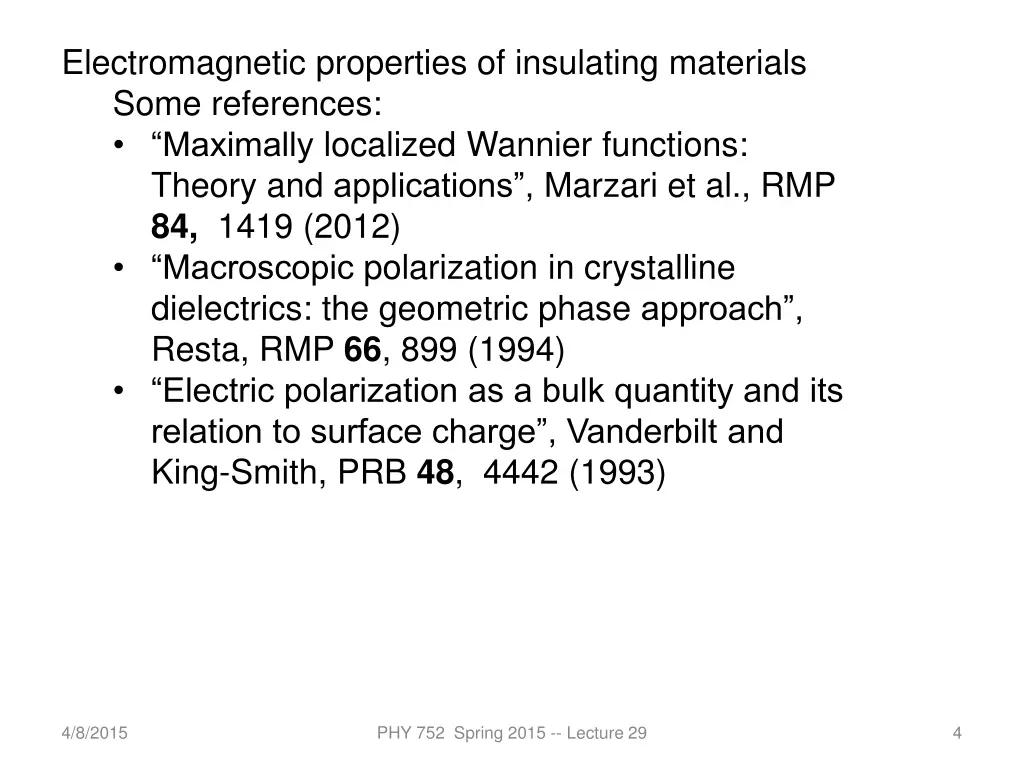
Electromagnetic properties of insulating materials Some references: Maximally localized Wannier functions: Theory and applications , Marzari et al., RMP 84, 1419 (2012) Macroscopic polarization in crystalline dielectrics: the geometric phase approach , Resta, RMP 66, 899 (1994) Electric polarization as a bulk quantity and its relation to surface charge , Vanderbilt and King-Smith, PRB 48, 4442 (1993) 4/8/2015 PHY 752 Spring 2015 -- Lecture 29 4
4/8/2015 PHY 752 Spring 2015 -- Lecture 29 5
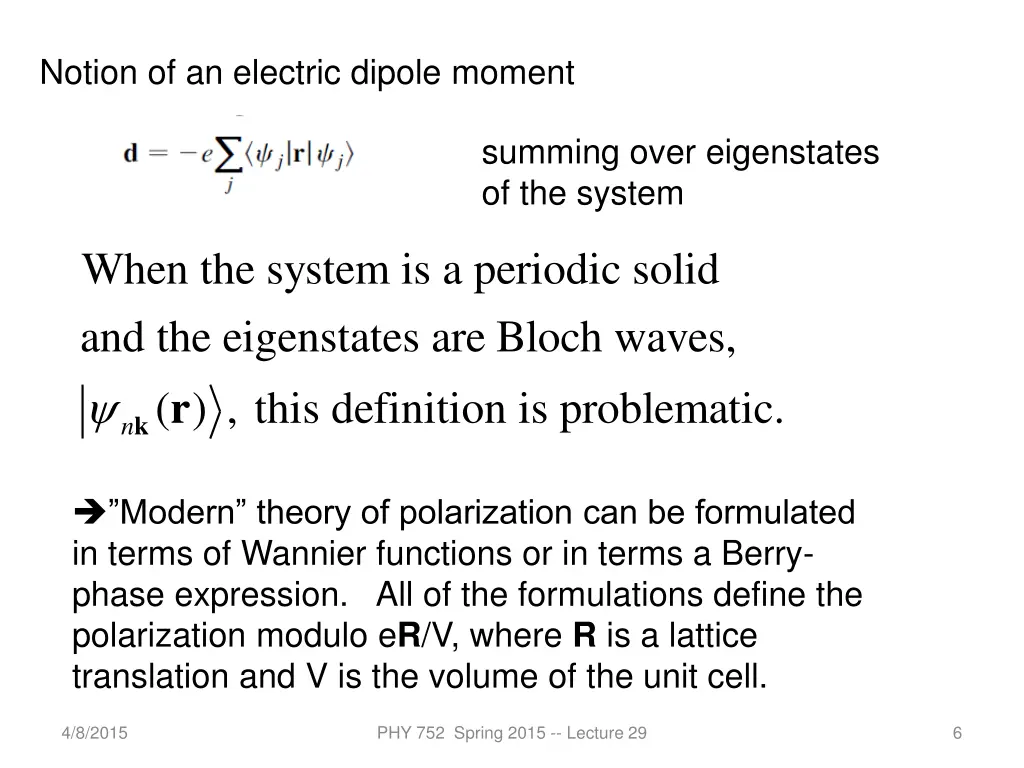
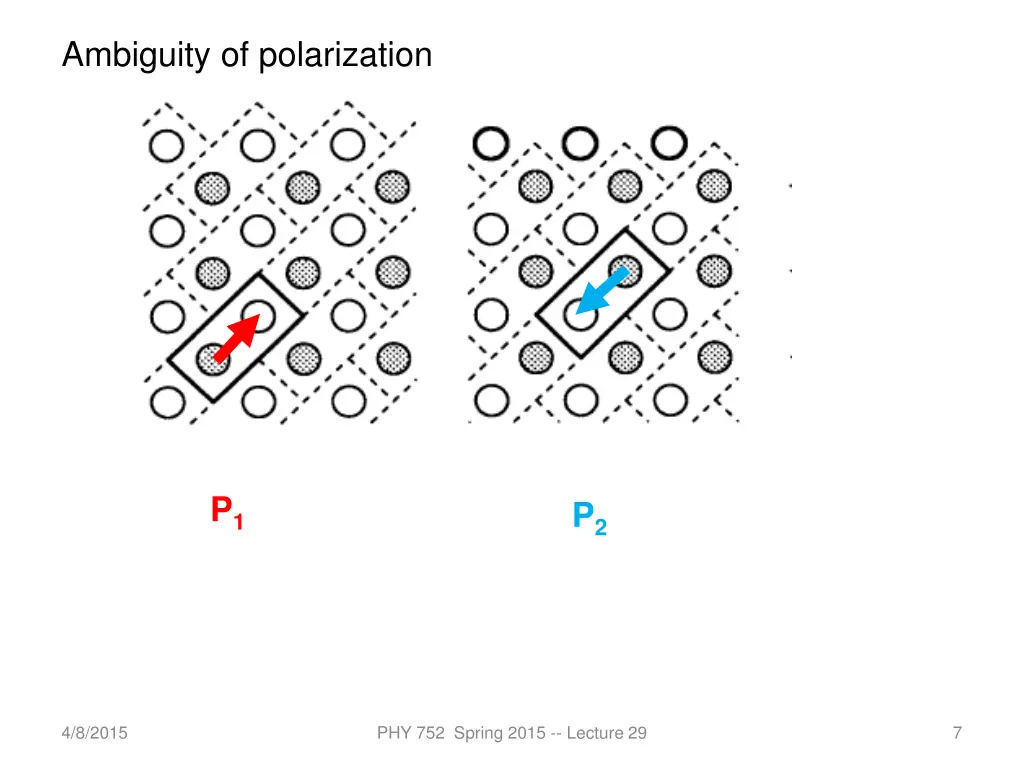
Notion of an electric dipole moment summing over eigenstates of the system When the system is a periodic solid and the eigenstates are Bloch waves, , this definition is problem t ( ) n kr a ic . Modern theory of polarization can be formulated in terms of Wannier functions or in terms a Berry- phase expression. All of the formulations define the polarization modulo eR/V, where R is a lattice translation and V is the volume of the unit cell. 4/8/2015 PHY 752 Spring 2015 -- Lecture 29 6
Ambiguity of polarization P1 P2 4/8/2015 PHY 752 Spring 2015 -- Lecture 29 7
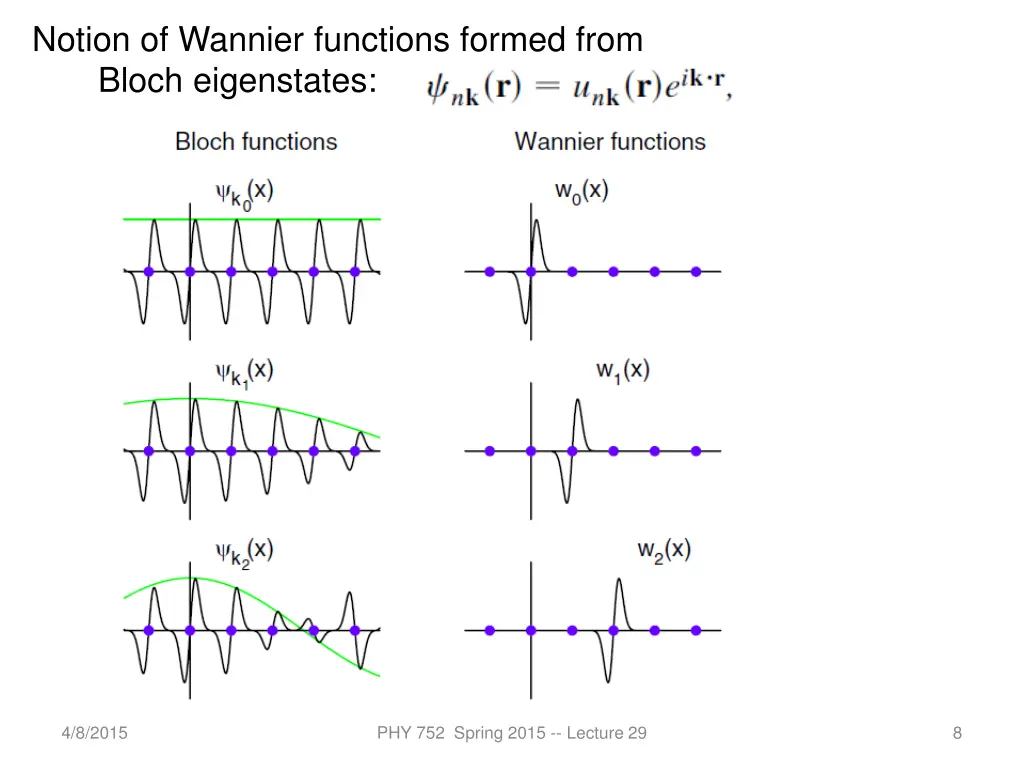
Notion of Wannier functions formed from Bloch eigenstates: 4/8/2015 PHY 752 Spring 2015 -- Lecture 29 8
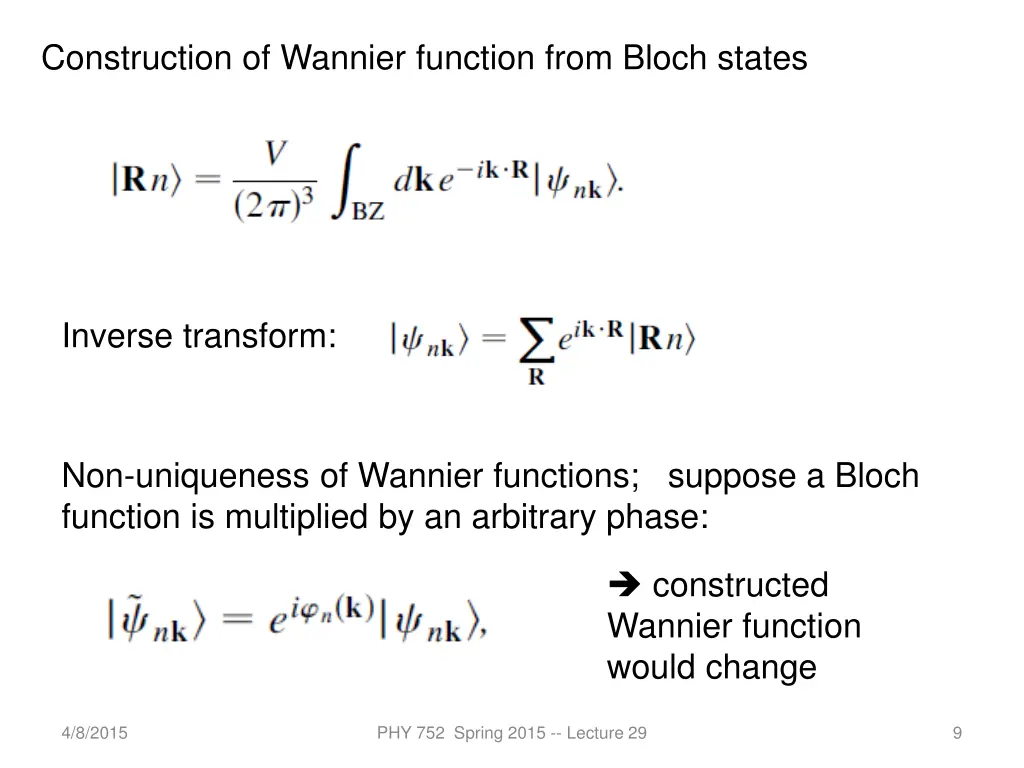
Construction of Wannier function from Bloch states Inverse transform: Non-uniqueness of Wannier functions; suppose a Bloch function is multiplied by an arbitrary phase: constructed Wannier function would change 4/8/2015 PHY 752 Spring 2015 -- Lecture 29 9
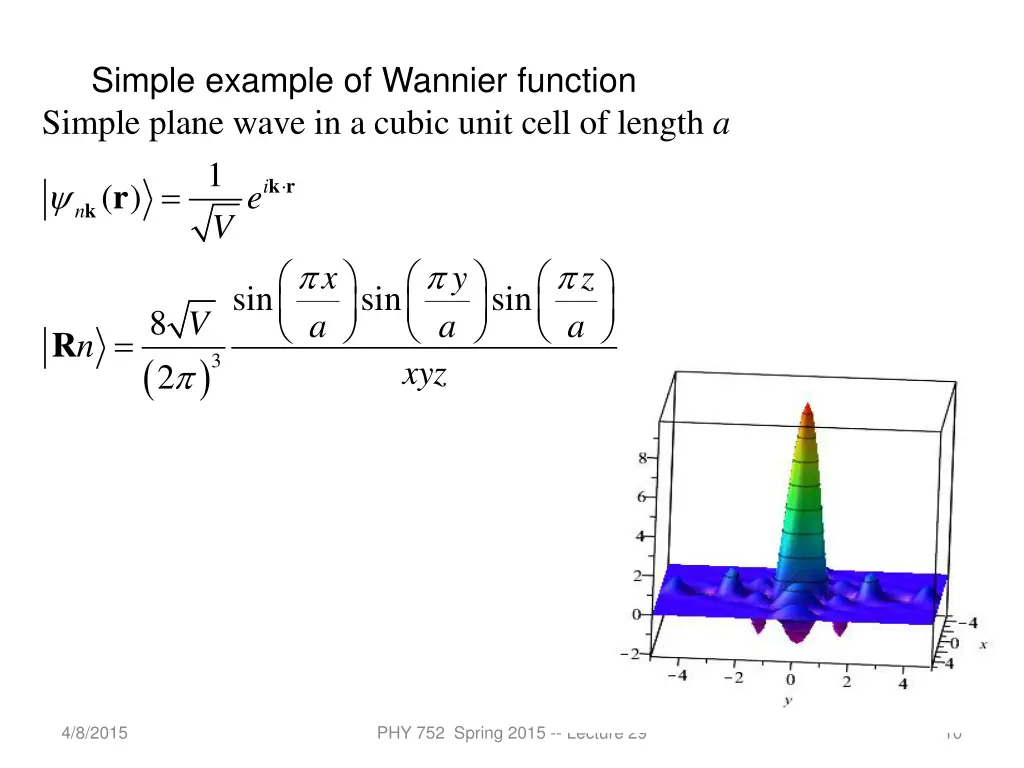
Simple example of Wannier function Simple plane wave in a cubic unit cell of length 1 i n e V = R a = k r ( ) r k x y z sin sin sin 8 2 V a a a n ( ) 3 xyz 4/8/2015 PHY 752 Spring 2015 -- Lecture 29 10
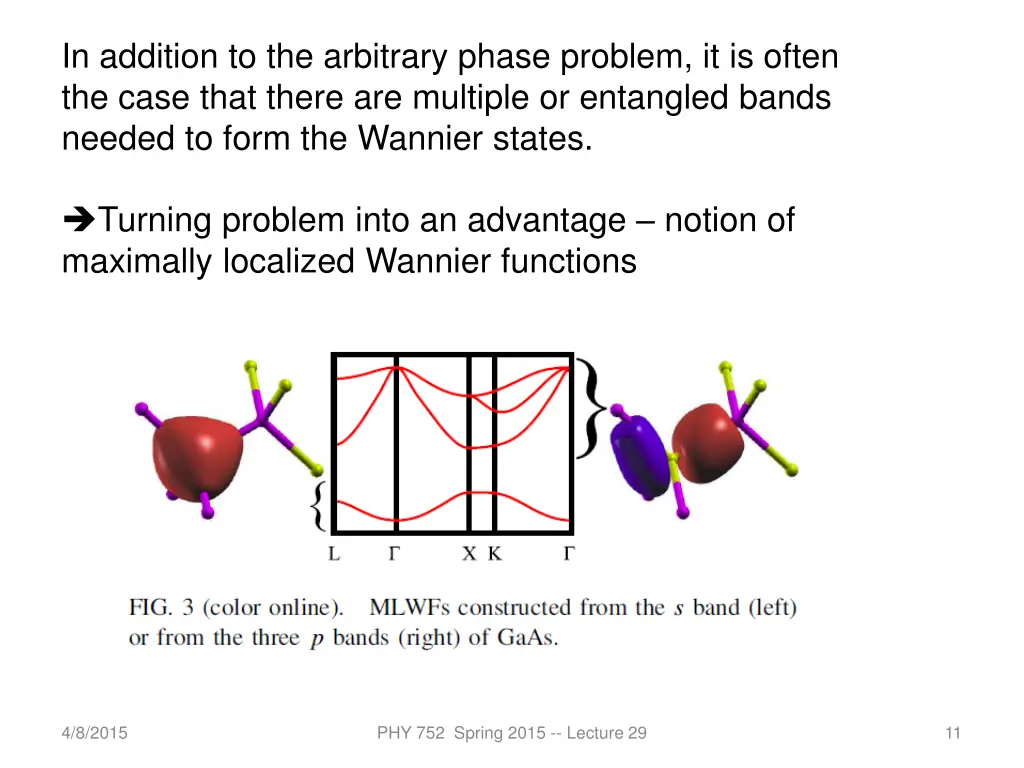
In addition to the arbitrary phase problem, it is often the case that there are multiple or entangled bands needed to form the Wannier states. Turning problem into an advantage notion of maximally localized Wannier functions 4/8/2015 PHY 752 Spring 2015 -- Lecture 29 11
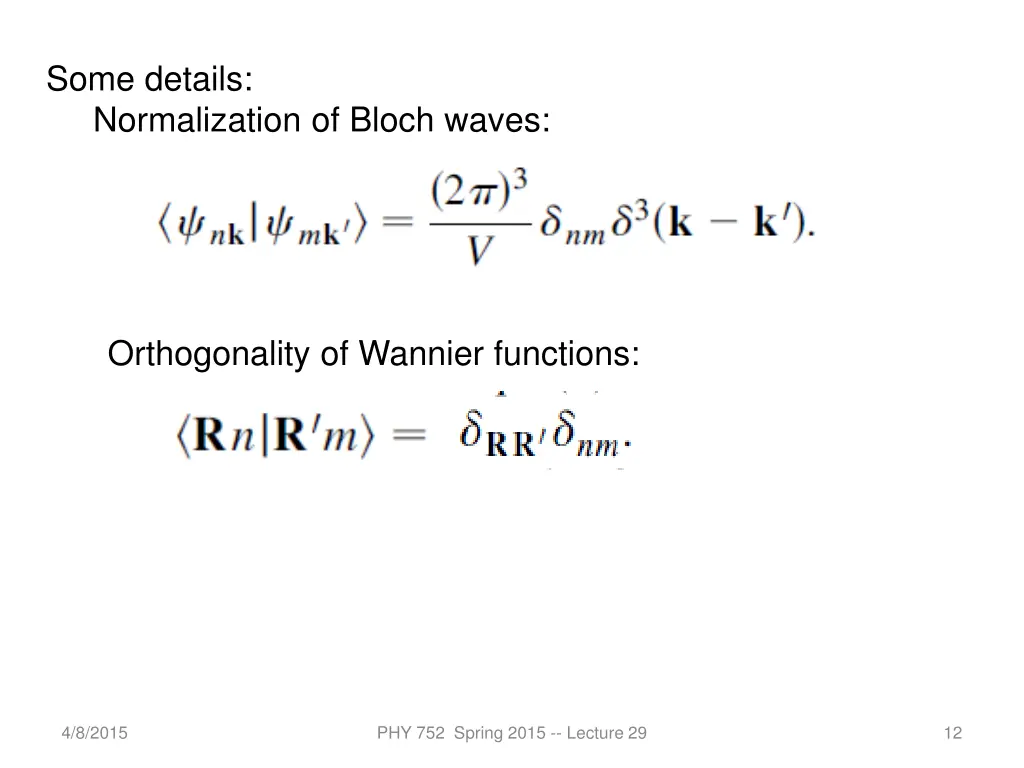
Some details: Normalization of Bloch waves: Orthogonality of Wannier functions: 4/8/2015 PHY 752 Spring 2015 -- Lecture 29 12
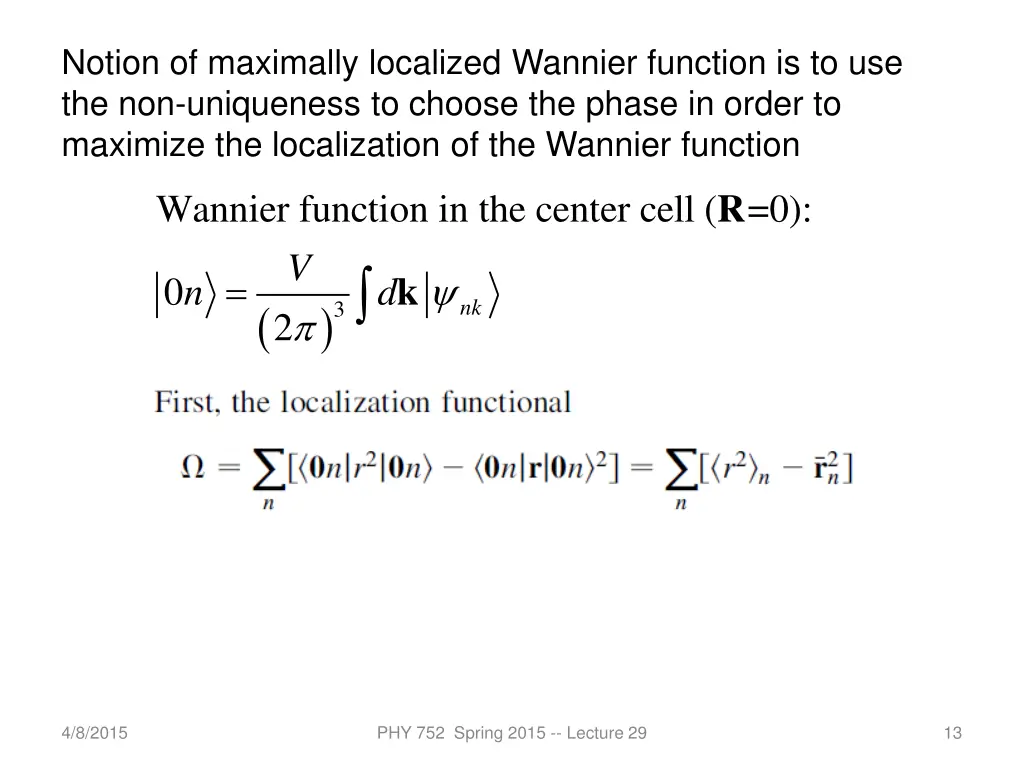
Notion of maximally localized Wannier function is to use the non-uniqueness to choose the phase in order to maximize the localization of the Wannier function R Wannier function in the center cell ( =0): V n d = k 0 ( ) nk 3 2 4/8/2015 PHY 752 Spring 2015 -- Lecture 29 13
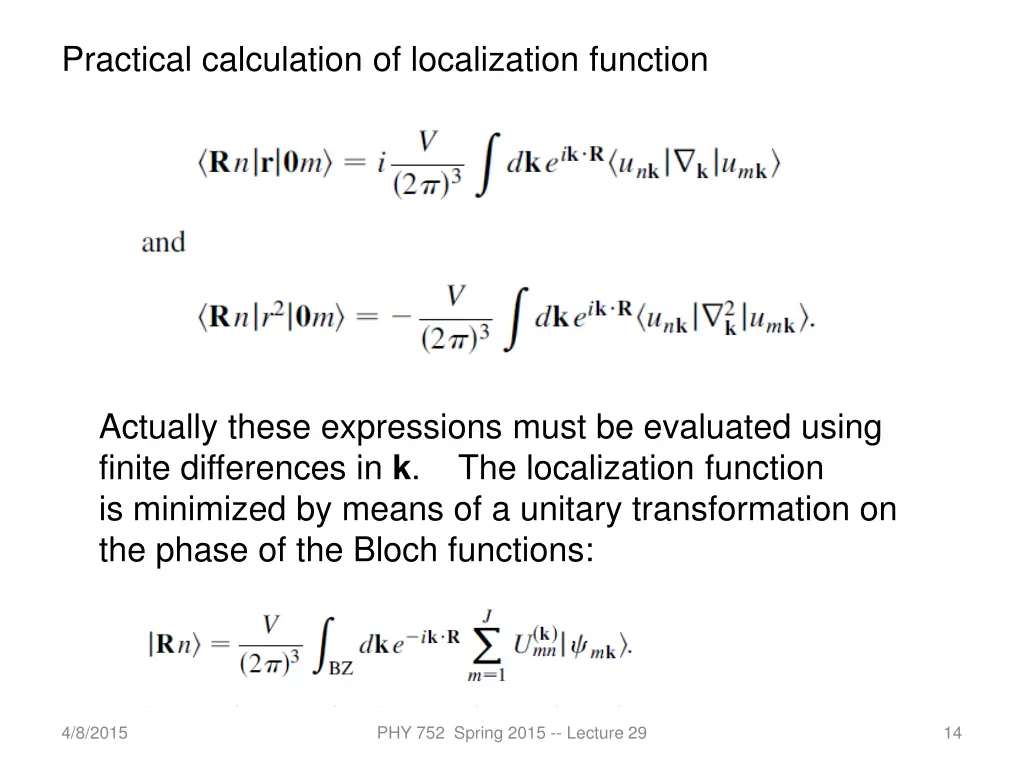
Practical calculation of localization function Actually these expressions must be evaluated using finite differences in k. The localization function is minimized by means of a unitary transformation on the phase of the Bloch functions: 4/8/2015 PHY 752 Spring 2015 -- Lecture 29 14
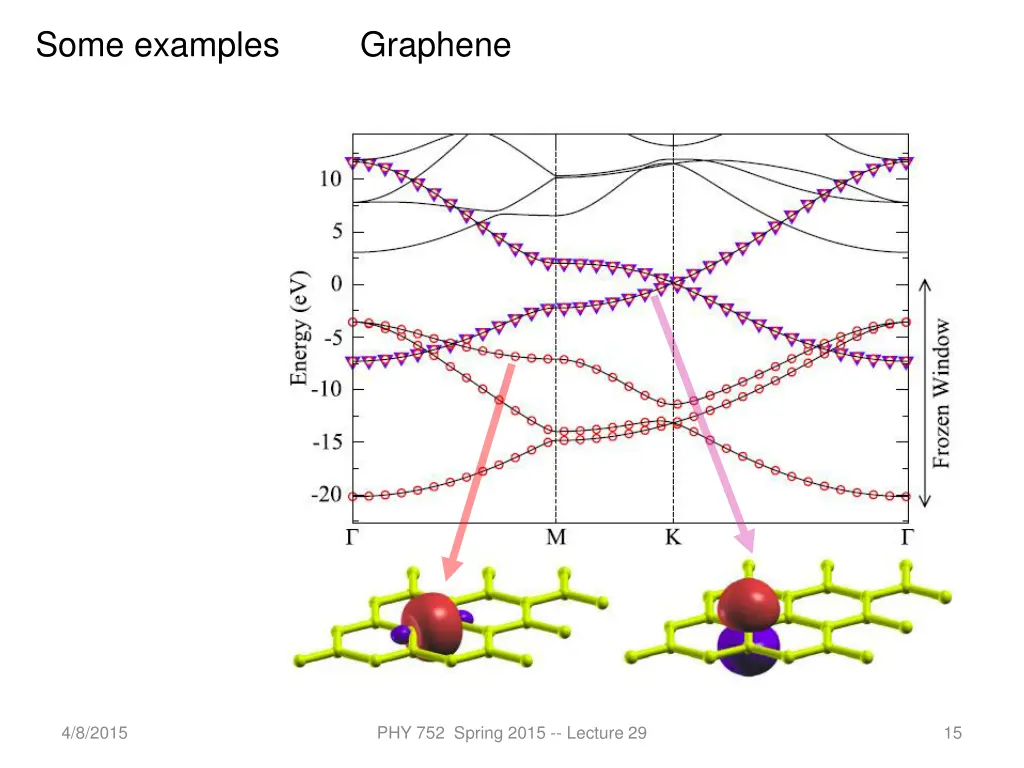
Some examples Graphene 4/8/2015 PHY 752 Spring 2015 -- Lecture 29 15
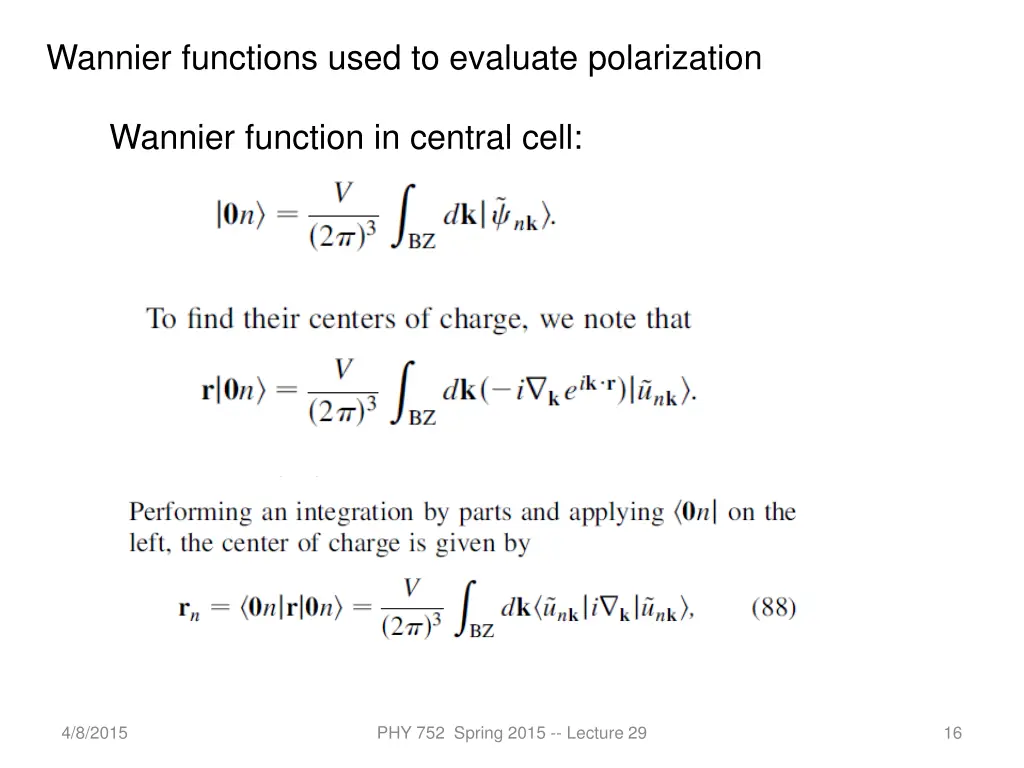
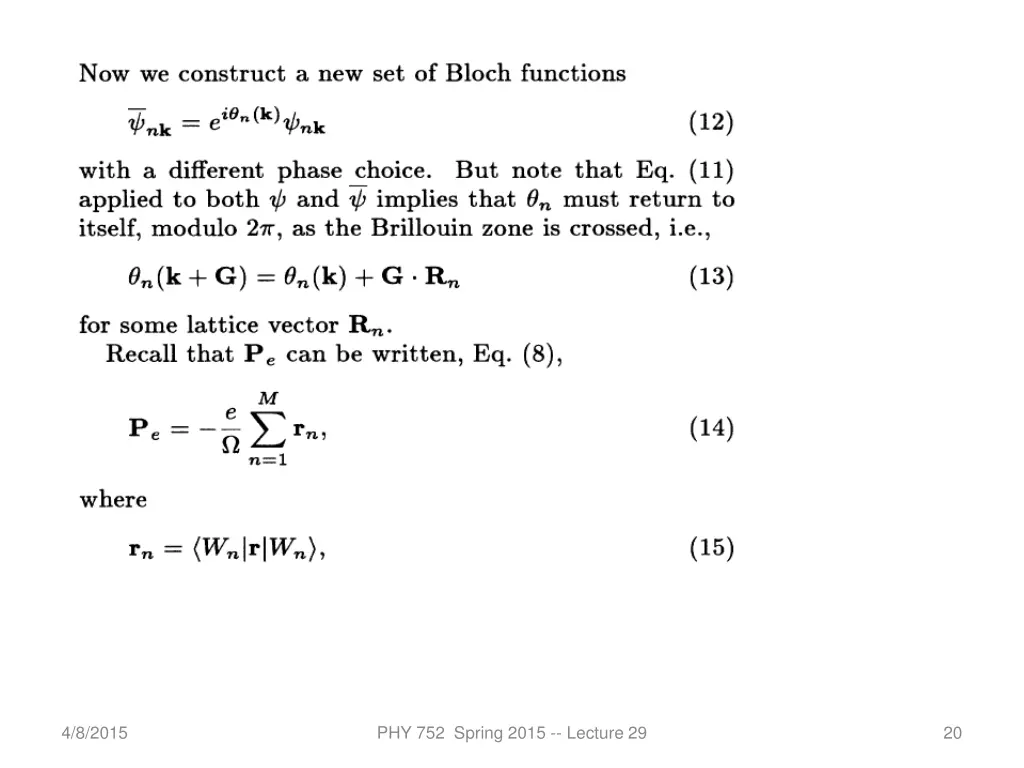
Wannier functions used to evaluate polarization Wannier function in central cell: 4/8/2015 PHY 752 Spring 2015 -- Lecture 29 16
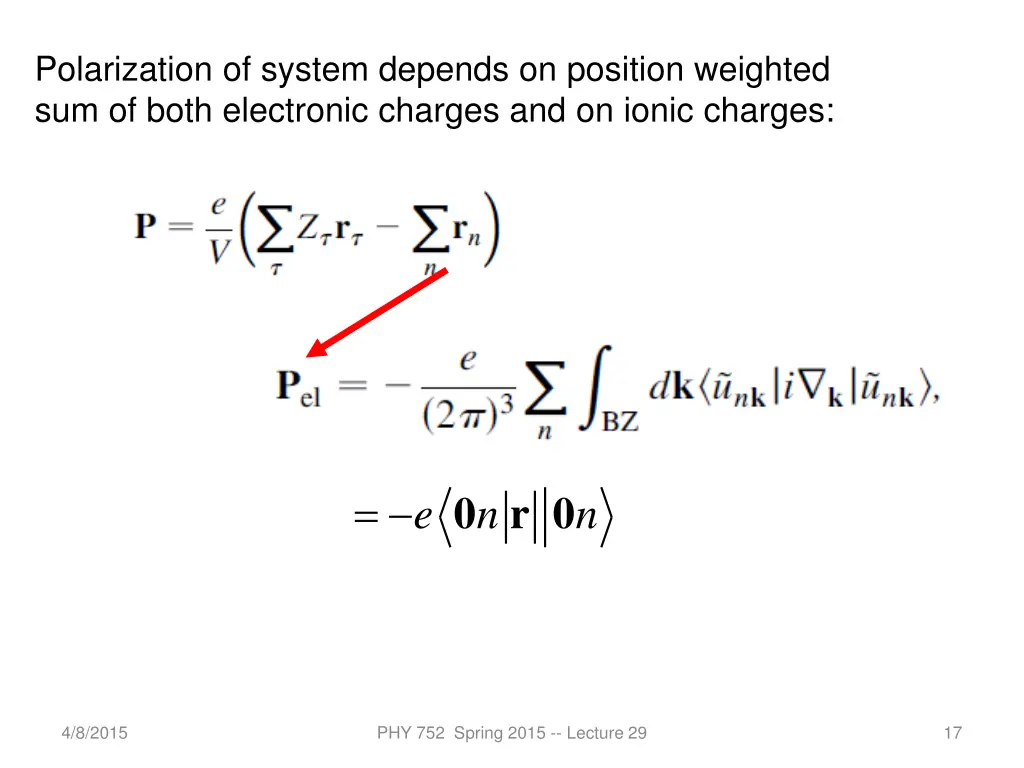
Polarization of system depends on position weighted sum of both electronic charges and on ionic charges: = 0 r 0 e n n 4/8/2015 PHY 752 Spring 2015 -- Lecture 29 17
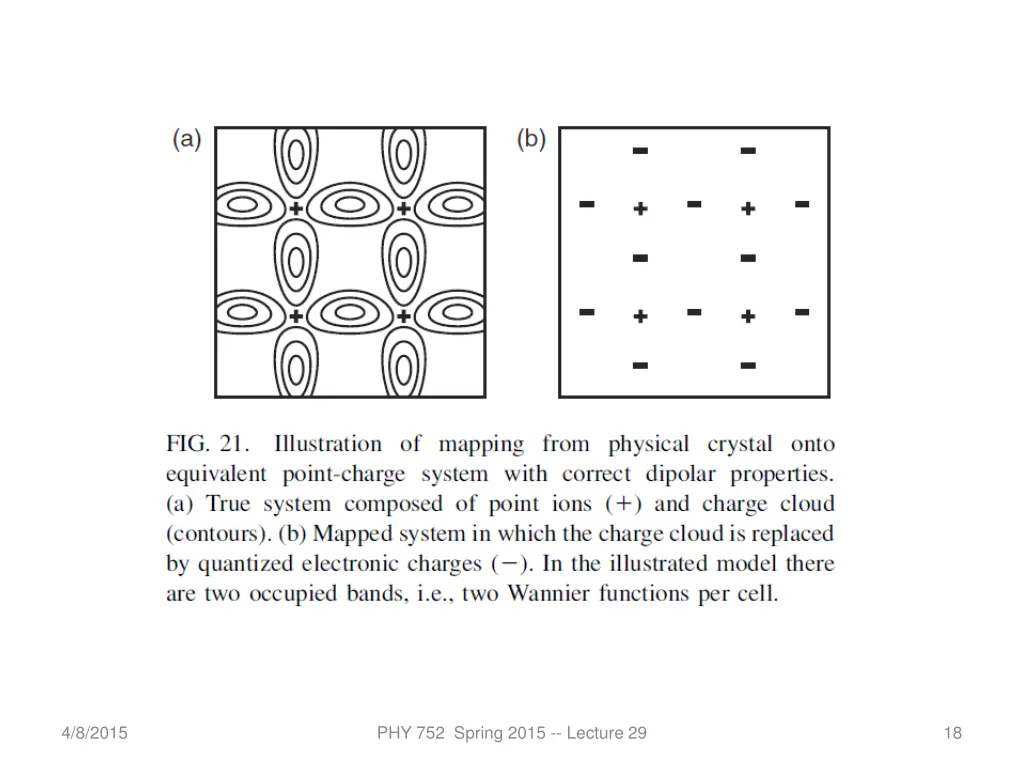
4/8/2015 PHY 752 Spring 2015 -- Lecture 29 18
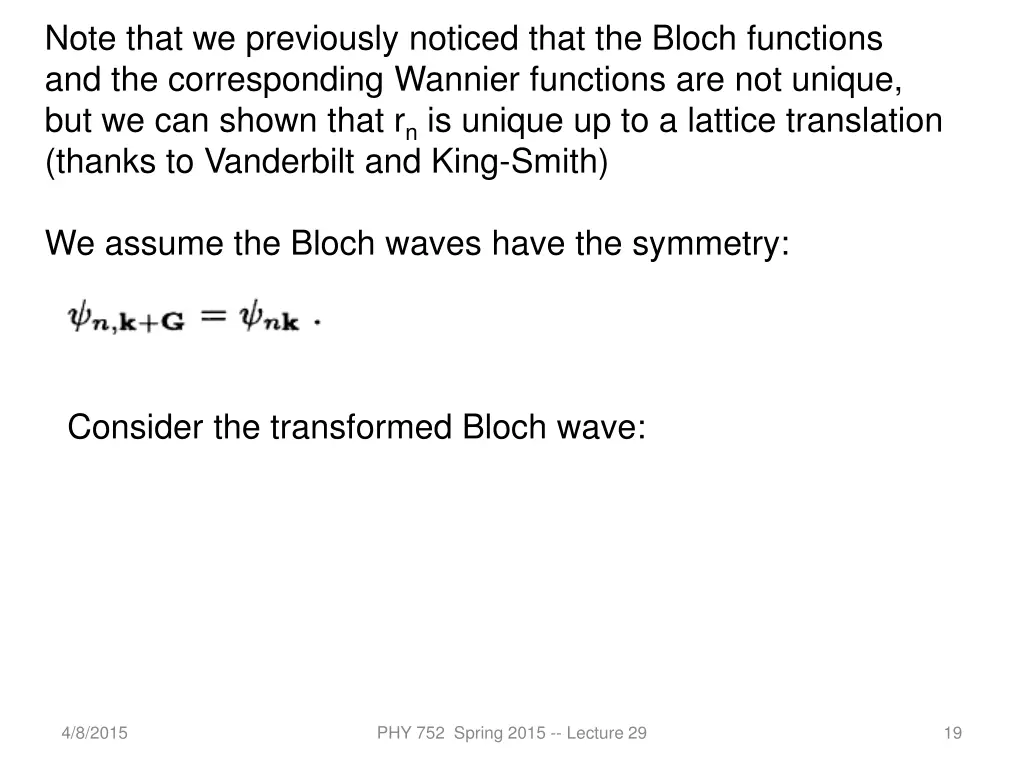
Note that we previously noticed that the Bloch functions and the corresponding Wannier functions are not unique, but we can shown that rn is unique up to a lattice translation (thanks to Vanderbilt and King-Smith) We assume the Bloch waves have the symmetry: Consider the transformed Bloch wave: 4/8/2015 PHY 752 Spring 2015 -- Lecture 29 19
4/8/2015 PHY 752 Spring 2015 -- Lecture 29 20
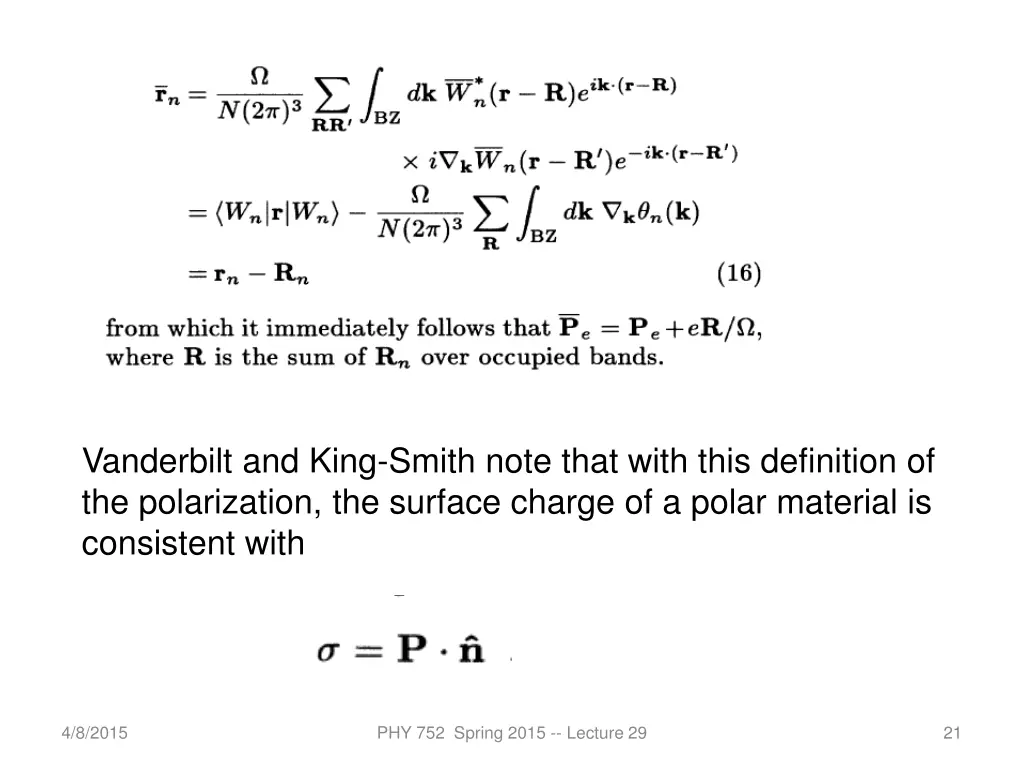
Vanderbilt and King-Smith note that with this definition of the polarization, the surface charge of a polar material is consistent with 4/8/2015 PHY 752 Spring 2015 -- Lecture 29 21