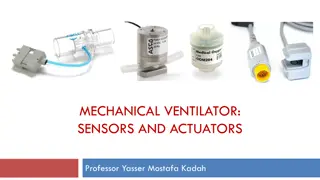
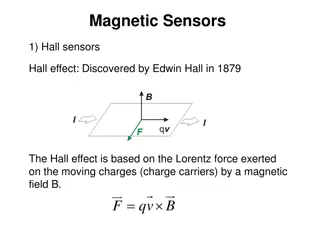
Embedded Sensors for Innovative Solutions

Dive into the world of embedded sensors with practical applications like embedding distance sensors in radio-controlled cars to prevent collisions, incorporating heat sensors in prosthetics for safety measures, and utilizing touch sensors in devices like hand sanitizers for convenient usage. Explore how to create and code solutions to enhance functionalities through sensor integration.

Download Presentation

Please find below an Image/Link to download the presentation.
The content on the website is provided AS IS for your information and personal use only. It may not be sold, licensed, or shared on other websites without obtaining consent from the author.If you encounter any issues during the download, it is possible that the publisher has removed the file from their server.
You are allowed to download the files provided on this website for personal or commercial use, subject to the condition that they are used lawfully. All files are the property of their respective owners.
The content on the website is provided AS IS for your information and personal use only. It may not be sold, licensed, or shared on other websites without obtaining consent from the author.
E N D
Presentation Transcript
Psychosocial support
Session outline Integrating psychosocial interventions into casework Psychosocial assessment Psychosocial interventions for child survivors Psychosocial interventions activity
Integrating psychosocial interventions into casework
Advanced Case Management Standard Case Management Advanced Case Management Intro, Engagement, Intake & Assessment Case Action Planning Intro, Engagement, Intake & Assessment Case Action Planning Implement the Action Plan Implement the Action Plan Psychosocial Interventions Case follow up/Monitoring Case follow up/Monitoring Case Closure Case Closure Evaluation of Service Evaluation of Service
Aims of PS interventions Provided to help child survivors (& family members) to: 1. Understand & manage reactions to abuse 2. Develop skills for managing anxiety & stress 3. Learn new skills for coping with negative reactions, & 4. Acquire new problem solving skills
The when & what WHEN: After child s immediate health & safety needs met. Likely during implement actions step WHAT: Evaluate broader areas & needs of child, family & community. Any additional info. on abuse
The who & how WHO: Gatherinformation from the child when aged 8+ years, non-offending caregiversand other trusted sources close to the child as decided by child and caseworker HOW: Develop a strategy, thinking through number of interviews, techniques and tools to be used
Refer to Child and Family Psychosocial Assessment tool on page 225 228 of CCS Guidelines
Psychosocial interventions for child survivors
Psychosocial interventions for child survivors The following psychosocial interventions can be applied in cases of child sexual abuse: Providing Healing Education Relaxation Training Coping Skills Problem Solving Healing education & relaxation training can be helpful even if child does not express psychosocial difficulties following sexual abuse
ProvidingHealing Education Type of education aimed at increasing child and family s understanding of what happened Improves children & families ability to cope with the experience by: A. Provide children & caregivers with understanding of sexual abuse & associated impacts B. Ensure children & caregivers can identify signs & symptoms of trauma
Relaxation training Children experience anxiety and / or psychosomatic complaints resulting from anxiety & stress Relaxation techniques help children feel in control of their bodies & calm their minds. This intervention aims to: A. Ensure that children & caregivers sleep & eat regularly B. Ensure that children & caregivers manage stress-related symptoms on their own
Coping skills Children may have negative feelings after sexual abuse. Coping skills help children learn to help themselves. This intervention aims to: A. Help children recognize their feelings, positive and negative B. Help children increase their capacity to cope with difficult emotions
Problem solving Children have ideas & knowledge about how to solve their problems. Caseworkers can help children develop problem solving plans to address their main problems. This intervention aims to: A. Teach children and caregivers to identify everyday problems B. Empower children and caregivers to think through solutions
Psychosocial interventions activity
Psychosocial interventions activity Split participants into 4 equal sized groups, number them 1 4 - Group 1 go to table 1: Providing Healing Education - Group 2 go to table 2: Relaxation Training - Group 3 go to table 3: Coping Skills - Group 4 go to table 4: Problem Solving Each group has 15 mins at each table
Key points 4 psychosocial interventions described and demonstrated can be used as a starting point to help children recover Child survivors with more extreme and persistent signs of distress should be referred to specialized mental health services whenever and wherever they are available