Emergency Medical Services and 911 Overview
Explore the vital role of Emergency Medical Services (EMS) and 911 in healthcare, public health, safety, and emergency management. Learn how EMS agencies provide crucial care, support public health initiatives, respond to emergencies, and help alleviate healthcare system strain. Discover the essential functions of EMS and 911 in saving lives, protecting Americans, and enhancing community resilience amidst challenges like COVID-19.

Uploaded on | 2 Views
Download Presentation

Please find below an Image/Link to download the presentation.
The content on the website is provided AS IS for your information and personal use only. It may not be sold, licensed, or shared on other websites without obtaining consent from the author. If you encounter any issues during the download, it is possible that the publisher has removed the file from their server.
You are allowed to download the files provided on this website for personal or commercial use, subject to the condition that they are used lawfully. All files are the property of their respective owners.
The content on the website is provided AS IS for your information and personal use only. It may not be sold, licensed, or shared on other websites without obtaining consent from the author.
E N D
Presentation Transcript
COVID-19 HHS/FEMA 10-1 Healthcare Resilience Task Force: EMS/911 Dr. Jon Krohmer, NHTSA, HRTF EMS/Pre-hospital Team Lead Kate Elkins, NHTSA, HRTF EMS/Pre-hospital Deputy Team Lead
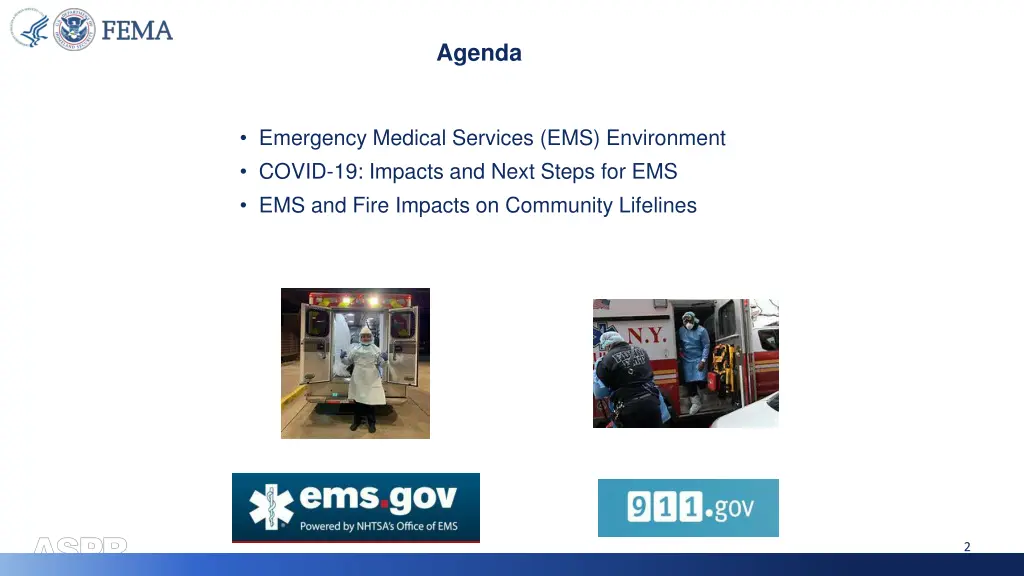
Agenda Emergency Medical Services (EMS) Environment COVID-19: Impacts and Next Steps for EMS EMS and Fire Impacts on Community Lifelines 2 Saving Lives. Protecting Americans. 2
Emergency Medical Services and 911 | Introduction EMS and 911 Quick Facts There are more than 23,000 licensed EMS agencies in the U.S. EMS agencies can be private non-profit, municipal third-service fire-based, hospital-based, and private for-profit. The majority of ambulance services are small non- governmental agencies that respond to fewer than 650 calls for service each year. There are more than 5,000 911 Public Safety Answering Points (PSAP)/Emergency Communication Centers (ECC) in the U.S. 911 centers can be run by law enforcement, information technology departments, emergency management agencies, or be independently operated. The majority of 911 centers operate with 2-5 telecommunicators on duty at any given time. EMS agencies respond to more than 40 million calls for service combined each year. 20% of EMS agencies answer 80% of the calls for service in the U.S. Between 33-50% of 911 centers provide pre-arrival medical instructions to callers to provide care while waiting for EMS to arrive. About 60% of fire departments provide emergency medical services. About 40% of EMS agencies are fire-based. 911 centers refer callers for non-emergency information and service. 911 centers refer non-acute calls for medical service to the appropriate levels of medical care, preserving healthcare system resources. 3 Saving Lives. Protecting Americans. 3
Emergency Medical Services and 911 | Introduction Emergency Medical Services (EMS) and 911 are an integral part of healthcare, public health, public safety, and emergency management Healthcare Delivery Public Health Public Safety Emergency Management EMS agencies provide emergency medical care to patients on the scene of a call, during transport to the hospital, as well as during transfers from hospitals and other healthcare facilities. EMS agencies support local public health systems through the provision of preventative care through community paramedic programs, point-of-care testing, and the delivery of vaccinations. EMS agencies are an integral part of public safety, responding to the full range of all-hazards 911 emergencies alongside police and fire agencies. EMS agencies provide crucial support to emergency management by serving as a backstop for other healthcare providers and stepping up to provide care in nursing homes and hospitals when they are overwhelmed. EMS systems are especially critical in rural areas that often have limited access to other healthcare resources. EMS and 911 centers can also preserve healthcare system capacity by triaging patients, treating them on the scene, and referring them to non-acute resources. 911 can refer non- emergency callers to public health resources. 4 Saving Lives. Protecting Americans. 4
2020 Assessment Total Number of EMS Agencies by State Legend 5-21 64-132 155-285 300-500 550-925 1,195-2,025 No Response Source: National Association of State EMS Officials (NASEMSO) National EMS Assessment, April 2020 5 Saving Lives. Protecting Americans. 5
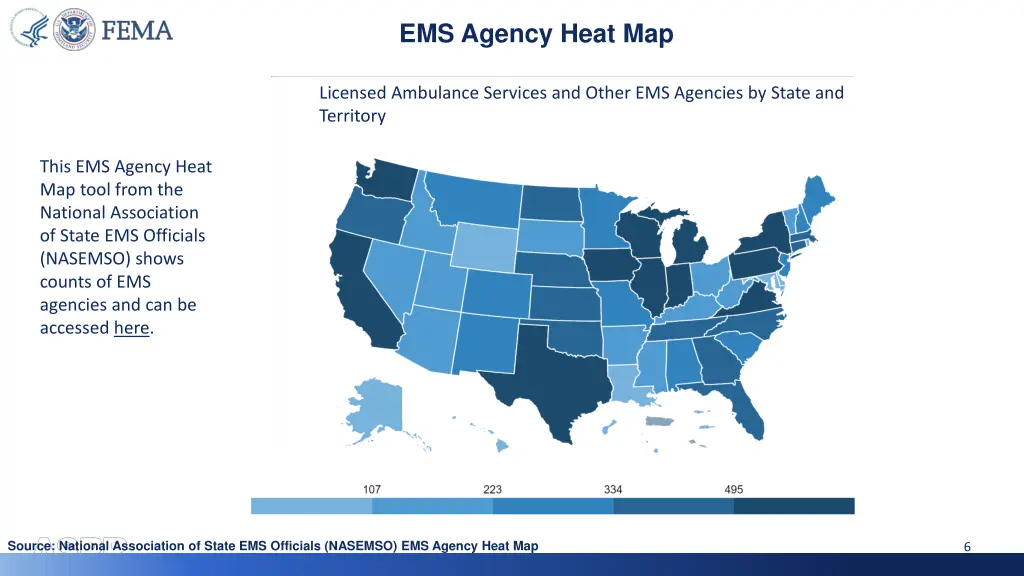
EMS Agency Heat Map Licensed Ambulance Services and Other EMS Agencies by State and Territory This EMS Agency Heat Map tool from the National Association of State EMS Officials (NASEMSO) shows counts of EMS agencies and can be accessed here. Source: National Association of State EMS Officials (NASEMSO) EMS Agency Heat Map 6 Saving Lives. Protecting Americans. 6
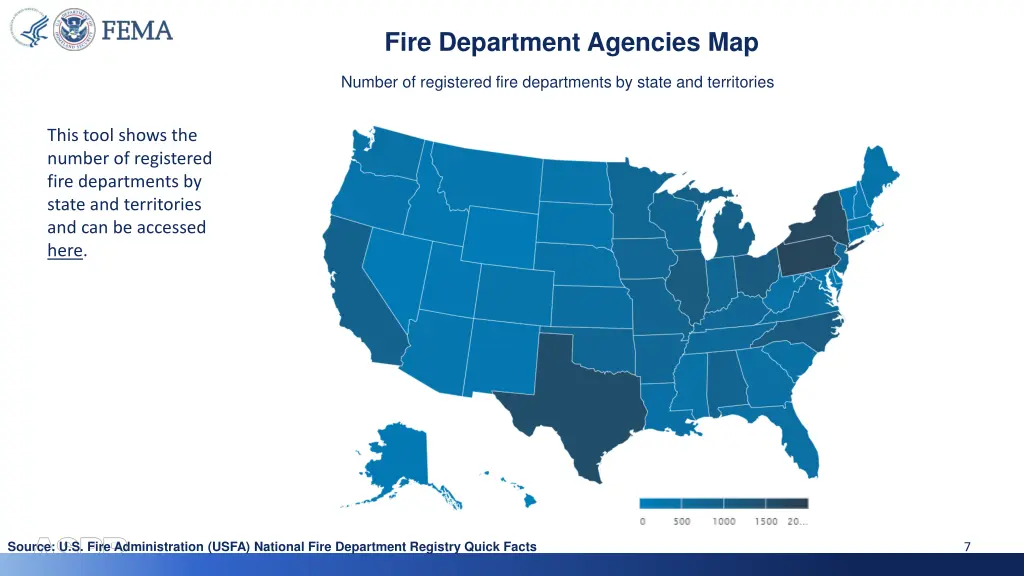
Fire Department Agencies Map Number of registered fire departments by state and territories This tool shows the number of registered fire departments by state and territories and can be accessed here. Source: U.S. Fire Administration (USFA) National Fire Department Registry Quick Facts 7 Saving Lives. Protecting Americans. 7
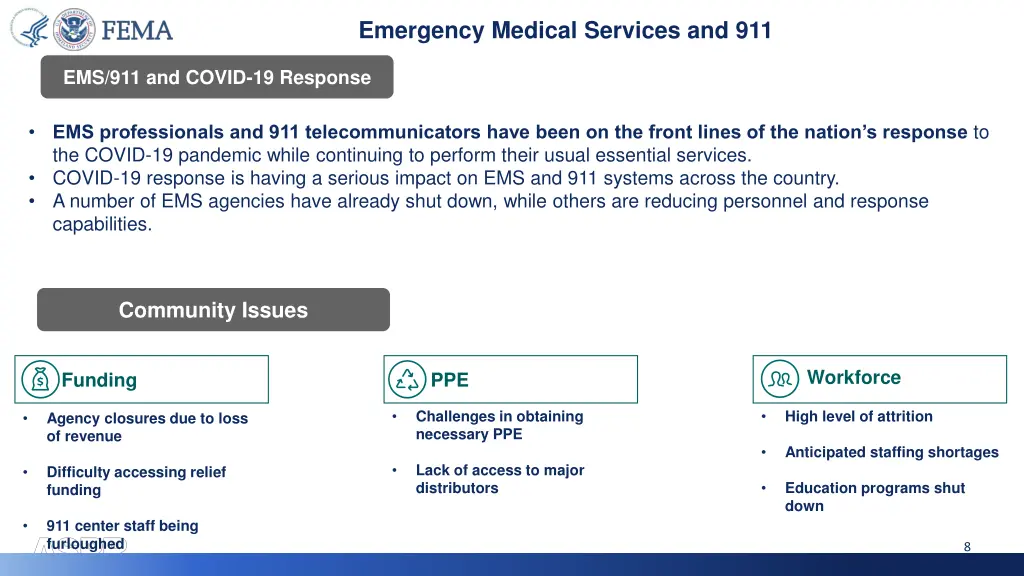
Emergency Medical Services and 911 EMS/911 and COVID-19 Response EMS professionals and 911 telecommunicators have been on the front lines of the nation s response to the COVID-19 pandemic while continuing to perform their usual essential services. COVID-19 response is having a serious impact on EMS and 911 systems across the country. A number of EMS agencies have already shut down, while others are reducing personnel and response capabilities. Community Issues Workforce Funding PPE Challenges in obtaining necessary PPE High level of attrition Agency closures due to loss of revenue Anticipated staffing shortages Lack of access to major distributors Difficulty accessing relief funding Education programs shut down 911 center staff being furloughed 8 Saving Lives. Protecting Americans. 8
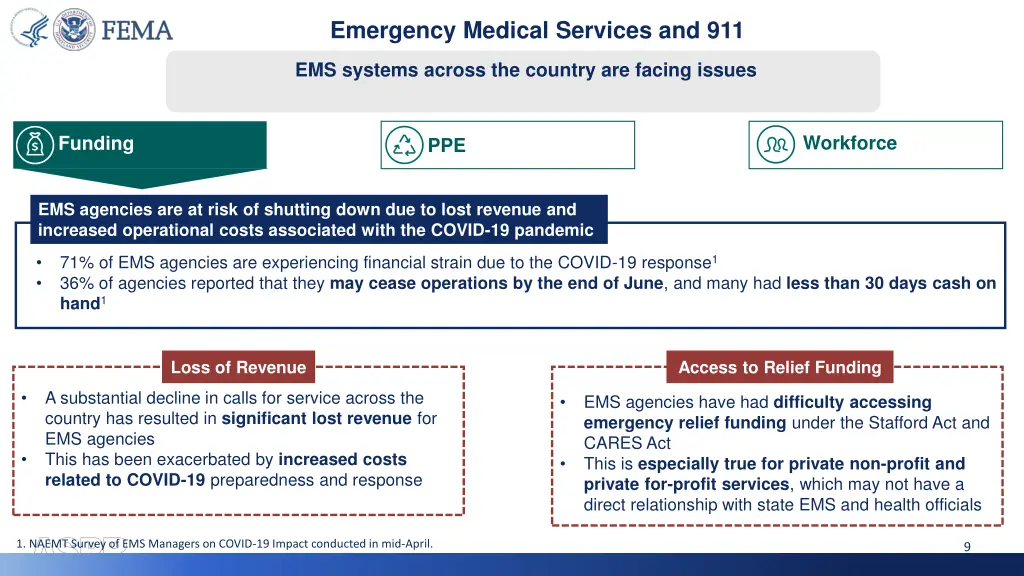
Emergency Medical Services and 911 EMS systems across the country are facing issues Workforce Funding PPE EMS agencies are at risk of shutting down due to lost revenue and increased operational costs associated with the COVID-19 pandemic 71% of EMS agencies are experiencing financial strain due to the COVID-19 response1 36% of agencies reported that they may cease operations by the end of June, and many had less than 30 days cash on hand1 Loss of Revenue Access to Relief Funding A substantial decline in calls for service across the country has resulted in significant lost revenue for EMS agencies This has been exacerbated by increased costs related to COVID-19 preparedness and response EMS agencies have had difficulty accessing emergency relief funding under the Stafford Act and CARES Act This is especially true for private non-profit and private for-profit services, which may not have a direct relationship with state EMS and health officials 1. NAEMT Survey of EMS Managers on COVID-19 Impact conducted in mid-April. 9 Saving Lives. Protecting Americans. 9
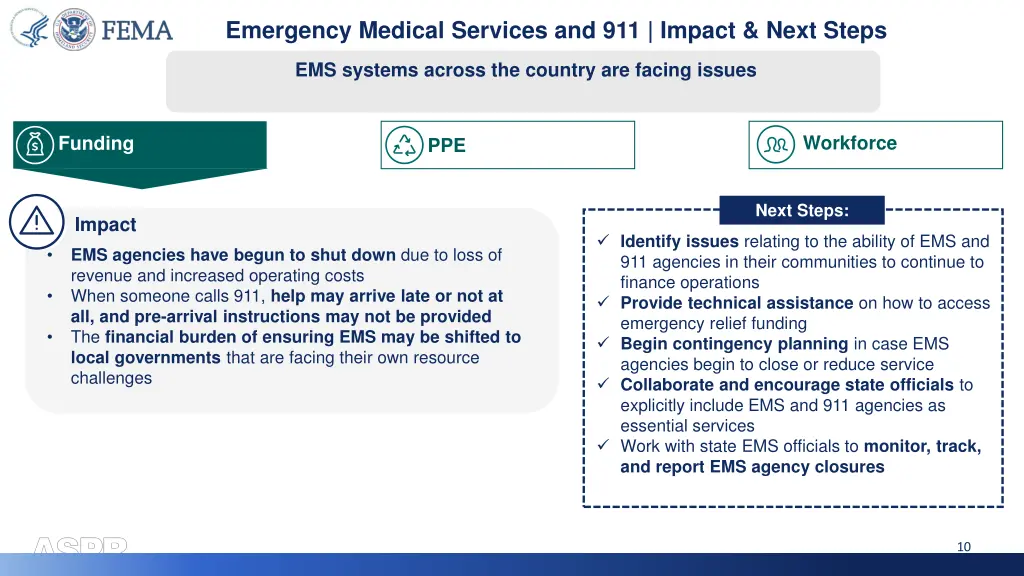
Emergency Medical Services and 911 | Impact & Next Steps EMS systems across the country are facing issues Workforce Funding PPE Next Steps: Impact Identify issues relating to the ability of EMS and 911 agencies in their communities to continue to finance operations Provide technical assistance on how to access emergency relief funding Begin contingency planning in case EMS agencies begin to close or reduce service EMS agencies have begun to shut down due to loss of revenue and increased operating costs When someone calls 911, help may arrive late or not at all, and pre-arrival instructions may not be provided The financial burden of ensuring EMS may be shifted to local governments that are facing their own resource challenges This is especially true for private non-profit and private for-profit services that may not have a direct relationship with state emergency management or public health officials. Collaborate and encourage state officials to explicitly include EMS and 911 agencies as essential services Work with state EMS officials to monitor, track, and report EMS agency closures 10 Saving Lives. Protecting Americans. 10
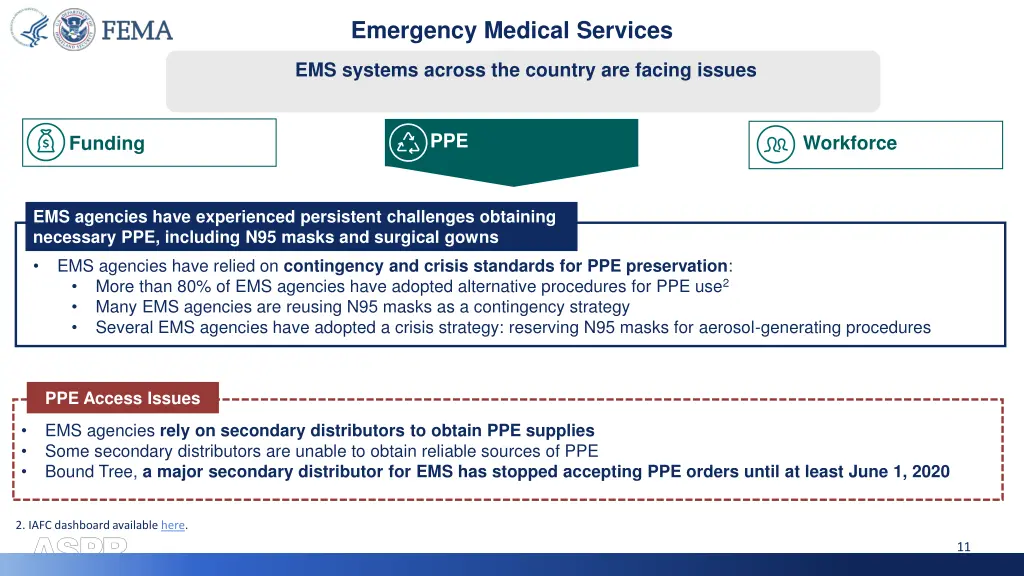
Emergency Medical Services EMS systems across the country are facing issues PPE Workforce Funding EMS agencies have experienced persistent challenges obtaining necessary PPE, including N95 masks and surgical gowns EMS agencies have relied on contingency and crisis standards for PPE preservation: More than 80% of EMS agencies have adopted alternative procedures for PPE use2 Many EMS agencies are reusing N95 masks as a contingency strategy Several EMS agencies have adopted a crisis strategy: reserving N95 masks for aerosol-generating procedures PPE Access Issues EMS agencies rely on secondary distributors to obtain PPE supplies Some secondary distributors are unable to obtain reliable sources of PPE Bound Tree, a major secondary distributor for EMS has stopped accepting PPE orders until at least June 1, 2020 2. IAFC dashboard available here. 11 Saving Lives. Protecting Americans. 11
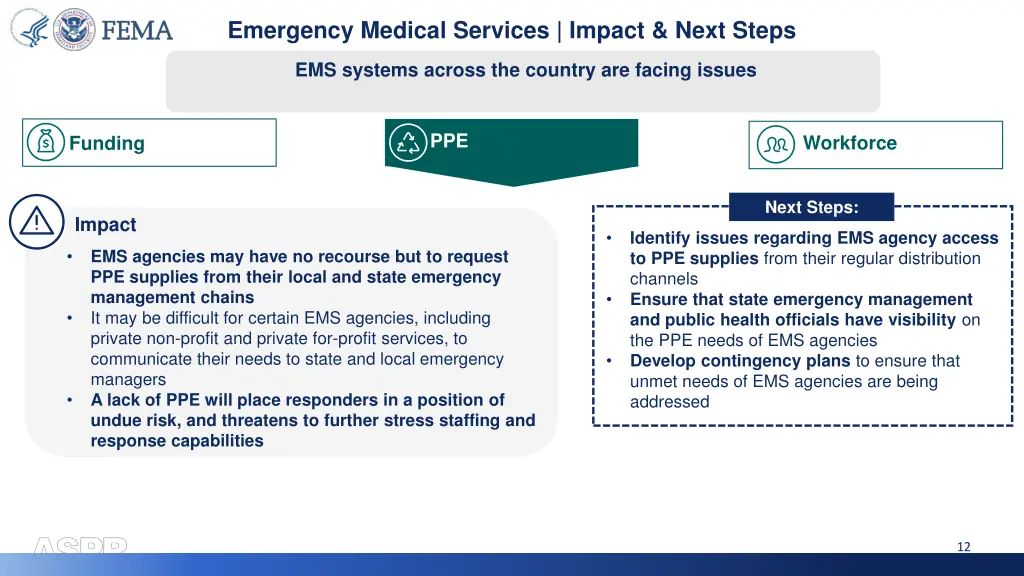
Emergency Medical Services | Impact & Next Steps EMS systems across the country are facing issues PPE Workforce Funding Next Steps: Impact Identify issues regarding EMS agency access to PPE supplies from their regular distribution channels Ensure that state emergency management and public health officials have visibility on EMS agencies may have no recourse but to request PPE supplies from their local and state emergency management chains It may be difficult for certain EMS agencies, including private non-profit and private for-profit services, to communicate their needs to state and local emergency managers A lack of PPE will place responders in a position of undue risk, and threatens to further stress staffing and response capabilities This is especially true for private non-profit and private for-profit services that may not have a direct relationship with state emergency management or public health officials. the PPE needs of EMS agencies Develop contingency plans to ensure that unmet needs of EMS agencies are being addressed 12 Saving Lives. Protecting Americans. 12
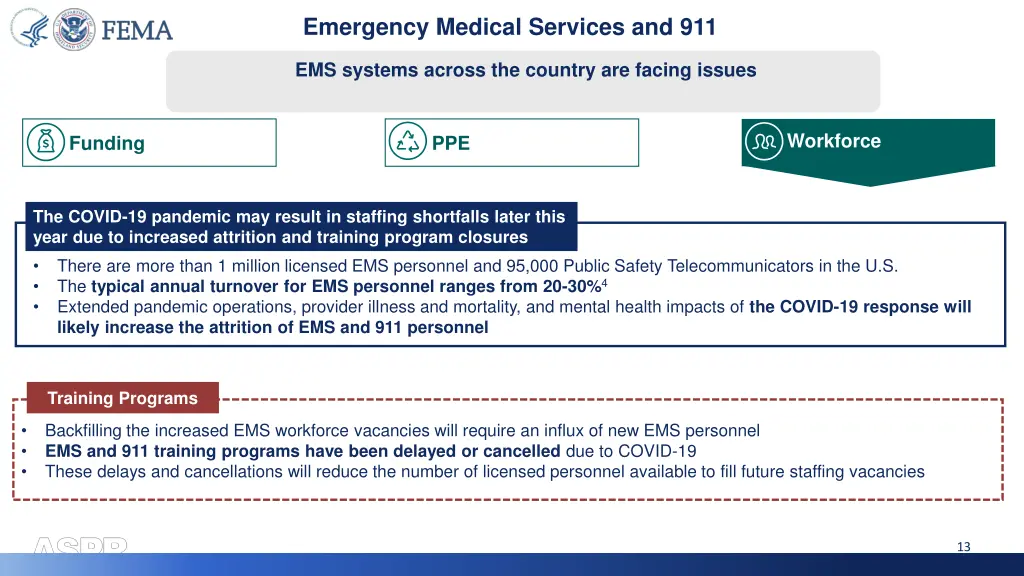
Emergency Medical Services and 911 EMS systems across the country are facing issues Workforce Funding PPE The COVID-19 pandemic may result in staffing shortfalls later this year due to increased attrition and training program closures There are more than 1 million licensed EMS personnel and 95,000 Public Safety Telecommunicators in the U.S. The typical annual turnover for EMS personnel ranges from 20-30%4 Extended pandemic operations, provider illness and mortality, and mental health impacts of the COVID-19 response will likely increase the attrition of EMS and 911 personnel Training Programs Backfilling the increased EMS workforce vacancies will require an influx of new EMS personnel EMS and 911 training programs have been delayed or cancelled due to COVID-19 These delays and cancellations will reduce the number of licensed personnel available to fill future staffing vacancies 13 Saving Lives. Protecting Americans. 13
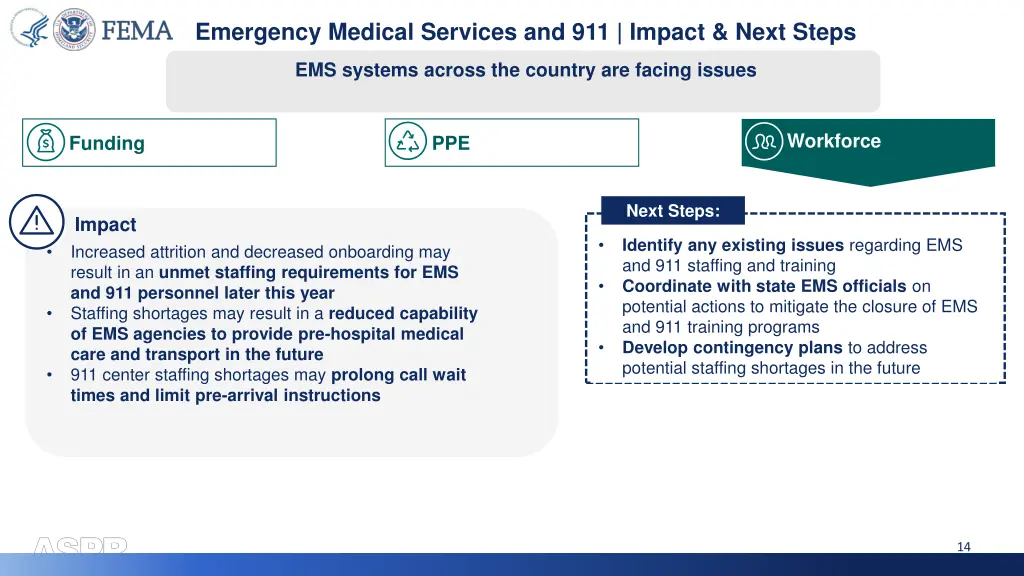
Emergency Medical Services and 911 | Impact & Next Steps EMS systems across the country are facing issues Workforce Funding PPE Next Steps: Impact Increased attrition and decreased onboarding may result in an unmet staffing requirements for EMS and 911 personnel later this year Staffing shortages may result in a reduced capability of EMS agencies to provide pre-hospital medical care and transport in the future 911 center staffing shortages may prolong call wait times and limit pre-arrival instructions Identify any existing issues regarding EMS and 911 staffing and training Coordinate with state EMS officials on potential actions to mitigate the closure of EMS This is especially true for private non-profit and private for-profit services that may not have a direct relationship with state emergency management or public health officials. and 911 training programs Develop contingency plans to address potential staffing shortages in the future 14 Saving Lives. Protecting Americans. 14
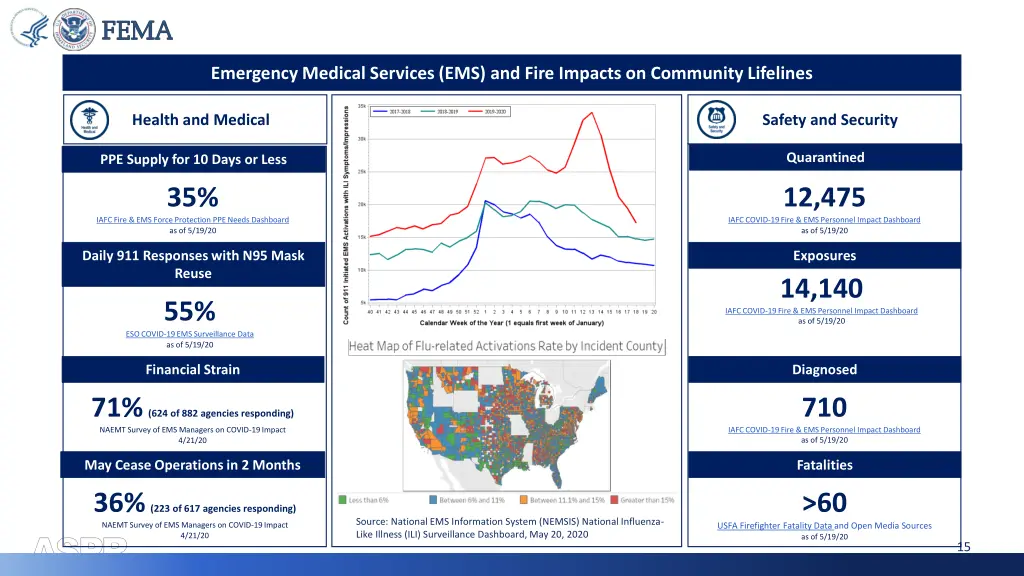
Emergency Medical Services (EMS) and Fire Impacts on Community Lifelines Health and Medical Safety and Security Quarantined PPE Supply for 10 Days or Less 35% 12,475 IAFC Fire & EMS Force Protection PPE Needs Dashboard as of 5/19/20 IAFC COVID-19 Fire & EMS Personnel Impact Dashboard as of 5/19/20 Daily 911 Responses with N95 Mask Reuse Exposures 14,140 55% IAFC COVID-19 Fire & EMS Personnel Impact Dashboard as of 5/19/20 ESO COVID-19 EMS Surveillance Data as of 5/19/20 Financial Strain Diagnosed 71%(624 of 882 agencies responding) NAEMT Survey of EMS Managers on COVID-19 Impact 4/21/20 710 IAFC COVID-19 Fire & EMS Personnel Impact Dashboard as of 5/19/20 May Cease Operations in 2 Months Fatalities 36%(223 of 617 agencies responding) NAEMT Survey of EMS Managers on COVID-19 Impact 4/21/20 >60 Source: National EMS Information System (NEMSIS) National Influenza- Like Illness (ILI) Surveillance Dashboard, May 20, 2020 USFA Firefighter Fatality Data and Open Media Sources as of 5/19/20 15 Saving Lives. Protecting Americans. 15
Back-up slides and Contact Information Dr. Jon R. Krohmer, MD, FACEP, FAEMS Team Lead FEMA Health Systems Resiliency TF EMS/Prehospital Team Director, Office of Emergency Medical Services National Highway Traffic Safety Administration 202-366-9966 Jon.Krohmer@dot.gov Kate Elkins, MPH, CPH, NRP Deputy Team Lead FEMA Health Systems Resiliency TF EMS/Prehospital Team EMS Specialist Office of Emergency Medical Services National Highway Traffic Safety Administration 202-680-4974 Katherine.Elkins@dot.gov 16
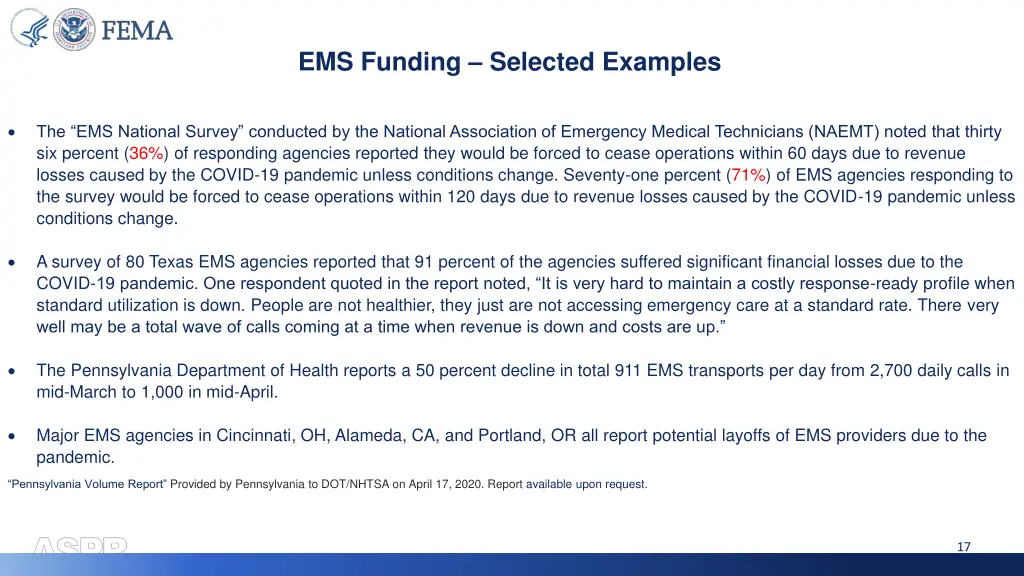
EMS Funding Selected Examples The EMS National Survey conducted by the National Association of Emergency Medical Technicians (NAEMT) noted that thirty six percent (36%) of responding agencies reported they would be forced to cease operations within 60 days due to revenue losses caused by the COVID-19 pandemic unless conditions change. Seventy-one percent (71%) of EMS agencies responding to the survey would be forced to cease operations within 120 days due to revenue losses caused by the COVID-19 pandemic unless conditions change. A survey of 80 Texas EMS agencies reported that 91 percent of the agencies suffered significant financial losses due to the COVID-19 pandemic. One respondent quoted in the report noted, It is very hard to maintain a costly response-ready profile when standard utilization is down. People are not healthier, they just are not accessing emergency care at a standard rate. There very well may be a total wave of calls coming at a time when revenue is down and costs are up. The Pennsylvania Department of Health reports a 50 percent decline in total 911 EMS transports per day from 2,700 daily calls in mid-March to 1,000 in mid-April. Major EMS agencies in Cincinnati, OH, Alameda, CA, and Portland, OR all report potential layoffs of EMS providers due to the pandemic. Pennsylvania Volume Report Provided by Pennsylvania to DOT/NHTSA on April 17, 2020. Report available upon request. 17 Saving Lives. Protecting Americans. 17
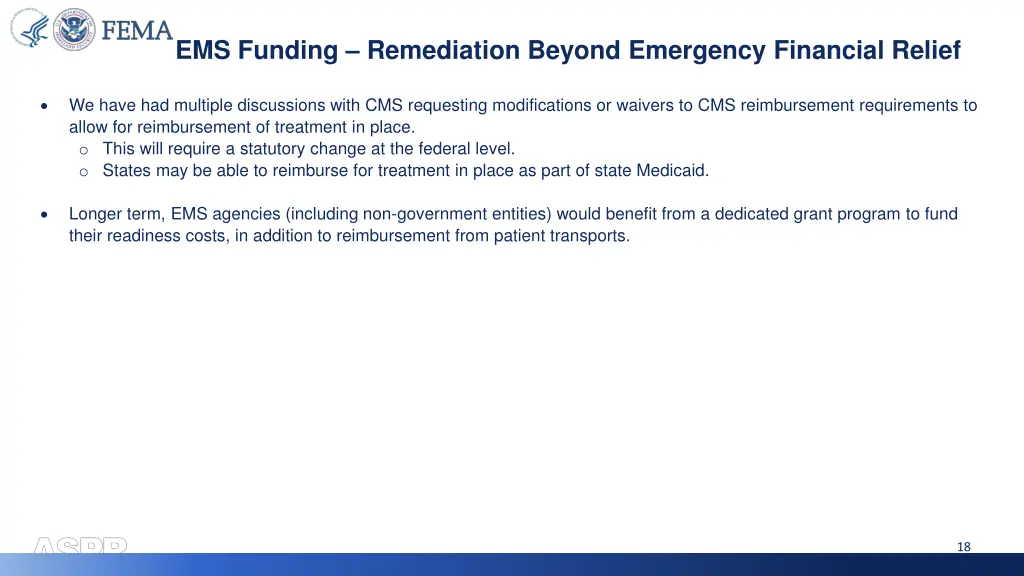
EMS Funding Remediation Beyond Emergency Financial Relief We have had multiple discussions with CMS requesting modifications or waivers to CMS reimbursement requirements to allow for reimbursement of treatment in place. o This will require a statutory change at the federal level. o States may be able to reimburse for treatment in place as part of state Medicaid. Longer term, EMS agencies (including non-government entities) would benefit from a dedicated grant program to fund their readiness costs, in addition to reimbursement from patient transports. 18 Saving Lives. Protecting Americans. 18
Pre-Hospital (EMS/911) Team Documents (with links) Redirecting 911 Calls for Information & Low Acuity Medical Complaints (EMS.gov) Mitigate Absenteeism by Protecting 911 Telecommunicators Psychological Health and Well-being during the COVID-19 Pandemic (911.gov) Managing Patient and Family Distress Associated with COVID-19 in the Pre-hospital Care Setting (EMS.gov) Mitigate Absenteeism by Protecting Emergency Medical Service (EMS) Clinicians Psychological Health and Well-being during the COVID-19 Pandemic (EMS.gov) Personal Protective Equipment Supply (EMS.gov) Considerations for State EMS Offices in Response to COVID-19 (EMS.gov) 911 and EMS algorithms (EMS.gov) Best Practices for COVID-19 Call Screening and Response (911.gov) COVID-19: Considerations, Strategies, and Resources for Emergency Medical Services Crisis Standards of Care (EMS.gov) Emergency Medical Services and 911 Resource Guide (EMS.gov) Burnout, Self-Care & COVID-19 Exposure for First Responders (EMS.gov) Burnout, Self-Care & COVID-19 Exposure for Families of First Responders (EMS.gov) Guidance for Preventing Disease Spread During Transport of Patients at High Risk for COVID-19 Illness (EMS.gov) Guidance for First Responder Interactions with Suspected/Confirmed COVID-19 Patients (EMS.gov) COVID-19: Supplemental Funding for Emergency Medical Services (EMS.gov) Epidemiology for COVID-19 Emergency Medical Service Providers: What You Need to Know (EMS.gov) COVID-19 Literature and Research Resources for Emergency Medical Services (EMS) (EMS.gov) COVID-19 Disinfection of Structural Firefighting Personal Protective Equipment (EMS.gov) COVID-19 Behavioral Health Resources for First Responders (EMS.gov) EMS Patient Contact Algorithm (EMS.gov) EMS Personnel Support for Population Testing, Screening, and Vaccination (EMS.gov) Safe Preservation of Personal Protective Equipment by EMS (EMS.gov) 19 Saving Lives. Protecting Americans. 19