Explore the concept of empathy, its contemporary relevance, and the paradox of self/other orientations in empathy. Learn about cognitive and physical empathy, and their implications for understanding others.
Please find below an Image/Link to download the presentation.
The content on the website is provided AS IS for your information and personal use only. It may not be sold, licensed, or shared on other websites without obtaining consent from the author. If you encounter any issues during the download, it is possible that the publisher has removed the file from their server.
You are allowed to download the files provided on this website for personal or commercial use, subject to the condition that they are used lawfully. All files are the property of their respective owners.
The content on the website is provided AS IS for your information and personal use only. It may not be sold, licensed, or shared on other websites without obtaining consent from the author.
E N D
Presentation Transcript
Imagining the lives of others: the paradox of empathy in public relations and implications for the curriculum Panel Presentation: Panel Presentation: Exploring parallels and linkages in international public Exploring parallels and linkages in international public relations and intercultural communication: theory relations and intercultural communication: theory development and implications for education development and implications for education EUPRERA Congress 2016 EUPRERA Congress 2016
What is empathy? O an affective response that stems from the apprehension or comprehension of another s emotional state or condition and is similar to what the other person is feeling or would be expected to feel (Eisenberg et al, 1994 in Eisenberg, 2000, p. 671 ) O Put simply: stepping into another person s shoes.
Empathy as contemporary concern O today, empathy seems to be of greater concern than ever before, as researchers from multiple disparate disciplines have become convinced of its relevance to a wide range of issues, such as the nature and conditions of morality and moral judgments, how we understand one another, what makes certain political candidates appealing, how and why we engage with works of art, what characterizes psychopaths and bullies, how medical workers should interact with their patients, and the recipe for successful psychotherapy. O (Coplan, 2011, p. 41)
Paradox of empathy: self/other orientations Self Self- -orientated orientated empathy is a form of perspective empathy is a form of perspective- - taking taking (pseudo (pseudo- -empathy; fake) empathy; fake): This is subject to ego-centric bias - we cannot always predict how a person different from us, or even similar to us, might feel - and is therefore unreliable. (Coplan, 2011). Also relates to role-taking (Mead, 1934) True (authentic) empathy True (authentic) empathy is operates at the level of feeling operates at the level of feeling: suppresses our own perspectives in order to focus on the other and their feelings in their particular situation. (Calloway-Thomas, 2010; Coplan, 2011). O O is other other orientated and orientated and O
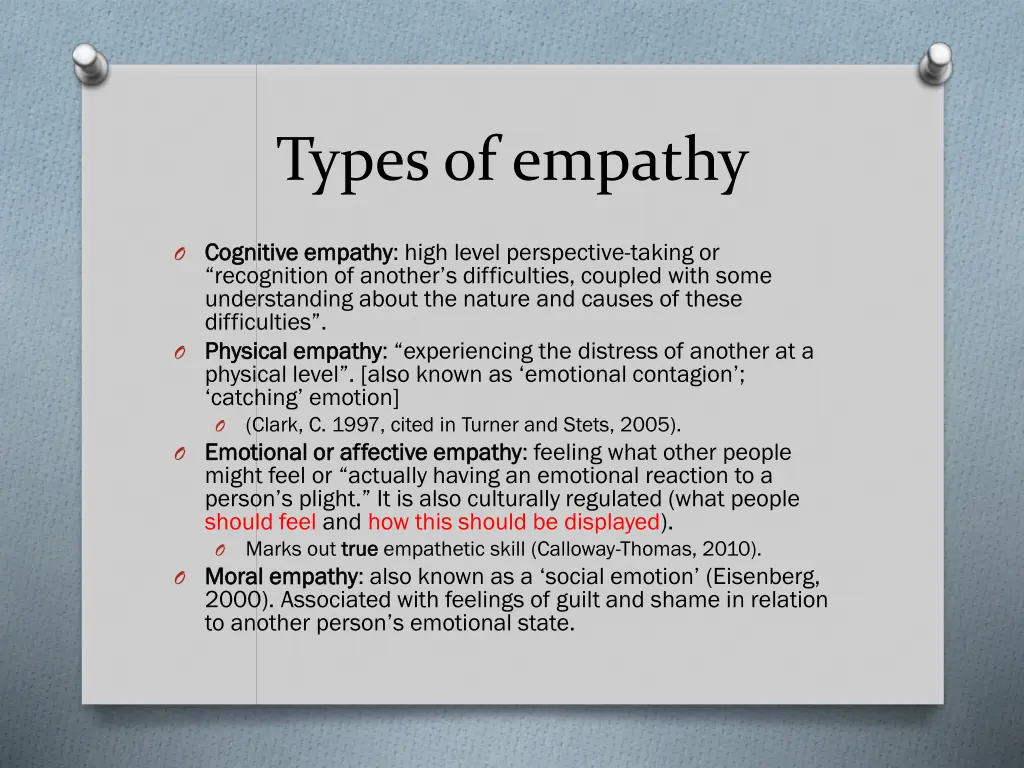
Types of empathy O Cognitive Cognitive empathy recognition of another s difficulties, coupled with some understanding about the nature and causes of these difficulties . O Physical empathy Physical empathy: experiencing the distress of another at a physical level . [also known as emotional contagion ; catching emotion] O (Clark, C. 1997, cited in Turner and Stets, 2005). O Emotional or affective empathy Emotional or affective empathy: feeling what other people might feel or actually having an emotional reaction to a person s plight. It is also culturally regulated (what people should feel and how this should be displayed). O Marks out true true empathetic skill (Calloway-Thomas, 2010). O Moral empathy Moral empathy: also known as a social emotion (Eisenberg, 2000). Associated with feelings of guilt and shame in relation to another person s emotional state. empathy: high level perspective-taking or
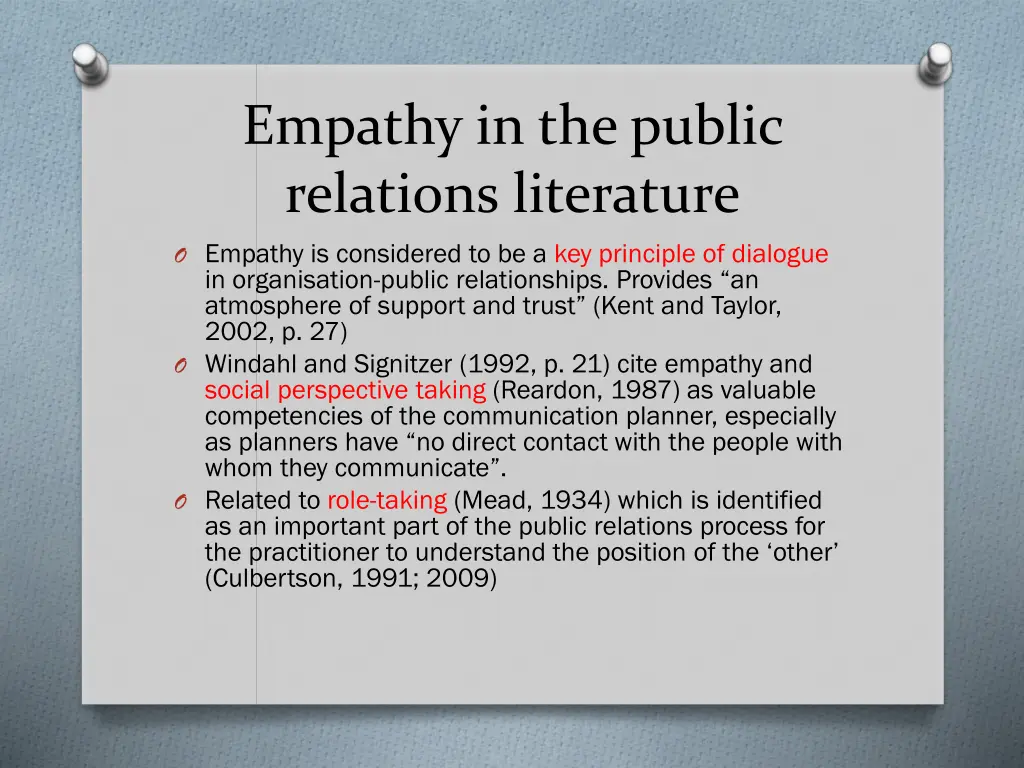
Empathy in the public relations literature O Empathy is considered to be a key principle of dialogue in organisation-public relationships. Provides an atmosphere of support and trust (Kent and Taylor, 2002, p. 27) O Windahl and Signitzer (1992, p. 21) cite empathy and social perspective taking (Reardon, 1987) as valuable competencies of the communication planner, especially as planners have no direct contact with the people with whom they communicate . O Related to role-taking (Mead, 1934) which is identified as an important part of the public relations process for the practitioner to understand the position of the other (Culbertson, 1991; 2009)
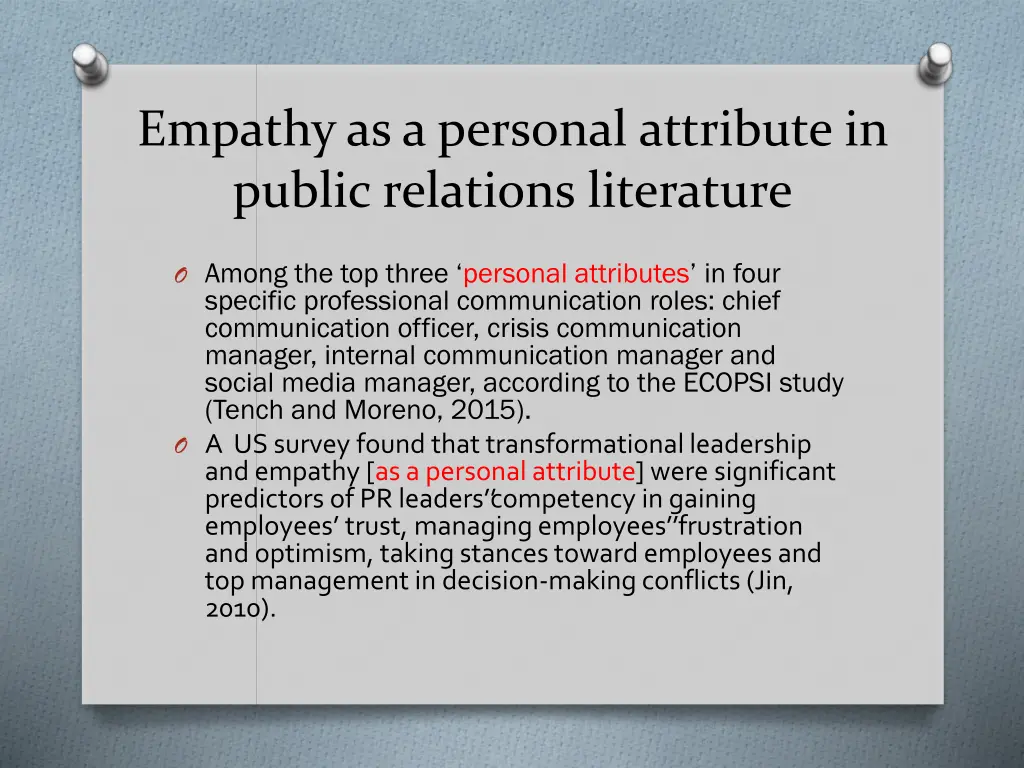
Empathy as a personal attribute in public relations literature O Among the top three personal attributes in four specific professional communication roles: chief communication officer, crisis communication manager, internal communication manager and social media manager, according to the ECOPSI study (Tench and Moreno, 2015). O A US survey found that transformational leadership and empathy [as a personal attribute] were significant predictors of PR leaders competencyin gaining employees trust, managing employees frustration and optimism, taking stances toward employees and top management in decision-making conflicts (Jin, 2010).
Empathy in PR consultancy relationships: PR executives O A key skill in public relations agency work which is learned on the job to manage the feelings and expectations of clients, journalists and colleagues O Linked to the process of educating the client about the value of PR work to their business O Linked to the process selling-in stories to journalists O Helps practitioners to manage upwards (with agency directors/managers) to ensure that confidence in their account- handling skills are maintained. O Some empathising strategies suggest deep acting (emotional empathy) techniques that could be considered harmful to one s sense of self; however in my study empathising was considered as part of the job . O Learning more about the other person s situation enabled practitioners to take control of the professional relationship (cognitive empathy).
Client alignment strategies to understand the client s situation O So we do try to understand what pressures they are under because the pharmaceutical industry s not doing well at the moment. (participant 5) O So we suggest things like go and hot desk ; go and actually sit and work in the client s office so you can see what s going on , because that sort of chemistry, that relationship I think is terribly important to do. (participant 2)
Developing empathy among junior team members O all the accounts will have regular internal meetings; it s a point that you can just say, look guys, you just need to be on it a bit more; remember, always think in their shoes, wear your client s shoes, what does it feel like? (participant 3) O I ll need to win him round to make him reflect on how, if he s going to develop a career and become a very senior consultant, maybe a little bit more empathy and therefore what are you going to do about it then? (participant 4, referring to a junior entrant who loudly complained about a stupid client)
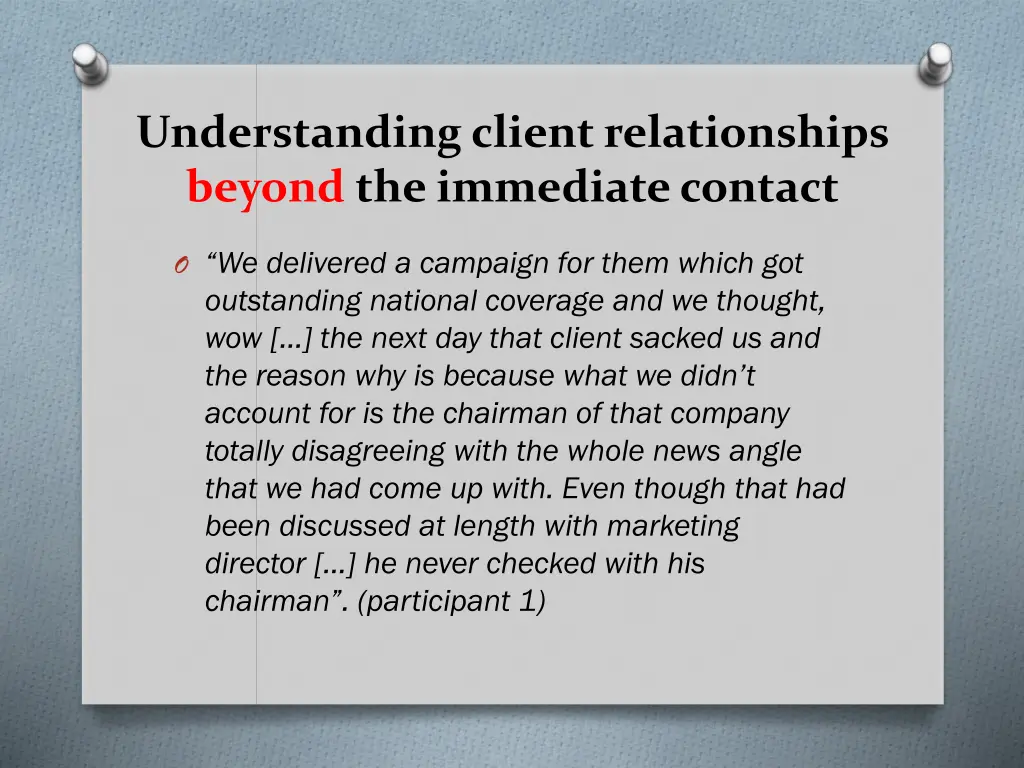
Understanding client relationships beyond the immediate contact O We delivered a campaign for them which got outstanding national coverage and we thought, wow [ ] the next day that client sacked us and the reason why is because what we didn t account for is the chairman of that company totally disagreeing with the whole news angle that we had come up with. Even though that had been discussed at length with marketing director [ ] he never checked with his chairman . (participant 1)
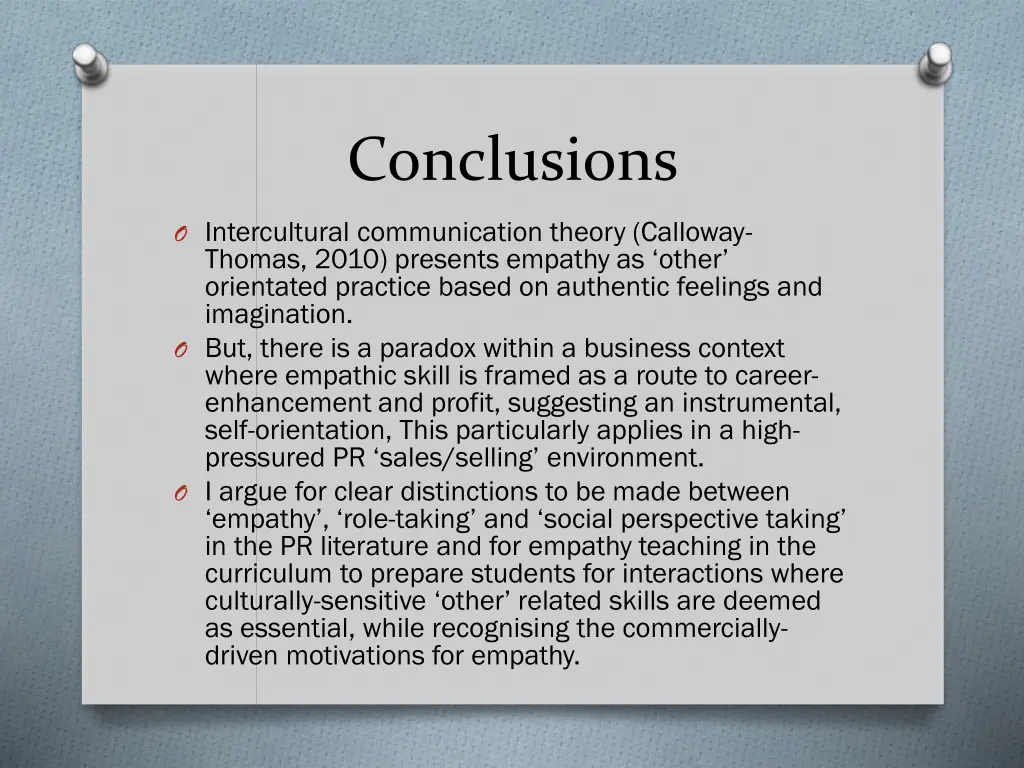
Conclusions O Intercultural communication theory (Calloway- Thomas, 2010) presents empathy as other orientated practice based on authentic feelings and imagination. O But, there is a paradox within a business context where empathic skill is framed as a route to career- enhancement and profit, suggesting an instrumental, self-orientation, This particularly applies in a high- pressured PR sales/selling environment. O I argue for clear distinctions to be made between empathy , role-taking and social perspective taking in the PR literature and for empathy teaching in the curriculum to prepare students for interactions where culturally-sensitive other related skills are deemed as essential, while recognising the commercially- driven motivations for empathy.
References Calloway-Thomas, C (2010) Empathy in the Global World: An Empathy in the Global World: An Intercultural Perspective Intercultural Perspective. Thousand Oaks: Sage. Clark, C. (1997) Misery and company: sympathy in everyday life Misery and company: sympathy in everyday life. Chicago: University of Chicago Press. Coplan, A. (2011) Will the real empathy please stand up? A case for a narrow conceptualization. The Southern Journal of The Southern Journal of Philosophy 40 65. Culbertson, H.M. (1991) Role-taking and sensitivity: keys to playing and making public relations roles. Public Relations Research Annual Public Relations Research Annual, 3, pp. 37-65. Culbertson, H.M. (2009) Role-taking: an important public relations process. Malaysian Malaysian Journal of Media Journal of Media Studies Eisenberg, N. (2000) Emotion, regulation and moral development. Annual Review of Psychology Annual Review of Psychology, 51, pp. 665-697. Hochschild, A. R. (1983) The managed heart: commercialization of The managed heart: commercialization of human feeling human feeling. Berkeley, CA: University of California Press. O O O Philosophy, 49, pp. O O Studies, 11 (1), pp. 1-8. O O
References Jin, Y (2010) Emotional leadership as a key dimension of public relations leadership: a national survey of public relations leaders. Journal of Public Relations Research Journal of Public Relations Research, 22 (2) 159-181. Kent, M. and Taylor, M. (2002) Towards a theory of dialogue in public relations. Public Relations Review Public Relations Review, 28, pp. 21-37. Olson, G. (2013) The neoliberal state and the state of empathy. In: Empathy Empathy Imperiled Imperiled: Capitalism, Culture and the Brain : Capitalism, Culture and the Brain. SpringerBriefs in Political Science 10, pp. 43-51. Mead, G. H. (1934) Mind, self and Mind, self and society society. Chicago: University of Chicago Press. Tench, R. & Moreno, A. (2015). Mapping communication management competencies for European practitioners. Journal of Communication Management, Management, 19(1), 39 61 Turner, J. and Stets, J. (2005) The sociology of emotions The sociology of emotions. Cambridge: Cambridge University Press. Windahl, S. and Signitzer, B. (1992) Using communication theory London: Sage. O O O O O Journal of Communication O Using communication theory. O