Employment Intensity Growth in the Free State Province
This presentation highlights the employment intensity growth in the Free State Province, emphasizing the need for provinces to customize national policies using research-based evidence. It discusses the relationship between unemployment and economic growth, presenting trends, measuring growth elasticity of employment, and includes future job and GDP targets for the Free State up to 2030, along with policy recommendations derived from empirical results and literature review.

Download Presentation

Please find below an Image/Link to download the presentation.
The content on the website is provided AS IS for your information and personal use only. It may not be sold, licensed, or shared on other websites without obtaining consent from the author.If you encounter any issues during the download, it is possible that the publisher has removed the file from their server.
You are allowed to download the files provided on this website for personal or commercial use, subject to the condition that they are used lawfully. All files are the property of their respective owners.
The content on the website is provided AS IS for your information and personal use only. It may not be sold, licensed, or shared on other websites without obtaining consent from the author.
E N D
Presentation Transcript
Employment Employment Intensity Growth in the Free State Province Growth in the Free State Province Intensity of Economic of Economic IJ Moses 3rd Annual Conference of the Public Sector Economists Forum, Mpumalanga 28-30 November 2011 1
Presentation Layout Presentation Layout Rationale & Background Unemployment & Economic Growth Free State Trends Measuring the Growth Elasticity of Employment Overview of Literature Global BRIC National Empirical Results Future Jobs & GDP Targets for Free State Initial & Revised 2020 Targets (5 scenarios) 2030 Targets Conclusion & Policy Recommendations
1. RATIONALE & 1. RATIONALE & BACKGROUND BACKGROUND 3
Rationale Rationale There is a need for provinces to customize national policies (e.g. GDS; IPAP2; NGP & NDP) This requires researched and evidence-based inputs into the policy- making process; National policies benefit from a surplus of data, which makes research a bit easier at that level; On the contrary, provincial policies, priorities and action plans (including budgets!) are hamstrung by the dearth of data, with the result that scholars have not paid sufficient attention to provincial and local government issues, despite the enormous challenges facing these tiers of government; The absence of data need not be a reason to limit analysis to national issues, but an opportunity to find ways to apply analysis to provinces; Input into the development of the GDS & Employment Strategy.
Background Background Original paper presented at ERSA in May 2011 Various customized and updated versions of this paper have been presented at various platforms, namely: Volkblad s Editorial Board SALGA s Provincial Special LED Task Team Premier s Coordinating Forum Fezile Dabi District Municipality IDP Indaba Guest Lecture at the Central University of Technology Original estimates have revised due to: data updates New national targets (i.e. NDP)
2. 2. UNEMPLOYMENT UNEMPLOYMENT & ECONOMIC GROWTH: ECONOMIC GROWTH: FREE STATE TRENDS FREE STATE TRENDS & 6
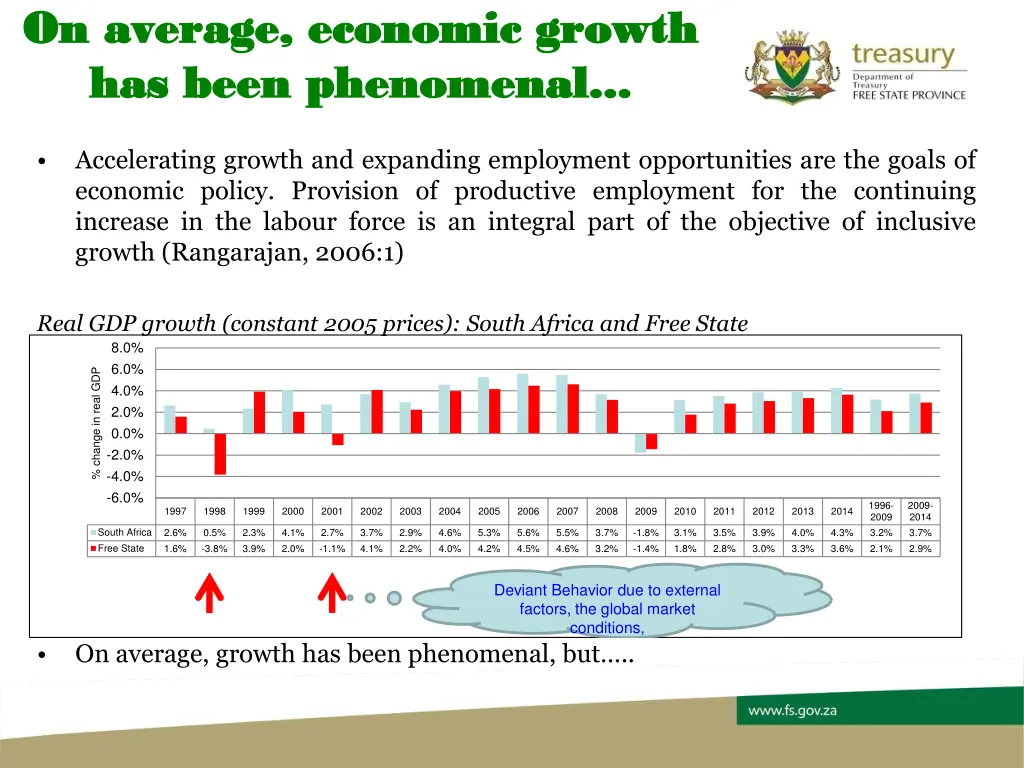
On average, economic growth On average, economic growth has been phenomenal... has been phenomenal... Accelerating growth and expanding employment opportunities are the goals of economic policy. Provision of productive employment for the continuing increase in the labour force is an integral part of the objective of inclusive growth (Rangarajan, 2006:1) Real GDP growth (constant 2005 prices): South Africa and Free State 8.0% 6.0% % change in real GDP 4.0% 2.0% 0.0% -2.0% -4.0% -6.0% 1996- 2009 3.2% 2.1% 2009- 2014 3.7% 2.9% 1997 1998 1999 2000 2001 2002 2003 2004 2005 2006 2007 2008 2009 2010 2011 2012 2013 2014 South Africa Free State 2.6% 1.6% 0.5% -3.8% 2.3% 3.9% 4.1% 2.0% 2.7% -1.1% 3.7% 4.1% 2.9% 2.2% 4.6% 4.0% 5.3% 4.2% 5.6% 4.5% 5.5% 4.6% 3.7% 3.2% -1.8% -1.4% 3.1% 1.8% 3.5% 2.8% 3.9% 3.0% 4.0% 3.3% 4.3% 3.6% Deviant Behavior due to external factors, the global market conditions, On average, growth has been phenomenal, but ..
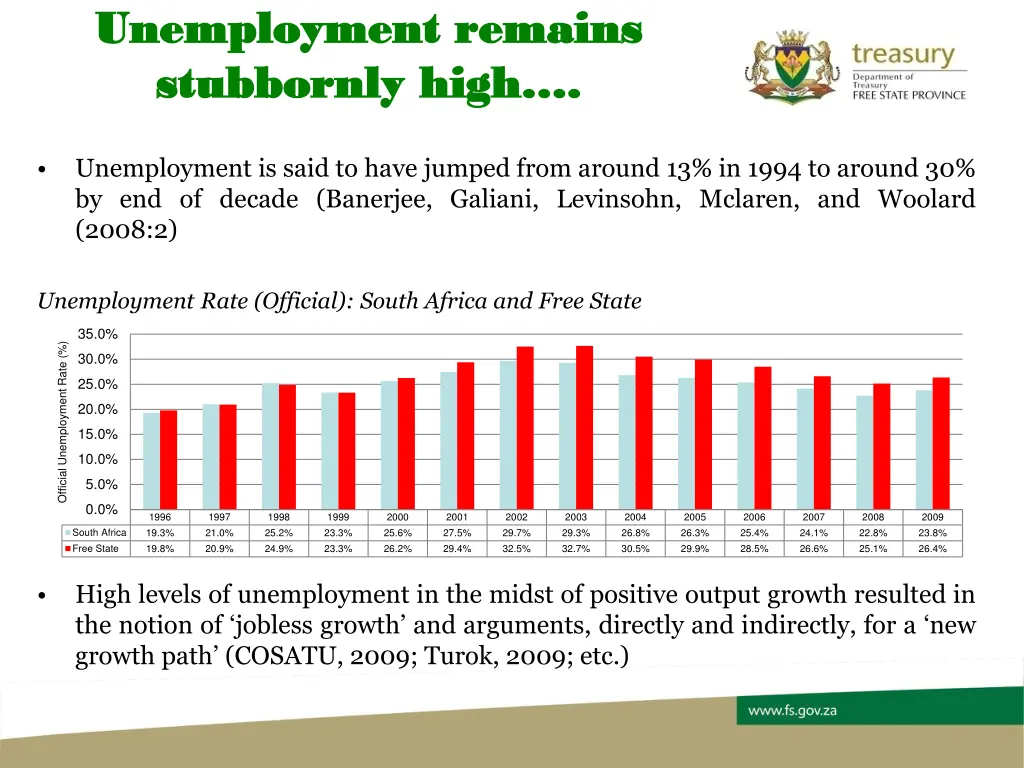
Unemployment remains Unemployment remains stubbornly high . stubbornly high . Unemployment is said to have jumped from around 13% in 1994 to around 30% by end of decade (Banerjee, Galiani, Levinsohn, Mclaren, and Woolard (2008:2) Unemployment Rate (Official): South Africa and Free State 35.0% Official Unemployment Rate (%) 30.0% 25.0% 20.0% 15.0% 10.0% 5.0% 0.0% 1996 19.3% 19.8% 1997 21.0% 20.9% 1998 25.2% 24.9% 1999 23.3% 23.3% 2000 25.6% 26.2% 2001 27.5% 29.4% 2002 29.7% 32.5% 2003 29.3% 32.7% 2004 26.8% 30.5% 2005 26.3% 29.9% 2006 25.4% 28.5% 2007 24.1% 26.6% 2008 22.8% 25.1% 2009 23.8% 26.4% South Africa Free State High levels of unemployment in the midst of positive output growth resulted in the notion of joblessgrowth and arguments, directly and indirectly, for a new growth path (COSATU, 2009; Turok, 2009; etc.)
3. 3. MEASURING MEASURING GROWTH ELASTICITY GROWTH ELASTICITY OF EMPLOYMENT OF EMPLOYMENT 9
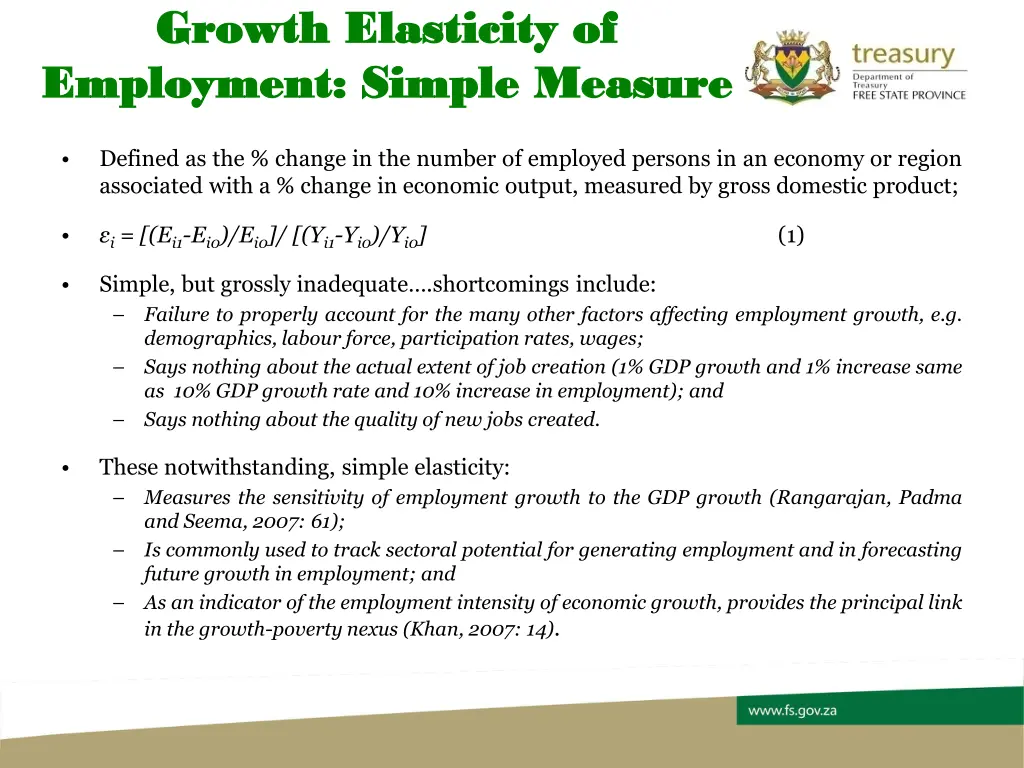
Growth Elasticity of Growth Elasticity of Employment: Simple Measure Employment: Simple Measure Defined as the % change in the number of employed persons in an economy or region associated with a % change in economic output, measured by gross domestic product; i = [(Ei1-Ei0)/Ei0]/ [(Yi1-Yi0)/Yi0] (1) Simple, but grossly inadequate .shortcomings include: Failure to properly account for the many other factors affecting employment growth, e.g. demographics, labour force, participation rates, wages; Says nothing about the actual extent of job creation (1% GDP growth and 1% increase same as 10% GDP growth rate and 10% increase in employment); and Says nothing about the quality of new jobs created. These notwithstanding, simple elasticity: Measures the sensitivity of employment growth to the GDP growth (Rangarajan, Padma and Seema, 2007: 61); Is commonly used to track sectoral potential for generating employment and in forecasting future growth in employment; and As an indicator of the employment intensity of economic growth, provides the principal link in the growth-poverty nexus (Khan, 2007: 14).
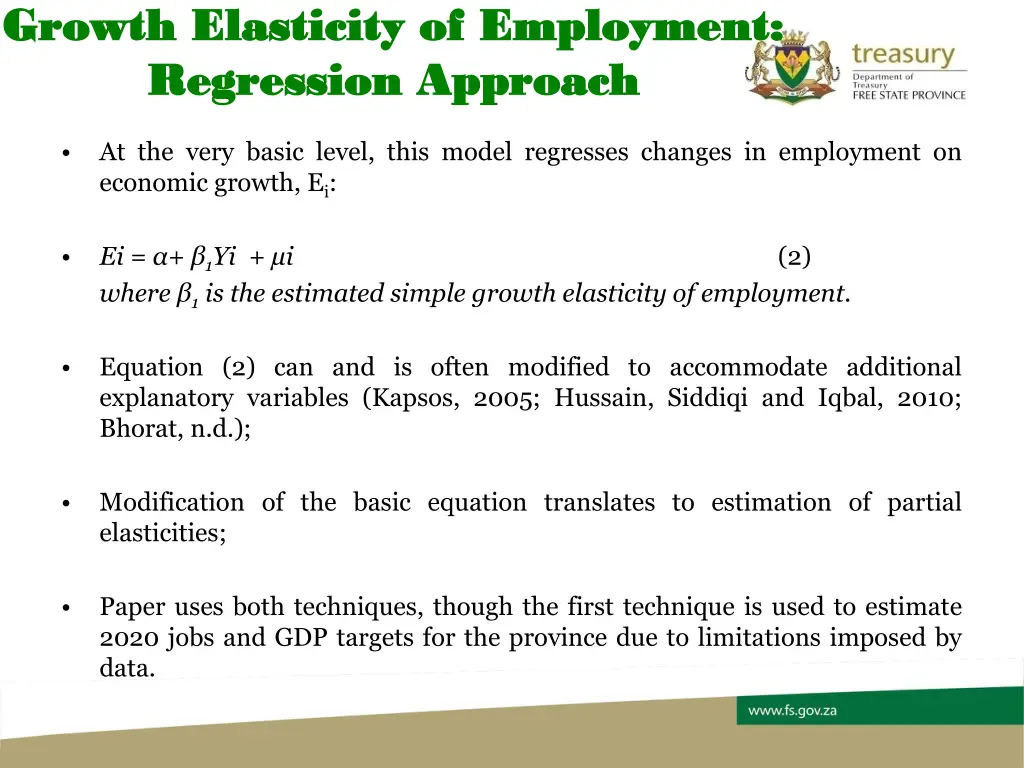
Growth Elasticity of Employment: Growth Elasticity of Employment: Regression Approach Regression Approach At the very basic level, this model regresses changes in employment on economic growth, Ei: Ei = + 1Yi + i where 1 is the estimated simple growth elasticity of employment. (2) Equation (2) can and is often modified to accommodate additional explanatory variables (Kapsos, 2005; Hussain, Siddiqi and Iqbal, 2010; Bhorat, n.d.); Modification of the basic equation translates to estimation of partial elasticities; Paper uses both techniques, though the first technique is used to estimate 2020 jobs and GDP targets for the province due to limitations imposed by data.
4. LITERATURE 4. LITERATURE OVERVIEW OVERVIEW 12
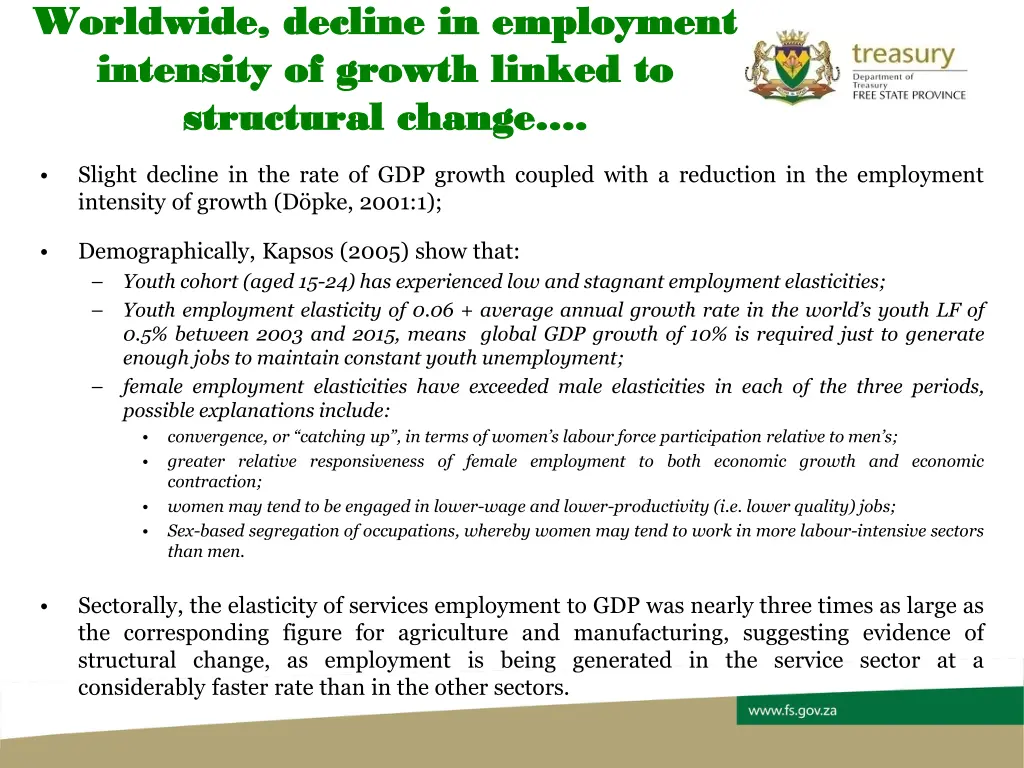
Worldwide, decline in employment Worldwide, decline in employment intensity of growth linked to intensity of growth linked to structural change . structural change . Slight decline in the rate of GDP growth coupled with a reduction in the employment intensity of growth (D pke, 2001:1); Demographically, Kapsos (2005) show that: Youth cohort (aged 15-24) has experienced low and stagnant employment elasticities; Youth employment elasticity of 0.06 + average annual growth rate in the world s youth LF of 0.5% between 2003 and 2015, means global GDP growth of 10% is required just to generate enough jobs to maintain constant youth unemployment; female employment elasticities have exceeded male elasticities in each of the three periods, possible explanations include: convergence, or catchingup , in terms of women s labour force participation relative to men s; greater relative responsiveness of female employment to both economic growth and economic contraction; women may tend to be engaged in lower-wage and lower-productivity (i.e. lower quality) jobs; Sex-based segregation of occupations, whereby women may tend to work in more labour-intensive sectors than men. Sectorally, the elasticity of services employment to GDP was nearly three times as large as the corresponding figure for agriculture and manufacturing, suggesting evidence of structural change, as employment is being generated in the service sector at a considerably faster rate than in the other sectors.
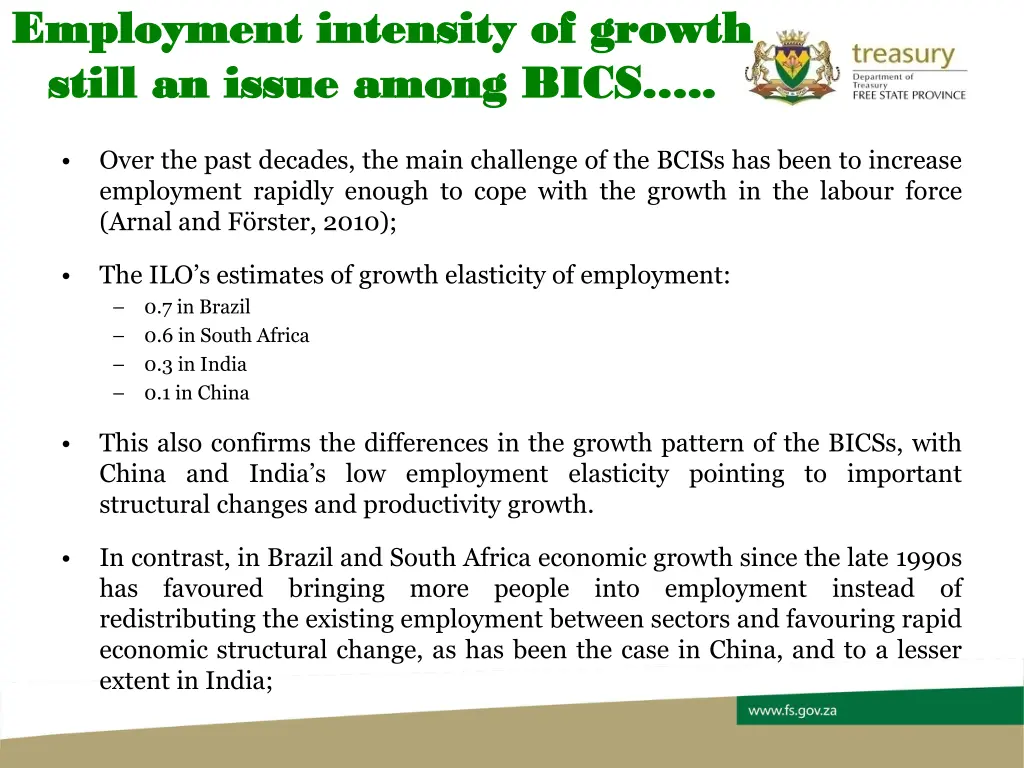
Employment intensity of growth Employment intensity of growth still an issue among BICS .. still an issue among BICS .. Over the past decades, the main challenge of the BCISs has been to increase employment rapidly enough to cope with the growth in the labour force (Arnal and F rster, 2010); The ILO s estimates of growth elasticity of employment: 0.7 in Brazil 0.6 in South Africa 0.3 in India 0.1 in China This also confirms the differences in the growth pattern of the BICSs, with China and India s low employment elasticity pointing to important structural changes and productivity growth. In contrast, in Brazil and South Africa economic growth since the late 1990s has favoured bringing more people into employment instead of redistributing the existing employment between sectors and favouring rapid economic structural change, as has been the case in China, and to a lesser extent in India;
Studies on SA emphasise shift of Studies on SA emphasise shift of analysis from demand to supply analysis from demand to supply- -side side Renewed focus on the issues of unemployment (e.g. Bhorat, n.d.; Marinkov and Geldenhuys, 2007; Biyase & Bonga-Bonga, 2007; Burger and Von Fintel: 2009; Mahadea & Simson: 2010; OECD, 2010); Biyase & Bonga-Bonga (2007:3) interestingly finds relationship between growth and employment paradoxical ; Bhorat (n.d: 19) argues that South Africa s unemployment crisis cannot and should not be readily ascribed to an output performance which is not sufficiently job-generating, instead the surge in labour force participation rates .; Banerjee, et al (2008) found that the supply of labour increased after the fall of apartheid, in particular due to an unprecedented influx of African women into the labour market; Burger and Von Fintel (2009: 2) argue post-apartheid school enrolment policies had the unintended consequence of pushing young (predominantly black) individuals into the labour market without the relevant skills, rather than continuing training that is required for eventual absorption into the workplace. In general, there is sufficient consensus that South Africa s unemployment is structural, and that whilst the notion of joblessgrowth may appear fashionable and politically correct , it is empirically not valid !
Emergency of strong arguments for Emergency of strong arguments for labour market reforms labour market reforms Mahadea and Simson (2010: 398-399) observe that economic growth absorbs some labour, but structural factors mitigate against complete labour absorptions. They find that various new labour laws have imposed rigidities on the labour market, and many employers, burdened by a multitude of labour regulations, switch to capital-intensive methods. Also argue that those that receive grants from government may view paid employment and social grants as substitutes at the margin. Acknowledgement that the post-1994 analysis of the relationship between economic growth and employment has been marred by data challenges. (Biyase & Bonga- Bonga, 2007: 4; Bhorat, n.d: 13). Having found that the bulk of the unemployment in South Africa post-1994 is structural rather than transitional, Banerjee, et al (2008:20), contend that the South African labor market appears to be very near the steady state so it is unlikely that the unemployment rate will fall without a policy intervention or an external shock. This conclusion is far reaching. Is the pursuit of high levels of economic growth the necessary policy intervention? Or, based on the diagnosis of the prevalence of structural unemployment, is the pursuit of economic growth misplaced? Is the New Growth Path the anticipated intervention?
5. GROWTH 5. GROWTH ELASTICITY OF ELASTICITY OF EMPLOYMENT EMPLOYMENT EMPIRICAL TESTS EMPIRICAL TESTS 17
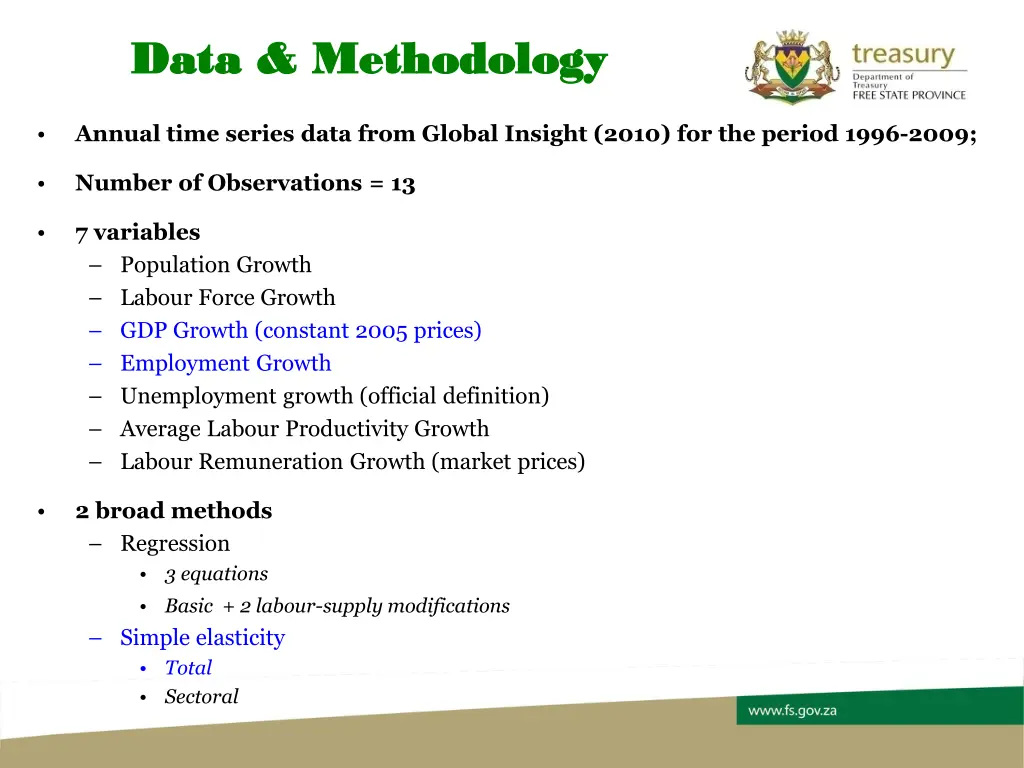
Data & Methodology Data & Methodology Annual time series data from Global Insight (2010) for the period 1996-2009; Number of Observations = 13 7 variables Population Growth Labour Force Growth GDP Growth (constant 2005 prices) Employment Growth Unemployment growth (official definition) Average Labour Productivity Growth Labour Remuneration Growth (market prices) 2 broad methods Regression 3 equations Basic + 2 labour-supply modifications Simple elasticity Total Sectoral
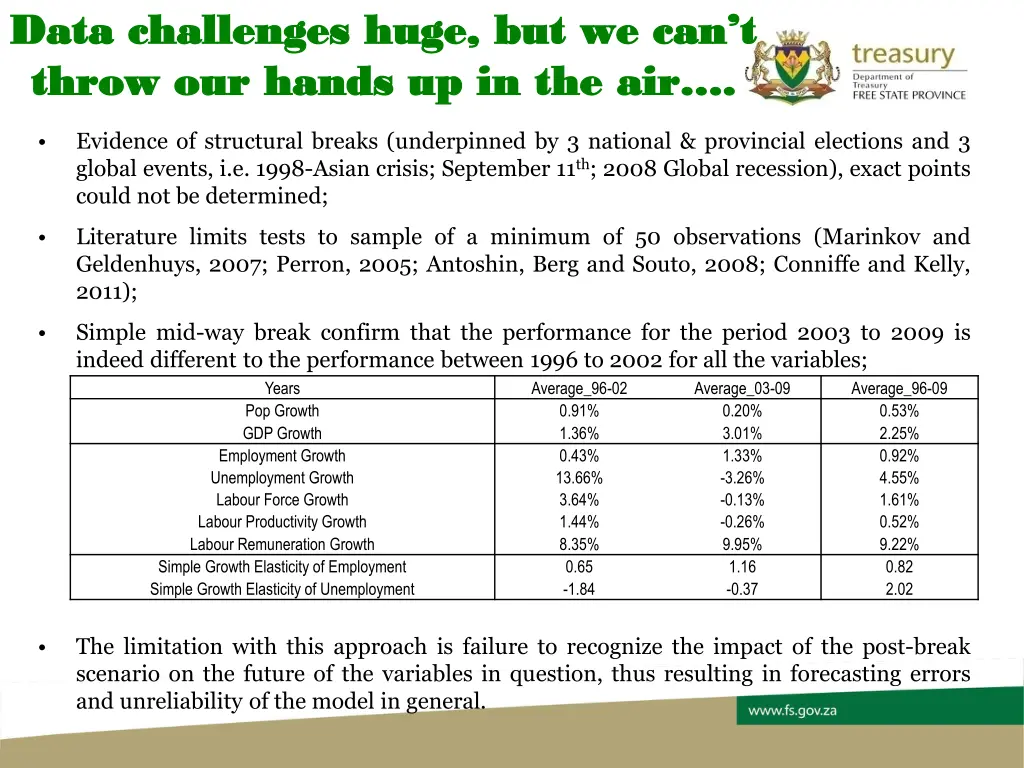
Data challenges huge, but we cant Data challenges huge, but we can t throw our hands up in the air . throw our hands up in the air . Evidence of structural breaks (underpinned by 3 national & provincial elections and 3 global events, i.e. 1998-Asian crisis; September 11th; 2008 Global recession), exact points could not be determined; Literature limits tests to sample of a minimum of 50 observations (Marinkov and Geldenhuys, 2007; Perron, 2005; Antoshin, Berg and Souto, 2008; Conniffe and Kelly, 2011); Simple mid-way break confirm that the performance for the period 2003 to 2009 is indeed different to the performance between 1996 to 2002 for all the variables; Years Average_96-02 0.91% 1.36% 0.43% 13.66% 3.64% 1.44% 8.35% 0.65 -1.84 Average_03-09 0.20% 3.01% 1.33% -3.26% -0.13% -0.26% 9.95% 1.16 -0.37 Average_96-09 0.53% 2.25% 0.92% 4.55% 1.61% 0.52% 9.22% 0.82 2.02 Pop Growth GDP Growth Employment Growth Unemployment Growth Labour Force Growth Labour Productivity Growth Labour Remuneration Growth Simple Growth Elasticity of Employment Simple Growth Elasticity of Unemployment The limitation with this approach is failure to recognize the impact of the post-break scenario on the future of the variables in question, thus resulting in forecasting errors and unreliability of the model in general.
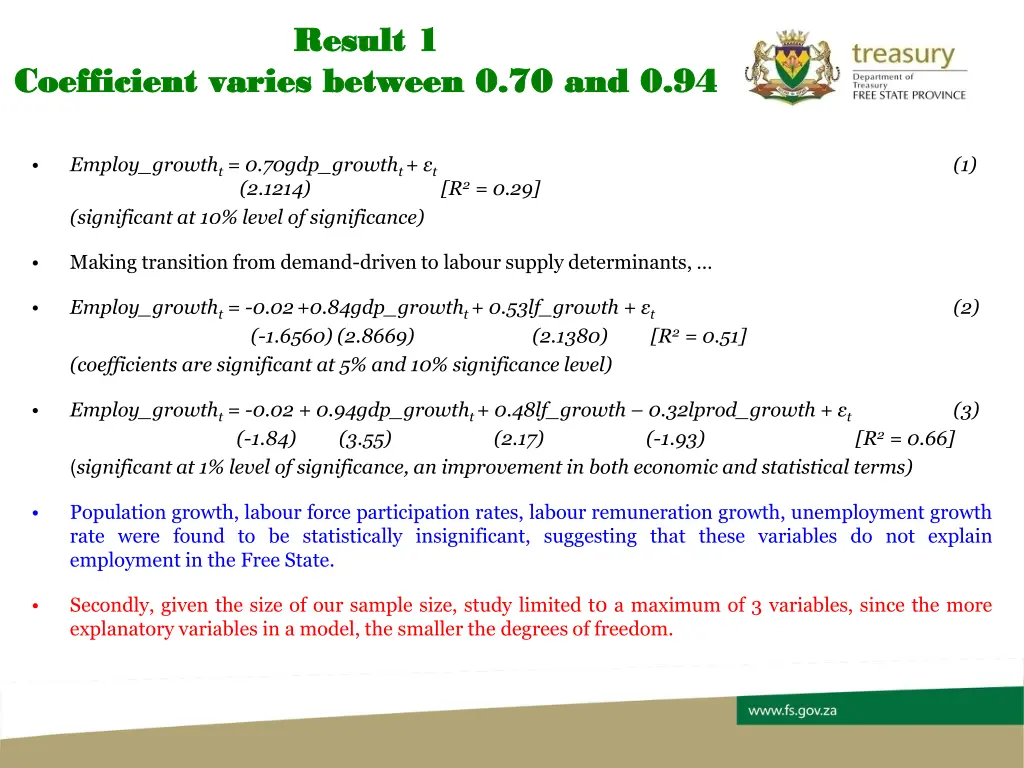
Result 1 Result 1 Coefficient varies between 0.70 and 0.94 Coefficient varies between 0.70 and 0.94 Employ_growtht = 0.70gdp_growtht + t (significant at 10% level of significance) (1) (2.1214) [R2 = 0.29] Making transition from demand-driven to labour supply determinants, Employ_growtht = -0.02+0.84gdp_growtht + 0.53lf_growth + t (-1.6560) (2.8669) (coefficients are significant at 5% and 10% significance level) (2) (2.1380) [R2 = 0.51] Employ_growtht = -0.02 + 0.94gdp_growtht + 0.48lf_growth 0.32lprod_growth + t (-1.84) (3.55) (2.17) (significant at 1% level of significance, an improvement in both economic and statistical terms) (3) (-1.93) [R2 = 0.66] Population growth, labour force participation rates, labour remuneration growth, unemployment growth rate were found to be statistically insignificant, suggesting that these variables do not explain employment in the Free State. Secondly, given the size of our sample size, study limited t0 a maximum of 3 variables, since the more explanatory variables in a model, the smaller the degrees of freedom.
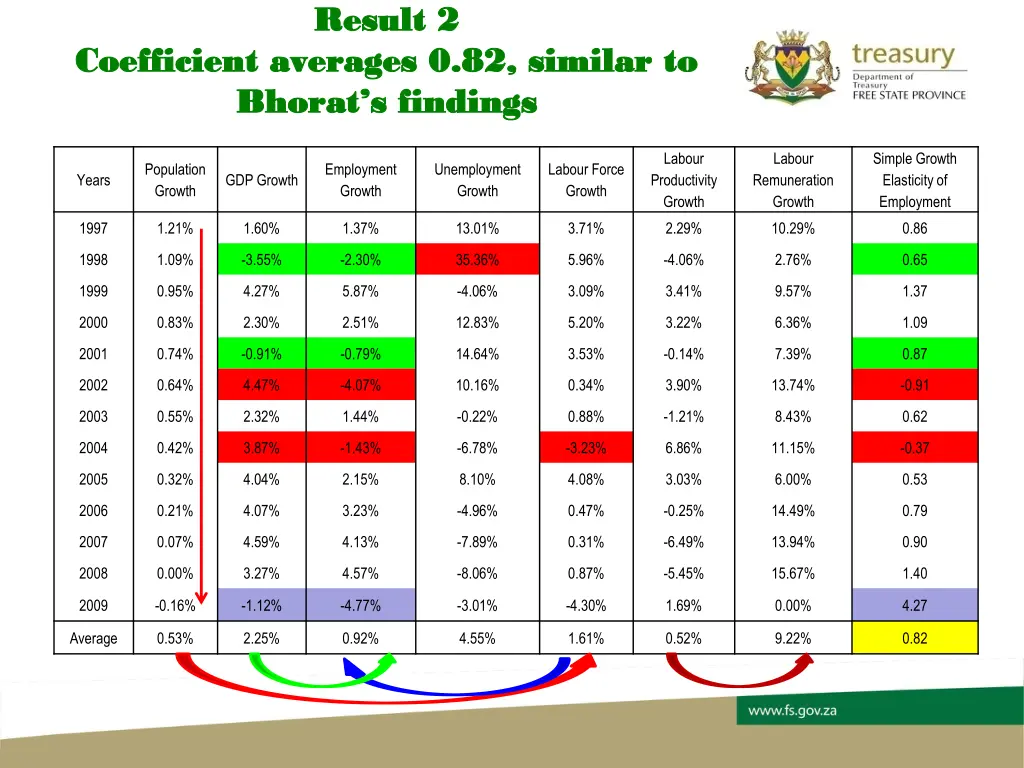
Result 2 Result 2 Coefficient averages 0.82, similar to Coefficient averages 0.82, similar to Bhorat s Bhorat s findings findings Labour Productivity Growth Labour Remuneration Growth Simple Growth Elasticity of Employment Population Growth Employment Growth Unemployment Growth Labour Force Growth Years GDP Growth 1997 1.21% 1.60% 1.37% 13.01% 3.71% 2.29% 10.29% 0.86 1998 1.09% -3.55% -2.30% 35.36% 5.96% -4.06% 2.76% 0.65 1999 0.95% 4.27% 5.87% -4.06% 3.09% 3.41% 9.57% 1.37 2000 0.83% 2.30% 2.51% 12.83% 5.20% 3.22% 6.36% 1.09 2001 0.74% -0.91% -0.79% 14.64% 3.53% -0.14% 7.39% 0.87 2002 0.64% 4.47% -4.07% 10.16% 0.34% 3.90% 13.74% -0.91 2003 0.55% 2.32% 1.44% -0.22% 0.88% -1.21% 8.43% 0.62 2004 0.42% 3.87% -1.43% -6.78% -3.23% 6.86% 11.15% -0.37 2005 0.32% 4.04% 2.15% 8.10% 4.08% 3.03% 6.00% 0.53 2006 0.21% 4.07% 3.23% -4.96% 0.47% -0.25% 14.49% 0.79 2007 0.07% 4.59% 4.13% -7.89% 0.31% -6.49% 13.94% 0.90 2008 0.00% 3.27% 4.57% -8.06% 0.87% -5.45% 15.67% 1.40 2009 -0.16% -1.12% -4.77% -3.01% -4.30% 1.69% 0.00% 4.27 Average 0.53% 2.25% 0.92% 4.55% 1.61% 0.52% 9.22% 0.82
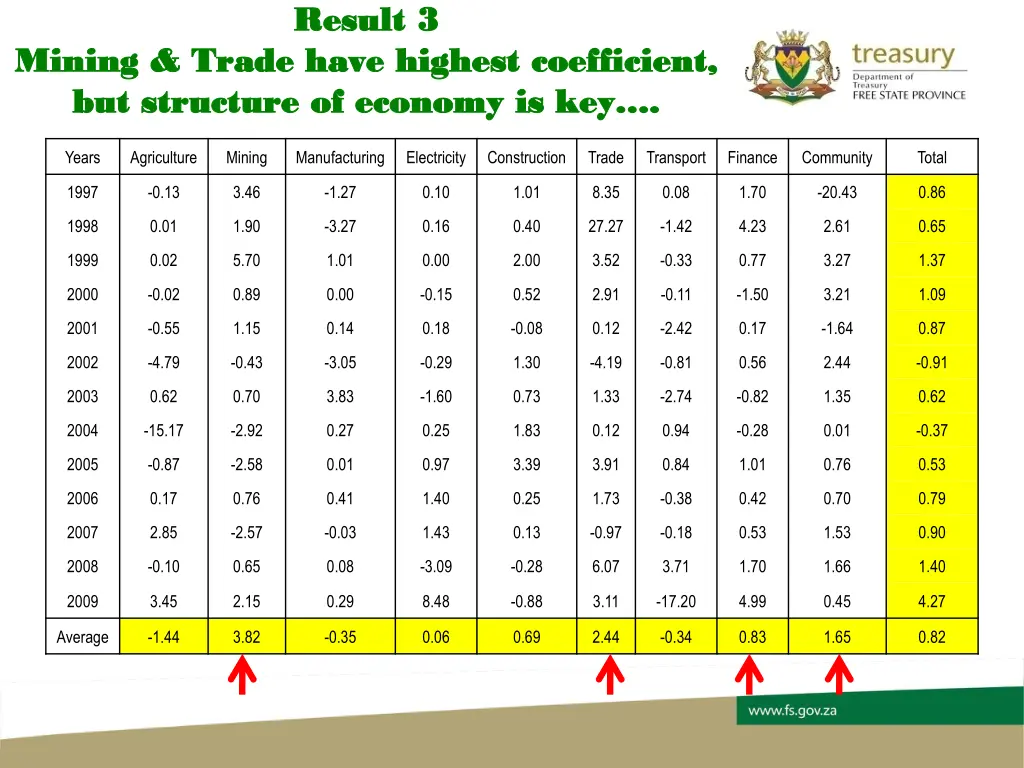
Result 3 Result 3 Mining & Trade have highest coefficient, Mining & Trade have highest coefficient, but structure of economy is key . but structure of economy is key . Years Agriculture Mining Manufacturing Electricity Construction Trade Transport Finance Community Total 1997 -0.13 3.46 -1.27 0.10 1.01 8.35 0.08 1.70 -20.43 0.86 1998 0.01 1.90 -3.27 0.16 0.40 27.27 -1.42 4.23 2.61 0.65 1999 0.02 5.70 1.01 0.00 2.00 3.52 -0.33 0.77 3.27 1.37 2000 -0.02 0.89 0.00 -0.15 0.52 2.91 -0.11 -1.50 3.21 1.09 2001 -0.55 1.15 0.14 0.18 -0.08 0.12 -2.42 0.17 -1.64 0.87 2002 -4.79 -0.43 -3.05 -0.29 1.30 -4.19 -0.81 0.56 2.44 -0.91 2003 0.62 0.70 3.83 -1.60 0.73 1.33 -2.74 -0.82 1.35 0.62 2004 -15.17 -2.92 0.27 0.25 1.83 0.12 0.94 -0.28 0.01 -0.37 2005 -0.87 -2.58 0.01 0.97 3.39 3.91 0.84 1.01 0.76 0.53 2006 0.17 0.76 0.41 1.40 0.25 1.73 -0.38 0.42 0.70 0.79 2007 2.85 -2.57 -0.03 1.43 0.13 -0.97 -0.18 0.53 1.53 0.90 2008 -0.10 0.65 0.08 -3.09 -0.28 6.07 3.71 1.70 1.66 1.40 2009 3.45 2.15 0.29 8.48 -0.88 3.11 -17.20 4.99 0.45 4.27 Average -1.44 3.82 -0.35 0.06 0.69 2.44 -0.34 0.83 1.65 0.82
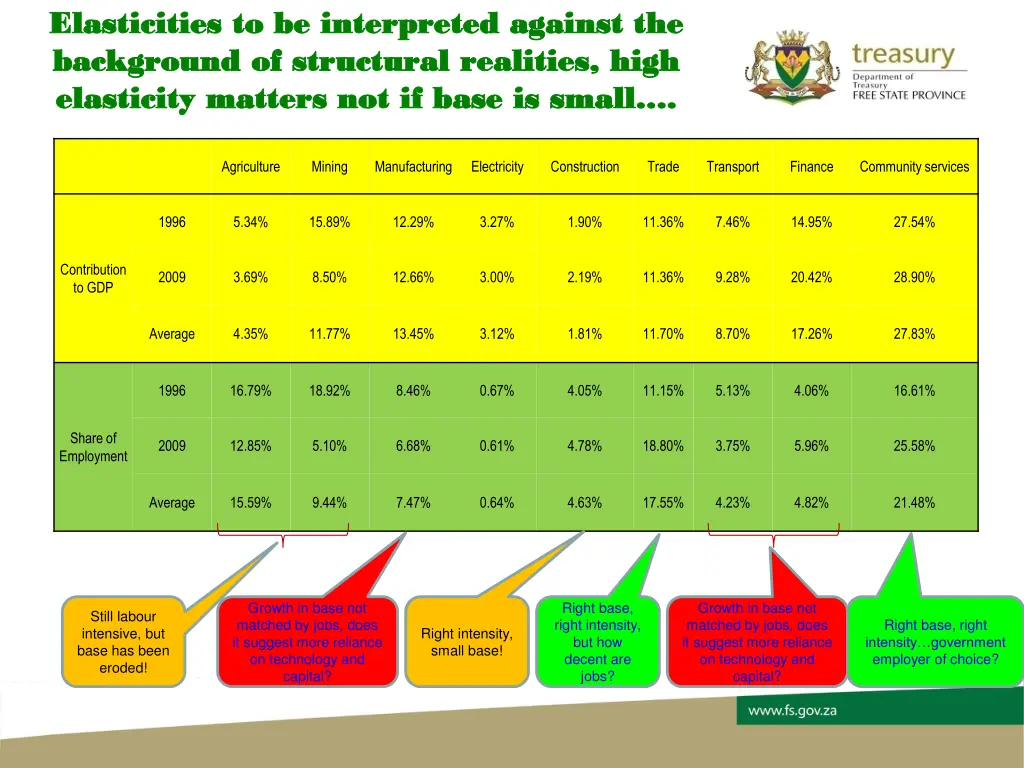
Elasticities to be interpreted against the Elasticities to be interpreted against the background of structural realities, high background of structural realities, high elasticity matters not if base is small . elasticity matters not if base is small . Agriculture Mining Manufacturing Electricity Construction Trade Transport Finance Community services 1996 5.34% 15.89% 12.29% 3.27% 1.90% 11.36% 7.46% 14.95% 27.54% Contribution to GDP 2009 3.69% 8.50% 12.66% 3.00% 2.19% 11.36% 9.28% 20.42% 28.90% Average 4.35% 11.77% 13.45% 3.12% 1.81% 11.70% 8.70% 17.26% 27.83% 1996 16.79% 18.92% 8.46% 0.67% 4.05% 11.15% 5.13% 4.06% 16.61% Share of Employment 2009 12.85% 5.10% 6.68% 0.61% 4.78% 18.80% 3.75% 5.96% 25.58% Average 15.59% 9.44% 7.47% 0.64% 4.63% 17.55% 4.23% 4.82% 21.48% Growth in base not matched by jobs, does it suggest more reliance on technology and capital? Right base, right intensity, but how decent are jobs? Growth in base not matched by jobs, does it suggest more reliance on technology and capital? Still labour intensive, but base has been eroded! Right base, right intensity government employer of choice? Right intensity, small base!
6. FUTURE TARGETS 6. FUTURE TARGETS 24
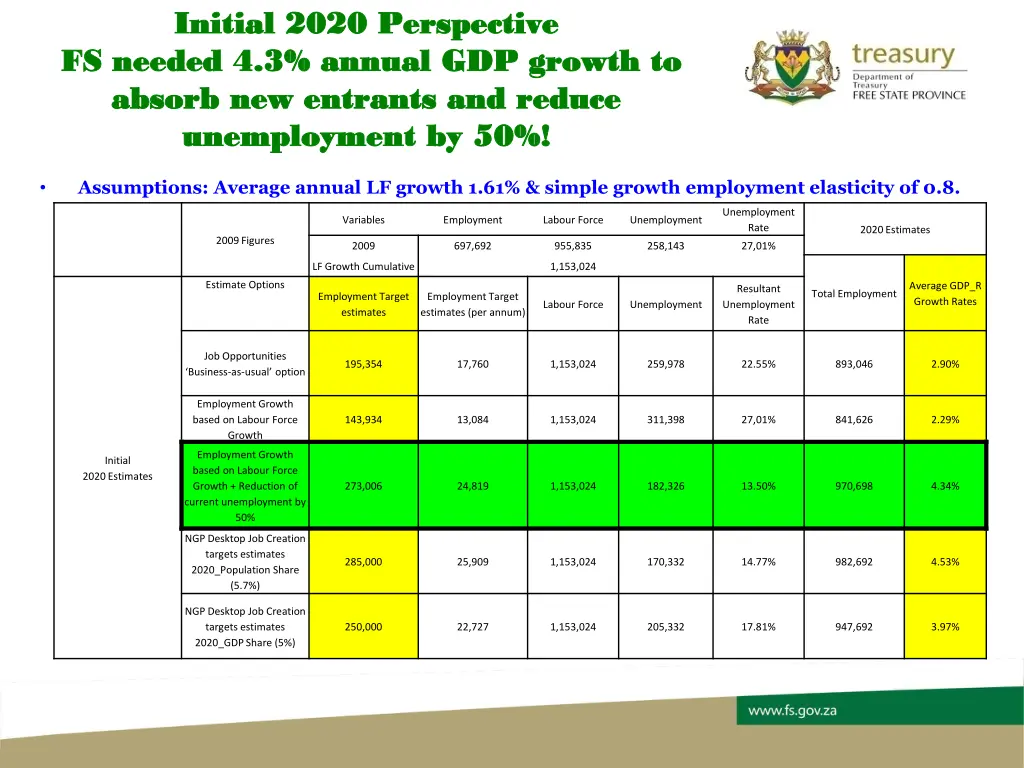
Initial 2020 Perspective Initial 2020 Perspective FS needed 4.3% annual GDP growth to FS needed 4.3% annual GDP growth to absorb new entrants and reduce absorb new entrants and reduce unemployment by 50%! unemployment by 50%! Assumptions: Average annual LF growth 1.61% & simple growth employment elasticity of 0.8. Unemployment Rate Variables Employment Labour Force Unemployment 2020 Estimates 2009 Figures 2009 697,692 955,835 258,143 27,01% LF Growth Cumulative 1,153,024 Estimate Options Average GDP_R Growth Rates Resultant Unemployment Rate Total Employment Employment Target estimates Employment Target estimates (per annum) Labour Force Unemployment Job Opportunities Business-as-usual option 195,354 17,760 1,153,024 259,978 22.55% 893,046 2.90% Employment Growth based on Labour Force Growth 143,934 13,084 1,153,024 311,398 27,01% 841,626 2.29% Employment Growth based on Labour Force Growth + Reduction of current unemployment by 50% Initial 2020 Estimates 273,006 24,819 1,153,024 182,326 13.50% 970,698 4.34% NGP Desktop Job Creation targets estimates 2020_Population Share (5.7%) 285,000 25,909 1,153,024 170,332 14.77% 982,692 4.53% NGP Desktop Job Creation targets estimates 2020_GDP Share (5%) 250,000 22,727 1,153,024 205,332 17.81% 947,692 3.97%
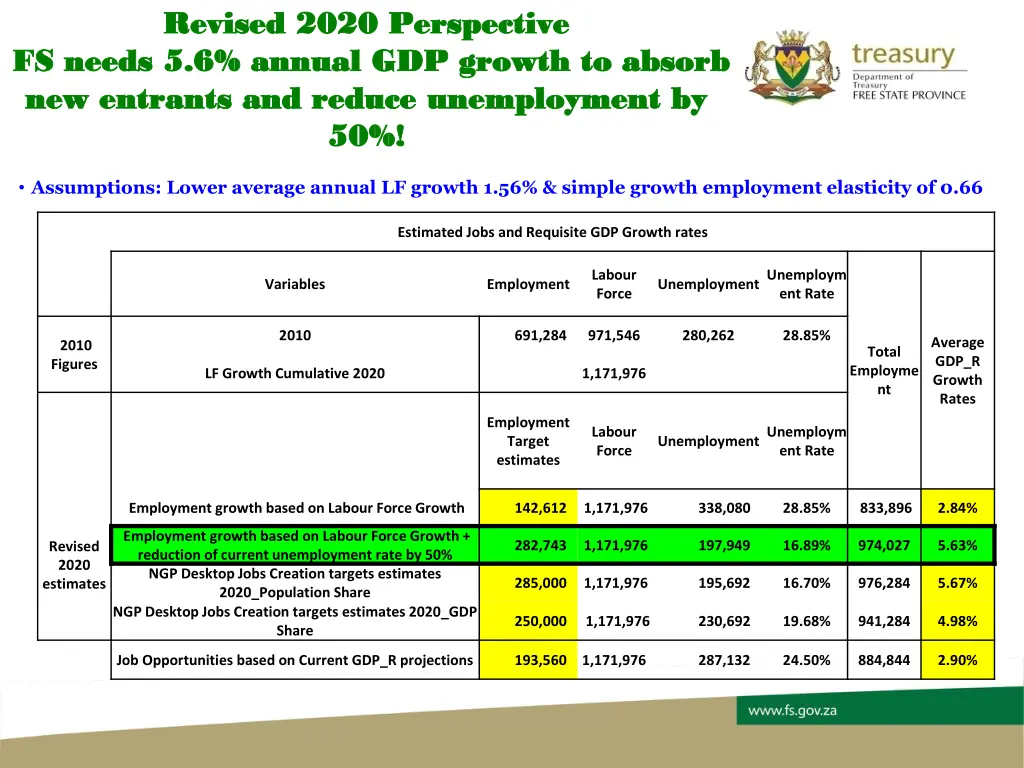
Revised 2020 Perspective Revised 2020 Perspective FS needs 5.6% annual GDP growth to absorb FS needs 5.6% annual GDP growth to absorb new entrants and reduce unemployment by new entrants and reduce unemployment by 50%! 50%! Assumptions: Lower average annual LF growth 1.56% & simple growth employment elasticity of 0.66 Estimated Jobs and Requisite GDP Growth rates Labour Force UnemploymentUnemploym Variables Employment ent Rate 2010 691,284 971,546 280,262 28.85% Average GDP_R Growth Rates 2010 Figures Total Employme nt LF Growth Cumulative 2020 1,171,976 Employment Target estimates Labour Force UnemploymentUnemploym ent Rate Employment growth based on Labour Force Growth 142,612 1,171,976 338,080 28.85% 833,896 2.84% Employment growth based on Labour Force Growth + reduction of current unemployment rate by 50% NGP Desktop Jobs Creation targets estimates 2020_Population Share NGP Desktop Jobs Creation targets estimates 2020_GDP Share 282,743 1,171,976 197,949 16.89% 974,027 5.63% Revised 2020 estimates 285,000 1,171,976 195,692 16.70% 976,284 5.67% 250,000 1,171,976 230,692 19.68% 941,284 4.98% Job Opportunities based on Current GDP_R projections 193,560 1,171,976 287,132 24.50% 884,844 2.90%
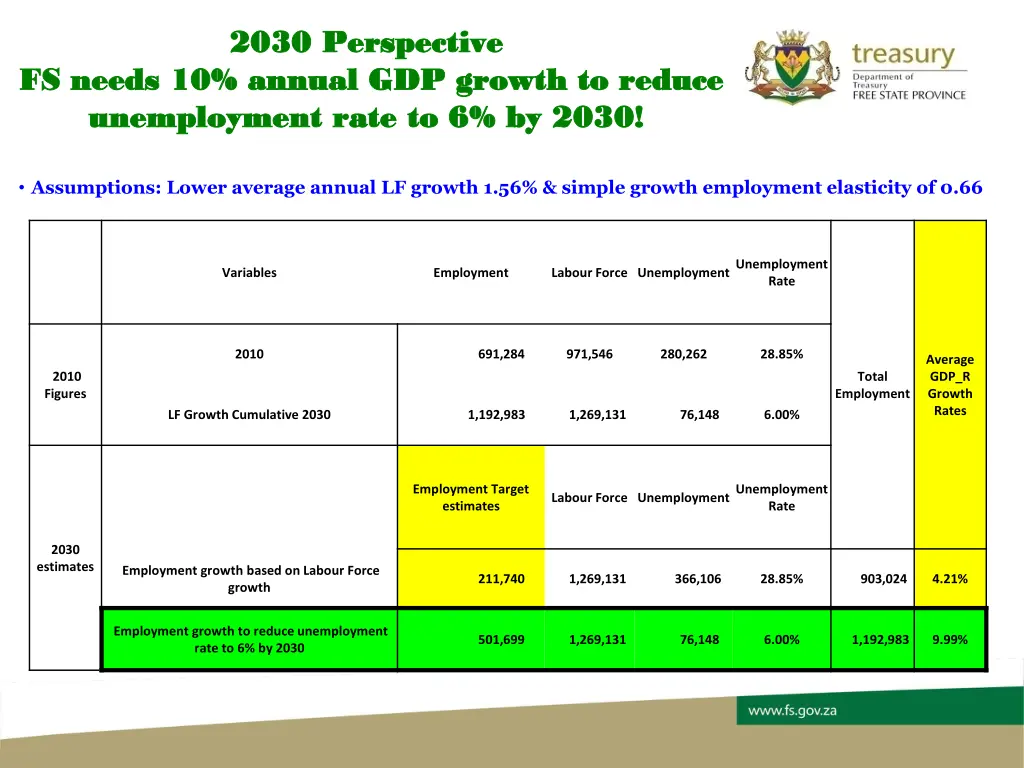
2030 Perspective 2030 Perspective FS needs 10% annual GDP growth to reduce FS needs 10% annual GDP growth to reduce unemployment rate to 6% by 2030! unemployment rate to 6% by 2030! Assumptions: Lower average annual LF growth 1.56% & simple growth employment elasticity of 0.66 Labour Force UnemploymentUnemployment Variables Employment Rate 2010 691,284 971,546 280,262 28.85% Average GDP_R Growth Rates 2010 Figures Total Employment LF Growth Cumulative 2030 1,192,983 1,269,131 76,148 6.00% Employment Target estimates Labour Force UnemploymentUnemployment Rate 2030 estimates Employment growth based on Labour Force growth 211,740 1,269,131 366,106 28.85% 903,024 4.21% Employment growth to reduce unemployment rate to 6% by 2030 501,699 1,269,131 76,148 6.00% 1,192,983 9.99%
7. POLICY 7. POLICY RECOMMENDATIONS RECOMMENDATIONS 28
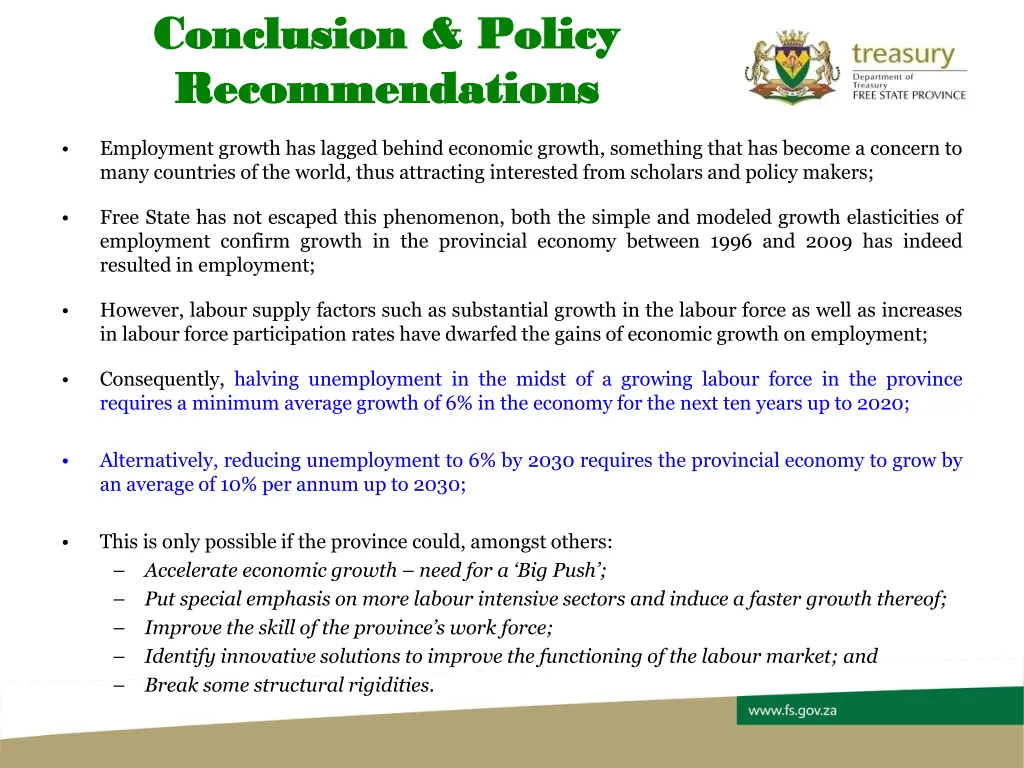
Conclusion & Policy Conclusion & Policy Recommendations Recommendations Employment growth has lagged behind economic growth, something that has become a concern to many countries of the world, thus attracting interested from scholars and policy makers; Free State has not escaped this phenomenon, both the simple and modeled growth elasticities of employment confirm growth in the provincial economy between 1996 and 2009 has indeed resulted in employment; However, labour supply factors such as substantial growth in the labour force as well as increases in labour force participation rates have dwarfed the gains of economic growth on employment; Consequently, halving unemployment in the midst of a growing labour force in the province requires a minimum average growth of 6% in the economy for the next ten years up to 2020; Alternatively, reducing unemployment to 6% by 2030 requires the provincial economy to grow by an average of 10% per annum up to 2030; This is only possible if the province could, amongst others: Accelerate economic growth need for a BigPush ; Put special emphasis on more labour intensive sectors and induce a faster growth thereof; Improve the skill of the province s work force; Identify innovative solutions to improve the functioning of the labour market; and Break some structural rigidities.
Thank You Thank You IJ Moses Chief Economist: FS Provincial Treasury Tel: +27-51-405-5978 Fax: +27-51-405-4999 Email: Mosesj@treasury.fs.gov.za 30