Empower Your Team Through Managing by Objectives
Take charge of your team's success by implementing Managing by Objectives (MBO) principles. Learn how setting clear goals and outcomes can boost accountability, drive performance, and foster innovation. Discover the importance of aligning objectives horizontally and vertically within your organization, and empower your team through effective prioritization and creative problem-solving techniques.

Download Presentation

Please find below an Image/Link to download the presentation.
The content on the website is provided AS IS for your information and personal use only. It may not be sold, licensed, or shared on other websites without obtaining consent from the author. If you encounter any issues during the download, it is possible that the publisher has removed the file from their server.
You are allowed to download the files provided on this website for personal or commercial use, subject to the condition that they are used lawfully. All files are the property of their respective owners.
The content on the website is provided AS IS for your information and personal use only. It may not be sold, licensed, or shared on other websites without obtaining consent from the author.
E N D
Presentation Transcript
Managing by Objectives. Driven by Outcomes. 1
Why? The unique era we now operate in puts great responsibility on managers to manage remote teams in time of change. The overload, work & personal boundaries become more and more complex and create a feeling of exhaustion. Lack of focus and priorities affect employees ability to perform at their best and meet expectations Setting goals and managing by outcomes will empower your employees to be accountable for their commitments, any where, any time, any way 2
The Rationale? Setting objectives drives outcomes, encourages accountability & demonstrates success through metric indicators. Objectives should be challenging, yet realistic & doable within a given timeframe. Aligning conversations is especially important for cross-functional team goals. 3
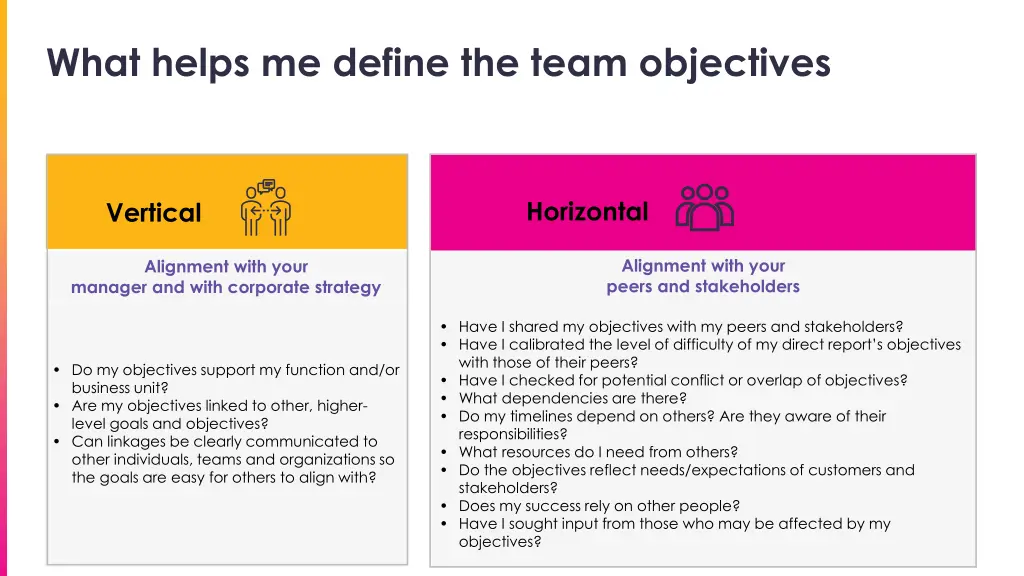
What helps me define the team objectives Horizontal Vertical Alignment with your peers and stakeholders Alignment with your manager and with corporate strategy Have I shared my objectives with my peers and stakeholders? Have I calibrated the level of difficulty of my direct report s objectives with those of their peers? Have I checked for potential conflict or overlap of objectives? What dependencies are there? Do my timelines depend on others? Are they aware of their responsibilities? What resources do I need from others? Do the objectives reflect needs/expectations of customers and stakeholders? Does my success rely on other people? Have I sought input from those who may be affected by my objectives? Do my objectives support my function and/or business unit? Are my objectives linked to other, higher- level goals and objectives? Can linkages be clearly communicated to other individuals, teams and organizations so the goals are easy for others to align with? 4
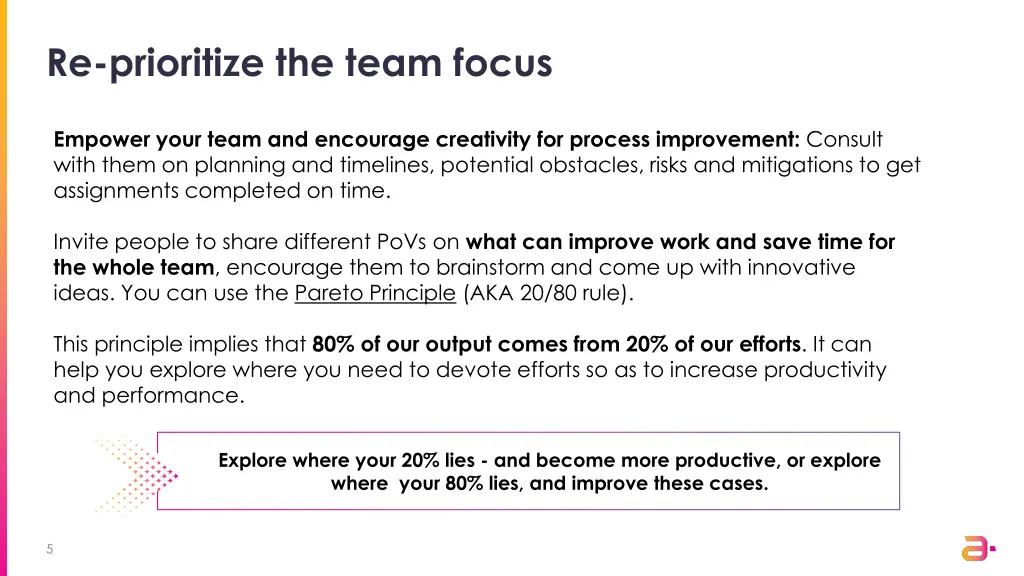
Re-prioritize the team focus Empower your team and encourage creativity for process improvement: Consult with them on planning and timelines, potential obstacles, risks and mitigations to get assignments completed on time. Invite people to share different PoVs on what can improve work and save time for the whole team, encourage them to brainstorm and come up with innovative ideas. You can use the Pareto Principle (AKA 20/80 rule). This principle implies that 80% of our output comes from 20% of our efforts. It can help you explore where you need to devote efforts so as to increase productivity and performance. Explore where your 20% lies - and become more productive, or explore where your 80% lies, and improve these cases. 5
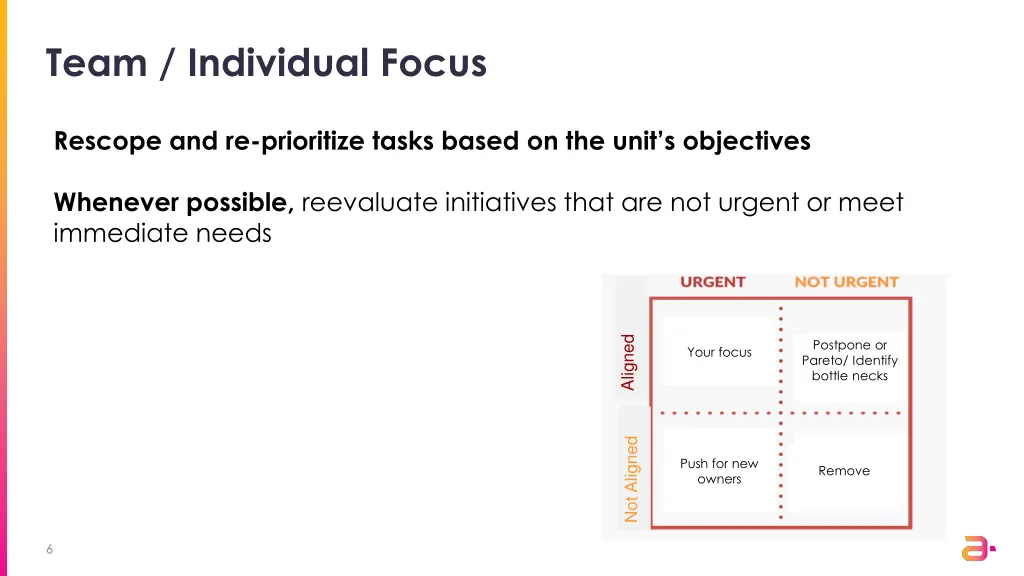
Team / Individual Focus Rescope and re-prioritize tasks based on the unit s objectives Whenever possible, reevaluate initiatives that are not urgent or meet immediate needs Aligned Postpone or Pareto/ Identify bottle necks Your focus Not Aligned Push for new owners Remove 6
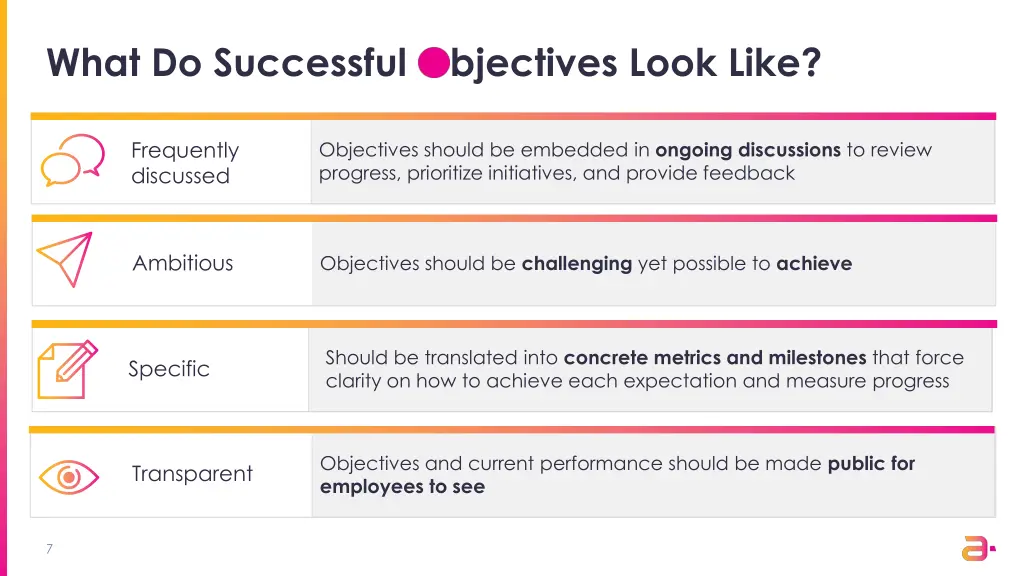
What Do Successful Objectives Look Like? Frequently discussed Objectives should be embedded in ongoing discussions to review progress, prioritize initiatives, and provide feedback Ambitious Objectives should be challenging yet possible to achieve Should be translated into concrete metrics and milestones that force clarity on how to achieve each expectation and measure progress Specific Objectives and current performance should be made public for employees to see Transparent 7
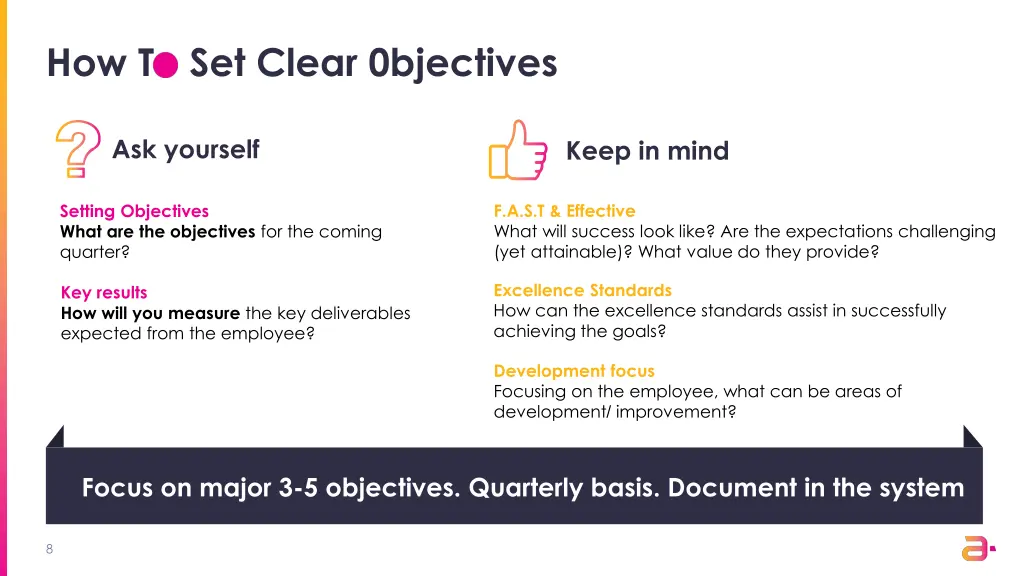
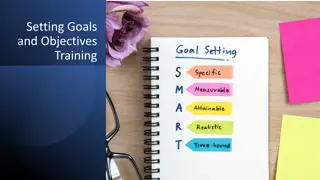
How To Set Clear 0bjectives Ask yourself Keep in mind F.A.S.T & Effective What will success look like? Are the expectations challenging (yet attainable)? What value do they provide? Setting Objectives Whatare the objectives for the coming quarter? Excellence Standards How can the excellence standards assist in successfully achieving the goals? Key results Howwill you measure the key deliverables expected from the employee? Development focus Focusing on the employee, what can be areas of development/ improvement? Focus on major 3-5 objectives. Quarterly basis. Document in the system 8
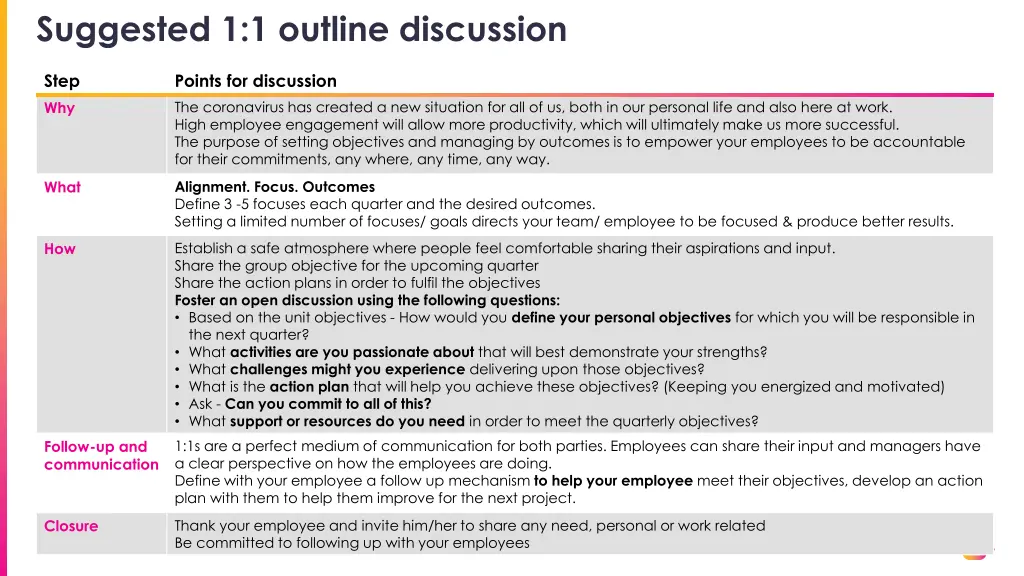
Suggested 1:1 outline discussion Step Why Points for discussion The coronavirus has created a new situation for all of us, both in our personal life and also here at work. High employee engagement will allow more productivity, which will ultimately make us more successful. The purpose of setting objectives and managing by outcomes is to empower your employees to be accountable for their commitments, any where, any time, any way. Alignment. Focus. Outcomes Define 3 -5 focuses each quarter and the desired outcomes. Setting a limited number of focuses/ goals directs your team/ employee to be focused & produce better results. What Establish a safe atmosphere where people feel comfortable sharing their aspirations and input. Share the group objective for the upcoming quarter Share the action plans in order to fulfil the objectives Foster an open discussion using the following questions: Based on the unit objectives - How would you define your personal objectives for which you will be responsible in the next quarter? What activities are you passionate about that will best demonstrate your strengths? What challenges might you experience delivering upon those objectives? What is the action plan that will help you achieve these objectives? (Keeping you energized and motivated) Ask - Can you commit to all of this? What support or resources do you need in order to meet the quarterly objectives? 1:1s are a perfect medium of communication for both parties. Employees can share their input and managers have a clear perspective on how the employees are doing. Define with your employee a follow up mechanism to help your employee meet their objectives, develop an action plan with them to help them improve for the next project. How Follow-up and communication Thank your employee and invite him/her to share any need, personal or work related Be committed to following up with your employees Closure 9
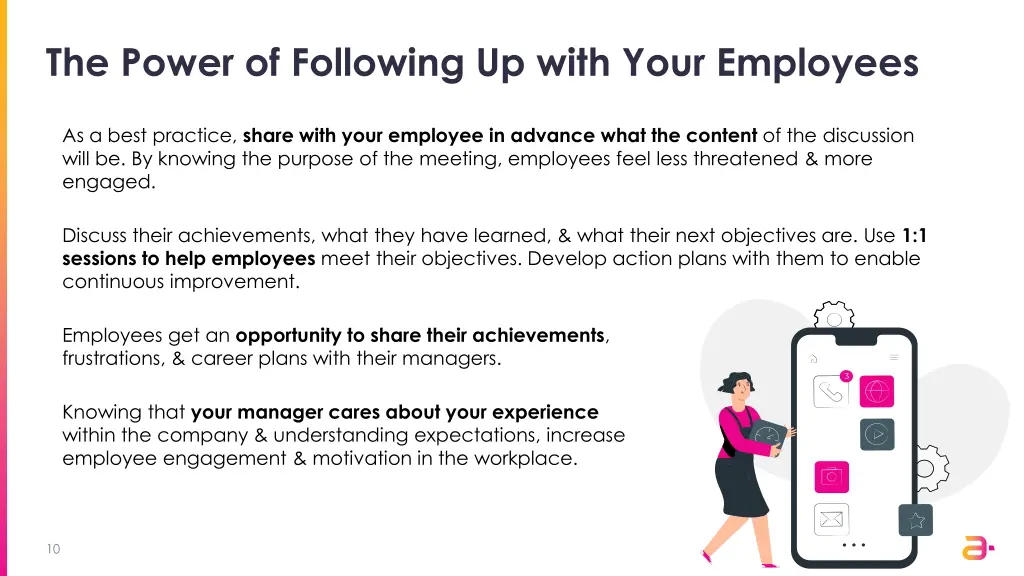
The Power of Following Up with Your Employees As a best practice, share with your employee in advance what the content of the discussion will be. By knowing the purpose of the meeting, employees feel less threatened & more engaged. Discuss their achievements, what they have learned, & what their next objectives are. Use 1:1 sessions to help employees meet their objectives. Develop action plans with them to enable continuous improvement. Employees get an opportunity to share their achievements, frustrations, & career plans with their managers. Knowing that your manager cares about your experience within the company & understanding expectations, increase employee engagement & motivation in the workplace. 10