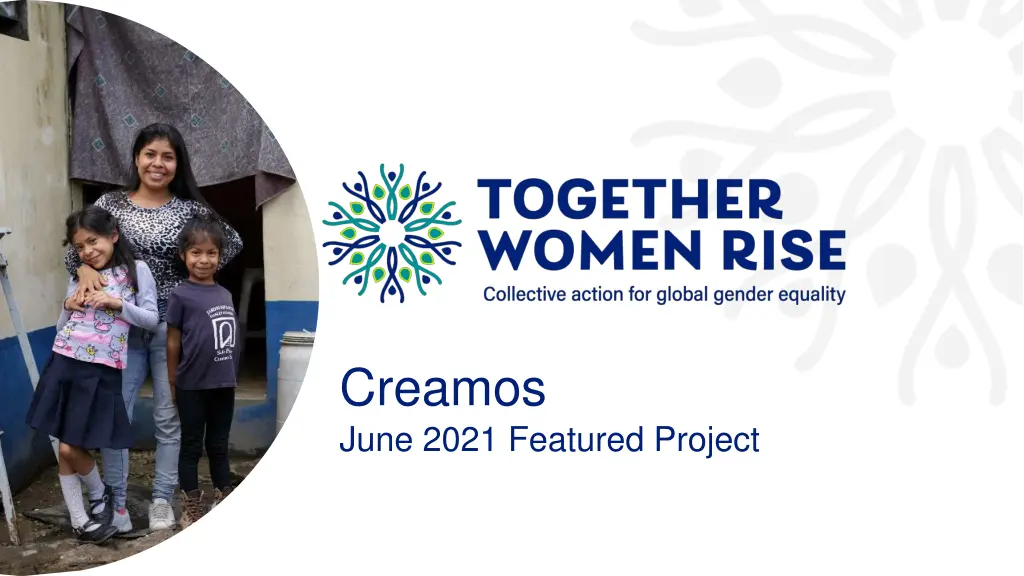
"Learn about Creamos' impactful project supporting women in Guatemala City's garbage dump community, addressing intimate partner violence, gender-based violence, and financial literacy to create a more stable future for vulnerable women."
Please find below an Image/Link to download the presentation.
The content on the website is provided AS IS for your information and personal use only. It may not be sold, licensed, or shared on other websites without obtaining consent from the author. If you encounter any issues during the download, it is possible that the publisher has removed the file from their server.
You are allowed to download the files provided on this website for personal or commercial use, subject to the condition that they are used lawfully. All files are the property of their respective owners.
The content on the website is provided AS IS for your information and personal use only. It may not be sold, licensed, or shared on other websites without obtaining consent from the author.
Introducing Creamos Intimate Partner Violence & Gender- based Violence Treatment Program for 140 Women in the Guatemala City Garbage Dump Community Creamos creates opportunities for women living in the communities surrounding the Guatemala City garbage dump (GCGD) through an inclusive approach to lifelong financial, emotional, and physical stability. The community surrounding the GCGD is riddled with chronic violence, the majority of which is gender-based, which results in disproportionate levels of physical, sexual, emotional, and economic abuse experienced by women. 2
Guatemala Guatemala suffers from one of the highest rates of Intimate Partner Violence (IPV) and femicide in the world. It is a predominantly poor country that struggles in several areas of health and development, including infant, child, and maternal mortality, malnutrition, literacy, and contraceptive awareness and use. It also has the highest population growth rate in Latin America, which is likely to continue because of its large reproductive-age population and high birth rate. 3
Life Challenges Women living in the GCGD community face overt dangers, including physical and sexual violence, and subtle pressures: high rates of teenage pregnancy, single motherhood, multiple children per household, lack of exposure to healthy relationships, low-self-esteem, and lack of financial independence. There are hundreds of women in the GCGD community who are living in isolation, experiencing violence, and who have never had the opportunity to access services. 4
Life Challenges Ninety-five percent of the organization s participants have reported experiencing IPV and/or gender-based violence (GBV) throughout their lifetime, and only 10% had ever sought legal or social support prior to enrolling in Creamos. Within the GCGD, the average household size is seven people, 43% of which are headed by single mothers. An informal census indicated that 91% of female GCGD residents did not own their own homes, 78% received no more than an elementary education, 95% did not have a bank account, and only 6% were formally employed. 5
The Project Creamos will implement a therapeutic and psychoeducational IPV and GBV treatment program for 140 women in the GCGD slum to decrease the instances of violence within the community. The project will consist of three components: Therapeutic Support Group, Psychoeducational Group, and Financial Literacy Workshops. The therapeutic and psychoeducational IPV and GBV treatment program will provide women who have been identified as involved in (or at risk of being involved in) abusive relationships with some of the tools, resources, and support necessary to begin to address their circumstances. 6
The Project Most notably, Creamos believes that the incorporation of this program will provide women with basic knowledge about the characteristics of IPV and GBV, which will help them identify violence in their own lives and in the lives of women in their community, develop safety plans to ensure an exit option for themselves and their families, increase exposure to life-saving services and resources in the community, and increase their understanding of women s rights and Guatemalan gender- based violence laws. 7
Budget Item Description Cost Portion of Social Worker's salary for all six months of program implementation Personnel $4,500 Assuming one disbursement of program materials and one workbook per participant to use for the six-month project Materials $9,800 Psychologist and DV/IPV Curriculum Consultant, Psycho-Education Facilitator cost, External Mental Health Service Provider costs Consultants $8,640 Other Transportation and professional development $2,080 $25,020 Total 8
About Creamos Creamos began in 2008 as a social entrepreneurship initiative by 20 women living in the community surrounding the Guatemala City garbage dump. They had historically relied on collecting, recycling, reusing and reselling items scavenged in the dump, in addition to other risky work, to make a living. After attending a course on how to make jewelry out of recycled paper, the group opened Creamos as a small business. Creamos jewelry program expanded to employ more women and took on an Executive Director to manage growth. In 2012, the organization incorporated a sewing program, doubling its enrollment. For several years, the business operated under the umbrella of Safe Passage, Creamos sister organization and financial sponsor. 9
About Creamos Creamos became an independent NGO at the end of 2014, with the sole mission of helping the women and mothers of the GCGD community become financially independent, healthy, and emotionally supported. Program offerings have expanded dramatically to include emotional support, physical wellness, and adult education. The emotional support program experienced rapid growth in its first five years. From psychoeducational and exercise groups, it slowly grew to integrate individual therapy, group therapy, and theme-specific groups. In its first year, the adult education program nearly doubled its anticipated enrollment and provided scholarships for three women to attend the local university, with 10 more engaged in the application process. 10
Share your thoughts Why do you think the women do not access services? What factors encourage silence about IPV? GBV is present in all countries and all social classes. Do you know of innovative programs in your own communities? 11
RIPPLE Africa June 2021 Sustained Grantee Changu Changu Moto Project (Malawi) This project brings the Changu Changu Moto (CCM) cookstove to 5,743 households in Nkhotakota and Mzimba Districts of Malawi. This simple, low-tech, fuel-efficient stove is constructed from mud bricks made from locally sourced materials that are free and readily available. RIPPLE Africa CCM project staff work alongside women to construct the stove as equals. 13
RIPPLE Africa Women are involved from beginning to end, ensuring a sense of pride and ownership of the stove and empowering them to maintain it ongoing. This has proven to be a key element in the overwhelming success of the CCM project as a replacement for the three-stone fire option. With the time that women and girls save after the adoption of the cookstoves, they can pursue education and income-generating opportunities. Direct Impact: 12,600; Indirect Impact: 25,000 14