Engaging Classroom Gaming for Effective Learning
Explore the benefits and guidelines for incorporating gaming in the classroom to enhance student interaction with academic skills. Discover how gaming can be a fun and educational tool for students in both primary and secondary grades, fostering voluntary learning and formative assessments.

Download Presentation

Please find below an Image/Link to download the presentation.
The content on the website is provided AS IS for your information and personal use only. It may not be sold, licensed, or shared on other websites without obtaining consent from the author. If you encounter any issues during the download, it is possible that the publisher has removed the file from their server.
You are allowed to download the files provided on this website for personal or commercial use, subject to the condition that they are used lawfully. All files are the property of their respective owners.
The content on the website is provided AS IS for your information and personal use only. It may not be sold, licensed, or shared on other websites without obtaining consent from the author.
E N D
Presentation Transcript
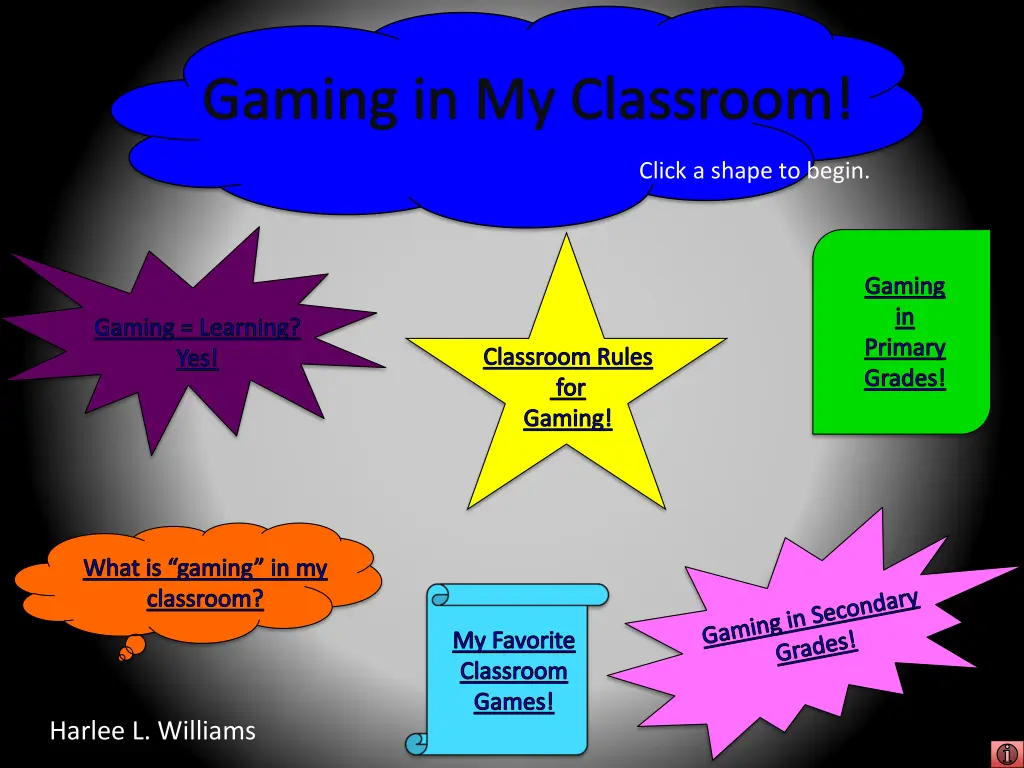
Gaming in My Classroom! Click a shape to begin. Gaming in Primary Grades! Gaming = Learning? Yes! Gaming = Learning? Yes! Classroom Rules for Gaming! Classroom Rules for Gaming! What is gaming in my classroom? What is gaming in my classroom? Gaming in Secondary Grades! Gaming in Secondary Grades! My Favorite Classroom Games! Harlee L. Williams
What is gaming in my classroom? - Gaming in my classroom involves students interacting with different kinds of technology to play a game that targets different academic or functional skills (Marzano, 2010) . - Games in my classroom provide students with time to practice, enhance or review their knowledge and skills. Games are not used to teach content initially (Davis, 2014) . - Games can range from whole group jeopardy, small group trivia games, and individual gaming apps. - Ergonomics: The physical component will be addressed by ensuring that students are physically positioned correctly when using computers in the classroom. The psychological component will be addressed by not requiring students to play games for too long, and not making the games high stakes ( not for a grade) (The Puget Sound Chapter of the Human Factors and Ergonomics Society, 2014). Learn More!
Classroom Rules for Gaming! Appropriate Use of Games: - All games must involve academic or functional skills (Marzano, 2010) . - Games must be pre-approved by the teacher. - Games are only to be played during free-time or other times indicated by the teacher. - Games must be Fun! - Games aren t for a grade, but try your best to learn! Learn More!
Gaming = Learning? Yes! Games are not just toys! Gaming allows students to fine tune skills they have learned during instruction (Marzano, 2010). Gaming provides students with additional practice that is a lot more fun than traditional homework. Games can include all different content areas, and can be differentiated for student needs (Marzano, 2010) . The best part about gaming, is that it is voluntary! Students willingly practice academic content, and therefore continue to learn and enhance their knowledge (Davis, 2014). Gaming can be used as formative assessments by teachers. This helps teachers gauge where students are, and plan accordingly for student needs (Davis, 2014). Learn More!
~Gaming in Primary Grades~ Students in Primary Grades are highly motivated by gaming! Making learning fun is the best way to get young students engaged in material! Games can be designed for all content areas, and students can practice these skills for fun! Gaming can be a friendly competition in the classroom. The stakes are never high, but the rewards are simple and just for fun! This adds an extra incentive to gaming (Davis, 2014)! Learn More!
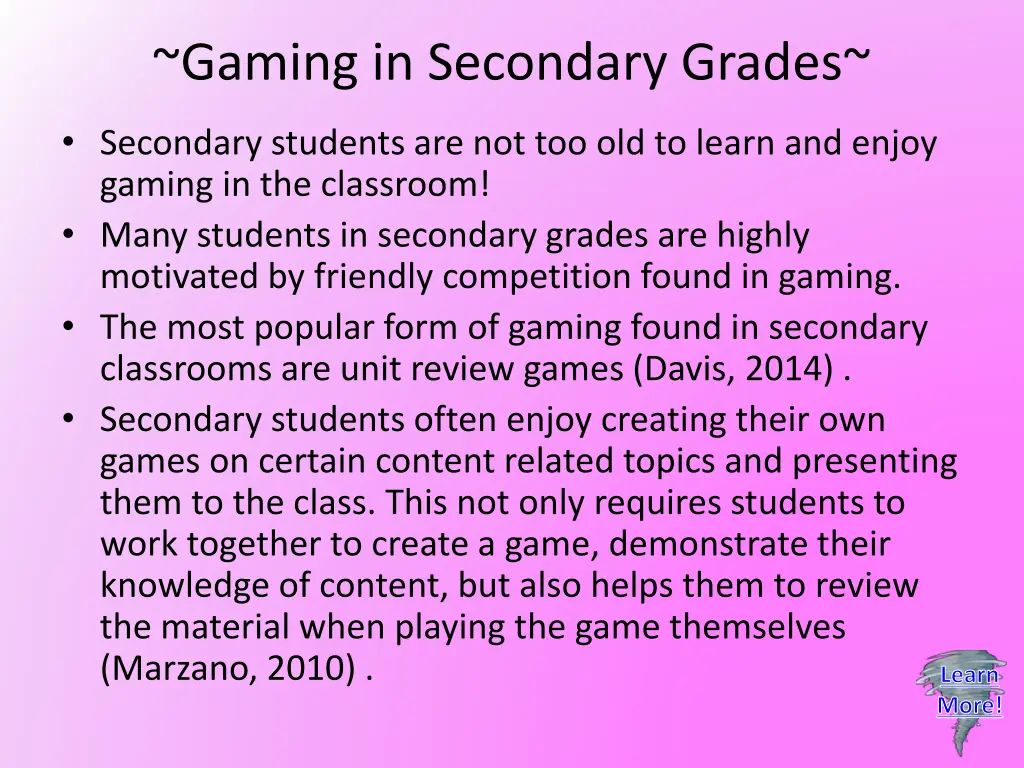
~Gaming in Secondary Grades~ Secondary students are not too old to learn and enjoy gaming in the classroom! Many students in secondary grades are highly motivated by friendly competition found in gaming. The most popular form of gaming found in secondary classrooms are unit review games (Davis, 2014) . Secondary students often enjoy creating their own games on certain content related topics and presenting them to the class. This not only requires students to work together to create a game, demonstrate their knowledge of content, but also helps them to review the material when playing the game themselves (Marzano, 2010) . Learn More!
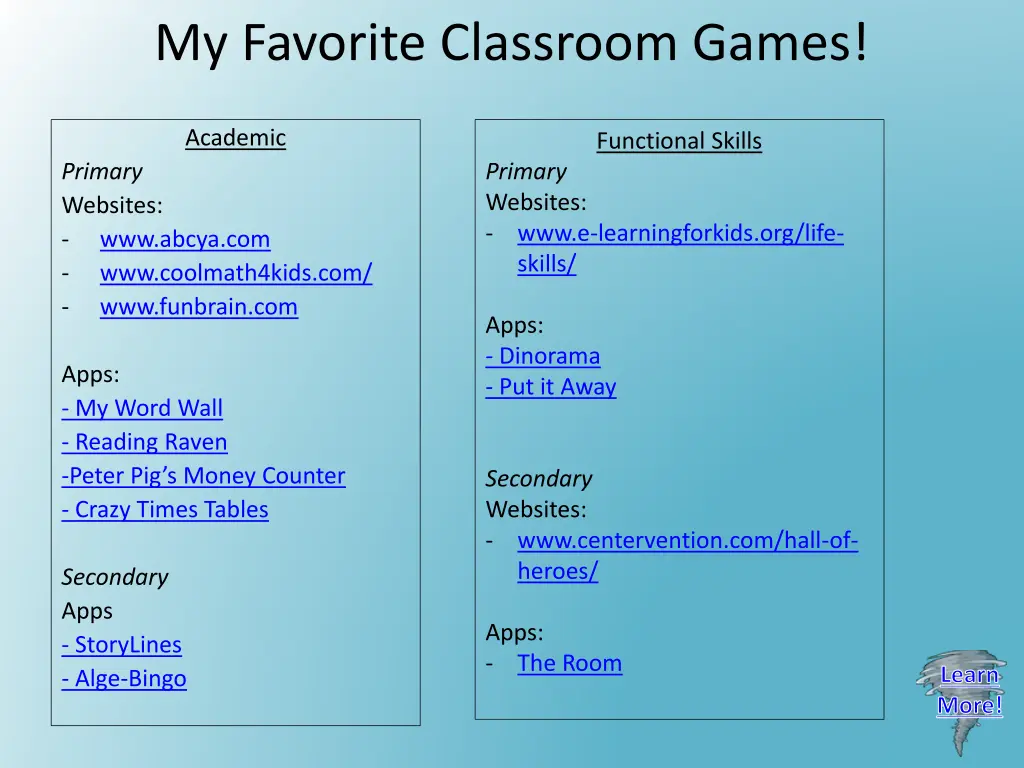
My Favorite Classroom Games! Academic Functional Skills Primary Websites: - www.abcya.com - www.coolmath4kids.com/ - www.funbrain.com Primary Websites: - www.e-learningforkids.org/life- skills/ Apps: - Dinorama - Put it Away Apps: - My Word Wall - Reading Raven -Peter Pig s Money Counter - Crazy Times Tables Secondary Apps - StoryLines - Alge-Bingo Secondary Websites: - www.centervention.com/hall-of- heroes/ Apps: - The Room Learn More!
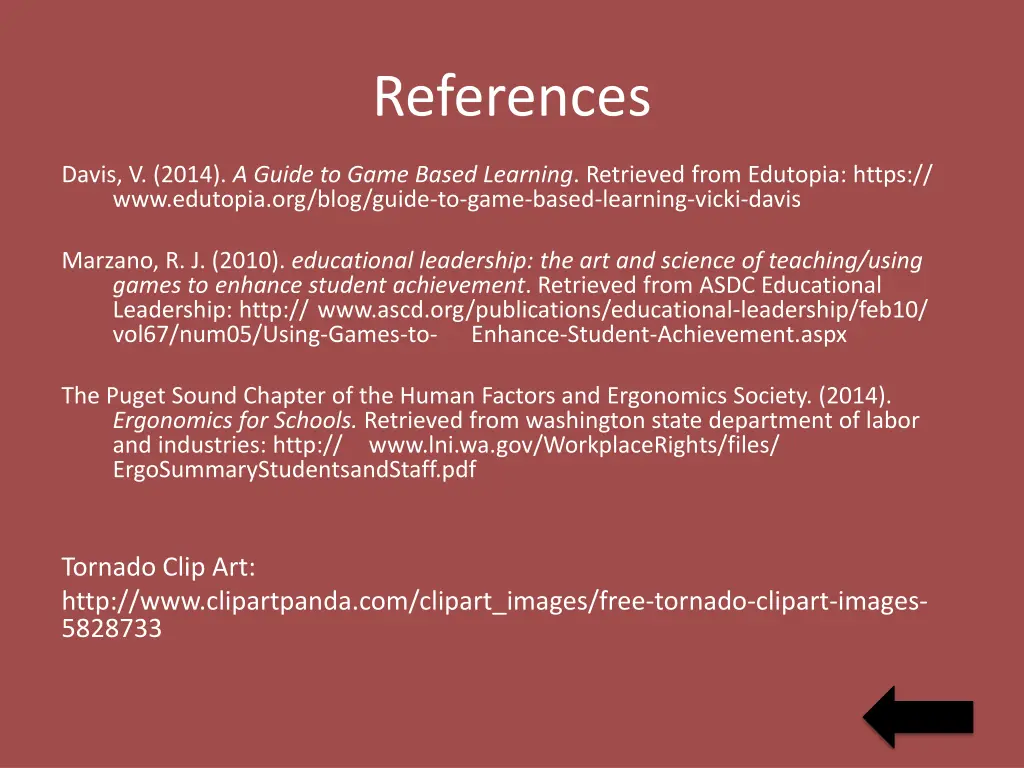
References Davis, V. (2014). A Guide to Game Based Learning. Retrieved from Edutopia: https:// www.edutopia.org/blog/guide-to-game-based-learning-vicki-davis Marzano, R. J. (2010). educational leadership: the art and science of teaching/using games to enhance student achievement. Retrieved from ASDC Educational Leadership: http:// www.ascd.org/publications/educational-leadership/feb10/ vol67/num05/Using-Games-to- Enhance-Student-Achievement.aspx The Puget Sound Chapter of the Human Factors and Ergonomics Society. (2014). Ergonomics for Schools. Retrieved from washington state department of labor and industries: http:// www.lni.wa.gov/WorkplaceRights/files/ ErgoSummaryStudentsandStaff.pdf Tornado Clip Art: http://www.clipartpanda.com/clipart_images/free-tornado-clipart-images- 5828733