Enhanced Seamless Roaming Architecture for IEEE 802.11 Networks
Explore the IEEE 802.11 document discussing seamless roaming within a mobility domain. Details on association with a Seamless Mobility Domain (SMD), roaming phases, e2e call flows, and security contexts are covered. The presentation addresses improved support for roaming in wireless networks.

Download Presentation

Please find below an Image/Link to download the presentation.
The content on the website is provided AS IS for your information and personal use only. It may not be sold, licensed, or shared on other websites without obtaining consent from the author. If you encounter any issues during the download, it is possible that the publisher has removed the file from their server.
You are allowed to download the files provided on this website for personal or commercial use, subject to the condition that they are used lawfully. All files are the property of their respective owners.
The content on the website is provided AS IS for your information and personal use only. It may not be sold, licensed, or shared on other websites without obtaining consent from the author.
E N D
Presentation Transcript
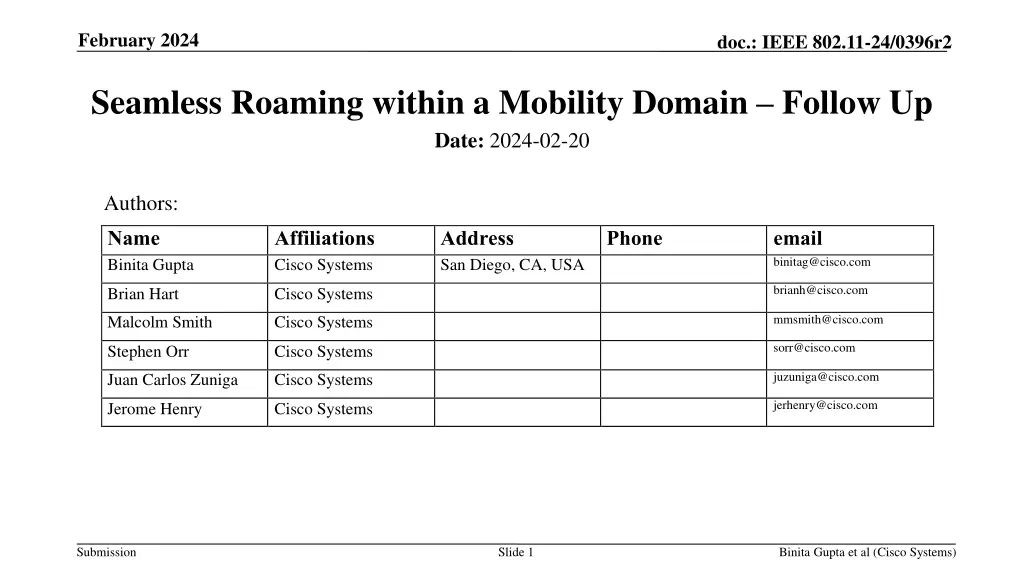
February 2024 doc.: IEEE 802.11-24/0396r2 Seamless Roaming within a Mobility Domain Follow Up Date: 2024-02-20 Authors: Name Binita Gupta Affiliations Cisco Systems Address San Diego, CA, USA Phone email binitag@cisco.com brianh@cisco.com Brian Hart Cisco Systems mmsmith@cisco.com Malcolm Smith Cisco Systems sorr@cisco.com Stephen Orr Cisco Systems juzuniga@cisco.com Juan Carlos Zuniga Cisco Systems jerhenry@cisco.com Jerome Henry Cisco Systems Submission Slide 1 Binita Gupta et al (Cisco Systems)
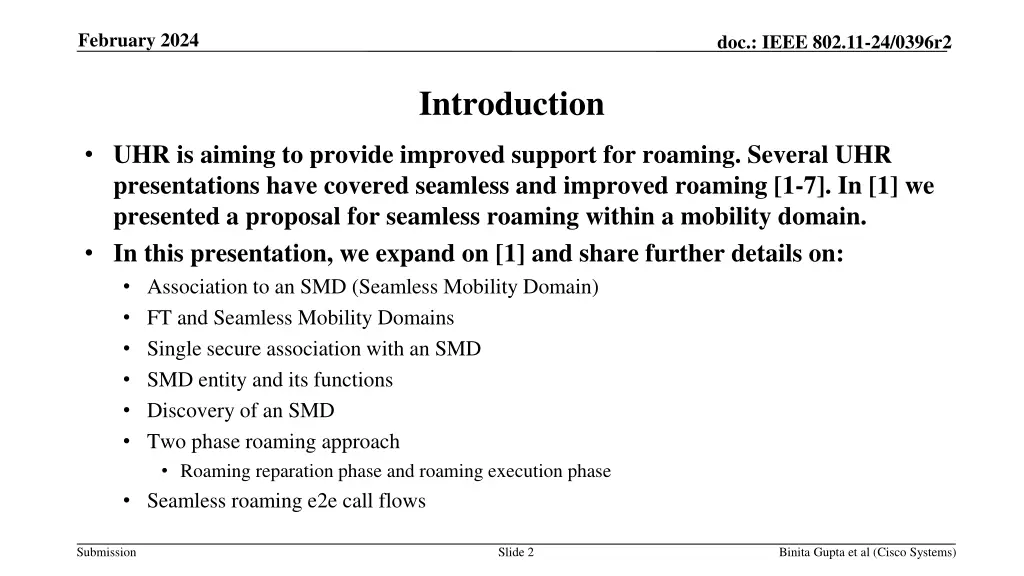
February 2024 doc.: IEEE 802.11-24/0396r2 Introduction UHR is aiming to provide improved support for roaming. Several UHR presentations have covered seamless and improved roaming [1-7]. In [1] we presented a proposal for seamless roaming within a mobility domain. In this presentation, we expand on [1] and share further details on: Association to an SMD (Seamless Mobility Domain) FT and Seamless Mobility Domains Single secure association with an SMD SMD entity and its functions Discovery of an SMD Two phase roaming approach Roaming reparation phase and roaming execution phase Seamless roaming e2e call flows Submission Slide 2 Binita Gupta et al (Cisco Systems)
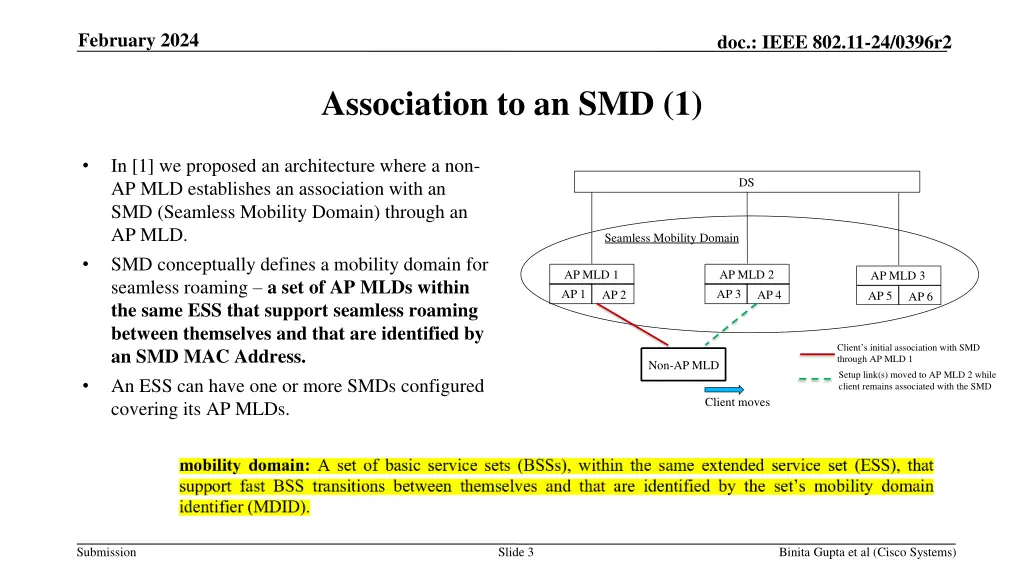
February 2024 doc.: IEEE 802.11-24/0396r2 Association to an SMD (1) In [1] we proposed an architecture where a non- AP MLD establishes an association with an SMD (Seamless Mobility Domain) through an AP MLD. SMD conceptually defines a mobility domain for seamless roaming a set of AP MLDs within the same ESS that support seamless roaming between themselves and that are identified by an SMD MAC Address. An ESS can have one or more SMDs configured covering its AP MLDs. DS Seamless Mobility Domain AP MLD 1 AP 1 AP MLD 2 AP 3 AP MLD 3 AP 2 AP 4 AP 5 AP 6 Client s initial association with SMD through AP MLD 1 Non-AP MLD Setup link(s) moved to AP MLD 2 while client remains associated with the SMD Client moves Submission Slide 3 Binita Gupta et al (Cisco Systems)
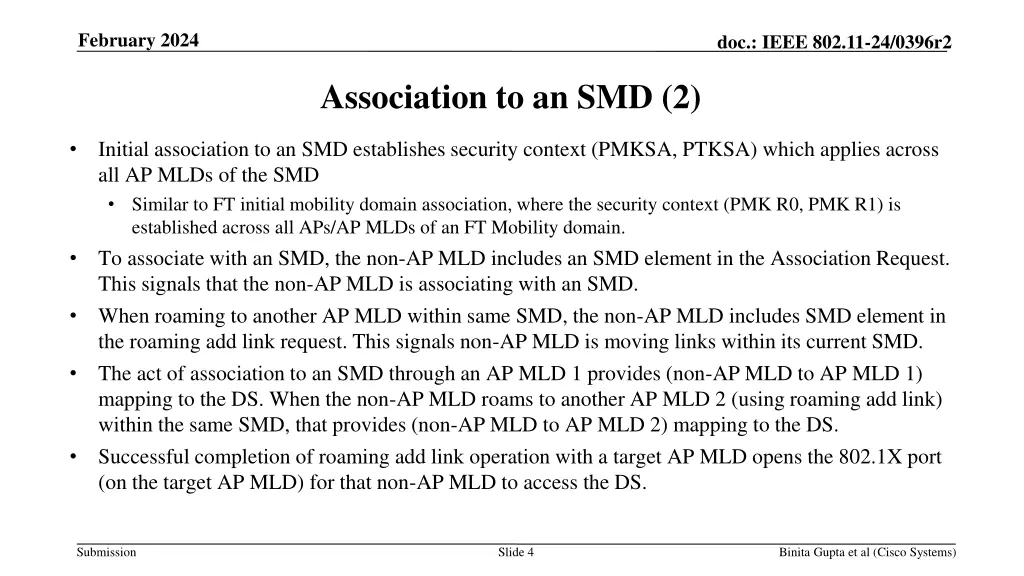
February 2024 doc.: IEEE 802.11-24/0396r2 Association to an SMD (2) Initial association to an SMD establishes security context (PMKSA, PTKSA) which applies across all AP MLDs of the SMD Similar to FT initial mobility domain association, where the security context (PMK R0, PMK R1) is established across all APs/AP MLDs of an FT Mobility domain. To associate with an SMD, the non-AP MLD includes an SMD element in the Association Request. This signals that the non-AP MLD is associating with an SMD. When roaming to another AP MLD within same SMD, the non-AP MLD includes SMD element in the roaming add link request. This signals non-AP MLD is moving links within its current SMD. The act of association to an SMD through an AP MLD 1 provides (non-AP MLD to AP MLD 1) mapping to the DS. When the non-AP MLD roams to another AP MLD 2 (using roaming add link) within the same SMD, that provides (non-AP MLD to AP MLD 2) mapping to the DS. Successful completion of roaming add link operation with a target AP MLD opens the 802.1X port (on the target AP MLD) for that non-AP MLD to access the DS. Submission Slide 4 Binita Gupta et al (Cisco Systems)
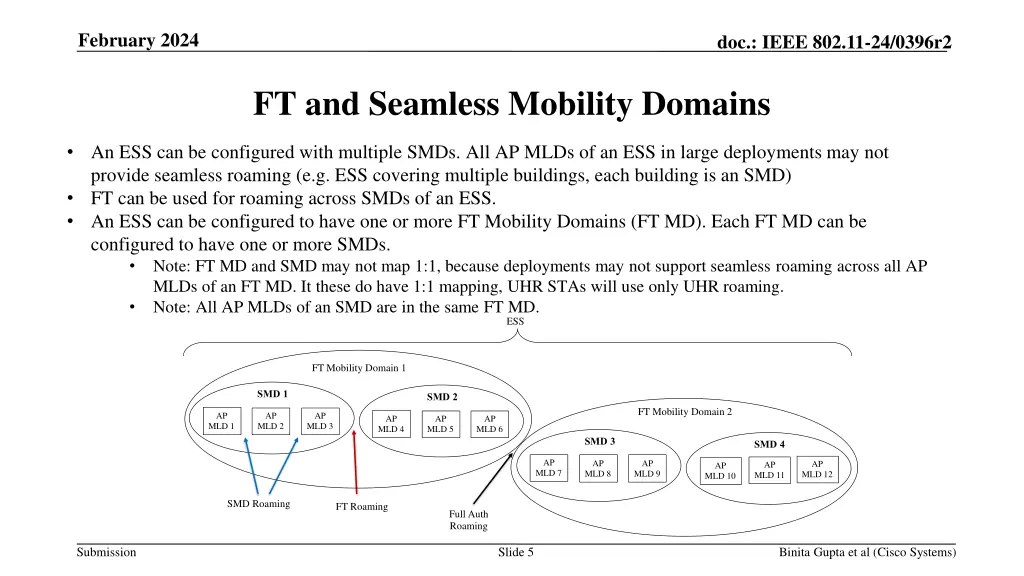
February 2024 doc.: IEEE 802.11-24/0396r2 FT and Seamless Mobility Domains An ESS can be configured with multiple SMDs. All AP MLDs of an ESS in large deployments may not provide seamless roaming (e.g. ESS covering multiple buildings, each building is an SMD) FT can be used for roaming across SMDs of an ESS. An ESS can be configured to have one or more FT Mobility Domains (FT MD). Each FT MD can be configured to have one or more SMDs. Note: FT MD and SMD may not map 1:1, because deployments may not support seamless roaming across all AP MLDs of an FT MD. It these do have 1:1 mapping, UHR STAs will use only UHR roaming. Note: All AP MLDs of an SMD are in the same FT MD. ESS FT Mobility Domain 1 SMD 1 SMD 2 FT Mobility Domain 2 AP AP AP AP AP AP MLD 1 MLD 2 MLD 3 MLD 4 MLD 5 MLD 6 SMD 3 SMD 4 AP AP AP AP AP AP MLD 7 MLD 8 MLD 9 MLD 12 MLD 11 MLD 10 SMD Roaming FT Roaming Full Auth Roaming Submission Slide 5 Binita Gupta et al (Cisco Systems)
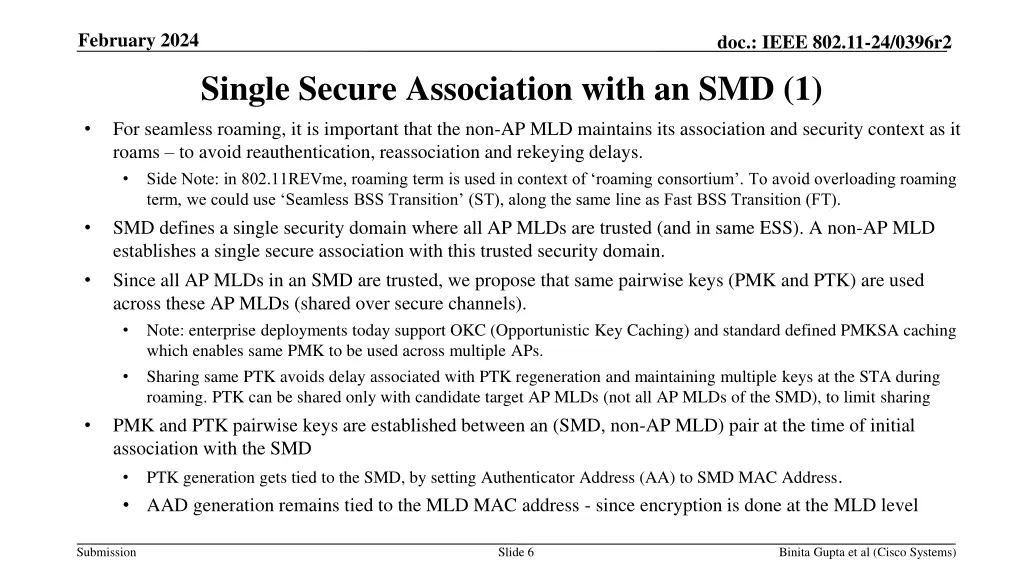
February 2024 doc.: IEEE 802.11-24/0396r2 Single Secure Association with an SMD (1) For seamless roaming, it is important that the non-AP MLD maintains its association and security context as it roams to avoid reauthentication, reassociation and rekeying delays. Side Note: in 802.11REVme, roaming term is used in context of roaming consortium . To avoid overloading roaming term, we could use Seamless BSS Transition (ST), along the same line as Fast BSS Transition (FT). SMD defines a single security domain where all AP MLDs are trusted (and in same ESS). A non-AP MLD establishes a single secure association with this trusted security domain. Since all AP MLDs in an SMD are trusted, we propose that same pairwise keys (PMK and PTK) are used across these AP MLDs (shared over secure channels). Note: enterprise deployments today support OKC (Opportunistic Key Caching) and standard defined PMKSA caching which enables same PMK to be used across multiple APs. Sharing same PTK avoids delay associated with PTK regeneration and maintaining multiple keys at the STA during roaming. PTK can be shared only with candidate target AP MLDs (not all AP MLDs of the SMD), to limit sharing PMK and PTK pairwise keys are established between an (SMD, non-AP MLD) pair at the time of initial association with the SMD PTK generation gets tied to the SMD, by setting Authenticator Address (AA) to SMD MAC Address. AAD generation remains tied to the MLD MAC address - since encryption is done at the MLD level Submission Slide 6 Binita Gupta et al (Cisco Systems)
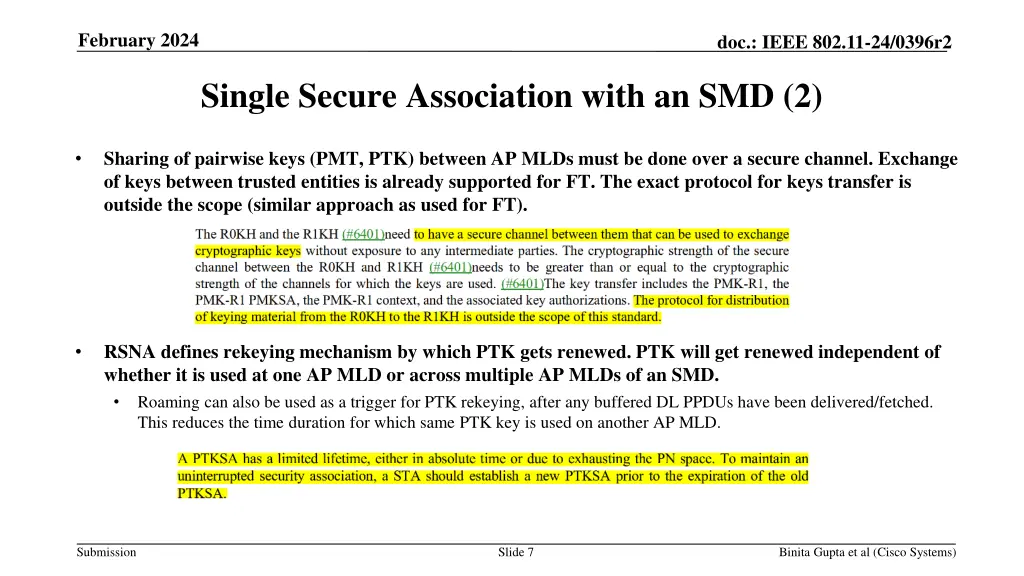
February 2024 doc.: IEEE 802.11-24/0396r2 Single Secure Association with an SMD (2) Sharing of pairwise keys (PMT, PTK) between AP MLDs must be done over a secure channel. Exchange of keys between trusted entities is already supported for FT. The exact protocol for keys transfer is outside the scope (similar approach as used for FT). RSNA defines rekeying mechanism by which PTK gets renewed. PTK will get renewed independent of whether it is used at one AP MLD or across multiple AP MLDs of an SMD. Roaming can also be used as a trigger for PTK rekeying, after any buffered DL PPDUs have been delivered/fetched. This reduces the time duration for which same PTK key is used on another AP MLD. Submission Slide 7 Binita Gupta et al (Cisco Systems)
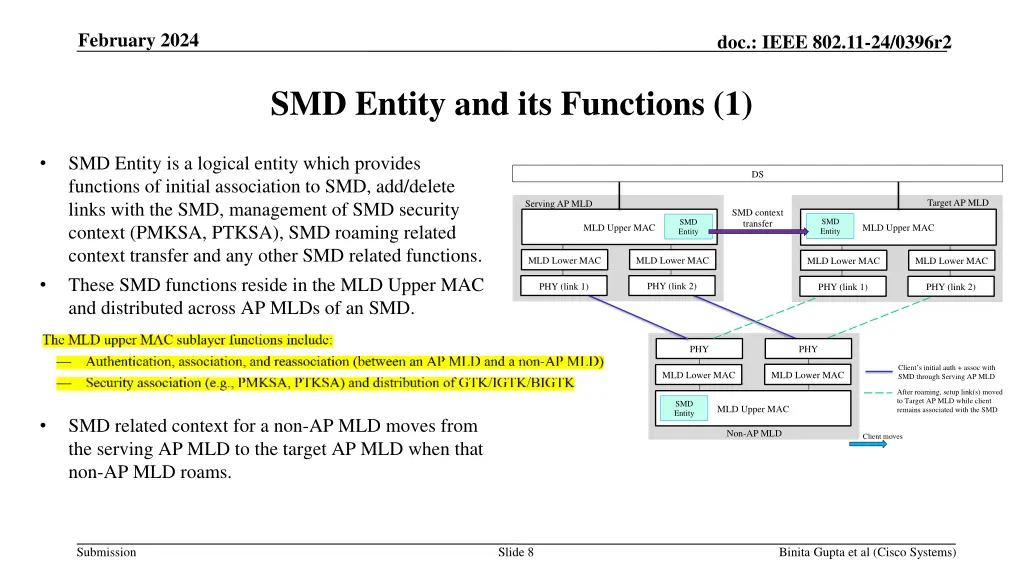
February 2024 doc.: IEEE 802.11-24/0396r2 SMD Entity and its Functions (1) SMD Entity is a logical entity which provides functions of initial association to SMD, add/delete links with the SMD, management of SMD security context (PMKSA, PTKSA), SMD roaming related context transfer and any other SMD related functions. These SMD functions reside in the MLD Upper MAC and distributed across AP MLDs of an SMD. DS Target AP MLD Serving AP MLD SMD context transfer SMD Entity SMD Entity MLD Upper MAC MLD Upper MAC MLD Lower MAC MLD Lower MAC MLD Lower MAC MLD Lower MAC PHY (link 2) PHY (link 1) PHY (link 1) PHY (link 2) PHY PHY Client s initial auth + assoc with SMD through Serving AP MLD MLD Lower MAC MLD Lower MAC After roaming, setup link(s) moved to Target AP MLD while client remains associated with the SMD SMD Entity MLD Upper MAC SMD related context for a non-AP MLD moves from the serving AP MLD to the target AP MLD when that non-AP MLD roams. Non-AP MLD Client moves Submission Slide 8 Binita Gupta et al (Cisco Systems)
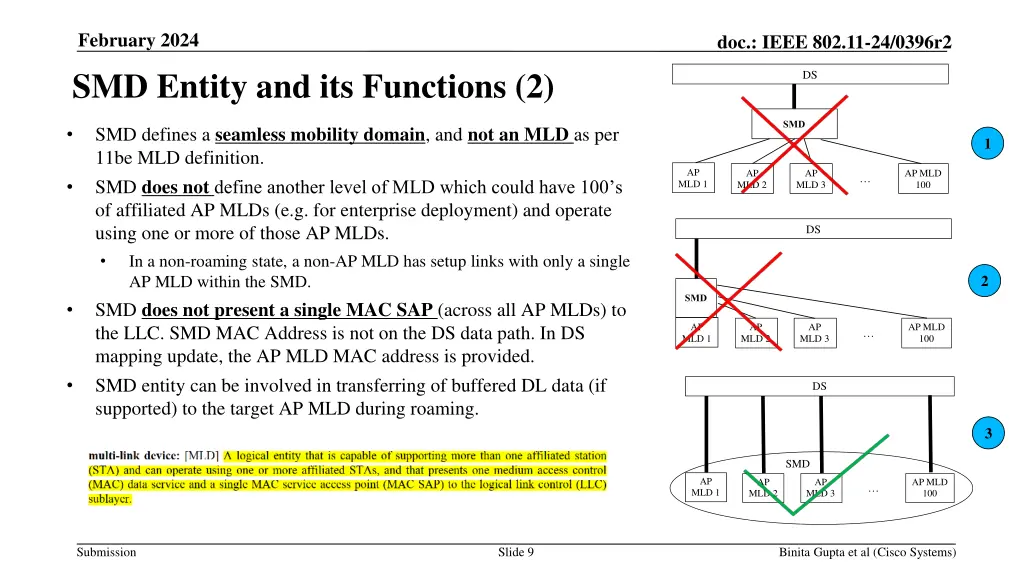
February 2024 doc.: IEEE 802.11-24/0396r2 SMD Entity and its Functions (2) DS SMD SMD defines a seamless mobility domain, and not an MLD as per 11be MLD definition. SMD does not define another level of MLD which could have 100 s of affiliated AP MLDs (e.g. for enterprise deployment) and operate using one or more of those AP MLDs. In a non-roaming state, a non-AP MLD has setup links with only a single AP MLD within the SMD. SMD does not present a single MAC SAP (across all AP MLDs) to the LLC. SMD MAC Address is not on the DS data path. In DS mapping update, the AP MLD MAC address is provided. SMD entity can be involved in transferring of buffered DL data (if supported) to the target AP MLD during roaming. 1 AP AP AP AP MLD 100 MLD 1 MLD 2 MLD 3 DS 2 SMD AP AP AP AP MLD 100 MLD 1 MLD 2 MLD 3 DS 3 SMD AP AP AP AP MLD 100 MLD 1 MLD 2 MLD 3 Submission Slide 9 Binita Gupta et al (Cisco Systems)
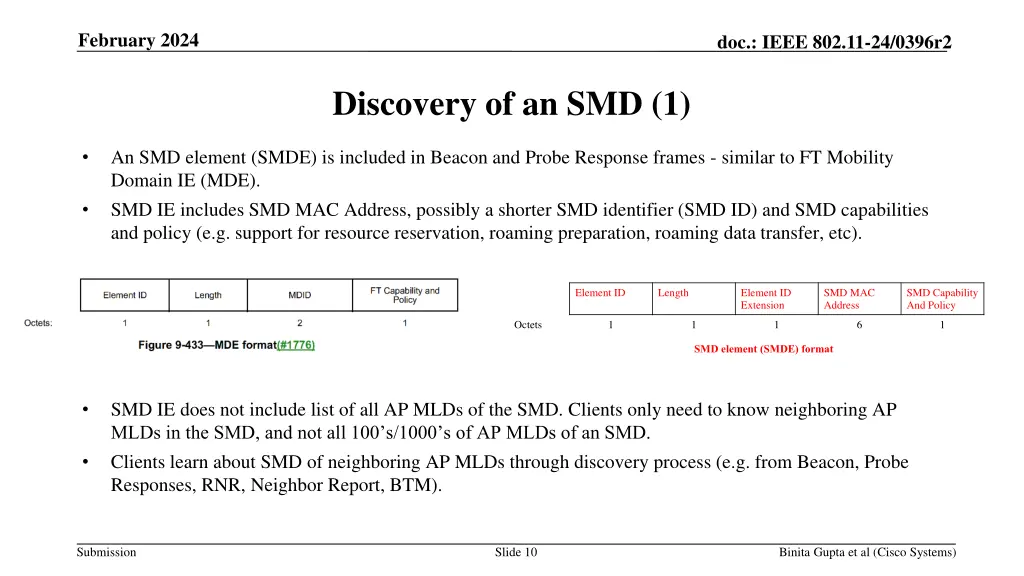
February 2024 doc.: IEEE 802.11-24/0396r2 Discovery of an SMD (1) An SMD element (SMDE) is included in Beacon and Probe Response frames - similar to FT Mobility Domain IE (MDE). SMD IE includes SMD MAC Address, possibly a shorter SMD identifier (SMD ID) and SMD capabilities and policy (e.g. support for resource reservation, roaming preparation, roaming data transfer, etc). Element ID Length Element ID Extension SMD MAC Address SMD Capability And Policy Octets 1 1 1 6 1 SMD element (SMDE) format SMD IE does not include list of all AP MLDs of the SMD. Clients only need to know neighboring AP MLDs in the SMD, and not all 100 s/1000 s of AP MLDs of an SMD. Clients learn about SMD of neighboring AP MLDs through discovery process (e.g. from Beacon, Probe Responses, RNR, Neighbor Report, BTM). Submission Slide 10 Binita Gupta et al (Cisco Systems)
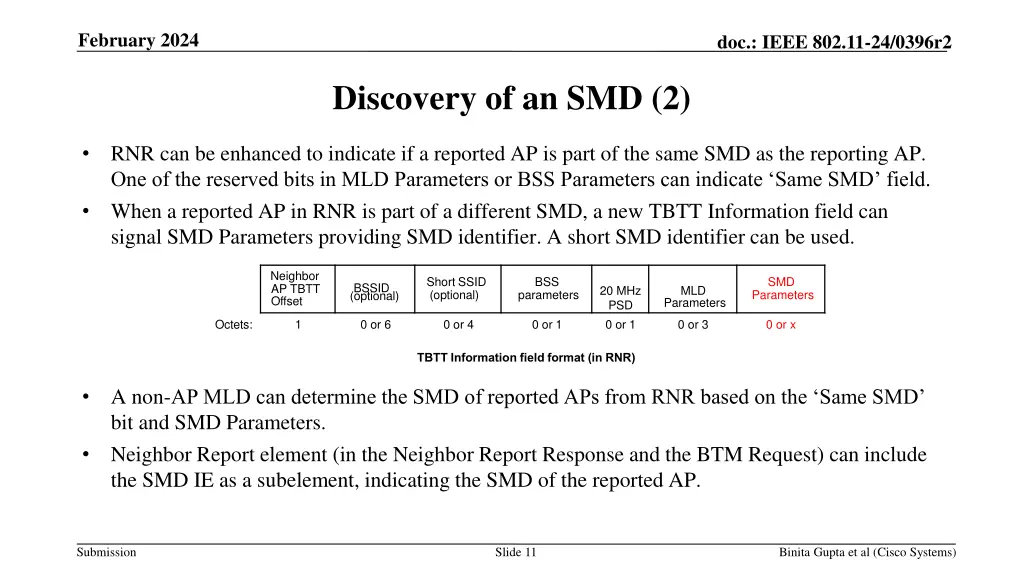
February 2024 doc.: IEEE 802.11-24/0396r2 Discovery of an SMD (2) RNR can be enhanced to indicate if a reported AP is part of the same SMD as the reporting AP. One of the reserved bits in MLD Parameters or BSS Parameters can indicate Same SMD field. When a reported AP in RNR is part of a different SMD, a new TBTT Information field can signal SMD Parameters providing SMD identifier. A short SMD identifier can be used. Neighbor AP TBTT Offset Short SSID (optional) BSS SMD BSSID (optional) 20 MHz PSD 0 or 1 MLD parameters Parameters Parameters Octets: 1 0 or 6 0 or 4 0 or 1 0 or 3 0 or x TBTT Information field format (in RNR) A non-AP MLD can determine the SMD of reported APs from RNR based on the Same SMD bit and SMD Parameters. Neighbor Report element (in the Neighbor Report Response and the BTM Request) can include the SMD IE as a subelement, indicating the SMD of the reported AP. Submission Slide 11 Binita Gupta et al (Cisco Systems)
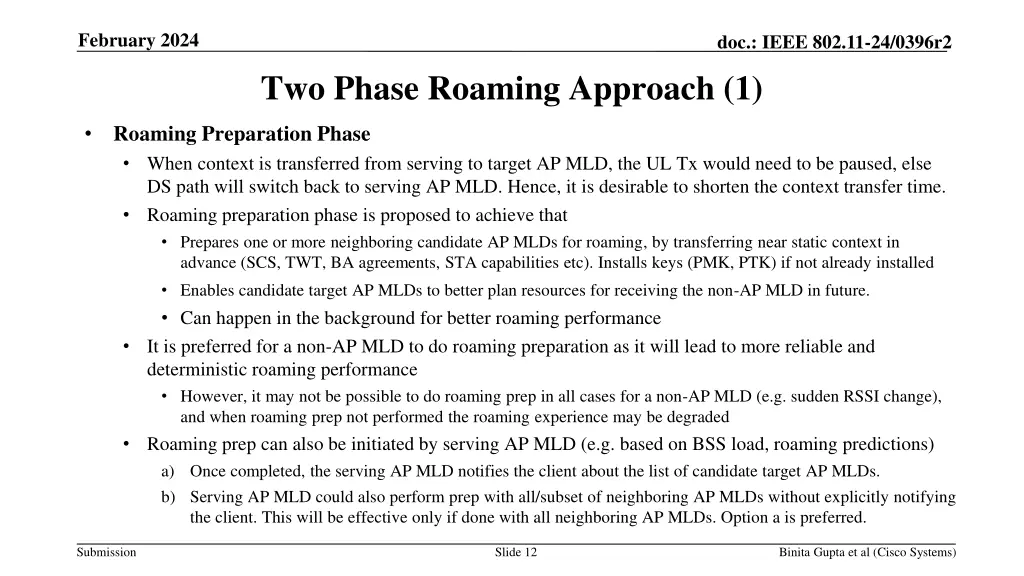
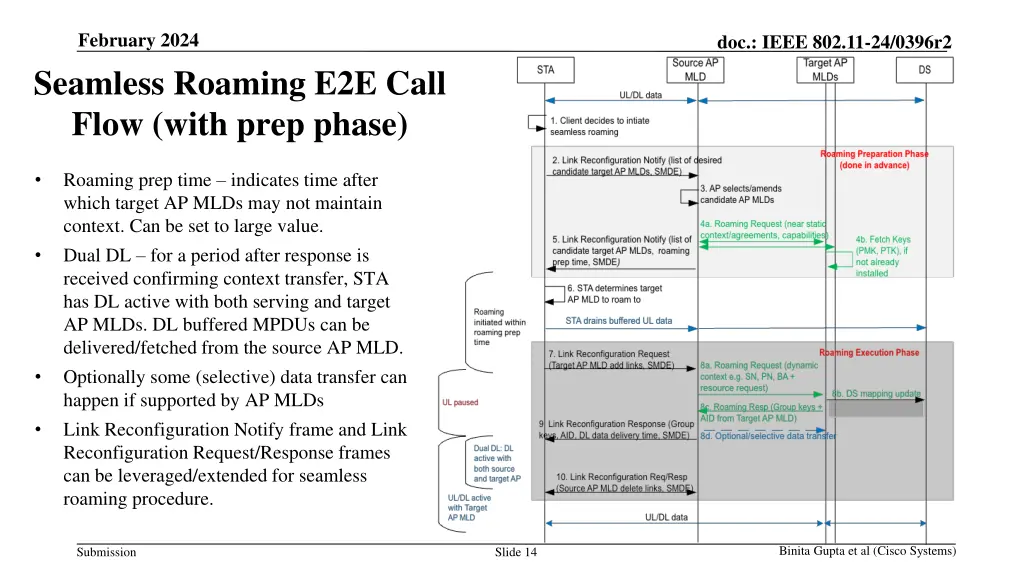
February 2024 doc.: IEEE 802.11-24/0396r2 Two Phase Roaming Approach (1) Roaming Preparation Phase When context is transferred from serving to target AP MLD, the UL Tx would need to be paused, else DS path will switch back to serving AP MLD. Hence, it is desirable to shorten the context transfer time. Roaming preparation phase is proposed to achieve that Prepares one or more neighboring candidate AP MLDs for roaming, by transferring near static context in advance (SCS, TWT, BA agreements, STA capabilities etc). Installs keys (PMK, PTK) if not already installed Enables candidate target AP MLDs to better plan resources for receiving the non-AP MLD in future. Can happen in the background for better roaming performance It is preferred for a non-AP MLD to do roaming preparation as it will lead to more reliable and deterministic roaming performance However, it may not be possible to do roaming prep in all cases for a non-AP MLD (e.g. sudden RSSI change), and when roaming prep not performed the roaming experience may be degraded Roaming prep can also be initiated by serving AP MLD (e.g. based on BSS load, roaming predictions) a) Once completed, the serving AP MLD notifies the client about the list of candidate target AP MLDs. b) Serving AP MLD could also perform prep with all/subset of neighboring AP MLDs without explicitly notifying the client. This will be effective only if done with all neighboring AP MLDs. Option a is preferred. Submission Slide 12 Binita Gupta et al (Cisco Systems)
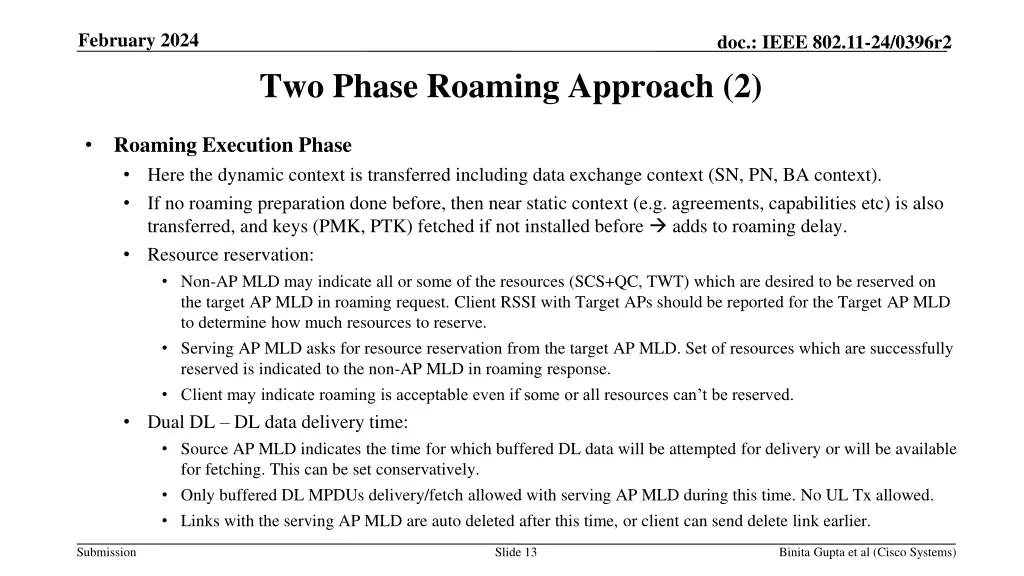
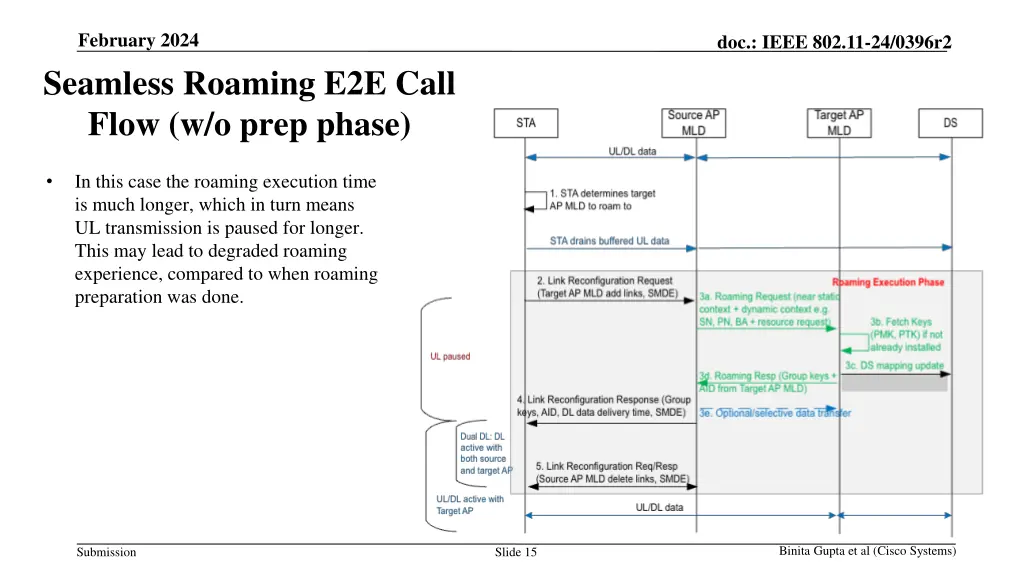
February 2024 doc.: IEEE 802.11-24/0396r2 Two Phase Roaming Approach (2) Roaming Execution Phase Here the dynamic context is transferred including data exchange context (SN, PN, BA context). If no roaming preparation done before, then near static context (e.g. agreements, capabilities etc) is also transferred, and keys (PMK, PTK) fetched if not installed before adds to roaming delay. Resource reservation: Non-AP MLD may indicate all or some of the resources (SCS+QC, TWT) which are desired to be reserved on the target AP MLD in roaming request. Client RSSI with Target APs should be reported for the Target AP MLD to determine how much resources to reserve. Serving AP MLD asks for resource reservation from the target AP MLD. Set of resources which are successfully reserved is indicated to the non-AP MLD in roaming response. Client may indicate roaming is acceptable even if some or all resources can t be reserved. Dual DL DL data delivery time: Source AP MLD indicates the time for which buffered DL data will be attempted for delivery or will be available for fetching. This can be set conservatively. Only buffered DL MPDUs delivery/fetch allowed with serving AP MLD during this time. No UL Tx allowed. Links with the serving AP MLD are auto deleted after this time, or client can send delete link earlier. Submission Slide 13 Binita Gupta et al (Cisco Systems)
February 2024 doc.: IEEE 802.11-24/0396r2 Seamless Roaming E2E Call Flow (with prep phase) Roaming prep time indicates time after which target AP MLDs may not maintain context. Can be set to large value. Dual DL for a period after response is received confirming context transfer, STA has DL active with both serving and target AP MLDs. DL buffered MPDUs can be delivered/fetched from the source AP MLD. Optionally some (selective) data transfer can happen if supported by AP MLDs Link Reconfiguration Notify frame and Link Reconfiguration Request/Response frames can be leveraged/extended for seamless roaming procedure. Binita Gupta et al (Cisco Systems) Submission Slide 14
February 2024 doc.: IEEE 802.11-24/0396r2 Seamless Roaming E2E Call Flow (w/o prep phase) In this case the roaming execution time is much longer, which in turn means UL transmission is paused for longer. This may lead to degraded roaming experience, compared to when roaming preparation was done. Binita Gupta et al (Cisco Systems) Submission Slide 15
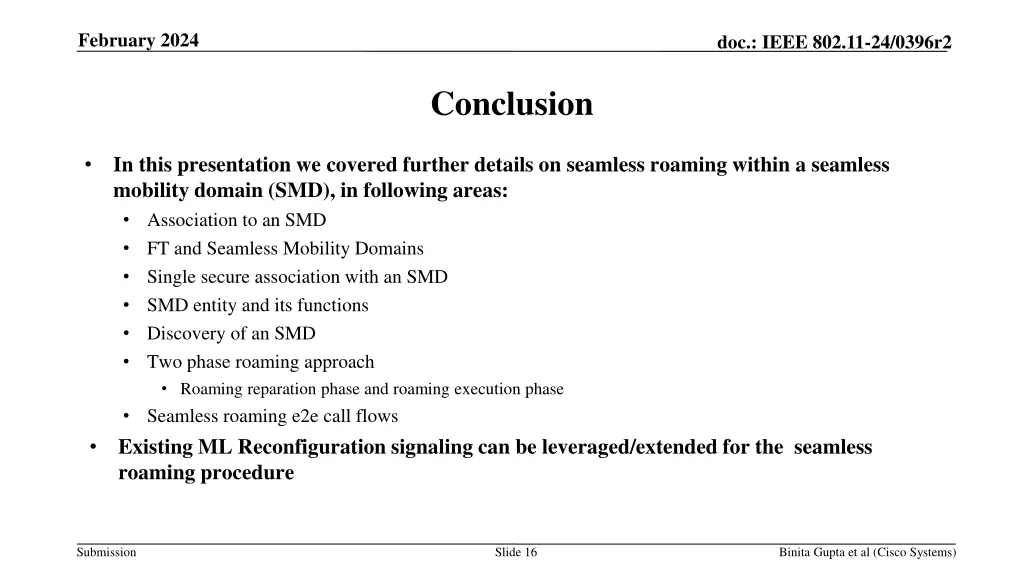
February 2024 doc.: IEEE 802.11-24/0396r2 Conclusion In this presentation we covered further details on seamless roaming within a seamless mobility domain (SMD), in following areas: Association to an SMD FT and Seamless Mobility Domains Single secure association with an SMD SMD entity and its functions Discovery of an SMD Two phase roaming approach Roaming reparation phase and roaming execution phase Seamless roaming e2e call flows Existing ML Reconfiguration signaling can be leveraged/extended for the seamless roaming procedure Submission Slide 16 Binita Gupta et al (Cisco Systems)
February 2024 doc.: IEEE 802.11-24/0396r2 SP1 Do you agree to define a mechanism in 11bn that enables a non-AP MLD to establish a single association with a logical entity covering a set of AP MLDs that are part of the same mobility domain, and the non-AP MLD remains associated and in state 4 with the logical entity as it roams from one AP MLD to another AP MLD within the set of AP MLDs? The DS mapping is updated from the serving AP MLD to the target AP MLD during roaming Note: Exact name of the logical entity is TBD Submission Slide 17 Binita Gupta et al (Cisco Systems)
February 2024 doc.: IEEE 802.11-24/0396r2 References [1] 11-23-2157 Seamless roaming within a mobility domain [2] 11-22/1910 Seamless Roaming for UHR [3] 11-23/0170 Smooth Roaming [4] 11-23/1131 Thoughts on seamless roaming [5] 11-23-1416 Seamless roaming follow up [6] 11-23-1996 Improve roaming between MLDs [7] 11-23-0632 smooth-roaming-follow-up Submission Slide 18 Binita Gupta et al (Cisco Systems)