Enhancing Academic Programs Through Comprehensive Reviews
Academic program reviews play a crucial role in enhancing program quality, sustainability, and alignment with institutional goals. Learn about the importance, history, and evolution of Comprehensive Program Reviews (CPR), as well as the structure, timeline, and helpful resources for conducting effective reviews.

Download Presentation

Please find below an Image/Link to download the presentation.
The content on the website is provided AS IS for your information and personal use only. It may not be sold, licensed, or shared on other websites without obtaining consent from the author. If you encounter any issues during the download, it is possible that the publisher has removed the file from their server.
You are allowed to download the files provided on this website for personal or commercial use, subject to the condition that they are used lawfully. All files are the property of their respective owners.
The content on the website is provided AS IS for your information and personal use only. It may not be sold, licensed, or shared on other websites without obtaining consent from the author.
E N D
Presentation Transcript
Why? Planning and conduct of academic program reviews is used for the progressive improvement and adjustment of programs in the context of the institution's strategic directions. Adjustments may include: program enhancement maintenance at the current level reduction in scope consolidation or termination
USG Policy 3.6.3 each USG institution shall develop procedures to evaluate the effectiveness of its academic programs to address the QUALITY, VIABILITY, and PRODUCTIVITY of efforts in teaching and learning, scholarship, and service Except for programs requiring a formal accreditation review, an institution's cycle of review for all undergraduate academic programs shall be no longer than seven (7) years, and for all graduate programs no longer than ten (10) years. Newly approved programs should automatically be reviewed seven years after launch. Institutions may align program review cycles with required external accreditation review, so long as no program review cycle at any level exceeds ten (10) years.
History of the CPR Used to be a.k.a the Low Enrollment Report or simply, The Behemoth Took months (semester+) to complete All hands-on deck Was reviewed, reviewed, and then reviewed again Required an external review team Many ended up being 100+ pages Data was notoriously wrong back in the day making the CPRs even more difficult, frustrating, and arduous to complete
CPR now The USG has other mechanisms in place now to determine low enrolled/low producing programs (Chris will explain) CPR is now a review of program quality and sustainability and used for long term goal-setting The template is MUCH easier than it used to be (newly revised in 2022) Data is complete, easy to access, and accurate
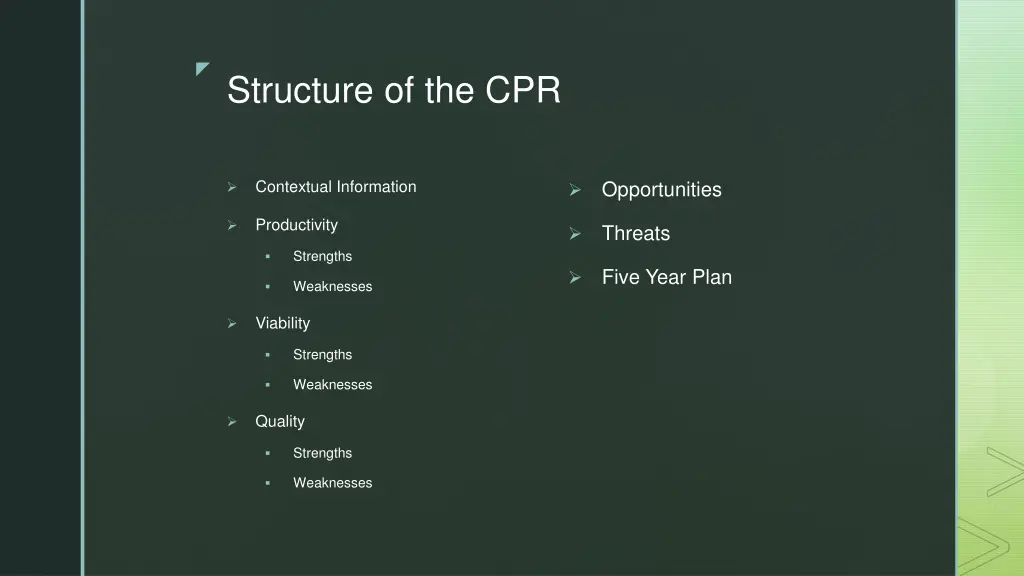
Structure of the CPR Contextual Information Opportunities Productivity Threats Strengths Five Year Plan Weaknesses Viability Strengths Weaknesses Quality Strengths Weaknesses
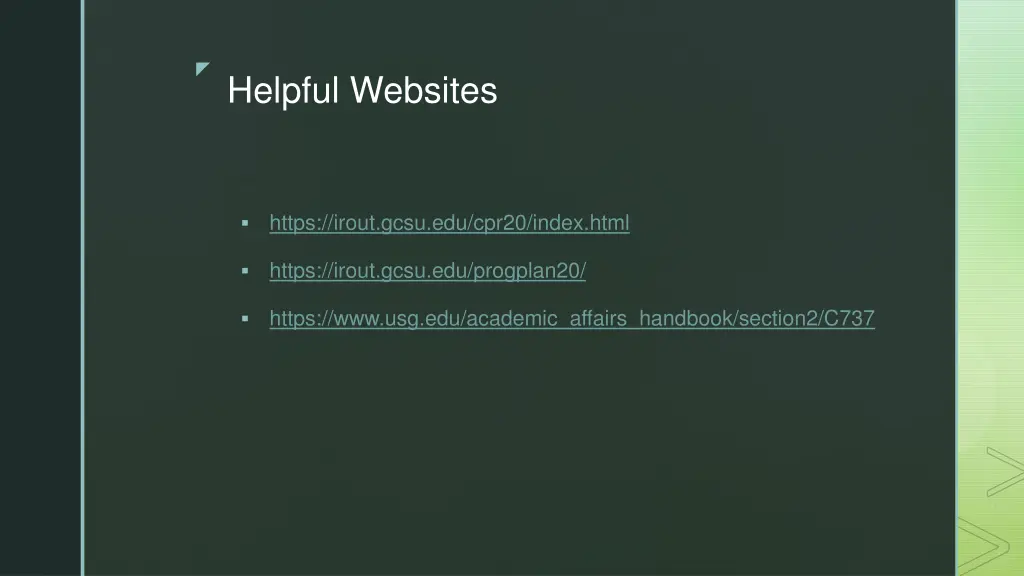
Helpful Websites https://irout.gcsu.edu/cpr20/index.html https://irout.gcsu.edu/progplan20/ https://www.usg.edu/academic_affairs_handbook/section2/C737