Enhancing Intelligence through Contextual Crowd Intelligence
Explore the concept of contextual crowd intelligence and its applications in enhancing human-machine processing. Discover how leveraging the crowd can contribute valuable insights to various domains, such as healthcare predictive analytics, entity resolution, and knowledge management in DBMS. Embrace a hybrid approach that integrates human expertise with machine learning for better outcomes.

Download Presentation

Please find below an Image/Link to download the presentation.
The content on the website is provided AS IS for your information and personal use only. It may not be sold, licensed, or shared on other websites without obtaining consent from the author. If you encounter any issues during the download, it is possible that the publisher has removed the file from their server.
You are allowed to download the files provided on this website for personal or commercial use, subject to the condition that they are used lawfully. All files are the property of their respective owners.
The content on the website is provided AS IS for your information and personal use only. It may not be sold, licensed, or shared on other websites without obtaining consent from the author.
E N D
Presentation Transcript
Contextual Crowd Intelligence Beng Chin Ooi National University of Singapore www.comp.nus.edu.sg/~ooibc
Crowd Intelligence Use of crowd in contributing useful contents Further use of these contents to infer, ascertain and enhance Use of crowd in doing what machines cannot do well -- Crowdsourcing Entity Resolution Are IBM and Big Blue the same company? Classification What make is the car in the image? Subjective Sorting Which pictures better visualize the Great Wall ? Others: Translation, Tagging, etc. Simple and domain dependent Privacy is a major obstacle Can we exploit the human intelligence a bit more?
Embedding Crowdsourcing in DBMS Most applications are industry/domain specific -- users are the experts Exceptional cases that are important but may be too hard to formalize and rules/patterns may be evolving over times Knowledge management at work Making humans who are subject matter experts as part of the feedback loop to continuously enhance the database processing a hybrid human-machine DB processing
Example: Healthcare Predictive Analytics ID Disease (f1) Lab (f2) Medication (f3) Temperature (f4) .. Risk level Patient 1 Diabetes v12 v13 v14 ? Patient 2 Diabetes v22 v23 v24 ? Patient 3 Hypertension v32 v33 v34 ? Medical Care Table Questions often asked by healthcare professionals: Who have high risk ? How many have contacted the medical team? What are the outcomes? Recurrence, deterioration, reasons etc. To predict, pre-empt, prevent for better healthcare outcome!
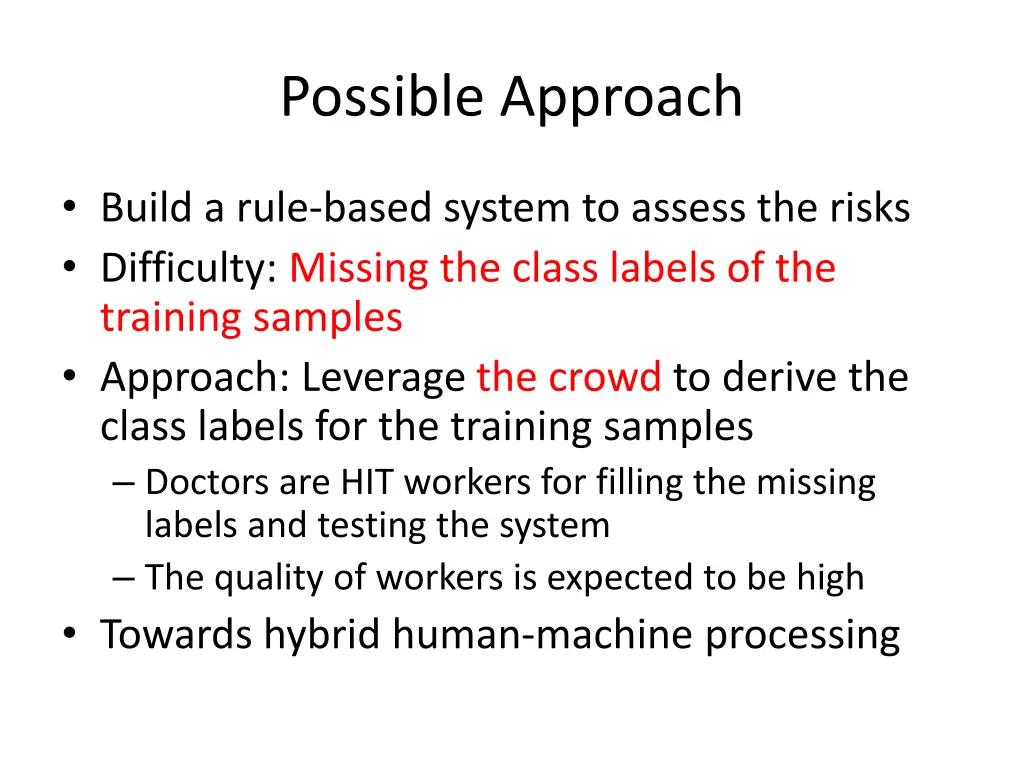
Possible Approach Build a rule-based system to assess the risks Difficulty: Missing the class labels of the training samples Approach: Leverage the crowd to derive the class labels for the training samples Doctors are HIT workers for filling the missing labels and testing the system The quality of workers is expected to be high Towards hybrid human-machine processing
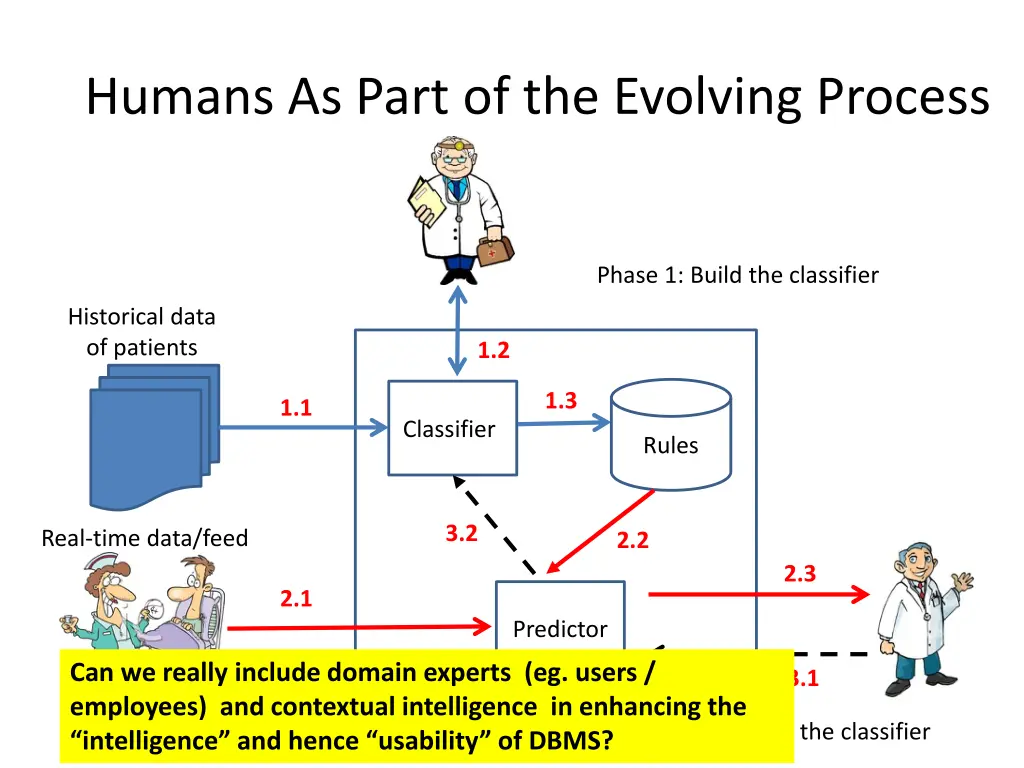
Humans As Part of the Evolving Process Phase 1: Build the classifier Historical data of patients 1.2 1.3 1.1 Classifier Rules 3.2 Real-time data/feed 2.2 2.3 2.1 Predictor Can we really include domain experts (eg. users / employees) and contextual intelligence in enhancing the intelligence and hence usability of DBMS? 3.1 Phase 2: Predict the severity Phase 3: Adjust the classifier
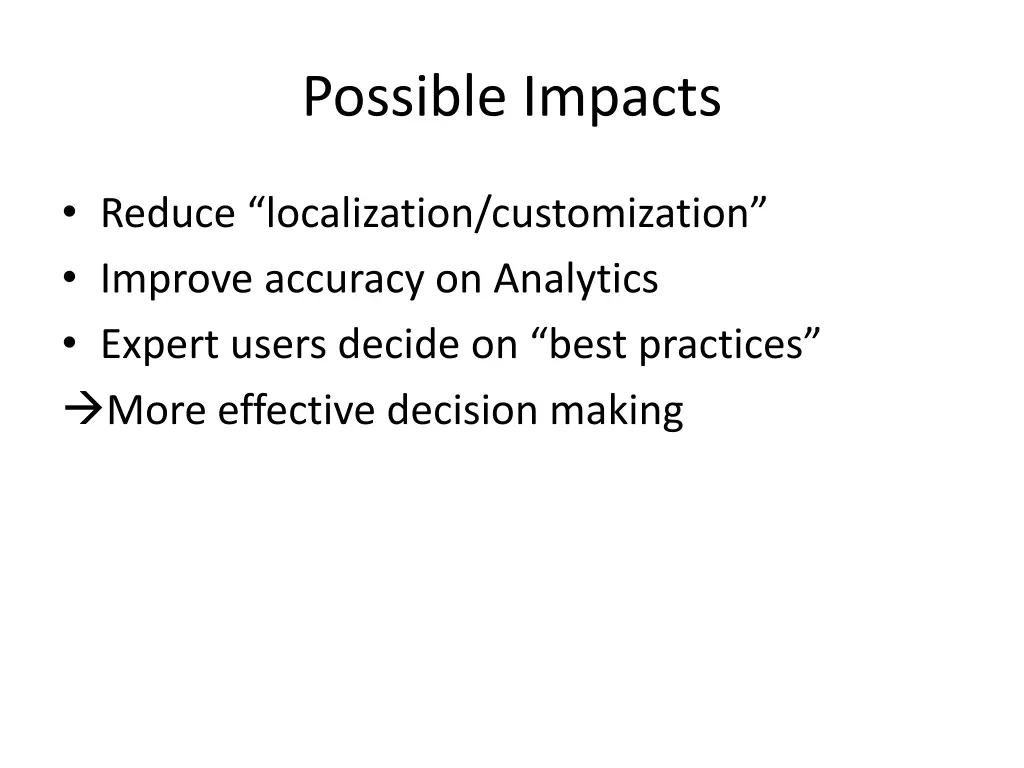
Possible Impacts Reduce localization/customization Improve accuracy on Analytics Expert users decide on best practices More effective decision making