Enhancing Interpreter Training Through Pre-Task Speech Revision
Explore the impact of pre-task speech revision on interpreter training quality, stress levels, and self-contentment. This study investigates how familiarizing interpreters with speech beforehand can improve their renditions and reduce stress, leading to increased self-satisfaction. Participants undergo qualitative analysis and surveys to gauge the effectiveness of pre-task speech revision as a training tool.

Download Presentation

Please find below an Image/Link to download the presentation.
The content on the website is provided AS IS for your information and personal use only. It may not be sold, licensed, or shared on other websites without obtaining consent from the author. If you encounter any issues during the download, it is possible that the publisher has removed the file from their server.
You are allowed to download the files provided on this website for personal or commercial use, subject to the condition that they are used lawfully. All files are the property of their respective owners.
The content on the website is provided AS IS for your information and personal use only. It may not be sold, licensed, or shared on other websites without obtaining consent from the author.
E N D
Presentation Transcript
PRE-TASK SPEECH REVISION AS AN INTERPRETER TRAINING TOOL Jan Marsza ek, MA, EMCI Institute of Applied Linguistics University of Warsaw
Idea behind presenting the speech beforehand motivation is key (Hod kov , 2021:186, Melicher kov , Dove, 2021:209) motivational factor: getting closer towards the trainees ideal-self (K lm n 2020:287, Wu 2016:17) developing the trainees memory (Tryuk, 2007:89) recognizing patterns and repetitive text-structures (Anisimova, Fedotova, Fomina, 2021:86). => several renditions of a single speech (Van Dam 1989 apud Bart omiejczyk 2015:222)
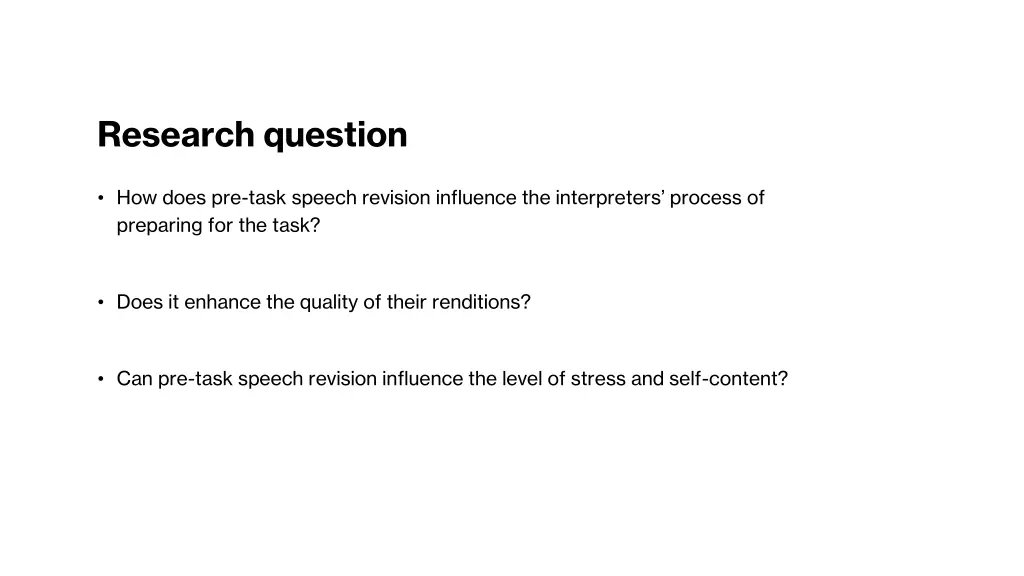
Research question How does pre-task speech revision influence the interpreters process of preparing for the task? Does it enhance the quality of their renditions? Can pre-task speech revision influence the level of stress and self-content?
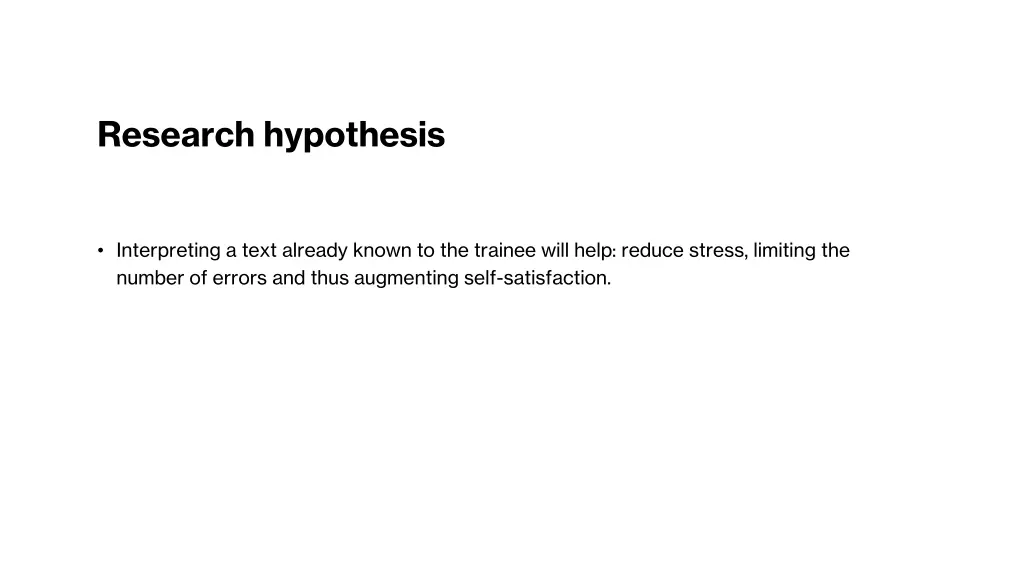
Research hypothesis Interpreting a text already known to the trainee will help: reduce stress, limiting the number of errors and thus augmenting self-satisfaction.
Participants and task 4 in the control group, 4 in the study group finalized formal training, no more than 25 commissions worth of market experience the task: preparing for and delivering a simultaneous interpretation of a nine-minute-long speech on antibiotic resistance, provided by Speech Repository participants could consult the title and provided terminology experimental stimulus: pre-task speech revision
Study method qualitative analysis of thinking-aloud protocols collected when the participants prepared for the task subsequent quantitative analysis of omissions, additions and substitutions in the renditions (Barik 1994) subsequent survey on stress during the task, self-satisfaction and subjective helpfulness of the tool provided (title+terms/title+terms+speech)
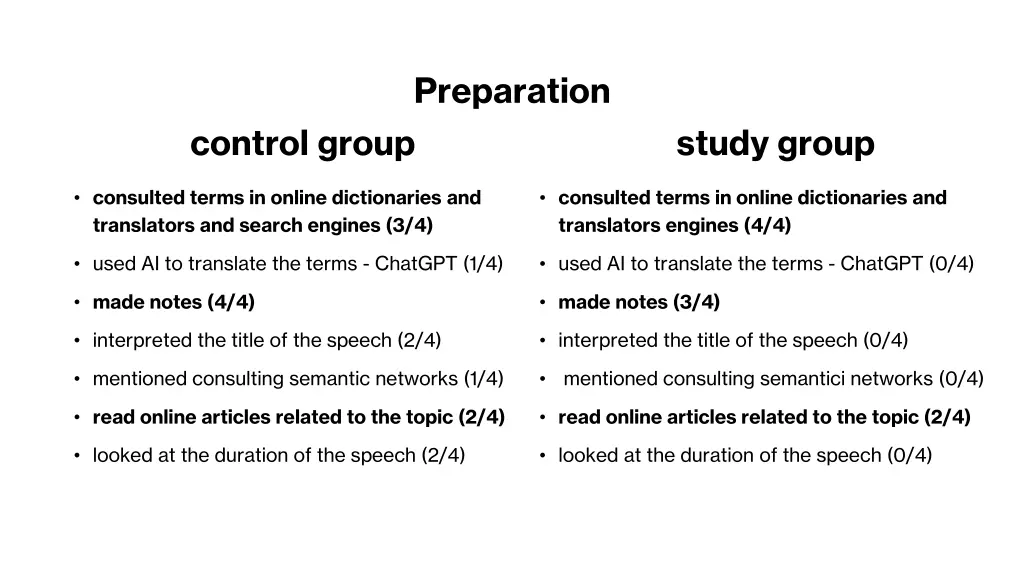
Preparation control group study group consulted terms in online dictionaries and translators and search engines (3/4) consulted terms in online dictionaries and translators engines (4/4) used AI to translate the terms - ChatGPT (1/4) used AI to translate the terms - ChatGPT (0/4) made notes (4/4) made notes (3/4) interpreted the title of the speech (2/4) interpreted the title of the speech (0/4) mentioned consulting semantic networks (1/4) mentioned consulting semantici networks (0/4) read online articles related to the topic (2/4) read online articles related to the topic (2/4) looked at the duration of the speech (2/4) looked at the duration of the speech (0/4)
Preparation stimulus-specific answers in the study group The speech is not complex, so I don t need to spend much time on preparation (C2) I ll write down the word liczba [number] because I tend to overuse the word ilo [quantity] (C2) I heard the word billion when listening to the speech. I ll check the translation, because I always seem to get it wrong (C3) I ll write down the number that I recall the speaker saying. I think it was 700 000, but I ll double- check when interpreting (C4) I heard the speaker say several decades. I ll write down the expression kilkadziesi t lat, I think it sounds better than dekady (C4) I recall the speaker saying that antibiotics were developed in the forties, I ll write the number down (C4)
Quality comparison PARTICIPANT 1 2 3 4 O: 25 O: 11 O: 25 O: 23 A: 1 A: 1 A: 1 A: 4 STUDY GROUP S: 9 S: 11 S: 15 S: 5 O: 30 O: 14 O: 11 O: 27 A: 1 A: 3 A: 0 A: 4 CONTROL GROUP S: 3 S: 9 S: 2 S: 15
Survey results PARTICIPANT 1 2 3 4 S: 2 S: 3 S: 2 S: 1 C: 3 C: 3 C: 3 C: 3 STUDY GROUP H: 5 H: 3 H: 5 H: 5 S: 4 S: 1 S: 3 S: 3 C: 2 C: 1 C: 4 C: 2 CONTROL GROUP H: 5 H: 5 H: 5 H: 5
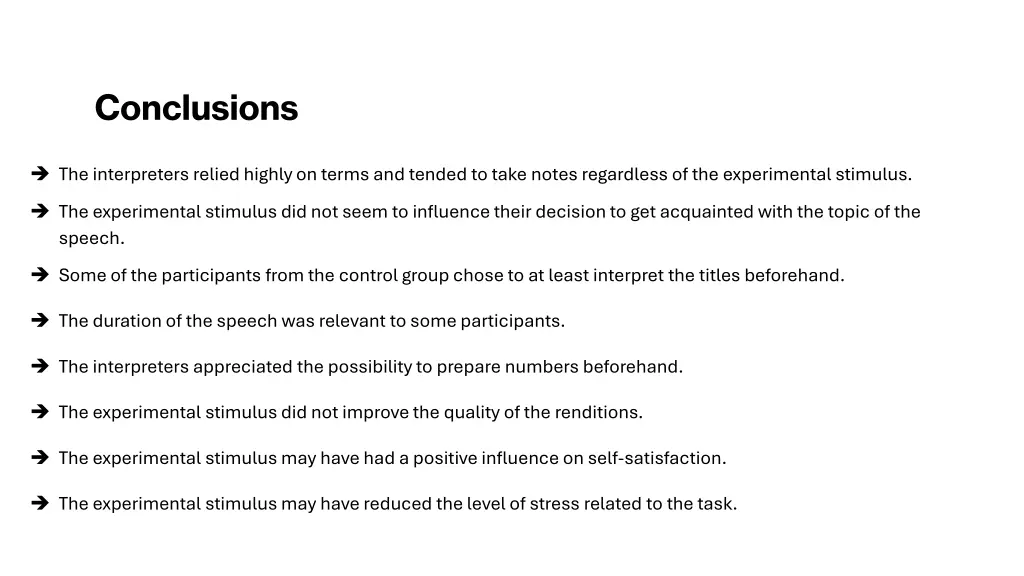
Conclusions The interpreters relied highly on terms and tended to take notes regardless of the experimental stimulus. The experimental stimulus did not seem to influence their decision to get acquainted with the topic of the speech. Some of the participants from the control group chose to at least interpret the titles beforehand. The duration of the speech was relevant to some participants. The interpreters appreciated the possibility to prepare numbers beforehand. The experimental stimulus did not improve the quality of the renditions. The experimental stimulus may have had a positive influence on self-satisfaction. The experimental stimulus may have reduced the level of stress related to the task.
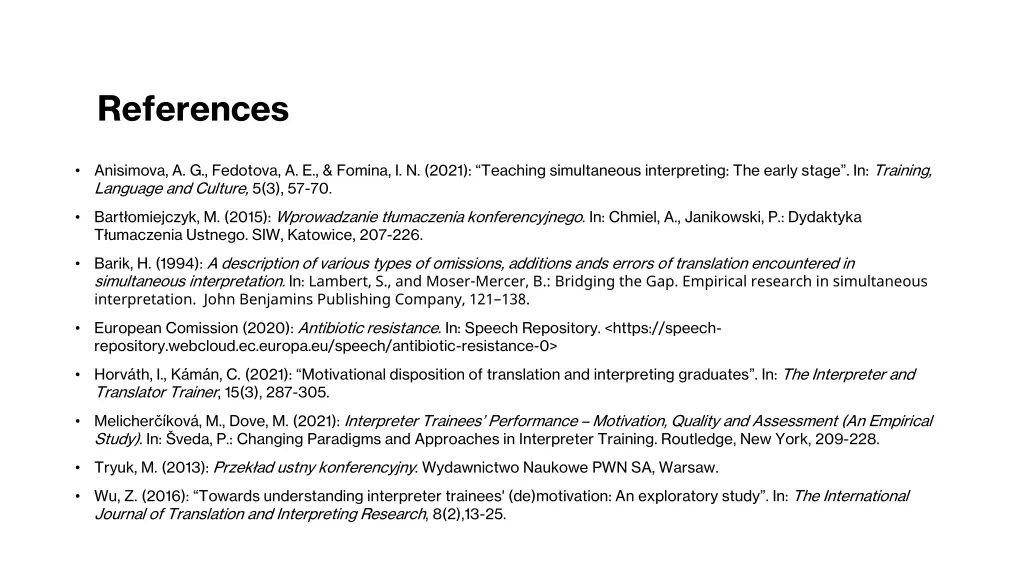
References Anisimova, A. G., Fedotova, A. E., & Fomina, I. N. (2021): Teaching simultaneous interpreting: The early stage . In: Training, Language and Culture, 5(3), 57-70. Bart omiejczyk, M. (2015): Wprowadzanie t umaczenia konferencyjnego. In: Chmiel, A., Janikowski, P.: Dydaktyka T umaczenia Ustnego. SIW, Katowice, 207-226. Barik, H. (1994): A description of various types of omissions, additions ands errors of translation encountered in simultaneous interpretation. In: Lambert, S., and Moser-Mercer, B.: Bridging the Gap. Empirical research in simultaneous interpretation. John Benjamins Publishing Company, 121 138. European Comission (2020): Antibiotic resistance. In: Speech Repository. <https://speech- repository.webcloud.ec.europa.eu/speech/antibiotic-resistance-0> Horv th, I., K m n, C. (2021): Motivational disposition of translation and interpreting graduates . In: The Interpreter and Translator Trainer, 15(3), 287-305. Melicher kov , M., Dove, M. (2021): Interpreter Trainees Performance Motivation, Quality and Assessment (An Empirical Study). In: veda, P.: Changing Paradigms and Approaches in Interpreter Training. Routledge, New York, 209-228. Tryuk, M. (2013): Przek ad ustny konferencyjny. Wydawnictwo Naukowe PWN SA, Warsaw. Wu, Z. (2016): Towards understanding interpreter trainees' (de)motivation: An exploratory study . In: The International Journal of Translation and Interpreting Research, 8(2),13-25.