Explore the project "Enhancing Social Inclusion of Youth Through Employment in AGRI-FOOD Sector" focusing on strategic partnerships for youth development in the agri-food industry under Erasmus+ Key Action 2. Discover how this initiative promotes cooperation, innovation, and the exchange of good practices to empower youth in the workforce.
Please find below an Image/Link to download the presentation.
The content on the website is provided AS IS for your information and personal use only. It may not be sold, licensed, or shared on other websites without obtaining consent from the author. If you encounter any issues during the download, it is possible that the publisher has removed the file from their server.
You are allowed to download the files provided on this website for personal or commercial use, subject to the condition that they are used lawfully. All files are the property of their respective owners.
The content on the website is provided AS IS for your information and personal use only. It may not be sold, licensed, or shared on other websites without obtaining consent from the author.
ENHANCING SOCIAL INCLUSION OF YOUTH THROUGH EMPLOYMENT IN AGRI-FOOD SECTOR PROJECT ACRONYM: [AGRI-FOOD] AGREEMENT NUMBER: 2019-3-TR01-KA205-079155 Programme Erasmus + (KA2) Strategic Partnerships Cooperation for innovation and the exchange of good practices Key Action Action KA205- Strategic Partnerships for Youth
Key Action 2 an overview Co-operation for Innovation and Exchange of Good Practices is all about enabling organisations to work together in order to improve their provision and share innovative practices Under Key Action 2 organisations can apply for funding to work in partnership with organisations from other participating countries. The projects funded under this Key Action will focus on sharing, developing and innovative education, training and youth provision between participating countries. transferring practices in
Key Action 2 an overview This Key Action supports: Strategic Partnerships in the field of education, training and youth; Knowledge Alliances; Sector Skills Alliances (implemented through a specific call for proposals); Capacity Building in the field of higher education; Capacity Building in the field of youth.
Key Action 2 an overview Projects are expected to include: Development, transfer and/or implementation of innovative practices Projects are expected to achieve: Positive and long-lasting effects on the participating organisations
Main Project Activities Project management and implementation project management (planning, managing finances, coordination, communication between the partners); smaller-scale Training, Teaching and Learning materials, tools and approaches; virtual cooperation and local project activities (e.g. classroom project work with learners, organisation and mentoring of embedded learning/training activities; information, promotion and dissemination activities (e.g. brochures, leaflets, website).
Transnational project meetings Meetings between the project partners to discuss the coordination and implementation of the project. These meetings must be hosted by one of the funded partner organisations in the country where they are based.
Main Project Activities Intellectual outputs Intellectual Outputs are substantial, high quality tangible outputs such as open educational resources, curricula, IT tools, studies or other pedagogical materials. They should have potential for wider use, exploitation and impact. KA2 projects supporting innovation will normally include Intellectual Outputs. Multiplier events (Strategic Partnerships supporting innovation only) Multiplier Events are national or transnational conferences, seminars or events aimed at sharing and disseminating Intellectual Outputs produced by the project. Only projects supporting innovation and delivering Intellectual Outputs can include Multiplier Events. Multiplier Events can take place in the country of one of the organisations participating in the project
Main Project Activities Representatives of participating organisations involved in the project cannot claim travel and/or subsistence costs associated with unit costs per local and/or per international participants. Eligible participants of Multiplier Events can be of two types; local or international. Local participants are from the country in which the event is taking place. International participants are from other countries. Representatives from the participating partner organisations attending the event cannot be counted as eligible participants for the purpose of calculating the unit costs.
PARTNERS BURSA BUYUKSEHIR BELEDIYE TARIMAS BURSA HAYVANCILIK TARIM TIC SAN AS (TARIMAS, TURKEY) COORDINATOR GENERAL DIRECTORATE OF AGRICULTURAL RESEARCH AND POLICIES (GDAR, TURKEY) CENTRAL RESEARCH INSTITUTE OF FOOD AND FEED CONTROL (CRIFFC, TURKEY) THE NATIONAL TECHNOLOGICAL CENTRE FOR THE FOOD AND CANNING INDUSTRY (CTC, SPAIN) CENTER OF FOOD AND FERMENTATION TECHNOLOGIES (TFTAK, ESTONIA)
ASSOCIATED PARTNERS Hamidiye Vocational and Technical Anatolian High School Women Development Cooperative in Oylat/Bursa (OYLAT FTL K)
Project Title: Enhancing Social Inclusion of Youth Through Employment in Agri-Food Sector Project Acronym: [AGRI-FOOD] Project Start Date: 01.02.2020 Project Total Duration: 20 months Project End Date: 30-09-2021
HORIZONTALPRIORITIES Supporting individuals in acquiring and developing basic skills and key competences Social inclusion
[AGRI-FOOD] The goal of the Project is; -To foster social inclusion and employability young people with fewer opportunities -To enhance the competencies and skills of the target group about agri-food sector activities -To prevent young people from leaving villages -To eliminate the feeling of exclusion of young people -To promote the integration of young people in the labour market -To match skills of youth with existing job vacancies (especially profitable activities like agri-food exportation)
[AGRI-FOOD] The goal of the Project is; -To teach new technologies used in farming (e.g. drones) -To open up youth work to cross-sectoral cooperation -To enhance the spirit of entrepreneurship -To prepare training materials including topics of GoodAgricultural Practices (GAP): Precision Farming, Agri-Food Marketing, Agricultural Entrepreneurship, Food Safety and Traditional Food Processing Technologies and Value-Added Food Products from Fruit & Vegetables -To create an E-learning platform for individuals who don t have a chance to attend training courses
TARGET GROUPS Students at High School or University Unemployed Youth Future Farmers Agri-Food Professionals Local Authorities NEETs
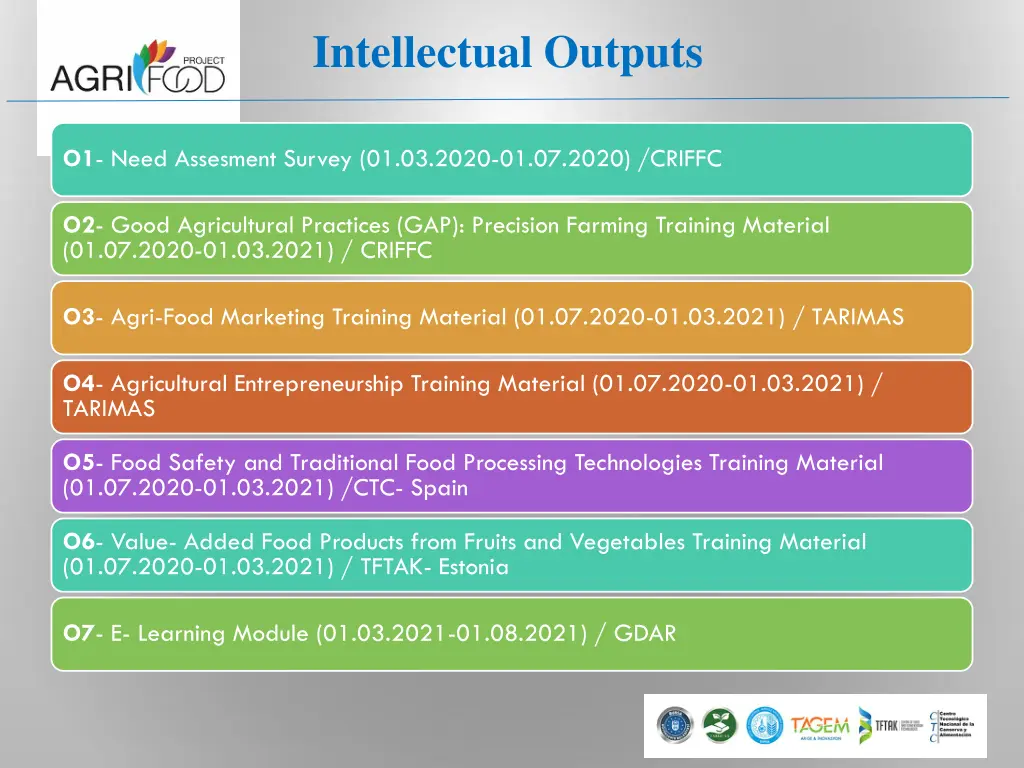
Intellectual Outputs O1- Need Assesment Survey (01.03.2020-01.07.2020) /CRIFFC O2- Good Agricultural Practices (GAP): Precision Farming Training Material (01.07.2020-01.03.2021) / CRIFFC O3- Agri-Food Marketing Training Material (01.07.2020-01.03.2021) / TARIMAS O4- Agricultural Entrepreneurship Training Material (01.07.2020-01.03.2021) / TARIMAS O5- Food Safety and Traditional Food Processing Technologies Training Material (01.07.2020-01.03.2021) /CTC- Spain O6- Value- Added Food Products from Fruits and Vegetables Training Material (01.07.2020-01.03.2021) / TFTAK- Estonia O7- E- Learning Module (01.03.2021-01.08.2021) / GDAR
Transnational Meetings 1. Kick-off meeting in TARIMAS TURKEY. (Month 1) Presenting the project and timetable, responsibilities and deadlines, partners presentation, signing the PartnershipAgreement, forming the Steering Committee, announcing the Project Quality Plan and introducing the operational and financial arrangements. Opening Conference: Target groups, relevant stakeholders, beneficiaries, policy-makers will participate in this conference. The budget will be provided from Project Management Budget. 2. Meeting in TFTAK, Estonia (Month 9) Objectives: The activities and outputs that was done in the first period will be evaluated. Need assessment survey report and dissemination activities will be assessed. The meeting will be a good opportunity to share experience between partners and discuss further activities within partner organizations.
3. Final Meeting in TURKEY, Month 20 Objectives: The completed activities and outputs of the project will be discussed in this meeting. The project results will be represented at TARIMAS and partners will be invited to attend. The final report and project budget will be discussed. 4. Final Dissemination conference in Bursa, Turkey, Month 20 Objectives: Presentation of project results to reach a wider audience (policy-makers, relevant stakeholders, target groups, local authorities), discussing opportunities for further collaboration, delivering dissemination materials (e.g. brochures).
Multiplier Events Event Title/ E1: Workshop on Agricultural Entrepreneurship in Bursa (03.2021) / TARIMAS Country of Venue: Turkey Event Date: Month 14 Event Description: A workshop will be performed in Bursa to share the project outputs to target groups. The feedback from participants will be used in the evaluation. Also, a presentation about English words that are used commonly in international trade will be performed to increase competence and selfconfidence of attenders.
Event Title: E2: Workshop on Food Safety and GoodAgricultural Practices (GAP) (06.2021) / CRIFFC Country of Venue: Bursa, Turkey Event Date: Month 17 Event Description: A Workshop will be organized to target group about Food Safety and Good Agricultural Practices (GAP). The outputs and results will be told and the results will be announced to a larger group.
Event Title: E3: Final Dissemination Conference (09.2021) / TARIMAS Country of Venue: Turkey Event Date: Month 20 Event Description: Project outputs will be launched through Final Dissemination Conference. It will be performed in Bursa with the participation of partners, target groups, policy-makers, opinion leaders, local authorities, primary beneficiaries. The Dissemination conference will be a valuable opportunity in order to present the project results to a wide audience of experts.
Event Title: On farm training about agricultural products that have high export potential (05.2021) Country of Venue: Bursa, Turkey Event Date: Month 16 Event Description: on-farm training agricultural products (blueberry, apple and fig etc.) that have high export potential will be performed by using non-formal education tools with the attendance of a specific number of participants. This activity will enhance social integration and the spirit of entrepreneurship of youth.
Event Title: On farm training about precision farming (04.2021) Country of Venue: Bursa, Turkey Event Date: Month 15 Event Description: On-farm training by using non-formal education tools about precision farming will be performed after completion of related training material. Learning new technology used in agriculture (e.g. drones, robots) will increase the technological skills of youth, which help to build self-confidence for business success
The following items will be used as an indicator in monitoring; Preparation of timetable for monitoring progress and the suitability of activities with time Evaluation of consistency between the budget estimate and the final budget The number of participants who attended the project activities The level of satisfaction of participants related to training and workshops The number of training materials prepared
Progress of the project will be evaluated by considering indicators given below; Qualitative Indicators; *The sense of fulfillment about communication between TARIMAS and the partners (via questionnaire) *The degree of contribution and collaboration of partners in the Project activities *The fulfillment and satisfaction level of project meetings Quantitative indicators; *The number of personnel from partner institutions participated in the project meetings *The harmony between the estimation of budget and the final budget *The number of activities performed *The percentage of consistency to deadlines of the tasks *The number of participants enhanced their knowledge in AGRI-FOOD project activities
Results will be evaluated by considering indicators given below; Qualitative Indicators; *The usability and ease of use of the learning objects (training materials and brochures etc.) and E-learning platform *The fulfillment and satisfaction level of the target group about prepared outputs Quantitative Indicators; *The number of outputs created *The number of recipients of intellectual results *The number of partners involved in the project *The number of people took part in the survey *The number of conference, workshop and on-field activity