Enhancing Student Learning Through Ongoing Assessment
Ongoing assessment, a practice crucial for improving student learning, involves continuous questioning, listening, and adapting instruction based on student responses. Research supports the effectiveness of formative assessment in enhancing student understanding and driving academic improvement over time.

Download Presentation

Please find below an Image/Link to download the presentation.
The content on the website is provided AS IS for your information and personal use only. It may not be sold, licensed, or shared on other websites without obtaining consent from the author.If you encounter any issues during the download, it is possible that the publisher has removed the file from their server.
You are allowed to download the files provided on this website for personal or commercial use, subject to the condition that they are used lawfully. All files are the property of their respective owners.
The content on the website is provided AS IS for your information and personal use only. It may not be sold, licensed, or shared on other websites without obtaining consent from the author.
E N D
Presentation Transcript
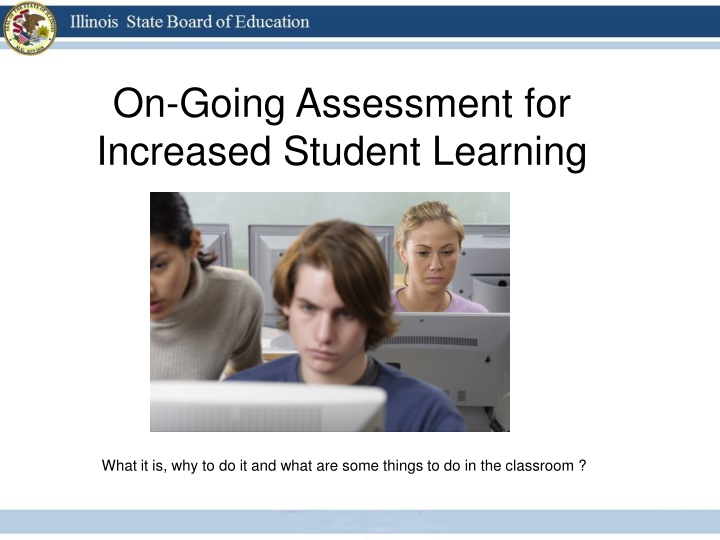
On-Going Assessment for Increased Student Learning What it is, why to do it and what are some things to do in the classroom ?
Presenter Sue Mainville Data and Assessment Specialist-Area 2
Here We Go! What is meant by on-going/assessment for learning? Why use the practice? How can I use on-going/assessment for learning to enhance what I currently do? simple ways to begin a classroom transition Content contained is licensed under a Creative Commons Attribution-ShareAlike 3.0 Unported License
Ongoing Assessment is like a GPS because Assessment FOR Learning Formative Content contained is licensed under a Creative Commons Attribution-ShareAlike 3.0 Unported License
Ongoing Assessment is NOT a test an interim test frequent summative assessments It is NOT formative unless something happens as a result of the evidence. Content contained is licensed under a Creative Commons Attribution-ShareAlike 3.0 Unported License
Ongoing assessment is to question rather than explain. to listen rather than talk. to center on student learning. to assess for learning. The instruction must change as a result of the assessment for it to be formative. Content contained is licensed under a Creative Commons Attribution-ShareAlike 3.0 Unported License
Why Ongoing Assessment? Research reported shows conclusively that formative assessment does improve learning. - Assessment in Education 1998 Reports conclude that formative assessment will improve student learning, even when not done perfectly . - James Popham, Ed.D (2011) Content contained is licensed under a Creative Commons Attribution-ShareAlike 3.0 Unported License
Why Ongoing Assessment? It supports the learning process by serving as practice for students. It checks for understanding along the way and provides the teacher and student with feedback so the student can improve. It inspires the student to do better the next time. Content contained is licensed under a Creative Commons Attribution-ShareAlike 3.0 Unported License
Why Ongoing Assessment? It gives students responsibility for their learning. Moves learning forward It targets individual student needs It gives on-going feedback It works! Content contained is licensed under a Creative Commons Attribution-ShareAlike 3.0 Unported License
Visible Learning: A Synthesis of over 800 meta analyses related to achievement by John Hattie Content contained is licensed under a Creative Commons Attribution-ShareAlike 3.0 Unported License
Brain Break http://www.youtube.com/watch?v= Zx9a7sxVeNM Content contained is licensed under a Creative Commons Attribution-ShareAlike 3.0 Unported License
Assessment FOR Learning Curricular components, classroom quizzes and activities Includes instructionally embedded activities Usually teacher/locally developed Yields rich diagnostic information Informs and focuses instructional decisions Occurs when we are teaching the components Content contained is licensed under a Creative Commons Attribution-ShareAlike 3.0 Unported License
Things to Consider Start small Teach students new class structure and climate Ask fewer, better questions Allow students freedom to discuss Explain to students their responsibility in learning Content contained is licensed under a Creative Commons Attribution-ShareAlike 3.0 Unported License
Ways to assess your students in the learning process Foldable and Graphic Organizers Read, write, pair, share 3-2-1 3 Facts and a Fib Vote with your feet Exit Slips ELA strategies and assessments
Increasing the Rigor in Multiple Choice Questions George collected 489 rocks for his science project. Matthew collected100 fewer than George. How many rocks did Matthew collect? a.389 b.479 c.589 d.379 Defend your answer and then select another answer and explain why it is incorrect. Content contained is licensed under a Creative Commons Attribution-ShareAlike 3.0 Unported License
Next Steps Once you assess your students, take action based on those results. reteach (usually in a different way based on their learning style) peer tutoring small group one-on-one Content contained is licensed under a Creative Commons Attribution-ShareAlike 3.0 Unported License
Data Management Clip boards Standards-based Grade Book Writer s Journals with Conference Sheets
Resources Black, Paul & Wiliam, D.(2001). Inside the Black Box -Raising StandardsThrough Classroom Assessment , King s College London School of Education. Balanced Assessment: The Key to Accountability and Improved Student Learning, NEA (2003). http://www.nea.org/accountability/nearesources-accountability.html Hattie, John,(2011). Visible Learning: A Synthesis of over 800 meta analyses related to achievement. (In)formative Assessments, Harvard Education Letter, 2006. Partnership for the Assessment of Readiness for College and Careers- www.parcconline.org Popham, James Ed. D, (2011). Reeves, Doug, (2012). The Leadership and Learning Center, Visible Learning: Applying John Hattie s Research to Maximize Learning in Your School (webinar), 1/23/12. Illinois State Board of Education www.isbe.state.il.us Show Me the Strategies - http://fcstn.net/show%20me%20the%20strategies.htm Content contained is licensed under a Creative Commons Attribution-ShareAlike 3.0 Unported License
Contact Information Agurann H. Bates ISBE-Thompson Building -Chicago, IL abates@isbe.net Dr. Brenda M. Arrington Area 1a ROE/Professional Development Alliance-Joliet , IL barrington@pdaonline.org Tim Farquer Areas 3&4 Two Rivers Professional Development Center Peoria, IL timfarquer@gmail.com Sue Mainville Area 2 K.I.D.S. - Loves Park, IL smainvil@kidsroe.org Content contained is licensed under a Creative Commons Attribution-ShareAlike 3.0 Unported License